Chindia Alert: You’ll be Living in their World Very Soon
aims to alert you to the threats and opportunities that China and India present. China and India require serious attention; case of ‘hidden dragon and crouching tiger’.
Without this attention, governments, businesses and, indeed, individuals may find themselves at a great disadvantage sooner rather than later.
The POSTs (front webpages) are mainly 'cuttings' from reliable sources, updated continuously.
The PAGEs (see Tabs, above) attempt to make the information more meaningful by putting some structure to the information we have researched and assembled since 2006.
BJP’s Meenakshi Lekhi had complaints to the Supreme Court that the words attributed by Rahul Gandhi to the Supreme Court in the Rafale case had been “made to appear something else”.
INDIAUpdated: Apr 15, 2019 14:06 IST
HT Correspondent
New Delhi
Supreme Court will next hear the case on April 23(AFP file photo)
Congress president Rahul Gandhi has been told by the Supreme Court to explain his remarks during the Lok Sabha campaign where he attributed comments to the top court which had ruled on the admissibility of three sets of documents in the Rafale review petition.
The bench said Gandhi had incorrectly attributed “views, observations and findings” in the Rafale case to the top court. Gandhi has been given till next Monday to come up with his explanation. The court, however, has not issued a formal notice to him yet.
“We also make it clear that this court had no occasion to record any such views or make observations in as much as what was decided by this court was the legal admissibility of certain document to which objections were raised,” the bench headed by Chief Justice of India Rajan Gogoi said.
BJP lawmaker Meenakshi Lekhi had last week filed a contempt petition against the Congress president for his attacks on Prime Minister Narendra Modi that she said, “replaced his personal statement as Supreme Court’s order “ and tried to create prejudice.
Watch: ‘Chowkidar chor’ vs ‘SC’s contempt’: Rahul, Nirmala face off on Rafale order
‘Chowkidar chor’ vs ‘SC’s contempt’: Rahul, Nirmala face off on Rafale order
Defence Minister Nirmala Sitharaman slammed Congress president Rahul Gandhi over his remarks on Supreme Court’s decision related to Rafale documents
Gandhi, who was in Amethi to file his nomination papers, had reacted to this setback to the government, saying: “Now the Supreme Court has made it clear that ‘chowkidarji’ (watchman) has committed a theft… I want to directly challenge that the Supreme Court has stated that you have indulged in corruption.”
The BJP and its top leaders had taken umbrage at the Congress president’s remarks, accusing him of wildly exaggerating and misquoting the court’s observations and the context. Defence Minister Nirmala Sitharaman had said Rahul Gandhi’s statement was contempt of contempt of court and was the Congress’s attempt to “perpetrate their own lies”.
Her party later filed a formal complaint against Gandhi with the Election Commission, charging him of lying. The Congress party wants to “perpetrate their own lies”. She further added that Gandhi’s comments are not based on the facts.
In her petition before the Supreme Court, Meenakshi Lekhi had complained that “the words used and attributed by him (Gandhi) to the Supreme Court in the Rafale case has been made to appear something else. He is replacing his personal statement as Supreme Court’s order and trying to create prejudice.”
The government’s April 2015 decision to buy 36 Rafale warplanes has been at the heart of the Congress-led opposition campaign against Prime Minister Narendra Modi and the ruling BJP-led national coalition. The $8.7 billion government-to-government deal replaced the previous United Progressive Alliance (UPA) regime’s decision to buy 126 Rafale aircraft, 108 of which were to be made in India by state-owned Hindustan Aeronautics Ltd (HAL).
The deal has become controversial with the Opposition, led by the Congress, claiming that the price at which India is buying Rafale aircraft now is Rs 1,670 crore for each, three times the Rs 526 crore, the initial bid by the company when the UPA was trying to buy the aircraft. It has also claimed the previous deal included a technology transfer agreement with HAL. The NDA has not disclosed details of the price.
NEW DELHI (Reuters) – India’s Hindu nationalist ruling party vowed on Monday to strip decades-old special rights from the people of Jammu and Kashmir, making an election promise that could provoke a backlash in the country’s only Muslim-majority state.
Prime Minister Narendra Modi’s Bharatiya Janata Party (BJP)is widely expected to retain power after a general election that starts on Thursday, though with a much smaller mandate, hit by concerns over a shortage of jobs and weak farm prices.
Pollsters say its re-election campaign got a boost from recent hostilities with arch-rival Pakistan, after a militant group based there claimed a February suicide bombing that killed 40 Indian security forces in the Himalayan region.
“Nationalism is our inspiration,” Modi said after releasing the BJP’s election manifesto at its headquarters in New Delhi, as supporters chanted “Modi, Modi”.
The BJP has consistently advocated an end to Kashmir’s special constitutional status, which prevents outsiders from buying property there, arguing that such laws have hindered its integration with the rest of India.
“We believe that Article 35A is an obstacle in the development of the state,” the party said, referring to a constitutional provision dating from 1954, and reiterated its long-held desire to abolish Kashmir’s autonomous status by scrapping another law known as Article 370.
BJP supporters have demanded the removal, expressing anger at many Kashmiris’ resistance to rule by India, which has spent three decades battling an armed insurgency in the region also claimed by Pakistan.
“The BJP’s campaign is largely around nationalism, national security and this is what is getting echoed in their manifesto,” said Sanjay Kumar, director of thinktank the Centre for the Study of Developing Societies.
Repeal would bring widespread unrest, Kashmiri political leaders warned.
“Let them do it and it will pave the way for our azadi,” Farooq Abdullah, president of Kashmir’s National Conference party, told an election rally, referring to freedom for the region. “They are wrong. We will fight against it.”
Mohammad Yousuf Tarigami, the leader of a left party in Kashmir, warned of “disastrous and unimaginable repercussions”.
Voting in the general election reut.rs/2KhaQlG begins on Thursday, but with about 900 million eligible voters, will be spread across several weeks, with ballots counted on May 23.
INCREASED INVESTMENT, TAX REFORM
In its manifesto last week, the main opposition Congress party pledged to create more jobs, hand money to India’s poorest and change a law on special powers for troops in Kashmir.
It dismissed the BJP manifesto as anti-farmer, despite its pledge of a pension scheme for small and marginal farmers who make up more than 80 percent of India’s estimated 263 million farmers, with landholdings smaller than 2 hectares (5 acres).
“Remember the good old days before 2014 when Indians had jobs and a PM that didn’t lie to them,” Congress said on Twitter, with a hashtag calling the BJP manifesto a gimmick.
The BJP also promised capital investment of 100 trillion rupees ($1.44 trillion) in infrastructure by 2024, to help create jobs for millions entering the workforce each year.
It pledged to simplify the goods and services tax, which disrupted businesses and hurt growth when Modi introduced it in 2017.
The party will work to cut tax and boost credit to small businesses to 1 trillion rupees ($14.4 billion) by 2024, it added.
In the run-up to the Indian election, which gets under way on 11 April, BBC Reality Check is examining claims and pledges made by the main political parties.
One of the most dramatic actions taken by the ruling BJP was the withdrawal in 2016 of all high-value banknotes from circulation, almost overnight.
This effectively removed 85% of all cash notes from the economy.
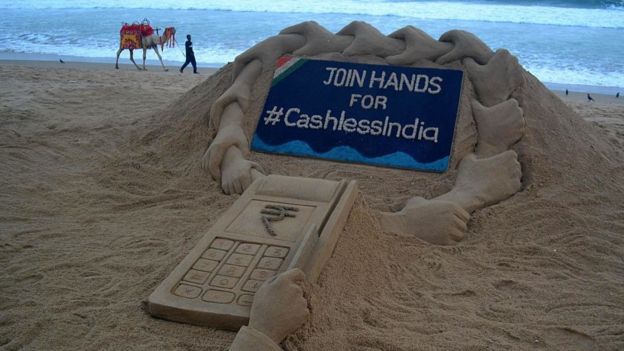
It also said it would help move India towards an economy less dependent on cash.
However, Reality Check has found that there’s little evidence the ban has helped root out illegally held assets.
And compared with other emerging economies, the level of cash in circulation in India has remained high.
What actually happened?
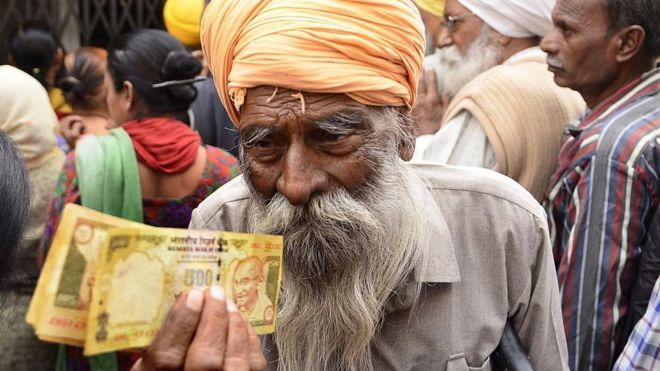
In November 2016, the two highest notes in circulation – 500 and 1,000 Indian rupees (£11) – were scrapped.
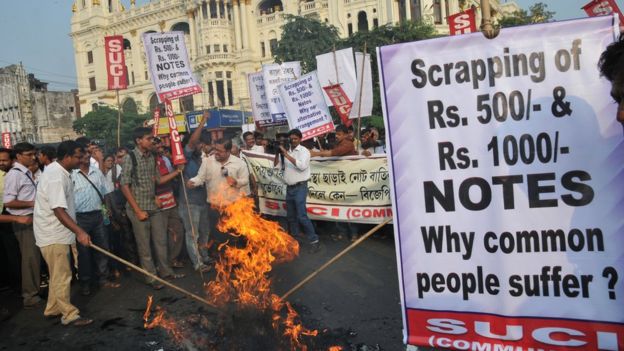
The surprise move – referred to in India as “demonetisation” – caused widespread confusion and led to street protests.
Image copyrightGETTY IMAGES
For a limited period only, the withdrawn notes could be exchanged for legal currency at banks – but there was a limit of 4,000 rupees per person.
What impact did it have?
Critics said the policy severely disrupted the economy, badly affecting the poor and rural communities that relied on cash.
The government said it was targeting illegal wealth held outside the formal economy, which fuelled corruption and other illegal activity and had not been declared for tax purposes.
It was assumed that those with large amounts of such cash would now find it difficult to exchange for legal tender.
But by August 2018, a report published by India’s central bank said that more than 99% of the old banknotes in circulation prior to the ban had been accounted for.
It was suggested that there had not been much unaccounted for wealth held in cash in the first place – or if there had been, the owners had found ways to convert it to legal tender.
Image copyrightGETTY IMAGES
Did the policy achieve the objective of exposing counterfeit currency?
Not really, according to India’s central bank.
The number of fake 500 and 1,000 rupee notes found after the ban was only marginally higher than the amount from the previous year.
In the two years before the currency withdrawal, tax collection growth rates had been in single digits.
Then in 2016-17, the amount of direct taxes collected increased by 14.5% over the previous year.
The following year, collections rose by 18%.
But the rate of growth in collecting direct taxes had seen a similar increase between 2008-09 and 2010-11, when the Congress party was in power.
And it’s likely that other policies – such as an income tax amnesty in 2016 and a new goods and services tax the following year – may have contributed as much to the growing tax take as demonetisation.
What about a cashless society?
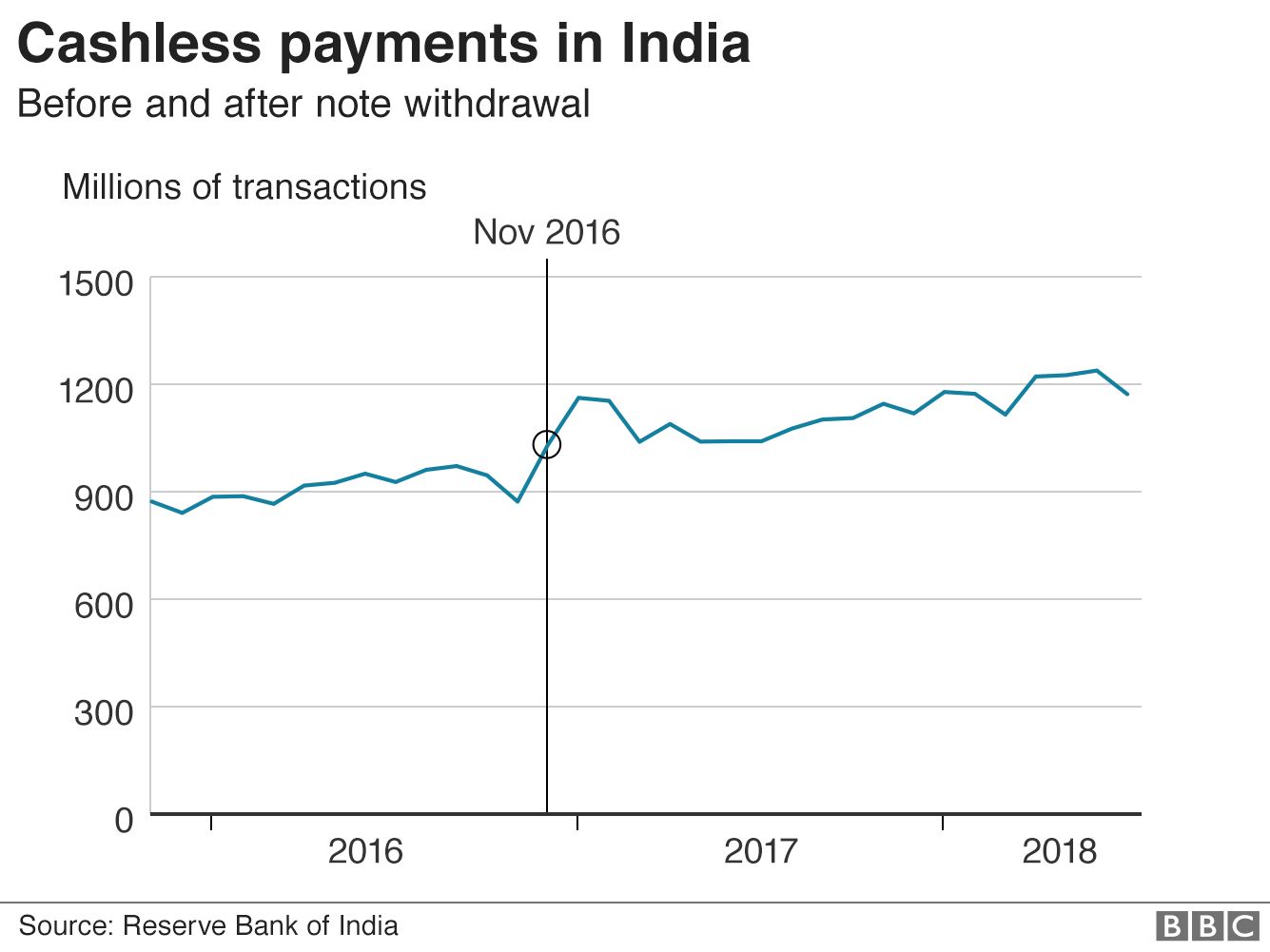
Against a long-term trend of a gradual rise in cashless payments, there is a significant jump at the end of 2016, when the notes were withdrawn.
But this reverted soon afterwards to the steady rising trend.
The overall increase over time may have less to do with government policy and more to do with changing technology and easier cashless payments.
As to whether the overall amount of cash in the economy has fallen, we can look at India’s currency to gross domestic product (GDP) ratio over time.
This is a measure of the amount of currency in circulation in proportion to the total value of goods and services produced.
This took a sharp dive immediately following the withdrawal of the 500 and 1,000 rupee notes – but by the following year, currency in circulation had reverted to pre-2016 levels.
MUMBAI (Reuters) – With India and Pakistan standing on the brink of war this week, several false videos, pictures and messages circulated widely on social media, sparking anger and heightening tension in both countries.
The video of an injured pilot from a recent Indian air show and images from a 2005 earthquake have been taken out of context to attempt to mislead tens of millions on platforms like Twitter, Facebook and its messenger service, WhatsApp.
The spurt of fake news comes after New Delhi this week launched an air strike inside Pakistan, the first such move in over more than decades. India says the attack destroyed a militant camp run by the group that claimed responsibility for killing 40 paramilitary troops in Indian Kashmir on Feb 14. Pakistan denied there had been any casualties in the attack.
Tensions between the nuclear-armed nations peaked with both sides claiming they’d shot down each other’s fighter jets on Wednesday, and Pakistan capturing an Indian pilot.
As claims and counter claims poured in from both sides, social media became a hotbed of unverified news, pictures and video clips, according to fact checkers.
Partik Sinha, co-founder of one such fact-checking website, Alt News, said it had received requests to verify news from journalists and people on social media.
“It’s been crazy since Tuesday. There is so much out there that we know is fake, but we’re not able to fact-check all of it,” Sinha said.
A Facebook group that says it supports Amit Shah, the chief of India’s ruling Bharatiya Janata Party (BJP), posted images on Tuesday of the alleged destruction caused inside Pakistan by the Indian air strike.
Three photos posted on the group page showed debris from a destroyed building and bodies and have been shared hundreds of times.
Alt News said the pictures were from a 2005 earthquake in Kashmir.
India, where roughly 450 million people have smartphones, is already struggling with a huge fake news problem with misinformation having led to mass beatings and mob lynchings.
Facebook, WhatsApp and Twitter have begun to take steps to combat the issue, but as India heads toward general elections, due by May, fake news is getting more intensely politicized.
Another message circulated on a WhatsApp group supporting the BJP claimed the Indian jet was not shot down, but crashed due to a technical snag and blamed the opposition Congress party for failing to upgrade the jets during its tenure.
Similarly in Pakistan, a purported video of a second captured Indian pilot was being widely circulated. Fact-checking website Boom noted the clip was from an air show in the southern Indian city of Bengaluru, where two planes crashed on Feb. 19.
“Everyone has a role to play in ensuring misinformation doesn’t spread on the internet and we encourage people who use Twitter not to share information unless they can verify that it’s true,” a spokeswoman for Twitter said.
Image copyrightGETTY IMAGES (ALLISON JOYCE)Image captionCow vigilantes in Ramgarh in 2015
A Muslim dairy farmer was stopped late one night last July as he led two cows down a track in rural Rajasthan, south of the Indian capital, Delhi. Within hours he was dead, but who killed him, asks the BBC’s James Clayton – the “cow vigilantes” he met on the road, or the police?
It’s 4am and Dr Hassan Khan, the duty doctor at Ramgarh hospital, is notified of something unusual.
The police have brought in a dead man, a man they claim not to know.
“What were the police like when they brought him in? Were they calm?” I ask him.
“Not calm,” he says. “They were anxious.”
“Are they usually anxious?” I ask.
“Not usually,” he says, laughing nervously.
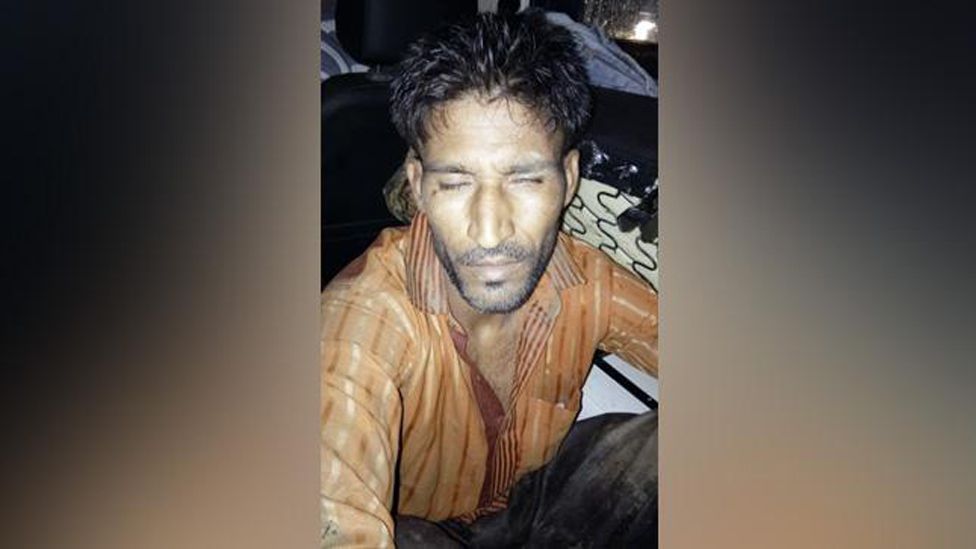
The dead man is later identified by his father as local farmer Rakbar Khan.
This was not a random murder. The story illustrates some of the social tensions bubbling away under the surface in India, and particularly in the north of the country.
And his case raises questions for the authorities – including the governing Hindu nationalist BJP party.
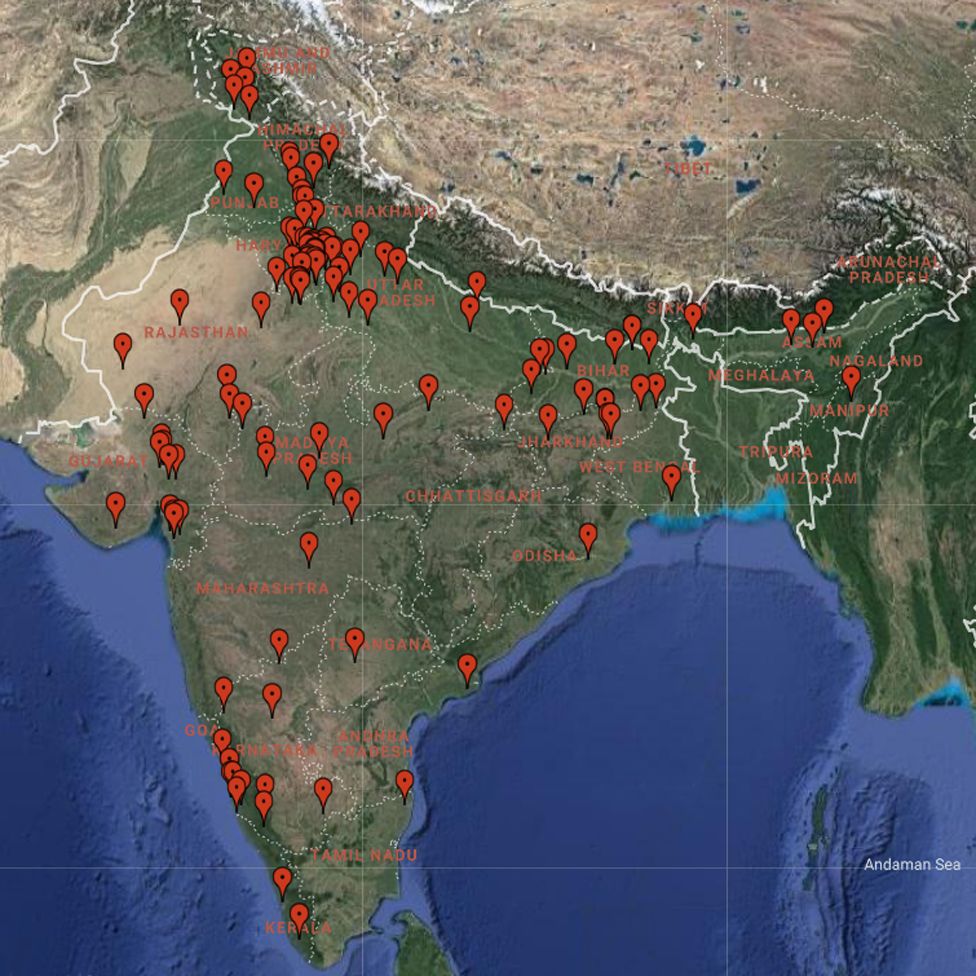
Cow-related violence – 2012-2019
Image copyrightINDIASPENDRakbar Khan was a family man. He had seven children.
He kept cows and he also happened to be a Muslim. That can be a dangerous mix in India.
“We have always reared cows, and we are dependent on their milk for our livelihood,” says Rakbar’s father, Suleiman.
“No-one used to say anything when you transported a cow.”
That has changed. Several men have been killed in recent years while transporting cows in the mainly Muslim region of Mewat, not far from Delhi, where Rakbar lived.
“People are afraid. If we go to get a cow they will kill us. They surround our vehicle. So everyone is too scared to get these animals,” says Suleiman.
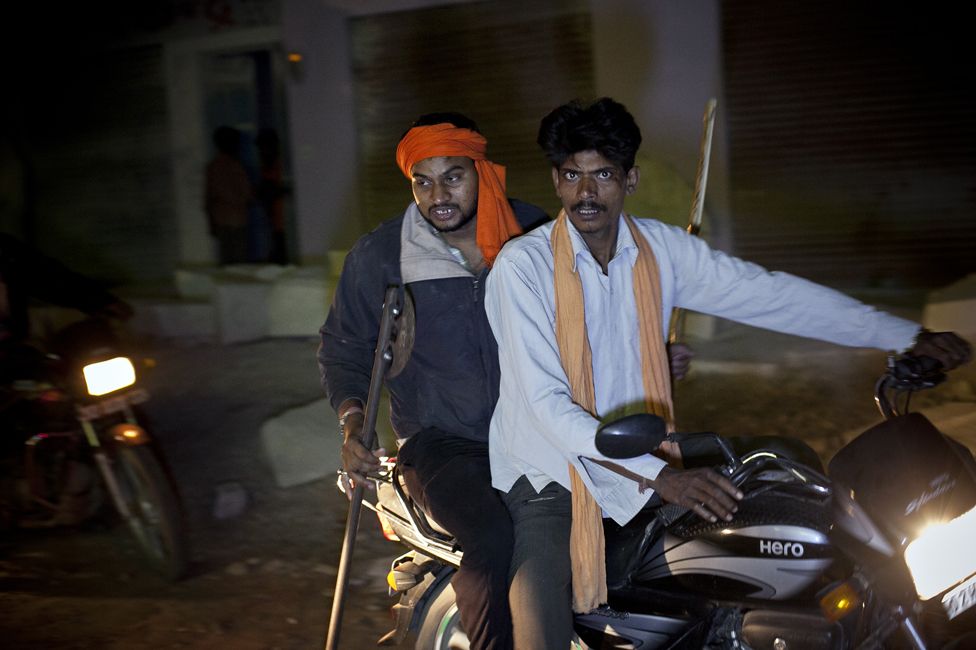
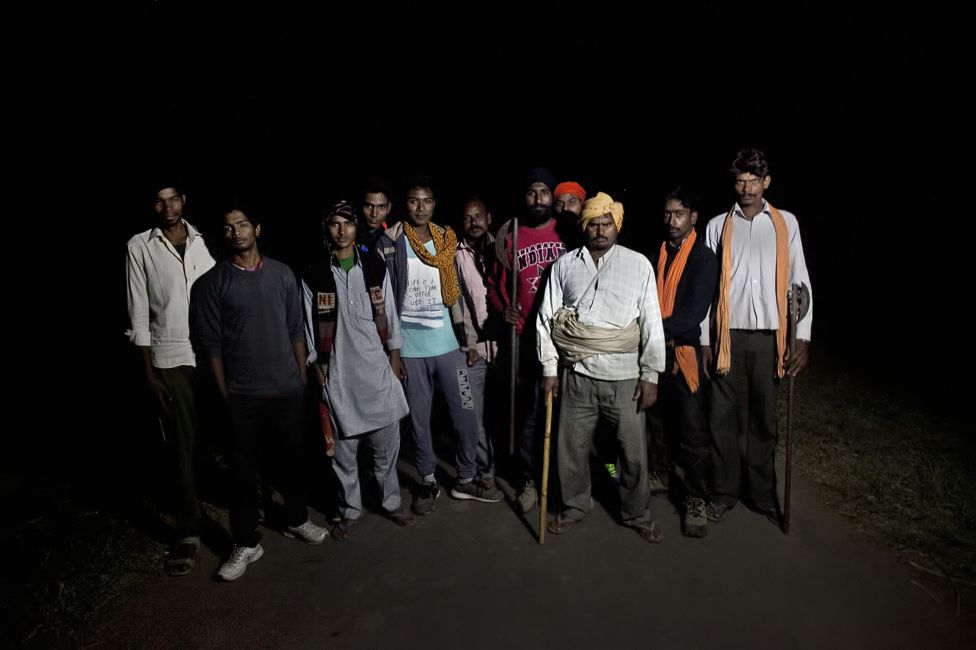
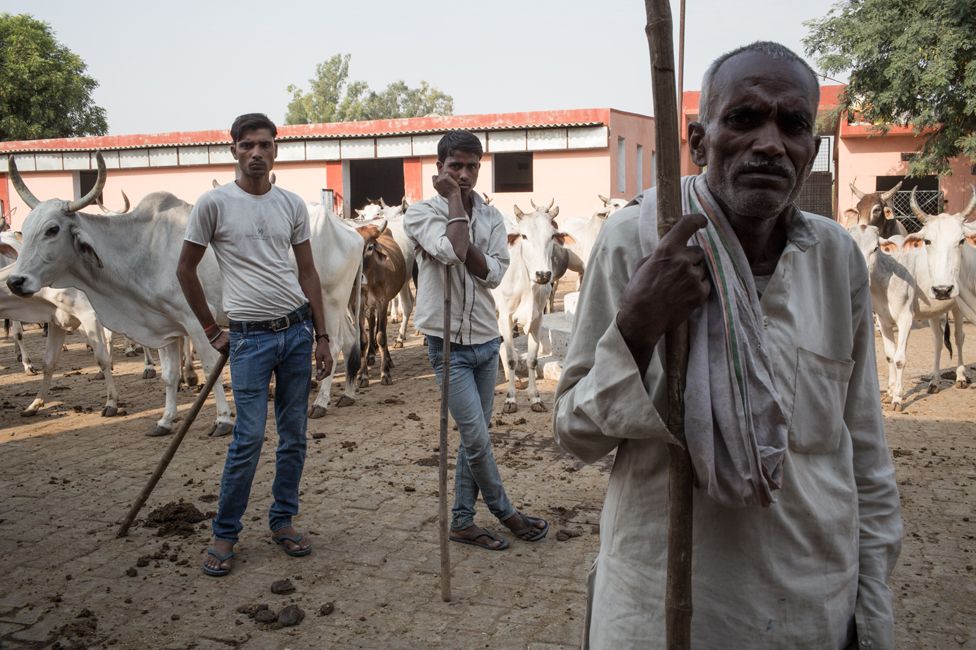
Everyone I speak to in the village where the Khans live is afraid of gau rakshaks – cow protection gangs.
Image copyrightGETTY IMAGES (ALLISON JOYCE)Image captionNawal Kishore Sharma’s cow protection group in 2015The gangs often consist of young, hardline Hindus, who believe passionately in defending India’s holy animal.
They believe that laws to protect cows, such as a ban on slaughtering the animals, are not being fully enforced – and they hunt for “cow smugglers”, who they believe are taking cows to be killed for meat.
Often armed, they have been responsible for dozens of attacks on farmers in India over the last five years, according to data analysis organisation IndiaSpend, which monitors reports of hate crimes in the media.
On 21 July 2018, Rakbar Khan met the local gau rakshak.
There are some things we know for certain about what happened that night.
Rakbar was walking down a small road with two cows. It was late and it was raining heavily.
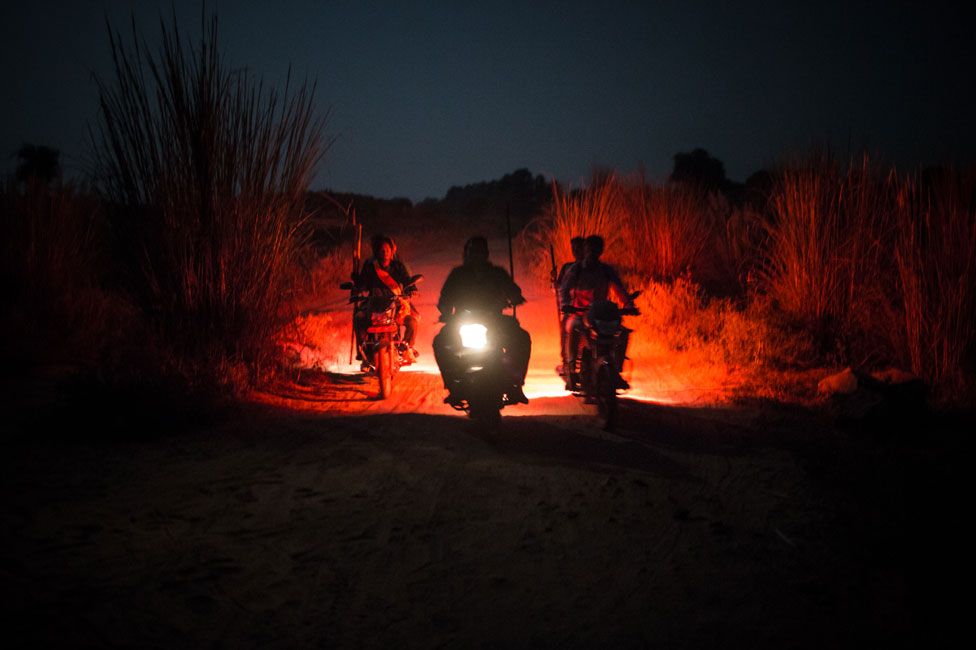
Then, out of the dark, came the lights of motorbikes. We know this, because Rakbar was with a friend, who survived.
Image copyrightGETTY IMAGES (ENRICO FABIAN)At this point the details become a little sketchier. There are three versions of the story.
The gang managed to catch Rakbar, but his friend, Aslam, slipped away. He lay on the ground, in the mud and prayed he wouldn’t be found.
“There was so much fear inside me, my heart was hurting,” he says.
“From there I heard the screams. They were beating him. There wasn’t a single part of his body that wasn’t broken. He was beaten very badly.”
The documentary India’s Cow Vigilantes can be seen on Our World on BBC World Newsand on the BBC News Channel (click for transmission times)
Aslam says that Rakbar was killed then and there.
But there is evidence that suggests otherwise.
Much of what happened next focuses around the leader of the local cow vigilante group, Nawal Kishore Sharma.
Aslam claims he heard the gang address him by name that night, but when I speak to Sharma, he denies he was there at all.
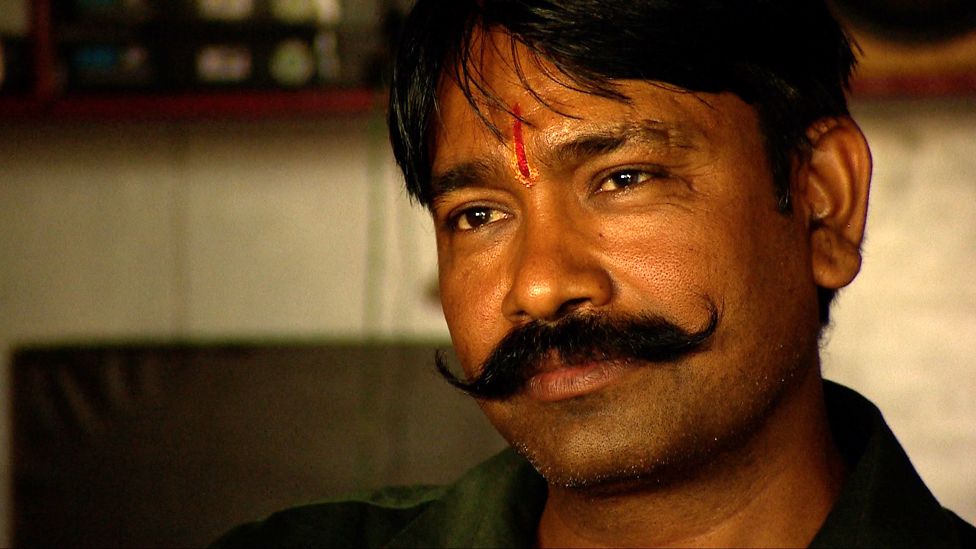
Image captionNawal Kishore Sharma
“It was about 00:30 in the morning and I was sleeping in my house… Some of my group phoned me to say they’d caught some cow smugglers,” he says.
According to Nawal Kishore Sharma, he then drove with the police to the spot. “He was alive and he was fine,” he says.
But that’s not what the police say.
In their “first incident report” they say that Rakbar was indeed alive when they found him.
“Nawal Kishore Sharma informed the police at about 00:41 that some men were smuggling two cows on foot,” the report says.
“Then the police met Nawal Kishore outside the police station and they all went to the location.
“There was a man who was injured and covered in mud.
“He told the police his name, his father’s name, his age (28) and the village he was from.
“And as he finished these sentences, he almost immediately passed out. Then he was put in the police vehicle and they left for Ramgarh.
“Then the police reached Ramgarh with Rakbar where the available doctor declared him dead.”
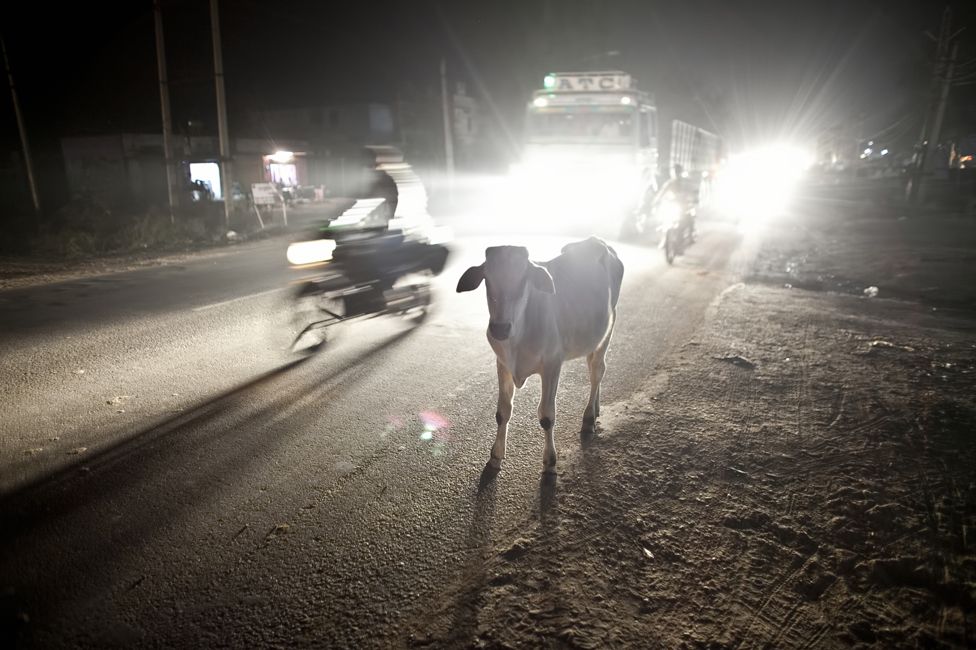
Image copyrightGETTY IMAGES (ALLISON JOYCE)Image captionRamgarh at nightBut this version of events is highly dubious.
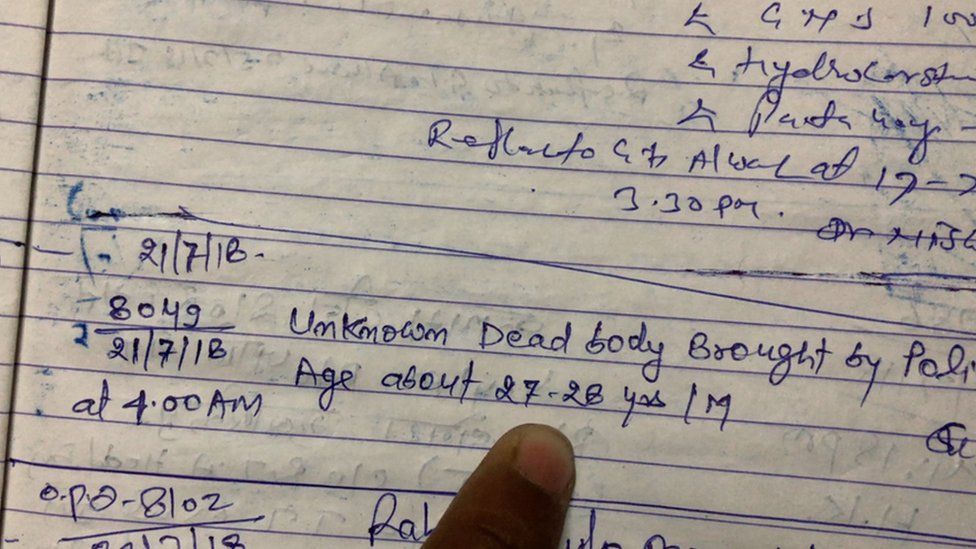
I go to the hospital in Ramgarh, where Rakbar was taken. Hospital staff are busily going through bound books of hospital records – looking for Rakbar’s admission entry.
And then, there it is. “Unknown dead body” brought in at 04:00 on 21 July 2018.
It’s not a long entry, but it contradicts the police’s story, and raises some serious questions.
For a start, Rakbar was found about 12 minutes’ drive away from the hospital. Why did it take more than three hours for them to take him there?
And if the police say Rakbar gave them his name, why did they tell the hospital they didn’t know who he was?
Nawal Kishore Sharma claims to know why. He paints a very different picture of what happened to Rakbar.
He tells me that after picking up Rakbar, they changed his clothes.
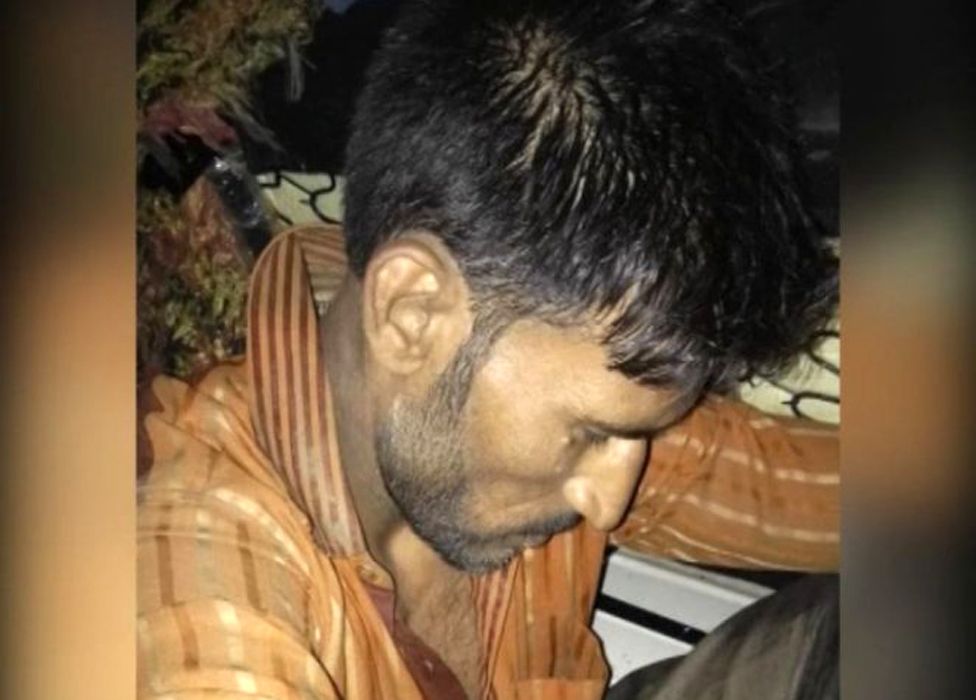
He then claims to have taken two photos of Rakbar – who at this point was with the police.
Sharma says that he went to the police station with the police. He claims that’s when the beating really began.
“The police injured him badly. They even beat him with their shoes,” he says.
“They kicked him powerfully on the left side of his body four times. Then they beat him with sticks. They beat him here (pointing at his ribs) and even on his neck.”
At about 03:00 Nawal Kishore Sharma says he went with some police officers to take the two cows to a local cow shelter. When he returned, he says, the police told him that Rakbar had died.
Rakbar’s death certificate shows that his leg and hand had been broken. He’d been badly beaten and had broken his ribs, which had punctured his lungs.
According to his death certificate he died of “shock… as a result of injuries sustained over body”.
I ask the duty doctor at the hospital whether he remembers what Rakbar’s body was like when the police brought it in.
“It was cold,” he says.
I ask him how long it would take for a body to become cold after death.
“A couple of hours,” he replies.
“I don’t want to talk about Rakbar’s case,” says Rejendra Singh, chief of police of Alwar district, which includes Ramgarh.
Since Rakbar’s murder several police officers have been suspended. I want to know why.
He looks uneasily at me.
“There were lapses on the police side,” he says.
I ask him what those lapses were.
“They had not followed the regular police procedure, which they were supposed to do,” he says. “It was one big lapse.”
Three men from Nawal Kishore Sharma’s vigilante group have been charged with Rakbar’s murder. Sharma himself remains under investigation.
The vigilante group and the police blame each other for Rakbar’s death, but neither denies working together that night.
The way Sharma describes it, the police cannot be everywhere, so the vigilantes help them out. But it’s the police that “take all the action” he says.
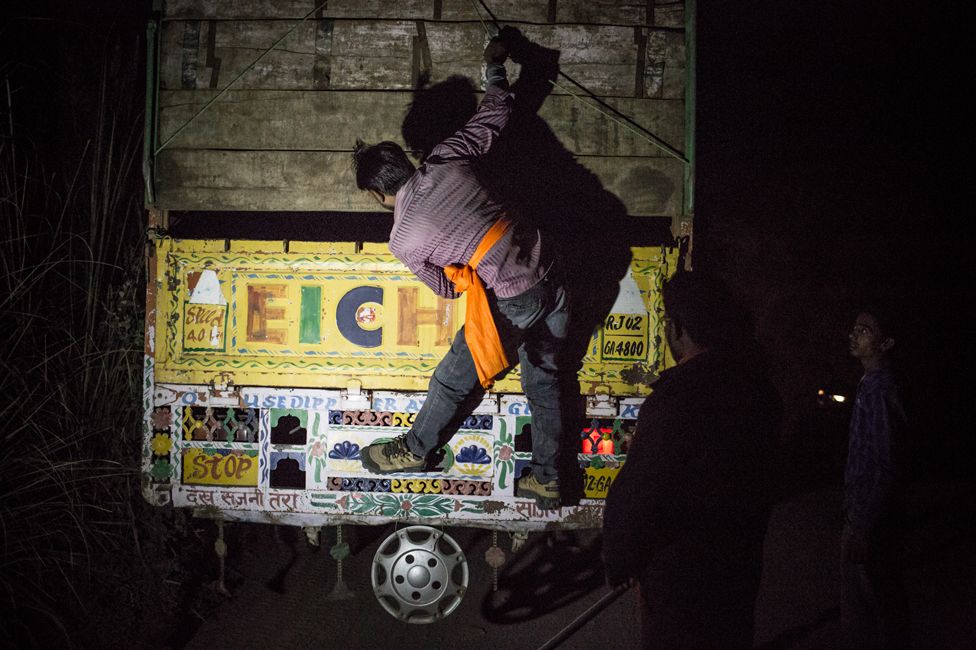
Image copyrightGETTY IMAGES (ENRICO FABIAN)Image captionNawal Kishore Sharma inspects a lorry transporting cows (October 2015)Much police activity in Rajasthan is focused on stopping cow slaughter.
Across the state there are dozens of formal cow checkpoints, where police stop vehicles looking for smugglers who are taking cows to be killed.
I visited one of the checkpoints. Sure enough police were patiently stopping vehicles and looking for cows.
The night before officers had had a gun battle with a group of men after a truck failed to stop.
These checkpoints have become common in some parts of India. Sometimes they are run by the police, sometimes by the vigilantes, and sometimes by both.
This gets to the heart of Rakbar’s case.
Human rights groups argue that his murder – and others like his – show that in some areas the police have got too close to the gangs.
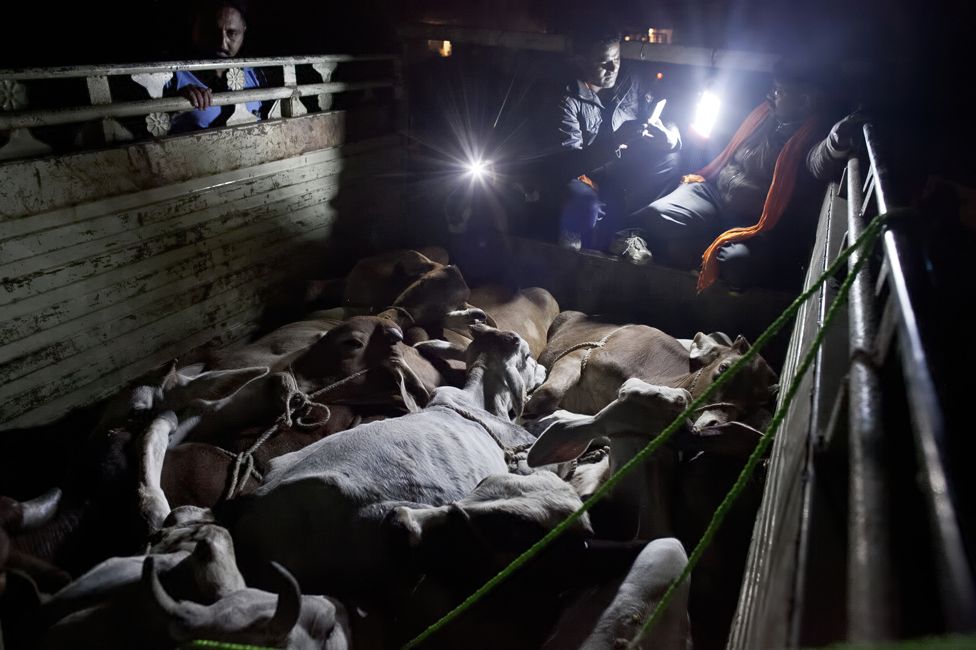
Image copyrightGETTY IMAGES (ALLISON JOYCE)Image captionThe vigilantes find what they are looking for (November 2015)“Unfortunately what we’re finding too often is that the police are complicit,” says Meenakshi Ganguly of Human Rights Watch, which published a 104-page report on cow-related violence in India this week.
In some areas, police have been reluctant to arrest the perpetrators of violence – and much faster to prosecute people accused of either consuming or trading in beef, he says.
Human Rights Watch has looked into 12 cases where it claims police have been complicit in the death of a suspected cow smuggler or have covered it up. Rakbar’s is one of them.
But this case doesn’t just illustrate police failings. Some would argue that it also illustrates how parts of the governing BJP party have inflamed the problem.
Gyandev Ahuja is a larger-than-life character. As the local member of parliament in Ramgarh at the time when Rakbar was killed he’s an important local figure.
He has also made a series of controversial statements about “cow smugglers”.
After a man was badly beaten in December 2017 Ahuja told local media: “To be straightforward, I will say that if anyone is indulging in cow smuggling, then this is how you will die.”
After Rakbar’s death he said that cow smuggling was worse than terrorism.
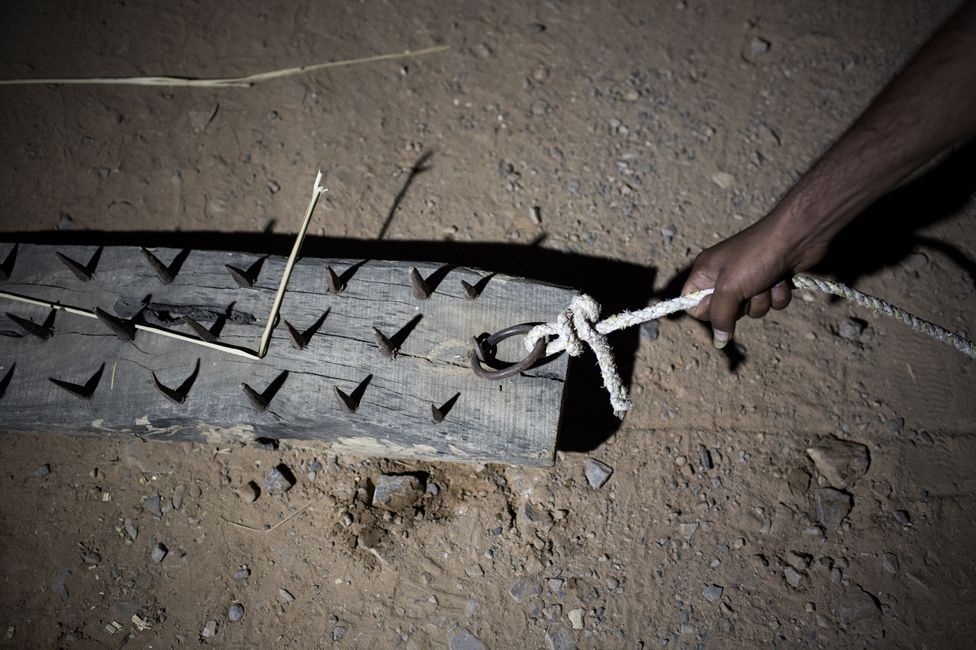
Image copyrightGETTY IMAGES (ENRICO FABIAN)Image captionNails used by the vigilantes to force lorries to stopGyandev Ahuja is just one of several BJP politicians who have made statements that are supportive of the accused in so-called “cow lynchings”.
One of Prime Minister Narendra Modi’s ministers was even photographed garlanding the accused murderers in a cow vigilante case. He has since apologised.
Meenakshi Ganguly of Human Rights Watch says it is “terrifying” that elected officials have defended attackers.
“It is really, at this point of time, something that is a great concern, because it is changing a belief into a political narrative, and a violent one,” he says.
The worry is that supportive messages from some of the governing party’s politicians have emboldened the vigilantes.
No official figures are kept on cow violence, but the data collected by IndiaSpend suggests that it started ramping up in 2015, the year after Narendra Modi was elected.
IndiaSpend says that since then there have been 250 injuries and 46 deaths related to cow violence. This is likely to be an underestimate because farmers who have been beaten may be afraid to go to the police – and when a body is found it may not be clear what spurred the attack. The vast majority of the victims are Muslims.
Image copyrightGETTY IMAGES (ENRICO FABIAN)Image captionA cow shelter in RamgarhA BJP spokesman, Nalin Kohli, emphatically rejects any connection between his party and cow violence.
“To say the BJP is responsible is perverse, inaccurate and absolutely false,” he tells me.
“Many people have an interest in building a statement that the BJP is behind it. We won’t tolerate it.”
I ask him about Gyandev Ahuja’s inflammatory statements.
“Firstly that is not the party’s point of view and we have very clearly and unequivocally always said an individual’s point of view is theirs, the point of view of the party is articulated by the party.
“Has the BJP promoted him or protected him? No.”
But a month after this interview, Ahuja was made vice-president of the party in Rajasthan.
Shortly afterwards, Prime Minister Narendra Modi visited Rajasthan – publicly slapping Ahuja on the back and waving together at crowds of BJP supporters.
In Mewat I speak to Rakbar’s wife, Asmina.
“Show me how you raise seven children without a husband. How will I be able to raise them?” she says, wiping away tears.
“My youngest daughter says that my father went to God. If you ask her, ‘How did he go to God?’ she says, ‘My father was bringing a cow and people killed him.’
“The life of an animal is so important but that of a human is not.”
The trial of the three men accused of his murder has yet to take place, but perhaps we will never know what really happened to Rakbar.
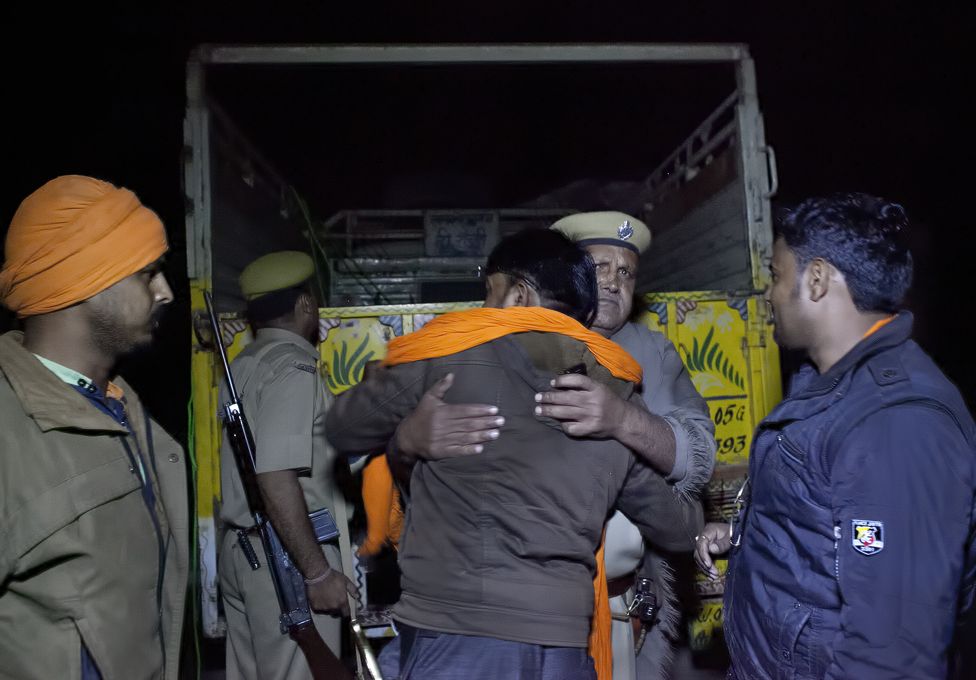
In November 2015, photographer Allison Joyce spent a night following Nawal Kishore Sharma’s vigilantes in the countryside near Ramgarh. One of her photographs shows a police officer embracing Sharma after a shootout between the vigilantes and a suspected cow smuggler.
Though the police now accuse the cow vigilantes of killing Rakbar Khan, and the vigilantes accuse the police, the photograph illustrates just how closely they worked together.
Image copyrightGETTY IMAGES (ALLISON JOYCE)In the Indian media there have been claims that the police took the two cows that Rakbar had been transporting to a cow shelter, as Rakbar lay dead or dying in a police vehicle.
There are also claims that the police stopped and drank tea instead of taking Rakbar to hospital.
Whatever they did, they did not take Rakbar to hospital immediately.
Addressing a rally in Assam’s North Lakhimpur, Amit Shah said that the NRC had been brought in to identify infiltrators and that the BJP would identifiy and deport all such infiltrators.
Saying that the NRC had been brought in to identify infiltrators, Amit Shah said, the BJP will rid Assam of all such aliens by deporting them.(HT Photo)
BJP chief Amit Shah on Sunday said that Modi-led government at the Centre will not allow Assam to become another Kashmir and that is why it has brought about the National Register of Citizens (NRC).
Saying that the NRC had been brought in to identify infiltrators, he said, the BJP will rid Assam of all such aliens by deporting them.
“We won’t let Assam become another Kashmir, this is our commitment. We’ll repeat the NRC exercise as many times as required to, but we’ll identify and deport each infiltrator from Assam,” Shah said while addressing a public rally at North Lakhimpur in Assam.
Shah criticised the Congress and its former ally Asom Gana Parishad (AGP), and said both the parties had done nothing to implement the Assam Accord despite ruling most of the period since the pact was signed in 1985.
Referring to the contentious Citizenship (Amendment) Bill, which the Centre couldn’t present in Rajya Sabha, he said misinformation was being spread as if it was only for Assam and other parts of the Northeast.
“It was not for Northeast alone, but for all refugees across the country. The way demography is changing in Assam, without the Citizenship Bill, the people of the state will be in danger,” he added.
He also spoke about the Pulwama attack in which 40 CRPF jawans were killed in a suicide bombing on Thursday.
“This cowardly act was done by Pakistani terrorists. Their (jawans’) sacrifices will not go in vain, because there is no Congress government at the Centre. It is BJP government and the Narendra Modi government will not compromise on any security issue,” he added.
Saying that the government at the Centre was not that of the Congress, Shah said that the current government was that of the BJP and was led by Modi, who he said was determined to uproot terrorism from the country.
LUCKNOW, India (Reuters) – Priyanka Gandhi Vadra, the latest entrant into politics from India’s Nehru-Gandhi dynasty, made her debut on Monday with a roadshow drawing thousands to see her in the most populous state, months before a general election due to be held by May.
Congress President Rahul Gandhi pulled a surprise last month by appointing his younger sister a party general secretary. She will also be its face in Uttar Pradesh, the state that sends the highest number of lawmakers to the lower house of parliament and is currently dominated by Prime Minister Narendra Modi’s ruling Bharatiya Janata Party (BJP).
But a string of BJP defeats in state elections late last year and rising discontent over a weak farm economy and lacklustre jobs growth have weakened Modi’s position, which an increasingly aggressive Congress is looking to capitalize on.
The 47-year-old Priyanka – she is usually referred to by just her first name – bears a striking resemblance to her grandmother, former Prime Minister Indira Gandhi, and is known for her gifts as a speaker able to connect with voters.
Congress hopes that the eyeballs she’s able to generate will turn into votes.
“It’s like Indira Gandhi has come back,” said Fuzail Ahmed Khan, 45, a Congress supporter. “The state’s farmers want Rahul Gandhi to be prime minister, Priyanka to be chief minister.”
Indira Gandhi, India’s only woman prime minister and known as the “Iron Lady”, was criticised for suspending civil liberties for nearly two years starting in 1975. The Hindu nationalist BJP calls Priyanka’s appointment an extension of Congress’s “dynastic politics”.
Posters of Priyanka lined the streets of the state capital, Lucknow, and hundreds of Congress supporters, accompanied by drummers, chanted her name as she emerged from the airport with her brother.
The siblings continuously waved at supporters from atop a bus and then later from an SUV during the drive from the airport to their state office.
At a stopover, Rahul Gandhi grabbed a microphone and said the appointments of Priyanka and lawmaker Jyotiraditya Scindia as state party leaders were aimed at beyond the general election and bringing Congress into power in Uttar Pradesh.
“If there is a heart of the country, it is Uttar Pradesh,” he said to loud cheers, Priyanka standing by his side. “They’re definitely focused on the parliamentary election but the aim also is to form a government in the state. We’ll bring a government of youth, poor and peasants.”
But it won’t be easy for the brother-sister combination in Uttar Pradesh, a poor state of 220 million people where two regional caste-based parties now compete for power with the BJP and Congress is only a marginal player.
The BJP won 73 of the 80 seats in the state in the last general election. BJP President Amit Shah said last week the party would win 74 seats there this year.
Although Priyanka has helped manage elections for her brother and her mother, former Congress chief Sonia Gandhi, she has never held an official party post until now.
“I hope that we can together start a new kind of politics,” she said in an audio message shared by Congress, but she did not make a speech in Lucknow amid fears, political analysts say, she could overshadow her brother.
Since the announcement of Priyanka’s entry into politics, India’s financial crime-fighting agency Enforcement Directorate has questioned her husband, Robert Vadra, in a case relating to alleged ownership of 1.9 million pounds of undisclosed assets abroad. His lawyer and Congress have dismissed the charges as politically motivated.
Priyanka, who drew more 78,000 followers soon after joining Twitter on Monday and even before sending a single tweet, will spend three days in Lucknow meeting workers from more than 40 constituencies.
From 21 seats in the 2009 general election in Uttar Pradesh, Congress’ tally fell to just two in 2014.
Modi’s visit was part of a series of public meetings in the region aimed at garnering support for the Bharatiya Janata Party ahead of elections that are due to be held by May.
Both India and China have sought to rebuild trust after an armed standoff over a stretch of the Himalayan border in 2017.(Twitter/BJP4India)
Prime Minister Narendra Modi’s visit to Arunachal Pradesh on Saturday saw jagged exchange between China and India. China’s foreign ministry Objected to PM Modi’s Arunachal visit saying “resolutely opposes” activities of Indian leaders in the region.
Responding to China’s objection to PM Modi’s visit to the northeastern state, the Ministry of External Affairs (MEA) said the state is “an integral and inalienable part of India.” Modi’s visit was part of a series of public meetings in the region aimed at garnering support for the Bharatiya Janata Party ahead of elections that are due to be held by May.
“The State of Arunachal Pradesh is an integral and inalienable part of India. Indian leaders visit Arunachal Pradesh from time to time, as they visit other parts of India… This consistent position has been conveyed to Chinese side on several occasions,” news agency ANI quoted MEA as saying.
Despite recent efforts to improve bilateral ties in both countries, disputes over the mountainous Indo-China border – which triggered a war in 1962 – and the region that China claims as southern Tibet have remained a sensitive issue.
“China urges the Indian side to proceed from the overall situation of bilateral relations, respect China’s interests and concerns, cherish the momentum of improving relations between the two countries, and refrain from any actions that intensify disputes and complicate the border issue,” the country’s foreign ministry said in a statement.
On Saturday, India’s foreign ministry did not immediately respond to a request for comment.
Both India and China have sought to rebuild trust after an armed standoff over a stretch of the Himalayan border in 2017.
Modi and Chinese President Xi Jinping met a number of times last year to give impetus to the trade discussions. But progress, according to Indian government officials and representatives of various Indian trade bodies, has been very slow.
Mamata Banerjee on dharna LIVE: West Bengal chief minister Mamata Banerjee said her struggle will continue till “the situation is resolved”. Her comments came as she visited the police commissioner’s residence.
West Bengal chief minister Mamata Banerjee launched a dharna in the heart of Kolkata on Sunday to protest the move of the CBI to question Kolkata Police commissioner Rajeev Kumar as she accused Prime Minister Narendra Modi and BJP president Amit Shah of plotting a ‘coup’.
She said her struggle will continue till “the situation is resolved.” Her comments came as she visited the police commissioner’s residence after a CBI team which showed up to quiz the Kolkata Police chief was detained by the local police.
Till 2014, the BJP and Sena used to have an understanding under which the former would contest a larger share of Lok Sabha seats and the latter would get a greater number of Maharashtra Assembly seats to fight.
SNS Web | New Delhi | January 28, 2019 5:28 pm
Prime Minister Narendra Modi and Shiv Sena chief Uddhav Thackeray. (File Photo: Facebook)
Bharatiya Janata Party’s warring ally Shiv Sena on Monday said that it would the big brother in alliance with the saffron party in Maharashtra and will stay the same.
Speaking to reporters after a meeting chaired by party chief Uddhav Thackeray, the Sena’s Rajya Sabha MP and chief whip in Parliament, Sanjay Raut, reiterated that the party will play the role of a big brother if an alliance is made for the upcoming Lok Sabha elections.
On reports of BJP and Shiv Sena to fight on an equal number of seats, Raut said, “There is no proposal from the BJP to form any alliance with the Shiv Sena. Those who wish to forge an alliance with us are talking about it. We are not waiting for any proposal to be offered to us”.
Raut also said that the party wanted the income tax threshold to be raised from the existing Rs 2.5 lakh to Rs 8 lakh.
“Uddhav Thackrey Ji said on the 10 per cent EWS quota to General Category that people with annual income of 8 lakh must be exempted from paying Income Tax. Since you have labelled them poor, they must be exempted,” he said.
At the meeting held in Thackeray’s Matoshree residence in Mumbai’s Bandra, with party MLAs and MPs in attendance, the Sena also took some other key decisions.
During the meeting, Thackeray also discussed the drought situation and farm distress in the state with party legislators, Raut said.
Till 2014, the BJP and Sena, allies for long, used to have an understanding under which the former would contest a larger share of Lok Sabha seats and the latter would get a greater number of Maharashtra Assembly seats to fight.
In this way, both parties took the role of the elder and younger sibling in the general and state polls in their political “brotherhood”.
The 2014 Assembly polls, however, ended this “sibling” agreement as the BJP, on the back of a strong Narendra Modi wave and contesting alone, won 122 seats against the Sena’s 63 in Maharashtra.
The BJP went on to form a government in the state under Devendra Fadnavis and the Sena had to contend being the junior partner.







 CHINDIA ALERT: You'll be living in their world, very soon