Archive for ‘Bohai Sea’

17/10/2019

China’s Type 001A aircraft carrier sets off on latest sea trial as navy prepares to commission ship ‘within months’

  • Country’s first home-grown carrier may soon be ready for service but observers warn a few glitches may still need to be ironed out
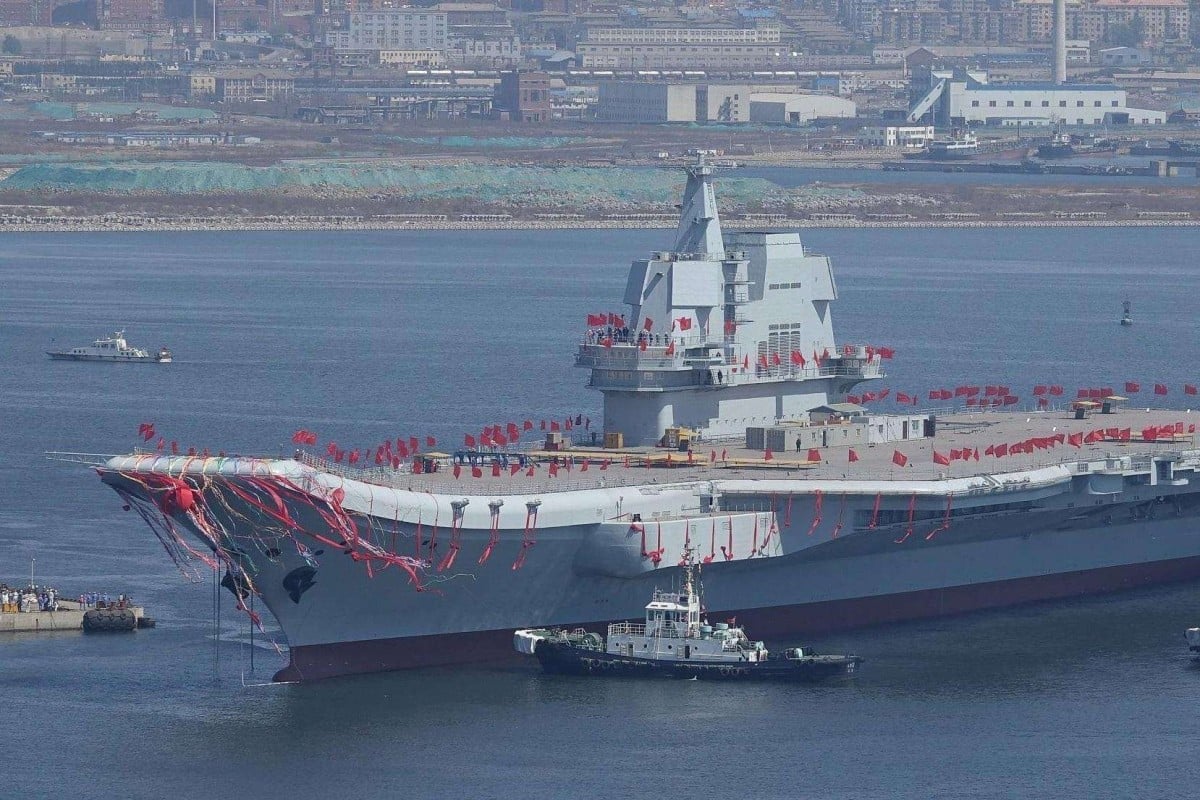
The Type 001A will be China’s second carrier and the first home-grown one. Photo:ifeng

China’s first home-grown aircraft carrier, Type 001A, will be commissioned within months, according to military observers.

The ship appeared to have set off on its eighth sea trial on Tuesday after photographs taken by a plane flying over a restricted area showed a carrier, with a warplane on deck, leaving the Dalian Shipyard, where the carrier is being built.

The timing coincided with a notice issued by China’s Maritime Safety Administration, saying an area of the Bohai Sea, near the yard would be cordoned off for military activities.

While the commissioning would mark an advance in China’s naval capacity, some analysts noted that the trial phase was taking longer than expected.
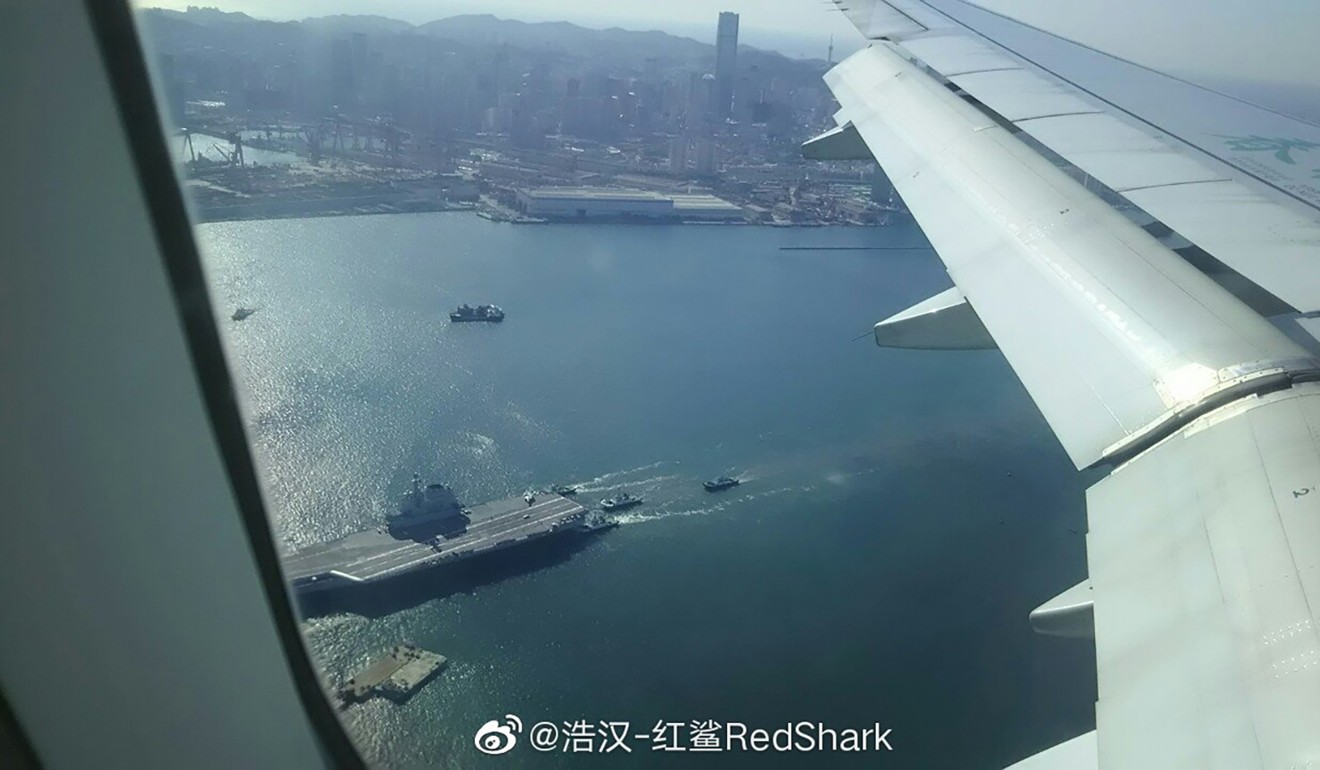
A photo shows a carrier leaving the Dalian shipyard on Tuesday. Photo: Weibo

Global Times, a tabloid affiliated to Communist Party mouthpiece People’s Daily, quoted naval observer Li Jie as saying that the Type 001A was likely to be undertaking its eighth sea trial after solving problems discovered in the previous trials.

In August the Type 001A identified technical problems that required immediate attention
during its seventh trial, a fairly common occurrence in the processes.

Zhou Chenming, a Beijing based military expert, said that the Type 001A’s commissioning had already been postponed and the major problem now was a lack of shipborne aircraft and problems with the flight control system.

Zhou said the control system worked with J-15 fighters, which will be the primary jets used on the ship, but “is not yet compatible with other aircraft, which hinders the aircraft carrier’s final commissioning”.

Once commissioned, the ship will join the country’s first carrier, the Liaoning, at sea, boosting the country’s naval capacity.

Collin Koh, a research fellow at the Institute of Defence and Strategic Studies from Singapore’s Nanyang Technological University, said: “With two aircraft carriers, the PLA Navy will have greater chances to hone its carrier capabilities – conducting more missions, training, and all of these contributing to the accumulation of expertise and know-how.

“This means qualitatively improving [its] carrier capability, including human capital.

“For long-term strategic significance, it means an expanding power projection capability of the PLAN that allows it to promote presence in regions where Beijing asserts national interests.”
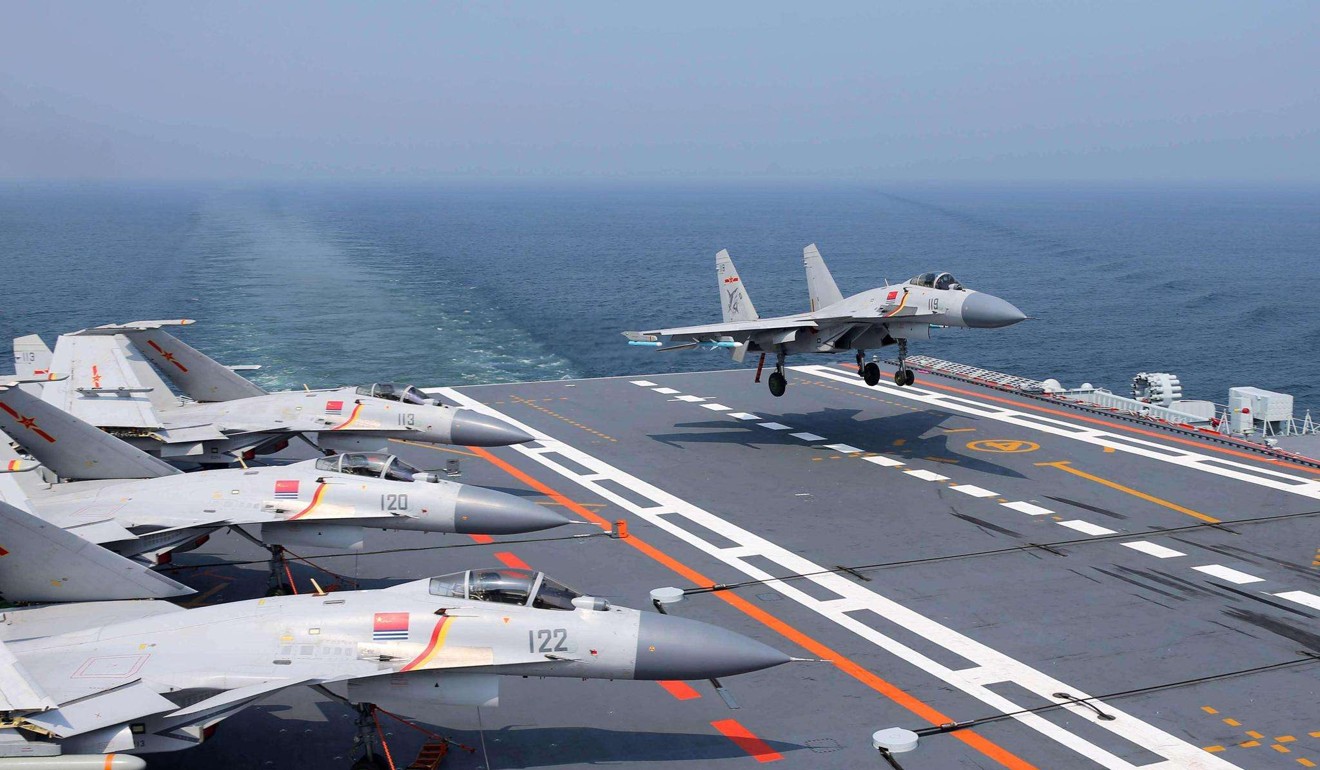
Once ready the ship will carry 32 J-15 fighters. Photo:ifeng

The Type 001A’s trial phase has taken longer than some military observers had expected. The aircraft carrier set out for its first sea trial in May 2018, some 17 months ago.

By comparison, the Liaoning, a former Soviet Kuznetsov-class vessel underwent 10 sea trials over a 13-month period before it was commissioned.

The Type 001A is a modified version of the design that features upgraded radar and bridge systems and will carry 36 J-15s compared with the Liaoning’s capacity of 24
.

The ship also features a ski-jump deck for take-offs, has a displacement of 70,000 tonnes and will be able to carry a total of 40 aircraft.

Source: SCMP

20/09/2019

Xi Focus: Xi stresses ecological protection and high-quality development of Yellow River

CHINA-HENAN-XI JINPING-SYMPOSIUM-YELLOW RIVER PROTECTION AND DEVELOPMENT (CN)

Chinese President Xi Jinping, also general secretary of the Communist Party of China Central Committee and chairman of the Central Military Commission, chairs and addresses a symposium on the ecological protection and high-quality development of the Yellow River in Zhengzhou, capital of central China’s Henan Province, Sept. 18, 2019. (Xinhua/Ju Peng)

ZHENGZHOU, Sept. 19 (Xinhua) — Chinese President Xi Jinping called for concerted efforts to promote ecological protection and high-quality development of the Yellow River.

Xi, also general secretary of the Communist Party of China Central Committee and chairman of the Central Military Commission, made the remarks while chairing a symposium Wednesday during his inspection tour to Henan Province.

NATIONAL STRATEGY

“The protection of the Yellow River is critical to the great rejuvenation and sustainable development of the Chinese nation,” said Xi, adding that it is a major national strategy.

Noting that the peace of the Yellow River is significant to the stability of China, Xi said Chinese people have struggled against the floods and droughts of the Yellow River since ancient times, and the Party and the state have attached great importance to the harnessing and development of the Yellow River after the founding of New China in 1949.

Originating in Qinghai Province, the Yellow River, known as China’s “Mother River” and the cradle of the Chinese civilization, runs through nine provinces and autonomous regions including Shaanxi and Henan before emptying into the Bohai Sea in east China’s Shandong Province.

The river got its name Huanghe in Chinese because of its yellow, muddy water, which appears as it runs through the Loess Plateau in northwest China.

The 5,464-km-long waterway feeds about 12 percent of China’s population, irrigates about 15 percent of arable land, supports 14 percent of national GDP, and supplies water to more than 60 cities.

Xi also pointed out difficulties and problems in protecting the Yellow River, including fragile ecological environment, severe condition of the water resources preservation and development quality that needs to be improved.

SOUL OF CHINESE NATION

Calling for strengthened protection of the ecological environment of the Yellow River basin, Xi said that differences between the upper, middle and lower reaches of the river should be fully considered, given that the Yellow River ecosystem is an organic whole.

Further efforts should be made to ensure the long-term stability of the Yellow River, Xi said, stressing that although the river has not seen major dangers for many years, we should not relax vigilance.

Over the past 2,500 years, the Yellow River has broken its dikes 1,600 times and has made 26 major changes in its course in the lower reaches.

Xi also stressed better use of water resources, with rational planning of the population, urban and industrial development to resolutely curb unreasonable water demand.

When pursuing high-quality development in the region, authorities should actively explore new ways with regional characteristics and participate in the construction of the Belt and Road to promote higher level of opening-up, Xi noted.

Meanwhile, Xi called for preserving, inheriting and carrying forward the Yellow River culture.

“The Yellow River culture, as an important part of the Chinese civilization, is the root and soul of the Chinese nation,” Xi said, calling for telling well the “Yellow River story” to pool spiritual strength for the realization of the Chinese dream of the great rejuvenation of the Chinese nation.

For over 3,000 years, some major dynasties in Chinese history built their capitals in the river basin, making the region the centers of politics, economy and culture in the country.

The Yellow River witnessed the birth of the four era-defining inventions in ancient China — printing techniques, papermaking, gunpowder and the compass, which all emerged in the drainage basin.

At Wednesday’s meeting, Vice Premier Han Zheng, also a member of the Standing Committee of the Political Bureau of the Communist Party of China Central Committee called for efforts to earnestly study and implement the spirit of Xi’s speech and strive to make new progress in the ecological protection and high-quality development of the Yellow River basin.

Source: Xinhua

05/06/2019

Do you believe in UFOs? China hints at test of new missile

BEIJING (Reuters) – With a cryptic message about UFOs and a picture of a missile launcher, China’s military has hinted that it has carried out a test of a new missile, after images of an object streaking towards the sky circulated on Chinese social media.

The People’s Liberation Army typically does not announce new missile tests, but occasionally drops hints about what it is up to, amid a massive modernisation push championed by President Xi Jinping to ramp up combat capabilities.
On Sunday, footage circulated on China’s Weibo microblogging service of an object travelling up into the sky, leaving a white trail behind it, over the Bohai Sea, partly closed at the time for military drills.
That caused some Chinese internet users to wonder if it was a UFO, though most thought it was probably the test of a new underwater launched ballistic missile.
In a short post on its official Weibo account late on Monday, the People’s Liberation Army Rocket Force showed a picture of what looked like a road mobile intercontinental ballistic missile launcher against a night sky.
“Do you believe in this world there are UFOs?” it wrote in the caption, without offering further explanation.
The navy then chimed in on its Weibo account with a picture of a missile being launched from underwater heading off into the blue sky above, with a similar caption: “Do you believe in UFOs?”
Defence publication Janes said on its website that the weekend pictures could have been China’s next generation submarine-launched ballistic missile, the JL-3.
The Ministry of Defence did not respond to a request for comment.
The development of the nuclear-armed JL-3 is being closely watched by the United States and its allies as it is expected to have a longer range than its predecessor and will significantly strengthen China’s nuclear deterrent.
In its latest annual survey of China’s military modernisation, the Pentagon said last month the new missile would likely to be fitted on China’s next generation nuclear missile submarines. Construction is due to start in the early 2020s.
Source: Reuters
Law of Unintended Consequences

continuously updated blog about China & India

ChiaHou's Book Reviews

continuously updated blog about China & India

What's wrong with the world; and its economy

continuously updated blog about China & India