Archive for ‘boycott’

04/06/2019

World’s largest technical professional society bans Huawei staff from peer review of research

  • IEEE’s ban has ignited a backlash from its Chinese members, resulting in calls to boycott the organisation
Staff at Huawei Technologies have been banned by the Institute of Electrical and Electronics Engineers from taking part in the peer review of research papers, including serving as editors for journals, after the Chinese telecommunications equipment maker was added to a US trade blacklist. Photo: AP
The US government’s efforts to reduce the influence of Huawei Technologies, the world’s largest telecommunications equipment supplier, has extended beyond business to cover scientific research.
That development emerged as the New York-based Institute of Electrical and Electronics Engineers (IEEE) moved to ban Huawei employees from the peer review of research papers, including serving as editors for its journals, after the Chinese hi-tech champion was added to a US trade blacklist.
The decision by IEEE, the world’s biggest technical professional organisation, was leaked online across Chinese social media on Wednesday, igniting a backlash from some of the country’s leading scientists who described the move as “anti-science” and “violating academic freedom”.

Zhang Haixia, a professor with the Institute of Microelectronics at Peking University, announced on her WeChat account on Wednesday that she was quitting IEEE because the decision to comply with the trade blacklist went “far beyond the basic line of science and technology” and challenged her professional integrity.

US is waging a tech war against this district in Shenzhen
“As a professor, I do not accept this,” Zhang wrote online in a public letter addressed to IEEE president-elect Toshio Fukuda.
Her resignation letter was viewed more than 40,000 times since it was posted online. The most popular comments on its thread included calls for Chinese scientists to boycott IEEE.

In a statement on May 30, the IEEE said it must comply with its legal obligations under the laws of the US and other jurisdictions and that compliance with regulations “protects the IEEE, our volunteers, and our members”.

It said Huawei employees are only barred from the peer reviewing process and that they can continue to participate in individual membership, corporate membership, enjoy voting rights and take part in a variety of other activities, including the submission of technical papers for publication.

Huawei said it had no comment about the peer review ban.

The issue between Huawei and IEEE has come amid a raging tech war between the world’s two biggest economies, which recently escalated when the US government placed Huawei and its affiliates under the US Entity List on May 16. That bars the Chinese group from buying hardware, software and services from American hi-tech suppliers without US approval.

A succession of major American technology companies, from Google and Microsoft to Intel and Qualcomm, have suspended their dealings with Huawei to comply with the US trade ban.

Growing disquiet in China as US steps up war on tech champions

US President Donald Trump has also signed an executive order barring US companies from using telecoms equipment made by companies that pose a threat to national security.

The trade blacklist, which is maintained by the Bureau of Industry and Security under the US Department of Commerce, identifies organisations and individuals believed to be involved, or pose a significant risk of becoming involved, in activities contrary to America’s national security or foreign policy interests.

A non-profit organisation founded in January 1963, IEEE had more than 422,000 members in more than 160 countries as of December 31 last year. More than 50 per cent of its members, who are rooted in electrical and computer sciences, engineering and related disciplines, are from outside the US.

Technology is true target of US attack on China, says diplomat

It also publishes around 200 transactions, journals and magazines, and sponsors more than 1,900 conferences in 103 countries.

There is no official data on how many IEEE members are based in mainland China. Public information online, however, showed that at least 80 Huawei employees are members of the organisation.

China’s biggest chip maker to delist from NYSE as US targets tech

In a statement released on May 16, IEEE said that as a corporation organised in New York, it must comply with its legal obligation under US laws. It said the US government’s export restriction covers not only physical goods and software but also technical information.

In the leaked IEEE email, the organisation warned its members of “severe legal implications” if they continue to use Huawei staff as reviewers or editors for the peer review process of its journals.

“IEEE is registered in the US, but we should suggest experts at all levels of IEEE to move its headquarters to places such as Switzerland,” said Zhou Zhihua, a leading computer science professor at Nanjing University and an IEEE fellow, in a post on microblogging site Sina Weibo. “More importantly, let’s show more support to China-produced English-language journals.”

Source: SCMP
16/05/2019

Amazon faces backlash in India for selling shoes, rugs with images of Hindu gods

MUMBAI (Reuters) – Amazon.com faced a social media backlash in India on Thursday after toilet seat covers and other items emblazoned with images of Hindu gods were spotted on its website.

Thousands of Twitter users backed a call for a boycott of the U.S. retailer, making #BoycottAmazon India’s top trending topic on Twitter. Some tagged Indian Foreign Minister Sushma Swaraj, urging her to take action against the company.

Amazon, the world’s biggest online retailer, said it was removing the products from its online store.

“All sellers must follow our selling guidelines and those who do not will be subject to action including potential removal of their account,” the company said in a statement.

The episode is reminiscent of an incident in 2017 when the Indian government took Amazon to task after its Canadian website was spotted selling doormats resembling India’s flag.

Swaraj at the time threatened to rescind visas of Amazon employees if the doormats were not removed from its site.

Reuters found several listings of toilet seat covers, yoga mats, sneakers, rugs and other items depicting Hindu gods, or sacred Hindu symbols, on Amazon’s U.S. website.

Some of the items were no longer available for purchase.

“Until you hit these Hinduphobics Business hard they will keep on insulting your gods, your beliefs & your entire civilization,” tweeted Sumit Kandel, whose profile describes him as a film trade analyst.

Source:Reuters

20/04/2019

Leica China video sparks backlash over Tiananmen Square image

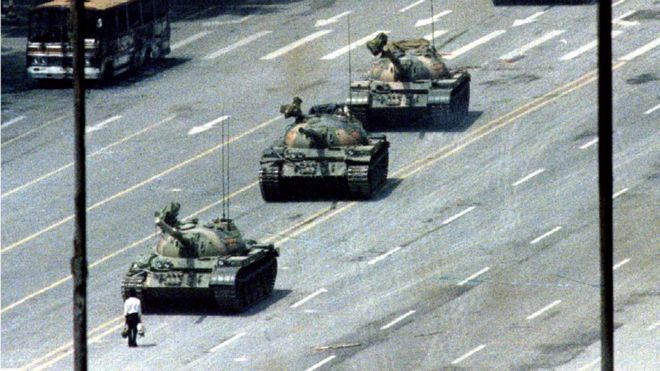
A man stands in front of three tanksImage copyrightREUTERS
Image caption This year marks the 30th anniversary of the pro-democracy protests

A promotional video for camera company Leica has sparked backlash in China for featuring a famous Tiananmen Square image.

The video depicts photographers working in conflicts around the world, including a photographer covering the 1989 protests.

People on Chinese social media site Weibo have called for a boycott of the camera brand.

Leica has distanced itself from the video.

“Tank Man” was a lone protester who brought a column of tanks to a standstill during a crackdown on pro-democracy protesters in Beijing in 1989.

He refused to move out of the way and climbed onto the leading tank to speak to the driver. He was later pulled away from the scene by two men. What happened to him remains unknown.

Beginning with the caption “Beijing 1989”, the Leica video features a photographer taking the famous image. The “Tank Man” can be seen in the camera’s lens.

Users on Chinese social media site Weibo have been forbidden from commenting on recent official posts by Leica. However some people are managing to post carefully worded comments on earlier official Leica posts, BBC Monitoring has found.

A search of the hashtag Leica shows that 42,000 users have left posts on Weibo but only 10 are available to view.

Some comments urge users to “boycott the camera” and joke about the company being linked to “patriotic Huawei”.

Chinese technology giant Huawei has been restricted by the US and other countries over security concerns in telecommunications networks. Consumers in China have rallied around the company, which uses Leica technology in its latest mobile phones.

A spokeswoman for Leica told the South China Morning Post that the film was not an officially sanctioned marketing film commissioned by the company. However it features Leica cameras and the company’s logo at the end of the footage.

They added that the company “must therefore distance itself from the content shown in the video and regrets any misunderstandings of false conclusions that may have been drawn”.

The BBC has contacted Leica for additional comment.


How China keeps Tiananmen off the internet

By Kerry Allen, BBC Monitoring China analyst

China has banned all activists’ commemorations of the 1989 Tiananmen incident for years and has strictly regulated online discussion of it.

If users search for “Tiananmen” on domestic search engines like Baidu or social media platforms like Sina Weibo, they only see sunny pictures of the Forbidden City in Beijing. If any pictures of tanks running along Chang’an Avenue are visible in image searches, they are only from Victory Day parades.

Hundreds of references to 4 June 1989 are banned all-year round by thousands of cyber police, and Weibo steps up censorship of even seemingly innocuous references to the incident on its anniversary.

Simple candle emojis, and number sequences that reference the date, such as “46” and “64” (4 June) and “1989” (the year of the protests), are instantly deleted. Small businesses also struggle to market items on 4 June every year, if their sale price is 46 or 64 yuan. Such advertising posts are swiftly removed by nervous censors.

But creative users always find ways of circumventing the censors. For example in 2014, when Taylor Swift released her 1989 album, the album cover featuring the words “T.S.” and “1989” was seen as an effective metaphor by users to talk about the incident – as T.S. could be taken to mean “Tiananmen Square”.


More than one million Chinese students and workers occupied Tiananmen Square in 1989, beginning the largest political protest in communist China’s history. Six weeks of protests ended with the bloody crackdown on protesters of 3-4 June.

Estimates of the death toll range from several hundred to more than 1,000.

China’s statement at the end of June 1989 said that 200 civilians and several dozen security personnel had died in Beijing following the suppression of “counter-revolutionary riots” on 4 June 1989.

Source: The BBC

08/03/2019

Indian cricketers wear army camouflage caps as patriotism grips country

NEW DELHI (Reuters) – Indian cricketers wore army camouflage-style caps in a match with Australia on Friday in solidarity with Indian paramilitary police killed in a militant attack by a Pakistan-based group and in an unusually strong display of patriotic fervour in sport.

The suicide bombing last month killed 40 in Indian-controlled Kashmir, a region also claimed by Pakistan. The attack prompted India to launch an air strike inside Pakistan, which responded with an aerial attack the next day.

The Board of Control for Cricket in India (BCCI) has in recent days tried unsuccessfully to isolate Pakistan in the cricketing world. The International Cricket Council rejected India’s calls to boycott games against Pakistan, whose prime minister is former cricketing hero Imran Khan.

But there are still calls within India for the national team to pull out of a World Cup match against Pakistan in June in England.

“(Indian cricket) teams have expressed solidarity in the past but not this kind of public display of that solidarity,” Majumdar told Reuters.

“Sport has always been meshed with politics and people have often used it to make very strong points. This is yet another one. This is a peaceful way of expressing solidarity in a manner which I don’t see problematic at all.”

But Pakistani lawyer Abdullah Nizamani said on Twitter the BCCI and international cricket board should keep “sports away from petty politics”. Some Pakistanis even asked on social media if Indian cricketers would turn up for the World Cup match with Pakistan in military fatigues.

Nuclear-armed neighbours India and Pakistan have fought two of their three wars since independence over Kashmir, which both sides claim in full but rule in part.

Source: Reuters

22/02/2019

Pulwama attack: India government must protect Kashmiris – top court

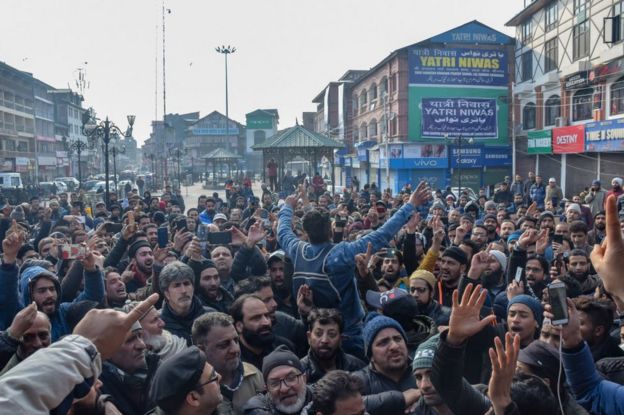
Protests against attacks on Kashmiris in Srinagar on 20 FebruaryImage copyrightGETTY IMAGES
Image captionProtests have been held in Indian-administered Kashmir over attacks on Kashmiris in other parts of India

India’s top court has ordered the government to protect Kashmiri people from attacks in apparent retaliation for last week’s deadly bombing in Indian-administered Kashmir.

There have been several reports of Kashmiri students and businessmen being harassed or beaten up in recent days.

The Supreme Court has also sought a response from the states where these alleged incidents happened.

The attack has sparked anger and anti-Pakistan protests across India.

The suicide bombing of an Indian security convoy in Pulwama on 14 February was claimed by a Pakistan-based militant group and has led to a war of words between nuclear-armed India and Pakistan.

But in some cases the anger has been directed against Kashmiri people living in other parts of India. The attack, which killed more than 40 Indian paramilitary police, was the deadliest against Indian forces in Kashmir in decades.

Hundreds of Kashmiri students, traders and businessmen have returned to Kashmir from various Indian cities out of fear that they could face harassment or attack.

Many Indians have expressed sympathy towards the Kashmiri students on social media, with some offering shelter in their own homes.

India has long had a volatile relationship with Muslim-majority Kashmir, where there has been an armed insurgency against Indian rule since the late 1980s.

The region has been a flashpoint between India and Pakistan since independence. Both countries claim all of Kashmir but control only parts of it. They have fought two wars and a limited conflict over the territory.

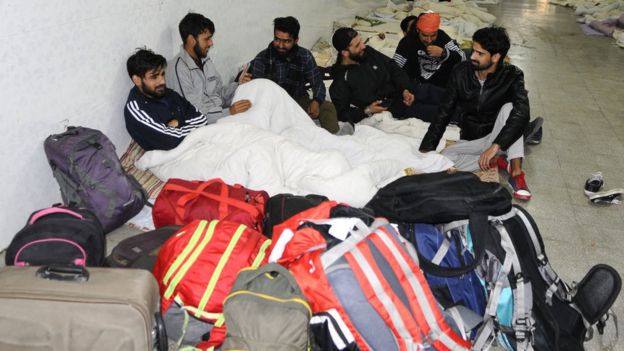
Kashmiri students from Dehradun, Ambala, Banur and Mohali leaving for Kashmir in Mohali, India.Image copyrightGETTY IMAGES
Image captionKashmiri students living in Dehradun and other cities have returned home since the attack

What did the court say?

The court’s decision singled out the federal government as well as governments in 10 states which are home to a sizeable Kashmiri population.

It asked authorities to widely publicise the details of officials who Kashmiris can contact if they face threats or violence.

The order was in response to a petition seeking protection for Kashmiris living across India. Tehseen Poonawala, one of the petitioners, told the BBC that he was moved to act because he was “disturbed” after reading reports of Kashmiris being attacked.

“It’s not about Kashmiris. It’s about human beings. We cannot be a country that responds with mob violence,” he said.

What happened to Kashmiri students?

In the days following the attack, isolated incidents of students from Kashmir being beaten up or evicted from their accommodation in northern Indian states were reported in local media. Kashmiri Muslims were warned to stay vigilant and India’s Central Reserve Police Force (CRPF) offered help to those in need, but also warned of false reports.

Twenty Kashmiri girls in the northern city of Dehradun were forced to lock themselves in their hostel after protesters gathered outside to demand their eviction, according to the Times of India.

Two other colleges in the city issued public statements saying they would not admit Kashmiri students in the next academic year.

“We did so to provide protection to the [Kashmiri] students,” the college principal, Aslam Siddidqu, told the BBC, adding that he had faced pressure from right-wing groups.

Federal education minister Prakash Javadekar has denied that “incidents” have taken place involving Kashmiri students.

But a police official in Dehradun told the BBC that 22 students had been arrested for protesting and demanding that Kashmiri students be expelled from colleges in the city.

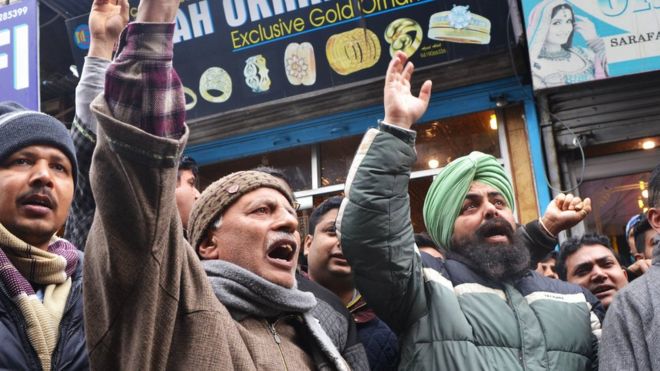
Kashmiri traders are seen shouting slogans during the protest. Traders in Lal Chowk and adjoining markets closed their shops as a mark of protest against attacks on Kashmiris elsewhere in India.Image copyrightGETTY IMAGES
Image captionMarkets and businesses were closed to protest against violence

What’s the bigger picture?

The attack has raised tensions between India and Pakistan, which have fought two wars and a limited conflict in the region and are both nuclear powers.

India has accused Pakistani intelligence services of having a hand in the attack, which was claimed by militant group Jaish-e-Mohammad.

Pakistan denies this and has warned that it will retaliate if India takes military action. In his first comments addressing the attack, Prime Minister Imran Khan said India should “stop blaming Pakistan without any proof or evidence” and urged Indian authorities to share any “actionable intelligence”.

India has moved to impose trade restrictions on Pakistan. It has also said it will build dams to reduce the flow of water to Pakistan from three rivers in India. Similar plans were announced in 2016, after a deadly militant attack on an Indian base in Kashmir.

The tensions between the neighbours may also have an impact on cricket, a national obsession in both India and Pakistan. Amid outrage over the attack, there have been calls for India to boycott its much anticipated match against Pakistan at the World Cup in June.

Indian cricket administrators say no decision has yet been made.

Source: The BBC

Law of Unintended Consequences

continuously updated blog about China & India

ChiaHou's Book Reviews

continuously updated blog about China & India

What's wrong with the world; and its economy

continuously updated blog about China & India