Archive for ‘Brexit’

31/03/2020

Coronavirus latest: New York begs for help; Indonesia bans foreigners entry; Italy extends lockdown

  • US death toll passes 3,000 as New York’s hospitals are pushed to breaking point
  • Italy extends lockdown as cases exceed 100,000; UN Security Council votes by email for first time
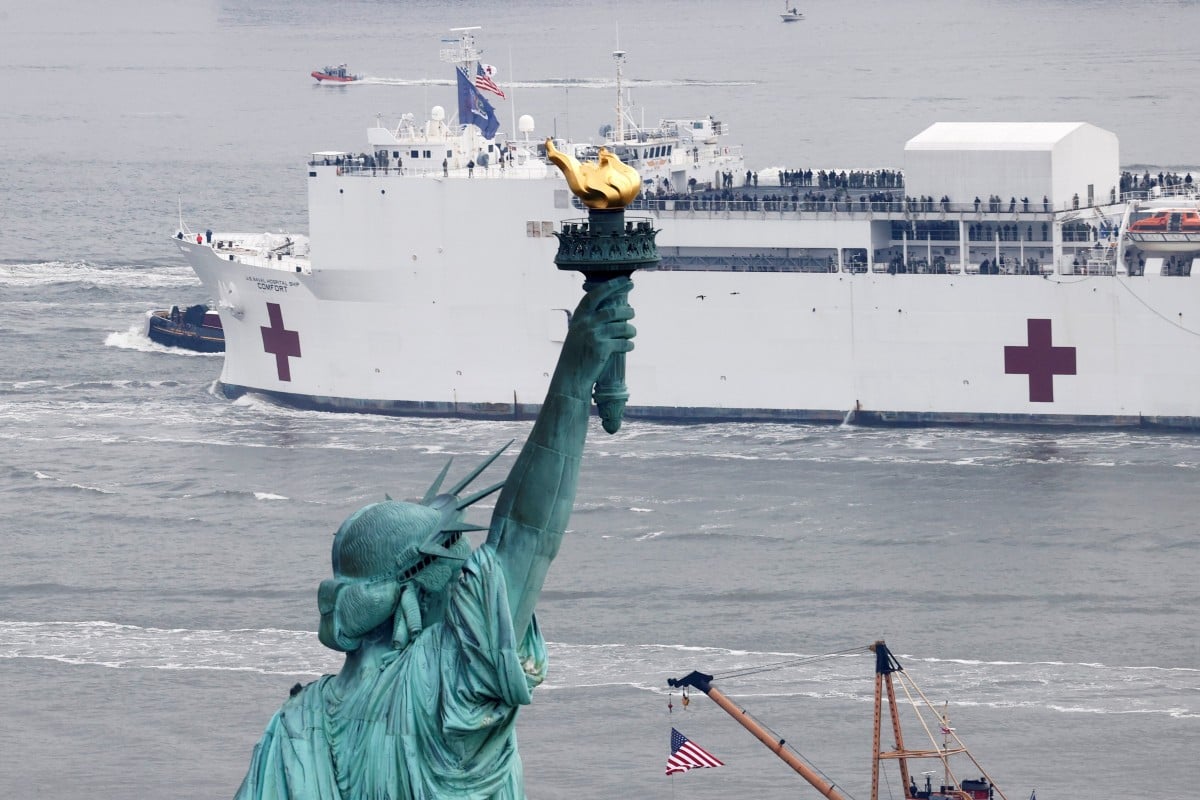
The USNS Comfort passes the Statue of Liberty as it enters New York Harbour on Monday. Photo: Reuters

Harsh lockdowns aimed at halting the march of the coronavirus pandemic extended worldwide Monday as the death toll soared toward 37,000 amid new waves of US outbreaks.

The tough measures that have confined some two-fifths of the globe’s population to their homes were broadened. Moscow and Lagos joined the roll call of cities around the globe with eerily empty streets, while Virginia and Maryland became the latest US states to announce emergency stay-at-home orders, followed quickly by the capital city Washington.

In a symbol of the scale of the challenge facing humanity, a US military medical ship sailed into New York to relieve the pressure on overwhelmed hospitals bracing for the peak of the pandemic.

France reported its highest daily number of deaths since the outbreak began, saying 418 more people had succumbed in hospital.

Spain, which announced another 812 virus deaths in 24 hours, joined the United States and Italy in surpassing the number of cases in China, where the disease was first detected in December.

On Tuesday, mainland China reported a rise in new confirmed coronavirus cases, reversing four days of declines, due to an uptick in infections involving travellers arriving from overseas.

Mainland China had 48 new cases on Monday, the National Health Commission said, up from 31 new infections a day earlier.

All of the 48 cases were imported, bringing the total number of imported cases in China to 771 as of Monday.

There was no reported new case of local infection on Monday, according to the National Health Commission. The total number of infections reported in mainland China stood at 81,518 and the death toll at 3,305. Globally, more than 760,000 have been infected, according to official figures.

Here are the developments:

Hospital ship arrives in New York

New York’s governor issued an urgent appeal for medical volunteers Monday amid a “staggering” number of deaths from the coronavirus, saying: “Please come help us in New York, now.”

The plea from Governor Andrew Cuomo came as the death toll in New York State climbed past 1,200 – with most of the victims in the big city – and authorities warned that the crisis pushing New York’s hospitals to the breaking point is just a preview of what other cities across the US could soon face.

Cuomo said the city needs 1 million additional health care workers.

“We’ve lost over 1,000 New Yorkers,” he said. “To me, we’re beyond staggering already. We’ve reached staggering.”

The governor’s plea came as a 1,000-bed US Navy hospital ship docked in Manhattan on Monday and a field hospital was going up in Central Park for coronavirus patients.

New York City reported 914 deaths from the virus as of 4:30pm local time Monday, a 16 per cent increase from an update six hours earlier. The city, the epicentre of the US outbreak, has 38,087 confirmed cases, up by more than 1,800 from earlier in the day.

Coronavirus field hospital set up in New York’s Central Park as city’s health crisis deepens

Gloom for 24 million people in Asia

The economic fallout from the coronavirus pandemic will prevent almost 24 million people from escaping poverty in East Asia and the Pacific this year, according to the World Bank.

In a report released on Monday, the Washington-based lender also warned of “substantially higher risk” among households that depend on industries particularly vulnerable to the impact of Covid-19. These include tourism in Thailand and the Pacific islands; manufacturing in Vietnam and Cambodia; and among people dependent on “informal labour” in all countries.

The World Bank urged the region to invest in expanding conventional health care and medical equipment factories, as well as taking innovative measures like converting ordinary hospital beds for ICU use and rapidly trining people to work in basic care.

Billionaire blasted for his Instagram-perfect isolation on luxury yacht
31 Mar 2020

Indonesia bans entry of foreigners

Indonesia barred foreign nationals from entering the country as the world’s fourth-most populous country stepped up efforts to contain the spread of the coronavirus pandemic.

The travel ban, to be effective soon, will also cover foreigners transiting through the country, Foreign Minister Retno Marsudi said after a cabinet meeting in Jakarta Tuesday. The curbs will not apply to holders of work permits, diplomats and other official visitors, she said.

The curbs on foreign citizens is the latest in a raft of measures taken by Indonesia to combat the deadly virus that’s sickened more than 1,400 people and killed 122. President Joko Widodo’s administration previously banned flights to and from mainland China and some of the virus-hit regions in Italy, South Korea and Iran. The president on Monday ordered stricter implementation of social distancing and health quarantine amid calls for a lockdown to contain the pandemic.

Indonesia has highest coronavirus mortality rate in Southeast Asia

First US service member dies

The first US military service member has died from the coronavirus, the Pentagon said on Monday, as it reported another sharp hike in the number of infected troops.

The Pentagon said it was a New Jersey Army National Guardsman who had tested positive for Covid-19 and had been hospitalised since March 21. He died on Saturday, it said.

Earlier on Monday, the Pentagon said that 568 troops had tested positive for the coronavirus, up from 280 on Thursday. More than 450 Defence Department civilians, contractors and dependents have also tested positive, it said.

US military has decided to stop providing more granular data about coronavirus infections within its ranks, citing concern that the information might be used by adversaries as the virus spreads.

The new policy, which the Pentagon detailed in a statement on Monday, appears to underscore US military concerns about the potential trajectory of the virus over the coming months – both at home and abroad.

School to resume in South Korea … online

South Korean children will start the new school year on April 9 with only online classes, after repeated delays due to the outbreak of the new coronavirus, the government said Tuesday.

Prime Minister Chung Sye Kyun said that despite the nation’s utmost efforts to contain the virus and lower the risk of infection, there is consensus among teachers and others that it is too early to let children go back to school.

The nation’s elementary schools, and junior and senior high schools were supposed to start the new academic year in early March, but the government has repeatedly postponed it to keep the virus from spreading among children.

The start was last postponed until April 6, but has now been delayed three more days to allow preparations to be made for online classes.

The nation now has 9,786 confirmed cases in total, with 162 deaths.

Italy extends lockdown as cases exceed 100,000

Italy’s government on Monday said it would extend its nationwide lockdown measures
against a coronavirus outbreak, due to end on Friday, at least until the Easter season in April.
The Health Ministry did not give a date for the new end of the lockdown, but said it would be in a law the government would propose. Easter Sunday is April 12 this year. Italy is predominantly Roman Catholic and contains the Vatican, the heart of the church.

Italians have been under lockdown for three weeks, with most shops, bars and restaurants shut and people forbidden from leaving their homes for all but non-essential needs.

Italy, which is the world’s hardest hit country in terms of number of deaths and accounts for more than a third of all global fatalities, saw its total death tally rise to 11,591 since the outbreak emerged in northern regions on February 21.

The death toll has risen by 812 in the last 24 hours, the Civil Protection Agency said, reversing two days of declines, although the number of new cases rose by just 4,050, the lowest increase since March 17, reaching a total of 101,739.

Deadliest day in Italy and Spain shows worst not over yet
28 Mar 2020
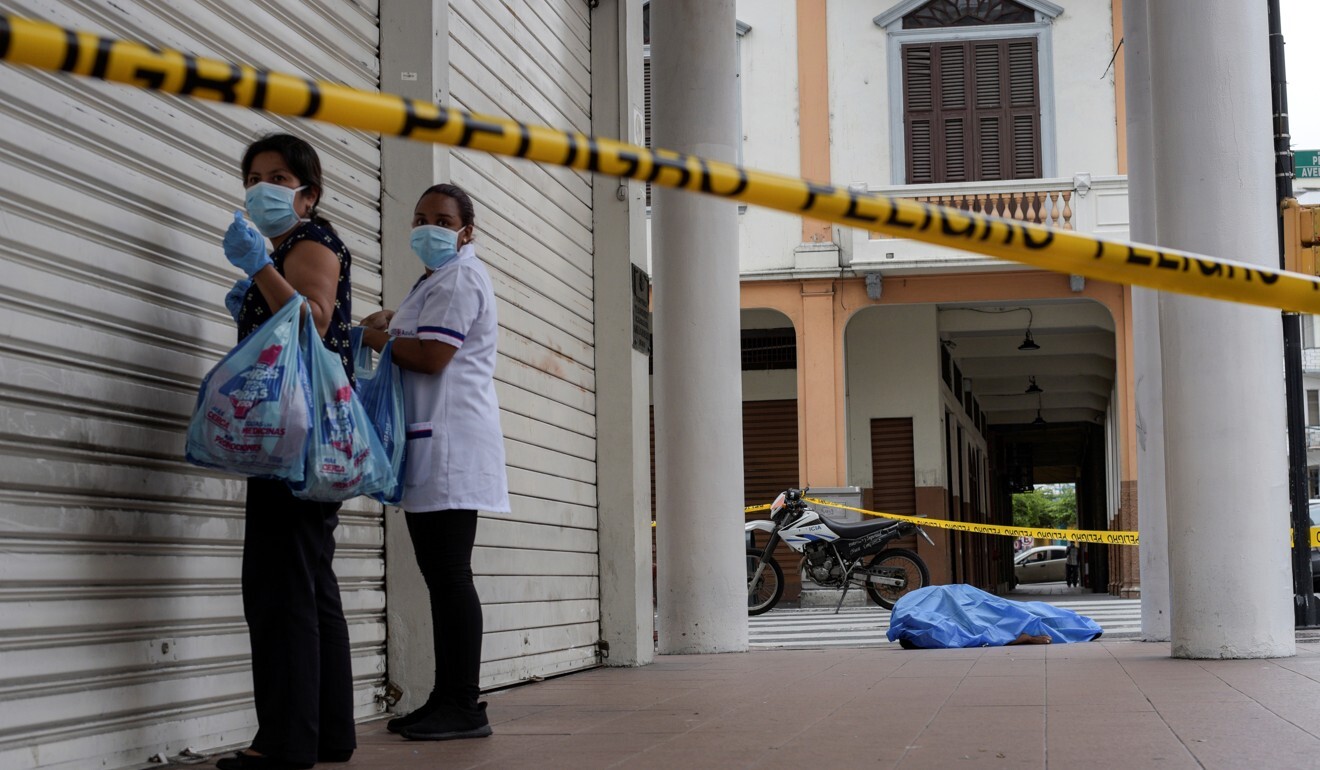
Women stand near the body of a man who died on the sidewalk in Guayaquil, Ecuador. Photo: Reuters

Ecuador struggles to collect the dead

Ecuadorean authorities said they would improve the collection of corpses, as delays related to the rapid spread of the new coronavirus has left families keeping their loved ones’ bodies in their homes for days in some cases.

Residents of Guayaquil, Ecuador’s largest city, have complained they have no way to dispose of relatives’ remains due to strict quarantine and curfew measures designed to prevent spread of the disease. Last week, authorities said they had removed 100 corpses from homes in Guayaquil.

But delays in collecting bodies in the Andean country, which has reported 1,966 cases of the virus and 62 deaths, were evident midday on Monday in downtown Guayaquil, where a man’s dead body lay on a sidewalk under a blue plastic sheet. Police said the man had collapsed while waiting in line to enter a store. Hours later, the body had been removed.

More than 70 per cent of the country’s coronavirus cases, which is among the highest tallies in Latin America, are in the southern province of Guayas, where Guayaquil is located.

Panama to restrict movement by gender

The government of Panama announced strict quarantine measures that separate citizens by gender in an effort to slow the spread of the novel coronavirus.

From Wednesday, men and women will only be able to leave their homes for two hours at a time, and on different days. Until now, quarantine regulations were not based on gender.

Men will be able to go to the supermarket or the pharmacy on Tuesdays, Thursdays and Saturdays, and women will be allowed out on Mondays, Wednesdays and Fridays.

No one will be allowed to go out on Sundays. The new measures will last for 15 days.

Police in Kenya use tear gas to enforce coronavirus curfew

Remote vote first for UN Security Council

The UN Security Council on Monday for the first time approved resolutions remotely after painstaking negotiations among diplomats who are teleworking due to the coronavirus pandemic.

The Security Council unanimously voted by email for four resolutions, including one that extended through April 2021 the expiring mandate of UN experts who are monitoring sanctions on North Korea, diplomats said.

The UN mission in Somalia was also prolonged, until the end of June, and the mission in Darfur until the end of May – two short periods decided due to uncertainty over the spread of the pandemic.

The Council also endorsed a fourth resolution aimed at improving the protection for peacekeepers.

The resolutions are the first approved by the Security Council since it began teleworking on March 12 and comes as Covid-19 rapidly spreads in New York, which has become the epicenter of the disease in the United States.

Congo ex-president dies in France

Former Republic of Congo president Jacques Joaquim Yhombi Opango died in France on Monday of the new coronavirus, his family said. He was 81.

Yhombi Opango, who led Congo-Brazzaville from 1977 until he was toppled in 1979, died at a Paris hospital of Covid-19, his son Jean-Jacques said. He had been ill before he contracted the virus.

Yhombi Opango was an army officer who rose to power after the assassination of president Marien Ngouabi.

Yhombi Opango was ousted by long-time ruler Denis Sassou Nguesso. Accused of taking part in a coup plot against Sassou Nguesso, Yhombi Opango was jailed from 1987 to 1990. He was released a few months before a 1991 national conference that introduced multiparty politics in the central African country.

When civil war broke out in Congo in 1997, Yhombi Opango fled into exile in France. He was finally able to return home in 2007, but then divided his time between France and Congo because of his health problems.

‘When I wake I cry’: France’s nurses face hell on coronavirus front line
31 Mar 2020

EU asks Britain to extend Brexit talks

The European Union expects Britain to seek an extension of its post-Brexit transition period beyond the end of the year, diplomats and officials said on Monday, as negotiations on trade have ground to a halt due to the coronavirus pandemic.

Europe has gone into a deep lockdown in a bid to curb the spread of the disease, with more than 330,000 infections reported on the continent and nearly 21,000 deaths.

In Britain, Prime Minister Boris Johnson and his health minister have both tested positive for the virus and the prime minister’s senior adviser Dominic Cummings – one of the masterminds behind Britain’s departure from the EU earlier this year – was self-isolating with symptoms.

London and the EU have been seeking to agree a new trade pact by the end of the year to kick in from 2021, even though the bloc has long said that such a time frame was extremely short to agree rules on everything from trade to security to fisheries.
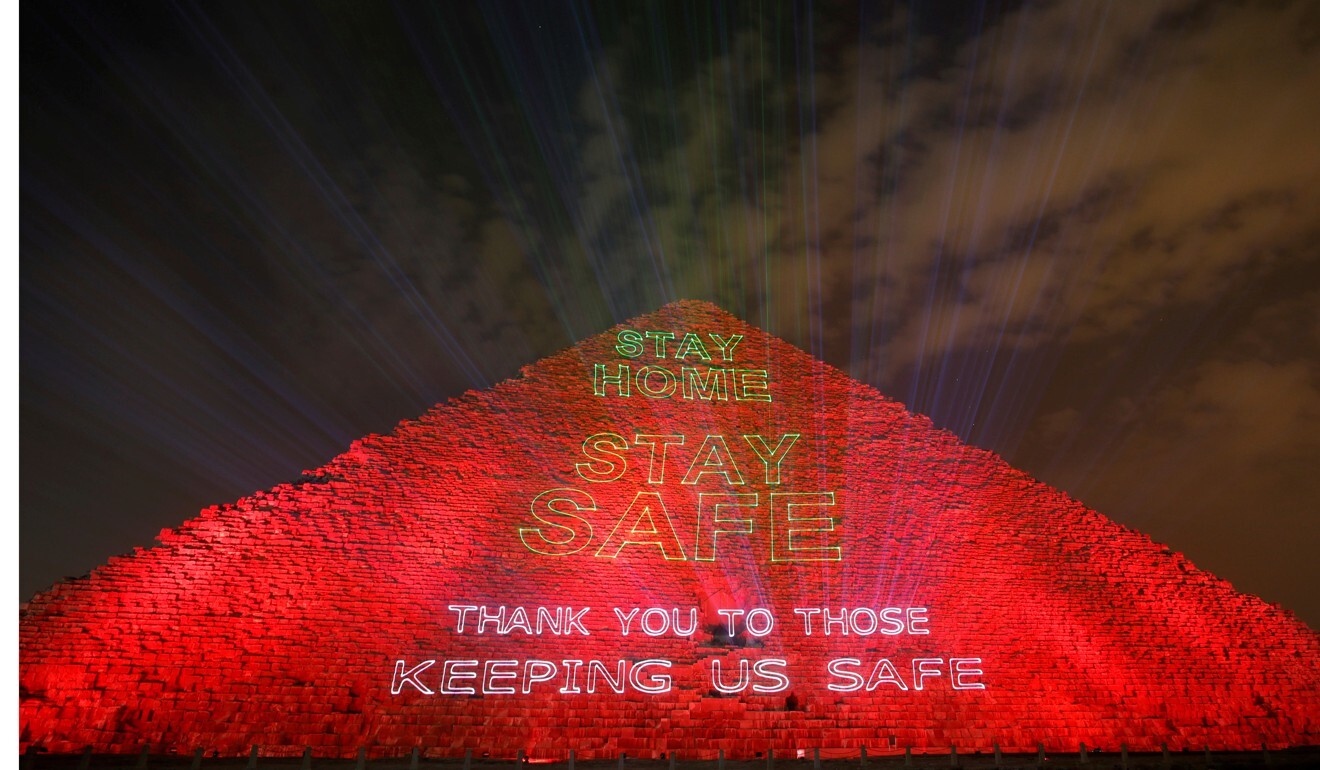
The pyramid of Khufu, the largest of the Giza pyramid complex. Photo: Reuters

Great Pyramid in Egypt lights up in solidarity

Egypt’s famed Great Pyramid was emblazoned Monday evening with messages of unity and solidarity with those battling the novel coronavirus the world over.

“Stay safe”, “Stay at home” and “Thank you to those keeping us safe,” flashed in blue and green lights across the towering structure at the Giza plateau, southwest of the capital Cairo.

Egypt has so far registered 656 Covid-19 cases, including 41 deaths. Of the total infected, 150 reportedly recovered.

Egypt has carried out sweeping disinfection operations at archaeological sites, museums and other sites across the country.

In tandem, strict social distancing measures were imposed to reduce the risk of contagion among the country’s 100 million inhabitants.

Tourist and religious sites are shuttered, schools are closed and air traffic halted.
Myanmar braces for ‘big outbreak’ after migrant worker exodus from Thailand
30 Mar 2020

Saudi king to pay for all patients’ treatment

Saudi Arabia will finance treatment for anyone infected with the coronavirus in the country, the health minister said on Monday.

The kingdom has registered eight deaths among 1,453 infections, the highest among the six Gulf Arab states.

Health Minister Tawfiq Al Rabiah said King Salman would cover treatment for citizens and residents diagnosed with the virus, urging people with symptoms to get tested.

“We are all in the same boat,” he told a news conference, adding that Crown Prince Mohammed bin Salman was overseeing containment efforts “night and day”.

Denmark eyes gradual reopening after Easter

Denmark may gradually lift a lockdown after Easter if the numbers of coronavirus cases and deaths remain stable, Prime Minister Mette Frederiksen said on Monday.

The Nordic country, which has reported 77 coronavirus-related deaths, last week extended until after Easter a two-week lockdown to limit physical contact between its citizens that began on March 11.

The number of daily deaths slowed to five on Sunday from eight and 11 on Saturday and Friday respectively. Denmark has reported a total of 2,577 coronavirus infections.

“If we over the next two weeks across Easter keep standing together by staying apart, and if the numbers remain stable for the next two weeks, then the government will begin a gradual, quiet and controlled opening of our society again, at the other side of Easter,” Frederiksen said.

Source: SCMP
18/05/2019

IMF’s Lagarde says U.S.-China trade war could be risk for world economic outlook

TASHKENT (Reuters) – The trade war between the United States and China could be a risk to the world economic outlook if it is not resolved, International Monetary Fund Managing Director Christine Lagarde told Reuters on Friday during a visit to Uzbekistan.

“Obviously, the downside risk that we have is continued trade tensions between the United States and China,” Lagarde said, referring to the IMF’s world economic outlook.

“And if these tensions are not resolved, that clearly is a risk going forward.”

The IMF last month cut its growth forecast for 2019 to 3.3%, down from the 3.5% it had previously predicted.

It warned at the time that growth could slow further due to trade tensions and a potentially disorderly British exit from the European Union.

“But we expect that at the end of 2019 and in 2020 it will bounce back,” Lagarde said of the world economic outlook on Friday.

The United States infuriated China this week when it announced it was putting Huawei Technologies Co Ltd, the world’s biggest telecoms equipment maker, on a blacklist that could make it hard to do business with U.S. companies.

On Friday Beijing suggested a resumption of talks between the world’s two largest economies would be meaningless unless Washington changes course.

Source: Reuters

10/05/2019

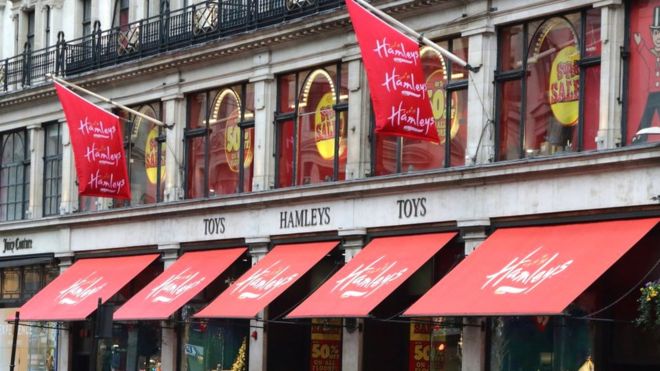
Hamleys: India’s richest man Mukesh Ambani buys iconic toy store

Hamleys store and brand logo seen in LondonImage copyright GETTY IMAGES
Image caption Hamleys is the world’s oldest toy retailer

India’s richest man Mukesh Ambani has bought the iconic British toy retailer Hamleys for an undisclosed sum.

Reliance Brands Limited, which is owned by Mr Ambani, said it had signed an agreement to buy the company from China’s C Banner International which had acquired it in 2015.

Hamleys, which was founded in 1760, is the world’s oldest toy retailer and has 167 stores across 18 countries.

Reliance Industries already operates 88 Hamleys stores across 29 Indian cities.

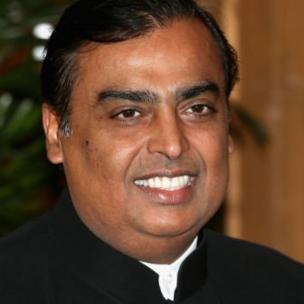
Mukesh Ambani
Image copyright GETTY IMAGES
Image caption Mukesh Ambani

According to Forbes, the 62-year-old Mr Ambani is worth $50.7bn.

“The worldwide acquisition of the iconic Hamleys brand…. is a long cherished dream come true,” Darshan Mehta, the CEO of Reliance Brands Limited, said in a statement.

Hamleys had last year reported a £9.2m loss, blaming Brexit and the threat of terrorism for the downturn.

It had opened four stores in the UK but later closed two.

However its flagship store in London’s Regent Street, which opened in 1881, continues to be one of the city’s major attractions.

Set over seven floors, it has an estimated 50,000 lines of toys on sale.

Source: The BBC

19/02/2019

HSBC warns on China, Britain slowdown as 2018 profit disappoints

HONG KONG/LONDON (Reuters) – HSBC Holdings turned in a disappointing annual profit as higher costs and a stocks rout chipped away at its trading businesses, while warning that an economic slowdown in China and Britain would throw up further hurdles this year.

Chief Executive John Flint, rounding off his first year at the helm of the company, said the bank may have to scale back investment plans in order to avoid missing a key target known as ‘positive jaws’ – which tracks whether it is growing revenues faster than costs – for a second straight year.

HSBC remains alert to the downside risks of the current economic environment,  economic environment and the future path of interest rates, Flint said, adding the bank was “committed” to the growth targets announced in June.

“We will be proactive in managing costs and investment to meet the risks to revenue growth where necessary, but we will not take short-term decisions that harm the long-term interests of the business,” Flint said on Tuesday, after HSBC reported a lower-than-expected 16 percent rise in 2018 profit before tax.

In June, Flint had said HSBC would invest $15-$17 billion in three years in areas including technology and China, while keeping profitability and dividend targets little changed.

ADVERTISEMENT

The bank said it failed to achieve positive jaws in 2018 due to the negative market environment in the fourth quarter.

A combination of U.S.-China trade tensions, central banks turning off the money taps and cooling growth in former hot spots wiped 10 percent off MSCI’s 47-country world stocks index last year, its first double-digit loss in any year since the 2008 global financial crisis.

GROWING BUT SLOWLY

Flint’s comments come as an economic slowdown in China, exacerbated by a bitter Sino-U.S. trade war, challenges HSBC’s strategy of pouring more resources into Asia where it already makes more than three quarters of its profits.

China’s economic growth slowed to 6.6 percent in 2018, the weakest in 28 years, weighed down by rising borrowing costs and a clampdown on riskier lending that starved smaller, private companies of capital and stifled investment.

Pressure on the world’s second-largest economy could increase if Beijing and Washington do not reach a deal soon to end their year-long trade dispute, which is taking a growing toll on export-reliant economies from Asia to Europe.

HSBC’s profits in Asia grew by 16 percent to $17.8 billion last year, accounting for 89 percent of the group profit.

“Clearly our customers are really more cautious and are more thoughtful around this trade war with the U.S.,” Flint said.

“It’s possible that we’ll see slightly lower growth rate this year but we are still going to see a growth rate.”

Since taking over from Stuart Gulliver last February, Flint has largely stuck to the same China-focused strategy as his predecessor while attempting to revive HSBC’s ailing U.S. franchise and putting less emphasis on its investment bank.

HSBC joined its London-based peer Royal Bank of Scotland in warning that uncertainties related to Brexit could drive businesses under.

“The longer we have the uncertainty the worse it’s going to be for the customers. Customers are absolutely postponing investment decisions … and that’s been the part of this slowdown that we have seen in the U.K.,” Flint said.

DISAPPOINTING PROFIT

Earlier in the day, HSBC reported a profit before tax of $19.9 billion for 2018, versus $17.2 billion the year before, but below an average estimate of $22 billion, according to Refinitiv data based on forecasts from 17 analysts.

HSBC’s Hong Kong shares dropped as much as 2.7 percent after the earnings announcement.

The stock was down 1.4 percent at 0732 GMT, while the Hong Kong market index was 0.3 percent lower.

HSBC said it would pay a full-year dividend of $0.51 per share, roughly in line with analysts’ expectations. The bank was confident of maintaining the dividend at this level, it said.

The bank’s core capital ratio, a key measure of financial strength, fell to 14 percent at end-December from 14.5 percent at end-2017, mainly due to adverse foreign exchange movements.

Source: Reuters

19/02/2019

Viewpoint: Should Britain apologise for Amritsar massacre?

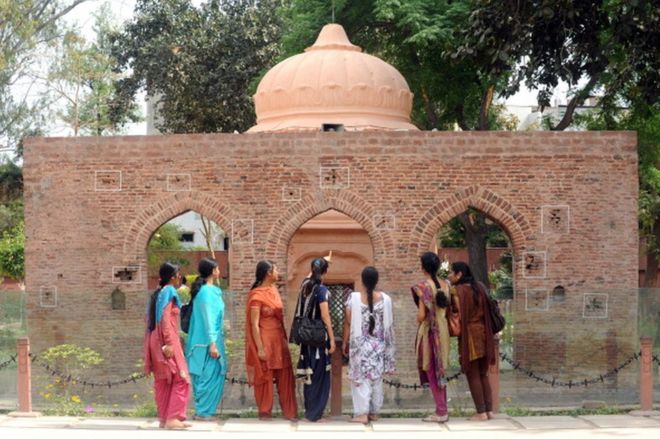
Indian visitors look at the bullet ridden wall at the historical site of the Jallianwala Bagh massacre in Amritsar on April 12, 2011Image copyrightAFP
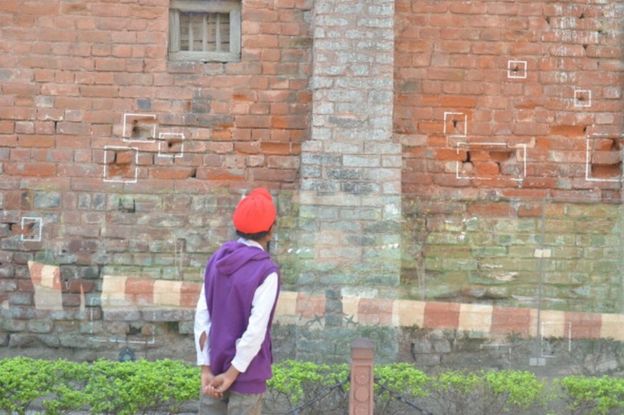
Image captionVisitors can inspect a bullet-ridden wall at the site of the massacre

Hundreds of Indians attending a public meeting were shot dead by British troops in the northern Indian city of Amritsar in 1919. Historian Kim Wagner sifts fact from fiction as the UK House of Lords prepares to debate the massacre, including if Britain should apologise.

On 13 April 1919, Sergeant WJ Anderson witnessed first-hand the brutal massacre of hundreds of Indian civilians at Jallianwala Bagh, a public garden in Amritsar city.

“When fire was opened the whole crowd seemed to sink to the ground, a whole flutter of white garments, with however a spreading out towards the main gateway, and some individuals could be seen climbing the high wall,” Anderson later recalled.

“There was little movement, except for the climbers. The gateway would soon be jammed. I saw no sign of a rush towards the troops.”

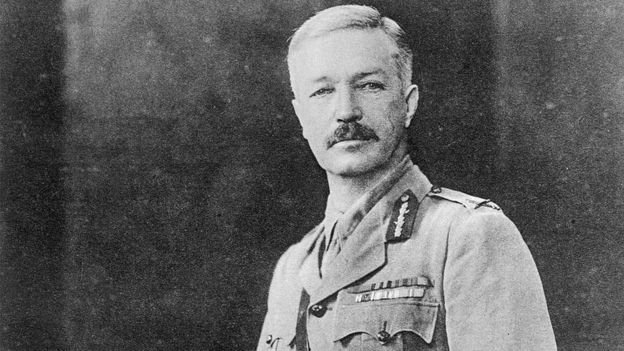
He had served as the bodyguard of Brigadier General RH Dyer, who had rushed to Amritsar a few days earlier to quell what he believed to be a major uprising.

The crowd of more than 20,000 people, however, were not armed rebels. They were local residents and villagers from the surrounding countryside who had come to listen to political speeches or simply to spend a few hours in the gardens.

It was also the day of the Baisakhi festival, which marked the anniversary of the creation of the Khalsa, or Sikh community, and annually attracted thousands of visitors and pilgrims.

The crowd comprised Hindus, Muslims and Sikhs. Most were men and young boys, including some infants; only a few women were present.

British Brigadier General R.E.H. DyerImage copyrightGETTY IMAGES
Image captionBrigadier General Dyer rushed to Amritsar to quell what he believed to be a major uprising

When Gen Dyer ordered his troops to cease firing, Jallianwala Bagh resembled a battlefield strewn with corpses. Between 500 and 600 people were killed, and probably three times as many wounded. The exact numbers will never be known for certain but the official death count, reached months later, was just 379.

In recent years, much of the public debate has focused on calls for a formal British apology – the demand has been led by, among others, Indian politician and author Shashi Tharoor.

Queen Elizabeth II visited the memorial at Jallianwala Bagh in 1997 and then Prime Minister David Cameron visited in 2013 – both showed their respect yet carefully avoided making an actual apology.

In December 2017, the Mayor of London, Sadiq Khan, nevertheless urged the British government to make just such a gesture during his own visit to Amritsar.

“I am clear that the government should now apologise, especially as we reach the centenary of the massacre. This is about properly acknowledging what happened here and giving the people of Amritsar and India the closure they need through a formal apology,” he said.

ritish Prime Minister David Cameron (C) along with Punjab State Chief Minister Parkash Singh Badal (2L), and Shiromani Gurdwara Parbandhak Committee (SGPC) President Avtar Singh Makkar (2R) visit the Sikh Shrine Golden temple in Amritsar on February 20, 2013Image copyrightAFP
Image captionOn his 2013 visit, Cameron avoided making an actual apology but said the massacre was “deeply shameful”

Exactly what happened at Jallianwala Bagh, however, remains unclear, and a century later, the actual circumstances of the massacre are still shrouded in myth and misconceptions.

There are, for instance, people, often with a nostalgic attachment to the Empire, who still insist that Gen Dyer only opened fire as a final resort when the crowd ignored his warning to disperse – even though the general himself was quite clear that he gave no such warning.

Similarly, the idea that the shooting was necessary and prevented much worse violence conveniently ignores the fact that Indian riots in April 1919 were in each and every case precipitated by British actions.

Factual inaccuracies are also to be found at the Jallianwala Bagh memorial today. Among other things, a sign claims that 120 bodies of the victims of the massacre were recovered from what has become known as the Martyrs’ Well. It’s believed that many people jumped into the well to escape the bullets.

But there is no evidence for this story, which appears to be based on a mix-up with the infamous well at Kanpur city, where the bodies of British women and children were disposed after a massacre in 1857.

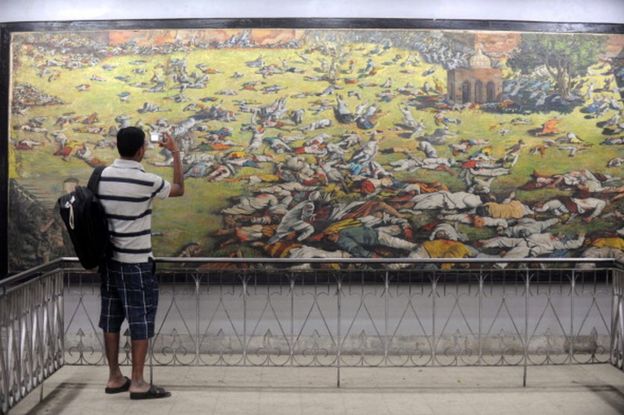
Visual depictions of the Jallianwala Bagh massacre also show machine guns being used, when the historical record is quite clear that the shooting was carried out by 50 Gurkha and Baluchi troops armed with rifles.

Gen Dyer also did not orchestrate the massacre, and deliberately trap the crowd inside the gardens, as some popular accounts have it.

An Indian man takes a photograph of a painting depicting the Jallianwala Bagh massacre in Amritsar on April 12, 2011. The Amritsar massacre, also known as the Jallianwala Bagh Massacre, took place on April 13, 1919 when British Indian Army soldiers on the direct orders of their British officers opened fire on an unarmed gathering killing at least 379 men, women and children, according to official records. AFP PHOTO /NARINDER NANU (Photo credit should read NARINDER NANU/AFP/Getty Images)Image copyrightGETTY IMAGES
Image captionThe crowd were not armed rebels but local residents and villagers

In fact, it was British panic and misreading of the political turmoil in India that was at the root of the violence.

While Indian nationalists were looking forward to political reforms and greater self-determination after the end of World War One, the British were still haunted by the spectre of the 1857 “mutiny”, an uprising that is often referred to as India’s first war of independence.

So, when riots broke out in Amritsar on 10 April – and five Europeans and dozens of Indians were killed – the authorities responded with immediate and indiscriminate force. Three days later, Gen Dyer entered what he mistakenly perceived to be a war zone.

Where popular depictions show a peaceful crowd of locals quietly listening to a political speech, Gen Dyer instead perceived a defiant and murderous mob, which had only days before run rampant through Amritsar. When he ordered his troops to open fire, it was an act of fear, spurred on by a disastrously flawed threat assessment.

None of this exonerates Gen Dyer or detracts from the sheer brutality of the massacre – nor does it justify the subsequent torture and humiliation of Indians under martial law. The indisputable violence of the Jallianwala Bagh massacre hardly requires any embellishment. Nevertheless, facts matter if we are to pay our respect to those who died rather than simply perpetuate politically convenient fiction. And to understand is not the same as to condone.

A visitor looking at the bullet marks on a wall on the eve of 95th anniversary of the massacre at Jallianwala Bagh on 12 April 2014 in Amritsar.Image copyrightGETTY IMAGES
Image captionThere are bullet marks on a wall in the garden

Apologies and centenaries, which are essentially about the present rather than the past, are rarely conducive to an honest and nuanced reckoning with history.

An apology from a British government in the throes of Brexit, at the moment, seems highly unlikely. It it indeed doubtful whether an official acknowledgement of the massacre would be construed as more than an act of political expediency.

The question thus remains whether an apology without a genuine understanding of the past can ever provide the “closure” that so many seek.

Source: The BBC

14/01/2019

Rare sight of robin in Beijing causes stir and Brexit jokes

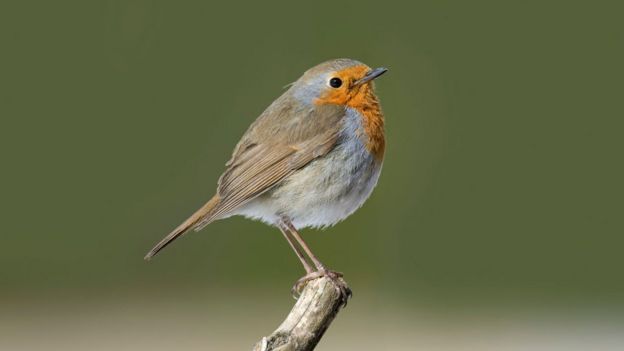
Photo of robin spotted in BeijingImage copyrightTERRY TOWNSHEND
Image captionThis is the bird that caused masses to flock to Beijing Zoo

The rare appearance of a European robin in Beijing has caused a stir among Chinese nature fans.

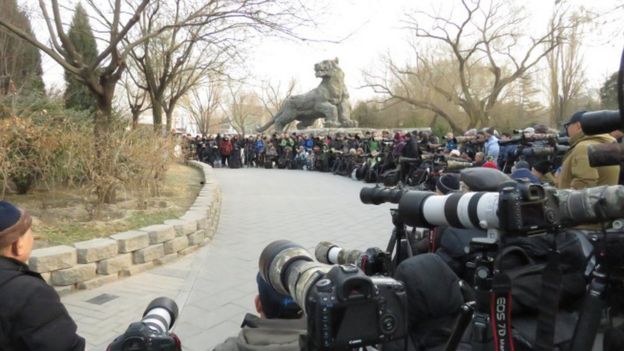
Hundreds of bird-watching photographers flocked to the Beijing Zoo last Friday after word spread that a European robin had been spotted there.

The red-breasted bird is common across Europe but is rarely seen in Beijing – it’s only the third time one has been recorded in the capital.

Some birdwatchers have joked the robin might be a “Brexit refugee”.

“It’s very rare to see [the European robin] in Beijing,” Terry Townshend, founder of Birding Beijing told the BBC.

“Almost 200 photographers camped out for it. I think a lot of people want to [capture it] because it’s a very photogenic bird and it has that sort of exotic feel.”

Birds in odd places

Mr Townshend was among the 200 photographers who camped out at Beijing Zoo last Friday.

200 photographers camped outImage copyrightTERRY TOWNSHEND
Image captionHundreds of photographers camped out for a chance to catch the bird

He said he found out about the sighting through bird watching groups on WeChat – a messaging app in China.

“A lot of people associate the bird with Britain… [so] someone in the WeChat group called the bird a ‘Brexit refugee’ because [they joked that it was] escaping the political chaos in the UK,” said Mr Townshend.

“Then the name kind of just caught on really.”

It is not common for robins to migrate and it is unclear how this one might have landed so far away from home.

“It normally lives in Europe [and] Beijing is at least 1,500 miles of where it should normally be,” said Mr Townshend. “But it’s likely that this bird is from the eastern part of Europe and not Britain.”

European robin perched on branch in winter.Image copyrightGETTY IMAGES
Image captionThe European robin is, as its name suggests, normally only found in Europe

“We don’t really know why birds sometimes turn up in odd places, it might be related to weather, when they are migrating they could be blown by strong winds.”

However it got there, the European robin is expected to stay in Beijing for some weeks to come.

Mr Townshend said a robin would normally only leave for home at the end of winter.

“So we would expect it to stay in Beijing for the rest of winter and it would probably disappear in March.”

The European robin was in 2015 chosen as UK’s first national bird in a poll of more than 200,000 people.

Law of Unintended Consequences

continuously updated blog about China & India

ChiaHou's Book Reviews

continuously updated blog about China & India

What's wrong with the world; and its economy

continuously updated blog about China & India