Archive for ‘BRICS summit’

14/11/2019

China ready to achieve common prosperity with Brazil: Xi

BRAZIL-BRASILIA-XI JINPING-BRAZILIAN PRESIDENT-TALKS

Chinese President Xi Jinping holds talks with Brazilian President Jair Bolsonaro in Brasilia, Brazil, Nov. 13, 2019. (Xinhua/Ding Haitao)

BRASILIA, Nov. 13 (Xinhua) — Chinese President Xi Jinping said on Wednesday China is fully confident in China-Brazil cooperation and stands ready to achieve common prosperity with Brazil.

Xi made the remarks when meeting here with Brazilian President Jair Bolsonaro.

Noting that Bolsonaro paid a successful state visit to China in October, Xi said the consensus reached by the two sides is being actively implemented.

At the recently concluded second China International Import Expo (CIIE), the transaction volume of Brazilian businesses grew 3.6 times compared with that at the first CIIE last year, Xi said, calling the results gratifying.

As the largest emerging-market country in the eastern and western hemispheres, respectively, Xi said, China and Brazil share broad common interests.

China is optimistic about Brazil’s development prospects and fully confident in bilateral cooperation, Xi said, adding that China stands ready to share development experience and gains with Brazil, so as to achieve common prosperity.

Xi expressed willingness to work with Bolsonaro to properly grasp and guide the direction of the development of China-Brazil relations.

China and Brazil are both major countries and the two sides should maintain strategic focus, adhere to mutual respect, treat each other as equals, strengthen exchanges and cement mutual trust, Xi stressed.

He urged both sides to open markets to each other and explore ways to establish long-term, stable and direct supply channels for basic products, including agricultural products, iron ore and crude oil.

China supports its enterprises to actively participate in Brazil’s infrastructure construction to promote connectivity, Xi said.

Xi called on both sides to advance cooperation in areas such as digital economy, next-generation communications, material science and biotechnology, wishing another successful launch of the China-Brazil Earth Resources Satellite in the near future, and urging the two sides to jointly promote the follow-up cooperation.

Xi also urged both sides to expand cultural and people-to-people exchanges and facilitate personnel exchanges.

China supports the Brazilian government’s efforts to combat the disaster in the Amazon rainforest and believes that Brazil is capable of overcoming the disaster, Xi said.

Both sides should work together to promote all-round exchanges and cooperation between China and Latin American countries, uphold multilateralism, build an open world economy, and safeguard the legitimate development rights and interests of emerging markets, Xi said.

The Chinese president added that China supports Brazil in hosting the upcoming BRICS summit and stands ready to work with all parties to make the summitry a success.

For his part, Bolsonaro said he has instructed relevant government departments to implement as soon as possible the consensus reached during his state visit to China, calling that visit a success.

Noting that China is a significant major country and Brazil’s largest trading partner, Bolsonaro said the Brazilian people hold admiration, respect and friendly feelings toward the Chinese people, and Brazil-China cooperation boasts increasing significance to Brazil’s future development.

Economies of Brazil and China are highly complementary and the areas of cooperation continue to expand, Bolsonaro said, adding that his country welcomes Chinese investment to Brazil and stronger cooperation in infrastructure construction, iron ore, and the energy sector, including oil and gas.

The Brazilian side values the important opportunities brought about by China’s opening-up of its market, he said, expressing the hope to expand bilateral trade and promote export of more Brazilian agricultural products to China.

His country is also willing to offer favorable conditions for Chinese enterprises and products to enter Brazil, he said, adding that Brazil stands ready to facilitate personnel exchanges and cultural and people-to-people exchanges.

Bolsonaro thanked China for supporting Brazil’s sovereignty over the Amazon rainforest issue and expressed his willingness to cooperate with China on biodiversity conservation.

He also thanked China for supporting Brazil in hosting the BRICS summit, adding that Brazil is ready to strengthen coordination and cooperation with other parties for a summit that produces positive outcomes.

Brazil is grateful for China’s trust and friendship, said Bolsonaro, adding that from a long-term perspective, Brazil attaches importance to strengthening cooperation with China in a wide range of areas, so as to deepen their traditional friendship and benefit the two peoples.

After the meeting, the two heads of state jointly met the press and witnessed the exchange of a number of documents on bilateral cooperation.

Source: Xinhua

28/07/2019

Chinese FM says BRICS cooperation a strategic choice, urges bigger BRICS role in world affairs

BRAZIL-RIO DE JANEIRO-CHINA-WANG YI-BRICS-MEETING

Chinese State Councilor and Foreign Minister Wang Yi (2nd L) poses for a group photo with Brazilian Foreign Minister Ernesto Araujo (3rd L), Russian Foreign Minister Sergey Lavrov (1st L), South African Foreign Minister Naledi Pandor (2nd R) and India’s Minister of State for External Affairs Vijay Kumar Singh in Rio de Janeiro, Brazil, July 26, 2019. Wang Yi attended the Formal Meeting of the BRICS Ministers of Foreign Affairs in Rio de Janeiro. (Xinhua/Xin Yuewei)

RIO DE JANEIRO, July 27 (Xinhua) — The rise of emerging markets and developing countries, represented by the BRICS countries, has bolstered a more multi-polar world, Chinese State Councilor and Foreign Minister Wang Yi said here on Friday.

At the Formal Meeting of the BRICS Ministers of Foreign Affairs, Wang also said BRICS cooperation is not a band-aid solution for the five countries but a strategic choice that focuses on common and long-term development and harbors bright prospects.

The five countries are Brazil, Russia, India, China and South Africa.

Wang said no matter how the international landscape changes, the direction of the BRICS cooperation must not change. Faced with new challenges, the five countries should let their voices be heard, offer more solutions to pressing global issues and play a greater role in world affairs.

Wang pointed out that unilateralism undermines international rules and challenges the international rule of law, which exacerbates the instability and uncertainty of the world.

The BRICS countries must take the lead in maintaining multilateralism and safeguarding the global governance system with the UN as its core and under international law.

Furthermore, the bloc should safeguard the multilateral trading system represented by the WTO and protect the common interests and development space of emerging market and developing countries, he said.

The five countries together must continue to integrate the interests of other emerging market countries and developing countries through flexible and diverse platforms such as “BRICS Plus.”

At the meeting, the five foreign ministers all agreed to safeguard the purposes and principles of the UN Charter, defend multilateralism and free trade, oppose unilateralism and protectionism, strengthen global governance, and build a community with a shared future for humankind.

They agreed that regional hotspot issues should be resolved through dialogue and consultation and that BRICS cooperation should work to benefit the peoples of the five countries.

The foreign ministers also agreed to maintain vigilance on cybersecurity issues and expressed opposition to the use of cybersecurity to suppress the development of science and technology in other countries. They agreed to strive toward an open and non-discriminatory environment for the application of information technology.

The foreign ministers were tasked with preparing for the BRICS summit to be held in Brasilia in November.

Source: Xinhua

14/07/2019

Will Narendra Modi’s snub of Xi Jinping’s belt and road derail China-India ties?

  • The Indian prime minister refused to back the Chinese leader’s ambitious global infrastructure vision at a summit last week, but the apparent snub is not getting in the way of amicable ties between Asia’s two biggest economies
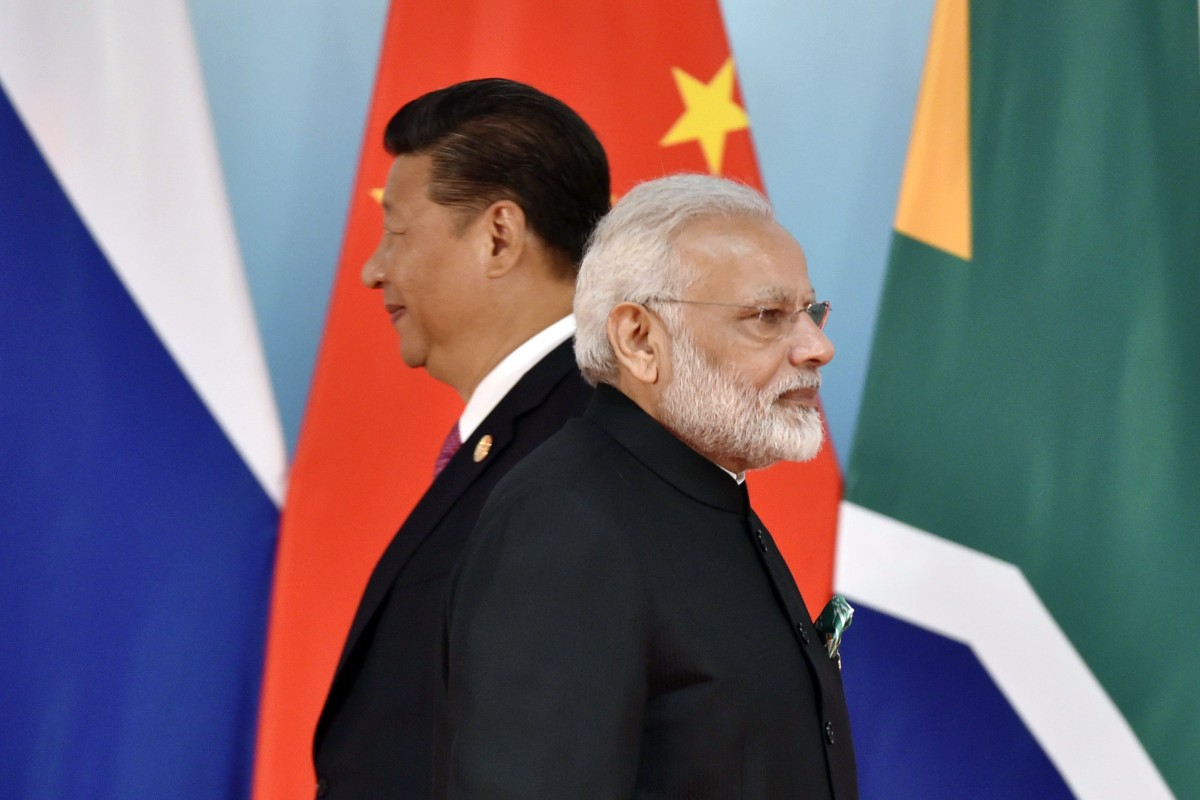
Chinese President Xi Jinping and Indian Prime Minister Narendra Modi at the BRICS Summit at the Xiamen International Conference and Exhibition Center in 2017. Photo: AFP
Their informal summit in Wuhan last year created all the right optics; even their chemistry seemed on point. So, when 
Indian Prime Minister Narendra Modi

and

Chinese President Xi Jinping

met last week on the sidelines of the Shanghai Cooperation Organisation (SCO), the bonhomie seemed like it was there to stay.

But a day later, cracks appeared to emerge. India, holding on to its long-stated position, delivered a public snub to China by refusing to endorse its ambitious, trillion-dollar 
Belt and Road Initiative

(BRI) in the SCO summit’s Bishkek declaration.

Now, after equal parts public bonhomie and disagreement over the BRI, where do 
India-China ties

finally stand? Somewhere in the middle, by all indications.

With just 10 days before Xi and Modi meet again at the Russia-India-China (RIC) trilateral meeting on the sidelines of the

Group of 20 (G20) summit

in Osaka, there have been increasing signs that both countries may now be trialling a fresh approach to diplomacy – one that neither sidesteps contentious issues nor does it allow differences to derail ties.

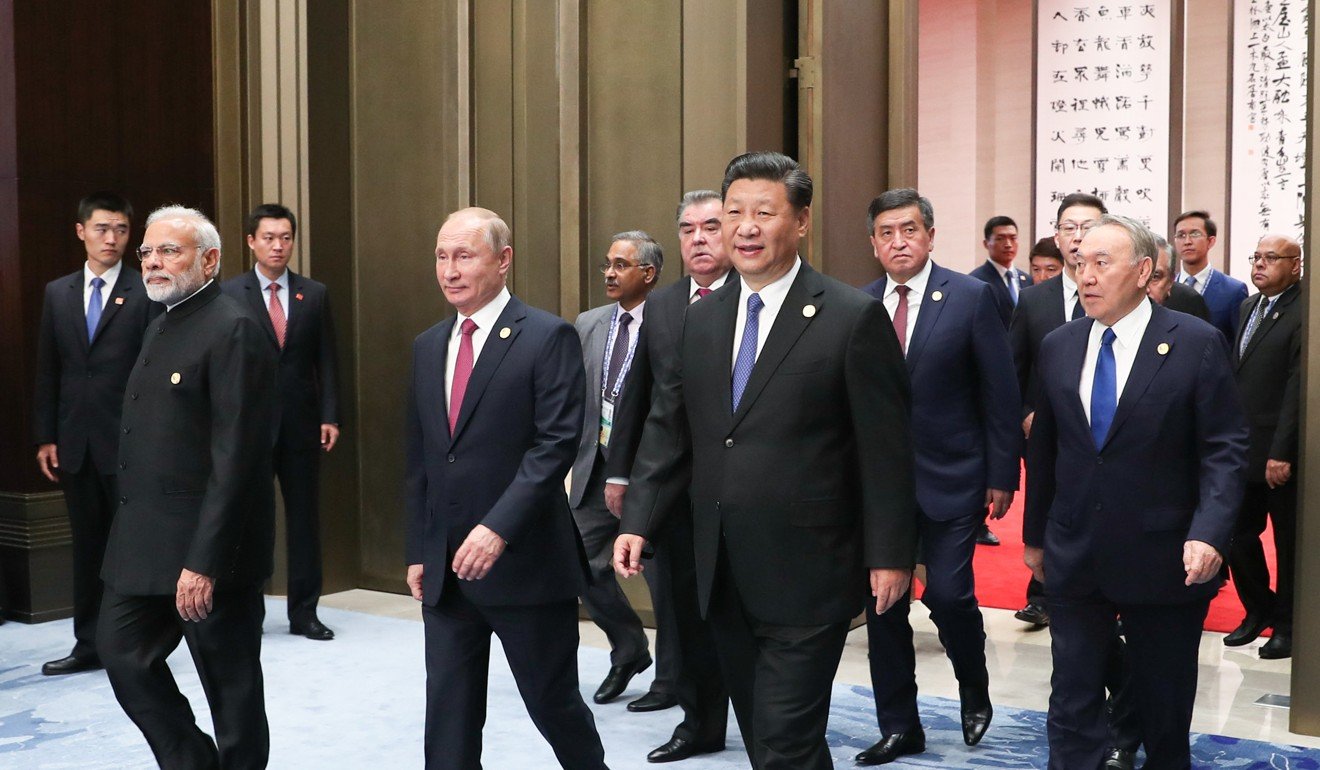
Chinese President Xi Jinping leads other leaders of Shanghai Cooperation Organisation: Russia’s Vladimir Putin and India’s Narendra Modi at the 2018 summit. Photo: Xinhua
Such an approach would delink the thorny issues – like the

decades-old border dispute

and the BRI – from other non-contentious issues of cooperation in other sectors.

But the jury is still out on whether it will pay off, especially given the historical distrust and the baggage that both countries carry.

ROAD BUMPS GALORE

In the last week alone, there have been at least three flashpoints in the Sino-India relationship.

While the dust was still settling on India’s refusal to sign the Bishkek declaration endorsing the BRI, reports emerged that the 

Maldives

was expected to scrap plans to build jointly with China an ocean observatory overlooking the Indian Ocean. The news came a week after Modi had visited the Maldives capital Male in early June.

For Modi 2.0, India’s US-China balancing act just got trickier

The Maldives’ decision to build the observatory was first mulled in December 2017, raising the Indian establishment’s hackles as it would have given China a presence in the region.

Another irritant between India and China has seemed to be the proposed 16-nation 

Regional Comprehensive Economic Partnership

(RCEP). India has been lukewarm on the free-trade bloc, frustrating the Chinese. Indications have been that China is likely to push for a 13-member bloc at the coming RCEP meeting in Thailand on June 20, excluding India.

BRI and border issues have not managed to overshadow the remaining business between the two countries Narayani Basu

Yet, despite all this, there has been no let down in engagement levels between Modi and Xi. Both leaders are expected to meet at the RIC summit on June 29 to 30, and have at least two more meetings planned this year alone – an informal Xi-Modi summit in India
in October and the BRICS summit on November 13 to 14.
For Narayani Basu, a New Delhi-based author and independent foreign policy analyst with a special focus on China, such sustained engagement between the two countries signals a new level of maturity.
“There has been a fairly successful attempt at delinking historical geopolitical and territorial issues from issues which are economic in nature,” Basu said. “As a result, the BRI and border issues have not managed to overshadow the remaining business between the two countries.”
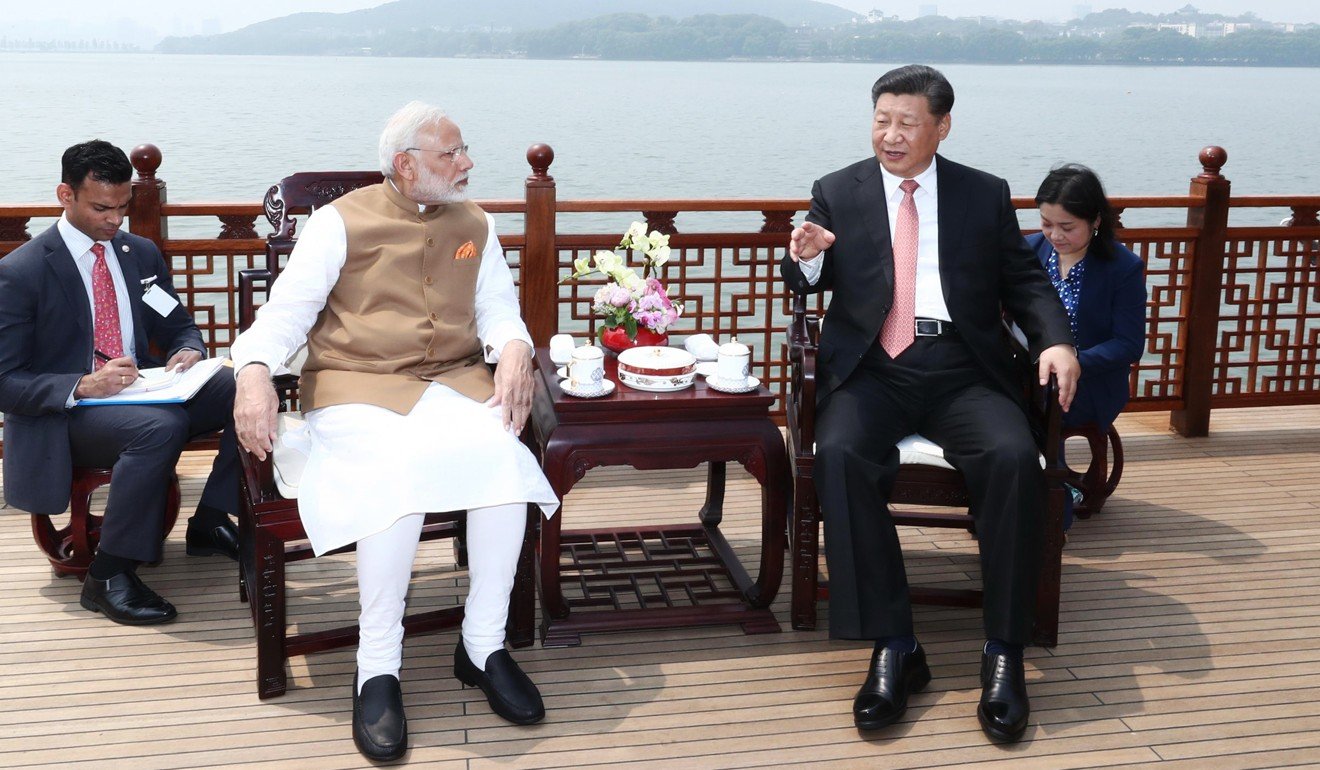
Indian Prime Minister Narendra Modi speaks with Chinese President Xi Jinping in Wuhan. Photo: Xinhua

STRONG LEADERS, STRONGER AGENDAS

The approach might also have to do with where both leaders currently stand.

Modi and his Bharatiya Janata Party (BJP) have freshly emerged from a landslide

victory in the Indian polls

. Through the campaign, Modi portrayed a hardline image of himself and his government, especially on issues of national security. Similarly, Xi has emerged as a stronger leader since his reappointment last year – his approach marked by a higher-than-ever emphasis on economic nationalism and connectivity. Modi made a reference to this in his SCO meeting with Xi.

Basu said Sino-India ties were also being guided by the personalities of both leaders – strong, with harder-than-before agendas.
Did Japan and India just launch a counter to belt and road?
“They both came back on agendas based on consolidation of power, protection of sovereignty and nationalism. These are all issues that will not allow either side to blink easily. “So, even as both leaders are looking to move forward, they also do not want to compromise on their core issues – primary among them being territorial sovereignty,” she said.

The message is loud – India’s opposition to the BRI does not mean India will allow adversarial relations to develop between the two Sana Hashmi

In his SCO summit speech, Modi brought up territorial sovereignty as a thinly veiled reference to China’s BRI, saying India only supported connectivity projects that are based on “respect of sovereignty” and “regional integrity”.
Sana Hashmi, an analyst with Perth-based think tank Future Directions International and author of China’s Approach Towards Territorial Disputes: Lessons and Prospects, agreed that India was not letting historical issues get in the way of its relationship with Beijing.
Hashmi noted that India’s main objections to BRI revolved around one component – the China-
Pakistan

Economic Corridor (CPEC), which runs through the disputed region of Kashmir.

“But to make sure this does not affect the relationship, PM Modi and President Xi are meeting numerous times,” Hashmi said. “The message is loud – India’s opposition to the BRI does not mean India will allow adversarial relations to develop between the two.”

A NEED FOR EACH OTHER

Another factor that has likely prompted the new approach between India and China is their need for each other, particularly as both Asian powers navigate bumpy relationships with US under 

China is caught in a protracted

battle with the US over trade deficits

and is reeling from the tariffs imposed on Chinese imports to America. India, too, has seen a similar but smaller version of this trade battle play out – things have escalated especially since the Trump administration withdrew its preferential trade treatment towards India. Responding to this, India imposed tariffs on 28 US products over the weekend.

Move over, ‘Made in China’. It’s ‘Made in Bangladesh’ era now
In such a context, a stronger relationship between the two Asian giants might be in mutual interest.
Basu said the scope for the relationship to deliver on, especially economically, is vast.

“Despite the chemistry, India and China’s promises to each other on the economic front haven’t materialised on the ground. Major projects as well as investments in each country are stuck.”

Source: SCMP

19/05/2019

Brazil’s vice-president Hamilton Mourao heads to China to mend relations

  • General will spend five days meeting top Chinese leaders including President Xi Jinping
  • Mission seeks to patch up wounds caused by Brazilian President Jair Bolsonaro’s anti-China rhetoric
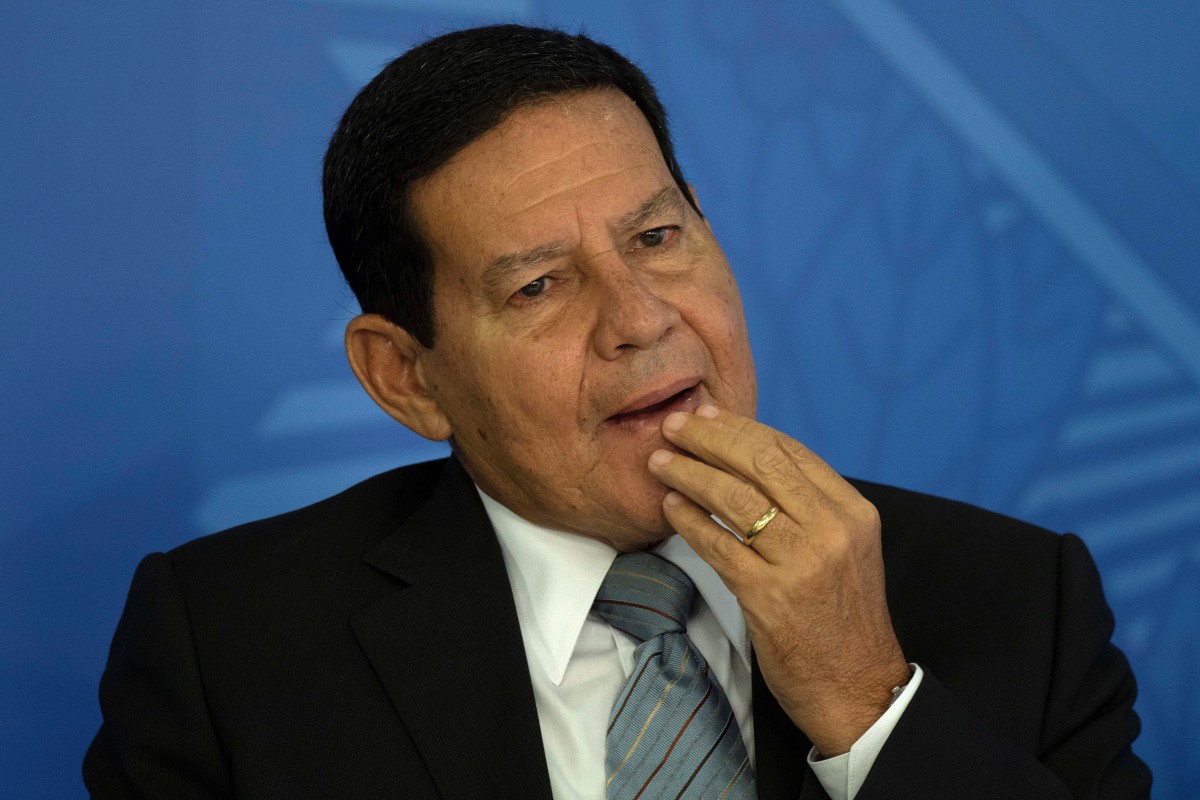
Hamilton Mourao favours maximising engagement with China. Photo: EPA-EFE
Brazil’s vice-president is expected to land in Beijing on Sunday on a mission to patch up wounds caused by President Jair Bolsonaro’s lacerating anti-China rhetoric.
General Hamilton Mourao will spend five days in China rubbing shoulders with some of the country’s most powerful leaders, culminating in an audience with President Xi Jinping, in an effort to shore up the relationship between the two emerging market giants. Bolsonaro himself is due to visit later this year, while Xi is due to visit Brasilia in November for the BRICS summit.
China – Brazil’s most important trading partner for the past decade – remains a sensitive subject in the Bolsonaro administration. While Mourao and the other business-oriented members of government favour maximising engagement with the Asian giant, Bolsonaro and his more radical appointees view China with a high degree of suspicion, as a predatory economy that wishes not merely to invest in Brazil, but to own it.

“The Chinese can buy in Brazil, but they can’t buy Brazil,” the president said at a breakfast with journalists last month.

Brazilian President Jair Bolsonaro said last month that the “Chinese can buy in Brazil, but they can’t buy Brazil”. Photo: AFP

Still, in comparison with his pre-election criticism of China as “heartless”, Bolsonaro in office has dialled down his anti-Beijing sentiment. Mourao’s visit is part of an effort to reset that relationship.

“The Chinese understand that Mourao plays a central role in toning down Bolsonaro’s rhetoric,” said Oliver Stuenkel, a specialist on BRICS – an association of five major emerging economies, namely Brazil, Russia, India, China and South Africa – at the FGV business school. “They know that the Mourao-China relationship will be fundamental.”

Should China be worried about Bolsonaro’s bromance with Trump?

Speaking to reporters recently, Mourao recognised the need to balance the Bolsonaro administration’s desire to pivot towards the United States with practical considerations of China’s economic significance.

“The US are the champions of democracy and freedom and our government has left it very clear what this represents,” the vice-president said. “But on the other side we have to be sufficiently pragmatic to understand the importance of China for Brazil’s economic development.”

Chinese investment in Brazil reached almost US$134 billion between 2003 and 2018, Brazilian government figures showed.

Chinese President Xi Jinping is expected to meet the visiting Brazilain vice-president. Photo: AP

While the trade war between the US and China may offer Brazil some short-term gains, particularly for its agricultural sector, the downsides outweigh the benefits, according to Renata Amaral, a foreign trade analyst at Barral MJorge consultancy.

“In truth this war is no good for anyone,” she said.

Mourao said that Brazil was monitoring the situation “critically and cautiously”.

Why US-China trade war could be good for Brazil
From the Chinese perspective, Beijing is looking for Brazil’s formal support for its “Belt and Road Initiative” – Chinese President Xi Jinping’s signature global infrastructure megaproject. Asked whether Brazil might sign up to the programme, Mourao said that any agreement would have to be approved by Bolsonaro in the second half of the year.
After trips to the Great Wall of China and the Shanghai Stock Exchange, Mourao will meet Xi, in a clear sign of Brazil’s importance to China. “The visit of vice-president Mourao will reinforce mutual political confidence, deepen our friendly cooperation and add new dimensions to our strategic partnership,” according to Chinese foreign ministry spokesman Geng Shuang.
With Beijing both uncertain about the direction of Brazilian foreign policy under Bolsonaro and eager to strike deals on infrastructure and food security, it makes sense for the Chinese to roll out the red-carpet for Mourao, according to Hussein Kalout, a specialist in foreign policy and a researcher at Harvard.
China trade vs economic growth: the dilemma for Brazil’s president
While the federal government remains ambivalent about its relationship with China, some of Brazil’s powerful state governors are seeking to develop their own relationship with the Asian country. One of them is Carlos Massa Ratinho Junior, the governor of the southern state of Parana, who travelled to China recently to discuss agriculture and railroad projects.
“We’re open to talk with any country that wants to and understands that the state of Parana is the best to place to invest in Brazil,” the governor said in an interview, adding that his actions did not conflict with the federal government’s stance towards Beijing.

But in a sign of the domestic pressure Bolsonaro is under not to abandon entirely his sceptical attitude to China, Luiz Philippe de Orleans e Braganca, the vice-president of the lower house’s foreign affairs committee and a lawmaker from Bolsonaro’s own party, said the government should set limits to the partnership.

“It’s good to talk to China, but it depends what is being discussed,” he said. “For example, the 5G network set up by China is dangerous because it will give the Chinese more information about Brazilian citizens than the Brazilian government.”

Source: SCMP

Law of Unintended Consequences

continuously updated blog about China & India

ChiaHou's Book Reviews

continuously updated blog about China & India

What's wrong with the world; and its economy

continuously updated blog about China & India