17/09/2019
- Powerful zoom functions can reveal fingerprint details which may be copied by criminals
A cybersecurity awareness campaign in China has prompted a warning about criminals harvesting fingerprint information from a popular pose in pictures uploaded to the internet. Photo: Shutterstock
A popular hand gesture adopted by China’s online community in uploaded pictures could be used by criminals to steal people’s fingerprints, Chinese cybersecurity experts have warned.
The “scissor hand” pose – similar to the peace sign or “V” for victory– could reveal a perfect fingerprint if held close enough to the camera, according to Zhang Wei, vice-director of the Shanghai Information Security Trade Association.
Speaking at an event promoting a national cybersecurity awareness campaign in Shanghai on Sunday, Zhang said photo magnifying and artificial intelligence-enhancing technologies meant it was possible to extract enough detail to make a perfect copy of the sensitive information.
According to a report by online news portal Thepaper.cn, Zhang’s advice was that scissor-hand pictures taken closer than three metres (10 feet) could be vulnerable and should not be published on the internet.
Chinese face-swapping app sparks privacy concerns soon after its release
“A scissor-hand picture taken within 1.5 metres (four feet 11 inches) can be used to restore 100 per cent of people’s fingerprints, while pictures taken about 1.5-3 metres away can turn out 50 per cent of the fingerprints,” he said.
Based on the information extracted from the pictures, criminals could make models of the prints which could then be used to register at fingerprint-based identity recognition checks, such as door access and payment systems, Zhang said.
Feng Jianjiang, a professor on fingerprint identification from the Department of Automation at Tsinghua University, told the South China Morning Post that, theoretically, pictures could show fingerprints clearly enough to be copied, but said he was unsure of what distance would be safe.
“Some people’s fingerprints could not be captured [at any distance] because of skin problems [for example],” Feng said. “But the fingerprint images would be fairly clear if the distance, angle, focus and lighting were all ideal.”
Feng suggested people check the clarity of detail by zooming in on their fingerprints in pictures before uploading them to social media.
Zang Yali, a researcher from the Institute of Automation at the Chinese Academy of Sciences, agreed that the conditions required to be able to harvest sufficiently detailed fingerprint information were “very demanding”, according to a report in China Science and Technology Daily.
The warning had been viewed on China’s Twitter-like platform Weibo 390 million times within 24 hours of Zhang’s address on Sunday, with 49,000 comments left on the website by Monday afternoon.
“It’s horrifying. I always present a scissor hand in photos,” one Weibo user wrote.
“Advanced technology has brought us convenience but meanwhile has also brought us risk and danger. What can we do now?” another commenter wrote.
One social media user had the perfect solution, writing: “No worries. just show the back of your hand to the camera if you are concerned.”
Source: SCMP
Posted in awareness, Camera, campaign, China alert, China Science and Technology Daily, Chinese Academy of Sciences, criminals, cybersecurity threat, Department of Automation, fingerprint information, harvesting, Institute of Automation, scissor-hand, selfie-takers, Shanghai Information Security Trade Association, south china morning post, Thepaper.cn, Tsinghua University, Twitter, Uncategorized, warned, Weibo |
Leave a Comment »
04/09/2019
- Two classrooms on Nanjing campus were chosen for pilot project
- Camera automatically captures students’ faces without their cooperation
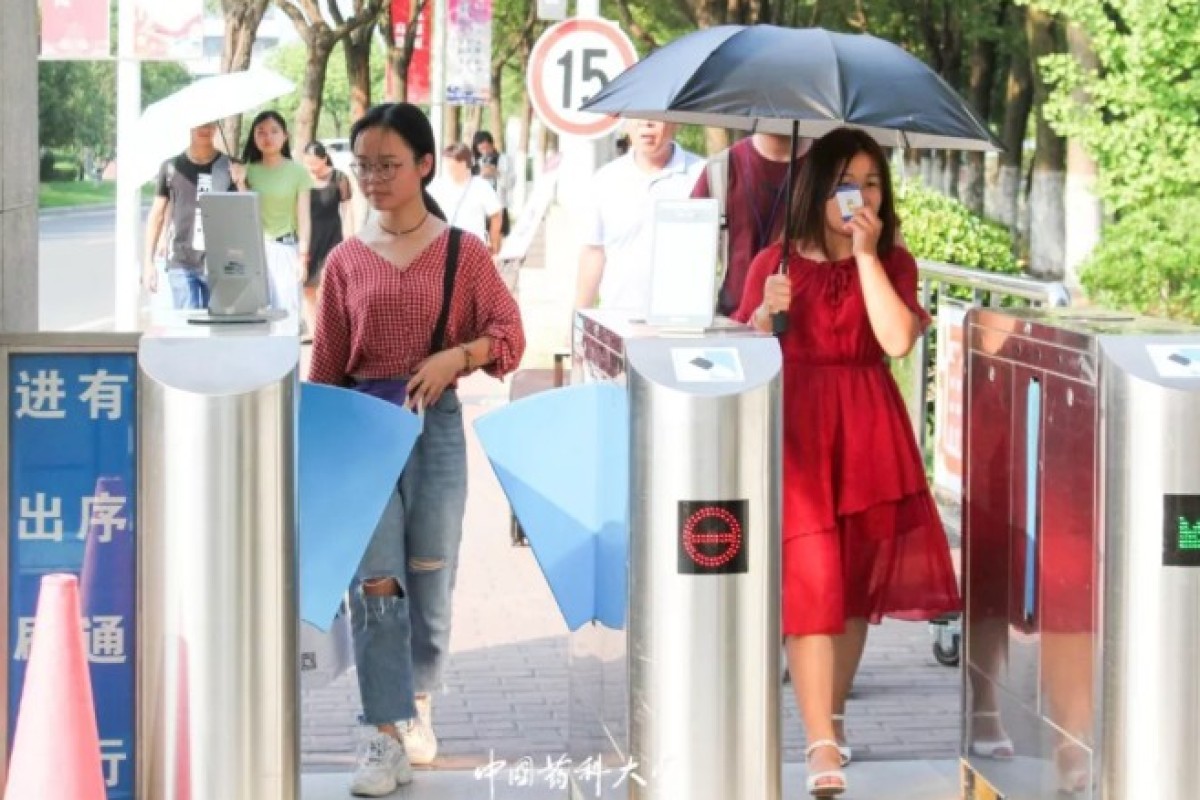
Students pass through a facial recognition turnstile at China Pharmaceutical University in Nanjing. Photo: Weibo
A university in eastern China has installed a facial recognition system at its entrance and in two classrooms to monitor the attendance and behaviour of students.
China Pharmaceutical University in Nanjing, Jiangsu province, announced on its website on Thursday that it was one of the first higher education institutions in the country to put such a system in place.
“It can effectively solve the management difficulties and low efficiencies in a traditional attendance system, and make it easier for managers to track their students,” Xu Jianzhen, director of the university’s library and information centre, told news website Thepaper.cn
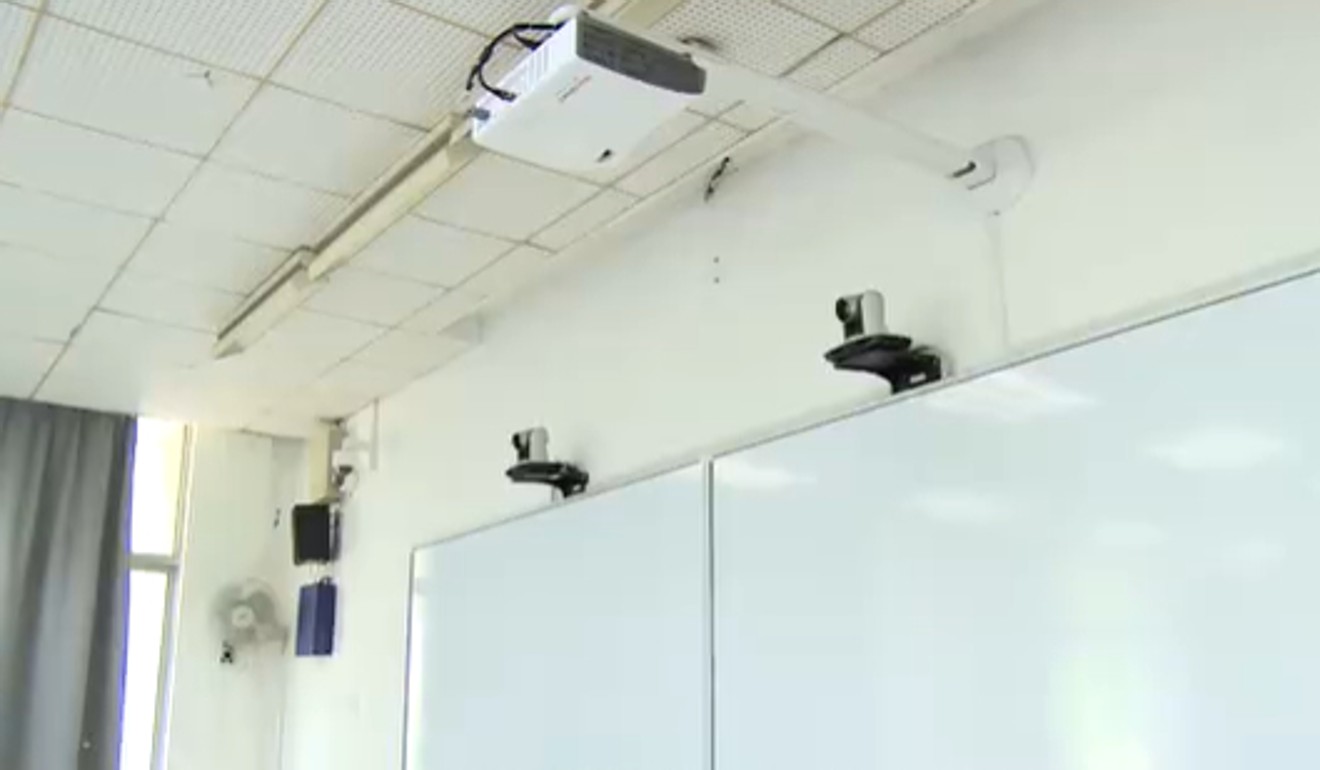
In a pilot project, two classrooms were equipped with an attendance system using facial recognition software, with a camera that automatically captured the faces of students in class without their cooperation, the university said.
“Besides attendance, the system installed in the classroom can provide surveillance of the students’ learning, such as whether they are listening to the lectures, how many times they raise their heads, and whether they are playing on their phones or falling asleep,” Xu told the news website.
“The school is taking action to cut down on students skipping class, leaving classes early, paying for a substitute to attend classes for them and not listening in class,” he said.
The plan was not well received online, with some critics raising privacy concerns for staff and students.
Why are Hong Kong protesters targeting lamp posts?
“What kind of talent are they trying to cultivate?” a user of the Twitter-style Weibo network asked. “I’ve never seen such a method.”
Another wrote: “If this system was being installed in Europe or America, they’d be sued and the school would have to close down.”
But Xu said the university had consulted the police and sought legal advice, and was told the system would not be considered an invasion of privacy as classrooms were public spaces.
“You are complaining about [a system] that’s meant to urge you to learn? Are you a student?” he told the news website.
A spokesman said China Pharmaceutical University was using a facial recognition system to improve class attendance. Photo: Weibo
The university would seek feedback from teaching staff before deciding whether to install facial recognition systems in all of its classrooms, according to the report.
In May last year, a school in Hangzhou, Zhejiang province, installed cameras to monitor pupils’ facial expressions and attentiveness in class as part of a “smart classroom behaviour management system” to give teachers real-time information on their students.
Elsewhere, facial recognition has been used to catch unlicensed drivers in the southern technology hub of Shenzhen, jaywalkers in Shanghai, and criminal suspects at public events across China.
Source: SCMP
Posted in America, attendance, attentiveness, automatically captures, Camera, China alert, China Pharmaceutical University, Chinese university, consulted, cooperation, criminal suspects, Europe, facial expressions, Facial recognition system, Hangzhou, invasion of privacy, jaywalkers, jiangsu province, legal advice, library and information centre, Nanjing, pilot project, Police, public events, Shanghai, Shenzhen, students’ faces, sued, Thepaper.cn, Uncategorized, university, unlicensed drivers, website, Weibo, without, zhejiang province |
Leave a Comment »




 CHINDIA ALERT: You'll be living in their world, very soon