Archive for ‘camps’

02/05/2020

China plans to send Uygur Muslims from Xinjiang re-education camps to work in other parts of country

  • Inmates who have undergone compulsory re-education programme to be moved to other parts of China under job placement scheme delayed by Covid-19 outbreak
  • Critics have said the camps are a move to eradicate cultural and religious identity but Beijing has defended them as way of boosting job opportunities and combating Islamic radicalisation
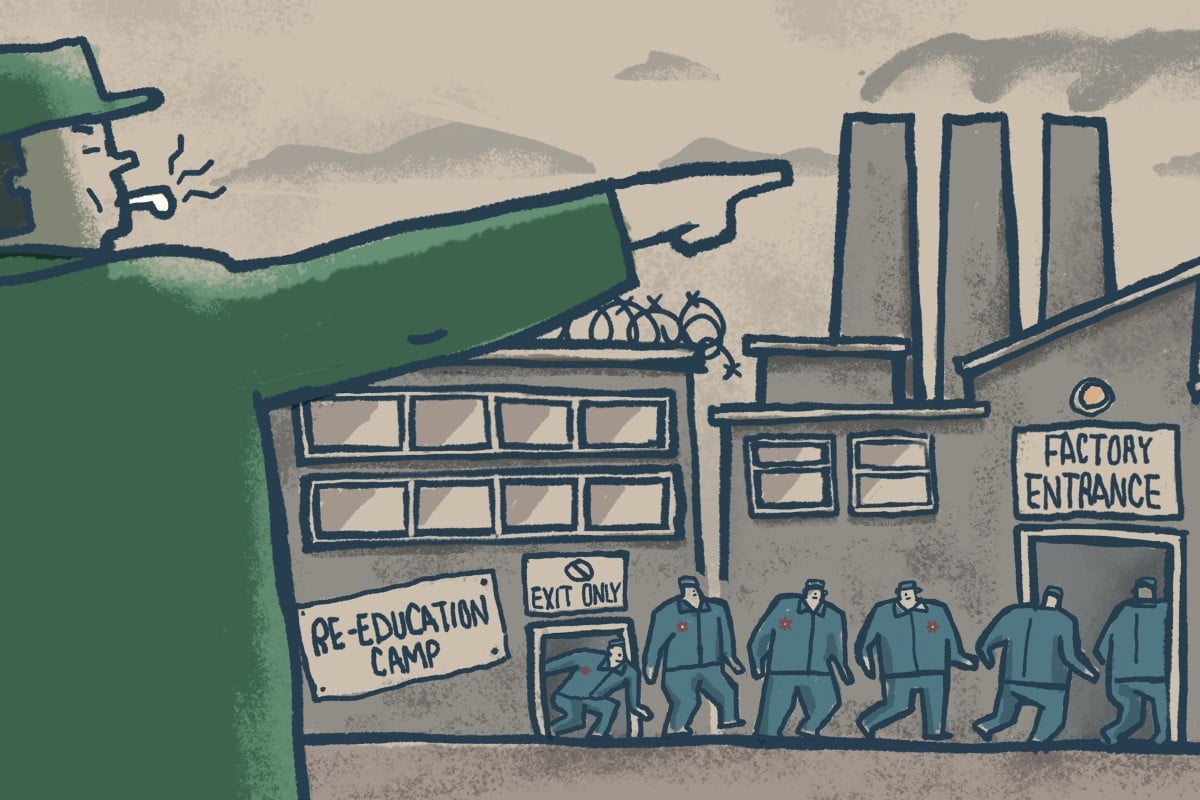
Illustration by Perry Tse

The Chinese government has resumed a job placement scheme for tens of thousands of Uygur Muslims who have completed compulsory programmes at the “re-education” camps in the far-western region of Xinjiang, sources said.

The plan, which includes a quota for the numbers provinces must take, was finalised last year but disrupted by the outbreak of Covid-19.

The delay threatens to undermine the Chinese government’s efforts to justify its use of internment camps in Xinjiang.

Critics have said these camps were part of the measures designed to eradicate the ethnic and cultural identity of Uygurs and other Muslim minorities and that participants had no choice but to undertake the re-education programme.
Beijing has repeatedly dismissed these criticisms and said the camps are to give Uygurs the training they need to find better jobs and stay away from the influence of radical fundamentalism.
First Xinjiang, now Tibet passes rules to promote ‘ethnic unity’
17 Feb 2020

Now with the disease under control, the Chinese government has resumed the job placement deal for other provinces to absorb Xinjiang labourers, sources said.

Despite the devastating impact of the disease on its economy and job markets, the Chinese authorities are determined to go ahead with the plan, which they believe would

“demonstrate the success of Xinjiang’s re-education centres policy”

, a source said.

“Excellent graduates were to be taken on as labourers by various inland governments, in particular, 19 provinces and municipalities,” said the source. It is unclear what constitutes “excellent graduates”.

Some sources earlier said that the programme may be scaled back in light of the new economic reality and uncertainties.

But a Beijing-based source said the overall targets would remain unchanged.

“The unemployment problem in Xinjiang must be resolved at all costs, despite the outbreak,” the source said.

The South China Morning Post has learned that at least 19 provinces and cities have been given quotas to hire Muslim minorities, mostly Uygurs, who have “graduated” from re-education camps.

As early as February, when the daily number of infections started to come down outside Hubei province, China already begun to send Uygur workers to their new jobs.

A photo taken in February showed thousands of young Uygurs, all wearing face masks and with huge red silk flowers pinned to their chests, being dispatched to work in factories outside their hometowns.

By the end of February, Xinjiang alone has created jobs for more than 60,000 Uygur graduates from the camps. A few thousand were also sent to work in other provinces.

Many have been employed in factories making toys and clothes.

Xinjiang’s new rules against domestic violence expand China’s ‘extremism’ front to the home

7 Apr 2020

Sources told the Post that the southern city of Shenzhen – China’s hi-tech manufacturing centre – was given a target last year to eventually resettle 50,000 Uygurs. The city is allowed to do this in several batches, with 15,000 to 20,000 planned for the first stage.

Shaoguan, a less developed Guangdong city where a deadly toy factory brawl between Uygurs and Han Chinese broke out in 2009, was also asked to take on another 30,000 to 50,000 Uygur workers.
In Fujian province, a government source also said they had been told to hire “tens of thousands of Xinjiang workers”.
“I heard the first batch of several thousands would arrive soon. We have already received official directives asking us to handle their settlement with care,” said the source.

He said the preparation work includes providing halal food to the workers as well as putting in place stronger security measures to “minimise the risks of mass incidents”. It is not known whether they will be given access to prayer rooms.

There are no official statistics of how many Uygurs will be resettled to other provinces and the matter is rarely reported by the mainland media.

But in March, Anhui Daily, the province’s official newspaper, reported that it had received 1,560 “organised labourers from Xinjiang”.

The Uygur workers on average could earn between 1,200 yuan (US$170) to 4,000 yuan (US$565) a month, with accommodation and meals provided by the local authorities, according to Chinese media reports.

However, they are not allowed to leave their dormitories without permission.
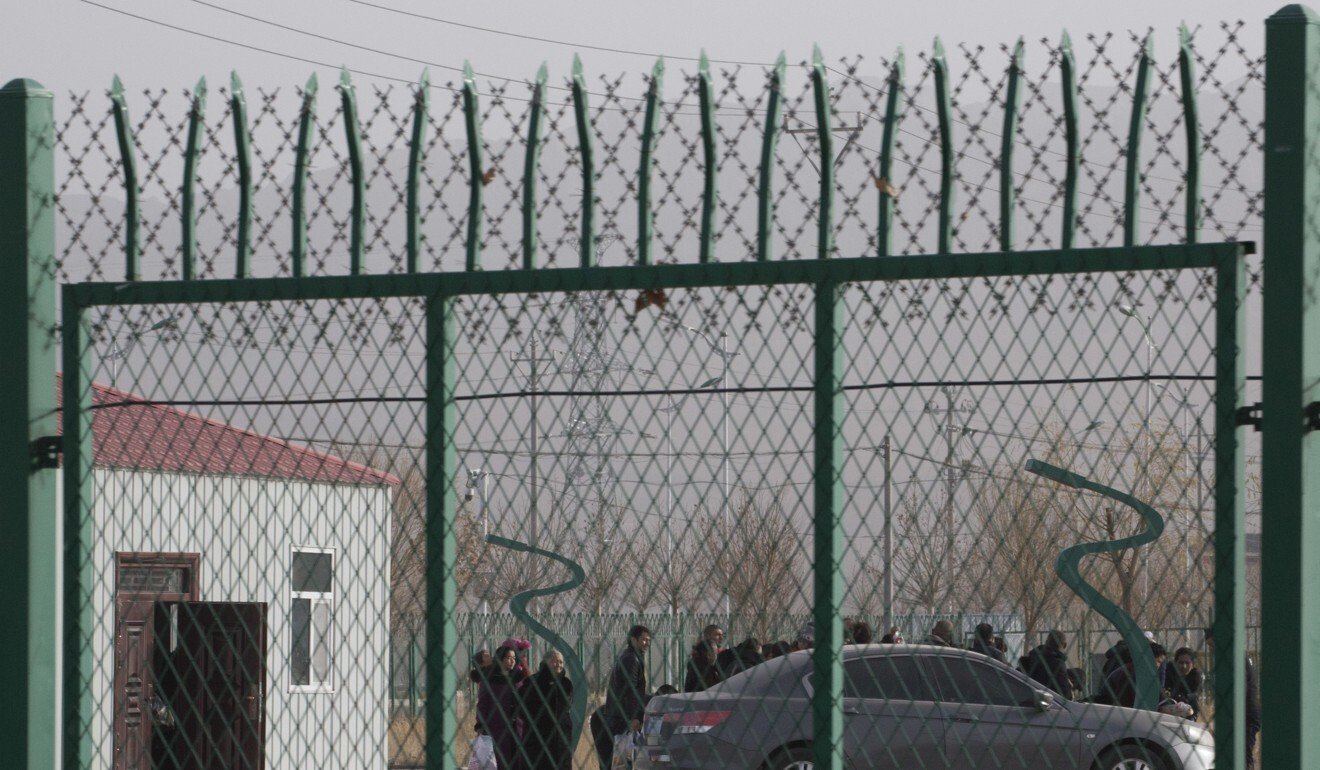
The UN has estimated that up to a million Muslims were being held in the camps. Photo: AP
Xinjiang’s per capita disposable income in 2018 was 1,791 yuan a month, according to state news agency Xinhua. But the salary level outside the region’s biggest cities such as Urumqi may be much lower.
The official unemployment rate for the region is between 3 and 4 per cent, but the statistics do not include those living in remote rural areas.
Mindful of the potential risks of the resettlement, Beijing has taken painstaking efforts to carefully manage everything – from recruitment to setting contract terms to managing the workers’ day-to-day lives.
Local officials will go to each Uygur workers’ home to personally take them to prearranged flights and trains. On arrival, they will be immediately picked up and sent to their assigned factories.
US bill would bar goods from Xinjiang, classifying them the product of forced labour by Uygurs
12 Mar 2020

Such arrangements are not unique to Uygurs and local governments have made similar arrangements for ethnic Han workers in other parts of China.

After screening them for Covid-19, local governments have arranged for workers to be sent to their workplaces in batches. They are checked again on arrival, before being sent to work.

China is accelerating such placement deals on a massive scale to offset the impact of the economic slowdown after the outbreak.

Sources told the South China Morning Post that the job placement deal was first finalised by governments in Xinjiang and other provinces last year.

The aim is to guarantee jobs for Uygur Muslim who have “completed vocational training” at the re-education camps and meet poverty alleviation deals in the region, one of the poorest parts of China.

The training they receive in the camps includes vocational training for various job types such as factory work, mechanical maintenance and hotel room servicing. They also have to study Mandarin, Chinese law, core party values and patriotic education.

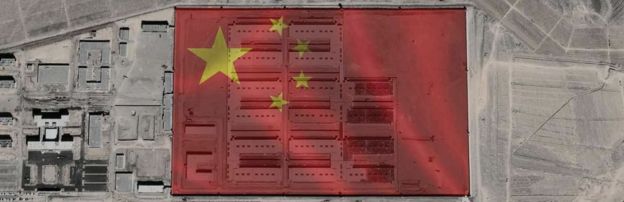
Xinjiang’s massive internment camps have drawn widespread international condemnation.

The United Nations has estimated that up to 1 million Uygur and other Muslim minority citizens are being arbitrarily detained in the camps, which Beijing insists are necessary to combat terrorism and Islamic radicalisation.

Late last year, Xinjiang’s officials announced that all the inmates of these so-called vocational training centres had “graduated” and taken up employment.

Before this labour placement scheme was introduced, it was extremely difficult for Uygurs to find jobs or live and work in inland regions.

The 2009 brawl at the factory in Shaoguan was one of the factors that triggered a deadly riot in Xinjiang’s capital Urumqi, that left 192 people dead and more than 1,000 wounded.

Muslim ethnic minorities, Uygurs in particular, have been subjected to blatant discrimination in China and the situation worsened after the 2009 clashes.

Earlier this month, the Australian Strategic Policy Institute released a report saying more than 80,000 Uygurs had been moved from Xinjiang to work in factories in nine Chinese regions and provinces.

It identified a total of 27 factories that supplied 83 brands, including household names such as Google, Apple, Microsoft, Mitsubishi, Siemens, Sony, Huawei, Samsung, Nike, Abercrombie and Fitch, Uniqlo, Adidas and Lacoste.

‘Psychological torture’: Uygurs abroad face mental health crisis over plight of relatives who remain in Xinjiang

11 Mar 2020

The security think tank concluded that the Chinese government had transferred Uygur workers “under conditions that strongly suggest forced labour” between 2017 and 2019, sometimes drawing labourers directly from re-education camps.

The report also said the work programme represents a “new phase in China’s social re-engineering campaign targeting minority citizens”.

Workers were typically sent to live in segregated dormitories, underwent organised Mandarin lessons and ideological training outside working hours and were subject to constant surveillance, the researcher found.

They were also forbidden from taking part in religious observances, according to the report that is based on open-source documents, satellite pictures, academic research and on-the-ground reporting.

Chinese foreign ministry spokesman Zhao Lijian criticised the report saying it had “no factual basis”.

Source: SCMP
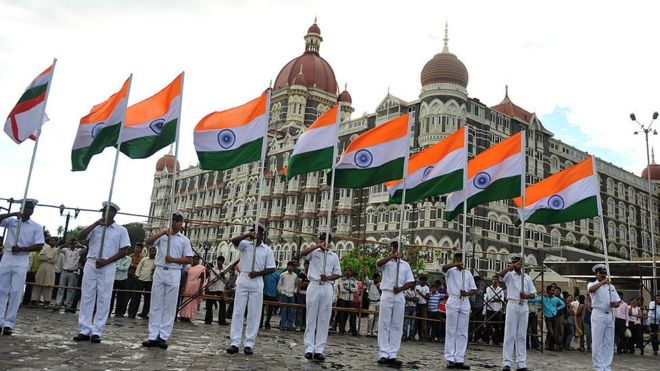
18/04/2020

India coronavirus: Navy says 21 sailors test positive at key Mumbai base

Navy cadets take part in a rehearsal infront of the Taj Mahal hotel in Mumbai on November 24, 2010.Image copyright GETTY IMAGES

Indian defence officials have reported a coronavirus outbreak at a key naval base in the western city of Mumbai.

Twenty-one personnel have tested positive for Covid-19 at INS Angre, which is the seat of the force’s western command, the navy said in a statement on Saturday.

It added that there are no infections aboard any ships or submarines.

India has 11,906 active infections and 480 deaths, according to the latest data from the ministry of health.

The Navy said that they had tested a number of personnel who had come into contact with a soldier who had tested positive earlier this month. Many of those who had tested positive for the virus, the statement added, were asymptomatic.

They are all currently undergoing treatment.

All 21 personnel live in the same residential block, which has been declared a containment zone and has been placed under lockdown.

In a video message to personnel last week, Navy Chief Admiral Karambir Singh stressed the importance of keeping ships and submarines free of the virus.

“The coronavirus pandemic is unprecedented and it has never been seen before. Its impact has been extraordinary across the globe, including India,” he said.

The navy has been playing an active role in India’s response to the Covid-19 outbreak.

It has set up isolation facilities to treat patients at one of its premier hospital units and is also running quarantine camps.

The outbreak aboard the Indian naval base follows reports of outbreaks aboard vessels belonging to other nations.

More than 500 sailors on the USS Roosevelt have tested positive for the virus and one of them died earlier this week. And nearly a third of the sailors serving with France’s aircraft carrier Charles de Gaulle – 668 out of nearly 2,000 – have been infected with coronavirus.

Source: The BBC

13/11/2019

Xinjiang cotton sparks concern over ‘forced labour’ claims

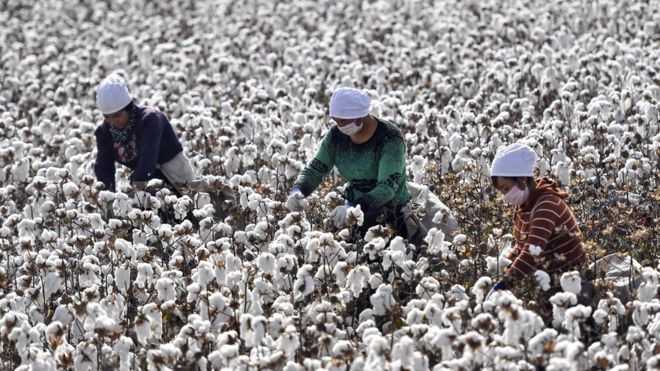
Farmers pick cotton during the harvest on October 21, 2019 in Shaya County, Xinjiang Uygur Autonomous Region of China.Image copyright GETTY IMAGES

Global retailers are facing scrutiny over cotton supplies sourced from Xinjiang, a Chinese region plagued by allegations of human rights abuses.

China is one of the world’s top cotton producers and most of its crop is grown in Xinjiang.

Rights groups say Xinjiang’s Uighur minority are being persecuted and recruited for forced labour.

Many brands are thought to indirectly source cotton products from the Xinjiang region in China’s far west.

Japanese retailers Muji and Uniqlo attracted attention recently after a report highlighted the brands used the Xinjiang-origin of their cotton as a selling point in advertisements.

H&M, Esprit and Adidas are among the firms said to be at the end of supply chains involving cotton products from Xinjiang, according to a Wall Street Journal investigation.

“You can’t be sure that you don’t have coerced labour in your supply chain if you do cotton business in China,” said Nathan Ruser, researcher at the Australian Strategic Policy Institute.

“Xinjiang labour and what is almost certainly coerced labour is very deeply entrenched into the supply chain that exists in Xinjiang.”

What is happening in Xinjiang?

UN experts and human rights groups say China is holding more than a million Uighurs and other ethnic minorities in vast detention camps.

Rights groups also say people in camps are made to learn Mandarin Chinese, swear loyalty to President Xi Jinping, and criticise or renounce their faith.

China says those people are attending “vocational training centres” which are giving them jobs and helping them integrate into Chinese society, in the name of preventing terrorism.

What is produced in Xinjiang?

The Xinjiang region is a key hub of Chinese cotton production.

China produces about 22% of global cotton supplies, according to a report by the Center for Strategic and International Studies (CSIS).

Last year, 84% of Chinese cotton came from Xinjiang, the report said.

That has raised concerns over whether forced labour has been used in the production of cotton from the region.

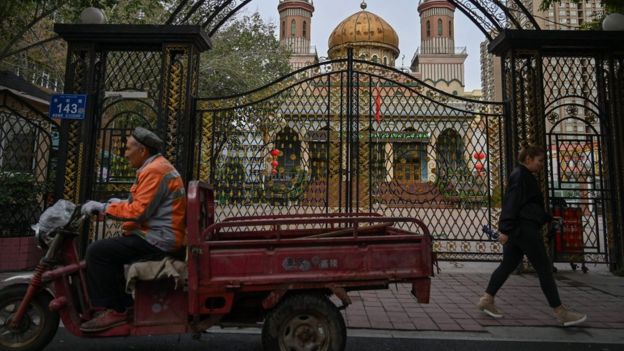
This photo taken on September 11, 2019 shows people walking past a mosque in Urumqi, the regional capital of Xinjiang.Image copyright GETTY IMAGES
Image caption The Uighurs are mostly Muslims, and number about 11 million in China’s Xinjiang region

Nury Turkel, chairman of the Uighur Human Rights Project in Washington, said the Uighurs were being “detained and tormented” and “swept into a vast system of forced labor” in Xinjiang.

In testimony to US congress, he said it was becoming “increasingly hard to ignore the fact” that the goods manufactured in the region have “a high likelihood” of being produced with forced labour.

Which brands use Xinjiang cotton?

Amy Lehr, director of CSIS Human Rights Initiative, said in many cases Western companies aren’t buying directly from factories in Xinjiang.

“Rather, the products may go through several stages of transformation after leaving Xinjiang before they are sent to large Western brands,” she said.

Some, like Muji, are very open about sourcing material from Xinjiang.

The Japanese retail chain launched a new Xinjiang Cotton collection earlier this year.

One of its advertisements boasts “soft and breathable” men’s shirts made from organic cotton “delicately and wholly handpicked in Xinjiang”.

Another Japanese fashion brand Uniqlo had also touted the Xinjiang region in an advertisement advertisment for men’s shirts.

In the fine print of the shirt description, the advert said the shirts were made from Xinjiang cotton, “famous for its superb quality”.

That reference was later removed from the advertisement “given the complexity of this issue”, according to a spokesperson for Uniqlo.

“Uniqlo does not have any production partners located in the Xinjiang region. Moreover, Uniqlo production partners must commit to our strict company code of conduct.

“To the best of our knowledge, this means our cotton comes only from ethical sources,” the spokesperson told the BBC.

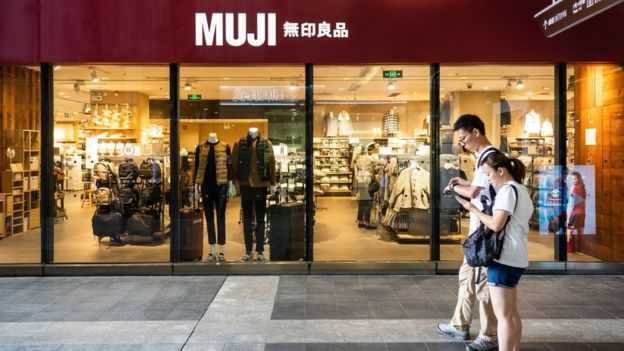
Pedestrians walk past a Japanese household and consumer goods retailer, Muji store in ShenzhenImage copyright GETTY IMAGES

According to the Wall Street Journal report which focused on workers at a mill operated by Huafu Fashion in Aksu, Xinjiang, yarn made in the region was present in the supply chains of several international retailers including H&M, Esprit and Adidas.

Many of the companies looked into the allegations, including those without clear links to the Huafu mill.

In a statement to the BBC, Adidas said: “While we do not have a contractual relationship with Huafu Fashion Co., or any direct leverage with this business entity or its subsidiary, we are currently investigating these claims.”

“We advised our material suppliers to place no orders with Huafu until we have completed those investigations,” the Adidas spokesperson said.

Esprit, which also does not source cotton directly from Xinjiang, said it had made several inquiries earlier this year.

“We concluded that a very small amount of cotton from a Huafu factory in Xinjiang was used in a limited number of Esprit garments,” the firm said in a statement.

The company has instructed all suppliers to not source Huafu yarn from Aksu, the statement said.

H&M said it does not have “a direct or indirect business relationship” with any garment manufacturer in the Xinjiang region.

“We have an indirect business relationship with Huafu’s spinning unit in Shanyu, which is not located in the Xinjiang region, and according to our data, the vast majority of the yarn used for our garment manufacturing comes from this spinning unit,” a spokesperson for H&M said.

“Since we have an indirect business relationship with the yarn supplier Huafu, we also asked for access to their spinning facilities in Aksu. Our investigations showed no evidence of forced labor.”

Source: The BBC

10/02/2019

Turkey demands China close camps after reports of musician’s death

John Sudworth reports from Xinjiang, where one million Uighurs have reportedly been detained

Turkey has called on China to close its detention camps following the reported death of a renowned musician from the ethnic Uighur minority.

Abdurehim Heyit is thought to have been serving an eight-year sentence in the Xinjiang region, where up to a million Uighurs are reportedly being detained.

A statement from Turkey’s foreign ministry said they were being subjected to “torture” in “concentration camps”.

China described the comments as “completely unacceptable”.

The Uighurs are a Muslim Turkic-speaking minority based in the north-west Xinjiang region of China, which has come under intense surveillance by Chinese authorities.

Their language is close to Turkish and a significant number of Uighurs have fled to Turkey from China in recent years.

So far few Muslim-majority countries have joined in public international condemnation of the allegations. Analysts say many fear political and economic retaliation from China.

What did Turkey say?

In a statement issued on Saturday, foreign ministry spokesman Hami Aksoy said: “It is no longer a secret that more than a million Uighur Turks exposed to arbitrary arrests are subjected to torture and political brainwashing” in prisons, adding that those not detained were “under great pressure”.

“The reintroduction of concentration camps in the 21st century and the systematic assimilation policy of Chinese authorities against the Uighur Turks is a great embarrassment for humanity,” Mr Aksoy said.

He also said the reports of Heyit’s death “further strengthened the Turkish public’s reaction to the serious human rights violations in Xinjiang” and called on UN Secretary General Antonio Guterres “to take effective steps to end the human tragedy” there.

Presentational grey line

China’s hidden camps

BBC
Presentational grey line

Rights groups say Uighurs, Kazakhs and other Muslim minorities are being detained indefinitely without charge for infractions like refusing to give a DNA sample, speaking in a minority language, or arguing with officials.

What was Beijing’s response?

In a statement quoted by the Associated Press, China through its embassy in Ankara called on Turkey to withdraw its “false accusations”.

“Both China and Turkey face the arduous task of fighting terrorism. We are opposed to maintaining double standards on the question of fighting terrorism,” it said.

“We hope the Turkish side will have a correct understanding of the efforts made by China to legally deploy measures to effectively fight terrorism and extremism, withdraw its false accusations and take measures to eliminate their harmful effects.”

Beijing claims that the detention camps in Xinjiang are “vocational education centres” designed to help rid the region of terrorism.

Speaking last October, the top Chinese official in Xinjiang, Shohrat Zakir, said “trainees” in the camps were grateful for the opportunity to “reflect on their mistakes”.

What do we know about Heyit’s fate?

Amnesty International said it was very concerned about reports of his death, which has not been officially confirmed.

Heyit was a celebrated player of the Dutar, a two-stringed instrument that is notoriously hard to master. At one time, he was venerated across China. He studied music in Beijing and later performed with national arts troupes.

Heyit’s detention reportedly stemmed from a song he performed titled Fathers. It takes its lyrics from a Uighur poem calling on younger generations to respect the sacrifices of those before them.

But three words in the lyrics – “martyrs of war” – apparently led Chinese authorities to conclude that Heyit presented a terrorist threat.

Presentational grey line

Who are the Uighurs?

Uighur men read newspapers in Xinjiang (2015)Image copyrightGETTY IMAGES

The Uighurs make up about 45% of the population in Xinjiang.

They see themselves as culturally and ethnically close to Central Asian nations.

In recent decades, large numbers of Han Chinese (China’s ethnic majority) have migrated to Xinjiang, and the Uighurs feel their culture and livelihoods are under threat.

Xinjiang is officially designated as an autonomous region within China, like Tibet to its south.

Source: The BBC

06/01/2019

China says pace of Xinjiang ‘education’ will slow, but defends camps

URUMQI/KASHGAR/HOTAN, China (Reuters) – China will not back down on what it sees as a highly successful de-radicalisation programme in Xinjiang that has attracted global concern, but fewer people will be sent through, officials said last week in allowing rare media access there.

January 4, 2019. PREUTERS/Ben Blanchard

Beijing has faced an outcry from activists, scholars, foreign governments and U.N. rights experts over what they call mass detentions and strict surveillance of the mostly Muslim Uighur minority and other Muslim groups who call Xinjiang home.

In August, a U.N. human rights panel said it had received credible reports that a million or more Uighurs and other minorities in the far western region are being held in what resembles a “massive internment camp.”

Last week, the government organised a visit to three such facilities, which it calls vocational education training centres, for a small group of foreign reporters, including Reuters.

In recent days, a similar visit was arranged for diplomats from 12 non-Western countries, including Russia, Indonesia, India, Thailand, Kazakhstan, according to Xinjiang officials and foreign diplomats.

Senior officials, including Shohrat Zakir, Xinjiang’s governor and the region’s most senior Uighur, dismissed what they called “slanderous lies” about the facilities.

Speaking in Xinjiang’s capital, Urumqi, Shohrat Zakir said the centres had been “extremely effective” in reducing extremism by teaching residents about the law and helping them learn Mandarin.

“As time goes by, the people in the education training mechanism will be fewer and fewer,” he said.

Shohrat Zakir said he could not say exactly how many people were in the facilities.

“One million people, this number is rather frightening. One million people in the education mechanism – that’s not realistic. That’s purely a rumour,” he said, stressing they were temporary educational facilities.

Dilxat Raxit, spokesman for the Munich-based exile group the World Uyghur Congress, told Reuters the Chinese government was using extremism as an excuse to lock people up.

“What they are trying to do is destroy Uighur identity,” he said.

INSIDE THE CENTRES

Human rights groups and former detainees have said that conditions in the camps are poor, with inmates subject to abuse. They said detainees did not receive vocational training.

Seeking to counter that narrative, the government took reporters to three centres, in Kashgar, Hotan and Karakax, all in the heavily Uighur-populated southern part of Xinjiang, where much of the violence has taken place in recent years.

In one class reporters were allowed to briefly visit, a teacher explained in Mandarin that not allowing singing or dancing at a wedding or crying at a funeral are signs of extremist thought.

The students took notes, pausing to look up as reporters and officials entered the room. Some smiled awkwardly. Others just looked down at their books. All were Uighur. None appeared to have been mistreated.

In another class, residents read a Chinese lesson in their textbook entitled “Our motherland is so vast.”

There was plenty of singing and dancing in other rooms reporters visited, including a lively rendition in English of “If You’re Happy and You Know It, Clap Your Hands,” that seemed to have been put on especially for the visit.

Several residents agreed to speak briefly to reporters, though all in the presence of government officials. Reporters were closely chaperoned at all times.

All the interviewees said they were there of their own accord after learning of the centres from local officials.

Many answers used extremely similar language about being “infected with extremist thought.”

Pazalaibutuyi, 26, told reporters at the Hotan centre that five years ago she had attended an illegal religious gathering at a neighbour’s house, where they were taught that women should cover their faces.

“At that time I was infected with extremist thought so I wore a face veil,” she said, speaking clear Mandarin after a year at the centre.

Government officials came to her village to talk to the villagers and after that, she said, “I discovered my mistake.”

In the Kashgar centre, Osmanjan, who declined to give his age, said he had incited ethnic hatred, so village police suggested he go for re-education.

“Under the influence of extremist thought, when non-Muslims came to my shop I was unwilling to serve them,” he said in unsteady Mandarin.

It was not possible to independently verify their stories. All the interviewees said they had not been forewarned of the visit.

Residents said they can “graduate” when they are judged to have reached a certain level with their Mandarin, de-radicalisation and legal knowledge. They are allowed phone calls with family members, but no cell phones. They are provided halal food.

Only minimal security was visible at any of the three centres.

Reuters last year reported on conditions inside the camps and took pictures of guard towers and barbed wire surrounding some. (tinyurl.com/y9zzouss)

‘A GOOD LIFE’

The situation in Xinjiang has stirred concern in Western capitals.

At least 15 Western ambassadors wrote to Xinjiang’s top official, Communist Party chief Chen Quanguo, late last year seeking a meeting to discuss their concerns. [nL4N1XQ2UR] Chen did not meet reporters on the trip.

Diplomatic sources told Reuters the ambassadors did not get a response.

The United States has said it is considering sanctions against Chen, other officials and Chinese companies linked to allegations of rights abuses in Xinjiang. [nL2N1VZ1WU]

Maya Wang, a Hong Kong-based Human Rights Watch researcher, said international pressure needs to increase.

“The fact that they feel they need to put on a show tour is a sign that this pressure is working,” she told Reuters.

Both Wang and Dilxat Raxit noted that the tight control over the visits and interviews showed China’s concern about their true nature.

Over a lunch of lamb kebabs, horse meat and naan, Urumqi party boss Xu Hairong told Reuters that “all of the reports are fake” when it comes to foreign coverage of Xinjiang. He dismissed worries about U.S. sanctions.

“We, including Party Secretary Chen, are working all out for the people of Xinjiang to have a good life,” Xu said. “If the U.S. won’t allow me to go, then I don’t want to go there. That’s the truth.”

The government says its goal is for Uighurs to become part of mainstream Chinese society. Shohrat Zakir said in parts of southern Xinjiang people couldn’t even say hello in Mandarin.

Officials point to a lack of violence in the past two years as evidence of programme’s success.

Urumqi’s Exhibition on Major Violent Terrorist Attack Cases in Xinjiang, normally closed to the public, displays graphic images and footage from what the government says are attacks.

“Only with a deeper understanding of the past can you understand the measures we have taken today,” Shi Lei, Xinjiang’s Communist Party committee deputy propaganda chief, told reporters.

One member of the Chinese armed forces, who has served in Kashgar, said the security situation had improved dramatically.

“You can’t imagine what it was like there in 2014 and 2015. There were attacks all the time, bombings, stabbings. It was chaos,” he said, speaking on condition of anonymity because he was not authorised to speak to the media.

In Kashgar, Hotan and Karakax, petrol stations are still surrounded by barbed wire and heavy security barriers. Residential areas are dotted with small police stations.

The stations have broader public service in mind, Zhang Yi, commander of one of the stations, told reporters. The one reporters visited provided pamphlets on a wide range of subjects, including how to legally change your sex.

Kashgar deputy party chief Zark Zurdun, a Uighur from Ghulja in northern Xinjiang, where many ethnic Kazakhs live, told Reuters that “stability is the best human right.”

“The West should learn from us” on how to beat extremism, he said, dismissing concerns Uighur culture was under attack.

“Did Kazakh vanish in the USSR when they all had to learn Russian?” he said. “No. So Uighur won’t vanish here.”

Source: Reuters

Law of Unintended Consequences

continuously updated blog about China & India

ChiaHou's Book Reviews

continuously updated blog about China & India

What's wrong with the world; and its economy

continuously updated blog about China & India