Chindia Alert: You’ll be Living in their World Very Soon
aims to alert you to the threats and opportunities that China and India present. China and India require serious attention; case of ‘hidden dragon and crouching tiger’.
Without this attention, governments, businesses and, indeed, individuals may find themselves at a great disadvantage sooner rather than later.
The POSTs (front webpages) are mainly 'cuttings' from reliable sources, updated continuously.
The PAGEs (see Tabs, above) attempt to make the information more meaningful by putting some structure to the information we have researched and assembled since 2006.
BENGALURU (Reuters) – The Indian economy is likely to suffer its worst quarter since the mid-1990s, hit by the ongoing lockdown imposed to stem the spread of coronavirus, according to a Reuters poll, which predicted a mild and gradual recovery.
Over 2.6 million people tmsnrt.rs/3aIRuz7 have been infected by the coronavirus worldwide and more than 180,000 have died. Business and household lockdowns have disrupted supply chains globally, bringing growth to a halt.
The April 17-22 Reuters poll predicted the economy expanded at an annual pace of 3.0% last quarter but will shrink 5.2% in the three months ending in June, far weaker than expectations in a poll published last month for 4.0% and 2.0% growth, respectively.
The predicted contraction would be the first – under any gross domestic product calculation, which has changed a few times – since the mid-1990s, when official reporting for quarterly data began.
“The extended lockdown until early May adds further downside risk to our view of a 5% year-on-year GDP fall in the current quarter, the worst in the last few decades,” said Prakash Sakpal, Asia economist at ING.
“We don’t consider economic stimulus as strong enough to position the economy for a speedy recovery once the pandemic ends,” he said.
(Graphic: Reuters poll graphic on coronavirus impact on the Indian economy IMAGE link: here)
The Indian government announced a spending package of 1.7 trillion rupees in March to cushion the economy from the initial lockdown, which has been extended until May 3.
In an emergency meeting last week, the Reserve Bank of India cut its deposit rate again, after reducing it on March 27 and lowering the main policy rate by 75 basis points. It also announced another round of targeted long-term repo operations to ease liquidity.
But even with those measures, 40% of economists, or 13 of 32 – who provided quarterly figures – predicted an outright recession this year. Only one had expected a recession last month.
In the worst case, a smaller sample of respondents predicted, the economy would contract 9.3% in the current quarter. That compares with 0.5% growth in the previous poll’s worst-case forecast in late March, underscoring how rapidly the outlook has deteriorated.
The latest poll’s consensus view still shows the economy recovering again slowly in the July-September quarter, growing 0.8%, then 4.2% in October-December and 6.0% in the final quarter of the fiscal year, in early 2021.
But that compares with considerably more optimistic near-term forecasts of 3.3%, 5.0% and 5.6%, respectively, in the previous poll.
“A rebound in economic activity following the disruption is expected, but the low starting point of growth implies a gradual recovery,” said Upasana Chachra, chief India economist at Morgan Stanley.
“Indeed, before disruptions related to COVID-19, growth was slowing, with domestic issues of risk aversion in financial sector … (and) those concerns will likely stay after the COVID-19 disruptions have passed unless the policy response is much larger than expected,” she said.
The unemployment rate has tripled to 23.8% since the lockdown started on March 25, according to the Centre for Monitoring Indian Economy, a Mumbai-based research firm.
The Indian economy was now forecast to expand 1.5% in the fiscal year ending on March 31, 2021 – the weakest since 1991 and significantly lower than 3.6% predicted in late March. It probably grew 4.6% in the fiscal year that just ended.
Under a worst-case scenario, the median showed the economy shrinking 1.0% this fiscal year. That would be the first officially reported economic contraction for a 12-month period since GDP was reported to have contracted for calendar year 1979.
“Unless fiscal policy is also loosened aggressively alongside monetary policy, there is a big risk the drastic economic slowdown currently underway morphs into an annual contraction in output and that the recovery is hampered,” said Shilan Shah, senior India economist at Capital Economics.
All 37 economists who answered a separate question unanimously said the RBI would follow up with more easing, including lowering the repo and reverse repo rates and expanding the new long-term loans programme.
The RBI was expected to cut its repo rate by another 40 basis points to 4.00% by the end of this quarter. Already lowered twice over the past month by a cumulative 115 basis points, the reverse repo rate was forecast to be trimmed by another 25 points by end-June to 3.50%.
Despite PMI data showing a return to growth in both the manufacturing and non-manufacturing sectors, China’s economic activity is still far from normal
Headwinds include the threat of global recession, a second wave of coronavirus infections and a property slump, analysts warn
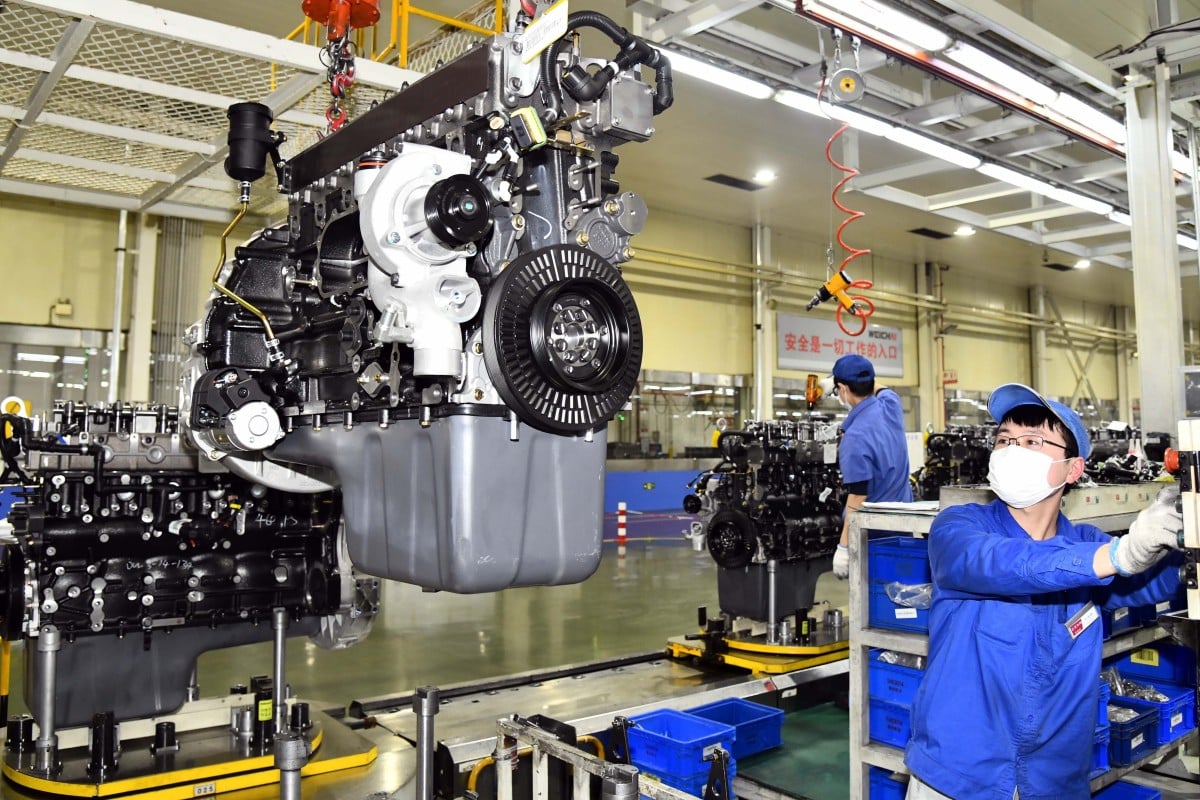
China’s economy has shown signs of recovery after a dismal start to the year. Photo: Xinhua
China’s economy showed signs of a recovery in March after a nationwide lockdown paralysed business in February, but analysts warned that it is not yet out of the woods.
Despite stronger-than-expected government data released on Tuesday, a series of threats lying ahead could derail China’s fragile recovery, including a second wave of infections, a global recession, worsening deflation due to plunging oil prices and a potentially sharp fall in the property market.
“While the lowest point is behind us, it’s not the time to celebrate,” said Larry Hu, chief China economist at Macquarie Bank.
For now, March’s figures suggest that business conditions are improving considerably, as more people are able to return to work and coronavirus cases continue to fall.
While the lowest point is behind us, it’s not the time to celebrateLarry Hu
The official purchasing managers’ index (PMIs) surveys showed that both the manufacturing and services sectors returned to growth in March, with many factories and retailers reopening as mainland authorities got the pandemic under control.
It will be welcome news for Beijing after a series of economic data plunged to all-time lows in January and February – including February’s PMIs, which are viewed as leading indicators of the state of the economy for the month ahead.
The manufacturing PMI, a survey of sentiment among factory owners, bounced back to 52.0 in March from 35.7 in February, which was an all-time low by some distance.
China’s non-manufacturing PMI – including both the services and construction sectors – was even weaker in February at 29.6, but its recovery to 52.3 was more marked.
Coronavirus: What impact will the economic fallout from the Covid-19 pandemic have on you?
A number above 50 signifies growth in sector activity, while a number below indicates contraction.
Both indices were significantly higher than expected and produced the V-shaped recovery in sentiment that policymakers had been so desperately pursuing.
But analysts warned that this may be short-lived as virus containment measures are set to sap demand across the globe, hitting China’s exports hard.
This was perhaps reflected in the fact that while many key components of the PMIs returned to growth in March, new export orders remained negative at 46.4.
Coronavirus: Chinese companies cut salaries and staff in industries hit hardest by Covid-19
“We would like to emphasise that the 52 reading [for manufacturing PMI] actually means a weak business resumption,” said Lu Ting, chief China economist at Nomura.
“We view the jump in both the manufacturing and non-manufacturing PMIs in March as one-off gains from the very low comparison bases in February.”
The dramatic collapse of the economy in the second month of the year meant March’s economic data was always likely to show a positive spike, with PMIs highly sensitive to short-term fluctuations in business conditions due to the way they are collated. Researchers simply ask respondents if things are better or worse than they were the previous month.
“This does not mean output is now back to its pre-virus trend,” said Julian Evans-Pritchard, senior China economist at Capital Economics, in a note. “Instead, it simply suggests that economic activity improved modestly relative to February’s dismal showing, but remains well below pre-virus levels. This is consistent with what the daily activity indicators show.”
It simply suggests that economic activity improved modestly relative to February’s dismal showing, but remains well below pre-virus levelsJulian Evans-Pritchard
Even the Chinese government urged caution against reading too much into the figures.
“We cannot say China’s economy has fully returned to normal levels based on a single month. We need to continue observing changes in the following months,” said a National Bureau of Statistics spokesman, adding that 96.6 per cent of large and medium-sized businesses were back to work as of March 25.
The official PMI survey, which is produced by the National Bureau of Statistics, is weighted more towards larger companies, including state-owned firms that have been the focus of government efforts to review production.
The Caixin-Markit manufacturing PMI data set to be published on Wednesday is weighted more towards smaller, private-sector firms and could show a less buoyant result given their struggles to resume operations.
A new phase of coronavirus blame game: what is the legacy of Covid-19 on global supply chains?
Officials in Beijing have been vocal in recent days about their concerns of a possible
. At a press conference in the capital on Monday, vice-minister of industry and information technology Xin Guobin said that small businesses and exporters might “struggle to survive” in the months ahead, due to global economic turbulence.
That was reflected in a new study by investment firm Fidelity International that showed while more than half of restaurants in China have reopened, daily turnover was 40 to 50 per cent below levels seen before the outbreak. Hotel occupancy figures, meanwhile, remain in single digits.
“Expect further slack in quarters three and four, which means the authorities will have to postpone their target to double gross domestic product growth levels to the first half of 2021,” said Carlos Casanova, Asia-Pacific economist at insurer Coface.
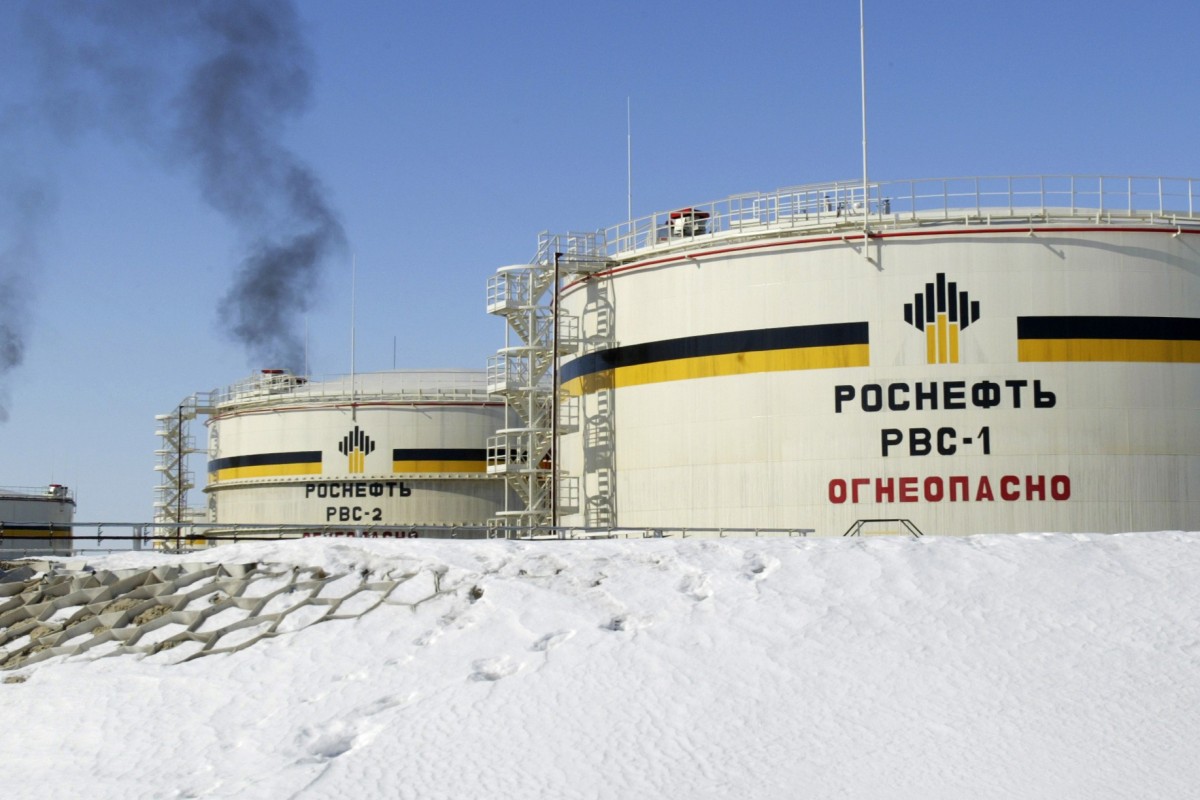
China imported 72 per cent of its oil in 2019, with Saudi Arabia and Russia, who are now locked in a price war, its largest suppliers
Oil prices again fell on Wednesday, with Brent crude down to US$36 a barrel as Saudi Arabia moved to boost output capacity in an escalation of its price war with Russia
China imported 506 million tonnes (3.7 billion barrels) of oil in 2019, an increase of 9.5 per cent from 2018, marking the 17th consecutive year of increased imports. Photo: AP
China’s coronavirus-hit industrial enterprises could receive a welcome boost from plunging oil prices, with the world’s largest importer and consumer set for significant cost savings, analysts said.
A total of 72 per cent of the oil consumed in China was imported in 2019, an average of 10 million barrels per day, meaning any sharp drop in costs as a result of the price war between Saudi Arabia and Russia will help firms reduce costs as they struggle to resume production.
“China benefits a lot from the price war as it is the world’s biggest crude importer,” said Bai Jun, an economic committee member at the China Petroleum Society, an association of Chinese energy researchers.
China imported 506 million tonnes (3.7 billion barrels) of oil in 2019, an increase of 9.5 per cent from 2018, marking the 17th consecutive year of increased imports.
Lower oil prices should raise output by 0.3 per cent above what it would have been with higher oil prices. This will provide some relief, but is a small offset to the many other drags facing the economy Julian Evans-Pritchard
Saudi Arabia and Russia topped a list, also including Angola, Iraq and Oman, that accounted for about 55 per cent of China’s total crude imports in 2018, according to China’s customs data.
Profits for China’s industrial firms could increase by 2 per cent this year as a result of lower oil prices, according to Julian Evans-Pritchard, senior China economist at Capital Economics.
“Lower oil prices should raise output by 0.3 per cent above what it would have been with higher oil prices. This will provide some relief, but is a small offset to the many other drags facing the economy, including the slump in global demand that has contributed to the fall in oil prices,” he said.
“For example, a 2 percentage point decline in export growth would fully wipe out the gains we foresee from lower oil prices. We expect a slowdown in
Global stock markets plummet amid coronavirus panic and falling oil prices
On the other hand, a crash in international oil prices could potentially lead to an increasingly monopolised supply structure as small suppliers could be priced out in the market. This would fly in the face of Beijing’s long-term strategy of securing multiple sources of supply, Wang Yongzhong, who leads the global energy research at the Chinese Academy of Social Sciences, a government think tank, said.
Beijing “is concerned more about the energy security, or how to find multiple sources of stable supply [than a gain from lowers prices],” according to Wang.
The price of Brent crude, the international benchmark, fell back to US$36 a barrel on Wednesday, reversing gains made earlier in the day, after plunging more than 30 per cent on Friday after Saudi Arabia moved to boost output capacity in the opening of a price war with Russia. In 2019, according to customs data, China’s average import price per barrel was around US$65.
China is also a big oil producer with 190 million tonnes (1.4 billion barrels) of output last year and the average cost is higher than US$40 per barrel – a fall in oil prices can push them into lossesBai Jun
But the drop is oil prices is not an unmitigated positive for the Chinese economy, as it will adversely impact domestic oil producers and overseas oilfield investments.
“China is also a big oil producer with 190 million tonnes (1.4 billion barrels) of output last year and the average cost is higher than US$40 per barrel – a fall in oil prices can push them into losses,” added Bai from the China Petroleum Society.
Dong Xiucheng, a professor at the University of International Business and Economics in Beijing, agreed that a lower oil price could help Chinese consumers and facilitate
but that it would also create a “cold winter” for China’s oil producers, especially state-owned enterprises who still have to maintain production levels.
“The coming days for them will be very hard,” Dong said. “State-owned players need to consider production targets and social stability. Workers can’t lose their jobs.”
As oil prices are falling, these projects could translate into big burden for Chinese investors as there’s now a big question mark over whether these projects can make any money Zhu Kunfeng
China National Offshore Oil (CNOOC), one of China’s three state-owned oil companies, has seen its share price in Hong Kong plummet over 20 per cent this week, closing down almost 6 per cent on Wednesday alone.
Zhu Kunfeng, a Beijing-based expert with consultancy firm IHS Markit, said the plunge in international crude prices could dampen China’s domestic output and force it to rely more on overseas supplies.
The collapse in oil prices could also question the financial viability of many Chinese-invested oil projects overseas.
“Chinese companies had been aggressive in buying overseas oil assets in the early 2010s … in the name of improving China’s energy security”, Zhu said.
“As oil prices are falling, these projects could translate into big burden for Chinese investors as there’s now a big question mark over whether these projects can make any money.”
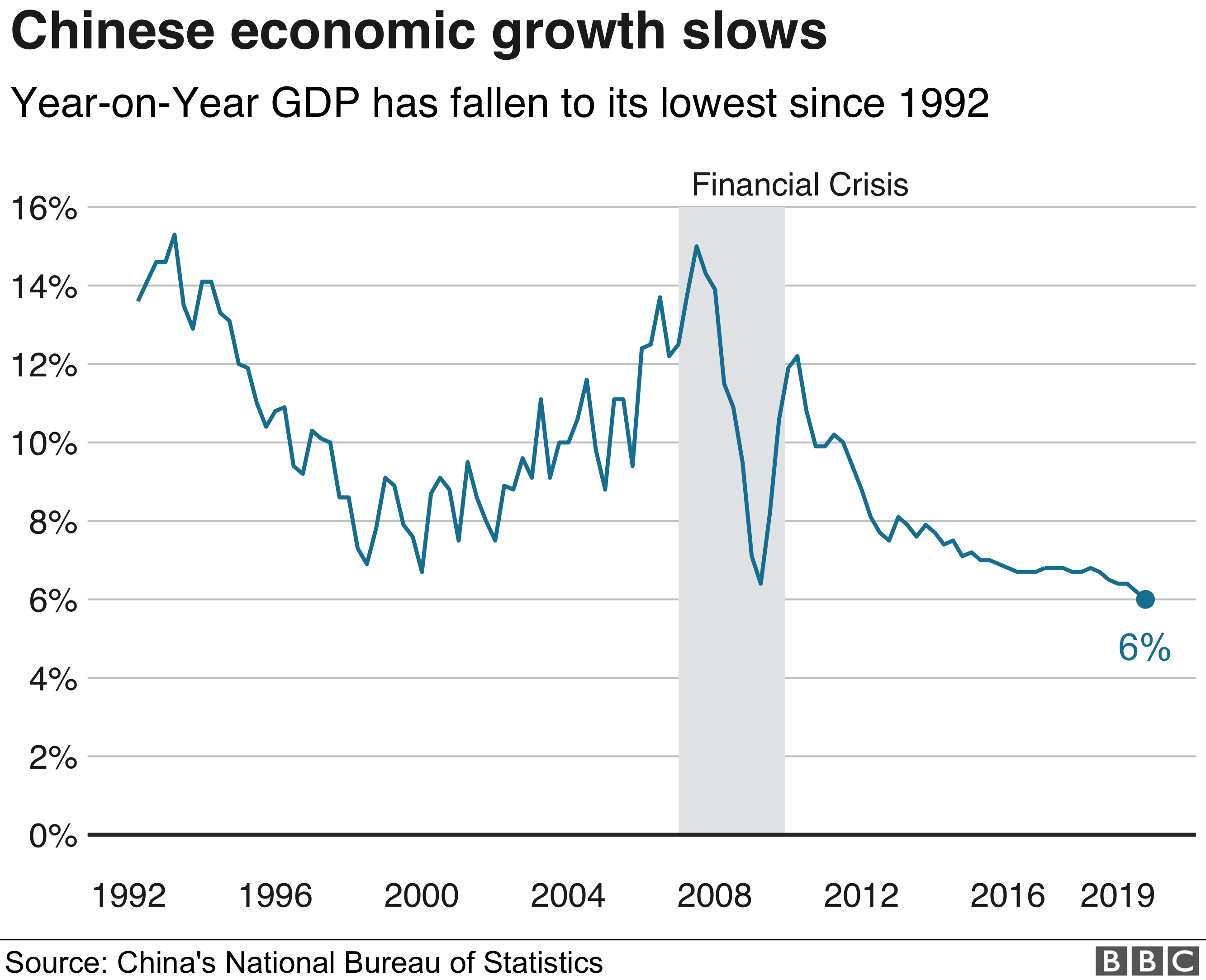
China’s economy grew at a slower pace than expected in the third quarter as it struggled with a US-led trade war and softer domestic demand.
In the three months to September, the economy expanded 6% from a year earlier, official figures showed.
The result fell just short of expectations for 6.1% growth for the period.
The slowdown comes despite government efforts to support the economy, including measures such as tax cuts.
The latest figures mark a further loss of momentum in the world’s second largest economy, which had already seen growth languishing at its slowest pace in around three decades.
The rate remained within the government’s target range for annual growth of between 6% and 6.5%.
The strength of the Chinese economy is closely watched as slowing growth can have far-reaching consequences for the global economy.
The country has become a key engine of growth in recent decades. Its healthy demand for a range of products, from commodities to machinery, has supported growth around the world.
Some analysts worry that a sharp slowdown in China could hurt an already sluggish world economy and increase the risk of a recession.
Julian Evans-Pritchard, senior China economist at Capital Economics, said pressure on the Chinese economy “should intensify in the coming months”.
He said more intervention by policymakers to support the economy was likely “but it will take time for this to put a floor beneath economic growth”.
What challenges does China face?
China has been fighting a trade war with the US for the past year, which has created uncertainty for businesses and consumers.
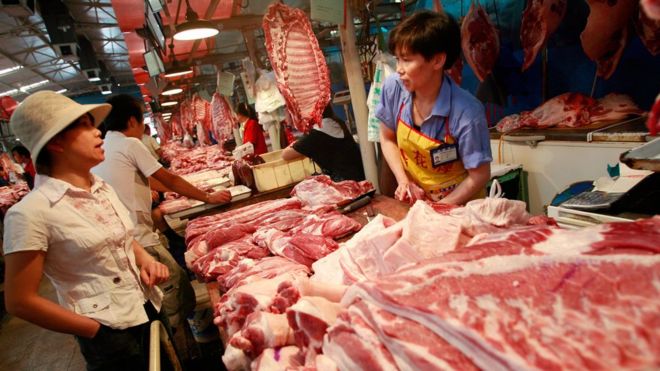
At the same time, it faces domestic challenges including a swine fever outbreak that has fuelled inflation and hit consumer spending.
Image copyright GETTY IMAGESImage caption China accounted for 16% of global gross domestic product in 2018, according to the McKinsey Global Institute
This week the International Monetary Fund trimmed its 2019 growth forecast for China to 6.1% from 6.2% due to the long-running trade dispute and slowing domestic demand.
But there have been some signs of progress toward resolving the trade battle, with the US and China reaching a “phase one deal” earlier this month.
Any analysis of China’s economic data has to come with a caveat: Many economists believe the actual figures are much lower than what we are told, but it’s the trajectory of growth and signalling from the government that you should pay attention to.
The fact that the growth figures have come in below market expectations indicate that China’s economy is hurting more than many thought.
There were signs from China that these numbers were going to be worrying. Earlier this week, Premier Li Keqiang made the unusual move to warn local officials that they must do “everything” to make sure they hit growth targets for this year.
China’s economy is being hit on three fronts: The US-led trade war, slowing demand at home and rising domestic challenges including the outbreak of swine fever that has dealt a huge blow to its pork farmers. It’s also pushed up prices for consumers.
China’s slowdown is nothing new. But these challenges pose new headaches for policymakers who are trying to manage the slowdown. The country’s political stability depends on economic security – and over the last forty years, that’s what the Communist Party has delivered. They’re under pressure to keep that contract.
China is set to release pork supplies from its central reserves as it moves to tackle soaring prices and shortages caused by an outbreak of swine fever.
A state-backed body will auction 10,000 tonnes of frozen pork from its strategic reserves on Thursday.
China, the world’s biggest producer and consumer of pork, has struggled to control the spread of the disease.
In a bid to stabilise prices, a state-backed group that manages the pork reserves will auction imported frozen pork from countries including Denmark, France, the US and UK.
Only 300 tonnes will be sold to each bidder at the auction.
Pork is used widely in Chinese festivals, and the auction comes as the country prepares to celebrate a week-long national holiday for the 70th anniversary of the People’s Republic of China.
Julian Evans-Pritchard, senior China economist at Capital Economics, said the auction would provide slight relief to the industry but would not do much to contain prices.
“In itself, I don’t think it will be able to prevent pork prices from rising further unless they manage to get the disease under control,” he said.
Beijing created its strategic pork reserve in 2007 but the size of the stockpile is not known.
Capital Economics estimates that at most, the stockpile would hold four days’ worth of pork supplies to feed China.
About 1.2 million pigs have been culled in China in an effort to halt the spread of swine fever since August 2018, according to data from the Food and Agriculture Organization, a UN agency.
In April, Rabobank estimated Chinese pork production would fall by up to 35% this year due to swine fever.
The supply shortage has sent pork prices soaring and has eaten into household incomes.
That poses a fresh challenge for the Chinese economy, which is already facing a slowdown and a trade war between Beijing and Washington.
BEIJING (Reuters) – China’s producer prices flatlined in June on lower oil prices and weak global demand, fuelling concerns that a slowdown in manufacturing from a bruising trade war will further drag on growth in the world’s second-biggest economy.
The producer price index (PPI) showed no growth in June from a year earlier, the National Bureau of Statistics (NBS) said on Wednesday. That compared with a 0.6% rise in May and a gain of 0.3% forecast by economists in a Reuters poll.
The June PPI reading was the lowest since August 2016 when the index last fell year-on-year. Factory gate prices slowed from May as well, falling 0.3%.
On the other hand, June consumer price growth in annual terms matched a 15-month high seen in May as supply shortages triggered by the African swine fever outbreak and extreme weather conditions continued to push up pork and fruit prices.
A cooling in producer prices, seen as a gauge of industrial demand that gives momentum to investment and profits in the Chinese economy, may rekindle worries about deflation and prompt the authorities to launch more aggressive stimulus.
“The bigger picture is inflation, apart from food inflation, is actually pretty weak and with the economy continuing to cool, I think the return to factory-gate deflation is very likely,” said Julian Evans-Pritchard, senior China economist at Capital Economics.
Tommy Xie, China economist at OCBC Bank in Singapore, also said he saw the risk of produce prices contracting in annual terms as early as next month.
Upstream sectors were particularly weak, with prices for oil and natural gas extraction down 1.8% from a year earlier, the NBS data showed. Price gains in the coal mining sector also eased.
Although Beijing and Washington reached another truce in their trade war last month, economists expect continuing pressure on the Chinese economy as manufacturers shift more production abroad to avoid U.S. tariffs on China-made goods.
China’s factory activity shrank more than expected in June as tariffs and weaker domestic demand hit new orders for goods.
Beijing is fast-tracking more infrastructure projects but prices for some construction materials remain lacklustre.
Spot prices for steel rebar in June lingered below the levels of a year earlier and may worsen due to seasonal slackening of construction activity amid high temperatures and rainfall in summer.
Premier Li Keqiang pledged earlier this month to implement financing tools including reserve requirement ratio (RRR) cuts to support small and private firms, adding to expectations for further stimulus measures.
At the same time, however, he and other top policymakers have reiterated that China will not resort to large-scale stimulus.
Evans-Pritchard from Capital Economics said the government could adopt more monetary easing and off-budget fiscal support to bolster the economy.
“But I think the days of big drastic stimulus are probably over. The most we can hope for is really it (more government support) helps to dampen the headwinds and prevent the economy from slowing too sharply.”
CPI STILL ELEVATED
The consumer price index (CPI) in June rose 2.7% in annual terms, driven by higher food prices. Fruit prices surged 42.7% from a year earlier while pork prices rose 21.1%.
Analysts polled by Reuters expected consumer prices to rise 2.7%, matching the pace seen in May.
Some economists said consumer inflation may accelerate due to dwindling pig stocks, but others contended price rises will cool.
“CPI may have peaked in June and could come off steadily in the second half,” said Wang Jun, Beijing-based chief economist at Zhongyuan Bank. “There are deflationary risks but the overall pressure is not big, because deflationary risk is only restricted to manufacturing products.”
Core inflation that strips out volatile food and energy prices was at 1.6% in June from a year earlier, the same annual pace as in May.
On a month-on-month basis, CPI fell 0.1% in June after no change in May.
Even though officials have sounded more positive about negotiations with the US recently, failure to achieve a deal would see tariffs on $200bn (£152bn) of Chinese goods rise almost immediately and could see the US impose fresh tariffs.
Still, Mr Evans-Pritchard said “broader weakness in global demand means that, even if Trump and Xi finalise a trade deal soon, the outlook for exports remains gloomy.”





 CHINDIA ALERT: You'll be living in their world, very soon
