Chindia Alert: You’ll be Living in their World Very Soon
aims to alert you to the threats and opportunities that China and India present. China and India require serious attention; case of ‘hidden dragon and crouching tiger’.
Without this attention, governments, businesses and, indeed, individuals may find themselves at a great disadvantage sooner rather than later.
The POSTs (front webpages) are mainly 'cuttings' from reliable sources, updated continuously.
The PAGEs (see Tabs, above) attempt to make the information more meaningful by putting some structure to the information we have researched and assembled since 2006.
Image copyright TWITTER/@ARVINDKEJRIWALImage caption Delhi Chief MinisterArvind Kejriwal has been handing out masks to school students
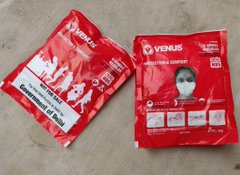
Five million masks are being distributed at schools in India’s capital, Delhi, after pollution made the air so toxic officials were forced to declare a public health emergency.
A Supreme Court mandated panel imposed several restrictions in the city and two neighbouring states, as air quality deteriorated to “severe” levels.
All construction has been halted for a week and fireworks have been banned.
The city’s schools have also been closed until at least next Tuesday.
Delhi’s Chief Minister Arvind Kejriwal said Delhi had been turned into a “gas chamber”.
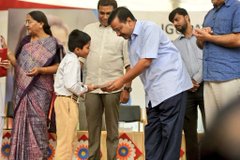
The masks are being handed out to students and their parents, and Mr Kejriwal has asked people to use them as much as possible.
The levels of tiny particulate matter (known as PM2.5) that enter deep into the lungs are 533 micrograms per cubic metre in the city. The WHO recommends that the PM2.5 levels should not be more than 25 micrograms per cubic metre on average in 24 hours.
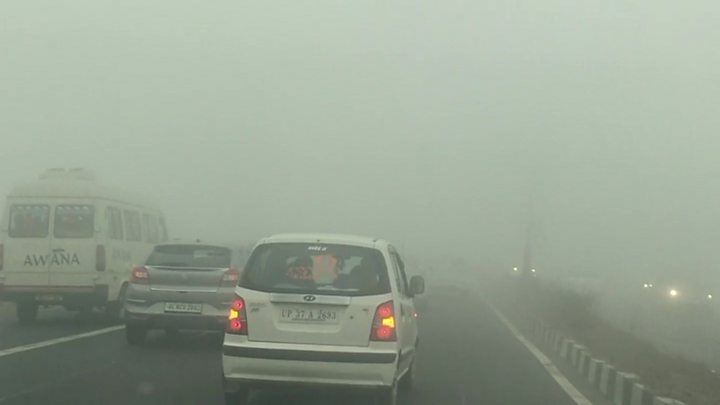
As thick white smog blanketed the city, residents started tweeting pictures of their surroundings. Many are furious that the situation remains the same year after year.
The hashtags #DelhiAirQuality and #FightAgainstDelhiPollition are trending on Twitter.
One of the main reasons for air quality in the city worsening every year in November and December is that farmers in the neighbouring states of Punjab and Haryana burn crop stubble to clear their fields. It’s made worse by the fireworks during the Hindu festival of Diwali.
There are other reasons too, including construction dust, factory and vehicular emissions, but farm fires remain the biggest culprit.
Media caption A hair-raising drive through the Delhi smog
More than two million farmers burn 23 million tonnes of crop residue on some 80,000 sq km of farmland in northern India every winter.
The stubble smoke is a lethal cocktail of particulate matter, carbon dioxide, nitrogen dioxide and sulphur dioxide.
Using satellite data, Harvard University researchers estimated that nearly half of Delhi’s air pollution between 2012 and 2016 was due to stubble burning.
The burning is so widespread that it even shows up in satellite photos from Nasa.
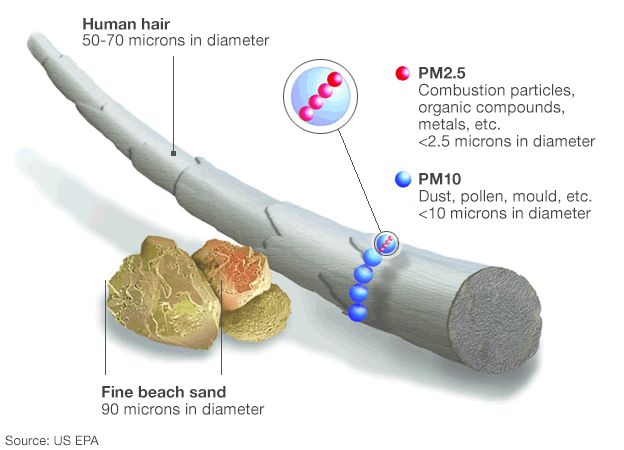
What are PM 2.5 particles?
Particulate matter, or PM, 2.5 is a type of pollution involving fine particles less than 2.5 microns (0.0025mm) in diameter
A second type, PM 10, is of coarser particles with a diameter of up to 10 microns
Some occur naturally – e.g. from dust storms and forest fires, others from human industrial processes
They often consist of fragments that are small enough to reach the lungs or, in the smallest cases, to cross into the bloodstream as well
The trip comes amid growing resistance from European leaders over what they see as China’s failure to change long-term practices unfair to foreign investors
French President’s trip to Beijing follows Chinese leader’s visit to France in March
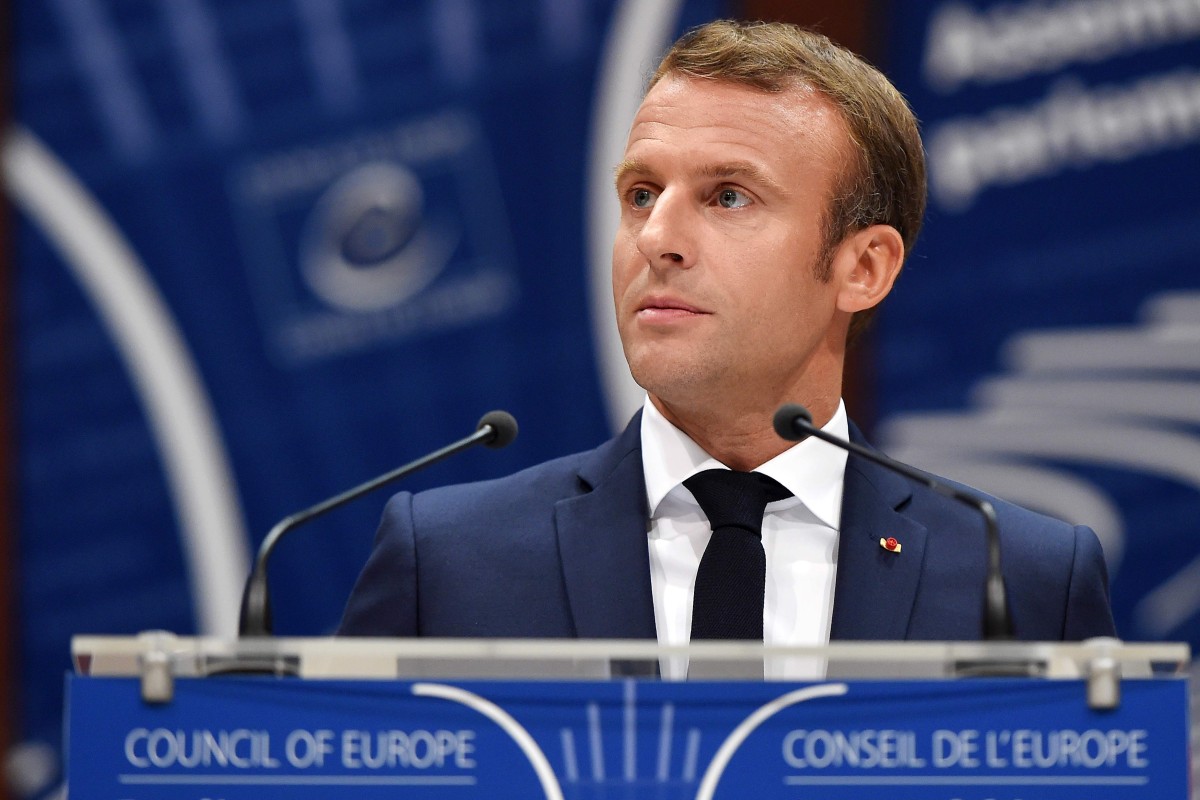
President Emmanuel Macron of France speaks to the Council of Europe parliamentary assembly on Tuesday. Photo: AFP
French President Emmanuel Macron will visit China next month as Europe’s most diplomatically active leader focuses on climate change cooperation and trade promotion with Asia’s leading power, a source briefed on the Elysee Palace’s discussions said.
This will be the second Chinese tour for Macron since he took office in 2017, and it will come amid escalating resistance from European politicians and business communities over what they see as China’s failure to change long-standing practices unfair to foreign investors.
His visit also comes at a time when France – as well as the European Union as a whole – is bracing for Washington’s potential levies of tariffs on European products, and the lack of progress on climate change policies with US President Donald Trump’s administration.
“President Macron will meet President Xi [Jinping], while France strives for better cooperation with China on climate and trade,” the source said. “His itinerary is still in the pipeline, but he is expected to visit Beijing and Shanghai.”
Macron, 41, who is widely seen as emerging as Europe’s most aggressive leader filling the political vacuum left by German Chancellor Angela Merkel’s political twilight, has cast himself as an honest broker between Russia and Ukraine, and between the US and Iran.
He has also been critical of China’s influence in Europe, joining forces with Merkel to push for a tougher EU stance on the world’s second biggest economy.
In March, when Xi claimed a major diplomatic victory by clinching a memorandum of understanding with Italy on the Belt and Road Initiative, Macron declared: “The time of European naivety is ended. For many years we had an uncoordinated approach and China took advantage of our divisions.”
Macron also backed investment screening mechanisms for Chinese business moves in Europe, while endorsing plans to change the EU’s notoriously strict antitrust rules in order to facilitate mergers between large European groups and companies to counter Chinese companies’ global ambitions.
Macron urges Iran and US to show ‘courage of building peace’
The EU is also wary of China’s effort to “divide and rule” the European Union. Greece and Hungary – both recipients of large amounts of Chinese investments – have repeatedly wanted to water down EU’s stance on issues deemed sensitive to Beijing, including the South China Sea and China’s human rights violations.
“It would be good [for Macron] to stress that 17+1 is irritating,” said Joerg Wuttke, president of EU Chamber of Commerce in China, in reference to China’s engagement with a group of EU and non-EU member states in eastern and southeastern Europe.
“After all, the EU has a ‘one China’ policy, [so] EU could expect this position from China too.”
Macron’s domestic call for EU unity has translated into diplomatic appeals, with China being one of the targets.
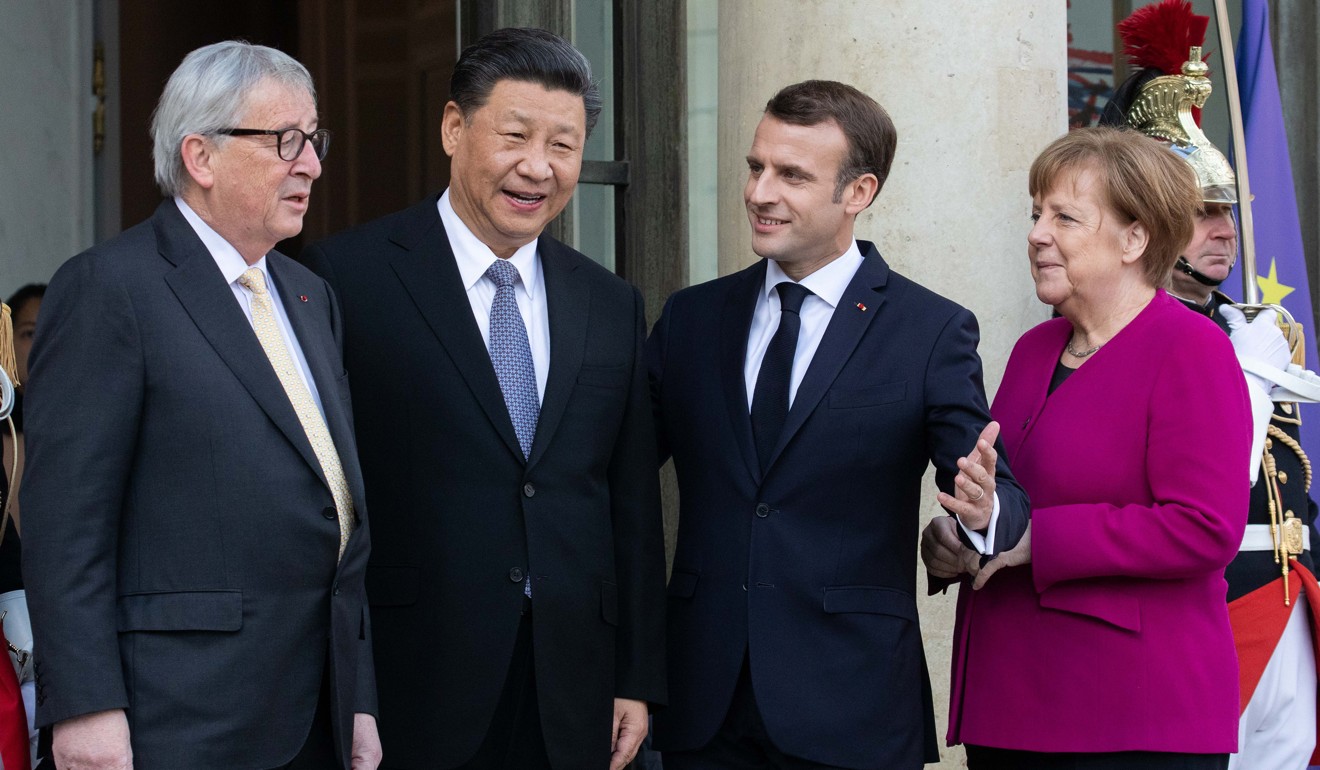
(From left) Jean-Claude Juncker, president of the European Commission; Xi Jinping, China’s leader; Emmanuel Macron, France’s president; and Angela Merkel, Germany’s chancellor, ahead of a meeting in Paris on March 26. Photo: Christophe Morin/Bloomberg
When Xi visited France in March, Macron hosted him at the Elysee Palace in the presence of Merkel and European Commission President Jean-Claude Juncker, showcasing European solidarity when it comes to EU-China policies.
In terms of French-Chinese bilateral ties, trade imbalances have persisted after Macron called for a “rebalancing” during his last visit.
France has a 1.4 per cent market share in China, compared with China’s 9 per cent market share in France. China represents France’s largest bilateral trade deficit, totalling €US$29.2 billion (US$31.9 billion) last year, ahead of Germany.
The EU has been calling for reciprocal investment treatment with China, a call that European business leaders in China expect Macron to make.
France bids farewell to late president Jacques Chirac
“We [Europe] need … a solid investment agreement to allow EU business to conduct their affairs in a similar manner as Chinese companies can operate in Europe. The agreement should be finalised in 2020, but not at all cost,” said Wuttke.
“The last thing EU business needs in China is a weak agreement that institutionalises imbalances,” he added.
Part of that involves building “more efficient defensive tools to prevent abusive technology transfers and to address the deep asymmetry in EU-China relations when it comes to access to public procurement markets,” said Mathieu Duchâtel, director of Asia programme at the Paris-based think tank Institut Montaigne.
Duchâtel added that it was also important to convey the message to Beijing that there are areas for cooperation even amid a more defensive China policy from France.
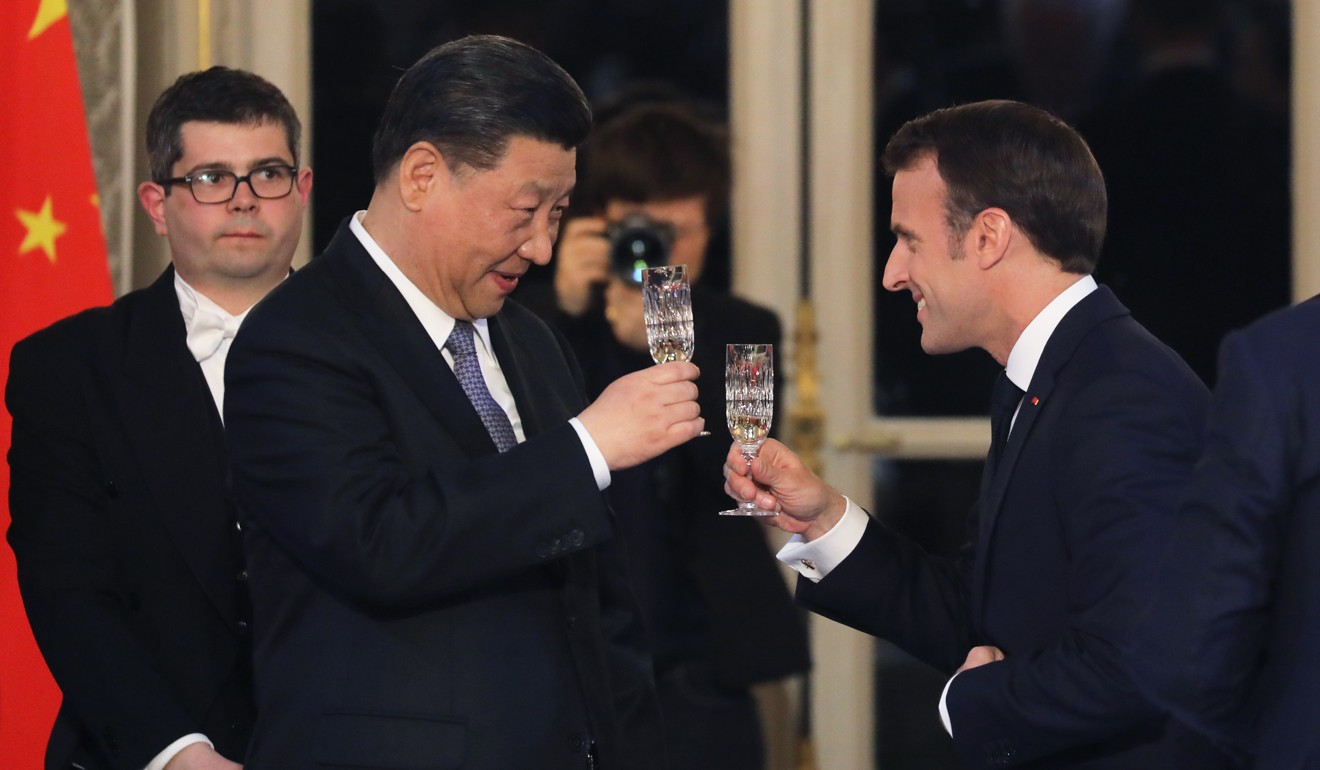
Chinese President Xi Jinping and French leader Emmanuel Macron toast raise a toast during a state dinner in Paris on March 25. Photo: EPA-EFE
One such area is the climate and environment, where China is “an important partner” for France to reach its goal of global carbon neutrality by 2050, he said.
“The energy/environment agenda is a political priority in Paris and one of very few issues on which cooperation with China remains promising and will continue to create business opportunities,” he said.
China is the world’s biggest carbon polluter, producing around 30 per cent of the planet’s man-made carbon dioxide. It remains committed to the 2015 Paris accord on climate change, even after Trump pulled the US out of the deal.
Under the agreement, the long-term temperature goal is to keep the increase in global average temperature to well below 2°C above pre-industrial levels, and to pursue efforts to limit the increase to 1.5°C.
WASHINGTON, Feb. 12 (Xinhua) — Data from NASA satellites have shown that China and India led the way in greening on land, thanks to ambitious tree-planting programs in China and intensive agriculture in both countries.
The study published in the latest edition in Nature Sustainability on Monday showed that at least 25 percent of the foliage expansion since the early 2000s globally came in China.
The researchers from Boston University found that global green leaf area has increased by 5 percent in the new century, an area equivalent to all of the Amazon rainforest.
“China and India account for one-third of the greening, but contain only nine percent of the planet’s land area covered in vegetation,” said lead author Chen Chi of Boston University.
“That is a surprising finding, considering the general notion of land degradation in populous countries from over-exploitation,” said Chen.
Rama Nemani, a research scientist at NASA’s Ames Research Center and a co-author of the study said: “When the greening of the Earth was first observed, we thought it was due to a warmer, wetter climate and fertilization from the added carbon dioxide in the atmosphere.”
But with data from NASA’s Terra and Aqua satellites, scientists realized that humans are also contributing.
“Humans are incredibly resilient. That’s what we see in the satellite data,” said Nemani.
China’s contribution to the global greening trend comes in large part from its programs to conserve and expand forests, accounting for about 42 percent of the greening contribution, according to the study.
Another 32 percent of the greening change in China, and 82 percent in India, resulted from intensive cultivation of food crops, since the farmland in China and India has not changed much since the early 2000s, while both increased their food production to feed large populations.
However, the researchers rang bells as well. They said that the gain in global greenness did not necessarily offset the loss of natural vegetation in tropical regions like Brazil and Indonesia.
The loss of sustainability and biodiversity in those ecosystems cannot be offset by the simple greenness of the landscape, according to the study.


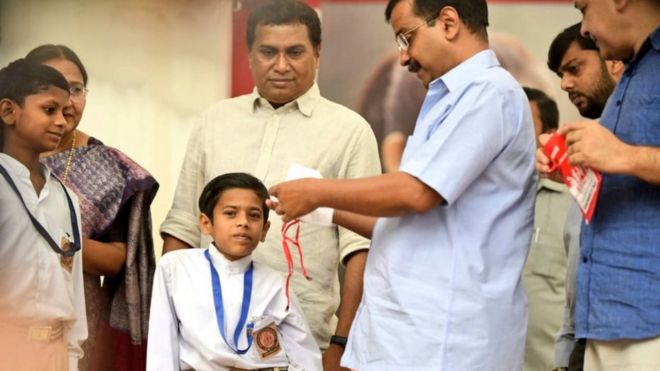 Image copyright TWITTER/@ARVINDKEJRIWAL
 Arvind Kejriwal


 Mrigshira Tripathi@MrigshiraT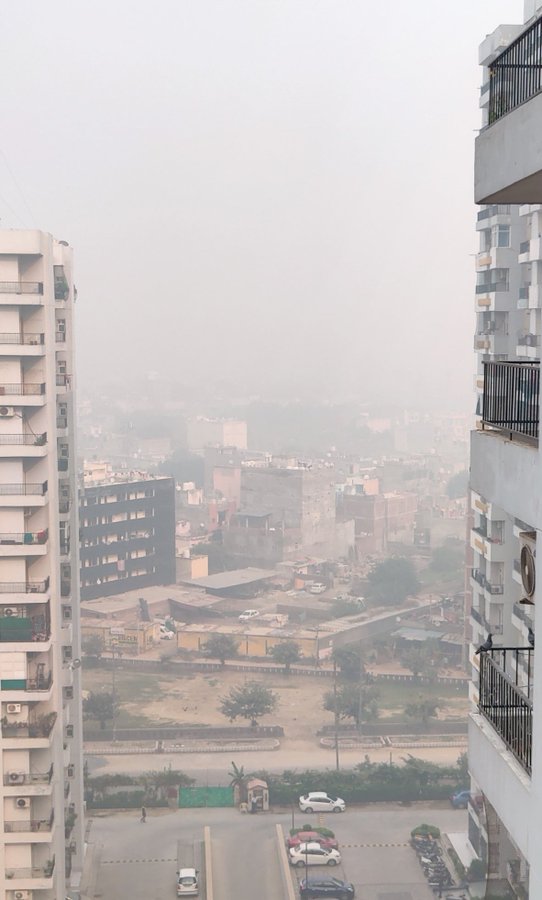
 Kashish Garg@erkashishgarg01
 BihariBabu@mayanksledger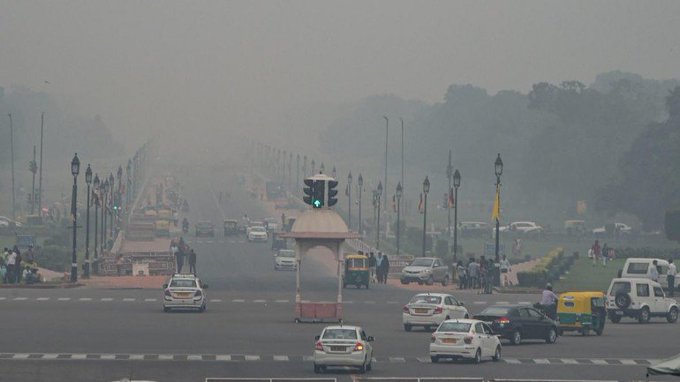
 Vishal L@vishmlondhe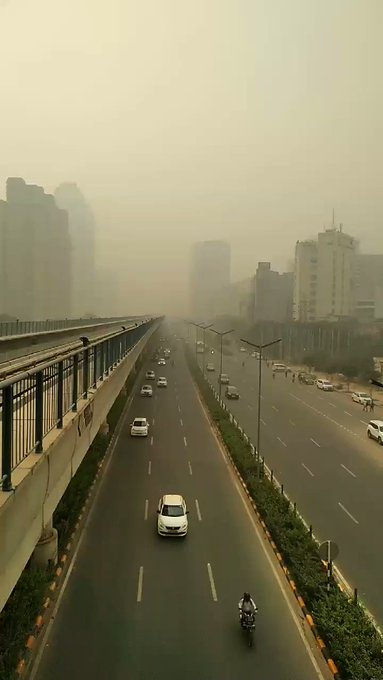

 CHINDIA ALERT: You'll be living in their world, very soon