Chindia Alert: You’ll be Living in their World Very Soon
aims to alert you to the threats and opportunities that China and India present. China and India require serious attention; case of ‘hidden dragon and crouching tiger’.
Without this attention, governments, businesses and, indeed, individuals may find themselves at a great disadvantage sooner rather than later.
The POSTs (front webpages) are mainly 'cuttings' from reliable sources, updated continuously.
The PAGEs (see Tabs, above) attempt to make the information more meaningful by putting some structure to the information we have researched and assembled since 2006.
Pou Chen makes footwear for the likes of Nike and Adidas, but says it has suffered from a lack of orders as global value chains strain under the impact from the virus
Chinese workers moved to Vietnam to help set-up new factories as the company expand its production, but have now become expendable
With the likes of Nike and Adidas closing retail stores around the world to comply with social distancing requirements, analysts also said orders plummeted 50 per cent in the second quarter, although the company declined to comment on the media reports. Photo: Bloomberg
A group of 150 Chinese workers believe the world’s largest maker of trainers used the coronavirus as an excuse to fire them, having helped Taiwanese firm Pou Chen successfully expand its production into Vietnam for more than a decade.
Pou Chen, which makes footwear for the likes of Nike and Adidas, informed the group in late April that they would no longer be needed as they were unable to return to
from their hometowns in China due to the coronavirus lockdowns.
“We believe we contributed greatly to the firm’s relocation process, copying the production line management experience and successful model of China’s factories to Vietnamese factories,” said Dave Zhang, who started working for Pou Chen in Vietnam in 2003.
“Now, when the factories over there have matured, and there is a higher automation level in production, our value has faded in the management’s eyes and we got laid off, in the name of the automation level.”
Rush hour chaos returns to Vietnam’s streets as coronavirus lockdown lifted
The group claims the firm began to fire Chinese employees several years ago, with the total number dropping from over 1,000 at its peak to around 400 last year.
“We 150 employees were the first batch of Chinese employees to be laid off this year. We are all pessimistic and expect more will be cut,” added Zhang.
In its email on April 27, Pou Chen said it was forced to terminate the contracts of the Chinese employees across five of its factories due to an unprecedented decline in orders and financial losses.
The Chinese employees, many of whom have been working for the shoemaker for decades, said the compensation offered was unfair and below the levels required by labour law in both Vietnam and China.
In a further statement to the South China Morning Post, Pou Chen stood by the move as the coronavirus pandemic had reduced demand for footwear products and so required an “adjustment of manpower.”
“[The dismissals were] in accordance with the relevant labour laws of the country of employment … and employee labour contracts,” added the statement from Pou Chen, which employs around 350,000 people worldwide.
Company data showed Pou Chen’s first quarter revenues tumbled 22.4 per cent year-on-year to NT$59.46 billion (US$1.99 billion), the weakest in six years.
With the likes of Nike and Adidas closing retail stores around the world to comply with social distancing requirements, analysts also said orders plummeted 50 per cent in the second quarter, although the company declined to comment on the media reports.
Last month, the company was also mulling pay cuts and furloughs that would affect 3,000 employees in Taiwan and officials based in its overseas factories, according to the Taipei Times.
Andy Zeng, who had worked for the firm since 1995, said the group were “very upset” when they received the news last month as the impact of the coronavirus pandemic began to reverberate around the world, disrupting global value chains.
“Most of us joined Pou Chen in the 1990s when we were in our late teens or early 20s, when the Taiwan-invested company started investing and setting up factories in mainland China. Now more than two decades have passed,” he said.
Zeng was among the first generation of skilled workers in China as Pou Chen developed rapidly, enjoying the benefits of cheap labour, although the workers themselves were rewarded with regular pay rises.
The company needed a group of skilled Chinese workers to go to its new factories in Vietnam. I said yes because I thought it was a good opportunity to see the outside world – Andy Zeng
“I worked at the Dongguan branch of Pou Chen for 11 years from 1995.” Zeng added “In the 1990s and early 2000s, the company expanded rapidly in Dongguan with a growing number of large orders, and every worker had to work hard around the clock. I remember I earned 300 yuan (US$42) a month in 1995, and my monthly salary rose to 1,000 yuan (US$141) in 1998.”
Zeng’s salary eventually rose to over 3,000 yuan in 2005 as China’s economy boomed, leading Pou Chen to seek alternative production sites in Vietnam and Indonesia where labour and land were even cheaper. However, in the early 2000s, the new locations lacked skilled shoe manufacturing workers like Zeng.
“The company needed a group of skilled Chinese workers to go to its new factories in Vietnam. I said yes because I thought it was a good opportunity to see the outside world and the offer of US$700 per month was not bad.” Zeng said.
“We actively cooperated with their plans. Over the past decade, we have been away from our families and hometowns, and followed the company’s strategy to work hard in Vietnam.
With no deaths and cases limited to the hundreds, Vietnam’s Covid-19 response appears to be working
“In 2005, the company sent me to its newly-built factory in Vietnam. This year was my 14th year in Dong Nai in Vietnam. I have witnessed the company’s production capacity in Vietnam become larger and larger. When I arrived, there were only a few production lines, and now there are at least dozens of them, employing more than 10,000 workers in each factory.”
According to a report in the Taipei Times on April 14, citing both Reuters and Bloomberg, Pou Chen was ordered to temporarily shut down one of its units in Vietnam over coronavirus concerns, according to Vietnamese state media.
The company was forced to suspend production for two days after failing to meet local rules on social distancing, Tuoi Tre newspaper reported.
“We Chinese employees actually were pathfinders for the company’s relocation from China to Vietnam,” said Zhang, who was in charge of a 1,700-worker factory producing 1.7 million shoe soles per month.
What our Chinese employees have done in Vietnam for more than a decade can be said to be very simple but very difficult – Dave Zhang
“We were sent to resolve any ‘bottlenecks’ in the production lines that were slowing down the rest of the plant, because during the launch of every new production line, Vietnamese workers would strike and get into disputes. As far as I know, there were over a thousand Chinese employees managing various aspects of the production lines in the company’s Vietnamese factories.
“In fact, what our Chinese employees have done in Vietnam for more than a decade can be said to be very simple but very difficult. That is to teach Vietnamese workers our experience of working on a production line, improve the productivity of the Vietnamese workers, and help the factories become localised.”
Overall, Pou Chen says it produces more than 300 million pairs of shoes per year, accounting for around 20 per cent of the combined wholesale value of the global branded athletic and casual footwear market.
“Because of cultural shock and great pressure to expedite orders, Vietnamese workers were not used to the management style of Taiwan factories,” Zhang added.
“Many of our Chinese employees were beaten by Vietnamese workers [due to cultural differences about work]. During anti-China protests in Vietnam, we were still under great pressure to keep the local production lines operating.”
SHANGHAI (Reuters) – Apple Inc’s (AAPL.O) discounts on the iPhone 11 in China and the release of a new low-price SE model have put the company in a better position than rivals to weather a coronavirus-related plunge in global smartphone demand.
While China, which accounts for roughly 15% of Apple’s revenue, appears to be a rare bright spot, investors will be keen to get a picture of global demand when the Cupertino, California-headquartered company reports second-quarter results on Thursday.
The iPhone maker has shut retail stores in the United States and Europe following the COVID-19 outbreak, and China is the only major market where it has been able to reopen all shops.
Consumer spending is expected to be muted as the pandemic has crippled economies and Apple, the world’s second-most valuable tech company, is better armed with the launch of its new price-conscious iPhone model, analysts said.
“Apple is better positioned than most to experience a rapid recovery in a post COVID world,” Evercore analyst Amit Daryanani said in a research note. “We see demand as pushed out, not canceled.”
He added that the launch of the $399 iPhone SE suggested that Apple’s supply chain was getting back on its feet after weeks of shutdown earlier this year.
Analysts expect Apple to report a 6% drop in revenue and an 11% fall in net income in its fiscal second quarter, according to Refinitiv data.
On the other hand, Chinese brands such as Oppo and Vivo who have steadily moved to offer high-end models to challenge iPhones, stand to lose marketshare as bargain hunters choose Apple.
Earlier this month, several online retailers in China slashed prices of the iPhone 11 by as much as 18% – a tactic Apple has used in the past to boost demand. And while initial social media reaction to the new iPhone SE was muted, analysts said they were seeing a pick up in demand.
The cheaper iPhone SE could tempt iPhone owners to opt for a newer device, something they might have otherwise delayed in a weak economy, said Nicole Peng, who tracks the smartphone sector at research firm Canalys.
“People want to avoid uncertainty in a downturn,” she said. “Having a brand like Apple that can showcase quality and make people less worried about breakdowns or after-sales service can bring in buyers.”
CHEAP IS GOOD
Early data suggests that the Chinese smartphone market is recovering rapidly in the aftermath of the virus, and Apple has emerged relatively unscathed.
Sales of iPhones in China jumped 21% last month from a year earlier and more than three fold from February, government data showed, meaning March-quarter sales in the country were likely to have slipped just 1%.
To be sure, a recovery in Chinese demand won’t offset sales lost in the United States and Europe. And the company is yet to launch a smartphone enabled with 5G wireless technology like those offered by Asian rivals, a disadvantage for Apple so far.
But those same expensive 5G models may not sell well in the current climate of frugality, analysts said.
“If there are no massive subsidies (in China), I doubt there will be many smartphone users who will be eager to upgrade to 5G,” said Linda Sui, who tracks the smartphone sector at research firm Strategy Analytics.
Sui expects iPhone shipments in 2020 to be down 2 percentage points at the most, versus double digit declines at Chinese firms.
Apple also has revenue from its services business to fall back on. It has leveraged its large iPhone customer base to boost services revenue from music, apps, gaming and video.
“Apple’s Services segment should remain resilient in today’s work-from-home environment, thereby demonstrating the durability of Apple’s model,” Cowen analyst Krish Sankar said.
BEIJING (Reuters) – China will cut its subsidies on new energy vehicles (NEV) by 10% this year, and will expand government purchases of NEVs, the finance ministry said on Thursday.
China will in principle cut such subsidies by 20% in 2021 and 30% in 2022, the finance ministry said in a statement. However, it will not cut subsidies on qualified new energy commercial vehicles earmarked for public purposes this year.
Under the plan, China would extend subsidies for NEV purchases to 2022, rather than ending them this year, and extend their purchase tax exemption for two years.
China will slightly lift the requirements for the driving range and power efficiency of cars qualified for the subsidies, the statement said, adding authorities will support the sales of cars with swappable batteries, a technology that has been pursued by Chinese electric vehicle makers Nio Inc (NIO.N) and BAIC BluePark (600733.SS).
Only passenger cars cheaper than 300,000 yuan (34,330.23 pounds) will be offered subsidies, it said. The price is higher than starting price of Tesla Inc’s (TSLA.O) China-made Model 3 sedans.
China also said authorities will give priority to purchase new energy vehicles for government use but did not give further details.
The new policy is effective from April 23. NEVs include battery-powered electric, plug-in hybrid and hydrogen fuel-cell vehicles.
China has set an aggressive goal for NEVs to account for a fifth of auto sales by 2025 compared with the current 5%, as it seeks to reduce pollution and cultivate homegrown champions.
Sales of NEVs, however, contracted for a ninth month in a row in March and were down over 50% from a year earlier, according to data from the China Association of Automobile Manufacturers (CAAM).
Deliveries will start in the next six to 10 months, carmaker says
Tesla will take on Chinese carmakers such as Geely and SAIC, and electric car start-ups including Nio and Xpeng Motors
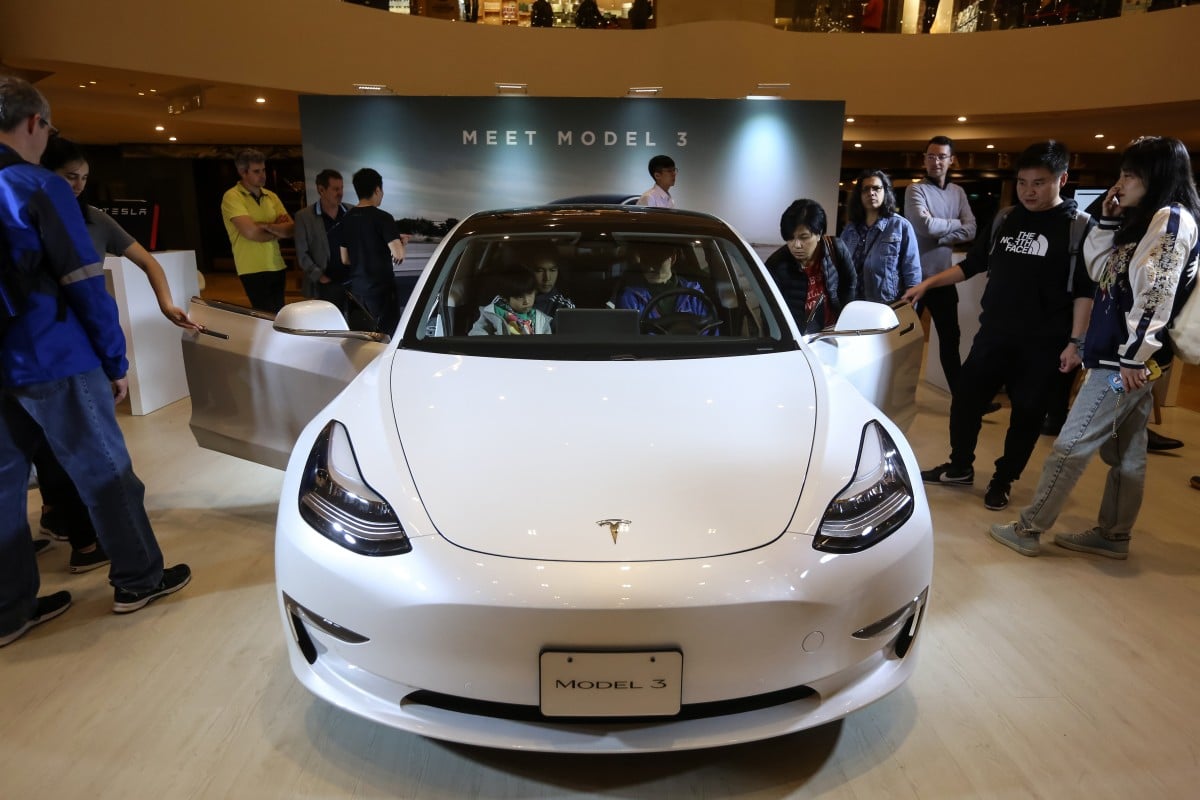
Tesla said on Friday that its Model 3 electric car, which will be assembled in China, will be ready for deliveries in six to 10 months. Photo: AFP
Customers can pre-order the Model 3 assembled in China after Tesla announced on Friday that it would be priced 13 per cent lower than the US imports, taking the electric carmaker a step closer in tapping the world’s largest EV market.
The standard range plus Model 3 car that Tesla plans to assemble at the Gigafactory 3 in Lingang, Shanghai, will be priced at 328,000 yuan (US$47,529), 49,000 yuan cheaper than the same model currently imported from the US.
Tesla’s US-built cars are now subject to a 25 per cent import duty in China. The bestselling US electric carmaker plans to start deliveries in the next six to 10 months.
“Today we announced that Model 3 Standard Range Plus vehicles built at Gigafactory Shanghai will begin at 328,000 yuan for our customers in China,” Tesla said in a statement.
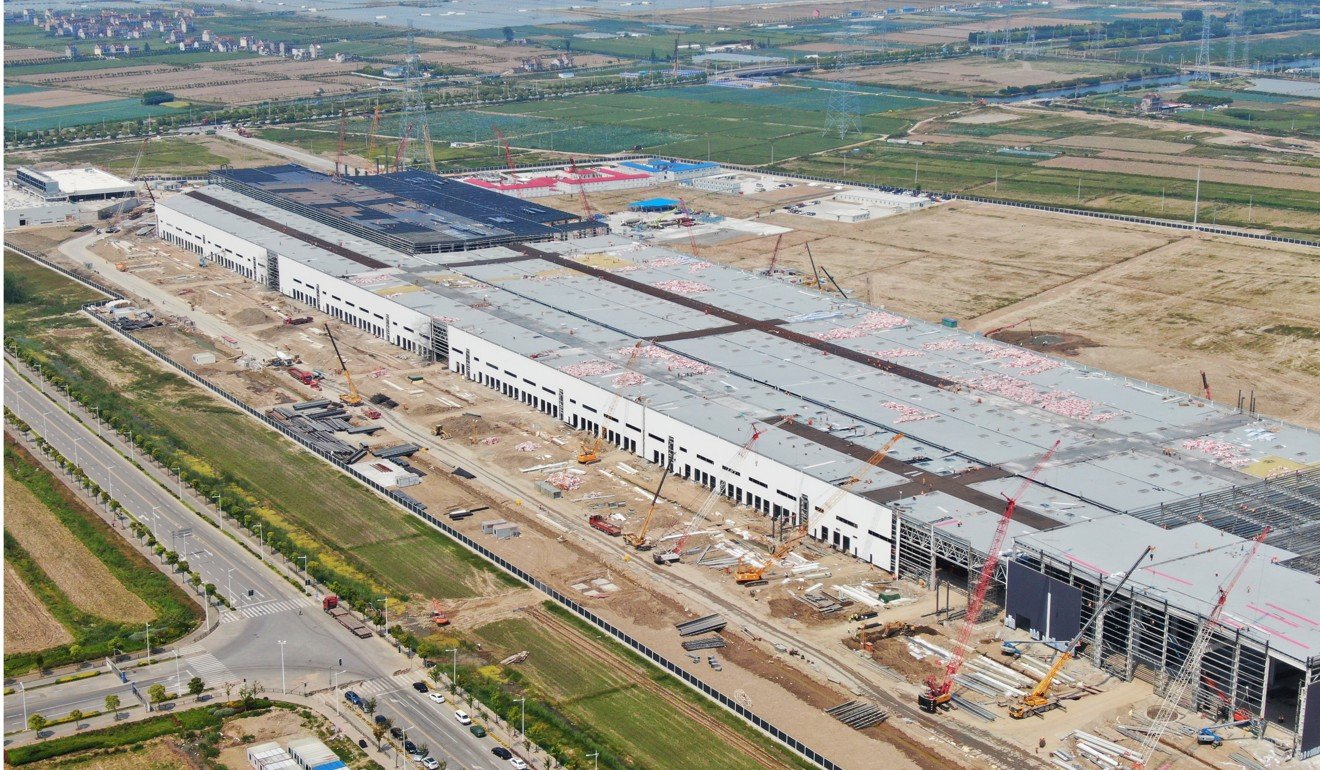
Aerial view of the Tesla Shanghai Gigafactory under construction in Lingang, Shanghai, on May 10, 2019. Photo: Imaginechina
The model has a range of 460km and a top speed of 225km/h.
Industry observers said that the price of the locally made car aimed at the mass market is on the higher side, adding that a 300,000 yuan price tag could attract thousands of Chinese buyers.
“If a Chinese customer can buy a Tesla car for less than 300,000 yuan, many of them will make a decision on the spur of the moment since it is viewed as the best EV in the world,” said Tian Maowei, a sales manager at Shanghai-based Yiyou Auto Service.
Tesla rushes Model 3s to China before trade war truce expires
US President Donald Trump has signed an executive order barring US companies from using telecoms equipment made by companies that pose a threat to national security, a move aimed at shutting out Huawei Technologies.
US technology companies including Google and Microsoft have severed business ties with Huawei to comply with the US trade ban.
Tesla’s Gigafactory 3 is expected to make around 3,000 Model 3 vehicles a week in the initial phase. Photo: AP
In January, Tesla started construction on a US$5 billion wholly-owned plant in Shanghai, the city’s single largest foreign direct investment just three months after it secured a land parcel to make electric cars locally.
The factory will produce Model 3 and Model Y electric vehicles that are seen as affordable to drivers in China.
Podcast: Here’s how the US-China tech war is affecting small electronics companies
Gigafactory 3 is expected to make around 3,000 Model 3 vehicles a week in the initial phase, ramping up to 500,000 per year when it becomes fully operational, Tesla said.
Tesla will take on Chinese carmakers such as Geely and SAIC and electric car start-ups including Nio and Xpeng Motors in China where sales of new-energy vehicles including battery-powered and plug-ins are expected to jump 27 per cent this year to 1.6 million units, according to the China Association of Automobile Manufacturers.
In March Beijing announced a cut in cash subsidies offered to NEV buyers by up to 60 per cent, believing it was time to remove the crutches and cull an industry that had spawned hundreds of small manufacturers.
It is unclear whether Tesla vehicles will receive subsidies from the Chinese government.



 CHINDIA ALERT: You'll be living in their world, very soon
Coronavirus: Chinese workers in Vietnam cry foul after being fired by Taiwanese firm making shoes for Nike, Adidas
A group of 150 Chinese workers believe the world’s largest maker of trainers used the coronavirus as an excuse to fire them, having helped Taiwanese firm Pou Chen successfully expand its production into Vietnam for more than a decade.
Pou Chen, which makes footwear for the likes of Nike and Adidas, informed the group in late April that they would no longer be needed as they were unable to return to
from their hometowns in China due to the coronavirus lockdowns.
“We 150 employees were the first batch of Chinese employees to be laid off this year. We are all pessimistic and expect more will be cut,” added Zhang.
In its email on April 27, Pou Chen said it was forced to terminate the contracts of the Chinese employees across five of its factories due to an unprecedented decline in orders and financial losses.
The Chinese employees, many of whom have been working for the shoemaker for decades, said the compensation offered was unfair and below the levels required by labour law in both Vietnam and China.
“[The dismissals were] in accordance with the relevant labour laws of the country of employment … and employee labour contracts,” added the statement from Pou Chen, which employs around 350,000 people worldwide.
Company data showed Pou Chen’s first quarter revenues tumbled 22.4 per cent year-on-year to NT$59.46 billion (US$1.99 billion), the weakest in six years.
With the likes of Nike and Adidas closing retail stores around the world to comply with social distancing requirements, analysts also said orders plummeted 50 per cent in the second quarter, although the company declined to comment on the media reports.
Andy Zeng, who had worked for the firm since 1995, said the group were “very upset” when they received the news last month as the impact of the coronavirus pandemic began to reverberate around the world, disrupting global value chains.
“Most of us joined Pou Chen in the 1990s when we were in our late teens or early 20s, when the Taiwan-invested company started investing and setting up factories in mainland China. Now more than two decades have passed,” he said.
Zeng was among the first generation of skilled workers in China as Pou Chen developed rapidly, enjoying the benefits of cheap labour, although the workers themselves were rewarded with regular pay rises.
The company needed a group of skilled Chinese workers to go to its new factories in Vietnam. I said yes because I thought it was a good opportunity to see the outside world – Andy Zeng
What our Chinese employees have done in Vietnam for more than a decade can be said to be very simple but very difficult – Dave Zhang
Posted in 50 per cent, accordance, Adidas, adjustment of manpower, around the world, automation level, below the levels, Bloomberg, boomed, bottlenecks, Chaos, cheaper, China, China’s economy, Chinese employees, Chinese workers, closing, comment, Company, compensation, comply, contributed, cooperated, coronavirus, coronavirus lockdowns, Covid-19 response, cry foul, cultural shock, deaths, decade, decline, declined, dismissals, disputes, Dong Nai, Dongguan, employee labour contracts,, expand, expendable, factories, families, financial losses, fired, footwear, furloughs, higher, hometowns, impact, Indonesia, Labour law, lack of orders, land, Mainland China, making, management experience, management style, media reports, Nike, opportunity, orders, pay cuts, pessimistic, plans, plummeted, Pou Chen, production, production line, relocation process, requirements, retail stores, returns, Reuters, Rush hour, second quarter, set up, shoe manufacturing, shoes, skilled, Social distancing, south china morning post, strain under, streets, strike, Taipei Times, Taiwan, Taiwan-invested, Taiwanese firm, Uncategorized, unfair, unprecedented, Vietnam, Vietnamese, Virus, workers, world’s largest maker of trainers | Leave a Comment »