Archive for ‘Cheongdo’

23/02/2020

Korea raises alert to highest level as coronavirus cases jump

SEOUL/SHANGHAI (Reuters) – South Korea raised its disease alert to the highest level on Sunday after a surge in coronavirus infections and two more deaths, while China state media warned the outbreak there had yet to reach a turning point despite some signs of easing.

South Korea’s president said he was putting the country on “red alert” due to the rapid rise in new cases, which are largely being traced back to church services. Health officials reported 169 new infections, bringing the total to 602, having doubled from Friday to Saturday.

The escalation in the alert level allows the government to send extra resources to Daegu city and Cheongdo county, which were designated “special care zones” on Friday.

South Korea’s Yonhap News Agency said it also enables the government to forcibly prevent public activities and order the temporary closure of schools, though the government gave no immediate details on what steps could be taken.

In China, the health commission confirmed 648 new infections – higher than a day earlier – but only 18 were outside of Hubei province, the lowest number outside of the epicenter since authorities started publishing data a month ago and locked down large parts of the country.

But the number of cases continued to climb elsewhere.

Japanese Prime Minister Shinzo Abe instructed government agencies on Sunday to urgently prepare medical provisions and draft a comprehensive plan to curb the spread of the virus, after it reported 27 more cases a day earlier.

The U.S. State Department raised its travel advisory level one notch for South Korea and Japan to Level 2 on a scale of 1 to 4.

Concern about the reach and rapid spread of coronavirus also grew in Europe and the Middle East.

Cases in Italy, Europe’s worst hit country, more than quadrupled to 79 on Saturday, with two deaths.

Iran reported a total of 43 infections, with eight deaths – all since Tuesday – forcing some of its neighbors to announce travel and immigration curbs.

The World Health Organization on Saturday stressed that the number of cases outside of China was still relatively few, but it was worried by the detection of infections without a clear link to China.

The disease has spread to some 26 countries and territories outside China, killing more than a dozen people, according to a Reuters tally. It has been fatal in 2% of reported cases, with the elderly and ill the most vulnerable, according to the WHO.

The potential economic impact of coronavirus was prominent at a meeting of G20 finance ministers in Riyadh, at which the International Monetary Fund chief said China’s 2020 growth would likely be lower at 5.6%, down 0.4 percentage points from its January outlook, with 0.1 percentage points shaved from global growth.

Graphic: Online site for coronavirus news here

Graphic: Tracking the novel coronavirus here

CHURCH CONTAGION

The last time South Korea raised the alert to the highest was 11 years ago during the Influenza A or H1N1 outbreak.

Many of South Korea’s new cases were linked to the Shincheonji Church of Jesus congregation in Daegu after a 61-year-old woman known as “Patient 31” tested positive for the virus last week. The woman had no recent record of overseas travel.

Catholic churches in Daegu and Gwangju have suspended mass and other gatherings, while churches elsewhere saw declines in attendance on Sunday, especially among the elderly.

“If the situation gets worse, I think we’ll need to take more measures. Currently, we’re limiting personal gatherings within the church except for Mass,” said Song Gi-young, 53, wearing a face mask at church.

Heo Young-moo, 88, expressed frustration.

“Devotees shouldn’t go to any risky places … Hasn’t it become so widespread because those people didn’t get checked?”,” he said.

Outside of the church was a sign that said: “All Shincheonji followers are strictly prohibited from entering”.

The foreign ministry said South Koreans aboard a plane to Israel had been denied entry there on Saturday due to concerns about the virus spread.

China said the number of new deaths on Saturday from COVID-19, as the disease caused by the virus is known, was 97, all but one of which were in Hubei.

Eighty-two of those were in the provincial capital Wuhan, where Xinhua news agency said nucleic tests were being carried out on the backlog of cases to try to contain the spread.

In total, China has reported 76,936 cases, and 2,442 deaths. The WHO says the virus is severe or critical in only a fifth of infected patients, and mild in the rest.

Graphic: Reuters graphics on the new coronavirus here

NOT OVER YET

Beijing, Zhejiang, Sichuan had no new infections on Feb. 22 for the first time since the outbreak was detected. There were signs of street life in Shanghai, with some cafes serving take-out food and families wearing masks walking their dogs.

State run television on Sunday urged people to avoid complacency, drawing attention to people gathering in public areas and tourist spots without wearing masks.

Analysts have been closely watching out for any signs of a secondary wave of infections as transport restrictions are eased and many migrant workers return to factories and offices. Business activity in the world’s second-biggest economy is only gradually returning to normal after widespread disruptions.

Japan’s health minister apologized on Saturday after a woman who was allowed to leave the coronavirus-struck Diamond Princess cruise ship tested positive despite having underwent quarantine.

At least 623 cases have been reported on the vessel, the biggest outbreak outside China, involving more than a dozen nationalities.

In Italy, schools and universities were closed and some soccer matches postponed in Lombardy and Veneto, the country’s industrial heartland.

Saudi Arabia, Kuwait, Iraq have travel and immigration curbs on Iran, while Oman on Sunday urged its citizens to steer clear of countries with high infection rates and said arrivals from those nations would be quarantined.

Source: Reuters
22/02/2020

Coronavirus: ‘Narrowing window’ to contain outbreak, WHO says

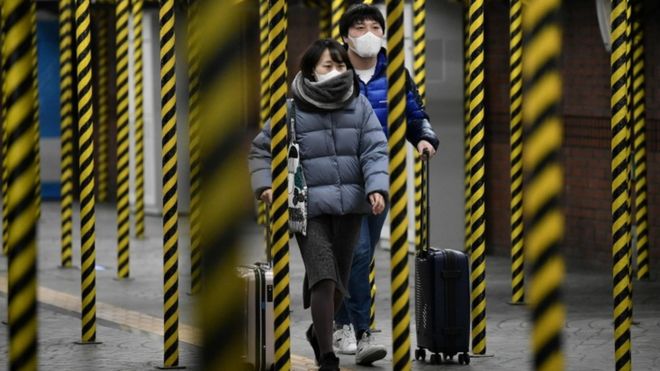
Passengers wearing face masks walk between columns at a subway station being renovated in SeoulImage copyright GETTY IMAGES
Image caption Cases of coronavirus have risen sharply in South Korea, where the outbreak is worsening

The head of the World Health Organization (WHO) has expressed concern at the number of coronavirus cases with no clear link to China or other confirmed cases.

Dr Tedros Adhanom Ghebreyesus said the window of opportunity to contain the virus was “narrowing”.

Chinese health authorities reported a decrease in deaths and new cases of the coronavirus on Saturday.

But cases are on the rise in South Korea, Italy, Iran and other countries.

Outside China, more than 1,200 cases of the virus have been confirmed in 26 countries and there have been eight deaths, the WHO says.

They include two deaths in South Korea, which has the biggest cluster of confirmed cases apart from China and a cruise ship quarantined in Japan.

On Saturday, South Korea reported 142 new confirmed cases of the coronavirus, bringing the national tally to 346.

An evacuation flight carrying 32 British and other European passengers has taken off from Japan and is due to land in England later on Saturday.

On Friday, doctors in Italy said a 78-year-old man became the first person in the country to die from the new coronavirus, Ansa news agency reported.

Earlier Italy had announced 16 more cases and its health minister said schools and offices would be closed and sports events cancelled in the affected regions.

China has reported 76,288 cases including 2,345 deaths. The new virus, which originated last year in Hubei province in China, causes a respiratory disease called Covid-19.

What did the WHO chief say?

Dr Tedros said the number of coronavirus cases outside China was “relatively small” but the pattern of infection was worrying.

“We are concerned about the number of cases with no clear epidemiological link, such as travel history to or contact with a confirmed case,” he said.

The new deaths and infections in Iran were “very concerning”, he said.

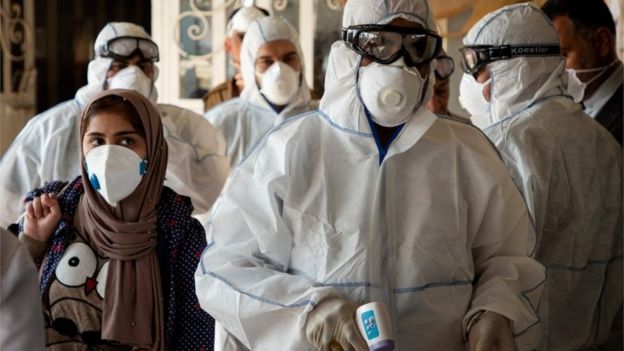
Iraqi medics check people returning from IranImage copyright AFP
Image caption Iraq has been checking people at its border with Iran

But he insisted that the measures China and other countries had put in place meant there was still a “fighting chance” of stopping further spread and called on countries to put more resources into preparing for possible outbreaks.

What is the latest in South Korea?

Prime Minister Chung Sye-kyun declared a public health emergency as the total number of cases surpassed 300 on Saturday.

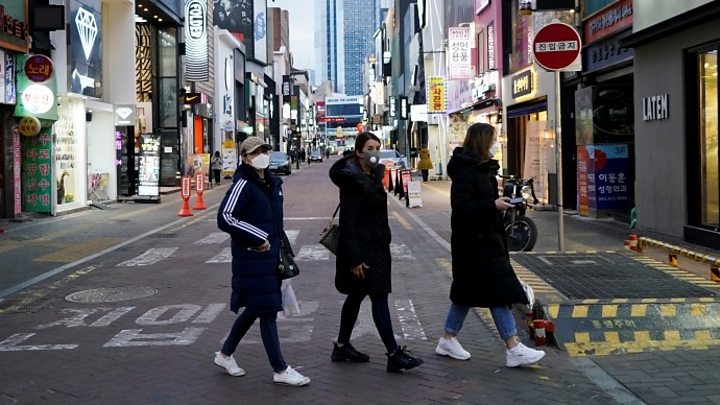
The southern cities of Daegu and Cheongdo have been declared “special care zones”. The streets of Daegu are now largely abandoned.

The nation’s capital, Seoul, banned demonstrations in central areas.

Two cases were also reported in Busan, South Korea’s second-largest city, and one on the Island of Jeju on Saturday – the first in both places.

Media caption People in Daegu have voiced concern over the spread of the virus

All military bases are in lockdown after three soldiers tested positive.

About 9,000 members of a religious group were told to self-quarantine, after the sect was identified as a coronavirus hotbed.

The authorities suspect the current outbreak in South Korea originated in Cheongdo, pointing out that a large number of sect followers attended the funeral of the founder’s brother from 31 January to 2 February.

Presentational white space

The sect – known as Shincheonji – which has been accused of being a cult, said it had now shut down its Daegu branch and that services in other regions would be held online or individually at home.

As of Friday, more than 400 members of the church were showing symptoms of the disease, though tests were still ongoing, the city mayor said.

Can we answer your question on the coronavirus?

Here’s what others have been asking
Once you’ve had coronavirus, will you be immune?
Could the coronavirus become a pandemic?
Is the coronavirus worse than flu or Sars?
Presentational grey line

Hand sanitizers and warning signs

By Hyung Eun Kim, BBC Korean Service, Seoul

Many people in South Korea are wearing masks on a daily basis.

Hand sanitizers have been placed at public transport stops and building entrances.

Warning government signs are everywhere. They say: “Three ways to prevent further infection: wear a mask at all times; wash your hands properly with soap for more than 30 seconds; and cover yourself when coughing.”

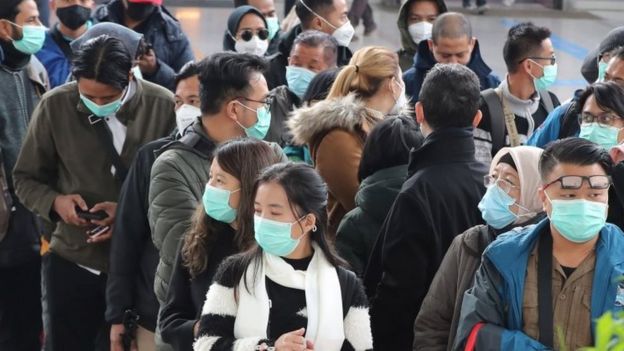
People wear masks in Seoul, South Korea. Photo: 21 February 2020Image copyright EPA
Image caption New norm: Mask-wearing crowd in Seoul

Koreans have also developed several apps and websites that tell you how much risk you face where you are. They show where the infected people are within a 10km radius.

“I can’t miss work, what I can do is minimise contact with others and stay at home during the weekend,” Seung-hye Lim, a Seoul resident, told the BBC.

“I do wonder if we reacted too laxly initially or if it really is because of the specific service practices of the Shincheonji sect.”

So-young Sung, a mother of two in Seoul, told the BBC: “It feels like my daily life is collapsing.”

She said she was struggling to find pharmacies that had masks.

She added that checking coronavirus-related alarms from her children’s schools and kindergartens was now a daily routine for her.

Presentational grey line

What about the Iran cases?

In Iran the outbreak is centred on the holy city of Qom, south of the capital Tehran, which is a popular destination for Shia Muslims in the region.

Iran reported two more deaths in Qom on Friday, adding to the two deaths it reported on Thursday. A total of 18 cases have been confirmed in the country.

Lebanon has reported its first confirmed case – a 45-year-old woman who was detected as she arrived in Beirut from Qom. The UAE, Israel and Egypt have also reported cases.

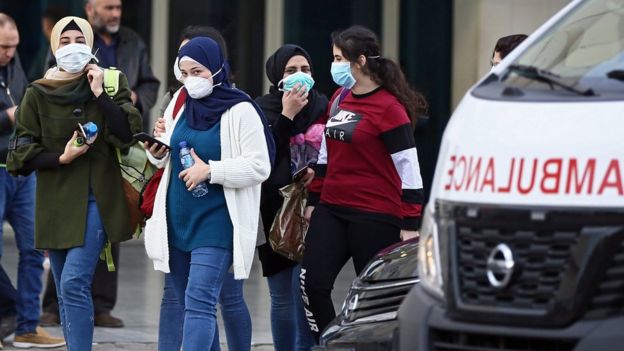
people outside Beirut hospital where the virus patient is being treatedImage copyright EPA
Image caption Lebanon has confirmed its first case – a woman returning from the Iranian city of Qom

Meanwhile Canadian officials said one of the nine cases there was a woman who had recently returned from Iran.

WHO officials said both Iran and Lebanon had the basic capacity to detect the virus and the WHO was contacting them to offer further assistance.

But Dr Tedros said the organisation was concerned about the virus’s possible spread in countries with weaker health systems.

What about China and elsewhere?

The virus has now hit the country’s prison system, with more than 500 inmates confirmed infected.

They include 230 patients in a women’s prison in Wuhan. More cases have been found in a prison in the eastern province of Shandong and the south-eastern province of Zhejiang.

Some 36 people at a hospital in Beijing have also tested positive.

Senior officials have been sacked for mishandling management of the outbreak.

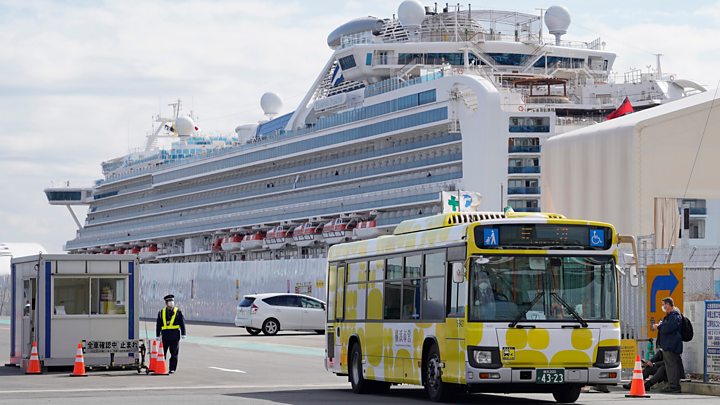
Passengers of the Diamond Princess cruise ship who have tested negative continue to disembark the ship in Yokohama after more than 14 days quarantined on board.

However, 18 American evacuees from the ship tested positive after arriving in the US, officials said. More than 300 other US nationals have arrived back in the US after disembarking.

Media caption Coronavirus: Quarantined passengers released from Japan ship

More than 150 Australian passengers have been evacuated from the ship and have already arrived in Darwin, where they will begin two more weeks of quarantine.

Australian officials said on Friday that six people had reported feeling unwell on arrival in Darwin and were immediately tested. Two of those people tested positive despite having received negative tests before leaving Japan.

The first batch of people from Hong Kong have also flown back to the city, where they will similarly be quarantined.

Source: The BBC

21/02/2020

Coronavirus: South Korea ’emergency’ measures as infections increase

South Korea has stepped up measures to contain the spread of the deadly new coronavirus, as confirmed infections increased sharply for a second day.

PM Chung Sye-kyun said it was now an emergency as 100 new cases and the country’s second death were confirmed.

The southern cities of Daegu and Cheongdo have been declared “special care zones”. The streets of Daegu are now largely abandoned.

All military bases are in lockdown after three soldiers tested positive.

About 9,000 members of a religious group were told to self quarantine, after the sect was identified as a coronavirus hotbed.

The authorities suspect the current outbreak in South Korea originated in Cheongdo, pointing out that a large number of sect followers attended a funeral of the founder’s brother from 31 January to 2 February.

On Friday, a second person who contracted the coronavirus died.

The victim was a woman in her 50s. She died in the south-western city of Busan after being transferred there from a hospital in a nearby country, according to Yonhap news agency.

Reports say she had earlier been a patient at the same mental hospital in Cheongdo as the country’s first victim – an elderly man. Another 15 patients there have also tested positive.

On Thursday, 53 new cases were reported. South Korea now has a total of 204 cases making it the largest cluster outside mainland China and the cruise ship docked off Japan.

The new virus, which originated last year in Hubei province in China, causes a respiratory disease called Covid-19.

What measures are being taken?

From the 100 new cases reported on Friday, 86 were in Daegu, a city 300km (186 miles) south-east of the capital Seoul, and nearly all of those were from a cluster involving the religious sect.

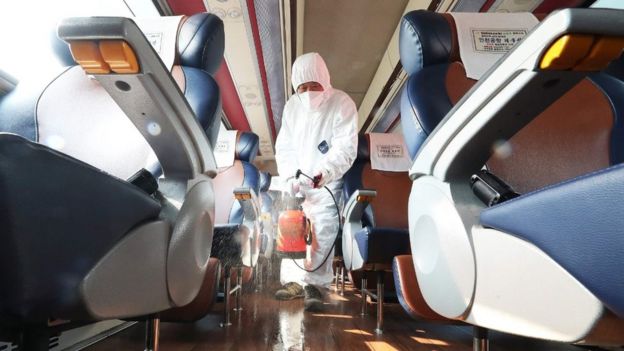
Worker disinfecting a trainImage copyright AFP
Image caption South Korea is trying hard to stop the local spread of the new coronavirus

Reacting to the quickly deteriorating situation, the government promised swift measures to prevent further spread of the virus.

“It is urgent to find people who have contacted infected people and cure patients,” PM Chung said, according to Yonhap.

He said the government was readying resources like sickbeds, medical equipment and health workers and warned the virus was now spreading locally.

“The government has so far focused on curbing infections coming from outside the country. From now on, the government will further prioritise preventing the virus from spreading locally.”

line

Health Minister Park Neung-hoo said authorities would allow hospitals to isolate respiratory patients from others in an effort to prevent any spread within medical institutions.

He also said that all pneumonia patients in Daegu hospitals would be checked for the virus.

What happened in Daegu?

The city’s biggest cluster appears to be at a branch of a religious sect which calls itself the Shincheonji Church of Jesus, Temple of the Tabernacle of the Testimony.

South Korean health officials believe these infections are linked to a 61-year-old woman who tested positive for the virus earlier this week.

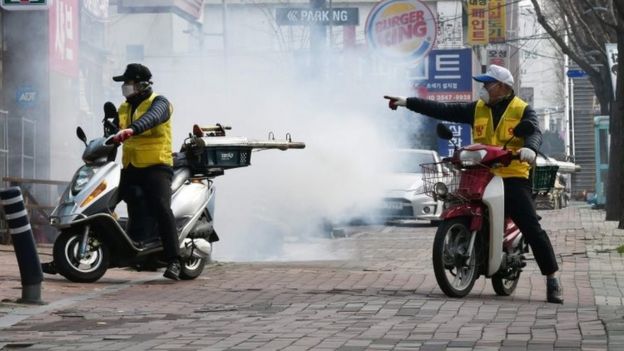
Workers on scooters disinfect the streets of Daegu, South Korea. Photo: 21 February 2020Image copyright AFP/GETTY IMAGES
Image caption Workers have been disinfecting the streets of Daegu, South Korea’s fourth-largest city

The Shincheonji, which has been accused of being a cult, said it had now shut down its Daegu branch and that services in other regions would be held online or individually at home.

As of Friday, more than 400 members of the church were showing symptoms of the disease, though tests were still ongoing, the city mayor said.

Can we answer your question on the coronavirus?

Here’s what others have been asking

Once you’ve had coronavirus, will you be immune?
Could the coronavirus become a pandemic?
Is the coronavirus worse than flu or Sars?

Daegu is the country’s fourth-largest city, with a population of 2.5 million people.

Residents are now being asked to remain at home after authorities described the church cluster as “super-spreading event”.

Presentational grey line

Hand sanitizers and warning signs

By Hyung Eun Kim, BBC Korean Service, Seoul

Many people in South Korea are wearing masks on a daily basis.

Hand sanitizers have been placed at public transport stops and building entrances.

Warning government signs are everywhere. They say: “Three ways to prevent further infection: wear a mask at all times; wash your hands properly with soap for more than 30 seconds; and cover yourself when coughing.”

People wear masks in Seoul, South Korea. Photo: 21 February 2020Image copyright EPA
Image caption New norm: Mask-wearing crowd in Seoul

Koreans have also developed several apps and websites that tell you how much risk you face where you are. They show where the infected people are within a 10km radius.

“I can’t miss work, what I can do is minimise contact with others and stay at home during the weekend,” Seung-hye Lim, a Seoul resident, told the BBC.

“I do wonder if we reacted too laxly initially or if it really is because of the specific service practices of the Shincheonji sect.”

So-young Sung, a mother of two in Seoul, told the BBC: “It feels like my daily life is collapsing.”

She said she was struggling to find pharmacies that had masks.

She added that checking coronavirus-related alarms from her children’s schools and kindergartens was now a daily routine for her.

Presentational grey line

What about China and elsewhere?

The latest figures from China put the death toll from the disease at 2,236 people and total infections at more than 75,000.

The virus has now hit the country’s prison system, with more than 500 inmates confirmed infected.

Senior officials have already been sacked for mishandling management of the outbreak.

The virus has also spread around the globe with more than 1,000 cases and several deaths in the rest of Asia, in Europe, the Middle East, the US and Africa.

On Friday, Iran confirmed 13 new cases, saying that two of those infected had died.

Health ministry official Minou Mohrez was quoted by the state-run Iran news agency as saying the coronavirus has spread to several cities, including the capital Tehran.

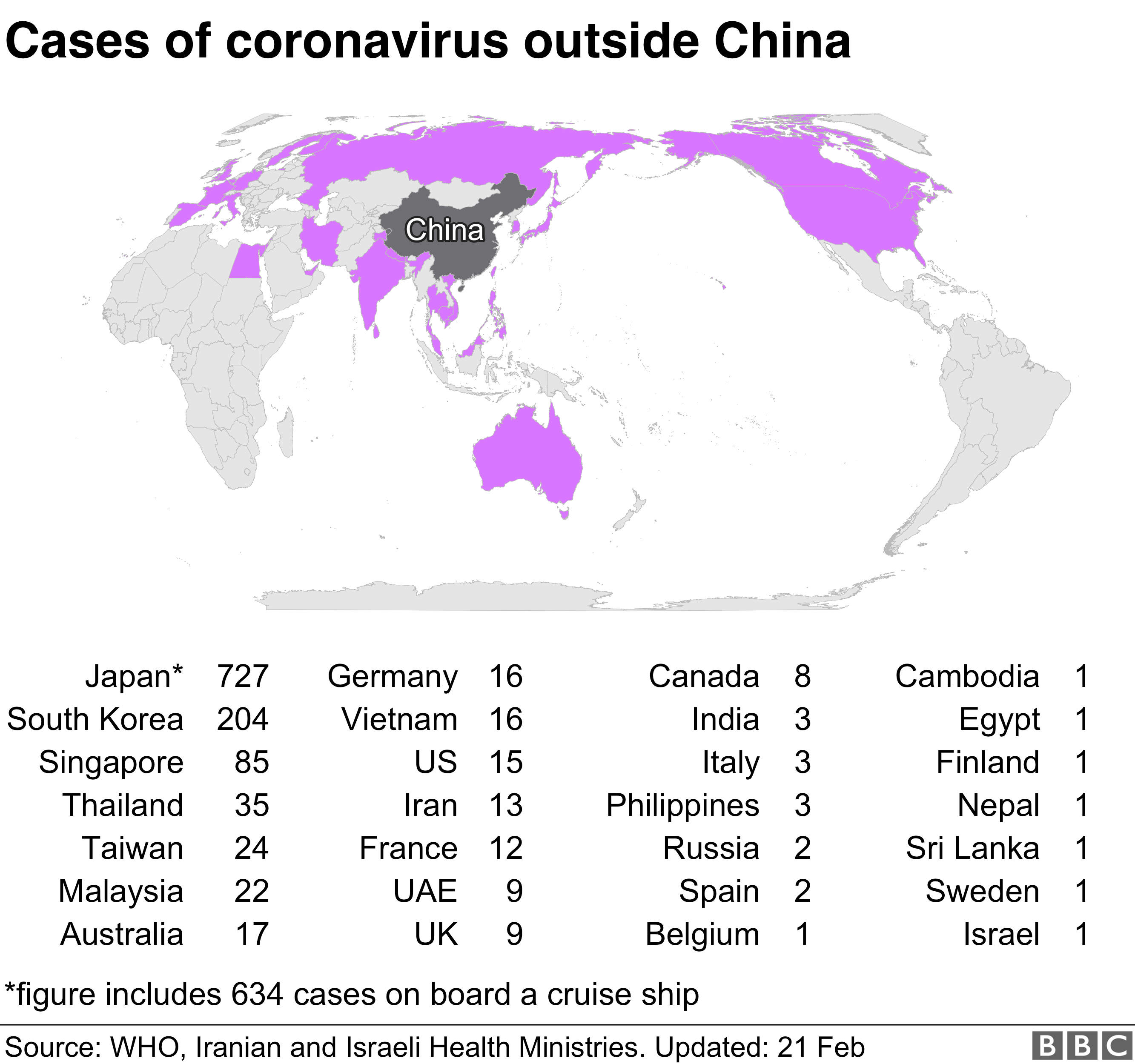
Cases of coronavirus outside China

South Korea is now the worst affected country after mainland China and the more than 600 infections on a cruise ship docked in Japan.

Media caption Coronavirus: Quarantined passengers released from Japan ship

Passengers of the Diamond Princess who have tested negative continue to disembark the ship in Yokohama after more than 14 days quarantined on board.

More than 150 Australian passengers have been evacuated from the ship and have already arrived in Darwin, where they will begin two more weeks of quarantine.

Australian officials said on Friday that six people had reported feeling unwell on arrival in Darwin and were immediately tested.

Two of those people tested positive despite having received negative tests before leaving Japan.

The first batch of people from Hong Kong have also flown back to the city, where they will similarly be quarantined.

Source: The BBC

Law of Unintended Consequences

continuously updated blog about China & India

ChiaHou's Book Reviews

continuously updated blog about China & India

What's wrong with the world; and its economy

continuously updated blog about China & India