Archive for ‘child’

17/11/2019

The truth behind India’s viral photo that got a girl into school

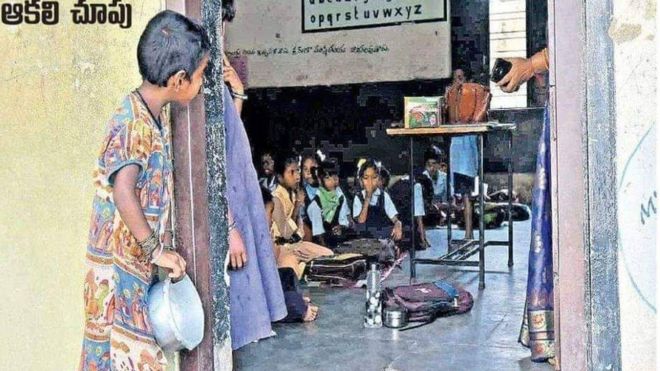
The viral photo in the newspaperImage copyright EENADU NEWSPAPER/A SRINIVAS
Image caption The photo that sparked an outcry

A five-year-old in the southern city of Hyderabad was enrolled in school after a photo of her peeking into a classroom sparked an outcry. BBC Telugu’s Deepthi Bathini reports on why the photo doesn’t tell the full story.

Divya is something of a local celebrity in the slum where she lives. The shy five-year-old was the subject of a recent photo which went viral – it showed her clutching a bowl and peeking into a classroom at the local government school.

The touching image was published in a Telugu newspaper on 7 November with a caption that translates from the Telugu as “hungry gaze”.

It quickly grabbed people’s attention: a children’s rights activist shared it on Facebook, lamenting that yet another child was being denied the right to food and education.

It had such an impact, the school enrolled Divya the following day.

But her father, M Lakshman, says the photo and the outcry it provoked was in fact unfair to him and his wife, Yashoda, who works as a sweeper.
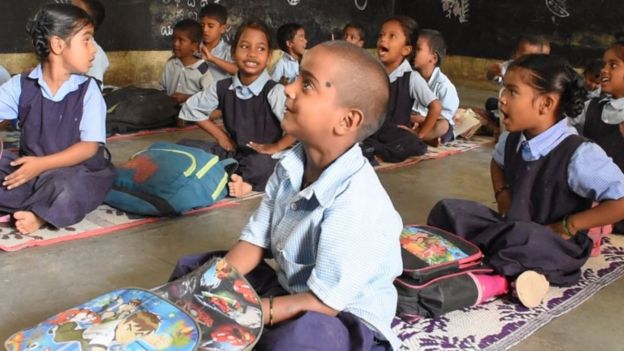
Divya in school
Image caption Five-year-old Divya enrolled in school after a photo of her in a newspaper went viral

“I felt sad when I saw the photo,” he told the BBC. “Divya has parents and we are working so hard to give her a good future – but she was portrayed as a hungry orphan.”

Mr Lakshman says he was waiting for Divya to turn six so he could enrol her in a government hostel where his other two daughters are studying. The couple also have a son, who has finished school and is now applying to college while helping Mr Lakshman, who works as a rag picker.

Breaking the cycle

Divya and her parents live in a one-room hut in a shanty town in the heart of Hyderabad. The slum is about 100 metres from the government school, where Divya was photographed. Most of the 300 families living here are daily wage labourers and their children attend the school nearby.

The home is sparse and plastic and glass are piled outside, ready to be sold for recycling. He says between him and his wife, they earn about 10,000 rupees ($139; £108) a month, which pays for their food and clothes. Education, however, is free for the children, since they are all enrolled in government-run schools.

Mr Lakshman knows what it is to struggle: he himself grew up without parents and always battled to earn a decent living. “I never wanted my children to have the life I had. So I made sure they all go to school.”

The photo, he adds, was especially hurtful because he has also been taking care of his brother’s five children.
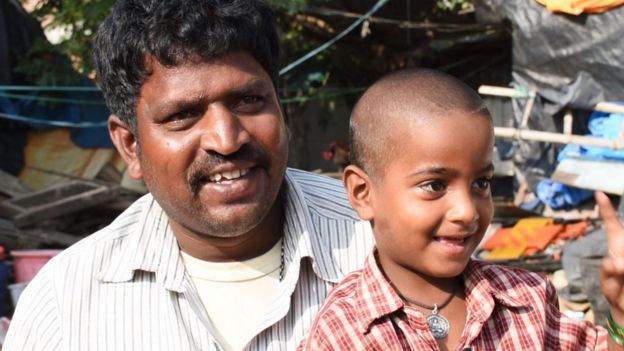
Divya with her father
Image caption Divya’s father said the outcry over the photo was “unfair” to his family

“My brother and sister-in-law passed away sometime ago. I didn’t want their five children to grow up as orphans. So, I enrolled all of them in a hostel and I take care of them.”

When asked why Divya had gone to the government school with a bowl in hand, Mr Lakshman explains that a lot of the younger children from the slum go there around lunch time to take advantage of the free midday meal – a government programme which provides cooked meals to children in more than a million schools – which they know about because their older brothers and sisters are already enrolled.

“Divya doesn’t go every day but she happened to go on that day and someone photographed her,” he explained.

This was confirmed by teachers at the school who told the BBC that some children brought lunch from home, so leftovers over from the free meal scheme would be given to the younger children who had not yet joined.

“Children are children. And there is no day-care centre, so a lot of these children hang around the school anyway,” says one teacher, who spoke on the condition of anonymity.
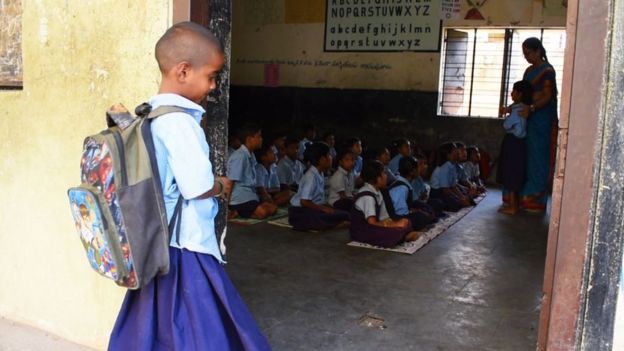
Divya in her new school
Image caption Divya says she’s excited to go to school

Mr Lakshman and his neighbours acknowledged the lack of an anganwadi, or government-sponsored day-care centre, in the neighbourhood was a major problem as parents had no place to leave their children so they could go to work.

The local school inspector, SU Shivram Prasad, says he hopes the attention generated by the Divya’s photo will hasten the process of setting up one up.

“It will help the parents and the children can eat a nutritious meal,” he adds.

Teachers at the school also hope that the media spotlight will improve facilities. They say there is an acute shortage of staff and teaching materials, and the school did not even have a compound wall, which meant they have to constantly watch the children during their breaks.

Divya, however, is excited to be going to school. She insists on taking her school bag with her everywhere, even to the playground. Other than saying her name, she does not answer any questions.

“She is a very calm child,” says Mr Lakshman, as his daughter holds his hand and kisses it.

And he admits that despite everything, the photo did do some good.

“Now other children who are Divya’s age are also enrolling in school. So that makes me happy.”

Source: The BBC

20/09/2019

Chinese woman fined US$28 for tossing coins from plane to ‘cure baby’s diarrhoea’

  • Superstitious medical student, 23, said it was customary in her hometown to throw money for good luck
  • Cousin’s child had fallen ill on flight from Jiangxi to Sichuan, she said
A woman was fined for tossing coins onto the apron at an airport in Sichuan province. Photo: Weibo
A woman who threw coins onto the parking apron at an airport in southwest China in the superstitious belief it might cure her cousin’s baby’s diarrhoea was instead fined 200 yuan (US$28), local media reported.
The incident happened on September 5, as the woman, surnamed Wang, and a group of her relatives arrived in Xichang, Sichuan province, after flying from Nanchang, Jiangxi province, to attend a family wedding, the Chengdu Business News reported on Friday.
Wang, 23, dropped the coins through the gap between the aircraft and the jet bridge as she and her family were disembarking.
Police said the medical student was shocked when she realised the trouble she had caused. Photo: Weibo
Although no one spotted what she had done at the time, airport workers later found three coins on the ground while conducting a security check and reported the matter to the police.
Officers reviewed footage from the airport’s surveillance cameras and identified Wang as the guilty party and went to see her at her hotel the following morning, the report said.

Wang said that during the flight her cousin’s baby had suffered from diarrhoea and that it was customary in her hometown to toss coins in the hope it would bring the child good luck.

“She said she didn’t realise her action could have had a very serious outcome,” a police officer was quoted as saying, adding that Wang appeared shocked when she realised the trouble she had caused.

However, as her actions had not resulted in any delays to flights or created any other problems, she was charged only with a minor offence.

Many Chinese think tossing coins before a flight will bring them good luck. Photo: EPA

Wang, who recently completed a bachelor’s degree in medicine and was preparing to sit a graduate school entrance examination, was worried the incident might have an impact on her future education and job prospects, the officer said.

More than 5,000 people commented on the story on news portal 163.com, with one asking: “You are so superstitious, how can you treat patients?”

In recent years there have been numerous reports of Chinese travellers causing delays and being punished for tossing coins onto airport runways and even into aircraft engines.

In April, a woman was detained for throwing six coins as she was about to board a plane in southern China in the hope it would guarantee her a safe trip.

Source: SCMP

21/02/2019

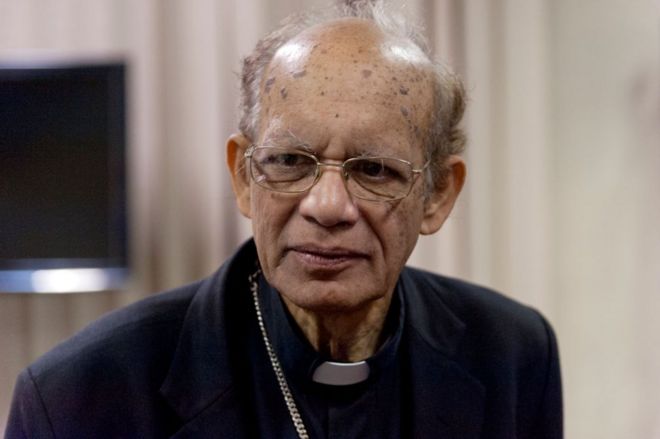
India Catholic Cardinal Oswald Gracias ‘failed abuse victims’

Cardinal Oswald Gracias, Archbishop of Bombay, during the launch of the bishops' declaration on climate justice on 26 October 2018 in Rome, Italy.Image copyrightGETTY IMAGES
Image captionCardinal Oswald Gracias told the BBC it pained him to hear accusations that he had neglected victims of alleged abuse

One of the Catholic Church’s most senior cardinals has admitted that he could have better handled sexual abuse allegations that were brought to him.

Oswald Gracias, the Archbishop of Mumbai is one of four men organising a major Vatican conference on child abuse this week.

We found two separate cases where the cardinal, who is tipped by some to possibly become the next Pope, is claimed to have failed to respond quickly or offer support to the victims.

Victims and those who supported them allege that Cardinal Gracias did not take allegations of abuse seriously when they were reported to him.

India’s Catholics say there is a culture of fear and silence in the Catholic Church about sexual abuse by priests. Those who have dared to speak out say it has been an ordeal.

‘My heart was hurt’

The first case dates back to 2015 in Mumbai.

A woman’s life changed when her son returned from Mass at the church and told her that the parish priest had raped him.

“I could not understand what should I do?” she said. She did not know this yet, but this event would put her on a collision course with the Catholic Church in India.

Media captionWhy is India’s Catholic church silent about sexual abuse?

The man she reached out to for help was and remains one of the most senior representatives of the Church.

It was nearly 72 hours after the alleged rape that the family briefly met Cardinal Gracias, then president of the Catholic Bishop’s Conference of India and Federation of Asian Bishops’ Conferences.

The issue of sexual abuse within the Church is being called the Vatican’s biggest crisis in modern times, and the integrity of the Catholic Church is said to ride on the outcome of this conference.

Pope Francis, flanked by Archbishop of Bombay Cardinal Oswald Gracias (L) and other bishops, arrives at Synod Hall in Vatican City on 24 October 2015Image copyrightGETTY IMAGES
Image captionPope Francis with Cardinal Oswald Gracias (fourth from left)

Over the past year, the Catholic Church has been reeling under multiple allegations of sexual abuse around the world.

But while abuse claims have made headlines in North and South America, Europe and Australia, very little is known about the problems in Asian countries. In countries such as India there is a social stigma about reporting abuse.

Among Christians, who are a minority of nearly 28 million people, a culture of fear and silence makes it impossible to gauge the true scale of the problem.

Cardinal Blase Cupich of Chicago – a colleague of Cardinal Gracias on the four-member organising committee – has promised that decisive action in Rome and in dioceses worldwide will follow after the meeting so as to safeguard children and bring justice to the victims.

Cardinal Gracias will open the second day of the summit with a conversation about accountability in the Church.

Media captionBrigitte, a survivor of child sex abuse by a chaplain, explains why she is ready to speak now

This vital role given to him during this crucial conference has made some in India unhappy.

They say his track record in protecting children and women from abusers is questionable. Those we have spoken to who have taken cases to him say they received little support from him.

The mother of the abused boy said: “I told the cardinal about what the priest had done to my child, that my child was in a lot of pain. So he prayed for us and told us he had to go to Rome…my heart was hurt in that moment.

“As a mother, I had gone to him with great expectations that he would think about my son, give me justice, but he said he had no time, he only cared about going to Rome.”

The family say they requested medical help but were offered none.

The cardinal told us it pained him to hear this, and that he was not aware that the boy needed medical help – and if he had been asked, he would have immediately offered it.

The Archbishop's house in Mumbai

The cardinal admits he left for Rome that night without alerting the authorities.

By failing to call the police, Cardinal Gracias may have violated India’s Protection of Children from Sexual Offences Act, 2012 (POCSO).

The provisions of this law state that if the head of any company or institution fails to report the commission of an offence in respect of a subordinate under his control, they shall be punished with imprisonment for a term which may extend to one year, and with a fine.

The cardinal told us he had telephoned his bishop the next day, who told him the family had subsequently informed the police themselves.

Asked if he regretted not calling the police personally at the time, he said: “You know I’m being honest, I’m not 100% sure… but I must reflect on that. I admit whether immediately, the police should have got involved, sure.”

He says he was under a duty to evaluate the credibility of accusations by speaking to the accused man.

Emerging from that meeting, the family decided to go to a doctor.

“He took one look at my boy and said that something has happened to him. This is a police case. Either you report it or I will… so we went to the police that night,” the mother said.

A police medical examination found that the child had been sexually assaulted.

Indian Catholics pray during Friday afternoon service at the Holy Name Cathedral in Mumbai on 15 March 2013.Image copyrightGETTY IMAGES
Image captionIndia is home to about 19 million Catholics

A current priest who spoke to us on the condition of anonymity said this was not the first time allegations about this priest had been brought to the cardinal’s attention.

“I met him some years before this [alleged] incident,” the priest told us.

“There were strong rumours about [the accused priest] in the diocese, and like these are about abuse that is taking place. And yet he seems to be moving from one place to another, one parish to another. The cardinal told me directly that he is not aware directly of all these things.”

The cardinal says he cannot recall the conversation. He says he did not recollect any “cloud of suspicion” over the man.

‘A lonely battle’

As part of our investigation, we wanted to see if there were other allegations of the cardinal being slow to act.

We found an instance dating back almost a decade, brought to his attention just a couple of years after becoming archbishop of Mumbai.

Virginia Saldanha.
Image captionCatholic activist Virginia Saldanha says three legal notices were sent to the cardinal, threatening court action unless took action about the claims of abuse

In March 2009, a woman approached him with accusations of sexual abuse by another priest who conducted retreats.

She says that he took no action against the priest so she reached out to a group of female Catholic activists, who say they forced the cardinal to act.

Under pressure, he finally set up an enquiry committee in December 2011. Six months after the enquiry, there was still no action and the accused priest continued working in his parish.

“We had to send the cardinal three legal notices to act, threaten to take the matter to the courts if he did not act,” said Virginia Saldanha, a devout Catholic who has worked on the women’s desk of multiple Church-affiliated positions for over two decades.

When the cardinal replied, he said: “The priest is not listening to me.”

Blurred image of family
Image captionThe family says they have been ostracised from the church and isolated within their communities since reporting the sexual assault

During the time, Saldanha said she had to leave the church because “I could not bear to see that man giving Mass in the church. I did not feel like going there.”

The priest was eventually removed from his parish, but the reasons for his departure were never made public.

The punishment, decided by the cardinal personally in October 2011, was a “guided retreat and therapeutic counselling”.

When we pressed him about the speed of process and punishment, the cardinal said it was a “complicated case”.

After a stay in the seminary, the accused priest was briefly given a parish again and still conducts retreats.

Meanwhile, the family of the allegedly raped minor feel abandoned by the institution that they had built their lives around.

“It has been a lonely battle,” the mother concedes. They say they have been ostracised from the church and isolated within their communities.

“After complaining to the police, when we would go into church, people would refuse to talk to us, to sit next to us during Mass. If I went to sit next to someone… they would get up and leave,” she said.

The hostility she encountered eventually “made us leave the church. But it got so difficult for us that we eventually had to change our home as well. We left it all behind”.

Church members say that it is this hostility that makes it harder for victims and their families to speak up.

Caught between an apparently unsupportive clergy and hostile social network, many find their voices faltering.

Source: The BBC

Law of Unintended Consequences

continuously updated blog about China & India

ChiaHou's Book Reviews

continuously updated blog about China & India

What's wrong with the world; and its economy

continuously updated blog about China & India