23/09/2019
BEIJING, Sept. 23 (Xinhua) — Chinese President Xi Jinping extended greetings to farmers and people working in agriculture and rural areas as Monday marked the second Chinese farmers’ harvest festival.
Xi, also general secretary of the Communist Party of China (CPC) Central Committee and chairman of the Central Military Commission, sent his greetings via the China Central Television’s newly-launched channel dedicated to agriculture and rural affairs.
“With a solid foundation laid by agriculture, we have full confidence in development,” Xi said.
The achievements that China has made in the fields related to agriculture, rural areas and farmers are not only the outcomes of concerted efforts of the whole CPC and the country but also the results of hard work of all farmers and people working in agriculture and rural areas, he said.
Xi also congratulated on the launch of the new channel, expecting the channel to publicize agricultural policies, plans as well as new looks of farmers and rural areas in-depth.
Xi also expected the channel to lead the audience to pay attention to agriculture, care for the countryside and farmers, and contribute to poverty alleviation, reform and development in agriculture and the countryside, and the realization of rural revitalization.
The Chinese farmers’ harvest festival is the first national festival created specifically for the country’s farmers. Starting in 2018, the festival coincides with the Autumnal Equinox each year, which is one of the 24 solar terms of the Chinese lunisolar calendar and usually falls between Sept. 22 and 24 during the country’s agricultural harvest season.
The new channel is the first national all-media channel dedicated to agriculture and rural affairs. With daily 18-hour programs, the channel officially began broadcasting on Monday.
Source: Xnhua
Posted in agriculture, Autumnal Equinox, Chairman of the Central Military Commission, China Central Television, China Central Television (CCTV), Chinese lunisolar calendar, Chinese President Xi Jinping, country's farmers, farmers, first national festival, general secretary of the Communist Party of China (CPC) Central Committee, harvest festival, rural areas, Uncategorized |
Leave a Comment »
28/08/2019
- Military insiders say the aircraft appears to have beaten the FC-31 in the race to become the PLA Navy’s fighter of the future
- A military source close said it would be almost impossible to develop both aircraft over the next few years given the risk of an economic downturn
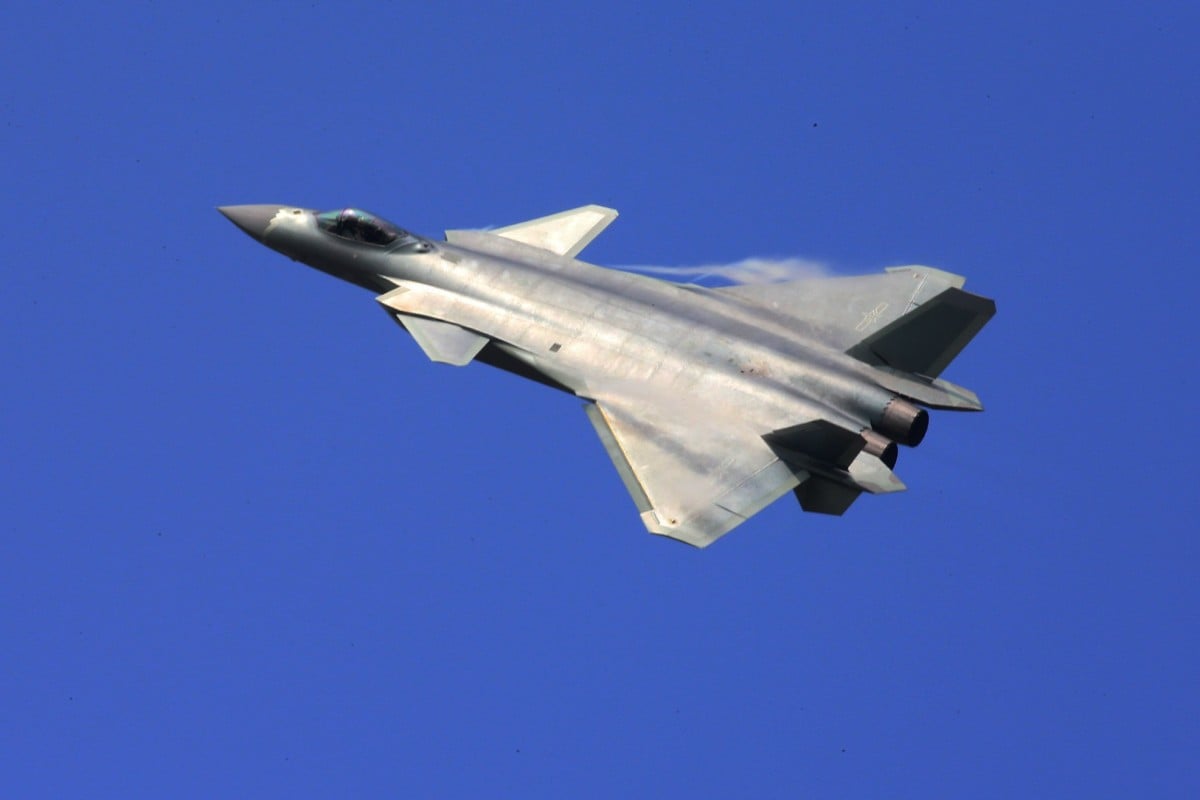
The J-20 stealth fighter is likely to be modified to serve on China’s next generation aircraft carriers. Photo: Xinhua
China’s military is likely to pick the country’s first active stealth fighter, the J-20, for its next generation aircraft carriers, according to military sources and a recent report on state media.
The J-20, made by the Chengdu Aerospace Corporation (CAC), appears to have a won a head-to-head contest with the FC-31, a fighter made by another company which is still undergoing testing.
A military insider told the South China Morning Post that the Central Military Commission, the People’s Liberation Army’s top decision-making body, now favoured adapting the J-20 for its new carriers.
“The Chengdu Aerospace Corporation will announce some new products, which will include a new version of their J-20. You can guess what type it will be,” the military insider, who requested anonymity because of the sensitivity of the subject, said.
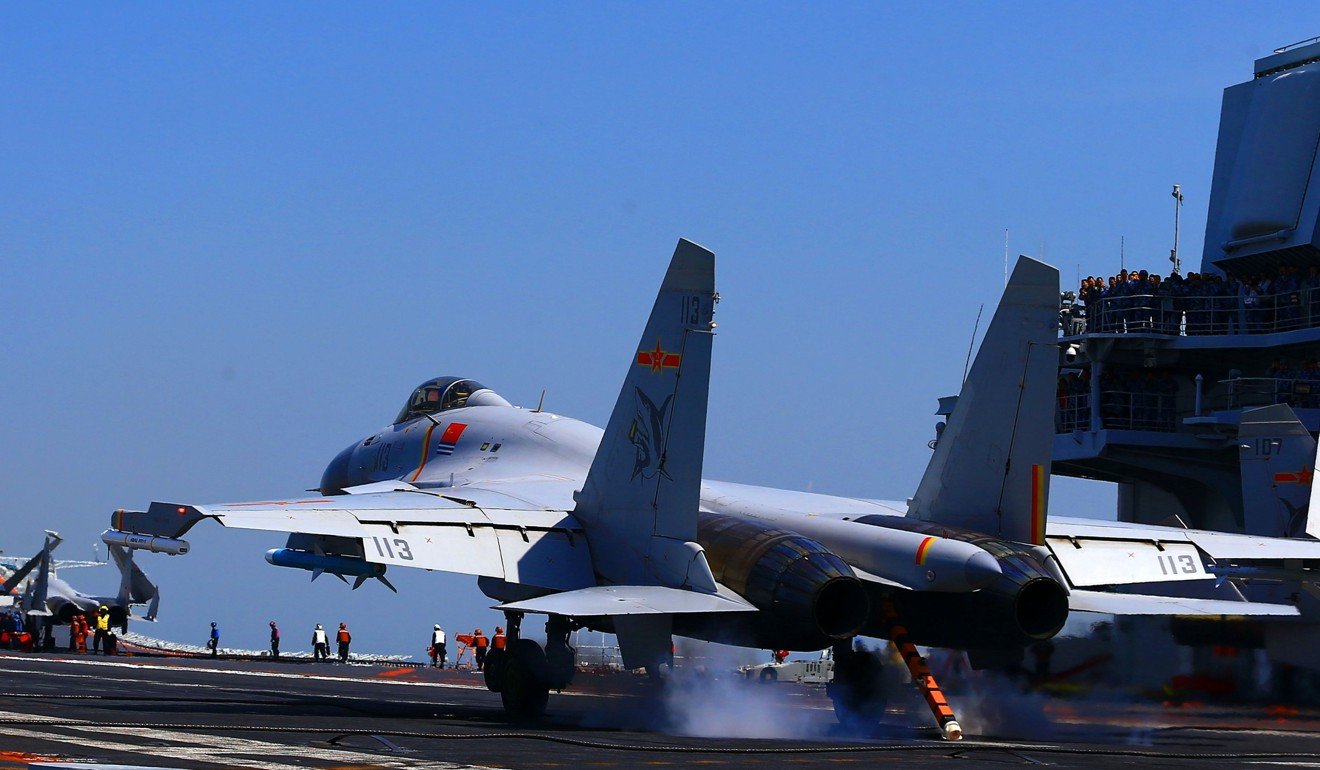
The FC-31 was independently developed by CAC’s sister company Shenyang Aircraft Corporation (SAC), which also produced the J-15 – the jets currently in use on the country’s only active aircraft carrier, the Liaoning.
Both aerospace firms are subsidiaries of the state-owned giant Aviation Industry Corporation of China, which specialises in designing and developing military aircraft, and were set up to ensure benign competition between manufacturers.
However, the SAC has faced criticism from some military leaders and experts for being too conservative and failing to innovate because of its bureaucratic structure.
A recent programme aired by the state broadcaster China Central Television also suggests the J-20 will be chosen.
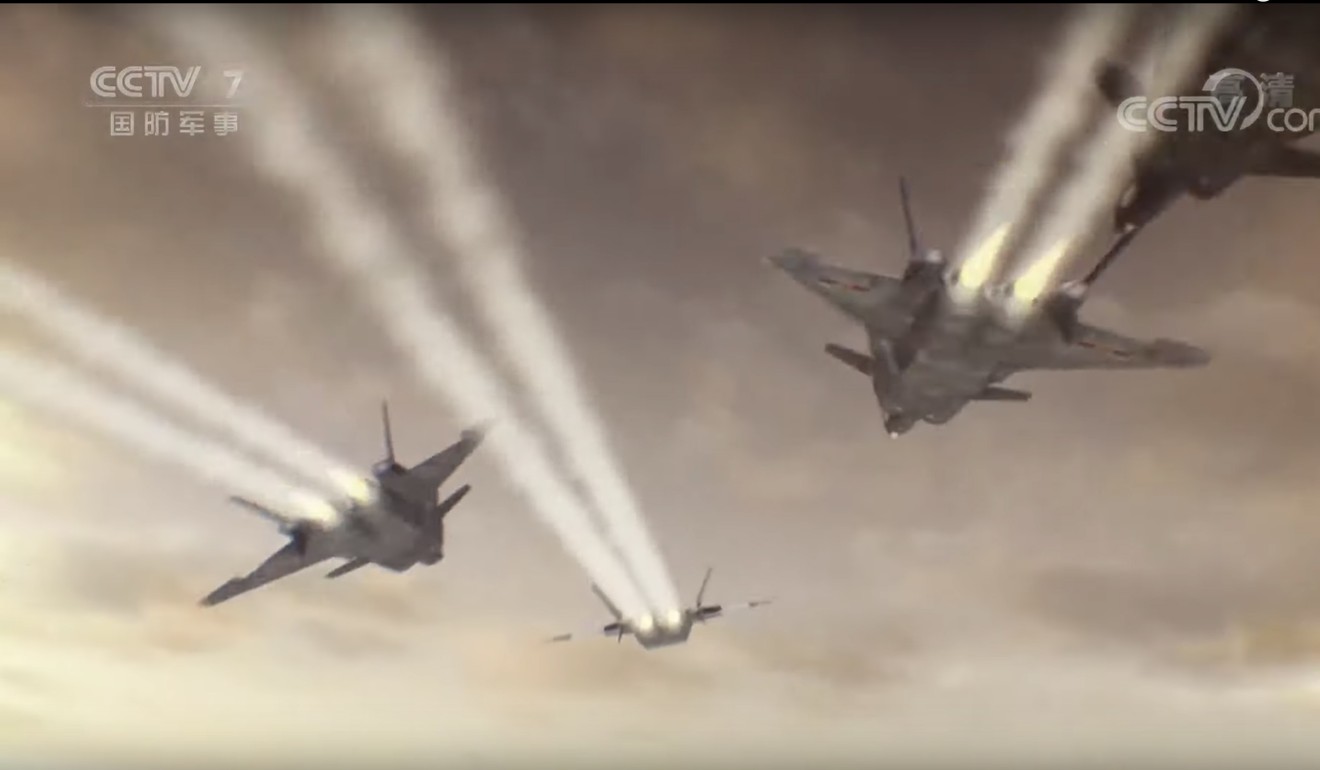
An episode of Military Documentary shown on August 16 reported how the PLA Navy was selecting candidates for pilot training and illustrated the feature with a mock-up of jets that looked like J-20s taking off from a carrier.
Ground-based J-20s – also known as Powerful Dragons – entered service with the PLA Air Force in 2017.
as China stepped up its efforts to counter the deployment of American F-22s and F-35s in the Asia-Pacific region.
A J-15 fighter lands on the Liaoning. Photo: AFP
If the selection of the J-20 is confirmed it will mark the end of a lengthy debate between its supporters and advocates of the FC-31 as to which would make a better carrier-based fighter.
Those who favoured the J-20 said it was more advanced and reliable than the FC-31, but its supporters said it was more light and nimble.
“Both the J-20 and FC-31 have their advantages. The size of the J-20 is similar to the J-15 since both are powerful heavy fighters,” Song Zhongping, a military commentator for Hong Kong-based Phoenix Television, said.
Song said the lighter FC-31 could be developed into a medium-sized carrier fighter that would complement the J-20 in future.
But another military source close to the PLA Navy said it would be almost impossible to develop both aircraft over the next few years given the risk of an economic downturn as the trade war with the US continues to escalate.
A video simulation broadcast on state television earlier this month showed fighters that resembled the J-20 taking off from a carrier. Photo: CCTV
The source said China’s next generation aircraft carriers would be with equipped electromagnetic catapults similar to those used on the US Navy’s Ford-class supercarriers.
These enable the use of heavier fighters because they are more powerful than the older diesel systems used on older carriers.
“The key problem of the J-20 is not weight, but length. If it wants to be a carrier-based fighter jet, it needs to be made shorter.”
Military insiders have previously said that CAC engineers are working to produce a shorter version of the J-20 that will work with the new launch system.
At present both the J-20 and F-31 still rely on Russian engines. The WS-15 engine that has been purpose built for the J-20 has undergone hundreds of hours of testing b
ut has yet to meet reliability targets while the F-31 prototype does not have a purpose-built engine.
China’s navy plans to build at least four carrier battle groups by 2030, three of which will be active at any given time.
Military analysts say China will need at least a decade to develop its new generation carrier-based fighters, so the J-15 will remain in service for at least a decade, if not two.
The J-15 made its maiden flight in 2009 and has been in service since 2012. They are the only fighters based on the Liaoning and will be used by its sister ship the Type 001A when it enters service, probably later this year.
Source: SCMP
Posted in aircraft carriers, Aviation Industry Corporation of China, benign competition, CAC engineers, carrier battle groups, carrier-based fighter, carriers, Central Military Commission, Central Military Commission (CMC), Chengdu Aerospace Corporation, Chengdu Aerospace Corporation (CAC), China Central Television, China Central Television (CCTV), China’s navy, electromagnetic catapults, Ford-class supercarriers, J-20 stealth jets, Liaoning, manufacturers, Military aircraft, Military Documentary, mock-up, new launch system, next generation, People’s Liberation Army, People’s Liberation Army (PLA), Phoenix Television, pick, pilot training, PLA Air Force, pla navy, Powerful Dragons, Russian engines, selecting candidates, Shenyang Aircraft Corporation (SAC), south china morning post, State broadcaster, state broadcaster CCTV, Uncategorized, US Navy |
Leave a Comment »
05/08/2019
- Analysts say mood is shifting in mainland China as demonstrators ‘cross a line’ with national symbols
Staff and students from Pui Kiu Middle School in North Point hold flag-raising ceremony on campus on Monday. Photo: Nora Tam
A Hong Kong protester’s decision to tear down a Chinese flag and throw it in Victoria Harbour on Saturday set off an outpouring of criticism, from Chinese internet users and celebrities to pro-Beijing businesses and schools in the city.
Then on Monday at about 7pm, a group of protesters went to the same flagstaff in Tsim Sha Tsui, tore down the flag again and threw it into the harbour, the second such incident in three days. In both cases, the protesters escaped.
In North Point, the Pui Kiu Middle School organised a flag-raising ceremony at the campus on Monday even though the school was officially on summer holidays.
Principal Ng Wun-kit said teachers and students were called back on short notice to take part.
“We saw [on the news] that some rioters in helmets threw the Chinese national flag in the harbour and we strongly condemn such behaviour. It was disrespectful,” Ng said.
“We wanted to show that we are one of the 1.4 billion Chinese people who want to protect the national flag. We hope that the students, teachers, and [Hong Kong] citizens who love the country and the Chinese Communist Party can respect the Chinese flag.”
Other Hong Kong businesses and organisations flying the Chinese flag on Monday included international hotel chain Courtyard by Marriott Hong Kong, Chinese engineering firm Shanghai Zhenhua Heavy Industries and Chinese pharmaceutical giant Beijing Tong Ren Tang.
Beijing’s Hong Kong affairs office condemns protesters who threw Chinese flag in the sea
A spokeswoman from the hotel chain said it had flown the flag for many years and Monday was no exception.
“We display the flag because we are a Chinese-funded company. We do not have plans to take it down any time soon,” she said.
On Sunday, a group of Beijing supporters sang the national anthem and raised the Chinese flag in Tsim Sha Tsui to replace the one taken down.
On microblogging site Weibo, mainland Chinese and Hong Kong celebrities were among those forwarding pictures of the flag or salutes to it, adding the hashtag “the Chinese national flag has 1.4 billion flag bearers”, a topic started by China Central Television (CCTV) on Sunday. As of Monday night, the trending topic had been read more than 2 billion times, with more than 8 million posts and support from Hong Kong actors Jackie Chan, Jordan Chan Siu-chun and Hawick Lau Hoi-Wai.
In a commentary published online on Sunday, CCTV said the topic had attracted a strong response because patriotism ran deep among the Chinese people.
“We protect the flag, the national emblem, our country, and we protect our country like we protect our own homes,” it said.
Hong Kong Chief Executive Carrie Lam blasts violence at Yuen Long and liaison office, amid further extradition bill unrest
Analysts said the mood on Chinese social media had changed as protesters in Hong Kong vandalised symbols of the central government, crossing a line for most mainland Chinese.
Wang Jiangyu, an associate law professor at the National University of Singapore, said that although many mainlanders had admired Hong Kong and sympathised with its civil movements in the past, the situation had changed.
“The Chinese flag being insulted is on the top of a list of things mainlanders dislike, and for state media, which represent the central government’s position, focusing on such issues can frame the protesters as enemies of the Chinese nation or the people,” Wang said.
“It can increase the hatred of mainlanders towards the Hong Kong protesters and gain support for the central government to take action in the future.”
Ma Ngok, a political scientist at Chinese University of Hong Kong, said mainland media were using the incident to achieve their own propaganda purposes.
“Mainland media made it seem like [the flag protest was] the theme for the whole movement … but it does not represent the main demands of the anti-extradition movement. They are turning single actions into broad propaganda, and biasing mainland sentiment about Hong Kong,” Ma said.
Source: SCMP
Posted in Beijing Tong Ren Tang, businesses, campus, Carrie Lam, celebrities, Central government, China Central Television (CCTV), chinese communist party, Chinese flag, Chinese University of Hong Kong, Courtyard, flag-raising ceremony, Hong Kong, Hong Kong Chief Executive, Jackie Chan, mainland media, Marriott Hong Kong, National University of Singapore, North Point district, patriotic stand, propaganda purposes, Protest, Pui Kiu Middle School, school, Shanghai Zhenhua Heavy Industries, Tsim Sha Tsui, Uncategorized, vandalised symbols, Victoria Harbour, Weibo |
Leave a Comment »




 CHINDIA ALERT: You'll be living in their world, very soon