Chindia Alert: You’ll be Living in their World Very Soon
aims to alert you to the threats and opportunities that China and India present. China and India require serious attention; case of ‘hidden dragon and crouching tiger’.
Without this attention, governments, businesses and, indeed, individuals may find themselves at a great disadvantage sooner rather than later.
The POSTs (front webpages) are mainly 'cuttings' from reliable sources, updated continuously.
The PAGEs (see Tabs, above) attempt to make the information more meaningful by putting some structure to the information we have researched and assembled since 2006.
KATHMANDU, March 29 (Xinhua) — The emergency epidemic prevention materials donated by the Chinese side arrived here on Sunday to help Nepal fight the COVID-19 pandemic.
The supplies that arrived at Tribhuvan International Airport in Nepali capital city Kathmandu in the wee hours of Sunday were formally handed over to the Nepali Health Minister Bhanu Bhakta Dhakal by the Chinese Ambassador to Nepal Hou Yanqi.
Dhakal welcomed the Chinese support and expressed gratitude to the northern neighbor for helping the Himalayan country overcome the epidemic.
“I would like to thank the Chinese people and the Chinese government for supporting Nepal in this difficult time to fight the COVID-19,” the minister said during the handover ceremony.
At a time when many countries are fighting against this battle, China keeping Nepal in the priority list and sending supplies immediately is really commendable, the minister expressed, adding that Nepal expects China’s support in the coming days as well.
The donations from China’s Sichuan Province and the Chinese Embassy include different kinds of masks, thermometers, Chloroquine phosphate tablets, protective clothing and portable ventilators weighing 1.1 tons.
Similarly, the donation from Alibaba Foundation, Jack Ma Foundation includes 100,200 N95 masks and 20,064 PCR test kits weighing 1.4 tons.
“We will try our best to send other necessary supplies as soon as possible. In case of any emergency, we can send a medical expert team or arrange a video conference meeting as well to help the health workers here,” the Chinese ambassador said.
She also welcomed the national lockdown enforced by the Nepal government, stating that it has received encouraging support from the general public.
Nepal is reportedly in dire need for medical supplies as the entire situation escalates in the country. Nepal, facing the shortage of test kits and personal protective equipment for health workers, has recorded five confirmed cases of the COVID-19 so far.
But there is a growing concern over a possible spike in the cases due to the relatively low number of tests. Nepal has enforced a week-long nationwide lockdown since March 24 to prevent the spread of infection.
The health ministry said that the received support materials will be distributed to federal and provincial levels hospitals immediately and will be useful for the prevention and management of the COVID-19 in Nepal.
Mahendra Shrestha, director general at the Department of Health Services under the Health Ministry, told Xinhua on Saturday, “The procured test kits from China will help us in the situation of spike in positive cases of the COVID-19.”
Throughout the world, overworked health care professionals are being infected with Covid-19, yet the Lion City has kept numbers low
Preparation, planning, patient ratios and protective equipment have all played a part. Still, even the best gear cannot guard against discrimination
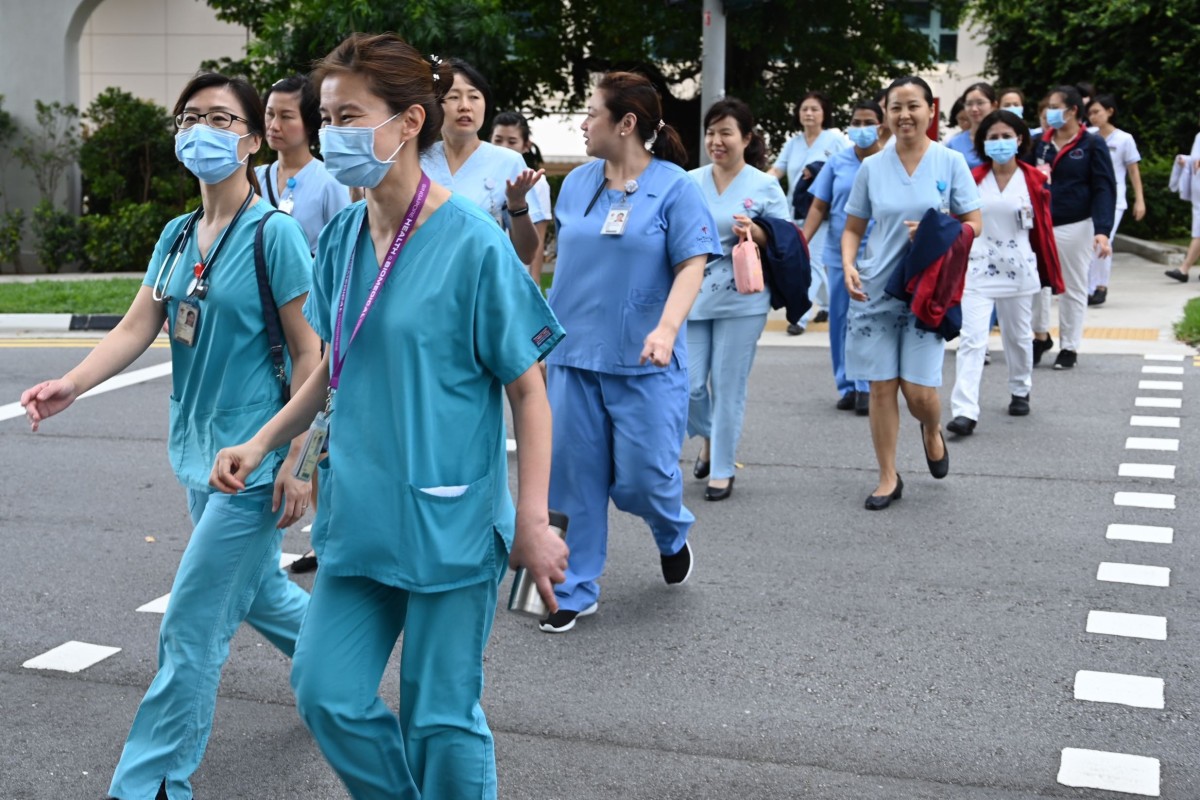
Medical staff walk to the National Centre for Infectious Diseases building at Tan Tock Seng Hospital in Singapore. Photo: AFP
Uncooperative patients, long hours and a lack of protective equipment are hampering health care workers across the world as they take the fight to the coronavirus, leading many to fall sick themselves.
In Malaysia, a pregnant woman who did not disclose that her father was infected tested positive after giving birth, leading to the shutdown of the entire hospital for cleaning. In the Philippines, nine doctors have died, two of whom had dealt with a patient who lied about her travel history.
In Spain, where more than 5,400 health care workers have been infected, accounting for about 14 per cent of the country’s patients, there are no longer enough workers to care for patients.
In Italy, which has more than 69,000 patients, the virus killed a doctor who had no choice but to work without gloves.
In the United States, which has surpassed China to become the world’s most infected nation with more than 83,000 people testing positive for Covid-19, hospitals are being overrun with patients.
Health care staff in the country say patients are packed into emergency wards and intensive care units (ICUs), further raising the risk of infections. They also report shortages of ventilators, face masks, gowns and shields.
The US Centres for Disease Control and Prevention on March 7 released interim guidelines saying health care workers exposed to the coronavirus could be asked to return to work as long as they wore face masks and were not showing symptoms, if their employers had no other manpower available.
Malaysian health workers at Kuala Lumpur International Airport. Photo: AFP
A REASON FOR OPTIMISM
However, amid all the gloom, Singapore’s experienceis being held up as a reason for optimism. The city state has reported more than 630 cases of infection, all of which are being treated in hospital, yet only a handful of its health care professionals have been infected. What’s more, even these cases, according to Vernon Lee, director of communicable diseases at the Ministry of Health, are thought to have been infected outside the health care setting.
Experts suggest this has been more than just luck, pointing to a case in which 41 health workers were exposed to the coronavirus in a Singapore hospital yet evaded infection.
The workers had all come within two metres of a middle-aged man with Covid-19 who was being intubated, a procedure which involves a tube being inserted into the patient’s trachea. The procedure is seen as being particularly hazardous for health workers as it is “aerosol generating” – patients are likely to cough.
The workers had not known at the time that the man had the virus and all were quarantined after he tested positive. However, on their release two weeks later, none of them had the virus.
Coronavirus: as Malaysia braces for third wave, doctors make their own face masks
27 Mar 2020
The case has come to widespread attention partly because the workers were wearing a mix of standard surgical masks and the N95 mask, which doctors see as the gold standard as it filters out 95 per cent of airborne particles.
The conclusion, published in The Annals of Internal Medicine this month, was this: “That none of the health care workers in this situation acquired infection suggests that surgical masks, hand hygiene, and other standard procedures protected them from being infected.”
Surgeon and writer Atul Gawande mentioned the case in an article for The New Yorker on how health care workers could continue seeing patients without becoming patients. He said there were things to learn from Asia and that some of the lessons came out of the “standard public health playbook”. In other words, there is much to be said for social distancing, basic hand hygiene and cleaning regimens.
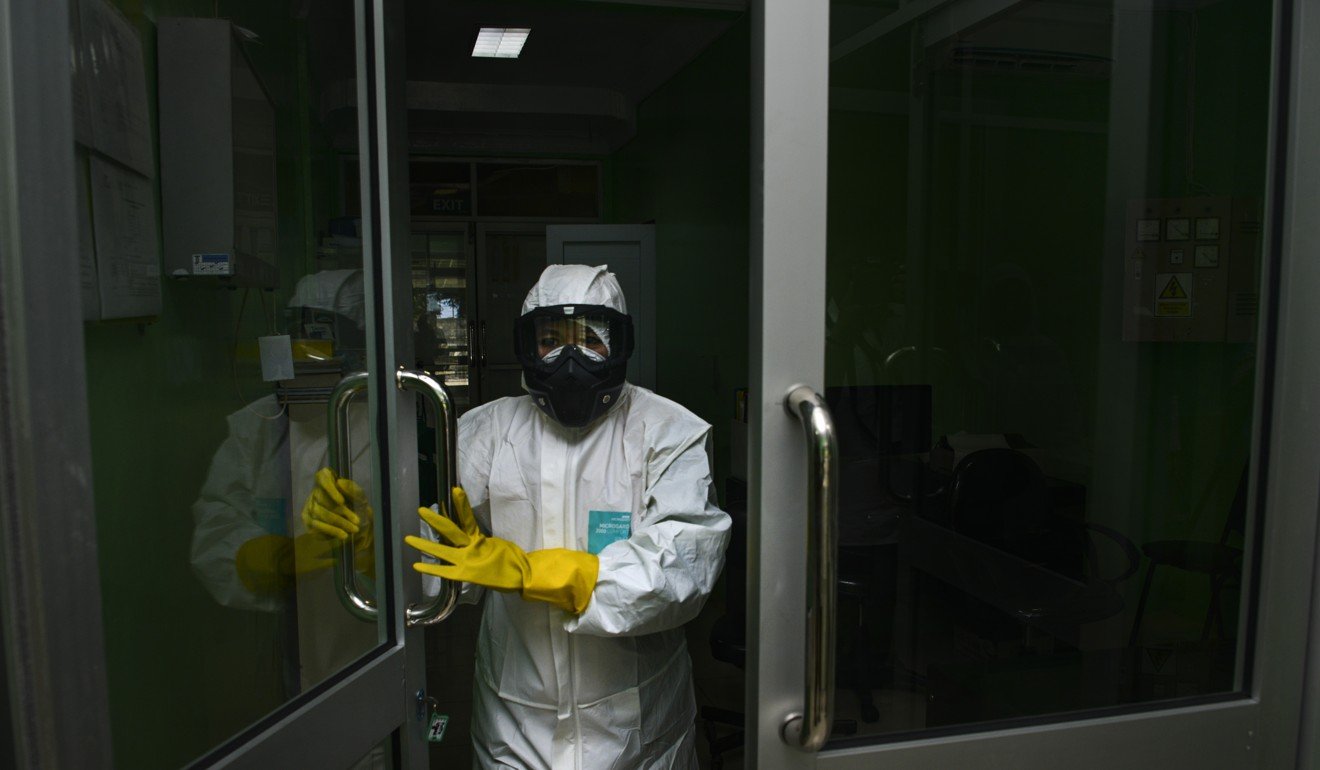
A health worker in protective gear walks into a quarantine room at a hospital in Banda Aceh, Indonesia. Photo: AFP
COMING TOGETHER
With critical supplies running short in many countries, experts say it is increasingly vital that countries share both knowledge and resources.
To this end, China has been donating personal protective equipment to places including the Philippines, Pakistan and Europe. China’s richest man Jack Ma is donating 1.8 million masks, 210,000 Covid-19 test kits and 36,000 pieces of protective clothing to 10 countries in Asia.
At the same time, doctors are encouraging the Western world to learn from Asia.
Infectious diseases expert Leong Hoe Nam said that being “bitten by Sars” (severe acute respiratory syndrome) in 2003 had prepared Asia for Covid-19, while Western countries were not similarly prepared and hence lacked sufficient protective equipment.
He pointed to how about 2,000 health care workers had fallen sick in China early in the outbreak because workers did not initially have protective gear. The trend reversed as equipment became available.
“Once the defences were up, there were very few health care workers who fell sick at work. Rather, they fell sick from contact with sick individuals outside the workplace,” he said.
Malaysia is a case in point. While it has reported 80 health care workers falling ill, most are thought to be community infections.
Coronavirus: Doctor explains the proper way to wash your hands and put on a face mask
In a webinar organised by Caixin Global on Thursday night, Peng Zhiyong, an intensive care specialist at Zhongnan Hospital of Wuhan University, shared how they managed a shortage of personal protective equipment early on in the outbreak by rationing workers to two sets of gear per shift.
Meanwhile, in the Philippines, doctors from Manila’s Chinese General Hospital held a video conference call with doctors in Zhejiang to learn from China’s experience of treating Covid-19 patients.
Crowdsourcing platforms have also been created to share advice. The Brigham and Women’s Hospital in Boston has released guidelines for treating critically ill patients and its website includes information from Chinese doctors.
Why Singapore’s coronavirus response worked – and what we can all learn
27 Mar 2020
The Jack Ma Foundation has also launched an online platform for doctors and nurses around the world to share knowledge on fighting the virus. “One world, one fight,” it said in a tweet.
Associate Professor Jeremy Lim from the global health programme at the Saw Swee Hock School of Public Health said it was crucial for countries to work together.
“Viruses don’t respect borders. Countries have to share information and help each other as we are only as strong as the weakest link. Any country can become a reservoir of disease and the world may then be forced to endure a ping-pong of outbreaks over and over again.”
And the advice of Lee, at Singapore’s Ministry of Health? “Practise good hygiene and wash hands regularly.”
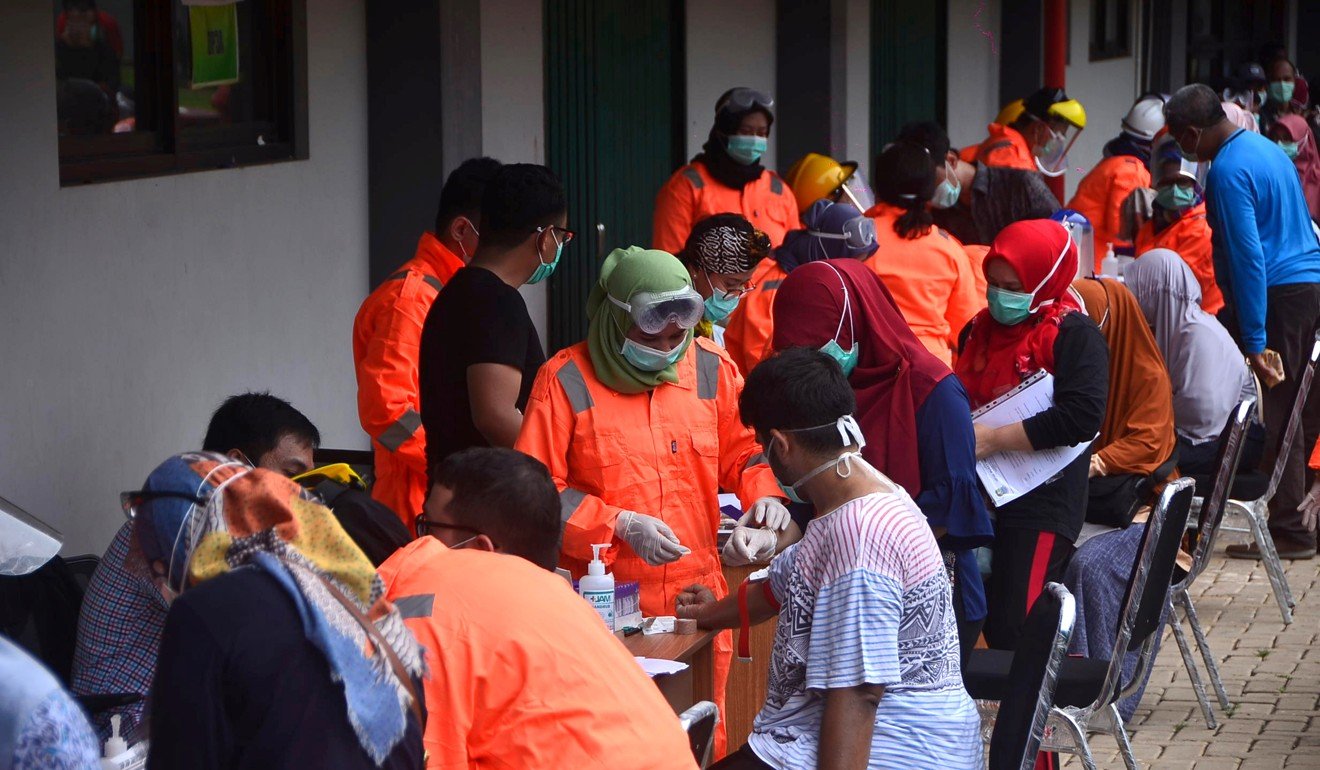
Indonesian medical staff administer mass testing for Covid-19 in Bekasi, West Java. Photo: AFP
SINGAPORE, A CASE STUDY
Amid this sharing of advice, it is often Singapore that is held up as an example to replicate. Despite the country grappling with a rising load of Covid-19 patients, most of whom have recently returned to the city state from abroad, its health care system has continued to run smoothly. Doctors say this is because it has been preparing for a pandemic ever since Sars caught it by surprise. During the Sars outbreak, health care workers accounted for 41 per cent of Singapore’s 238 infections.
Consequently its hospitals swung into contingency planning mode early on in the coronavirus outbreak, telling staff to defer leave and travel plans after its first cases emerged.
Meanwhile, its hospitals swiftly split their workforces into teams to ensure there were enough workers if the outbreak worsened, and to ensure workers got enough rest.
Singapore has 13,766 doctors, or 2.4 doctors for every 1,000 people. That compares to 2.59 in the US, 1.78 in China and 4.2 in Germany. Places like Myanmar and Thailand have fewer than one doctor for every 1,000 people.
Coronavirus: Covid-19 could live on in Indonesia long after world recovers
22 Mar 2020
“The objective is that you can run essential services with the greatest amount of security. Make sure functional units have redundancy built in, and are separate from each other. It depends on what you feel is sufficient to carry on services if one team is affected, factoring in rest periods and some system of rotation,” said Chia Shi-Lu, an orthopaedic surgeon.
The key is to ensure a good doctor-to-patient ratio and ensure there are enough specialists for the critical work, such as doctors and nurses who can provide intensive care, and know how to operate mechanical ventilators or machines to pump and oxygenate a patient’s blood outside the body.
At the emergency department where paediatrics emergency specialist Jade Kua treats Covid-19 cases in addition to regular emergencies, doctors are split into four teams of 21. Each team takes alternate 12-hour shifts and does not interact with other teams.
“We are in modular teams so the teams move together. So you and I would both do morning, off, night, off, morning off. Together. And then the other teams would do the same and we don’t intermingle,” said Kua.
US now has world’s most coronavirus cases, surpassing China
Chia, who works at the Singapore General Hospital, said doctors had been split up according to their functions.
“We try not to meet at all with the other teams as much as possible. We’ll just say hi from across the corridor. Meals are the same. All our cafeterias and everything have got social distancing spaced in already,” said Chia, who is also a member of parliament and chairs a shadow committee on health.
Chia said the health care system could also tap on doctors in the private sector.
Not every country has a plan like this. Last year’s Global Health Security Index by the Economist Intelligence Unit found that 70 per cent of 195 countries scored poorly when it came to having a national plan for dealing with epidemics or pandemics. Almost three in 10 had failed to identify which areas were insufficiently staffed. In India, with a population of 1.3 billion, only about 20,000 doctors are trained in key areas such as critical care, emergency medicine and pulmonology.
Singapore, Hong Kong, Taiwan: the real coronavirus world leaders
19 Mar 2020
In contrast, Singapore published its first Influenza Pandemic Preparedness and Response Plan in June 2005 and has since honed it to a tee. Hospitals regularly war-game scenarios such as pandemics or terrorist attacks and the simulations are sometimes observed by the Ministry of Health, which grades the performance and recommends areas for improvement.
The plan also covers the need to stockpile equipment to avoid the sort of shortages many countries are now facing, another lesson inspired by Sars when masks, gloves and gowns were in short supply.
In a pandemic preparation paper published in 2008, Singapore public health specialist Jeffery Cutter wrote that Singapore’s stockpile was sufficient to cover at least 5 to 6 months’ use by all front-line health care workers.
During the Covid-19 outbreak, it has also told citizens to not wear masks so it can conserve supply for medical staff.
Having enough protective gear has reassured Singapore’s health care workers such as Kua, a mother of six who blogged about her experience fighting Covid-19. Kua said: “I’m safe and my family is safe.”
India’s poor hit hard by 21-day nationwide lockdown amid the coronavirus pandemic
SOMETHING YOU CAN’T GUARD AGAINST
Despite the many positives to emerge from the Lion City, its health care workers are struggling with another problem: discrimination.
While in France, Italy and Britain, residents cheer health care workers from their windows, in Singapore health care workers are seen by some people as disease carriers.
“I try not to wear my uniform home because you never know what kind of incidents you may encounter,” said one Singapore nurse. “The public is scared and wearing our uniforms actually causes quite a bit of inconvenience. One of my staff tried to book a private-hire car to the hospital for an emergency and she was rejected by five drivers.”
There is a similar stigma in India, where the All India Institute of Medical Sciences has appealed to the government for help after health workers were forced out of their homes by panicked landlords and housing societies.
“Many doctors are stranded on the roads with all their luggage, nowhere to go, across the country,” the institute said in a letter.
Lim, from the Saw Swee Hock School of Public Health, said the worst human impulses and “every man for himself” attitudes could emerge in crises and “that is exactly why governments have to step in”.
Discrimination could affect both the performance and motivation of health care workers, Lim warned.
Meanwhile, when health care workers are infected, it creates a “triple whammy” threat.
“It means one fewer professional in an already-strained system, another patient to care for and, potentially, a team of colleagues who need to be quarantined,” said Lim.
“We must do everything possible to keep our health care workforce safe and free from Covid-19.” ■
Anyone caught breaking Singapore’s social distancing rules could be jailed from Friday, as the city state ramped up its coronavirus defence and announced the introduction of distance learning for schools.
Under updates to its powerful infectious diseases law, anyone who intentionally sits less than 1 metre away from another person in a public place or on a fixed seat demarcated as not to be occupied, or who stands in a queue less than a metre away from another, will be guilty of an offence.
Offenders can be fined up to S$10,000 (US$6,990), jailed for up to six months, or both. The rules, in place until April 30, can be applied to individuals and businesses.
The news was followed later by an announcement from the education ministry that starting from April, schools will start conducting one day of home-based learning for students per week.
Singapore’s new social distancing laws send needed signal, experts say
27 Mar 2020
“The recent spike in imported cases signals a new phase in our nation’s fight against Covid-19. To support further safe distancing, schools will progressively transit to a blended learning model, starting with one day of home-based learning a week,” the ministry said in a statement.
It added schools will remain open for students whose parents are not able to secure alternative childcare arrangements.
Hundreds of thousands of students in Singapore returned to class on Monday after a week of school holidays, despite growing calls for schools to be closed.
Singapore is one of the few jurisdictions in the region that has yet to suspend schools, unlike Hong Kong, Thailand, Indonesia, and Malaysia.
Education Minister Ong Ye Kung had earlier cited scientific evidence, saying that the pneumonia-like Covid-19 illness does not affect the young as much as adults.
Authorities in the city state, however, have said that suspending schools and closing workplaces are among the next steps to be taken should the situation worsen. Singapore has confirmed 683 cases so far, of which 172 have recovered and two died.
Global condom shortage looms amid virus lockdowns
A global shortage of condoms is looming, the world’s biggest producer said, after a coronavirus lockdown forced it to shut down production.
Malaysia’s Karex makes one in every five condoms globally. It has not produced a single condom from its three Malaysian factories in the past 10 days because of the lockdown imposed by the government to halt the spread of the virus.
That’s already a shortfall of 100 million condoms, normally marketed internationally by brands such as Durex, supplied to state health care systems such as Britain’s NHS or distributed by aid programmes such as the UN Population Fund.
“We are going to see a global shortage of condoms everywhere, which is going to be scary,” Karex Chief Executive Goh Miah Kiat said this week.
“My concern is that for a lot of humanitarian programmes deep down in Africa, the shortage will not just be two weeks or a month. That shortage can run into months.”
The other major condom-producing countries are China, where the coronavirus led to widespread factory shutdowns, and India and Thailand, which are seeing infections spiking only now.
Goh said Karex was in the process of appealing to the government for an exemption to operate under specific conditions. Malaysia is approving other essential goods producers to operate with half of their workforce.
“The good thing is that the demand for condoms is still very strong because like it or not, it’s still an essential to have,” Goh said. “Given that at this point in time people are probably not planning to have children. It’s not the time, with so much uncertainty.”
China to ban most foreign arrivals
China has banned most foreigners from entering the country in an effort to block the spread of the coronavirus through imported cases.
With several exceptions, including transit visas and foreigners arriving via Hong Kong and Macau with short-term entry permits, entry visas issued to foreigners will be suspended as an “interim measure”, according to a statement late on Thursday by the country’s foreign ministry.
“In view of the rapid spread of the new coronavirus epidemic worldwide, China has decided to temporarily suspend entry of foreigners with currently valid visas and residence permits in China,” the ministry said.
“This is an interim measure that China has to take in order to respond to the current epidemic situation, with reference to the practice of many countries,” it added. “The Chinese side will adjust the above measures according to the epidemic situation through separate announcements.”
Pakistan aid workers lack basic kit
Pakistan’s biggest charity, famous for its emergency services for the poor, is kitting staff out in raincoats and rubber boots in the battle against the coronavirus as it can’t get hold of proper personal protective equipment, the organisation says.
Pakistan has reported the highest number of coronavirus infections in South Asia, with 1,179 cases and nine deaths, but health experts say there is a lack of public awareness about the virus and the cash-strapped government is ill-prepared to tackle it.
The Edhi Foundation has for decades stepped in to help when government services fail communities and it runs the country’s largest ambulance service.
Now it has had to train dozens of staff on how to handle suspected coronavirus patients. But providing them with proper protection is a problem given a nationwide shortage of the equipment.
“We’ve compromised on certain things and use alternatives,” Facial Edhi, head of the Edhi Foundation, said at his office in Karachi, Pakistan’s biggest city, on Thursday.
“Full aprons are in short supply in the market.”
He said he was confident the raincoats would work just as well.
South Korea pleads with residents to stay indoors
Authorities in South Korea pleaded with residents on Friday to stay indoors and avoid large gatherings as new coronavirus cases hovered close to 100 per day.
South Korea reported 91 new infections on Friday, taking the national tally to 9,332, the Korea Centres for Disease Control and Prevention said. The country has reported similar daily numbers for the past two weeks, down from a high of over 900 in late February.
The government has sought to convince a restless public that several more weeks of social distancing and self-isolation may be needed to allow health authorities to tamp down the smaller but still steady stream of new cases.
“As the weather is getting nicer, I know many of you may have plans to go outside,” said Yoon Tae-ho, director general for public health policy at the health ministry. “But social distancing cannot be successful when it’s only an individual, it needs to be the whole community.”
Coronavirus: California officials alarmed by rate of infection
27 Mar 2020
Italy reports 662 new deaths, with uptick in new cases
Italy is reporting an uptick in new novel coronavirus infections, after four consecutive days in which new cases had decreased.
The country now has 62,013 active cases, a daily increase of 4,492, the Italian Civil Protection Agency said in its bulletin.
On Wednesday the daily variation was 3,491, on Tuesday 3,612, on Monday 3,780, on Sunday 3,957, and on Saturday a record 4,821.
There are also 662 new fatalities, bringing the total death toll to 8,165, while overall infections, including deaths and recoveries, have risen to 80,539, a daily increase of 8.3 per cent.
Recoveries are up by around 11 per cent to 10,361, while the number of intensive care patients – a closely watched figure given the shortage of hospital beds – has risen by 3.5 per cent, to 3,612.
Russia closes all restaurants nationwide
Russia is temporarily closing restaurants nationwide for a nine-day period starting on Saturday to prevent the spread of the coronavirus.
Restaurants will still be able to provide delivery services during that time, according to the decree by Prime Minister Mikhail Mishustin, published on his website on Friday.
Russia has reported more than 800 cases of coronavirus, predominantly in Moscow, which has seen at least two virus-related deaths. Mayor Sergei Sobyanin has warned that the actual number of cases is probably “significantly more”.
The country has already prohibited regular international flights, and imposed strict quarantine measures for anyone entering the country and anyone who could have been exposed to someone infected with the virus – though has not yet opted to impose lockdown measures like those seen elsewhere.
Coronavirus containment measures spark prison protests across Italy as nation goes into lockdown
First casualty in Kenya
Kenya has recorded its first coronavirus death as a rapid rise in confirmed cases puts Africa’s fragile health systems to the test.
Kenyan Health Cabinet Secretary Mutahi Kagwe said a 66-year-old Kenyan man died on Thursday afternoon despite treatment in an intensive care unit.
Kagwe said the man, who arrived into the country on March 13 from South Africa via Swaziland, was a diabetic. Also on Thursday, three women aged between 30 and 61 tested positive for Covid-19, the disease caused by the coronavirus, taking the country’s total to 31.
Kenya is the second country in East Africa and the 15th on the continent to confirm a coronavirus-related death. Algeria has the highest death toll in Africa with 25 fatalities, while Egypt has reported 24 and Morocco 11.
About a week ago, the continent of 54 countries had reported fewer than 300 cases. But by Friday Africa had 3,221 confirmed cases and 87 deaths. WHO regional director for Africa Matshidiso Moeti said on Thursday that the situation in Africa was “evolving very quickly in terms of geographic spread and the increasing number of cases”.
Australian military to enforce quarantine
The Australian military will help enforce the quarantine of travellers returning to the country, with the prime minister unveiling strict new measures and door-to-door checks on Friday to rein in the spread of Covid-19.
With some two-thirds of Australia’s 3,000 Covid-19 cases still linked to overseas travel, Scott Morrison said 14-day home quarantines would now be actively policed with the help of the military.
Thousands of citizens and residents are still arriving in Australia every day and there have been instances of return travellers repeatedly breaking a promise to stay at home.
Morrison said all returnees arriving after midnight Saturday would now be kept in hotels in the city of arrival for the duration of their quarantine.
Those already on Australian soil and under orders to self-quarantine for two weeks will face active checks, he said.
Quarantine measures will be getting “a lot tougher and a lot stricter,” Morrison said, adding the Australian Defence Force would “assist in the compliance with these arrangements.”
Afghanistan to release 10,000 prisoners
Afghanistan will release at least 10,000 prisoners over the age of 55 in an attempt to prevent the spread of the coronavirus, officials said on Thursday.
“The president has issued a decree that several thousand prisoners will be released soon due to coronavirus,” an official in President Ashraf Ghani’s office said.
Those released will not include members of Islamist militant groups the Taliban or Islamic State, and the process will be completed within 10 days, said two government officials.
Afghanistan has reported 91 cases of coronavirus and three deaths. The country’s western Herat province has recorded at least 54 of the 75 total cases reported in the last week.
International aid groups in recent weeks have raised concerns about the possibility of the coronavirus spreading in prisons across Afghanistan.
Giuseppe Remuzzi’s comments were seized on by Chinese state media amid the acrimonious row with the US, but he says the key question is how far Covid-19 had spread before it was identified
Academic says ‘strange pneumonias’ in Italy last November suggest it may have reached Europe before anyone knew what the disease was
Giuseppe Remuzzi told NPR there had been ‘strange pneumonias’ in Italy in November and December. Photo: Handout
The coronavirus that causes Covid-19 may have spread beyond China before the health authorities had even discovered the disease, according to the Italian professor who recently said there had been “very strange pneumonias” in Europe as early as November last year.
Remuzzi’s comments attracted much attention in China, where the authorities have been working hard to steer the international narrative about the pandemic, and stop people describing it as the “China virus” or “Wuhan virus” after the city where the disease was first identified.
In an interview with the Chinese science and technology news outlet DeepTech, which was published on Tuesday, Remuzzi said the key point in his NPR interview was not where the virus came from, but how far it had spread before it was discovered.
Coronavirus: Italy has a brief glimpse of hope as new cases drop to a five-day low
24 Mar 2020
He said a major question was how long the disease, which has so far infected more than 378,000 and killed over 16,500 people worldwide, had been spreading in China before health authorities realised its severity.
Taking into account the long incubation period, Remuzzi said he would not be surprised if some asymptomatic carriers had travelled around China or even abroad before December.
The professor also said that while it was possible it originated outside Wuhan, there had so far been no proof to support the theory.
As the outbreak gathered pace in the US, where it has now killed more than 500 people, Washington has escalated its rhetoric. President Donald Trump had repeatedly referred to it publicly as the “Chinese virus” until he changed tone on Monday and declined to use the phrase.
China, meanwhile, has described the rhetoric adopted by “certain US politicians and senior officials” as an attempt to defame and stigmatise China over the pandemic.
A number of Chinese state media outlets, including party mouthpiece People’s Daily and its tabloid affiliate Global Times, seized on Remuzzi’s comments about “strange pneumonias” to counter the “Chinese virus rhetoric”.
Coronavirus: why are so many more people dying in Italy than Germany?
23 Mar 2020
In the NPR interview, Remuzzi tried to explain why Italy had been caught off guard when the outbreak started gathering pace in February.
He discussed the difficulty of combating a disease that people did not know existed, and said the unusual cases in November and December could mean that virus was already circulating in Lombardy, the country’s worst-hit region, before people were aware of what was unfolding in Wuhan.
Remuzzi also shared details of the early suspected cases in Lombardy with DeepTech and Chinese state-run international network CGTN.
Remuzzi said he had learned about the cases from a few general practitioners and he has not yet been able to verify the information.
But he said there are some other suspicious cases he “knows for sure”, including two pneumonia cases in Scanzorosciate in northern Italy in December, where the patients developed high fever, a cough and had difficulty in breathing.
He said there had also been 10 patients who developed bilateral interstitial pneumonia in two other nearby towns, Fara Gera D’Adda and Crema, who had similar symptoms.
Coronavirus: confusion as Chinese face masks bound for Italy end up in Czech Republic
23 Mar 2020
Remuzzi said local doctors considered these cases to be “unusual” but ruled out the possibility of seasonal influenza, as all these patients had been vaccinated.
“The reason we don’t know if it was Covid-19 is because at that time this could not be tested; the patients didn’t have X-rays,” he told CGTN.
They recovered within 15 days, with some receiving two or three courses of antibiotics.
Remuzzi added there had also been a patient diagnosed with bilateral interstitial pneumonia in Alzano Lombardo Hospital in Lombardy around the time.
WUHAN, China (Reuters) – The growing number of imported coronavirus cases in China risked fanning a second wave of infections at a time when “domestic transmission has basically been stopped”, a spokesman for the National Health Commission said on Sunday.
“China already has an accumulated total of 693 cases entering from overseas, which means the possibility of a new round of infections remains relatively big,” Mi Feng, the spokesman, said.
In the last seven days, China has reported 313 imported cases of coronavirus but only 6 confirmed cases of domestic transmission, the commission’s data showed.
There were 45 new coronavirus cases reported in the mainland for Saturday, down from 54 on the previous day, with all but one involving travelers from overseas.
RELATED COVERAGE
China says imported virus cases raise risk of new infection wave
Most of those imported cases have involved Chinese returning home from abroad.
Airlines have been ordered to sharply cut international flights from Sunday. And restrictions on foreigners entering the country went into effect on Saturday.
Five more people died on Saturday, all of them in Wuhan, the industrial central city where the epidemic began in December. But Wuhan, the capital of Hubei province, has reported only one new case on the last 10 days.
A total of 3,300 people have now died in mainland China, with a reported 81,439 infections.
Saturday marked the fourth consecutive day that Hubei province recorded no new confirmed cases. The sole case of domestically transmitted coronavirus was recorded in Henan province, bordering Hubei.
With traffic restrictions in the province lifted, Wuhan is also gradually reopening borders and restarting some local transportation services.
“It’s much better now, there was so much panic back then. There weren’t any people on the street. Nothing. How scary the epidemic situation was,” a man, who gave his surname as Hu, told Reuters as he ventured out to buy groceries in Wuhan.
“Now, it is under control. Now, it’s great, right?”
All airports in Hubei resumed some domestic flights on Sunday, with the exception of Wuhan’s Tianhe airport, which will open to domestic flights on April 8. Flights from Hubei to Beijing remain suspended.
A train arrived in Wuhan on Saturday for the first time since the city was placed in lockdown two months ago. Greeting the train, Hubei Communist Party Secretary Ying Yong described Wuhan as “a city full of hope” and said the heroism and hard work of its people had “basically cut off transmission” of the virus.
More than 60,000 people entered Wuhan on Saturday after rail services were officially restarted, with more than 260 trains arriving or travelling through, the People’s Daily reported on Sunday.
On Sunday, streets and metro trains were still largely empty amid a cold rainy day. Flashing signs on the Wuhan Metro, which resumed operations on Saturday, said its cars would keep passenger capacity at less than 30%.
The Hubei government on Sunday said on its official WeChat account that a number of malls in Wuhan, as well as the Chu River and Han Street shopping belt, will be allowed to resume operations on March 30.
Concerns have been raised that a large number of undiagnosed asymptomatic patients could return to circulation once transport restrictions are eased.
China’s top medical adviser, Zhong Nanshan, played down that risk in comments to state broadcaster CCTV on Sunday. Zhong said asymptomatic patients were usually found by tracing the contacts of confirmed cases, which had so far shown no sign of rebounding.
With the world’s second-biggest economy expected to shrink for the first time in four decades this quarter, China is set to unleash hundreds of billions of dollars in stimulus.
The ruling Communist Party’s Politburo called on Friday for a bigger budget deficit, the issuance of more local and national bonds, and steps to guide interest rates lower, delay loan repayments, reduce supply-chain bottlenecks and boost consumption.
BEIJING, March 28 (Xinhua) — China has sent a team of medical experts to Pakistan to help the country fight the COVID-19 pandemic, Foreign Ministry spokesperson Geng Shuang announced Saturday.
The team, organized by the National Health Commission, consists of experts selected by the health commission of Xinjiang Uygur Autonomous Region, Geng said in a press statement.
The team left for Pakistan on Saturday afternoon, he said.
SHANGHAI (Reuters) – China’s authorities plan stronger steps to revive an economy hit by the spread of coronavirus, as the nation on Saturday reported no new locally transmitted infections for the previous day.
The ruling Communist Party’s Politburo said on Friday it would step up macroeconomic policy adjustments and pursue more proactive fiscal policy, state media reported. With the world’s second-biggest economy expected to shrink for the first time in four decades this quarter, China is set to unleash hundreds of billions of dollars in stimulus.
The Politburo called for expanding the budget deficit, issuing more local and national bonds, guiding interest rates lower, delaying loan repayments, reducing supply-chain bottlenecks and boosting consumption.
“We expect government ministries to roll out more tangible measures in the coming weeks as this Politburo meeting gave them no choice but to do more,” Goldman Sachs analysts said in a note.
The Politburo did not elaborate on plans for the central government to issue special treasury bonds, which would be the first such issuance since 2007.
Restrictions on foreigners entering the country went into effect on Saturday, as China reported no new locally transmitted infections and a small drop in so-called imported cases.
Airlines have been ordered to sharply cut international flights from Sunday.
Beijing has in recent days emphasised the risk posed by imported virus cases after widespread lockdowns within China helped to sharply reduce domestic transmissions. The Politburo said it would shift its focus to prevent more imported cases and a rebound in locally transmitted infections.
“We must be extremely vigilant and cautious, and we must prevent the post-epidemic relaxation from coming too soon, leading to the loss of all our achievements,” the Communist Party’s official People’s Daily newspaper said in a front-page editorial.
The authorities also reversed planned reopenings of movie theatres, the state-owned China Securities Journal reported, citing sources.
DEATH TOLL AT 3,295
China’s National Health Commission said on Saturday that 54 new coronavirus cases were reported on the mainland on Friday, all imported cases. There were 55 new cases a day earlier, one of which was transmitted locally.
The number of infections for mainland China stands at 81,394, with the death toll rising by three to 3,295, the commission said.
Hubei province reported no new cases, and three new deaths. The province of 60 million, where the virus was first detected, has recorded 67,801 coronavirus cases and 3,177 deaths.
Shanghai reported the highest number of new cases, with 17. An additional 11 cases were reported in Guangdong, six in Fujian, five in Tianjin, four in Zhejiang, three each in Beijing and Liaoning, two each in Inner Mongolia and Jilin, and one in Shandong.
Chinese President Xi Jinping told U.S. President Donald Trump on Friday that China would support U.S. efforts to fight the coronavirus.
The number of confirmed cases of coronavirus in the United States rose by at least 16,000 on Friday to nearly 102,000, the most of any country.
George Gao, the director-general of the Chinese Center for Disease Control and Prevention, urged people to wear masks to control the virus’s spread overseas.
Gao told the journal Science in an interview published late on Friday that the “big mistake in the United States and Europe has been the failure to wear masks, which “can prevent droplets that carry the virus from escaping and infecting others.”
BEIJING, March 27 (Xinhua) — As the novel coronavirus disease (COVID-19) makes social distancing and working from home the new normal, leaders of the Group of 20, home to almost two-thirds of the world’s population and about 86 percent of the gross world product, convened Thursday for a virtual summit that sent a clear message: We are in the same boat.
The G20 Extraordinary Virtual Leaders’ Summit on COVID-19 was the first of its kind in the history of G20, and also the first major multilateral event attended by President Xi Jinping since the outbreak of the COVID-19.
Speaking to his colleagues via video link from Beijing, Xi put forward four proposals to cope with a situation that is “disturbing and unsettling,” calling for an all-out global war against the COVID-19 outbreak and enhancing international macro-economic policy coordination to prevent a recession.
“At such a moment, it is imperative for the international community to strengthen confidence, act with unity and work together in a collective response,” Xi said. “We must comprehensively step up international cooperation and foster greater synergy so that humanity as one could win the battle against such a major infectious disease.”
In a demonstration of the need for greater global coordination and solidarity, the G20 members were joined by leaders from invited countries including hard-hit Spain as well as multiple international organizations including the United Nations (UN), the World Health Organization (WHO), the World Trade Organization (WTO), and the International Monetary Fund (IMF).
While previous G20 summits often discussed high-stake topics like economic recession and boosting development policy, Thursday’s emergency meeting came at a time when the world is grappling with a dicey pandemic and concerns are mounting over the “black swan” event that could derail the global economy.
As China’s epidemic prevention and control are continuously improving, and the trend of an accelerated restoration of normal production and life is being consolidated and expanded, his remarks at the G20 summit are timely and of critical importance for countries now fighting at the front lines of a battle to stem the pandemic and forestalling a recession.
UNITED WE STAND
The number of COVID-19 cases worldwide topped 462,684, with 20,834 deaths as of 10 a.m. Central European Time, Thursday, according to the data kept by the WHO. The economic toll is also climbing as more businesses and trade come to a grinding halt amid massive lockdowns.
“The COVID-19 pandemic is endangering countries rich and poor, large and small, strong and weak alike,” said Wei Jianguo, vice chairman of the China Center for International Economic Exchanges and former vice minister of Commerce. “We are now at a critical juncture of fighting the pandemic and stabilizing the global economy, and the international community expects the G20 to play a leading role.”
The significance and urgency of Thursday’s meeting hark back to scenarios in the depth of the global financial crisis in 2008 when meetings of G20 finance ministers and central bank governors were raised to the level of heads of state and government for better crisis coordination. What’s different is that grave challenges facing the world today have led to warnings of a downturn even worse than in 2008.
“This pandemic will inevitably have an enormous impact on the economy,” WTO Director-General Roberto Azevedo said in a video clip posted on the website of the organization. “Recent projections predict an economic downturn and job losses that are worse than the global financial crisis a dozen years ago.”
To prevent the world economy from falling into recession, Xi said countries need to leverage and coordinate their macro policies to counteract the negative impact as the outbreak has disrupted production and demand across the globe.
“We need to implement strong and effective fiscal and monetary policies to keep our exchange rates basically stable. We need to better coordinate financial regulation to keep global financial markets stable. We need to jointly keep the global industrial and supply chains stable,” he told the summit in a speech titled “Working Together to Defeat the COVID-19 Outbreak.”
Xi’s remarks on fighting as one echoed. IMF Managing Director Kristalina Georgieva said: “We project a contraction of global output in 2020, and recovery in 2021. How deep the contraction and how fast the recovery depends on the speed of containment of the pandemic and on how strong and coordinated our monetary and fiscal policy actions are.”
“We will get through this crisis together. Together we will lay the ground for a faster and stronger recovery,” she said in a statement released after the conference call.
The important lesson in international solidarity is often forgotten when things are going fine, William Jones, Washington bureau chief of the U.S. publication Executive Intelligence Review, told Xinhua in a recent interview.
“The experience with the COVID-19 will hopefully lead to more collaborative efforts between countries and strengthen the notion of a community with a shared destiny,” he said.
As China is a key driver of global economic growth, its economic performance bears great significance on the outlook of global recovery. In a strong morale and practical boost, Xi reaffirmed China would actively contribute to the global war against COVID-19 and a stable world economy.
“Guided by the vision of building a community with a shared future for mankind, China will be more than ready to share its good practices, conduct joint research and development of drugs and vaccines, and provide assistance where it can to countries hit by the growing outbreak,” Xi said.
Xi said China will contribute to a stable world economy by continuing to advance reform and opening-up, widen market access, improve the business environment and expand imports and outbound investment, and called on all G20 members to take collective actions — cutting tariffs, removing barriers, and facilitating the unfettered flow of trade.
The country is beefing up wider opening-up to foreign investment. Revision of the negative list on foreign investment is underway as part of the plan to improve business environment and expand the catalog of industries where foreign investment is encouraged.
New editions of the list will probably be released in May, expanding market access of the tertiary sector, such as health care, aged service, finance, transportation, logistics, tourism, education and training and value-added services of telecommunications, said Zhang Fei with the Chinese Academy of International Trade and Economic Cooperation.
Noting that a global solution is needed to address the global challenge brought about by the pandemic, Azevedo said cross-border trade and investment flows have a role to play in efforts to combat the COVID-19 pandemic and will be vital for fostering a stronger recovery once the medical emergency subsides.
“No country is self-sufficient, no matter how powerful or advanced it may be. Trade is what allows for the efficient production and supply of basic goods and services, medical supplies and equipment, food and energy that we all need,” he said.
Legislation ‘blatantly obstructs other sovereignties from developing legitimate diplomatic relations with China’, foreign ministry says
US president’s decision could damage efforts by Beijing and Washington to work together in the fight against Covid-19, observers say
The United States’ new Taipei Act aims to discourage Taiwan’s allies from cutting diplomatic ties with the island due to pressure from Beijing. Photo: EPA-EFE
Beijing has condemned US President Donald Trump’s decision to sign into law an act designed to bolster Taiwan’s diplomatic standing in the world, describing it as an act of hegemony.
“China expresses its strong indignation and firmly opposes the bill,” foreign ministry spokesman Geng Shuang told a press conference on Friday.
The legislation, he said, “blatantly obstructs other sovereignties from developing legitimate diplomatic relations with China, which is an act of hegemony” adding that it also “seriously violated the one-China principle … [and] brutally interferes in Chinese domestic affairs”.
Trump signed the Taiwan Allies International Protection and Enhancement Initiative (Taipei) Act of 2019 on Thursday, just hours before speaking to Chinese President Xi Jinping over the telephone to discuss how the two countries can work together to tackle the coronavirus pandemic.
China calls for ‘concrete steps’ from US to cooperate on fighting Covid-19
27 Mar 2020
The legislation aims to discourage Taiwan’s diplomatic allies from cutting ties with the island due to pressure from Beijing. It also requires the US to supplement its own diplomatic presence in countries that support Taiwan and reduce its diplomatic footprint if they side with Beijing.
The bill was written by Republican senator for Colorado Cory Gardner and Democrat senator for Delaware Chris Coons, who said the US should support Taiwan in strengthening its alliances around the world amid increased pressure and “bullying tactics” from Beijing.
It was passed unanimously by the House of Representatives on March 4 after being reconciled with the Senate’s version that was approved in October.
Relations between Beijing and Taipei have been at a low ebb since Tsai Ing-wen, from the independence-leaning Democratic Progressive Party, was elected president in 2016, and re-elected for a further four-year term in January.
Taiwan’s foreign ministry welcomed the legislation, thanking the United States for its support for the island’s “diplomatic space” and right to participate in world affairs.
In the coronavirus fog, tussling over Taiwan goes under the radar
27 Mar 2020
Observers said that while the new act would benefit Taipei on the world stage, it would also be detrimental to its relationship with Beijing, and could be damaging to the commitments made between Xi and Trump to work together to fight Covid-19.
“Given it has been suppressed by Beijing in recent years, the new act will help Taiwan to gain more support from the international community,” said Zheng Zhengqing, an expert on Taiwan affairs at Tsinghua University in Beijing.
He said that Xi believed Taipei’s international role should be decided by Beijing, not Washington.
“What Trump has done comes from the opposite direction … and could hinder engagement and cooperation between [mainland] China and the US amid the coronavirus outbreak and make matters worse,” he said.
Zhu Songling, a professor at the Institute of Taiwan Studies at Beijing Union University, said the Taipei Act had crossed a red line for Beijing and would bring further uncertainty to China-US relations, as well as relations across the Taiwan Strait.
Beijing considers Taiwan part of its sovereign territory awaiting reunification with the mainland, by force if necessary.
Taipei-based political and military commentator Chi Le-yi said that while the new legislation was significant, it remained to be seen how it would affect Taiwan’s global standing or the stability of the Taiwan Strait amid the ongoing strategic gamesmanship between mainland China and the US.
“The bill itself is very meaningful, it has turned the US’s concerns about Taiwan issue into a legal issue,” he said.
“But its impact will depend on how it is implemented by America’s executive units.”
Although the rules seem dramatic, many foreign airlines had already stopped flying to China – and a number of cities already had restrictions for arrivals.










 CHINDIA ALERT: You'll be living in their world, very soon