Chindia Alert: You’ll be Living in their World Very Soon
aims to alert you to the threats and opportunities that China and India present. China and India require serious attention; case of ‘hidden dragon and crouching tiger’.
Without this attention, governments, businesses and, indeed, individuals may find themselves at a great disadvantage sooner rather than later.
The POSTs (front webpages) are mainly 'cuttings' from reliable sources, updated continuously.
The PAGEs (see Tabs, above) attempt to make the information more meaningful by putting some structure to the information we have researched and assembled since 2006.
(Reuters) – Beijing threatened to retaliate against Czech companies with operations in China if a senior Czech lawmaker went ahead with a planned visit to Taiwan, according to a diplomatic letter seen by Reuters.
The Jan. 10 letter, which was sent by China’s embassy in Prague to the Czech president’s office, suggested that Czech companies operating in mainland China, such as Volkswagen (VOWG_p.DE) subsidiary Skoda Auto or lender Home Credit Group, would suffer if Senate speaker Jaroslav Kubera visited the self-ruled island.
Kubera died unexpectedly on Jan. 20, before his trip had been due to take place, but the letter, written in Czech, reveals how explicit Beijing was about the possible consequences if the visit had gone ahead.
“Czech companies whose representatives visit Taiwan with Chairman Kubera will not be welcome in China or with the Chinese people,” the letter said.
“Czech companies who have economic interests in China will have to pay for the visit to Taiwan by Chairman Kubera,” the letter added, noting that “China is the largest foreign market for many Czech companies like Skoda Auto, Home Credit Group, Klaviry Petrof and others”.
Chinese officials in Beijing did not immediately respond to a request for comment. The Czech president’s spokesman confirmed the office had received the letter but did not comment on its content.
The Foreign Ministry in Taiwan, which Beijing considers a breakaway province, criticised China’s warning to Prague.
“China’s business pressure on the Czech Republic proves that ‘one belt one road’ is a predatory policy tool, bringing only counter-effects to the global business order,” Foreign Ministry spokeswoman Joanne Ou said.
‘SERIOUS BREACH’
As speaker of the Czech Republic’s Senate, Kubera was the country’s second-most senior official after President Milos Zeman.
Zeman and Prime Minister Andrej Babis had expressed concern that Kubera’s plans to visit Taiwan would lead China to retaliate against the Central European country’s business community.
The Senate’s office said Kubera had been aware of the letter and its content after receiving a copy at a regular meeting of top Czech foreign policy officials.
The Chinese letter warns that Kubera’s trip would be seen as a “serious breach” of the so-called one China policy on Taiwan, under which Beijing insists it is the sole representative of China.
Babis’s government, which has the main say on foreign policy, has said repeatedly it adheres to the one China policy.
However, diplomatic ties cooled last year when city authorities in Prague showed support for Tibet and demanded changes to an intercity partnership agreement with Beijing over a reference to China’s policy on Taiwan.
The agreement was eventually cancelled, and Prague instead signed a cooperation deal with Taiwan’s Taipei, further infuriating Beijing.
Another upset to bilateral relations took place in December 2018 when the Czech cyber-security watchdog warned about the risks of using network technology provided by Chinese telecoms equipment makers Huawei and ZTE.
A Home Credit spokesman said he had not been aware of the letter, while Skoda could not be reached immediately for comment.
Czech senators elected a replacement for Kubera as speaker on Wednesday.
China was widely expected to announce a gross domestic product (GDP) growth target for 2020 of ‘around 6 per cent’ following 6.1 per cent growth in 2019
Zhang Yansheng, who is an adviser to China’s economic policymakers, says ‘there will definitely be adjustments’
(190305) — BEIJING, March 5, 2019 (Xinhua) — Xi Jinping (C, front), Li Keqiang (3rd R, front), Wang Yang (3rd L, front), Wang Huning (2nd R, front), Zhao Leji (2nd L, front), Han Zheng (1st R, front) and Wang Qishan (1st L, front) attend the opening meeting of the second session of the 13th National People’s Congress at the Great Hall of the People in Beijing, capital of China, March 5, 2019. (Xinhua/Li Xueren)
China may revise down its annual economic growth target for 2020 in response to the impact of the coronavirus outbreak, but will still not give up the overall target of maintaining economic growth “in a reasonable range”, according to a Chinese government researcher.
The Chinese government has never officially published its goal for 2020, but it is widely expected that the specific gross domestic product (GDP) growth target for 2020
would be “around 6 per cent”, marking a potential slight slowdown from 6.1 per cent growth in 2019 but enough to achieve Beijing’s grand goal of doubling the size of its economy in 2020 from 2010.
China’s 2020 growth target was originally to be released during Premier Li Keqiang’s government work report at the National People’s Congress, but the March 5 annual parliamentary meeting is set to be postponed due to the coronavirus outbreak.
“There will definitely be adjustments. For the central government, it hasn’t defined what the ‘reasonable range’ should be after the outbreak of coronavirus. People are still watching how the outbreak will develop and influence the economy,” Zhang Yansheng, the chief research fellow at the Beijing-based think tank, the China Centre for
International Economic Exchanges, told the South China Morning Post on Tuesday.
As for the final GDP target figure, we have to be true to facts. The GDP target was not a compulsory requirement but a soft forecast figureZhang Yansheng
“As for the final GDP target figure, we have to be true to facts. The GDP target was not a compulsory requirement but a soft forecast figure – strictly speaking, a forecast figure could be revised three or four times in a year.”
Zhang, though, referenced the fact that 29 of China provincial-level regions, out of a total of 31, had published their 2020 economic growth targets at the Central Economic Work Conference in December.
“The direction and the goals are clear. It’s not the case that people have not known what they should do this year,” added Zhang, who is an adviser to China’s economic policymakers.
has repeatedly said over the last two weeks that China will still strive to achieve its economic and social development goals for 2020 despite the outbreak, which has claimed over 1,800 lives and infected over 70,000 people, and remain on course to build the country into a “comprehensively well-off society”.
China to postpone the year’s biggest political gathering amid coronavirus outbreak
One key aspect of that vision is that China will double the size of its GDP in 2020 from 2010, which would require a minimum 5.6 per cent growth rate in 2020, although Beijing has never clearly defined the full details of the goal.
On Tuesday, Ren Hongbin, vice-chairman of the State-owned Assets Supervision and Administration Commission of the State Council, said that the annual production goals and reform tasks set earlier in the year for state-owned enterprises would also not change despite the outbreak.
“The impact of the epidemic is temporary and phased, will not change the long-term positive fundamentals of the Chinese economy,” he said.
We should neither view 6 per cent as a red line nor take doubling the GDP size as a bottom line Song Xiaowu
Before the country fell into an economic standstill around the extended Lunar New Year holiday as the virus spread from the city of Wuhan, economists and analysts have been engaged in a heated debate over whether China needs to keep its growth rate above 6 per cent in 2020.
Song Xiaowu, former president of the China Society of Economic Reform, a state-backed think tank, said at a forum on Saturday that China’s GDP growth rate could drop to 3 per cent in the first quarter and 5 per cent for the whole of 2020.
“We should neither view 6 per cent as a red line nor take doubling the GDP size as a bottom line,” said Song, in a speech published by the China Development Research Foundation, who organised the forum.
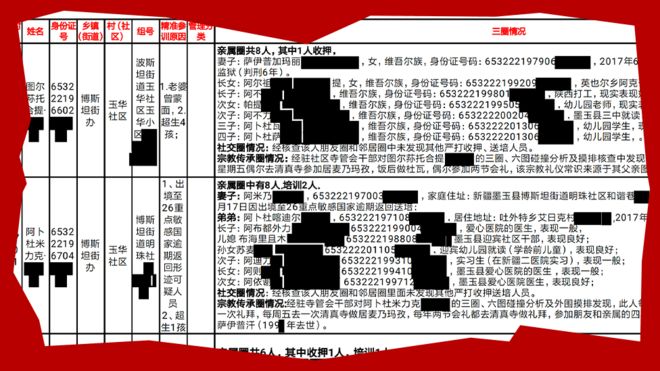
A document that appears to give the most powerful insight yet into how China determined the fate of hundreds of thousands of Muslims held in a network of internment camps has been seen by the BBC.
Listing the personal details of more than 3,000 individuals from the far western region of Xinjiang, it sets out in intricate detail the most intimate aspects of their daily lives.
The painstaking records – made up of 137 pages of columns and rows – include how often people pray, how they dress, whom they contact and how their family members behave.
China denies any wrongdoing, saying it is combating terrorism and religious extremism.
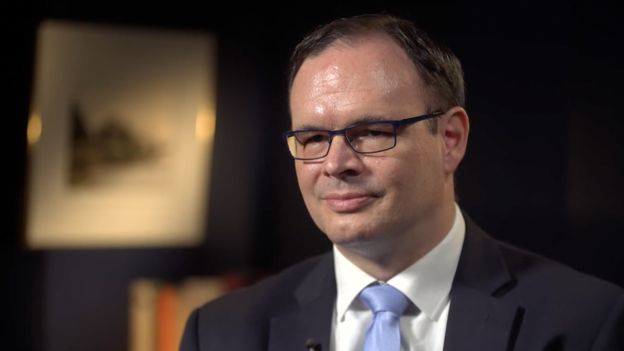
One of the world’s leading experts on China’s policies in Xinjiang, Dr Adrian Zenz, a senior fellow at the Victims of Communism Memorial Foundation in Washington, believes the latest leak is genuine.
“This remarkable document presents the strongest evidence I’ve seen to date that Beijing is actively persecuting and punishing normal practices of traditional religious beliefs,” he says.
One of the camps mentioned in it, the “Number Four Training Centre” has been identified by Dr Zenz as among those visited by the BBC as part of a tour organised by the Chinese authorities in May last year.
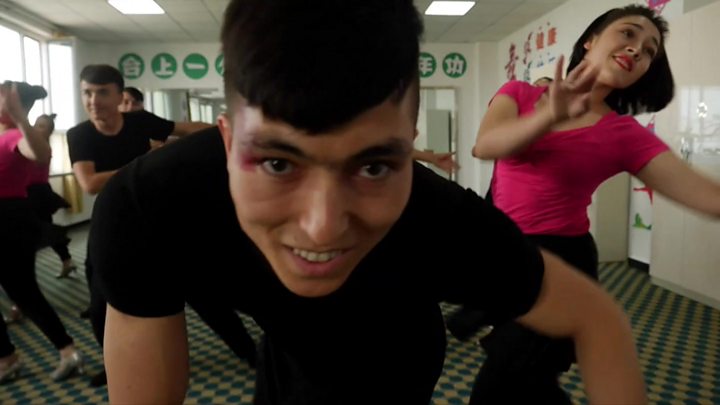
Media caption The BBC previously visited one of the camps identified by scholars using the Karakax List
Much of the evidence uncovered by the BBC team appears to be corroborated by the new document, redacted for publication to protect the privacy of those included in it.
It contains details of the investigations into 311 main individuals, listing their backgrounds, religious habits, and relationships with many hundreds of relatives, neighbours and friends.
Verdicts written in a final column decide whether those already in internment should remain or be released, and whether some of those previously released need to return.
It allows a glimpse inside the minds of those making the decisions, he says, laying bare the “ideological and administrative micromechanics” of the camps.
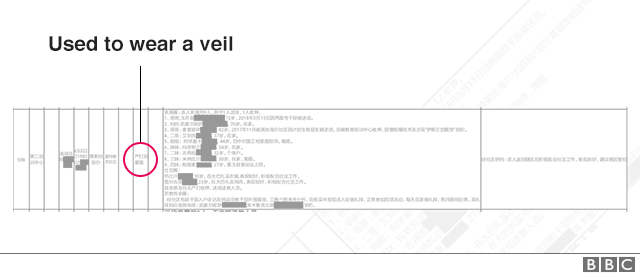
Row 598 contains the case of a 38-year-old woman with the first name Helchem, sent to a re-education camp for one main reason: she was known to have worn a veil some years ago.
It is just one of a number of cases of arbitrary, retrospective punishment.
Others were interned simply for applying for a passport – proof that even the intention to travel abroad is now seen as a sign of radicalisation in Xinjiang.
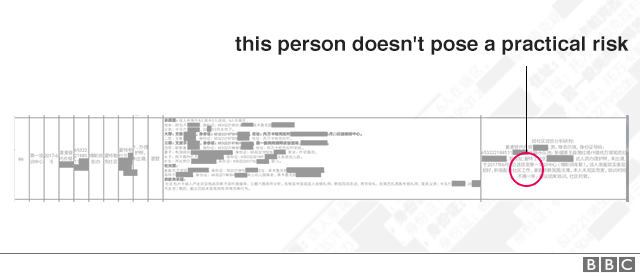
In row 66, a 34-year-old man with the first name Memettohti was interned for precisely this reason, despite being described as posing “no practical risk”.
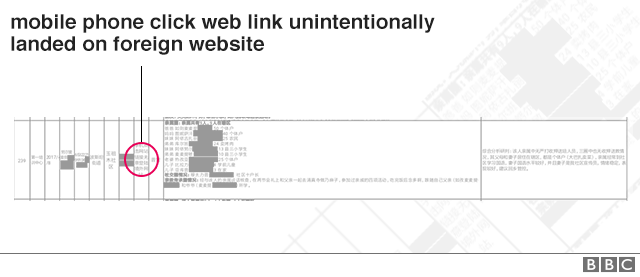
And then there’s the 28-year-old man Nurmemet in row 239, put into re-education for “clicking on a web-link and unintentionally landing on a foreign website”.
Again, his case notes describe no other issues with his behaviour.
The 311 main individuals listed are all from Karakax County, close to the city of Hotan in southern Xinjiang, an area where more than 90% of the population is Uighur.
Predominantly Muslim, the Uighurs are closer in appearance, language and culture to the peoples of Central Asia than to China’s majority ethnicity, the Han Chinese.
In recent decades the influx of millions of Han settlers into Xinjiang has led to rising ethnic tensions and a growing sense of economic exclusion among Uighurs.
Those grievances have sometimes found expression in sporadic outbreaks of violence, fuelling a cycle of increasingly harsh security responses from Beijing.
It is for this reason that the Uighurs have become the target – along with Xinjiang’s other Muslim minorities, like the Kazakhs and Kyrgyz – of the campaign of internment
The “Karakax List”, as Dr Zenz calls the document, encapsulates the way the Chinese state now views almost any expression of religious belief as a signal of disloyalty.
To root out that perceived disloyalty, he says, the state has had to find ways to penetrate deep into Uighur homes and hearts.
In early 2017, when the internment campaign began in earnest, groups of loyal Communist Party workers, known as “village-based work teams”, began to rake through Uighur society with a massive dragnet.
With each member assigned a number of households, they visited, befriended and took detailed notes about the “religious atmosphere” in the homes; for example, how many Korans they had or whether religious rites were observed.
The Karakax List appears to be the most substantial evidence of the way this detailed information gathering has been used to sweep people into the camps.
It reveals, for example, how China has used the concept of “guilt by association” to incriminate and detain whole extended family networks in Xinjiang.
For every main individual, the 11th column of the spreadsheet is used to record their family relationships and their social circle.
Alongside each relative or friend listed is a note of their own background; how often they pray, whether they’ve been interned, whether they’ve been abroad.
In fact, the title of the document makes clear that the main individuals listed all have a relative currently living overseas – a category long seen as a key indicator of potential disloyalty, leading to almost certain internment.
Rows 179, 315 and 345 contain a series of assessments for a 65-year-old man, Yusup.
His record shows two daughters who “wore veils and burkas in 2014 and 2015”, a son with Islamic political leanings and a family that displays “obvious anti-Han sentiment”.
His verdict is “continued training” – one of a number of examples of someone interned not just for their own actions and beliefs, but for those of their family.
The information collected by the village teams is also fed into Xinjiang’s big data system, called the Integrated Joint Operations Platform (IJOP).
The IJOP contains the region’s surveillance and policing records, culled from a vast network of cameras and the intrusive mobile spyware every citizen is forced to download.
The IJOP, Dr Zenz suggests, can in turn use its AI brain to cross-reference these layers of data and send “push notifications” to the village teams to investigate a particular individual.
Image caption Adrian Zenz has analysed the leaked document
The man found “unintentionally landing on a foreign website” may well have been interned thanks to the IJOP.
In many cases though, there is little need for advanced technology, with the vast and vague catch-all term “untrustworthy” appearing multiple times in the document.
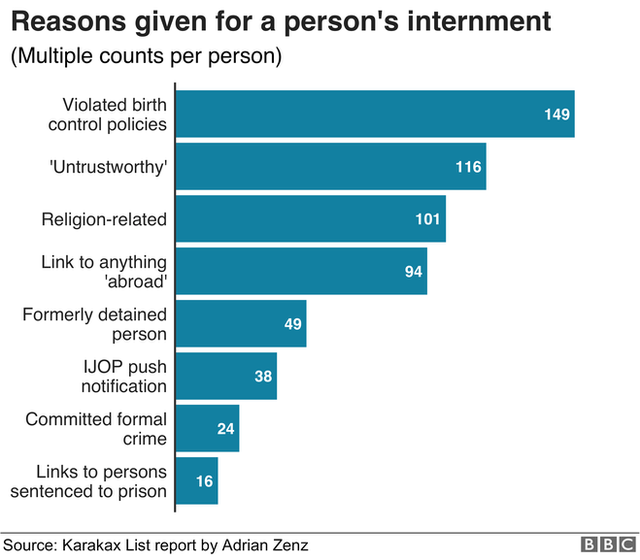
It is listed as the sole reason for the internment of a total of 88 individuals.
The concept, Dr Zenz argues, is proof that the system is designed not for those who have committed a crime, but for an entire demographic viewed as potentially suspicious.
China says Xinjiang has policies that “respect and ensure people’s freedom of religious belief”. It also insists that what it calls a “vocational training programme in Xinjiang” is “for the purposes of combating terrorism and religious extremism”, adding only people who have been convicted of crimes involving terrorism or religious extremism are being “educated” in these centres.
However, many of the cases in the Karakax List give multiple reasons for internment; various combinations of religion, passport, family, contacts overseas or simply being untrustworthy.
The most frequently listed is for violating China’s strict family planning laws.
In the eyes of the Chinese authorities it seems, having too many children is the clearest sign that Uighurs put their loyalty to culture and tradition above obedience to the secular state.
China has long defended its actions in Xinjiang as part of an urgent response to the threat of extremism and terrorism.
The Karakax List does contain some references to those kinds of crimes, with at least six entries for preparing, practicing or instigating terrorism and two cases of watching illegal videos.
But the broader focus of those compiling the document appears to be faith itself, with more than 100 entries describing the “religious atmosphere” at home.
The Karakax List has no stamps or other authenticating marks so, at face value, it is difficult to verify.
It is thought to have been passed out of Xinjiang sometime before late June last year, along with a number of other sensitive papers.
They ended up in the hands of an anonymous Uighur exile who passed all of them on, except for this one document.
Only after the first batch was published last year was the Karakax List then forwarded to his conduit, another Uighur living in Amsterdam, Asiye Abdulaheb.
She told the BBC that she is certain it is genuine.
Image caption Asiye Abdulaheb decided to speak out, despite the danger
“Regardless of whether there are official stamps on the document or not, this is information about real, live people,” she says. “It is private information about people that wouldn’t be made public. So there is no way for the Chinese government to claim it is fake.”
Like all Uighurs living overseas, Ms Abdulaheb lost contact with her family in Xinjiang when the internment campaign began, and she’s been unable to contact them since.
But she says she had no choice but to release the document, passing it to a group of international media organisations, including the BBC.
“Of course I am worried about the safety of my relatives and friends,” she says. “But if everyone keeps silent because they want to protect themselves and their families, then we will never prevent these crimes being committed.”
Almost 90% of the 311 main individuals in the Karakax List are shown as having already been released or as being due for release on completion of a full year in the camps.
But Dr Zenz points out that the re-education camps are just one part of a bigger system of internment, much of which remains hidden from the outside world.
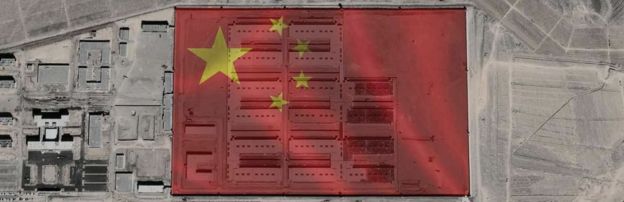
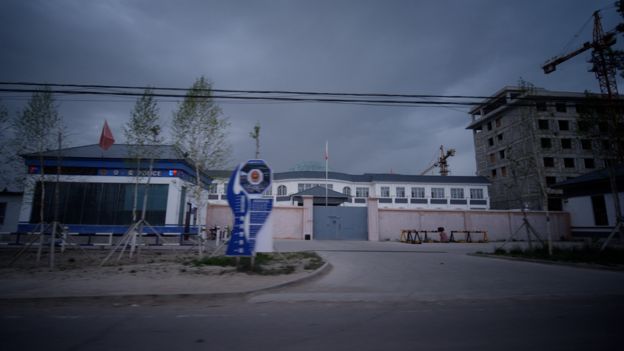
Image caption The outside of one of the camps in Xinjiang
More than two dozen individuals are listed as “recommended” for release into “industrial park employment” – career “advice” that they may have little choice but to obey. There are well documented concerns that China is now building a system of coerced labour as the next phase of its plan to align Uighur life with its own vision of a modern society.
In two cases, the re-education ends in the detainees being sent to “strike hard detention”, a reminder that the formal prison system has been cranked into overdrive in recent years.
Many of the family relationships listed in the document show long prison terms for parents or siblings, sometimes for entirely normal religious observances and practices.
One man’s father is shown to have been sentenced to five years for “having a double-coloured thick beard and organising a religious studies group”.
A neighbour is reported to have been given 15 years for “online contact with people overseas”, and another man’s younger brother given 10 years for “storing treasonable pictures on his phone”.
Whether or not China has closed its re-education camps in Xinjiang, Dr Zenz says the Karakax List tells us something important about the psychology of a system that prevails.
“It reveals the witch-hunt-like mindset that has been and continues to dominate social life in the region,” he said.
Experts to visit Beijing, Guangdong and Sichuan but no word on whether Hubei is on the itinerary
Specialists say visit must include a trip to the outbreak’s epicentre to get a full picture
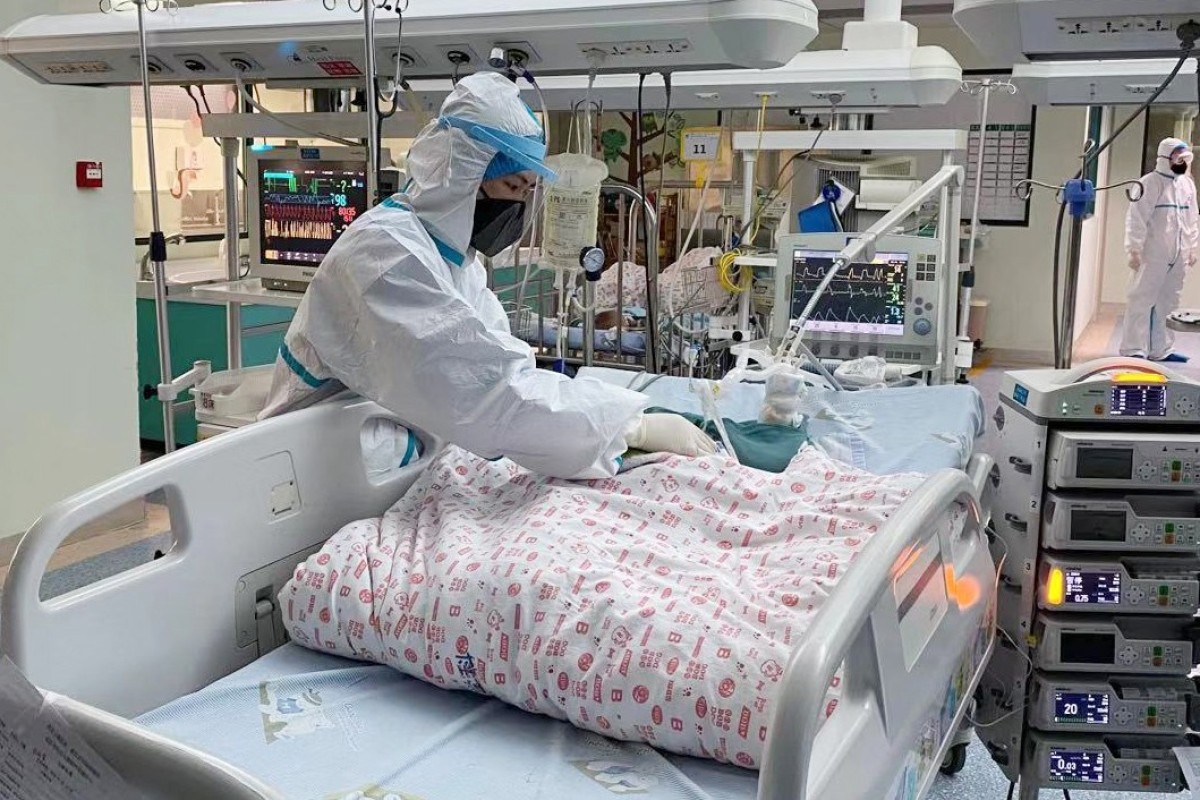
A nurse cares for a 14-month-old baby infected with the novel coronavirus in an ICU isolation ward of Wuhan Children’s Hospital in Wuhan, at the epicentre of the outbreak. Photo: Xinhua
A team of medical experts from the World Health Organisation (WHO), including specialists from the US, will visit Beijing and the Chinese provinces of Guangdong and Sichuan from Monday to assess the country’s efforts to contain the spread of a deadly coronavirus, according to the Chinese foreign ministry.
The death toll from the coronavirus had risen to 1,770 on mainland China as of Sunday, infecting 70,548 people, including more than 1,700 medical workers. Most of those confirmed with the disease, now known as Covid-19, are in Wuhan.
On Monday, the Ministry of Foreign Affairs said the WHO delegation would include Americans, but gave no further details.
The announcement came as a commentary in Communist Party mouthpiece People’s Daily accused Washington of dragging its feet on a funding pledge to help with the epidemic, saying it had a “dark mentality and taken dangerous action” during the outbreak.
WHO director general Tedros Adhanom Ghebreyesus said on Friday that the mission to China included 12 international medical specialists, and they would, with 12 Chinese experts, learn more about the transmission of the virus and the effectiveness of the measures in a bid to work out the next containment steps for China and the world.
An advance team of WHO medical experts arrived in Beijing last Monday, led by Canadian emergency expert Bruce Aylward, Tedros said.
China’s National Health Commission (NHC) said all of the delegation’s members arrived in Beijing over the weekend, and held talks with Chinese medical experts, public health officials and other government departments.
They exchanged views on virus containment, wildlife management and vaccine development, the NHC said.
Experts said the international team would be left with an “incomplete picture” of the outbreak if it did not go to Wuhan or Hubei.
“Unfortunately, this feeds into a narrative that China is trying to hide the true nature of the outbreak, so it would seem to be shortsighted and counterproductive to China’s efforts to say to the world that it is doing everything it can to contain this outbreak,” said Adam Kamradt-Scott, a specialist in global health security and international relations at the University of Sydney.
“We have seen in the past when we have external teams, they are often able to identify areas for improvement or to make recommendations for measures that national authorities may not have thought of – we’ve seen that through other examples where external expertise can be valuable in times of crisis.”
He said any impression of a cover-up would likely further strengthen the resolve of countries that had taken strict measures, including travel bans, to keep them in place or tighten them further.
“China has got a public relations campaign that it also needs to be mindful of in engaging with the international community, so there are the actual measures that the government needs to take in order to control the outbreak, but the government also needs to be seen to be doing everything that it can,” he said.
BEIJING (Reuters) – China’s parliament and its top political consultative body are both considering delaying annual meetings set for March, state media said on Monday, as the country battles a coronavirus outbreak that has killed more than 1,700 people.
The meetings of the parliament, or National People’s Congress (NPC), and the Chinese People’s Political Consultative Conference (CPPCC) were both due to begin early next month.
The gatherings see more than 5,000 delegates descend on Beijing, the capital, from all over China, for at least 10 days, to pass legislation and unveil the year’s key economic targets.
A postponement would be the first since China adopted the current March schedule in 1995 for the meeting of parliament.
The standing committee of the NPC will meet on Feb. 24 in Beijing, the official Xinhua news agency said.
“The upcoming session is … expected to deliberate a draft decision on postponing the third annual session of the 13th NPC,” it said. The session was due to have begun on March 5.
The proposal was made in the belief it was important to focus on reining in the epidemic, Xinhua said. China has imposed transport curbs to halt the spread of the virus, which has killed 1,770 and infected nearly 71,000 in mainland China.
The CPPCC is also studying whether to postpone its annual meeting, state-run CCTV said, due to have begun two days earlier, on March 3.
Five people familiar with the matter told Reuters this month that China was considering delaying the meetings as Beijing grapples with the epidemic.
The parliamentary committee will also consider a proposed law banning wildlife trade and discuss government changes, Xinhua said, without elaborating.
The measures China has taken to stop the spread of the coronavirus are starting to have an impact, Mi Feng, a spokesman at the National Health Commission, said on Sunday.
In other developments:
The number of people who have tested positive on the Diamond Princess cruise ship, which is being held in quarantine in Japan, has risen to 355. The US and Canada are sending planes to evacuate their citizens
A Chinese tourist has died in France – the first fatality outside Asia
An 83-year-old American woman has tested positive after disembarking another cruise ship that was turned away by a number of countries before being allowed to dock in Cambodia
In the UK, all but one of nine people being treated have been discharged from hospital
On Saturday, World Health Organization (WHO) head Tedros Adhanom Ghebreyesus praised Beijing’s response to the outbreak.
“China has bought the world time. We don’t know how much time,” he said. “We’re encouraged that outside China, we have not yet seen widespread community transmission.”
How is China coping?
Tens of millions of Chinese still face heavy restrictions on their day-to-day life as part of the government’s efforts to halt the spread of the disease, which causes a disease named Covid-19.
Much of the response has focused on the hard-hit province of Hubei and its capital Wuhan, where the outbreak began. The city is all but sealed off from the rest of the country.
Foreign Minister Wang Yi said that along with a drop in infections within Hubei there had also been a rapid increase in the number of people who had recovered.
China’s central bank will also disinfect and store used banknotes before recirculating them in a bid to stop the virus spreading.
Media caption Medics in Wuhan resort to shaving their heads in a bid to prevent cross-infection of the coronavirus
In another development Chinese state media published a speech from earlier this month in which Chinese President Xi Jinping said he said he had given instructions on 7 January on containing the outbreak.
At the time, local officials in the city of Wuhan were downplaying the severity of the epidemic.
This would suggest senior leaders were aware of the potential dangers of the virus before the information was made public.
With the government facing criticism for its handling of the outbreak, analysts suggest the disclosure is an attempt to show the party leadership acted decisively from the start.
LONDON (Reuters) – The British government has not talked to China about helping build High Speed 2, the major rail project given the green light last week despite being billions of pounds over budget, Transport Secretary Grant Shapps said on Sunday.
A report in the Financial Times said China had offered to build the rail line, known as HS2, in five years and for less money.
“I’ve certainly had no advice on the subject, obviously I will be asking to see what the communication has been,” Shapps told the BBC’s Andrew Marr on Sunday.
“This has not been a discussion with the department, it’s been a discussion with HS2 as I understand it.”
Shapps said he wanted to push ahead with major projects more quickly.
“There are things we can do to speed this up and I want to learn from everyone but I also want to make sure the British ingenuity and skills and apprentices and all the rest of it come through on this massive project,” he said.
Shapps also told Marr the resignation of finance minister, or chancellor, Sajid Javid on Thursday could result in a delay to the budget planned for March 11.
“This is a matter for the new chancellor Rishi (Sunak),” he said.
“I don’t think we’ve said it will definitely go ahead on the same date that was mentioned before in March, that will be a matter for the chancellor.”
MUNICH (Reuters) – U.S. Secretary of State Mike Pompeo defended on Saturday his nation’s global role despite misgivings in Europe, vowing that Western values would prevail over China’s desire for “empire”.
Pompeo was seeking to reassure Europeans troubled by U.S. President Donald Trump’s “America first” rhetoric, ambivalence over the transatlantic NATO military alliance and tariffs on European goods.
“I’m happy to report that the death of the transatlantic alliance is grossly exaggerated. The West is winning, and we’re winning together,” he said in a speech at the Munich Security Conference, listing U.S. steps to protect liberal democracies.
RELATED COVERAGE
U.S., allied firms testing alternatives to Chinese 5G technology – Esper
Pompeo was, in part, responding to German President Frank-Walter Steinmeier, who on Friday accused the United States, Russia and China of stoking global mistrust.
Trump’s decision to pull out of the 2015 Iran nuclear deal, as well as the Paris climate accord, have undermined European priorities, while moves such as recognition of Jerusalem as Israel’s capital have weakened European diplomacy, envoys say.
Pompeo defended the U.S. strategy, saying Europe, Japan and other American allies were united on China, Iran and Russia, despite “tactical differences.”
He reiterated Washington’s opposition to the Nord Stream 2 gas pipeline under construction between Russia and Germany under the Baltic Sea, a project backed by the government of German Chancellor Angela Merkel.
Citing Russia’s 2014 annexation of Crimea, cyber threats in Iran and economic coercion by China, Pompeo said those countries were still “desiring empires” and destabilising the rules-based international system.
U.S. Secretary of Defense Mark Esper, speaking immediately after Pompeo, focused his remarks solely on China, accusing Beijing of a “nefarious strategy” through telecommunications firm Huawei [HWT.UL].
“It is essential that we as an international community wake up to the challenges presented by Chinese manipulation of the long-standing international rules-based order,” Esper said.
He said it was not too late for Britain, which last month said it would allow Huawei a limited role in building its 5G networks, to take “two steps back,” but added he still needed to asses London’s decision.
“We could have a win-win strategy if we just abide by the international rules that have been set in place for decades … that respect human rights, that respect sovereignty,” he said.
MUNICH (Reuters) – Germany’s president took an indirect swipe at U.S. President Donald Trump on Friday in accusing Washington, China and Russia of stoking global mistrust and insecurity with a “great powers” competition” that could threaten a new nuclear arms race.
In opening remarks at the annual Munich Security Conference, German President Frank-Walter Steinmeier deplored the three big powers’ approach to global affairs and, without naming Trump, took issue with his vow to “make America great again”.
“‘Great again’ – even at the expense of neighbours and partners,” quipped Steinmeier, a former Social Democrat foreign minister whose comments on foreign policy carry authority.
As foreign minister in 2014, he was central to the so-called “Munich consensus” when German leaders said Berlin was ready to assume more responsibility in global affairs. Steinmeier pressed that point again on Friday, but not before bemoaning the foreign policy approaches of Russia, China and the United States.
“Russia…has made military force and the violent shifting of borders on the European continent the means of politics once again,” he said in the text of a speech for delivery at the opening of the conference.
“China…accepts international law only selectively where it does not run counter to its own interests,” Steinmeier said.
“And our closest ally, the United States of America, under the present administration itself, rejects the idea of an international community.”
The upshot is “more mistrust, more armament, less security…all the way to a new nuclear arms race,” he said.
In response, he said, Germany should raise defence spending to contribute more to European security and to maintain its alliance with the United States, recognising that U.S. interests were gravitating away from Europe toward Asia.
He also called for a European policy towards Russia “that is not limited to condemning statements and sanctions alone”.
Europe, he added, “must find its own balance with China between intensifying competition between systems and the need for cooperation.”
BEIJING, Feb. 12 (Xinhua) — China highly appreciates a BRICS chairmanship statement in support of China’s fight against the novel coronavirus epidemic, Foreign Ministry Spokesperson Geng Shuang said Wednesday at an online press briefing.
Russia, holding this year’s chairmanship of the emerging-market bloc that groups Brazil, Russia, India, China and South Africa, on Tuesday issued the statement representing the BRICS countries to support the “firm commitment and decisive efforts of the Chinese government” to combat the epidemic.
The statement also called for international cooperation and coordination within the World Health Organization framework to protect regional and global public health security, and underlined the importance of avoiding discrimination, stigmatization and overreaction while responding to the outbreak.
Calling other BRICS countries as important partners for China, Geng said this statement delivered positive and constructive messages, voiced support for China’s efforts and called for greater international cooperation in safeguarding public health security.
“This demonstrates the BRICS spirit of helping each other during difficult times. It also epitomizes the support China has received from the international community. We highly appreciate it,” he said.
“We will continue to work with the international community including the BRICS countries to combat the epidemic and safeguard regional and global public health security,” said the spokesperson.






 CHINDIA ALERT: You'll be living in their world, very soon