Chindia Alert: You’ll be Living in their World Very Soon
aims to alert you to the threats and opportunities that China and India present. China and India require serious attention; case of ‘hidden dragon and crouching tiger’.
Without this attention, governments, businesses and, indeed, individuals may find themselves at a great disadvantage sooner rather than later.
The POSTs (front webpages) are mainly 'cuttings' from reliable sources, updated continuously.
The PAGEs (see Tabs, above) attempt to make the information more meaningful by putting some structure to the information we have researched and assembled since 2006.
BEIJING, May 28 (Xinhua) — Chinese lawmakers Thursday voted to adopt the country’s long-expected Civil Code at the third session of the 13th National People’s Congress, the top legislature.
The Civil Code will take effect on Jan. 1, 2021.
In addition to general provisions and supplementary provisions, the Civil Code, the world’s latest modern-day civil law, has six parts on real rights, contracts, personality rights, marriage and family, succession, and tort liabilities.
The personal rights, property rights and other lawful rights and interests of the parties to civil legal relations shall be protected by law and shall not be infringed upon by any organization or individual, reads the Civil Code in its opening chapter.
Lawmakers say the codification is not about formulating a new civil law but rather systematically incorporating existing civil laws and regulations, modifying and improving them to adapt to new situations while maintaining their consistency.
A major innovation of China’s Civil Code, jurists say, is embodied in the personality rights part. While some countries have related law provisions, few have a specific law book in civil code dedicated to protecting personality rights.
The personality rights part covers stipulations on a civil subject’s rights to his or her life, body, health, name, portrait, reputation and privacy, among others.
The personality rights part shows that China has reached a new height in protecting the dignity of people, said Chen Jingying, a national lawmaker and vice president of East China University of Political Science and Law.
The Civil Code is a milestone in developing the socialist legal system with Chinese characteristics, and will greatly boost the modernization of China’s system and capacity for governance, said Wang Yi, dean of the law school at Renmin University of China.
Chinese President Xi Jinping, also general secretary of the Communist Party of China Central Committee and chairman of the Central Military Commission, takes part in a deliberation with his fellow deputies from the delegation of Inner Mongolia Autonomous Region at the third session of the 13th National People’s Congress (NPC) in Beijing, capital of China, May 22, 2020. (Xinhua/Ju Peng)
BEIJING, May 23 (Xinhua) — “What is people first?” Chinese President Xi Jinping asked, before offering his own answer when he was talking with lawmakers at the ongoing national legislative session.
“So many people worked together to save a single patient. This, in essence, embodies doing whatever it takes (to save lives),” he said.
Xi, also general secretary of the Communist Party of China Central Committee and chairman of the Central Military Commission, is a deputy to the 13th National People’s Congress.
During his deliberations with fellow deputies from Inner Mongolia Autonomous Region on Friday, “people” was a keyword.
Xi referred to a story told by another deputy that morning. Luo Jie, from the COVID-19 hard-hit province of Hubei, told reporters at the session how medical workers in his hospital spent 47 days saving an 87-year-old COVID-19 patient.
“About 10 medical workers meticulously took care of the patient for dozens of days, and finally saved the patient’s life,” Xi said. “I am really impressed.”
In the COVID-19 pandemic, health workers around the world got to know the elderly are the most difficult to treat and require the most sophisticated medical resources. China has given every patient equal treatment irrespective of their age or wealth.
Chinese President Xi Jinping, also general secretary of the Communist Party of China Central Committee and chairman of the Central Military Commission, takes part in a deliberation with his fellow deputies from the delegation of Inner Mongolia Autonomous Region at the third session of the 13th National People’s Congress (NPC) in Beijing, capital of China, May 22, 2020. (Xinhua/Huang Jingwen)
In Hubei alone, more than 3,600 COVID-19 patients over the age of 80 have been cured. In the provincial capital Wuhan, seven centenarian patients have been cured.
“We mobilized from around the nation the best doctors, the most advanced equipment and the most needed resources to Hubei and Wuhan, going all out to save lives,” Xi said during the deliberations, adding that the eldest patient cured is 108 years old.
“We are willing to save lives at all costs. No matter how old the patients are and how serious their conditions have become, we never give up,” Xi said.
Xi joined political advisors and lawmakers on Thursday and Friday in paying silent tribute to the lives lost to COVID-19 as the top political advisory body and the national legislature opened their annual sessions.
This year’s government work report said China’s economy posted negative growth in the first quarter of this year, but it was “a price worth paying” to contain COVID-19 as life is invaluable.
“As a developing country with 1.4 billion people, it is only by overcoming enormous difficulties that China has been able to contain COVID-19 in such a short time while also ensuring our people’s basic needs,” the report said.
Epidemic response is a reflection of China’s governing philosophy.
The fundamental goal for the Party to unite and lead the people in revolution, development and reform is “to ensure a better life for them,” Xi said.
The nation’s average life expectancy reached 77 years in 2018, more than double that in 1949, when the people’s republic was founded.
Chinese people are not just living longer but better lives, with more material wealth and broader choices to pursue individual dreams. All rural poor will bid farewell to poverty this year as part of the goal of building a moderately prosperous society in all respects.
The Party’s long-term governance, Xi said, rests on “always maintaining close bond with the people.”
“We must always remain true to the people’s aspiration and work in concert with them through thick and thin,” Xi said.
Chinese President Xi Jinping, also general secretary of the Communist Party of China Central Committee and chairman of the Central Military Commission, takes part in a deliberation with his fellow deputies from the delegation of Inner Mongolia Autonomous Region at the third session of the 13th National People’s Congress (NPC) in Beijing, capital of China, May 22, 2020. (Xinhua/Huang Jingwen)
BEIJING, May 22 (Xinhua) — President Xi Jinping stressed acting on the people-centered philosophy in every aspect of work when he participated in a deliberation on the first day of the annual session of the National People’s Congress (NPC), China’s national legislature.
Xi, also general secretary of the Communist Party of China (CPC) Central Committee and chairman of the Central Military Commission, made the remarks Friday when joining in discussions with fellow lawmakers from north China’s Inner Mongolia Autonomous Region.
Xi, an NPC deputy himself, exchanged views with other deputies on a wide range of topics including poverty eradication, grassland ecological conservation, and ethnic unity.
The fundamental goal for the Party to unite and lead the people in revolution, development and reform is to ensure a better life for them, Xi said, adding that the CPC will never waver in pursuing such a goal.
He particularly stressed adhering to “people first” in coordinating epidemic control and economic and social development.
In the face of the spread of COVID-19, the CPC has, from the very beginning, stated clearly that people’s life and health should be considered as the top priority. “We are willing to protect people’s life and health at all costs,” he said.
Xi stressed improving the regular epidemic response mechanisms to prevent a resurgence of the outbreak.
Commending the people as the main source of confidence for the Party, Xi said the masses have been the fundamental strength in the country’s epidemic response.
China’s socialist democracy is the broadest, most genuine, and most effective democracy to safeguard the fundamental interests of the people, he said.
Noting that the epidemic has brought relatively huge impact to China’s economic and social development, the president said it has also led to new opportunities for development.
He urged targeted efforts in mapping out major plans, reforms and policies that will serve as locomotives in the country’s high-quality development and high-efficiency governance.
Authorities must make working for the people their primary political achievements, Xi said.
He also highlighted efforts to consolidate and expand the progress in using industrial development and employment as poverty-alleviation methods, and doing a good job in facilitating employment for graduating college students, migrant workers, and demobilized military personnel.
Xi voiced his complete support for a government work report submitted to the NPC deputies for deliberation. He also expressed full acknowledgment of the work of Inner Mongolia over the past year, stressing the importance of upholding and improving the system of regional ethnic autonomy.
He called for maintaining the strategic resolve of building an ecological civilization, noting that the green ecological barrier in Inner Mongolia should be further fortified.
Xi also called for firm efforts to combat corruption and oppose the practice of formalities for formalities’ sake and bureaucratism.
BEIJING, May 17 (Xinhua) — China’s Chang’e-4 probe has survived 500 Earth days on the far side of the moon while conducting a scientific exploration of the virgin territory.
The lander and rover of the Chang’e-4 probe have resumed work for the 18th lunar day on the far side of the moon after “sleeping” during the extremely cold night.
The lander woke up at 3:25 a.m. Sunday (Beijing time), and the rover awoke at 11:53 a.m. Saturday. Both are in normal working order, according to the Lunar Exploration and Space Program Center of the China National Space Administration (CNSA).
The Chang’e-4 probe, launched on Dec. 8, 2018, made the first-ever soft landing on the Von Karman Crater in the South Pole-Aitken Basin on the far side of the moon on Jan. 3, 2019.
A lunar day equals 14 days on Earth, and a lunar night is the same length. The Chang’e-4 probe switches to dormant mode during the lunar night due to the lack of solar power.
The rover Yutu-2, or Jade Rabbit-2, has driven 447.68 meters, and is now 292 meters away from the lander. It has conducted scientific detection on lunar rocks, the lunar soil on its track and some impact craters.
Scientists used the Lunar Penetrating Radar on Yutu-2 to study the geological structure with a depth of 40 meters, unveiling the secrets buried under the surface of the far side of the moon, enriching our understanding about the history of celestial collisions and volcanic activities and shedding new light on the geological evolution on the moon.
Scientists also analyzed the data of the infrared imaging spectrometer on Yutu-2 and revealed the material composition on the moon’s far side, verifying that the lunar mantle is rich in olivine, which deepens our understanding of the formation and evolution of the moon.
China plans to launch its first Mars exploration mission Tianwen-1 in July. Due to the modification of the ground communication facilities, the rover and the lander will conduct in-situ detection during the 18th lunar day, said the CNSA.
The scientific tasks of the Chang’e-4 mission include conducting low-frequency radio astronomical observation, surveying the terrain and landforms, detecting the mineral composition and shallow lunar surface structure and measuring neutron radiation and neutral atoms.
The Chang’e-4 mission embodies China’s hope to combine wisdom in space exploration with four payloads developed by the Netherlands, Germany, Sweden and Saudi Arabia.
— As the continued global spread of COVID-19 is weighing on the world economy, China’s foreign trade is under considerable downward pressure.
— Many export-oriented companies in China are turning to the domestic market for a lifeline while grappling with dropping overseas orders as major markets remain in the grip of the pandemic.
by Xinhua writers Zhang Yizhi, Li Huiying, Hu Guanghe, Xu Ruiqing
FUZHOU, May 9 (Xinhua) — Walking back and forth between shelves of neatly stacked shoes, some 20 live streamers dashed at the instructions of their followers on the phone, grabbing a shoe now and then from the shelves for a close-up in front of the camera.
At around eight o’clock every night, the supply chain platform 0594 in the city of Putian, east China’s Fujian Province, springs to life as live streamers flock to the exhibition area to sell shoes produced by the local manufacturers, many of which are troubled by the cancellations or delays of overseas orders amid the global coronavirus pandemic.
“To get rid of the excess inventory, many manufacturers in Putian are turning to live streaming to explore the domestic market,” said Chen Xing, general manager of 0594. “We are now cooperating with over 40 manufacturers and there will be more of them joining us in the future.”
The platform is also building an internet celebrity incubator and has so far organized seven rounds of influencer training courses enrolling more than 200 attendees.
Huang Huafang, 39, signed up for the two-day crash course in late March and soon after started her first live streaming session. She works from around 2 p.m. to 10 p.m., attracting over 500 followers and selling more than 20 pairs of shoes every day.
Though she is not a well-known live streamer, she is optimistic about the future. “There is a long way to go, but I believe live streaming is a trend. It is an essential skill for anyone who wants to market online,” said Huang.
A staff sells shoes through live streaming at an e-commerce warehouse in Putian, southeast China’s Fujian Province, May 7, 2020. (Xinhua/Lin Shanchuan)
According to Chen, the platform 0594 sold almost 130,000 pairs of shoes in April alone. As the domestic economic outlook continues to pick up, the sales target of May has been set at 200,000 pairs.
Like manufacturers in Putian, a city with a large number of export-oriented enterprises, many Chinese factories are turning to the domestic market for a lifeline, while grappling with dropping overseas orders as major markets remain in the grip of the pandemic.
ADAPT OR DIE
With decades of experience in manufacturing and developing products for overseas clients, some export-oriented companies in China are rolling out products catering to the domestic market.
After months of gloomy business, Wu Songlin, general manager of Putian-based Hsieh Shun Footwear Co., Ltd., heaved a sigh of relief as trucks loaded with therapeutic shoes tailored to the home market left his factory.
It was the first shipment for the domestic market since Wu and his partners started the company in 2010. In the past, his company only had two clients, one from Europe and the other from Japan. Business used to run smoothly and life was good.
But his factory was on the brink of a shutdown in March when the coronavirus pandemic started to ravage the global economy. No new orders came in and shipments of existing orders were requested to be delayed until June.
People work in a footwear workshop in Putian, southeast China’s Fujian Province, April 27, 2020. (Xinhua/Lin Shanchuan)
“Orders were canceled after completion of production, and our capital flow is stuck in our inventory. The pressure is mounting to keep the factory running,” Wu said. “By the end of June, workers would be left with no work to do as soon as we complete the existing orders.”
After losing almost all their orders from overseas clients, the desperate shoemaker turned to the domestic market. He called one of his old business partners and secured an order for massage footwear, which is selling like hot cakes in the domestic market as health tops the agenda in the time of the novel coronavirus.
The factory produced 10,000 pairs of massage shoes in April, and the number is expected to reach 30,000 in May, enough to keep the production lines running.
Thanks to the company’s quick adaptation, about 200 workers kept their jobs in the factory, while 20 percent were furloughed and the remaining workers were arranged to work in other companies as part of the city’s employee sharing program.
“If domestic orders keep coming in, our operation will hopefully get back to normal by September when the monthly output of massage shoes will reach 90,000,” Wu said. “By then the company will live and thrive without any orders from overseas customers.”
A woman works in a workshop of Hsieh Shun Footwear Co., Ltd. in Putian, southeast China’s Fujian Province, May 7, 2020. (Xinhua/Lin Shanchuan)
But switching to another market is not easy, explained Wu. In the past, export-oriented factories were only in charge of manufacturing, while brands would take care of sales, promotion as well as customer support.
“If you are selling to the domestic market, you need to have your own brand and marketing capacity,” he said. “Working with e-commerce platforms could be one way out, but it’s more important to understand domestic consumers and meet their needs.”
CUSTOMIZE THE FUTURE
For years, many export-focused manufactures have been trying to climb up the value chain and tap the uncharted waters of the domestic market. As the pandemic continues to spread, there is a strong push for them to embrace customized manufacturing.
In an experience store located in downtown Putian, customers line up waiting to have their feet measured on a smart device. After a few seconds, they get their readings on the phone, and a few swipes and clicks later, they place their orders with unique features, colors, and shapes.
Adjacent to the experience store, there is a flexible manufacturing workshop, which gives quick responses to orders and produces shoes following the customized demands of individual buyers.
SEMS, a longstanding sports footwear manufacturer that has established a partnership with several international brands, started to adopt flexible manufacturing years ago in an effort to adapt to the evolving domestic market.
A customer has her feet measured on a smart device in sports footwear manufacturer SEMS in Putian, southeast China’s Fujian Province, May 8, 2020. (Xinhua/Lin Shanchuan)
Customization gives consumers the benefit of products that fit their needs, and at the same time allows factories to utilize improved workflows and technology to maintain high output and omit the process of inventory and distribution, said Zhu Yizhen, the executive vice president of the company.
“Currently we only sell over 100 pairs of customized shoes a day, but we are at the dawn of a new era,” Zhu said. “We hope more companies awaken to the developing trend and join in the practice of mass customization.”
Customer to manufacturer, or C2M, which allows consumers to place orders directly to factories for customized products, has become a buzzword among export-oriented manufacturers hoping to reach domestic consumers amid the pandemic.
Li Junjie, who runs a ceramic flowerpot plant in Fujian’s Dehua County, one of the manufacturing centers of ceramics in China, did not sell a single pot to his overseas customers since the coronavirus outbreak in late January.
The factory used to export 30 percent of its flowerpots to the United States and Spain, but Li managed to make up for the lost deals by selling on domestic e-commerce platforms. Instead of bulk orders placed by foreign clients, domestic consumers tend to purchase customized products in small amounts.
Photo shows the automatic production line of a customized workshop in sports footwear manufacturer SEMS in Putian, southeast China’s Fujian Province, May 8, 2020. (Xinhua/Lin Shanchuan)
With the big data provided by e-commerce platforms, Li can tell which items will be a hit so as to increase their production and develop new products based on a thorough analysis of different consumer groups.
“Our online sales almost doubled over the past year, and we have sold over 100,000 customized pots this year, thanks to the C2M business model,” Li said.
Li’s company is one of many Chinese small and medium-sized enterprises (SMEs) that have benefited from the e-commerce giant Alibaba’s Spring Thunder Initiative, which is aimed at helping export-focused SMEs expand into new markets.
The initiative will also help some SMEs to transform and develop their business in the Chinese market through measures such as resource support, fee reductions, and fast-track processing.
Staff members pose for a group photo to celebrate the timely finding of the return capsule of the trial version of China’s new-generation manned spaceship that successfully returned to the Dongfeng landing site in north China’s Inner Mongolia Autonomous Region, May 8, 2020. The return capsule successfully returned to the Dongfeng landing site at 1:49 p.m. (Beijing Time) Friday, according to the China Manned Space Agency (CMSA). (Photo by Wang Jiangbo/Xinhua)
by Xinhua writers Quan Xiaoshu, Yu Fei and Li Guoli
JIUQUAN, May 8 (Xinhua) — The return capsule of the trial version of China’s new-generation manned spaceship successfully returned to the Dongfeng landing site in north China’s Inner Mongolia Autonomous Region at 1:49 p.m. (Beijing Time) Friday, according to the China Manned Space Agency (CMSA).
The test was a complete success, the agency said.
Following the instructions from the Beijing Aerospace Control Center, the experimental spaceship applied the brake and entered the return orbit at 12:21 p.m., and its return capsule separated with its service capsule at 1:33 p.m.
After it re-entered the atmosphere and reached the designated altitude, the two deceleration parachutes and three main parachutes on the return capsule opened, slowing the flight speed of the spacecraft to the driving speed of an urban vehicle. Before touching down, its six airbags were deployed and inflated to help it land softly, according to the China Aerospace Science and Technology Corporation (CASC).
At 1:49 p.m., the return capsule landed safely. The search team found it in a timely manner and confirmed that the capsule structure was intact.
China launched the trial version of the new spaceship without a crew by the Long March-5B carrier rocket from the Wenchang Space Launch Center in southern China’s island province of Hainan on Tuesday.
The experimental spaceship flew in orbit for two days and 19 hours, during which it carried out a series of space science and technology experiments, including space 3D printing, said CMSA.
It also tested key technologies including the heat shielding and control during its re-entry into the atmosphere, as well as multi-parachute recovery and partial reuse, CMSA said.
The new-generation manned spaceship is an advanced space transport vehicle adapted to multiple tasks. It can be used not only in low-Earth orbit missions to support the construction of China’s space station but also for deep-space exploration, such as manned lunar exploration, CMSA said.
INNOVATIVE DESIGN
Developed by the China Academy of Space Technology (CAST) under the CASC, the test spaceship is nearly 9 meters tall and about 4.5 meters at its widest point. It weighs more than 20 tonnes.
Different from the three-capsule structure of Shenzhou spaceships currently in use, the new spacecraft comprises a return capsule, which is the command center and the living place for astronauts, and a service capsule, which provides power and energy, according to the CAST.
In Shenzhou spaceships, astronauts have to go back and forth between two smaller capsules for life and work. The return capsule of the new ship has a larger sealed space. In the future, it can be partitioned to set up a work area, entertainment area, dining area and bathroom, so as to provide a more comfortable living environment for astronauts.
The capsule can also be equipped with large screens for entertainment and display instruments connected with wearable devices so that astronauts can enjoy colorful space travel and be kept informed of the ship’s conditions.
The new design can also shorten the spaceship development cycle and cut the development costs, which will show a significant advantage in the future with space exploration activities more and more frequent, said Yang Qing, a designer of the experimental spaceship with the CAST.
Researchers have integrated the power supply, propulsion, fuel resources and other subsystems all into the service capsule, so that the same return capsule can be paired with different service capsules to meet variant needs of multiple tasks, including the space station operation and subsequent manned space missions.
The return capsule is designed to be reusable. Star sensors, computers and other high-value equipment have been moved from the service capsule to the return capsule so that they can be recycled after returning to Earth.
The return capsule is wrapped in two items of “clothing.” The inner layer is made of new metal materials and acts as a “wall” around the “driving cab.” The outer layer is made of a new type of light heat-resistant material, which can withstand ablation of thousands of degrees Celsius in the process of re-entry and return, according to Guo Bin, a member of the development team of the experimental spaceship with the CAST.
The new heat-resistant materials, adopted for the first time, are lighter than the traditional materials by 30 percent but have a greater heat-shielding capacity. They are also replaceable to improve the reusable rate of the capsule, Guo said.
The return capsule also uses a non-toxic propulsion system, consisting of 12 monopropellant-powered engines with the largest thrust in the world, which are applied for the first time in China to make the capsule safer and reusable, Guo said.
NEW DREAM SHIP
China started its manned space program in 1992 and has so far witnessed 11 astronauts enter space and return safely.
However, when the country eyes on the moon and the deeper space, Shenzhou spaceships and Tianzhou cargo spacecraft are no longer enough to meet its greater dreams.
Engineers started to create the new test spaceship from January 2017 and completed it in just three years after making many technological breakthroughs.
It can transport both people and goods, greatly expanding the capability and application of China’s manned spacecraft, Yang said.
It can be called a “space bus” as it is able to send six to seven astronauts at a time into low-Earth orbit. It can also be converted into a “space truck” according to new mission requirements, delivering a large number of supplies to the space station or bringing back space engineers’ test samples to Earth, Yang said.
The reliability, safety, comfort, economy and intelligence of the new spaceship have been greatly improved.
When in orbit, the ship’s “brain” — the guidance, navigation and control systems — can control the flight independently without relying on instructions from the ground. Through the combination of high-performance computers and sensors, the ship can fulfill emergency orbit entry, orbit raising and lift control autonomously, enabling it to cope with various emergencies quickly and calmly.
If a “health problem” occurs, the new spaceship can make a diagnosis itself through its intelligent system to locate the lesion and remove it temporarily or permanently. It will then share the work of the malfunctioning part by optimizing and recombining the functions of other parts, which can greatly simplify the ground control and support work.
In addition to the non-toxic monopropellant-powered engines, the new spacecraft adopts a series of advanced technologies, including the distributed integrated electronic system, solar cells with high conversion efficiency and multi-terminal human-computer interaction system, which improve its overall performance by leaps and bounds.
The engineers also installed a data acquisition system in the test spaceship, which will help provide scientific reference for the development and optimization of the follow-on versions of the new spaceship.
“The new and old spaceships will compliment each other. Just as trucks, buses and vans are all available on the road, there should be more transport means between space and Earth, and the new ship will enrich the selections,” Yang said.
US President Donald Trump has described the coronavirus pandemic as the “worst attack” ever on the United States, pointing the finger at China.
Mr Trump said the outbreak had hit the US harder than the Japanese bombing of Pearl Harbor in World War Two, or the 9/11 attacks two decades ago.
His administration is weighing punitive actions against China over its early handling of the global emergency.
Beijing says the US wants to distract from its own response to the pandemic.
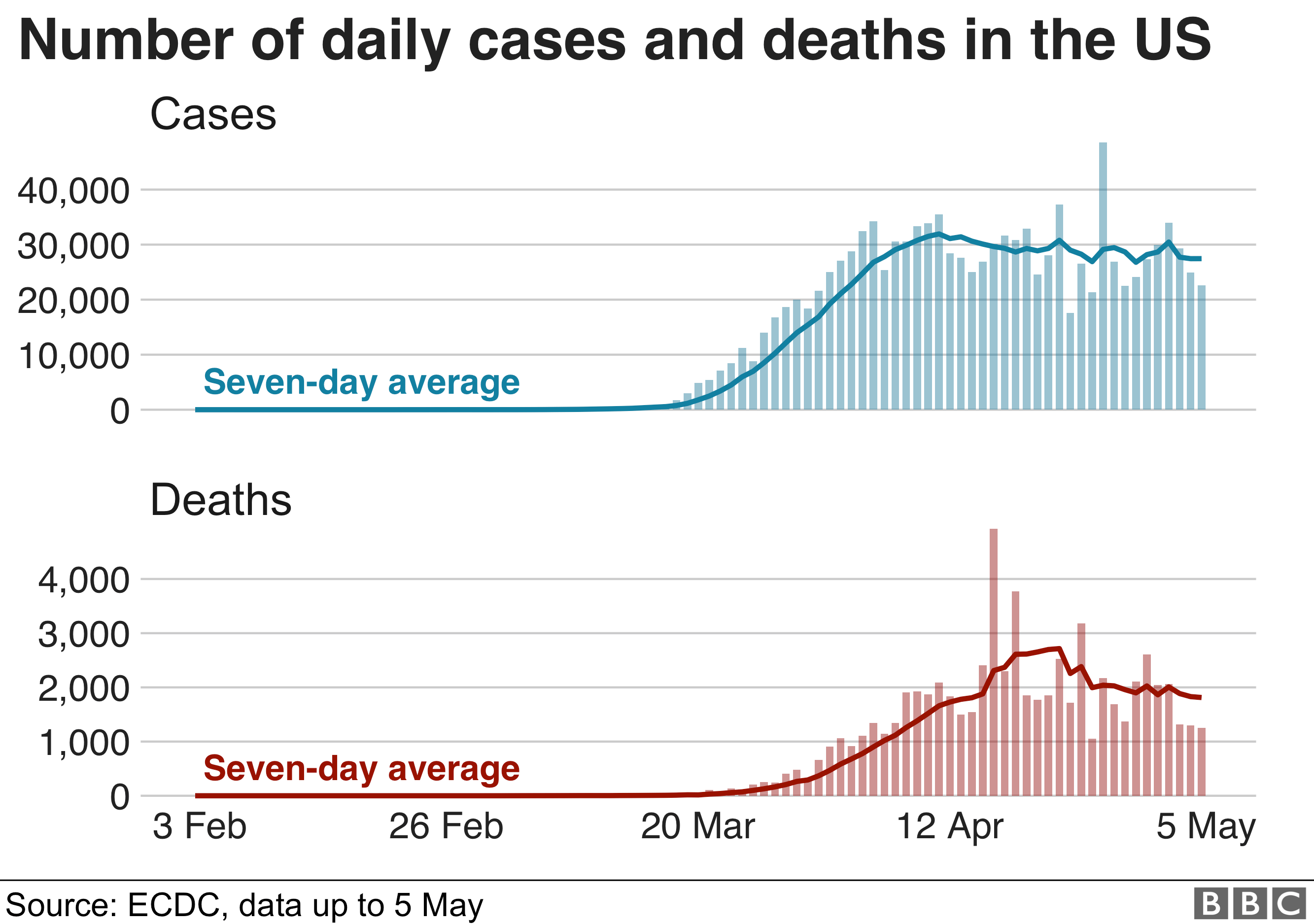
Since emerging in the Chinese city of Wuhan in December, the coronavirus is confirmed to have infected 1.2 million Americans, killing more than 73,000.
Speaking to reporters in the Oval Office of the White House on Wednesday, Mr Trump said: “We went through the worst attack we’ve ever had on our country, this is worst attack we’ve ever had.
“This is worse than Pearl Harbor, this is worse than the World Trade Center. There’s never been an attack like this.
“And it should have never happened. Could’ve been stopped at the source. Could’ve been stopped in China. It should’ve been stopped right at the source. And it wasn’t.”
Media caption Life for asylum seekers in lockdown on the US-Mexico border
Asked later by a reporter if he saw the pandemic as an actual act of war, Mr Trump indicated the outbreak was America’s foe, rather than China.
“I view the invisible enemy [coronavirus] as a war,” he said. “I don’t like how it got here, because it could have been stopped, but no, I view the invisible enemy like a war.”
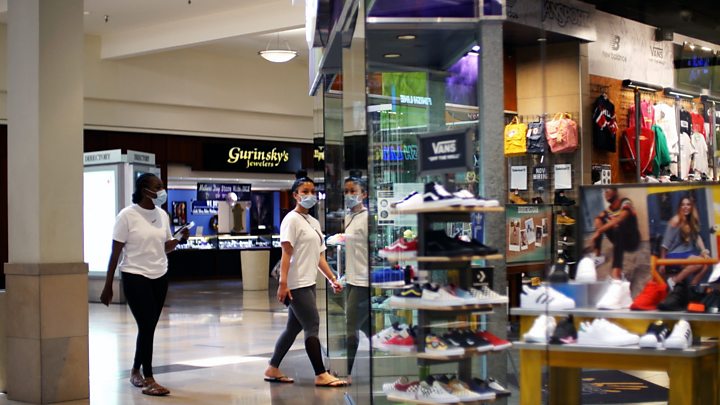
Media caption US shopping centres re-open: ‘This is the best day ever’
Who else in Trump’s team is criticising China?
The deepening rift between Washington and Beijing was further underscored on Wednesday as Secretary of State Mike Pompeo renewed his rhetoric against China, accusing it of covering up the outbreak.
He stuck by his so far unsubstantiated charge that there is “enormous evidence” the coronavirus hatched in a Chinese laboratory, even while acknowledging there is still uncertainty about its origins.
“Those statements are both true,” America’s top diplomat told the BBC. “We don’t have certainty and there is significant evidence that it came from a lab.”
One of the most trusted US public health experts has said the best evidence indicates the virus was not made in a lab.
Dr Anthony Fauci, a member of Mr Trump’s coronavirus task force, said on Monday the illness appeared to have “evolved in nature and then jumped species”.
Why is the US blaming China?
President Trump faces a tough re-election campaign in November, but the once humming US economy – which had been his main selling point – is currently in a coronavirus-induced coma.
As Mr Trump found his management of the crisis under scrutiny, he began labelling the outbreak “the China virus”, but dropped that term last month days before speaking by phone with Chinese President Xi Jinping.
Both Mr Trump and his likely Democratic challenger, Joe Biden, appear to be fastening on to China’s unpopularity as an election issue, with each accusing the other of being a patsy for America’s primary economic competitor.
As the coronavirus began spreading in the US back in January, Mr Trump signed phase one of a trade deal with China that called a truce in their tariff war. The US president’s hopes of sealing a more comprehensive phase two deal are now in limbo because of the pandemic.
BEIJING (Reuters) – Tang Yue, a 27-year-old teacher from the city of Guilin in southwest China, steam-presses a blue dress and takes dozens of photographs before picking one to clinch her 200th online sale.
For a growing number of Chinese like Tang, hit by job losses, furloughs and salary cuts, the consumer economy has begun to spin in reverse. They are no longer buying – they are selling.
Instead of emerging from the coronavirus epidemic and returning to the shopping habits that helped drive the world’s second-largest economy, many young people are offloading possessions and embracing a new-found ethic for hard times: less is more.
With Tang’s monthly salary of about 7,000 yuan ($988), the self-described shopaholic said she has bought everything from Chanel lipsticks to Apple’s (AAPL.O) latest iPad in the past three years.
But the adrenaline rush that comes with binge-shopping is gone, said Tang, whose wages have been slashed with the suspension of all the classes on tourism management she usually teaches.
“The coronavirus outbreak was a wake-up call,” she said. “When I saw the collapse of so many industries, I realised I had no financial buffer should something unfortunate happen to me.”
There is no guarantee that the nascent minimalist trend will continue once the coronavirus crisis is fully over, but if it does, it could seriously damage China’s consumer sector and hurt thousands of businesses from big retailers to street-corner restaurants, gyms and beauty salons.
To be sure, there are signs that pent-up demand will drive a rush of spending as authorities reopen malls, leisure venues and tourist spots. In South Korea, the first major economy outside of China to be hit by the virus, people thronged malls this weekend to go “revenge shopping” to make up for time lost in lockdown.,
There are some signs that a similar trend will take hold in China, where some upscale malls are starting to get busy, although luxury firm Kering SA (PRTP.PA) – which owns Gucci, Balenciaga and other fashion brands – has said it is hard to predict how or when sales in China might come back.
A recent McKinsey & Co survey showed that between 20% and 30% of respondents in China said they would continue to be cautious, either consuming slightly less or, in a few cases, a lot less.
“The lockdown provided consumers with a lot of time and reasons to reflect and consider what is important to them,” said Mark Tanner, managing director at Shanghai-based research and marketing consultancy China Skinny.
“With much more of their days spent in their homes, consumers also have more time and reasons to sort through things they don’t feel they need – so they’re not living around clutter that is common in many apartments.”
#DITCHYOURSTUFF
Tang made a spreadsheet to keep track of her nearly 200 cosmetic products and hundreds of pieces of clothing. She then marked a few essentials in red that she wanted to keep. In the past two months, she has sold items worth nearly 5,000 yuan on second-hand marketplaces online.
Bargain-hunting online has become a new habit for some Chinese as the stigma that once hung over second-hand goods has begun to fade.
Idle Fish, China’s biggest online site for used goods, hit a record daily transaction volume in March, its parent company Alibaba (BABA.N) told Reuters.
Government researchers predict that transactions for used goods in China may top 1 trillion yuan ($141 billion) this year.
Posts with the hashtag #ditchyourstuff have trended on Chinese social media in recent weeks, garnering more than 140 million views.
Jiang Zhuoyue, 31, who works as an accountant at a traditional Chinese medicine company in Beijing – one of the few industries that may benefit from the health crisis – has also decided to turn to a simpler life.
“I used to shop too much and could be easily lured by discounts,” said Jiang. “One time Sephora offered 20% off for all goods, I then bought a lot of cosmetics because I feel I’m losing money if I don’t.”
Jiang, the mother of a 9-month-old baby, said she recently sold nearly 50 pieces of used clothing as the lockdown gave her the opportunity to clear things out. “It also offered me a chance to rethink what’s essential to me, and the importance of doing financial planning,” she said.
Eleven Li, a 23-year-old flight attendant, said she used to spend her money on all manner of celebrity-endorsed facial masks, snacks, concert tickets and social media activity, but now has no way to fund her spending.
“I just found a new job late last year, then COVID-19 came along, and I haven’t been able to fly once since I joined, and I’ve gotten no salary at all,” said Li, who said she was trying to sell her Kindle.
Some are even selling their pets, as they consider leaving big cities like Beijing and Shanghai where the high cost of living is finally catching up with them.
NO RETURN TO OLD WAYS?
As the coronavirus comes under control in China, the government is gradually releasing cities from lockdown, easing transport restrictions and encouraging consumers to venture back into malls and restaurants by giving out billions-worth of cash vouchers, worth between 10 yuan and 100 yuan.
But many people say they are still worried about job security and potential wage cuts because of the struggling economy. Nationwide retail sales have plunged every month so far this year.
Xu Chi, a Shanghai-based senior strategic analyst with Zhongtai Securities, said some Chinese consumers may prove the ‘21 Day Habit Theory,’ a popular scientific proposition that it only takes that long to establish new habits.
“We believe people’s spending patterns follow the well-known theory, which means most people in China, having been cooped-up at home for more than a month and not having binge-shopped, may break the habit and not return to their old ways,” Xu said.
Jiang said she was determined not to return to her free-spending ways and planned to cook more at home.
“I’ll turn to cheaper goods for some luxury brands,” she said. “I’ll choose Huawei’s smartphone, because (Apple’s) iPhone has too much brand premium.”
Tang, who has recently used 100 yuan of shopping coupons to stock up on food, is going to hold the purse strings even tighter.
“I’ve set my monthly budget at 1,000 yuan,” she said. “Including one – and just one – bottle of bubble tea.”
BEIJING, May 2 (Xinhua) — Chinese religious circles have slammed the United States Commission on International Religious Freedom for smearing China’s freedom of religious belief in the commission’s recent report.
The annual report, which groundlessly blamed the freedom of religious belief in China and viciously slandered China’s religious policies, was met with general revulsion and indignation among Chinese religious circles and numerous religious believers, said a statement issued by the secretariat of the joint conference of China’s national religious groups.
“We express our strong condemnation,” the statement said.
It is obvious to all that the Chinese government protects citizens’ basic rights in accordance with the law, and religious believers enjoy full freedom of religious belief, the statement noted.
Chinese religious circles have made remarkable achievements in the development of theological theories, the construction of religious venues and the cultivation of talents, it said.
However, the United States has ignored the facts and piled unwarranted criticism on China’s religious situation, exposing its arrogance and prejudice, the statement said, adding that the acts have interfered in China’s internal affairs, smeared China’s freedom of religious belief and hurt the feelings of Chinese religious believers.
“We urge the United States to stop using religious matters to interfere in other countries’ internal affairs and stir up troubles,” it said.
WINDHOEK, May 1 (Xinhua) — China’s poverty eradication policy and deliberate attempts to improve the lives of the rural population is a model for Namibia and Africa in general to follow in dealing with inequality in society, experts have said.
University of Namibia social and political analyst Ndumbah Kwamwayah said China has laid a strong foundation in dealing with poverty and emancipating its people since the days of Mao Zedong.
“Chinese literature especially the life journey of Chairman Mao is a good benchmark for developing countries that want to find ways of creating equal societies. If you check here in Namibia inequality and rural poverty are there despite our economy being agro-based.
“We need to take a cue from countries like China who have created better societies through improving agriculture production and mechanization through investing heavily in local people,” he said.
According to Kamwayah, China continues to value its agro-based economy as well as investment in rural development.
“China through its leaders in the past and present has come up with strong policies of decentralizing key services and also curbing rural urban drift through developing villages. Chinese literature also strongly captures the aspect of local development.
“In Namibia there are many regions including the Kunene, Zambezi and Kavango which are heavily affected by poverty. These need deliberate policies to be improved,” he said.
Political analyst from University of Namibia, Hoze Riruako said poverty eradication remains one of the biggest challenges confronting Namibia in contemporary times.
“What is more important is not to reproduce the Chinese way of doing things but to pick certain traits that can dent poverty and rural development from them,” he said.




 CHINDIA ALERT: You'll be living in their world, very soon