Archive for ‘China alert’

21/12/2016

Your feedback much appreciated – revised

imgresI’ve been posting on this website for several years and have had over 70,000 visits from 181 countries and nearly 500 regular followers.  I would like your feedback. It will only take 5 minutes of your time.  Pls go to:

https://www.surveymonkey.co.uk/r/5MJZ5G9.

Many thanks in anticipation.

Tags: ,
21/12/2016

China seizes an underwater drone and sends a signal to Donald Trump | The Economist

IT WAS an operation carried out with remarkable cool. On December 15th, less than 500 metres away from an American navy ship, a Chinese one deployed a smaller boat to grab an underwater American drone. The object was then taken to the Chinese ship, which sailed off with it. Point deftly made.

The incident occurred in the South China Sea, in which China says the Americans have no business snooping around. By seizing the drone, it has made clear that two can play at being annoying. Mercifully no shots were fired. After remonstrations by the Americans, China agreed to give the drone back “in an appropriate manner”. It chose its moment five days later, handing the device over in the same area where it had snatched it. The Pentagon, though clearly irritated, has downplayed the drone’s importance, saying it cost (a mere) $150,000 and that most of its technology was commercially available. The drone was reportedly carrying out tests of the water’s properties, including salinity and temperature.

But it may turn into less of a game. Relations between the two nuclear powers, never easy at the best of times, are under extra strain as Donald Trump prepares to take over as president on January 20th. Mr Trump has already angered China by talking on the phone to Taiwan’s president, Tsai Ing-wen, and challenging China’s cherished “one-China” policy, crucial to which is the idea that Taiwan is part of it.

The capture of the drone took place on the outer perimeter of China’s expansive claim to the sea, about 50 miles (80km) from the Philippine port of Subic Bay, which was once home to a large American naval base (see map).

It appeared calculated to show China’s naval reach, with only minimal risk of any conflict—the American ship that was operating the drone, the Bowditch, is a not a combat vessel. Once in office, however, Mr Trump could face tougher challenges, exacerbated by China’s growing presence in the South China Sea: it appears to be installing weapons on islands it has been building there.

His two predecessors were each tested by a dangerous military standoff with China in their first months in office. With George Bush it involved a mid-air collision in April 2001 between an American spy-plane and a Chinese fighter-jet off China’s southern coast. The Chinese pilot was killed and the disabled American plane made an emergency landing at a Chinese airfield. There the crew of 24 was released after 11 days of painstaking diplomacy. The aircraft, full of advanced technology, was returned—in pieces—months later.

In March 2009 it was Barack Obama’s turn. According to the Pentagon, an American surveillance ship, the Impeccable, was sailing 75 miles from China’s coast when it was buzzed by Chinese aircraft and then confronted by five Chinese ships. First the Chinese forced it to make an emergency stop, then they scattered debris in front of the American ship as it tried to sail away. They also attempted to snatch sonar equipment it was towing. The Impeccable soon returned—this time in the reassuring company of an American destroyer.

For now, feuding between Mr Trump and China is less nail-biting. In Twitter messages, Mr Trump bashed China for taking the drone and later said China should keep it. Chinese media have in turn bashed Mr Trump. One newspaper said he had “no sense of how to lead a superpower”. Global Times, a nationalist newspaper in Beijing, said that China would “not exercise restraint” should Mr Trump fail to change his ways once in the White House. He would be wise to study the form.

Source: China seizes an underwater drone and sends a signal to Donald Trump | The Economist

21/12/2016

What China claims to have invented | The Economist

Strange the Chinese felt the need to do their own reasearch about its inventiveness when that had already been done thoroughly by Joseph Needham – http://www.nri.cam.ac.uk/joseph.html – and summarised in

  The Genius of China: 3,000 Years of Science, Discovery, and Invention
Robert Temple
Inner Traditions
Paperback
288 pages
November 2007

http://www.curledup.com/geniusch.htm

Needham’s research uncovered many more than 88 Chinese inventions!

EIGHT is a lucky number in China. How fortunate it was, then, that a team of more than 100 scientists was able, after three years of research, to declare that ancient Chinese had achieved no fewer than 88 scientific breakthroughs and engineering feats of global significance. Their catalogue of more than 200 pages, released in June, was hailed as a major publishing achievement.

All Chinese schoolchildren can name their country’s “four great inventions”: paper, printing, the compass and gunpowder. Now it appears they have a lot more homework to do. The study purports to prove that China was first with many other marvels, including the decimal system, rockets, pinhole imaging, rice and wheat cultivation, the crossbow and the stirrup.

It is no coincidence that the project, led by the prestigious Chinese Academy of Sciences, got under way a few months after Xi Jinping took over as China’s leader in 2012. Mr Xi has been trying to focus public attention on the glories of China’s past as a way to instil patriotism and provide a suitable historical backdrop for his campaign to fulfil “the Chinese dream of the great rejuvenation of the Chinese nation”.

Mr Xi is building on a long tradition among the Communist Party’s propagandists of claiming world firsts. “China invented Lassie,” ran a headline in Global Times, a party-controlled newspaper, about dogs being domesticated in China 16,000 years ago (another group of scientists reckon China first did this 33,000 years ago). In 2006 official media shocked the Scots with an assertion that China invented golf a millennium ago, hundreds of years before the game took off in Scotland.

As a lover of football, Mr Xi likes drawing attention to China’s pioneering of that sport, too. On a visit to Britain in 2015 he stopped at one of the country’s most famous football clubs, Manchester City. There he was presented with a copy of the first rules for the modern game (drawn up by an Englishman in 1863). In return, he handed over a copper representation of a figure playing cuju, a sport similar to football invented by China 2,000 years ago (see picture, from a football museum in Shandong province). It was apparently popular both among urban youths and as a form of military fitness training. Mr Xi would like a great rejuvenation of this, too. In 2014 he announced plans to put football on the national curriculum. The aim is to make China a “first-class power” in football by 2050 (it has a long way to go).

The growing attention that China pays to its ancient achievements, real and exaggerated, contrasts with the almost total rejection of them by Mao Zedong after he seized power in 1949. In Mao’s China history was not something to celebrate. A central aim of his Cultural Revolution was to attack the “four olds”: customs, culture, habits and ideas. Many Chinese dynasties destroyed some glories of the previous one, but the Communists took this to new extremes. Across the country state-sponsored vandals destroyed temples, mansions, city walls, scenic sites, paintings, calligraphy and other artefacts.That began to change after Mao died in 1976. Now Mr Xi claims that Chinese civilisation “has developed in an unbroken line from ancient to modern times”. He glosses over not just the chaos and destruction of the Mao era but the long centuries when the geographical area now called China was divided into many parts, and even run by foreign powers (Manchu and Mongol).

The party also wants to use ancient prowess to boost China’s image abroad and to counter widespread (and often unfair) impressions in the West that the country is better at copying others’ ideas than coming up with its own. The four great inventions were one of the main themes at the opening ceremony of the Olympic Games in Beijing in 2008, an event that China saw as its global coming-out party after decades of being treated with suspicion and contempt by foreign powers.

Envy of the West’s rapid gains in technology since the 19th century has been a catalyst of Chinese nationalism for over 100 years. It fuels a cultural competitiveness in China that turns ancient history into a battleground. This was evident in China’s prickly response to a recent documentary made by the BBC and National Geographic, which suggested that China’s famous terracotta warriors in Xi’an showed Greek influence. Some people interpreted this as a slight. One Chinese archaeologist dismissed the theory as “dishonest” and having “no basis”; another said that foreign hands could not have sculpted the figures because “no Greek names” were inscribed on their backs. Likewise in 2008 Boris Johnson, then mayor of London, was derided for saying that table tennis originated not in China but on Victorian dining tables and was known as whiff-whaff.

Just a slight inconsistency

The publication of the 88 achievements, however, has drawn attention again to an enduring mystery: why, after a long record of remarkable attainment in technology, did Chinese innovations largely cease for the 500 years or so leading up to the collapse of the last imperial dynasty in 1911? As state media observed, few of the inventions on the new list belong to this period. This puzzle is often referred to as the “Needham question”, after a British scientist and Sinologist, Joseph Needham. (It was he, in his study of China’s ancient science in the 1950s, who first identified the four great inventions—before then most people thought they had emerged in the West.) A member of the team that produced the list said the question deserved “deep reflection” and would be a topic of future research.

Mr Xi skates over this. He lauds Zheng He, a eunuch who launched maritime voyages from China across the Indian Ocean from 1405, as one of China’s great innovators—an early proponent of a vision of China that Mr Xi would like to recreate: prosperous, outward-looking and technologically advanced (the admiral’s massive boat is number 88 on the list). Yet he fails to point out that soon after Zheng He’s explorations China turned inward, beginning its half-millennium of stagnation.

In this 15th-century turning point, reformists in China see an obvious answer to Needham’s question: isolation from the rest of the world is bad for innovation. They take heart in China’s efforts since the 1970s to re-engage with the West, but lament the barriers that remain. With luck, it will not take 100 state-sponsored Chinese scientists another three years to reach the same conclusion.

Source: What China claims to have invented | The Economist

Tags: ,
18/12/2016

China to return seized US underwater drone, Pentagon says – BBC News

The Pentagon says it has “secured an understanding” with China that it will return an underwater drone seized in the South China Sea.China captured the US vessel in international waters on Thursday. It has not explained why and accused the US of “hyping-up” the incident.US President-elect Donald Trump accused the Chinese of “stealing”.

“We should tell China that we don’t want the drone they stole back – let them keep it!” he tweeted.

The incident is among the most serious military confrontations between the two powers for decades.

The Pentagon said the drone, known as an unmanned underwater vehicle (UUV), was being used to carry out scientific research at the time it was captured and demanded its immediate return. It warned China not to repeat such a move in the future.

But a spokesman said later on Saturday that an agreement had been reached.”Through direct engagement with Chinese authorities, we have secured an understanding that the Chinese will return the UUV to the United States,” Pentagon spokesman Peter Cook said in a statement.

The Chinese defence ministry said the vessel would be returned in an “appropriate manner”. It is not clear when this might happen.

It criticised the earlier US response, calling it “inappropriate and unhelpful”.

Source: China to return seized US underwater drone, Pentagon says – BBC News

16/12/2016

Taiwan fears becoming Donald Trump’s bargaining chip | The Economist

BY THE end of this month, say Chinese officials, work will be completed on a big upgrade of facilities at a monument to one of the scariest moments in the recent history of relations between China and the United States: an upsurge of tensions in the Taiwan Strait in the mid-1990s that saw the two nuclear powers inching towards the brink of war.

The structure is a concrete tower on an island in the strait, just off the Chinese coast. Atop it more than 100 generals watched a mock invasion of Taiwan by China’s army on a beach below. “Unite the motherland, invigorate China”, says a slogan in gold characters down the side of the building. The meaning of these words at a place where tanks and troops once stormed ashore with warplanes streaking overhead is: we want Taiwan back, by force if necessary.

The building work involves an expansion of the tower’s car park, improvements to the road up to it and other changes to make the place on Pingtan Island in Fujian province more tourist-friendly. The timing may be fortuitous. On December 11th America’s president-elect, Donald Trump, in an interview with Fox News, questioned what China regards as a sacred underpinning of its relationship with America: the principle that there is but “one China” (which, decoded, means that the government of Taiwan is illegitimate). China, bristling with rage, may well seek to remind its citizens, as well as America, of what happened when that principle was last challenged by the United States with a decision in 1995 by its then president, Bill Clinton, to allow his Taiwanese counterpart, Lee Teng-hui, to pay a private visit to America. Handy, then, that Pingtan will be able to handle extra busloads of visitors to that hilltop where China’s brass surveyed the pretend assault.

Relations between China and America are far less precarious than they were during those tense months, when China fired dummy missiles near Taiwan and America sent two aircraft-carrier battle groups close to the island to warn China not to attack it. China, though enraged by Mr Trump’s remarks (and a congratulatory call he took from Taiwan’s president, Tsai Ing-wen, on December 2nd), is unlikely to take retaliatory action unless Mr Trump continues to challenge the notion of one China after his inauguration on January 20th.

The chip is down

Taiwan has been in the doghouse anyway since Ms Tsai took office in May. China has cut off channels of communication with the island to show its displeasure with her own refusal to embrace the one-China idea. But Ms Tsai may have reservations herself about the way Mr Trump phrased his one-China scepticism. “I don’t know why we have to be bound by a one-China policy unless we make a deal with China having to do with other things, including trade,” he said. Mr Trump listed ways in which America was being “badly hurt” by China, such as by the fall in the value of its currency and its island-building in the South China Sea. He accused China of “not helping us at all with North Korea”.

Many Taiwanese worry that this could mean their island will be treated by Mr Trump as a bargaining-chip. Memories are still fresh in Taiwan of secretive dealings between America and China during the cold war, which resulted in America severing diplomatic ties with the island in 1979. Ms Tsai’s government has avoided direct comment on Mr Trump’s remarks. Apparently to avoid raising tensions with China, she has also avoided public crowing over her phone call with Mr Trump.

Mr Trump’s remarks would have riled the Chinese leadership at any time. But they are particularly unwelcome at this juncture for China’s leader, Xi Jinping. He is absorbed by preparations for crucial meetings due to be held late in 2017 at which sweeping reshuffles of the Politburo and other Communist Party bodies will be announced. Those trying to block his appointments would be quick to seize on any sign that he is being soft on America over such a sensitive matter as Taiwan. Should Mr Trump persist in challenging the one-China idea, the risk of escalation will be even greater than usual in the build-up to the conclaves—all the more so, perhaps, given Mr Xi’s insistence that differences between China and Taiwan “cannot be passed on from generation to generation”. Hawkish colleagues may say that it is time to settle the issue by force.

Street protests in China against America or Taiwan would also make it more difficult for Mr Xi to compromise: he would fear becoming a target himself of Chinese nationalists’ wrath. But the risk of this may be low. Since Mr Xi took over in 2012 there have been no major outbreaks of nationalist unrest, partly thanks to his tightening of social and political controls (including locking up ever more dissidents).

Sun Zhe of Tsinghua University says people are unlikely to demonstrate over Taiwan “because they understand the new rules, the new emphasis on political discipline in the last few years.” He says a lot of people in China still admire Mr Trump for his wealth and his unexpected political success. They think that “he wants to make a deal with China.”

In Taiwan, some take comfort in the difficulty Mr Trump would face in changing the terms of America’s relations with Taiwan, such as by announcing a permanent end to arms sales. These are guaranteed by the Taiwan Relations Act, which was passed by Congress in 1979 to reassure Taiwan that America still had an interest in the island’s defence, despite the severance of official ties. Many Republicans sympathise with Taiwan and would be reluctant to support any change to that law (itself a challenge to the one-China idea with which China has—very grudgingly—learned to live).

They might also take solace in what appears to be a change in the Chinese government’s tone since the war games 20 years ago. In April Global Times, a newspaper in Beijing, published a poll showing that 85% of respondents supported unifying China with Taiwan by force, and that 58% agreed the best time would be within the next five years. It was reportedly chastised by China’s internet regulator for “hyping sensitive events” by running such a survey.

Source: Taiwan fears becoming Donald Trump’s bargaining chip | The Economist

16/12/2016

China upset as Dalai Lama meets President Pranab Mukherjee | Reuters

China expressed dissatisfaction on Friday after exiled Tibetan spiritual leader the Dalai Lama met President Pranab Mukherjee, saying it hoped India would recognise the Nobel Peace Prize winning monk as a separatist in religious guise.

Mukherjee hosted the Dalai Lama and other Nobel Peace laureates at a conference on children’s rights at the presidential palace on Sunday.

Those who attended, and spoke, included Princess Charlene of Monaco and the former president of East Timor, Jose Ramos-Horta.

The Indian government had ignored China’s “strong opposition and insisted” on arranging for the Dalai Lama to share the stage with Mukherjee, and meet him, Foreign Ministry spokesman Geng Shuang told a daily news briefing in the Chinese capital.

“China is strongly dissatisfied and resolutely opposed to this,” he said, adding that the Dalai Lama used the guise of religion to engage in separatist activities and China opposed any form of official contacts with him.China wanted India to recognise the “anti-China, separatist essence of the Dalai Lama clique and take steps to banish the negative impact of this incident” to avoid disrupting ties between the Asian giants, Geng said.

While the Dalai Lama has had private meetings with Indian leaders, Sunday’s conference was the first public event, said the political head of the Tibetan government in exile based in the hill town of Dharamsala.

“There are many European governments shying away from hosting His Holiness,” he told Reuters. “Here you have the president of India hosting His Holiness. I think is a powerful message to the world, and particularly to Beijing.”

China regards the Dalai Lama as a separatist, though he says he merely seeks genuine autonomy for his Himalayan homeland Tibet, which Communist Chinese troops “peacefully liberated” in 1950.

The Dalai Lama fled into exile in India in 1959 after a failed uprising against Chinese rule.

China also expressed displeasure with India this month over the visit to a sensitive border region of another senior Tibetan religious figure, the Karmapa Lama, Tibetan Buddhism‘s third-most-senior monk, who fled into exile in India in 2000.India is home to a large exiled Tibetan community.

Source: China upset as Dalai Lama meets President Pranab Mukherjee | Reuters

15/12/2016

Trump and China: 5 Views From Beijing – China Real Time Report – WSJ

Stephen Sestanovich, a professor at Columbia University and senior fellow at the Council on Foreign Relations, is the author of “Maximalist: America in the World From Truman to Obama.” He is on Twitter: @SSestanovich.

When the Chinese Foreign Ministry expresses “serious concern” about things Donald Trump has said about Taiwan—and a party-controlled newspaper calls him “as ignorant as a child”—it’s clear that Beijing is alarmed. Yet after spending last week in China, I came away struck by the overall complacency of Chinese attitudes toward the president-elect. From officials (and former officials), entrepreneurs, journalists, NGO leaders, and think-tankers, I heard five different reasons for not worrying too much about how Mr. Trump could affect U.S.-China relations.

1. China is powerful.

Sure, a new administration might want to rethink the relationship between Beijing and Washington, but that can’t be the end of the story, I heard. China has so many ways to push back. Soon enough the Americans would come to their senses.

2. The U.S. is constrained.

Standing up to China is expensive, I was reminded. As one former trade official told me, “America may decide it wants to patrol the South China Sea more often, but that costs money.” (I pointed out to people I talked to that Mr. Trump was committed to a big increase in the Pentagon budget—but everyone knows there are a lot of claims on those dollars, and many would have no impact on China.)

3. Businessmen are practical people.

China’s economic surge, now more than three decades old, was premised on an abandonment of ideology. As a successful businessman, Mr. Trump—I was told—must be a pragmatist at heart. One journalist I talked to thought it might help the president-elect to cultivate a Nixon-style “mad man” reputation, but most of my interlocutors seemed confident this was all for show.

4. Bureaucratic and interest-group politics.

The Chinese have seen previous presidents campaign on anti-Chinese themes only to abandon them in office. Why, they ask, does this happen? Their answer: the institutions of the U.S. government know how to bury new ideas. Someone like Mr. Trump, with no prior experience in Washington, will find it difficult to ignore Congress and the federal bureaucracy.

5. Habit and mutual benefit.

Chinese of all outlooks believe that, in the 45 years since Henry Kissinger first visited Beijing, a relationship has been created from which both sides derive obvious benefits. “Win-win” seems to be a favorite buzz phrase in China, and the idea that it would be questioned evokes a certain incredulity.The status quo has a powerful hold on people’s imaginations everywhere. Still, the Chinese assumption of policy continuity—after everything that has happened this year!—was a surprise for me. I told the people I spoke to that Mr. Trump had convinced many voters that he is determined to scrap outmoded policies. One person, who knows the U.S. well, had an interesting response: “You mean ‘win-win’ could be one of them?”

Source: Trump and China: 5 Views From Beijing – China Real Time Report – WSJ

13/12/2016

A New Highway Links China’s Capital to a Hoped-For Future – China Real Time Report – WSJ

Beijing built it. Now will the traffic jams come?

A new highway loop around China’s capital opened last week, ticking off another checkbox in a long-held state plan to tie the city and its surrounding suburbs into a massive megalopolis known as Jing-Jin-Ji.

Locally known as the Seventh Ring Road and officially as the G-95 national highway, the roadway spans nearly 1,000 kilometers (about 620 miles) and links a dozen existing highways in a chain that circles the far outskirts of Beijing. Five successively smaller coils of highways sit inside of it. The smallest, and nearest to the Forbidden City in the core of the capital, is the Second Ring Road.

If the seventh ring were unwound and moved to the U.S., it would stretch roughly a sixth of the way across the United States.

As it is, about 90% of the Seventh Ring Road snakes through 13 cities and largely undeveloped areas and farmland in nearby Hebei province. The name for the megalopolis, Jing-Jin-Ji, combines characters from Beijing and the port city of Tianjin and a name for Hebei.

Government planners hope that one day soon the less developed areas of this conurbation will be transformed into bedroom communities, office parks and industrial estates, giving impetus to new sources of economic growth and easing the pressure on Beijing’s clogged roadways and soaring property prices.

“Transportation is making a leading breakthrough, accelerating the integration of Jing-Jin-Ji,” the Ministry of Transport said in a statement last week.  The Communist Party’s newspaper, People’s Daily, said Monday that the new ring road “will effectively ease the pressure on vehicles in the capital region.”

Sanhe, a city in Hebei, is typical of the official plans for the region and was spotlighted by the government as an important link in the Seventh Ring Road. Sanhe borders the eastern Beijing suburb of Tongzhou district, where new Beijing city government offices are slated to open by the end of next year. Over the last year, the prospect of new business activity and services in Tongzhou spurred a mini home-buying frenzy.

Locals are anticipating that housing demand could someday spill into Sanhe. Wang Qiang, a 30-year-old installation engineer for a Chinese construction company, and his wife bought a one-bedroom apartment two years ago in Yanjiao, a town that is part of Sanhe and sits on the Tongzhou border. The value of his apartment has roughly doubled since then, a sign of rising demand for his neighborhood, he says. “Yanjiao prices closely follow Tongzhou prices,” Mr. Wang said.

During a recent drive to Sanhe, it took nearly an hour and half to escape the snarl of Beijing traffic. A few convenience stores dotted local roads. A sign for a “World Business Valley” housing development stretched over an archway in front of a land parcel overgrown with weeds.Three days after its official opening, the Sanhe stretch of the Seventh Ring Road was empty. The toll booths were staffed. The six-lane highway was smoothly paved. Half an hour went by, but there were no other cars on a sunny, blue-skied morning.

The taxi driver, Ms. Zhai, was asked if she’d consider buying a home someday in Sanhe, the site of possible future development.

“Here?” Ms. Zhai sighed. “I wouldn’t. I’m from Beijing, from Tongzhou. There are no businesses, no factories out here. I’d have to wait a few years, then maybe I’d buy. Maybe in 2020.”

Source: A New Highway Links China’s Capital to a Hoped-For Future – China Real Time Report – WSJ

Tags: , ,
09/12/2016

China has gained hugely from globalisation | The Economist

LI DONGSHENG, who is 35, says he is too old to learn new skills and too old to get married. Construction and factory work used to be plentiful, he says, as he eats his lunch from a yellow plastic container while sitting on a wall outside a job centre in Hangzhou, a city on China’s wealthy eastern seaboard. But these days he can rarely find even odd jobs. He sleeps rough and has not visited his parents, who live hundreds of kilometres inland, for two years.
Millions of people like Mr Li have powered China’s rise over the past three decades, working in the boom-towns that have prospered thanks to China’s enthusiastic embrace of globalisation. Yet many are anxious and angry.Factory workers in America and Europe often blame China for stealing their jobs. There is no doubt that China has benefited enormously from its vast pool of people, like Mr Li, who are willing to work for a fraction of what Western counterparts might earn. Since 1979 China’s transformation into the workshop of the world has helped lift hundreds of millions of Chinese out of poverty.

Yet many of the worries that have recently animated Western voters are common in China, too. Working-class Chinese, as well as members of the new middle class, fret about rising inequality, the impact of mass migration from the countryside into cities and job losses. “China will not shut the door to the outside world but open more,” said the president, Xi Jinping, in November. But even globalisation is occasionally attacked. On December 6th Global Times, a jingoistic newspaper published in Beijing, ran an opinion piece blaming globalisation for China’s income inequality, housing bubbles and the ravaging of its environment.

China’s own policy failures are much to blame, too. But the government has sensed the danger of rising public anger created by the divide between rich and poor (in the 1980s China was among the most equal societies in the world; now it is one of the least so). A decade ago it switched its “chief task” from “economic construction” to establishing a “harmonious society”—ie, one with a more even distribution of wealth (as well as a beefed-up police force to keep malcontents in check). China is now becoming slightly fairer overall: thanks to a dwindling supply of cheap labour and government efforts to boost the minimum wage, blue-collar salaries are rising faster than white-collar ones.But many people feel that inequality and social mobility are getting worse in other respects. For example, members of the fast-growing middle class complain about the emergence of a new plutocracy. They say that the wealthiest owe their fortunes to corruption and personal relationships, not hard work. Mr Xi’s waging of the longest and most intense campaign against graft since the party came to power in 1949 is partly (as he admits) a sign of fear that anger over widespread and egregious corruption might imperil the party’s rule.


Among blue-collar workers, a structural shift in China’s economy, from labour-intensive manufacturing to higher-tech industries and services, is fuelling job insecurity. In 2013, for the first time, the contribution to GDP from services, such as transport, shops, restaurants and finance, pulled ahead of industry, including manufacturing, mining and construction (see chart).

In the past couple of years, jobs in manufacturing have been declining, partly because globalisation is beginning to play the same sort of role in China as it does in developed countries. Some factories have been moving to cheaper locations abroad.The impact is pronounced in many of the hundreds of towns that specialise in making certain products. Datang, China’s “sock city” near Hangzhou, is a good example: in 2014 it made 26bn pairs of socks, some 70% of China’s production, but many factories are closing as garment-making moves to cheaper countries in Asia. As a local boss explains, “People simply won’t pay more for a pair of socks.”

Millions more jobs are threatened by efforts to reduce overcapacity in bloated and heavily indebted state-owned enterprises (SOEs), such as steelmakers and mining companies. Nervous officials often prefer to prop up such businesses rather than risk an explosion of unrest among laid-off urban-born workers. The government worries more about such people than it does about unemployed migrants from rural areas: they stay in the cities rather than return to the countryside.

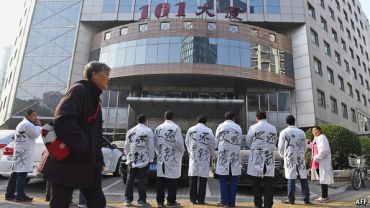
The official unemployment rate in urban areas has remained remarkably steady at around 4% for years, even during the worst of the global financial crisis. But those figures are highly misleading. For one thing they exclude migrants from the countryside, who often suffer the worst labour abuses, such as long periods of unpaid leave as well as of unpaid work: bosses often suffer the worst labour abuses, such as long periods of unpaid leave as well as of unpaid work: bosses often hold back wages for months. About 40 construction workers in Beijing protested last month to demand unpaid wages from a project three years ago (pictured above).

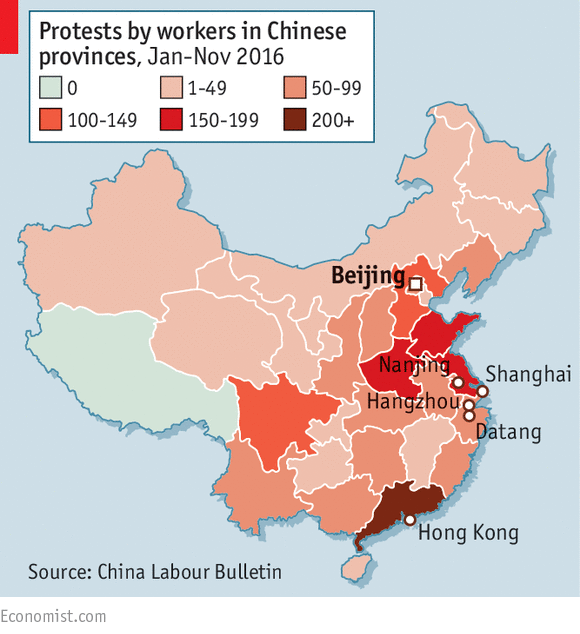
Many of those who used to work in factories, such as Mr Li in Hangzhou, are ill-equipped to find new jobs in service industries. Official data show that more than two-thirds of workers laid off in recent years were poorly educated and around half were aged 40 or older. Those are big handicaps. The government has assigned 100bn yuan ($14.5bn) to pay for the resettling and retraining of workers laid off in the steel and coal industries. But the scheme’s details are unclear. Migrants, usually first out of the door, often cannot afford to stay in a city without a job. Those who do find work in service industries are not necessarily happier. In the third quarter of 2016, for the first time, labour unrest in such firms was more common than in manufacturing, according to China Labour Bulletin. The Hong Kong-based NGO recorded 2,271 protests by workers in all industries between January and November (see map). That is more than 14 times as many as in the same period of 2011.

Drawbridge up

As anxieties grow, migrants are likely to suffer. Like those in the West who resent foreign immigrants, Chinese urbanites often blame their cities’ problems on outsiders, albeit on people from other parts of the country (who often speak very different dialects and lack “civilised” city ways). The 280m such migrants in urban China feel marginalised and resented. Weibo, a microblogging site, has accounts dedicated to subjects such as “Beijingers safeguarding the city of Beijing”. In May, 12 city and provincial governments tried to broaden their pool of university entrants by reducing quotas for local students. Parents in three cities staged demonstrations, worried their children would lose a precious advantage (pictured is one such protest in the eastern city of Nanjing).

More often, migrants are subjected to a kind of apartheid, in effect excluded from subsidised urban health care and other public services because they have no urban hukou, or residence permit. Urban schools commonly (and illegally) require that parents of migrant children pay extra fees and produce documents such as rental or job contracts that few of them can supply. Children who do get places are sometimes taught separately from those of urban-born parents. The central government is making it easier for migrants to obtain hukou in small towns and cities where apartment blocks often lie empty but jobs are scarce. But it is getting harder for people from the countryside to settle in megacities such as Beijing and Shanghai, owing to measures such as the demolition of ramshackle housing where many of them live and stricter qualifications for local hukou.

The Communist Party has treated the presidential election in America and Britain’s vote to leave the European Union as propaganda victories. People’s Daily, the party’s mouthpiece, gleefully reported on the “dark, chaotic and negative” election campaign that had revealed the “ill” state of America’s “so-called democracy”. China Daily called the Brexit vote a “political earthquake”. Its message was clear: giving people the freedom to make such momentous decisions can have dangerous consequences. With the West plunged into uncertainty, China has seized the chance to present itself as a beacon of stability.

Yet the party knows that in China, too, the rise of inequality and loss of manufacturing jobs present big challenges. Mr Xi may talk confidently of keeping China open, but the case for doing so is not clear to many of China’s citizens, nor even to the government (ask foreign businesses in China about the difficulties they face). Since the country first launched its “reform and opening” policy in the late 1970s, arguments have never ceased over how far to go. In the 1990s, when the party launched its first wave of SOE closures, resulting in millions of lay-offs, some angry workers even began to embrace a neo-Maoist movement that harked back to the days of guaranteed jobs (and far firmer controls on internal migration). As he prepared to take over in 2012, Mr Xi engaged in a fierce struggle with another leader, Bo Xilai, who had gained huge popularity partly thanks to his Maoist rhetoric. Mr Bo is now in jail, but Mr Xi has adopted his Mao-loving style and has lashed out at Mao’s critics.

Parents want to take back control

Anti-elite sentiment, such as Britain and America are experiencing, is the party’s worst fear. Mr Xi is a member of the party’s upper class: his father was Mao’s deputy prime minister until he was purged. Many of his closest allies are also “princelings”, as offspring of the party’s grandees are often called. That is why he has tried hard to portray himself as a “common man”, highlighting his experiences of living in a cave and working in the fields during Mao’s Cultural Revolution. He is appealing to popular nationalism, too, with talk of the country’s “great rejuvenation” and the “Chinese dream” (shades of Mr Trump’s “Make America Great Again”).

China does not have the complication of free elections, much less referendums. But the party feels that it needs to appear responsive to popular opinion in order to stay in power. That is becoming more difficult as economic growth slows and the main public demand—for greater wealth—becomes harder to satisfy. Even with strong institutions, rule of law and freedom of the press, Britain and America are struggling to contain popular rage. China is dealing with many of these same forces with fewer outlets for discontent. Mr Xi is trying to keep anger from spilling over by locking up dissidents with greater resolve than any Chinese leader has shown in years. He knows that global elites are under attack. That is making him all the more determined to protect China’s.

Source: China has gained hugely from globalisation | The Economist

09/12/2016

Mr Trump’s backing of an admirable but neglected country is worrisome | The Economist

WHEN President-elect Donald Trump tweeted last week that he had spoken to Taiwan’s leader, Tsai Ing-wen—“The President of Taiwan CALLED ME”—almost all of Washington’s Asia hands suffered palpitations.

It was the first presidential-level contact between America and Taiwan since “normalisation” in 1979, when Jimmy Carter broke off diplomatic relations with “Free China”, as Taiwan was then often known, and recognised the Communist government in Beijing instead.

At the time Congress tried to reassure Taiwan by making provisions for continued weapons sales and hinting that America would step in should the island be attacked. But, under immense Chinese pressure, America has always kept Taiwan at diplomatic arm’s length. China regards Taiwan as one of its provinces, and refuses even to honour Ms Tsai with her title of president. It has long been assumed in Washington that any American move to alter the status quo would so infuriate China that it might wage war on the island, probably dragging in America. Didn’t Mr Trump know he was playing with fire? To Washington’s Asia experts neither possible answer to that question seemed encouraging.

But then, something strange happened: nothing. No explosion of rage issued from Beijing, as many expected. The foreign minister, Wang Yi, dismissed Ms Tsai’s call as a “small step”, or “petty” as it might also be translated—a mild response by Chinese standards. In the lull, some Asia hands allowed themselves to breathe out. Perhaps, even, the breach was not wholly without precedent—Ronald Reagan had invited senior Taiwanese officials to his inauguration, after all, and got away with it.

Perhaps, even, Mr Trump gets grudging admiration for reminding the world that Taiwan deserves more recognition as a peaceful, prosperous democracy. For too long China has controlled the narrative over the island. Far from being a renegade part of China, it has in its entire history been ruled directly from the Chinese capital for not much more than a decade: briefly in the second half of the 19th century, and from 1945-49. Never have the Communists ruled Taiwan, so shouldn’t their bullying be decried more often? As for the “one China” idea that the Communist Party insists upon, America has never agreed to it; formally, it merely “acknowledges” that both China and Taiwan hold to the principle that there is but one China. That acknowledgment was made in the 1970s, with dictatorships in Beijing and Taipei both claiming to rule all of China. Today, a democratic Taiwan has no such pretensions. Why should American policy be set in stone?

For now, many Taiwanese are basking in Mr Trump’s attention. They hope for further gestures when he is president—a free-trade deal, perhaps, which Mr Trump’s advisers say they are keen on striking with Taiwan, and more American weapons. There have been rumours that Mr Trump is mulling another possible flourish before then: a meeting in New York in January with Ms Tsai, who will be travelling to Guatemala, one of a handful of countries that officially recognise Taiwan. Ms Tsai’s office dismisses talk of this as “excessive speculation”. But were such an encounter to happen, it would cause rapture in Taiwan. It would also trigger even greater palpitations in Washington.

China would still play things cool. For a country that craves predictability in its external environment, a Trumpian America has suddenly become the wild card. But, Chinese officials remind themselves, using an old saying, the way to deal with 10,000 changes is not yourself to change. Some Chinese policymakers are pessimistic about relations with America under Mr Trump, noting his staunchly protectionist views and his inclination to improve ties with Russia in ways that might leave China isolated. (Anti-China tweets from Mr Trump reinforce the downbeat view.) Others are more hopeful, seeing a transactional president minded to cut deals with China, America’s essential counterpart on everything from trade to security. The appointment of the China-friendly governor of Iowa, Terry Branstad, as ambassador to Beijing is a fillip. For now, the regime will bide its time.

Yet, far from diminishing, the risks will grow. One, in the near term, lies in the nature of Mr Trump’s team. Almost the entire Republican establishment of seasoned Asia experts has refused to serve under him. So those handling policy towards Asia are notable for their inexperience or for their ideological inclination to favour Taiwan over those once disparaged as “ChiComs”.

For all Taiwan’s virtues, this should be a worry. America’s relationship with China is broader, more complex and far, far more vital than its one with Taiwan. Making the running on Taiwan implies disregard for the bigger relationship. China’s help on many global issues, including counter-terrorism, is essential. And there is an urgent need for agreement over North Korea’s nuclear-weapons programme, which is developing dangerously fast. Only China can make North Korea change course. Finding the means to cajole or coerce China to act should be an American priority, from which much of the rest of Asia policy should flow. Yet Mr Trump’s team appears to be giving little thought to this.

Stop that tiger, I wanna get off

And then comes the risk of increased Chinese neuralgia over Taiwan during a Trump presidency. Years of propaganda and “patriotic education” have fuelled an irrational nationalism over Taiwan among ordinary Chinese. President Xi Jinping himself has said that the Taiwan “problem” can no longer be left to future generations. For now, the nationalism is in check. After all, officials claim that, for all the mischief by Taiwan’s splittist politicians, ordinary folk are true Chinese patriots. But should Mr Trump stir things up, it may dawn on the Chinese that the claim is not true, and that Taiwanese politicians promote de facto independence because that is what people want. If public anger grows, Mr Xi will be riding a tiger from which he will struggle to dismount. By then, it will no longer be possible to wait and see.

Source: Mr Trump’s backing of an admirable but neglected country is worrisome | The Economist

Law of Unintended Consequences

continuously updated blog about China & India

ChiaHou's Book Reviews

continuously updated blog about China & India

What's wrong with the world; and its economy

continuously updated blog about China & India