Chindia Alert: You’ll be Living in their World Very Soon
aims to alert you to the threats and opportunities that China and India present. China and India require serious attention; case of ‘hidden dragon and crouching tiger’.
Without this attention, governments, businesses and, indeed, individuals may find themselves at a great disadvantage sooner rather than later.
The POSTs (front webpages) are mainly 'cuttings' from reliable sources, updated continuously.
The PAGEs (see Tabs, above) attempt to make the information more meaningful by putting some structure to the information we have researched and assembled since 2006.
A Chinese Muslim‘s call for e-commerce giant Alibaba to rename one of its services because it uses the word “pig” has sparked a backlash in China.
It all began when Alibaba changed the name of its popular travel booking app from Alitrip to one that means “Flying Pig” in Chinese. Its English name is Fliggy.
Over the weekend, Uighur businessman Adil Memettur criticised this decision on popular microblogging network Sina Weibo, where he has hundreds of thousands of followers.
He noted that the app is popular among minorities because it lets people whose names have unusual spellings make bookings.
“But now that Alitrip has changed its name to Flying Pig, I can only uninstall it, and maybe all my Muslim friends too, because the word “pig” is taboo to Muslims all over the world. Alibaba is an international corporation, could it take Muslim taboos into consideration?” he said.
Image copyrightSINA WEIBO / ADIL MEMETTUR. Mr Memettur is an Uighur Chinese who runs a cake business
His post quickly sparked condemnation and ridicule from other Chinese online, with some asking if this meant China had to expunge all references to pigs in popular culture and literature.
“We each have our own way of life; we do not force you to live according to our rules, but you cannot force us to change the law,” said Weibo user Fireflyinred.
Mr Memettur quickly took down the post and on Sunday night he posted an apology.
Alibaba told the BBC that they decided to rebrand the app to appeal to a younger demographic. “We embrace diversity and respect all creeds and religions. The name change is meant to reflect the demographic’s aspirations to pursue dreams, sit back and enjoy life,” said the spokesman.
The visceral pushback stems from the fact that the pig occupies an important place in Chinese culture.
Pork is not only a staple of Chinese cuisine – the government keeps a national reserve of pork in case of market shortages – but the pig is also celebrated in folklore and the Chinese zodiac.
Online, the reaction to Mr Memettur has been intense, often descending into derogatory comments and insulting jokes about Muslims and Uighur culture.
It has also highlighted how gaps in understanding between Muslim minorities and the Han Chinese majority can arise.
Image copyrightAFP/GETTY IMAGES – The Uighurs are one of China’s biggest Muslim minorities
Because of their relatively small numbers, concentrated mostly in the West, Muslims still do not figure largely in Chinese public discourse.
China’s 21 million Muslims, comprising minority ethnic groups such as the Huis and Uighurs, make up only 1.6% of the population, with the rest from the Han ethnic majority and they have mostly co-existed peacefully.
The western province of Xinjiang, home to many Chinese Uighurs, has seen unrest with residents saying they have been economically and culturally displaced by a growing influx of Han migrants. Violence there has been attributed by the authorities to Islamist militants and separatists – rights groups point to increasingly tight control by Beijing.
Image copyrightGETTY IMAGES- Xinjiang cities like Kashgar are home to Muslim minorities such as the Uighurs
In this instance some online, like blogger Han Dongyan, have called for respect and calm.”Don’t extend this to all Muslims… (Mr Memettur) has made a mistake and he can be criticised, but don’t respond to an extreme with another extreme and tar them all with the same brush, this is wrong too!” he wrote in one popular post.
The past three turnovers in the inner circle of China’s Communist Party leadership have come with an age guideline for retirement: Those 67 years old or younger could stay; those 68 or older had to go.
Now, comments from a senior party functionary are adding fuel to speculation that President Xi Jinping may break with the norm at a once-every-five-years party congress late next year.Speaking to reporters Monday, Deng Maosheng, a director at the party’s Central Policy Research Office, dismissed the qishang baxia (“seven up, eight down”) retirement convention as a “popular saying” that “isn’t trustworthy.”
“The strict boundaries of ‘seven up, eight down’ don’t exist,” said Mr. Deng, whose office is headed by one of Mr. Xi’s top policy advisers. Rather, he said, retirement rules are “flexible” and subject to revision as circumstances require.
His comments were the most public expression to date of what some party insiders have been saying privately for months. The age norm is a burden to Mr. Xi as he works to sideline rivals and hold on to allies in the next leadership lineup in the party’s Politburo and its standing committee, the inner sanctum of Chinese political power.
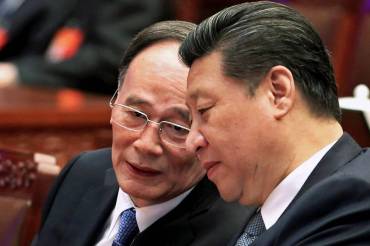
Political observers say one of those allies is 68-year-old Wang Qishan, who has directed the president’s withering crackdown on graft and, increasingly, political disloyalty. Under the qishang baxia norm, Mr. Wang is among five members of the Politburo Standing Committee, which currently numbers seven, due to retire at the next party congress.Party insiders have also speculated that the 63-year-old Mr. Xi may try to defy another recent convention, by not promoting a potential successor to the Standing Committee next year. That could set him up to remain in power after the expiration in 2022 of his second—and by recent custom, final—term. He would be 69 by then.Mr. Deng’s comments send “a clear signal that Xi will be a ‘rule modifier’ rather than a strict rule follower,” said Jude Blanchette, a Beijing-based researcher who is writing a book on Mao Zedong’s legacy. The rules are merely norms, and not well settled, he said.
As for the age norm, China politics experts say it was introduced by Jiang Zemin, then the outgoing party chief, to push a rival into retirement at the 2002 congress. According to Mr. Blanchette, that episode showed that Chinese leaders have “readjusted” malleable party norms “to fit political exigencies.”Or, as Mr. Deng put it in a news briefing in Beijing, the “strict organizational procedures and sufficient democratic processes” used in selecting top party leaders are “subject to adjustments in accordance with practical conditions.”
Mr. Xi’s growing clout may represent just such a practical condition. A top-level party conclave last week designated him as the party leadership’s “core,” an arcane title that political observers say signified his pre-eminent status. It was previously applied to Mao Zedong, Deng Xiaoping and Mr. Jiang but not Mr. Xi’s predecessor, Hu Jintao.
At Monday’s briefing, Mr. Deng of the party’s policy research office said the designation reflects Mr. Xi’s unanimous support within the party and broad public acclaim, but doesn’t threaten a return of a Mao-style “cult of personality”—which the party has explicitly banned—or contradict the party’s principles of collective leadership. Rather, the title was necessary to help the party and the country overcome new economic and political challenges, he said.
Mr. Hu, according to Mr. Deng, repeatedly declined to be designated as a “core” leader.“That time had its own circumstances,” he said. “The present has its own needs.”
ON OCTOBER 30th India celebrates Diwali, the most important festival in the Hindu calendar. Over five days, millions of lamps and candles will be placed on doorsteps and rooftops; prayers will be offered to Lakshmi, the goddess of prosperity; and fireworks will go off in the skies over the streets of nearly every town and village. A festival that celebrates the victory of light over darkness, Diwali has in recent years brightened the mood of Chinese exporters as well: many Indian households favour cheaper, electric decorations made in China over the traditional earthen diyas (pictured).
But this year’s edition could take a dark turn. The country’s noisy social media are cluttered with posts calling for Indians to shun Chinese goods. A fake letter championing the boycott, ostensibly signed Narendra Modi, the prime minister, has gone viral. Politicians from India’s ruling Hindu-nationalist Bharatiya Janata Party (BJP) have endorsed the cause. What is going on?
The economic roots of the boycott are not new. China is India’s largest trading partner, with $71bn worth of goods exchanged between them in the past financial year. But China is also the nation with which India has its largest trade deficit, an imbalance that rose 9% to $53bn in 2015-2016. In contrast, China’s trade surplus with America reached $367bn in 2015. What the deficit is made of matters most. China’s light-industry goods compete directly and with overwhelming success against India’s small industries, the lifeline of its manufacturing sector and a reservoir of jobs. So India exports mostly raw materials to its neighbour. That has the government worried: of the 572 anti-dumping measures India took between 1995 and 2015, 146 were aimed at Chinese-made goods. The “Make in India” campaign, which has been championed by Mr Modi and sees foreign investment as crucial to boosting his country’s manufacturing power, has been careful not to advocate protectionism. Yet in a country where economic boycotts were first popularised as a non-violent strategy to combat British rule, such appeals carry emotional and historical heft. Geopolitics provided the spark for the current call. India has long been trying to get Masood Azhar, the boss of Jaish-e-Mohammad (JeM), a Pakistan-based jihadist group, listed as a terrorist by the United Nations. India suspects JeM of carrying out the January attack on an air-force base in Punjab, which killed eight Indians, including one civilian. JeM is also the alleged perpetrator of last month’s massacre at the Kashmiri garrison of Uri, in which 19 soldiers were killed (though another group claimed responsiblity). Yet twice this year, China used its Security Council veto to block Mr Azhar’s addition to the UN sanctions list. The move underscored Beijing’s all-weather support for the Pakistani establishment, elements of which India suspects of harbouring Mr Azhar. Some Indians don’t understand why they should have to trade with a nation working against their interests. This perception of China was compounded by its decision in June to oppose India’s accession to the Nuclear Suppliers Group, a 48-nation body that governs the global nuclear trade.
Yet calls for a boycott of Chinese-made goods are unlikely to have much effect. Both India and China are members of the World Trade Organisation, which forbids arbitrary bans on foreign goods. India’s commerce minister, Nirmala Sitharaman, recognised as much earlier this month when she said blocking imports was not a feasible option. A BJP leader deleted his tweets, blaming staff for the text; the opposition is silent on the issue. Nor is the wider business community likely to embrace the cause. Traders and industrialists, who have come to rely heavily on Chinese-made merchandise and machinery, form powerful lobbies. Yet with Mr Modi’s government promoting an increasingly assertive brand of nationalism, anger over China’s snubs will not easily go away. Expect further diplomatic fireworks.
China launched its longest manned space mission on Monday, sending two astronauts into orbit to spend a month aboard a space laboratory that is part of a broader plan to have a permanent manned space station in service around 2022.
The Shenzhou 11 blasted off on a Long March rocket at 7:30 am (2330 GMT) from the remote launch site in Jiuquan, in the Gobi desert, in images carried live on state television.
The astronauts will dock with the Tiangong 2 space laboratory, or “Heavenly Palace 2”, which was sent into space last month. It will be the longest stay in space by Chinese astronauts, state media reported.
Early on Monday, Fan Changlong, a vice chairman of China’s powerful Central Military Commission, met astronauts Jing Haipeng and Chen Dong and wished them well, state news agency Xinhua reported.
“You are going to travel in space to pursue the space dream of the Chinese nation,” Fan said.”With all the scientific and rigorous training, discreet preparation, and rich experience accumulated from previous missions, you will accomplish the glorious and tough task… We wish you success and look forward to your triumphant return.”
Shenzhou 11 is the third space voyage for Jing, who will command the mission and celebrate his 50th birthday in orbit.
In a manned space mission in 2013, three Chinese astronauts spent 15 days in orbit and docked with a space laboratory, the Tiangong 1.Advancing China’s space program is a priority for Beijing, with President Xi Jinping calling for the country to establish itself as a space power.
China insists its space program is for peaceful purposes.
Shenzhou 11, whose name translates as “Divine Vessel”, will also carry three experiments designed by Hong Kong middle school students and selected in a science competition, including one that will take silk worms into space.
The U.S. Defense Department has highlighted China’s increasing space capabilities, saying it was pursuing activities aimed at preventing other nations using space-based assets in a crisis.
China has been working to develop its space program for military, commercial and scientific purposes, but is still playing catch-up to established space powers the United States and Russia.
China’s Jade Rabbit moon rover landed on the moon in late 2013 to great national fanfare, but soon suffered severe technical difficulties.
The rover and the Chang’e 3 probe that carried it there were the first “soft landing” on the moon since 1976. Both the United States and the Soviet Union had accomplished the feat earlier.
China will launch a “core module” for its first space station some time around 2018, a senior official said in April, part of a plan for a permanent manned space station in service around 2022.
Property magnate Wang Jianlin of Dalian Wanda tops the list of 594 billionaires in the country, ahead of 535 billionaires in the US.
Alibaba‘s Jack Ma was second, with his wealth having risen 41% from last year.
The annual list is compiled by Shanghai publishers Hurun and often compared to the Forbes list in the US.The Hurun Report’s rich list is one of the most closely-watched and accurate assessments of wealth in China. The annual report has been published for the past 18 years.
Earlier this year, the publisher released a separate, global list, showing that the number of billionaires in China outnumbered those in the US for the first time.
However, none of China’s super-rich make it into the global top 20.
Global reach
At the top of the China rich list is Wang Jianlin, who sits on a personal fortune of $32.1bn (£26.4bn).
His company Dalian Wanda has made headlines throughout the year with a number of high profile forays into the US movie markets. It has taken over Legendary Pictures, as well as stepping into US and UK cinema chains and striking an alliance with Sony Pictures.
Alibaba’s Jack Ma is a close second with $30.6bn, and Pony Ma of internet and online gaming giant Tencent comes third with $24.6bn.
Image copyright REUTERS
The biggest increase came from Yao Zhengua of investment and real estate firm Baoneng Group, whose wealth jumped by 820% to $17.2bn, putting him in fourth position.
Hurun chairman Rupert Hoogewerf said Mr Yao’s rise illustrated a shift in China’s maturing economy.
“Yao’s financial investment model represents the new wave of wealth creation in China,” he explained. “The first money made in China 20 years ago came from trading, followed by manufacturing, real estate, IT, and today it is about using the capital markets for financial investments.
“Robin Li and Melissa Ma of search engine Baidu have a fortune of $14.7bn, ranked eighth while founder of smartphone makers Xiaomi, Lei Jun, dropped out of the top 10 to number 14 as competition in China’s smartphone market intensified.
Most of China’s billionaires live in Beijing, followed by Shenzhen, Shanghai and Hangzhou.
Globally, the Forbes rich list is topped by Microsoft founder Bill Gates with $75bn, followed by Amancio Ortega of Zara and legendary investor Warren Buffett.
A fatal building collapse in southern China has highlighted a practice that more than once has produced death traps: structures built with little oversight by villagers on former farmland.
Such slapped-together buildings have tended to grow even more precarious as they age and as extra floors are added.
Four six-story buildings in a suburban area of Wenzhou, a city on China’s southern coast, collapsed Monday morning, claiming at least 22 lives, according to the state-run Xinhua News Agency, which cited local authorities. Six survivors were pulled from the building before the rescue was called off, Xinhua said.
The buildings were close to industrial parks of Wenzhou, a hub for light manufacturing including shoemaking, and most residents were migrant workers.The buildings were several decades old and erected by villagers, according to an article by the Wenzhou Daily that the local government reposted on its official website Tuesday. It said investigations were under way but an initial analysis showed that the collapse was likely caused by the buildings’ low quality and shaky foundation, a problem made worse by continuous rainfall in the past few days.
It used to be common practice in the 1980s and 1990s for residents outside China’s urban area to build houses with their own hands, often on what had been farmland. Over the years, floors were added without approval, leaving tottering buildings crumbling under the extra weight.
As cities have grown to incorporate such areas, local governments have tried to get rid of these “towns within cities,” tearing down the aging and shoddily built structures. The Wenzhou government had targeted much of the complex of the recent collapse for demolition, some of which had already started.
It wasn’t the first collapse of villager-built housing. Two years ago, a building under construction by local farmers in Xian in western China collapsed, killing five people.
Some online commenters pointed out that photos of the buildings involved show that more floors had been added to the original construction. The state-run newspaper Beijing News quoted a Wenzhou resident as saying that it was common for self-built buildings in the area to have additional floors.
The practice of adding floors has sometimes been a way for the owners of buildings targeted for demolition to extract more compensation from the government, which bases amounts to pay out to residents on the size of the living areas.
Another building collapse in Xian in 2011, which claimed seven lives, was caused by illegal additions the building’s owner had made to get more compensation, according to the local government. The owner was detained by the local police.
That tragedy came months after the Xian government rolled out new regulations to forbid compensation for illegal additions to a building. The local government said at the time that more than 50 cases of “self-built” building collapses had caused 69 deaths since 2007.
It was unclear whether the owners of the collapsed buildings in Wenzhou, who weren’t identified by the local government, will be held legally responsible for the casualties.
The Wenzhou collapse prompted calls for more regulation. “If relevant departments are still indifferent in face of self-built houses in such a disastrous state,” read one commentary by Beijing News on Tuesday, “then similar tragedies will be repeated.”
In 2011, we tried our hand at predicting the ways in which, in the decade to come, Chinese consumers would change their preferences and behaviors.
This article takes stock of those predictions.
Why check in now? One reason is we’re about halfway to 2020. Another is a comprehensive new McKinsey survey, which follows nearly ten years of previous research that includes interviews with more than 60,000 people in upward of 60 cities in China. Along the way, we’ve bolstered our own team’s data on consumer preferences and behavior with a number of complementary analyses and models, including McKinsey’s macroeconomic and demographic studies of Chinese urbanization and income development. We’ve also interviewed academics to draw out the major trends shaping the course of the Chinese economy, such as its rapidly aging population, the growing independence of women in society, and the postponement of critical life milestones, such as marrying and having children.
We’ve done it all with the abiding belief that companies getting ahead of the trends can build their brands and offerings to fit a rapidly evolving set of consumer needs in China. Deeper and more nuanced understanding of Chinese consumers can help reveal fresh opportunities—for new entrants and incumbents alike—and signal those areas where established players may need to be more wary.
Looking back nearly five years on, it is plain that Chinese consumers are evolving along many, though not all, of the lines we’d predicted. While geographic differences persist, Chinese consumers are, on the whole, more individualistic, more willing to pay for nonnecessities and discretionary items, more brand loyal, and more willing to trade up to more expensive purchases—even as their hallmark pragmatism endures.
Evolving geographic differences
Much of the research we described five years ago highlighted the vast differences we found among consumers in China’s various cities and regions. Just as it was then, generalizing about Chinese consumers continues to be almost as difficult (and maybe as foolish) as it is to generalize about European consumers.
We predicted these differences would remain—and even grow more significant, especially in the consumption patterns and tastes that relate to discretionary items. To help companies better tailor their go-to-market approach, we grouped most cities in China into clusters based on their similarities, including their geographic proximity and the transportation infrastructure that connects them.
As the economic structure in each of the 22 biggest city clusters has evolved—and as each of them has been affected differently by the recent slowdown of China’s economy—significant differences, for instance, in consumer confidence, do indeed persist between these clusters.
For instance, some 70 percent of consumers in the Fuzhou–Xiamen city cluster, which lies on the coast across from Taiwan, said in our latest report that they are confident their income will significantly increase over the next five years. In that same report, the Byland–Shandong city cluster, which lies on the coast between Beijing and Shanghai, was comparatively pessimistic, with only 33 percent of its consumers expressing such confidence.
Furthermore, when our latest survey compared the consumers in the Shanghai area to those around Beijing and Hangzhou, certain spending attitudes also showed marked differences. For example, brand loyalty increased much faster in Shanghai (24 percent increase in three years versus just 7 percent in Beijing and 9 percent in Hangzhou), as did the willingness to pay for better or healthier products.
Despite geographic differences, there are broad similarities among Chinese consumers. These mirror the general trends economists have found among consumers around the world as economies develop. The general tendency is for consumers, as they earn more, to spend a lower percentage of their income on food, a little more on healthcare, and even more on travel and transportation, as well as on recreational activities. It was no great stretch then, in our report five years ago, to predict a significant shift in consumption from necessities and seminecessities into discretionary categories.
Sure enough, our new survey shows Chinese consumers following the anticipated pattern. When we asked how they plan to increase spending as their income increases, dramatically fewer consumers said they will increase it on food (46 percent in the latest survey, compared to the 76 percent who said they would do so three years earlier).
Responses trended slightly up for healthcare products (from 16 percent to 17 percent), and increased for travel (from 14 percent to 23 percent) and leisure (from 17 percent to 25 percent).
Aspirational trading up
In our previous predictions, we also argued that as the income of Chinese consumers grew, they would aspire to improve their quality of life by not only spending more on discretionary items, but also by shifting their spending to more expensive items in the same categories.
In necessity categories such as food, for example, we predicted consumers would be willing to spend more for healthier versions of the same products—for instance, that olive oil would grow much faster than less healthy (and less expensive) oils. In semi-necessity categories like apparel, we predicted people would buy more special-occasion and premium brands. We anticipated that the strongest beneficiaries of these changes would be in the more discretionary and aspirational categories, such as skincare and automotive. So what has happened so far?
Premium categories have really accelerated. Comparing cosmetics purchases between 2011 and 2015, 44 percent of consumers have traded up their purchases, compared with 4 percent who traded down. Even for rice, 25 percent of consumers traded up versus 3 percent who traded down. Automotive was not included in our survey, but sales data from the Traffic Management Bureau of the Ministry of Public Security in China suggest significant trading up. In 2011, 51 percent of the renminbi spent on cars by Chinese consumers were for autos cheaper than 100,000 RMB. These sales accounted for only 43 percent of the market. Cars selling for 100,000 to 250,000 RMB grew twice as fast with a compound annual growth rate (CAGR) of 19 percent versus 9 percent. And cars with price tags between 250,000 and 400,000 RMB grew the fastest of all, with 23 percent CAGR.
Emerging senior market
In 2011, we observed a big generational difference between consumers in their late 50s and early 60s, who were very conservative spenders, and all of the age cohorts younger than them.
We predicted that by 2020, as the needs of consumers over the age of 55 changed along with their economic confidence, their spending habits would follow suit, making this age group worth pursuing by consumer-product companies. If anything, we underestimated the speed and force with which this trend would unfold.
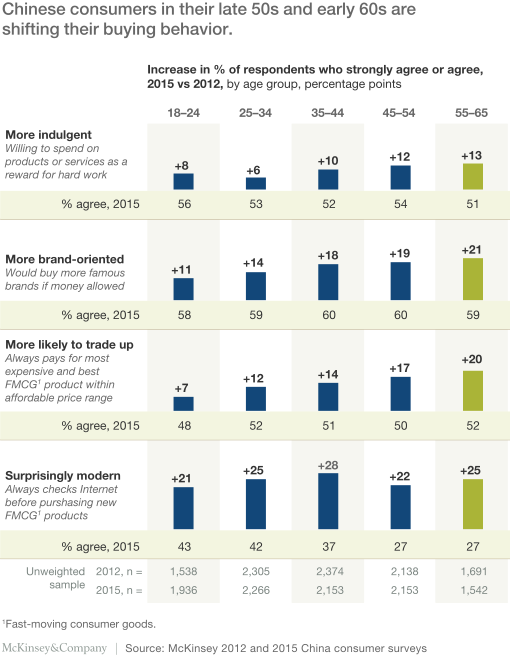
By 2015, the 55–65 age group had started to shift even faster than the rest of the population. For example, 52 percent of the people in this age group showed a preference for premium products, compared to just 32 percent in 2012. They leaped from being the most conservative age group to the one most likely to trade up. Similarly, the preference for famous brand names among these older buyers jumped by more than 20 percent, fully closing the previous difference among cohorts. As Exhibit 1 shows, these older consumers don’t shy away from indulgences, and they have grown more likely to use the Internet to research their purchases, even if they still do so less often than younger consumers.
Exhibit 1
That said, the upper age group has remained more pragmatic and cost conscious than any other age group, as we discuss in the following section.
The still-pragmatic consumer
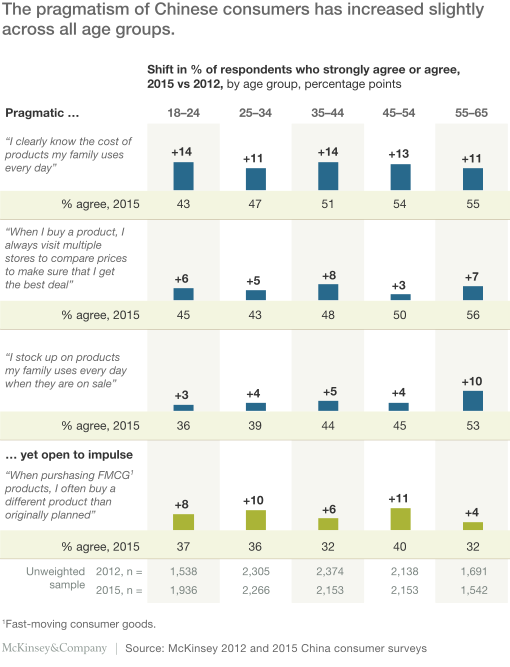
Back in 2011, even as we were predicting changes in the behavior and preferences of Chinese consumers, we also saw ways in which their essential pragmatism would likely stay the same. For instance, we anticipated that impulse buying would remain lower than in other countries and that value for money would continue to be an important consideration when choosing products and services. Interestingly, Chinese consumers across all age groups have, in some ways, become even more pragmatic. They’re now even more likely to compare prices across multiple stores, to be more price aware, and to stock up on promotions. That said, they’re now willing to buy more often on impulse (Exhibit 2).
Exhibit 2
The individual consumer
We also predicted that as Chinese consumers aspire to a better life and trade up their purchases, they would become more discerning and gradually more individualistic. This would lead, for example, to a shift toward more healthy choices, more user-friendly products, and products and brands that better fit their personality. This could be a big opportunity for niche brands—and a threat to the mass-market brands that had won big in previous years by using scale and ubiquitous availability, supported by the trust gained by heavy advertising.
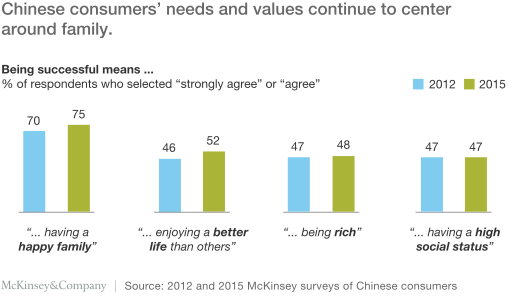
Our latest research certainly shows a decrease in consumption in categories deemed less healthy and a willingness to spend significantly more on health and more environmentally conscious categories. It also shows consumers are more likely to spend more to indulge themselves and more likely to try new technology. While their consumption choices have become more individualistic, though, it is important to note that family values continue to be at the top of their priorities (Exhibit 3).
Exhibit 3
One area our predictions missed, however, was by anticipating that consumers, as they became more individualistic in their choices, might focus less on basic product reliability and safety. Perhaps in part because of a number of more recent food scandals, however, consumers seemed more concerned with these issues in 2015 than they were before.
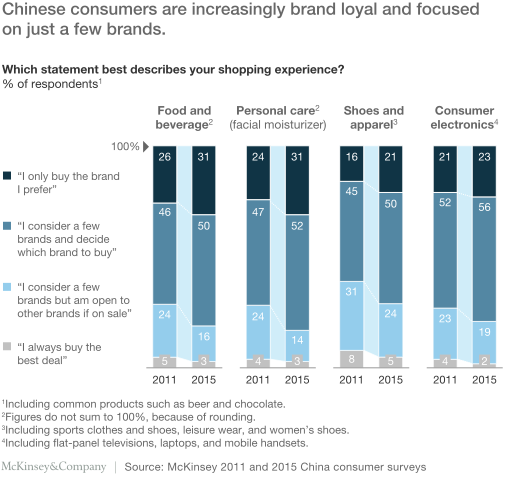
The increasingly loyal consumer
When our team first started researching Chinese consumers, nearly ten years ago, many of us were surprised by their fickle attitude toward brands. Fewer than half of consumers tended to stick with their favorite brands, compared, for example, with almost three quarters of US consumers.
As we debated this tendency while making our predictions, we wondered if, in the clash between pragmatism and individualism, brand loyalty would stay low, increase, or even decline. Ultimately, we decided it would increase as the emotional benefits of brands became more important to consumers and as increased choice and availability of branded products (online and off) would allow consumers to optimize for price and convenience without changing choices too often.
Our recent research confirmed the changes we anticipated. Consumers are now significantly less likely to buy a brand that is not already among their favorites, continuing the upward trend we observed in 2011 (Exhibit 4).
Exhibit 4
The modern shopper
Our 2011 predictions were bullish on e-commerce, predicting that Chinese consumers would adapt their channel choices even faster than has occurred in developed markets.
We estimated that by 2020, online consumer-electronics purchases would jump to 40 percent, from about 10 percent. More mainstream categories would rise to 15 percent, and some categories, such as groceries (now below 1 percent), could reach about 10 percent. These changes are occurring even as the enduring pragmatism and diligence of the Chinese consumer continue to be in place. Our latest research shows that consumers of all age groups are much more likely to collect information online, even on fast-moving consumer goods, than they were just three years ago.
In 2015, online food and beverages sales (excluding fresh) reached 7.2 percent: reaching our predicted 10 percent in five years looks very likely. The online share of consumer-electronic purchases, meanwhile, has reached a whopping 39 percent in 2015, and it now looks possible that by 2020 it will be about 50 percent of overall sales.
Looking from today’s perspective at our 2011 predictions, it is impressive to see the evolution of Chinese consumers—even as their most characteristic traits endure. Certainly, we’ll check in on their progress as we get ever closer to the year 2020. Making predictions may be difficult, especially about the future—as US Baseball Hall of Famer Yogi Berra famously observed. But they can still provide valuable foresight for executives.
CHINA’S cities abound with restaurants and food stalls catering to Muslims as well as to the many other Chinese who relish the distinctive cuisines for which the country’s Muslims are renowned.
So popular are kebabs cooked by Muslim Uighurs on the streets of Beijing that the city banned outdoor grills in 2014 in order to reduce smoke, which officials said was exacerbating the capital’s notorious smog (the air today is hardly less noxious).
Often such food is claimed to be qing zhen, meaning “pure and true”, or halal, prepared according to traditional Islamic regulations. But who can tell? Last year angry Muslims besieged a halal bakery in Xining, the capital of Qinghai province, after pork sausages were found in the shop’s delivery van. There have been several scandals in recent years involving rat meat or pork being sold as lamb. These have spread Muslim mistrust of domestically produced halal products.
In response, some local governments have introduced regulations requiring food purporting to be halal to be just that (though not going into detail of what halal means, such as the slaughter of animals with a knife by a Muslim). Earlier this year, however, the national legislature suspended its work on a bill that would apply such stipulations countrywide.
There is much demand for one. Local rules are often poorly enforced. Advocates of a national law say a lack of unified standards is hampering exports to Muslim countries. According to Wang Guoliang of the Islamic Association of China, the country’s halal food industry makes up a negligible 0.1% of the global market.
The government began drafting a national halal law in 2002. But Muslim communities in China have varying definitions of the term. Work on the bill was slow. Each year, during the legislature’s annual session in March, Muslim delegates called for faster progress. But there were opponents, too. Some scholars argued that the government should not regulate on matters relating to religious faith. Others said that by giving in to the Muslims’ demands, China would encourage them to press for more concessions and ultimately form their own enclaves run by sharia.
Such views may have given pause to China’s leaders. In April, at a high-level meeting on religious affairs, President Xi Jinping said religion should be prevented from interfering with the law. That month Wang Zhengwei, a Muslim official who had been pushing for halal legislation, was removed from his post as the head of the State Ethnic Affairs Commission.
Also in April, the Communist Party chief of Ningxia urged officials to “sharpen [their] vigilance” against the use of halal labels on products such as toilet paper, toothpaste and cosmetics. And the government of Qinghai province ordered the inspection of Muslim-only toilets and hospital rooms, as well as shops catering to Muslims, to make sure that halal symbols were being used only on food. Xinjiang, the far-western region that is home to the Uighurs, recently introduced an anti-terrorism law threatening punishment of those who “overextend” halal rules. Officials clearly worry that those who do so might be the same sort of people who embrace jihad.
Ismael An, a Muslim writer, says this is overreacting. “Supporters of the halal law are not the so-called extremists, because real extremists don’t make demands through legislation,” he says. On the internet, however, a small but vocal group of Islamophobes has been calling for a boycott of halal-certified products. They say the price of such goods factors in payments to Islamic groups that grant the certificates—they do not want to give the religion even indirect support. Ironically, it is the non-Muslim love of Muslim food that will ensure the campaign will not succeed.
THE faithful are returning from the haj. Waiting for prayers outside the Great Mosque in Tongxin, a remote town in the western province of Ningxia, Li Yuchuan calls his pilgrimage a liberation: “Our prayers are just homework for it.” His 84-year-old friend (pictured, right) leaps up and twists himself with lithe agility into the shape of a pretzel. “We Muslims pray five times a day,” he says. “We are flexible and tough.” China’s Muslims need to be.
China has a richly deserved reputation for religious intolerance. Buddhists in Tibet, Muslims in the far western region of Xinjiang and Christians in Zhejiang province on the coast have all been harassed or arrested and their places of worship vandalised. In Xinjiang the government seems to equate Islam with terrorism. Women there have been ordered not to wear veils on their faces. Muslims in official positions have been forced to break the Ramadan fast. But there is a remarkable exception to this grim picture of repression: the Hui.
China has two big Muslim groups, the Uighur of Xinjiang and the more obscure Hui. Though drops in the ocean of China’s population, they each have about 10m people, the size of Tunisia. But while the Uighur suffer, the Hui are thriving.
The number of mosques in Ningxia (cradle of the Hui, as one of their number puts it) has more than doubled since 1958, from 1,900 to 4,000, says Ma Ping, a retired professor at Northern Nationalities University. New ones are being built across the province. The Hui are economically successful. They are rarely victims of Islamophobia. Few Muslim minorities anywhere in the world can say as much.
The Hui’s religious practices reflect the waves of Islam that have washed over China. According to Ma Tong, a Hui scholar, just over half of them follow the Hanafi school of Sunni Islam, which was brought to China centuries ago. At the Najiahu mosque south of Yinchuan, Ningxia’s capital, banners adorn the entrance saying “ancient and authentic religion” and “cleave to the original path”. A fifth of the Hui follow the more austere code of Wahhabism brought to China in the 19th century (there are also a handful of more extreme Salafist converts resulting from recent contacts through the haj). And a fifth follow one of three Sufi schools of Islam, an esoteric and mystical branch derided as apostate by hardline Salafists. The Hui’s religious diversity makes it easier for the party to tolerate them. Divide and rule.
But the real secret of the Hui’s success lies in the ways they differ from the Uighur. The Uighur, of Turkic origin, are ethnically distinct. They speak their own language, related to Turkish and Uzbek. They have a homeland: the vast majority live in Xinjiang. A wall of discrimination separates them from the Han Chinese. If they have jobs in state-owned enterprises, they are usually menial.
In contrast, the Hui are counted as an ethnic minority only because it says so on their hukou (household-registration) documents and because centuries ago their ancestors came as missionaries and merchants from Persia, the Mongol courts or South-East Asia. Having intermarried with the Han for generations, they look and speak Chinese. They are scattered throughout China (see map); only one-fifth live in Ningxia.
Unlike the Uighur and Tibetans, they have taken the path of assimilation.
At the new Qiao Nan mosque in Tongxin, the congregation is celebrating the life of an important local figure in the mosque’s history. The ceremony begins with a sermon by the ahong (imam). Then come prayers chanted in Arabic. At the house of the local worthy’s grandson, the worshippers read from the Koran, then visit the tomb. But the afternoon ends very differently, with a reading from an 18-metre-long scroll written by the grandson, Ma Jinlong. This consists of excerpts from eighth-century classical Chinese poetry, illustrated with his own delicate water-colours. Mr Ma is both a stalwart of the mosque and a Chinese gentleman-scholar.
A close connection with Chinese society is characteristic of the Hui. Some of the most famous historical figures were Hui, though few Chinese are aware of it. They include Zheng He, China’s equivalent of Columbus, who commanded voyages of discovery around 1400. Recently, the party chief in Jiangsu province as well as the head of the Ethnic Affairs Commission, a government body, were Hui.
Relations with the Han have not always been good. The so-called Dungan revolt by the Hui in the 1860s and 1870s was a bloodbath. But since the death of Mao in 1976, the two sides have reached an accommodation. Dru Gladney, of Pomona College in California, says a hallmark of the Hui is their skill at negotiating around the grey areas of China’s political system.
Thanks to this, they have been successful economically. They dominate halal food production. They are emerging as the favoured middlemen between state enterprises and firms in Central Asia and the Gulf. China’s largest school of Arabic is a private college, set up and partly financed by Hui, on the outskirts of Yinchuan. Most students are training to be corporate interpreters.
One sign of how far the government tolerates the Hui is that they are even able to practice Islamic (sharia) law to a limited extent. Sharia is not recognised by the Chinese legal code. Yet at the Najiahu mosque, the ahong and the local county court share the same mediation office. Every week or so, the ahong adjudicates in family disputes usingsharia. Only if he fails do civil officials step in.
Surprisingly, the Hui have not lost their religion or identity despite centuries of assimilation. Mr Ma, the retired professor, says Hui people often form close-knit communities and pursue similar occupations; restaurants and taxis in many cities are run by Hui. But their religion is “still the most important binding factor”, he says. The Hui maintain a delicate balance. They can practise their religion undisturbed thanks to assimilation. But it is their religion that makes them distinct.
This is a fine line, and it means the Hui are vulnerable to China’s shifting religious attitudes. They have so far mostly escaped Islamophobia. But bigotry is becoming more common on social media. “The greens” (a significant colour in Islam) has become an online term of abuse. So far the government has tolerated the Hui’s culture. But in Ningxia in July, Xi Jinping, the president, told his audience to “resolutely guard against illegal infiltration”—even though there is little sign of any. His government has become more repressive towards many religious groups. The Hui could be next.
But the lessons offered by the Hui’s experience are largely positive. Islam, the Hui show, are not the threat that party leaders sometimes imply it is. They show that you can be both Chinese and Muslim. At Yinchuan airport, a returning pilgrim is waiting for his luggage. He wears a white robe with “Chinese pilgrimage to Mecca” stitched in green Arabic letters below a Chinese flag embroidered in red, the symbol of an atheist party-state. “It was the experience of a lifetime,” he says of the haj—and disappears into a sea of white hats worn by hundreds of cheering fellow Muslims who fill the arrivals hall to welcome him home.
At a time of Brexit and talk of a wall between the United States and Mexico, it seems the Chinese are embracing international engagement.
They think their country’s power is rising, that their living standards will keep improving, that corruption is being cleaned up and that air pollution should be fixed even if it means slowing down economic growth.
Elsewhere there is fear and uncertainty. Here optimism trumps all.
When asked about economic globalisation, 60% of people said it is a good thing and only 23% think it is bad for China.
While some China watchers are warning that this country’s mounting local government debt could mean that a hard landing is on the way, Chinese people don’t appear to share this pessimism.
Nearly 90% of respondents amongst this group of 3,154, interviewed face-to-face in China earlier this year, think that the state of their country’s economy is either “very good” or “somewhat good”.
GETTY IMAGES – Chinese people seem to remain optimistic
Looking into the future things will apparently get even better: 76% of people think the economy will improve over the next 12 months, 70% said their personal financial situation will improve and eight out of 10 people believe that their children will have a better standard of living than they do.
Bread and butter issues
It’s not that people are without concerns.
“Corrupt officials” is at the top of the table when it comes to people’s worries (83% said this was a “very big” or “moderately big” problem) and yet here too we see optimism.
Some 64% of them said that President Xi Jinping‘s massive anti-corruption drive would improve the situation over the next five years.
Running down the concern list, an alarmingly high number of people see income inequality and the safety of food and medicine as “very big” problems.
If you enjoy monopoly power on the basis that you are delivering “socialism with Chinese characteristics” then a small group of ultra-rich driving around in their sports cars and showing off their wealth while most struggle to pay the rent is surely at odds with your central message.
Then, if ordinary Chinese people can’t even trust the food and medicine they are giving their children, the possibility for social unrest over bread and butter issues is looming large.
The environment also emerges as a massive challenge with water and air pollution at the front of people’s minds.
Air pollution is so bad in China that half of those polled said their country should fight air pollution harder even if it means sacrificing economic growth.
GETTY IMAGES – Emissions from coal-powered industries, cars and heating systems generate the smog
Only 24% saw air deterioration as a necessary price to pay.
When it comes to the war of ideas in the top echelons of power here, those ministers in favour of tougher environmental protection measures could do worse than table this research.
A “major threat” to China?
The South China Sea and other geo-strategic tensions offer some of the most bleak opinions.
Nearly six out of 10 people think that territorial pressures with neighbours could lead to military conflict; 77% say their way of life needs to be protected from “foreign influence” (up by 13 percentage points since 2002) and only 22% say China should help other nations.
Regarding relations with rival superpower the United States people views are complex and, at times, seemingly contradictory.
Around half of Chinese respondents rated the US favourably but more than half think that Washington is trying to prevent China from becoming an equal power.
About 45% said that US power and influence poses a “major threat” to China. In fact the US came in at number one as the top international threat to the country.
GETTY IMAGES – More than half of Chinese people think that Washington is trying to prevent China from becoming an equal power
It’s interesting that some would see the Obama administration’s so-called “pivot to Asia” as a greater threat than say jihadist extremist groups just across the western border promoting bloody conflict in China’s vast Muslim region of Xinjiang.
Either way, whatever the perceived threat, China is seen as becoming ever more important and with ever more power at its disposal.Information is being controlled here ever more tightly – whether it is coming from the traditional media or sources online – so some analysts will see these views as the inevitable result of messages being delivered to the Chinese people by their government.
This may the be case but, in a world where politicians in various countries are accused of exploiting people’s fear and insecurity, could it be that a quarter of the globe’s population are going around with a smile on their dial because every day they look out the window and to them it just gets better and better?









 CHINDIA ALERT: You'll be living in their world, very soon