12/09/2019
BEIJING, Sept. 11 (Xinhua) — Premier Li Keqiang on Wednesday expressed his expectation for the Japanese economic community to seize the opportunities of China’s opening up, increase investment in China and expand bilateral cooperation areas to promote more achievements in trade and the economy.
Li made the remarks in a meeting with a delegation from Japan’s business community, led by president of the Japan-China Association on Economy and Trade Shoji Muneoka, chair of the Japan Chamber of Commerce and Industry Akio Mimura, and Nobuyuki Koga, chairman of the Board of Councilors of the Japan Business Federation.
China-Japan relations have returned to the right track since last year thanks to the joint efforts of the two sides, and the trade and economic cooperation between the two countries has been steadily advanced and the prospects for bilateral cooperation are broad, said Li.
When China-Japan relations encountered difficulties, the Japanese economic community made important efforts and contributions to maintain their healthy and steady development as well as accelerate pragmatic cooperation between the two countries, the Chinese premier said.
According to Li, China and Japan are two of the world’s major economies, and should give full play to their complementary advantages and work together to deepen cooperation, which will not only benefit the two countries, but also conducive to regional and global economy, as well as the prosperity and stability of the world.
Noting that economic globalization is irreversible, and economic and trade exchanges should not be blocked by national borders, Li pointed out that promoting the healthy development of globalization is the way of progress.
“China has always firmly upheld the multilateral trading system with the World Trade Organization at its core and promotes the liberalization and facilitation of trade and investment,” Li said, stressing China will unswervingly promote all-round opening up, and strive to optimize the business environment.
China welcomes the Japanese economic community to seize the opportunity brought forth by China’s opening up and increase investments in China, expand cooperation areas, and promote more cooperation achievements in trade and economic areas between the two countries, he said.
While expressing congratulations on the 70th anniversary of the founding of the People’s Republic of China, the Japanese economic delegation said that Japan and China have witnessed progress in bilateral ties since last year, and close high-level exchanges have facilitated the two countries’ economic and trade cooperation.
The Japanese economic community firmly supports free trade and hopes China and the United States will resolutely resolve their trade disputes through negotiation, they said.
Speaking highly of China’s efforts in promoting trade and investment liberalization, expanding market access and improving the business environment, they said that the Japanese economic community is willing to boost cooperation with the Chinese side in science and technology innovation, climate change, health care and third-party markets.
They also expressed their expectation of concluding the negotiations for the Regional Comprehensive Economic Partnership (RCEP), a proposed free trade agreement between the 10 ASEAN (the Association of Southeast Asian Nations) members and Australia, China, India, Japan, South Korea and New Zealand, by the end of the year.
Source: Xinhua
Posted in 70th anniversary, Akio Mimura, ASEAN (the Association of Southeast Asian Nations), Australia, Board of Councilors of the Japan Business Federation, China alert, China–Japan relations, congratulations, economic and trade exchanges, economic globalization, facilitation of trade and investment, founding, founding of the People's Republic of China (PRC), free trade agreement, India alert, irreversible, Japan, Japan Chamber of Commerce and Industry, Japan-China Association on Economy and Trade, Japanese economic community, liberalization, major economies, multilateral trading system, national borders, New Zealand, Nobuyuki Koga, People's Republic of China, People's Republic of China (PRC), Premier Li Keqiang, Regional Comprehensive Economic Partnership (RCEP), Shoji Muneoka, South Korea, Uncategorized, United States, World Trade Organization (WTO) |
Leave a Comment »
12/09/2019
Chinese Vice Premier Liu He, also a member of the Political Bureau of the Communist Party of China Central Committee, meets with Chairman of the U.S.-China Business Council (USCBC) Evan Greenberg at the latter’s request in Beijing, capital of China, on Sept. 12, 2019. (Xinhua/Liu Bin)
BEIJING, Sept. 12 (Xinhua) — Chinese Vice Premier Liu He on Thursday met with Chairman of the U.S.-China Business Council (USCBC) Evan Greenberg in Beijing at the latter’s request.
Liu, also a member of the Political Bureau of the Communist Party of China Central Committee, said China welcomes the U.S. side’s latest decision to delay an increase in tariffs, which was previously scheduled for Oct. 1.
The whole world looks forward to seeing progress in trade consultations between China and the United States, Liu said, adding that working groups of both sides will meet next week and have earnest discussions on trade balance, market access, protection of investors and other issues of common concern.
The U.S. business sector does not want to see a hike in tariffs, and hopes that the two countries will solve their differences through consultations and bring bilateral trade back to normal, Greenberg said.
The USCBC is willing to play a positive role in this regard, he added.
Source: Xinhua
Posted in Beijing, China alert, Chinese Vice Premier Liu He, Evan Greenberg, member of the Political Bureau of the Communist Party of China Central Committee, U.S., U.S.-China Business Council (USCBC), Uncategorized |
Leave a Comment »
12/09/2019
- Military stresses combat readiness and war mentality in production released just weeks before 70th anniversary of the People’s Republic
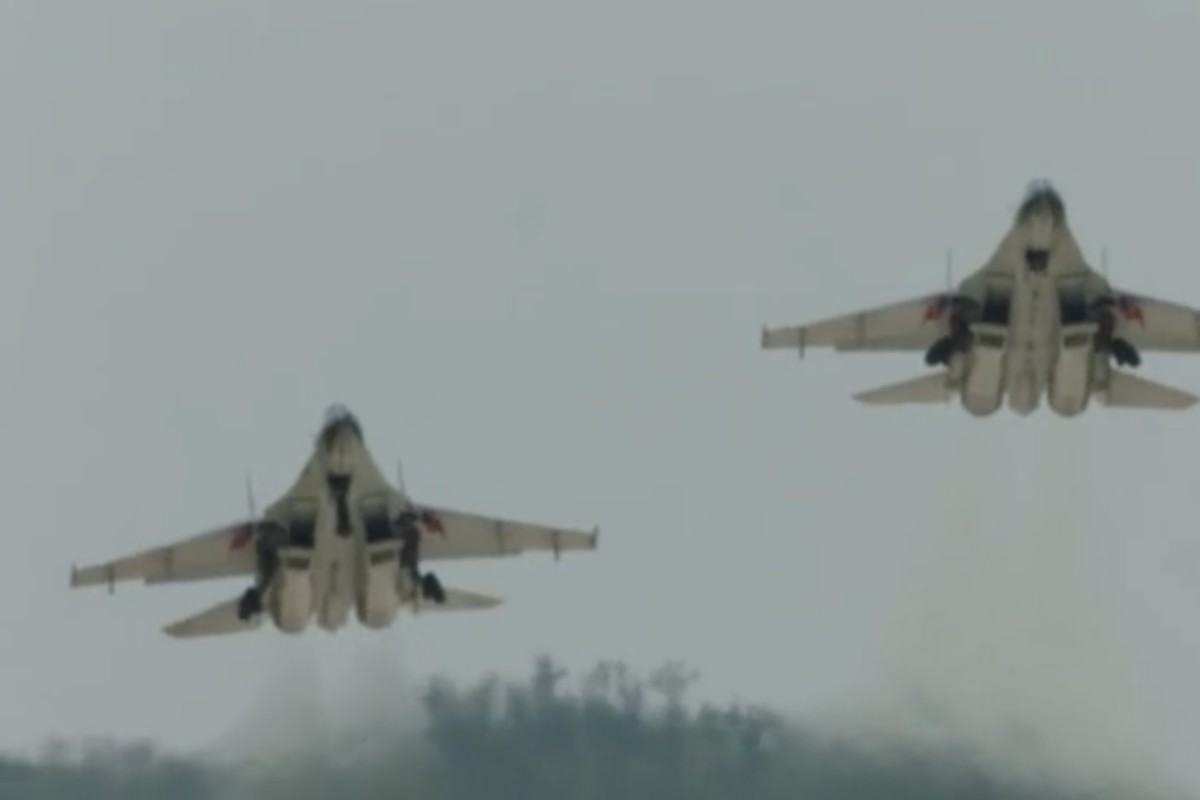
China’s air force shows a more assertive side in a new propaganda video. Photo: Handout
The Chinese air force has ramped up its combat rhetoric in its latest propaganda video, with pilots warning enemies in English and top brass stressing the need for crisis mode.
The four-minute video was posted on the Ministry of National Defence’s website on Wednesday and begins with two J-20 stealth fighters taking off from an unidentified airbase.
At least three missile-carrying J-11 jets are then shown make low passes and various aerobatics at sea.
After that, a pilot shouts in English: “This is the PLA Air Force speaking. You are about to enter Chinese airspace. Leave immediately. Leave immediately.”
The video also features members of an elite brigade called the “Eagles of Liaoning province”, a frequent winner of PLA Air Force competitions.
PLA Air Force formation ‘a sign of stealth fighter mass production’ in China
Brigade member Bai Long, a J-20 fighter pilot, says the team have a higher calling.
“Winning over enemies is more important than winning competitions,” Bai says.
Also featured is Wang Hai, a 93-year-old combat veteran from the Korean war, who encourages air force personnel to fear nothing during combat.
“You cannot do anything if you are not brave enough. You can’t be a pilot if you fear death,” Wang says.
Wang Yongtong, a brigade commander, is also quoted as saying that the Chinese air force is using war games to strengthen its combat readiness.
“We will meticulously prepare for war and improve our combat capacity to resolutely safeguard national sovereignty, security and interests,” he says.
The video’s release comes just a few weeks before China marks the 70th anniversary of the founding of the People’s Republic with a massive military parade showcasing its military weapons.
It also underlines China’s increasingly assertive efforts to defend its interests.
On Wednesday, China hit out at Canada for sending a warship to traverse the Taiwan Strait.
And in late July, South Korea claimed that two Chinese warplanes entered South Korea’s air defence identification zone, a claimed denied by the Chinese foreign ministry.
And in late January, a Chinese surveillance plane crossed the Sea of Japan and the East China Sea via the Tsushima Strait, prompting the Japanese air self-defense force to scramble fighter jets.
Posted in 70th anniversary, Aerobatics, air defence identification zone, airbase, brigade commander, canada, China alert, Chinese air force, Chinese foreign ministry, Chinese warplanes, deploys, Eagles of Liaoning province, East China Sea, English, fighter jets, founding of the People’s Republic, interests, J-20 stealth fighters, Japanese air self-defense force, Korean War, mass production, massive military parade, military weapons, Ministry of National Defence, national sovereignty, PLA Air Force, safeguard, scramble, Sea of Japan, security, South Korea, stealth fighter, surveillance plane, Taiwan Strait, Tsushima Strait, Uncategorized, veteran, video rallying cry, warship |
Leave a Comment »
12/09/2019
BEIJING (Reuters) – China and Malaysia have agreed to set up a joint dialogue mechanism for the disputed South China Sea, the Chinese government’s top diplomat said on Thursday after meeting Malaysia’s foreign minister.
Recent Chinese naval deployments in the strategic waterway, through which more than $3.4 trillion worth of goods are transported annually, have reignited tension with Vietnam and the Philippines. Malaysia, Brunei and Taiwan also have competing claims in the South China Sea.
Malaysia had been critical of China’s South China Sea position, but has not been excessively outspoken recently, especially after China pumped in billions of dollars into infrastructure projects under its Belt and Road Initiative.
Malaysia regularly tracked Chinese naval and coastguard vessels entering Malaysia’s territorial waters, but China respects Malaysia and had “not done anything that caused us trouble, so far”, Defence Minister Mohamad Sabu told Reuters last month.
Chinese State Councillor Wang Yi told a news conference with Malaysian Foreign Minister Saifuddin Abdullah that this year, tensions in the South China Sea had dropped.
Littoral states and China were committed to continue appropriately handling the South China Sea issue and jointly safeguard peace and stability there, said Wang, who is the Chinese government’s top diplomat.
“To this end, our two sides have agreed to set up a bilateral consultation mechanism for maritime issues, a new platform for dialogue and cooperation for both sides,” he said.
Abdullah, who referred to Wang as “my brother”, said the mechanism would be led by the two countries’ foreign ministries.
“Our officers will be discussing the details, but I think this is one important outcome of the meeting today and also the 45 years of our diplomatic relations,” he said.
China is debt-heavy Malaysia’s biggest trade partner and the countries have close cultural ties too.
In July, China and Malaysia resumed construction on a train project in northern Malaysia, which is part of China’s Belt and Road plan, after a year-long suspension and following a rare agreement to cut its cost by nearly a third, to about $11 billion.
Source: Reuters
Posted in Belt and Road Initiative, Belt and Road Initiative (BRI), belt and road plan, Brunei, China alert, coastguard vessels, defence minister, dialogue, infrastructure projects, Littoral states, Malaysia, Malaysian Foreign Minister, mechanism, Mohamad Sabu, naval deployments, naval vessels, Philippines, Reuters, Saifuddin Abdullah, set up, South China Sea, State Councillor Wang Yi, strategic waterway, Taiwan, Uncategorized, Vietnam |
Leave a Comment »
11/09/2019
- Agriculture ministry says long-term goal is achievable despite the loss of a third of domestic livestock owing to impact of disease
- Observers believe foreign producers will never be able to produce enough to satisfy the world’s largest market for the meat
A pork vendor sleeps at a stall at a Beijing wholesale market. Photo: Simon Song
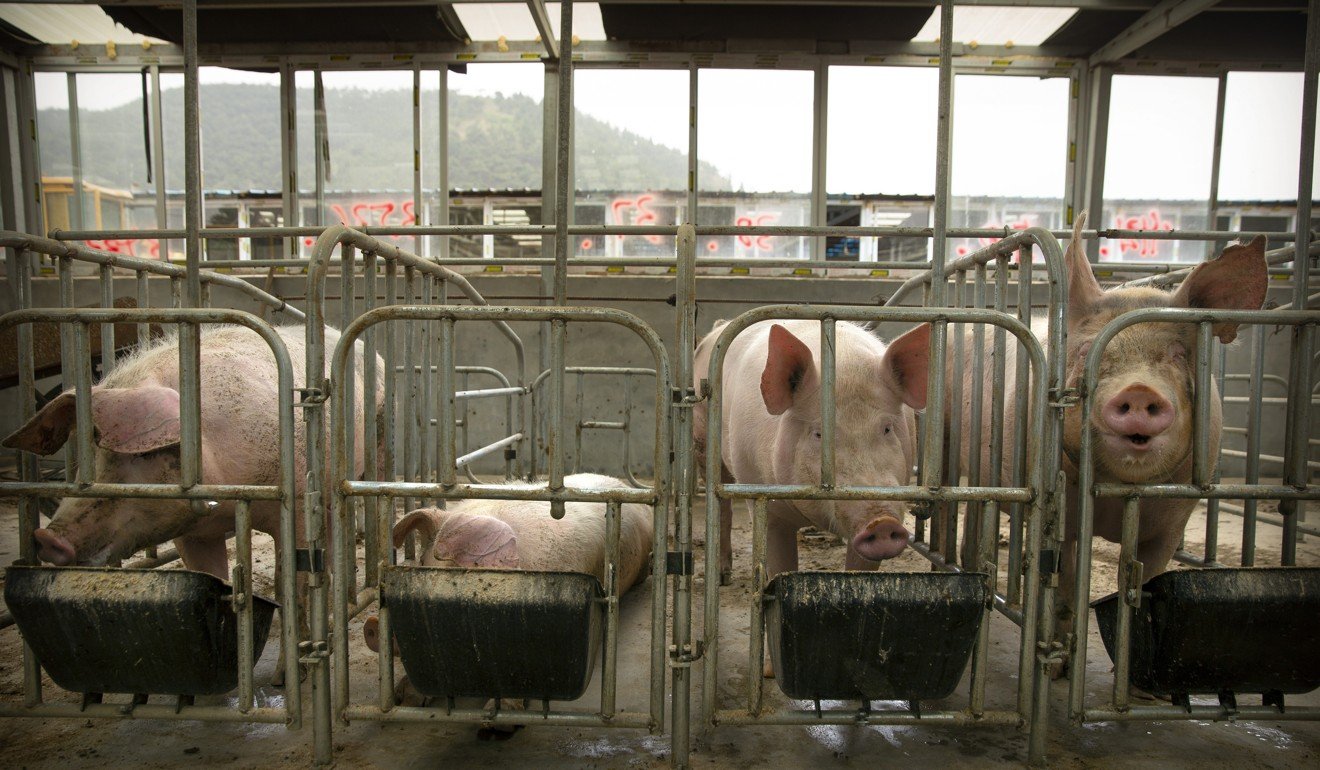
China will continue to strive for self-sufficiency in pork production although its farming industry has suffered a devastating blow after African swine fever wiped out about one-third of its hog herds, officials said on Wednesday.
Yu Kangzhen, a vice-minister for agriculture, said it was unrealistic for China to pin its hope on imports in meeting the country’s demand for pork.
Last year, China consumed about half of the world’s pork but more than 95 per cent was sourced from domestic supplies, which have taken a serious hit this year due to swine fever.
The disease is deadly for pigs, although not for humans, and there is currently no cure or vaccine.
“Even at its highest level, imports accounted for about 2 per cent of China’s domestic production,” said Yu at a press conference in Beijing.
“So from the statistics alone, we can see that we must adhere to the principle of self-sufficiency if we are to meet our demand for meat, and this also explains why we have put forward a 95 per cent self-sufficiency target.”
According to Yu, the total global trade in pork last year was 8 million tonnes – less than 15 per cent of China’s total production of 54 mi
Peng Shaozong, an official from the pricing department of the National Development and Reform Commission (NDRC), expressed confidence that foreign suppliers would be interested in filling any gaps in the Chinese market.
“Imports are guided by the market. If there is money to be made [in selling to China], they will definitely come,” said Peng on the sidelines of the press conference.
Pan Chenjun, from agribusiness bank Rabobank, said China’s pork production was expected to continue to fall in the coming year, putting pressure on the country’s US$140 billion pork industry.
In July, China’s pig population had fallen by 32.2 per cent from a year earlier, and was down 9.4 per cent compared with the previous month, according to latest government figures.
However, Pan said the government’s 95 per cent self-sufficiency target was in line with market realities.
China’s domestic pig stocks have fallen by a third. Photo: AP
“In any case, the 95 per cent [self-sufficiency] goal is reasonable, as China’s pork market size is too big, and imports, despite rising this year, still represent just a small part,” Pan said.
Although China’s domestic shortfall may offer a windfall to foreign suppliers, they must obtain government approval before they could sell to China.
On Monday, Beijing approved imports from 25 Brazilian meat factories, bringing the country’s total number to 89.
On Wednesday, Danish officials completed a three-day trip to China, saying they expected to increase pork exports to China.
Danish food minister Mogens Jensen attended the opening of a new meat processing facility near Shanghai operated by Danish Crown.
China imported 230,000 tonnes of pork from Denmark in 2018, according to the country’s foreign ministry.
On Tuesday, the Chinese State Council issued a new set of guidelines to support the industry, outlining measures such as increased subsidies to boost domestic production in the face of worsening pork shortages that have sent prices to record highs.
The consumer price index released on Tuesday reinforced the bleak picture of a tight market supply as the data showed that pork prices rose by 46.7 per cent in August compared with a year earlier, almost double the 27 per cent rise witnessed in July.
Prices of pork are one of the major indicators used by Chinese citizens to gauge their well-being and, at the moment, that well-being is being eroded rapidly.
According to NDRC, China has already spent a total of 3.23 billion yuan (US$454 million) in subsidies so far this year to tackle the pork shortage crisis.
“As much as 1.1 billion yuan has been newly added under the budget of the central government, with the focus on supporting western provinces in the Yangtze River basin to carry out farm improvement works to control pollution and reduce livestock and poultry waste,” Peng from the NDRC said.
However, a report published by research firm Gavekal Dragonomics on Wednesday cautioned that the government’s plans to soften the blow on the industry might not be effective.
“As the overhaul of pig-raising practices to eliminate the disease would take years even if the government was moving more aggressively, high prices and pork shortages are going to persist,” the report said.
Source: SCMP
Posted in African swine fever, agribusiness bank, Agriculture ministry, aims, Beijing, Brazilian, China alert, Chinese State Council, cure, Danish Crown, Danish food minister, Denmark, despite, devastating blow, farming industry, Gavekal Dragonomics, meat factories, meat processing facility, Mogens Jensen, National Development and Reform Commission (NDRC), pork production, pork vendor, Rabobank, self-sufficient, Shanghai, sleeps, stall, Uncategorized, Vaccine, vice-minister for agriculture, wholesale market, Yangtze River basin |
Leave a Comment »
09/09/2019
- Merkel makes the case on sensitive issues in Beijing without being offensive, observer says
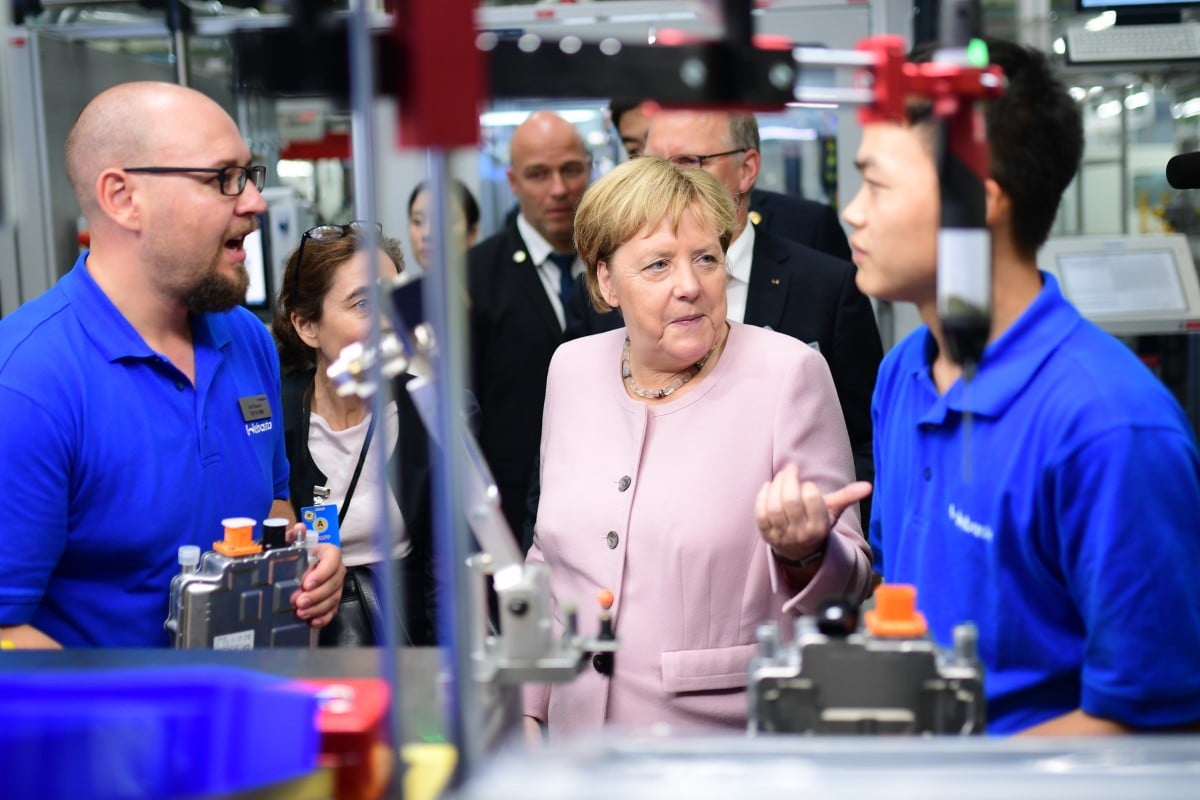
German Chancellor Angela Merkel (centre) talks to staff at manufacturer Webasto during a visit in Wuhan on Saturday. Photo: EPA-EFE
German Chancellor Angela Merkel may be slowly declining in influence in European politics but she remains the EU’s strongest voice in dealing with China, analysts said after her latest trip to China last week.
During the two-day visit, Merkel and Chinese President Xi Jinping discussed the sensitive topic of Hong Kong and the social credit system in China.
German diplomats also averted a plan by Chinese officials to scrap a joint press conference by Merkel and Chinese Premier Li Keqiang out of concerns that it could be dominated by questions about the escalating protests in Hong Kong.
Two sources told the South China Morning Post that the Chinese side initially suggested not letting journalists ask questions during the press conference. German diplomats persisted, saying that Merkel would hold her own press conference to take media questions, the sources said.
Germany’s Angela Merkel renews call for peaceful resolution to Hong Kong protests
After talks with the Chinese president and premier, Merkel said Beijing had listened to her views about resolving the Hong Kong conflict without violence, adding: “This is important.”
She said she also pressed the European Union’s position that the Sino-British Joint Declaration on Hong Kong remained effective, countering Beijing’s assertion that the 1984 document has ceased to be valid.
“Merkel navigated the narrow line to raise these sensitive issues without being overly offensive,” said Jan Weidenfeld, of the Berlin-based Mercator Institute for China Studies.
Joerg Wuttke, president of the EU Chamber of Commerce in China, said Merkel’s biggest achievement was to raise the issue about the social credit system in China, a policy that aims to rank every individual and corporate entity based on their compliance with state-stipulated social norms.
“It is important to us that she makes the Chinese leadership aware that the German business community would like to get better briefed and prepared for this major change in company compliance by the Chinese authorities,” Wuttke said. “Merkel was the first foreign leader to do so.”
Despite Merkel’s tough approach, China’s foreign ministry was full of praise for the German leader’s visit, saying both sides were “satisfied” with the outcomes.
“This is Chancellor Merkel’s 12th China visit, so she should be one of the Western leaders who visited China the most times and knows China the best,” ministry spokeswoman Hua Chunying said on Monday.
Hong Kong is a matter for China, Premier Li Keqiang tells Angela Merkel
Back home, however, German media and businesses remained sceptical about the future.
Bild, the country’s biggest-circulation newspaper, has been following closely the arrest of Hong Kong pro-democracy activist Joshua Wong Chi-fung, who was detained at Hong Kong airport on his way to Berlin at the newspaper’s invitation. Wong was later cleared to travel abroad.
Several newspapers have put pressure on Merkel to speak out for Hong Kong, with one calling on her to replace a stop in mainland China with one in the former British colony, which she refused.
On the business side, German businesses also urged Merkel to caution Beijing against sending troops to Hong Kong out of concerns that the lucrative Chinese market would become subject to international sanctions.
Another concern is the slow pace of structural reforms that would open up Chinese markets to foreign businesses.
Source: SCMP
Posted in Angela Merkel, averted, Beijing, Berlin, Bild, China alert, Chinese leadership, Chinese premier Li Keqiang, Chinese President Xi Jinping, Europe, European Union, former British colony, German business community, German Chancellor, German diplomats, Hong Kong, Hong Kong airport, Joshua Wong Chi-fung, Mainland China, Mercator Institute for China Studies, Sino-British Joint Declaration on Hong Kong, social credit system, south china morning post, strong voice, Uncategorized, views, Webasto, Wuhan |
Leave a Comment »
08/09/2019
Chinese State Councilor and Foreign Minister Wang Yi (L), Pakistani Foreign Minister Shah Mahmood Qureshi (C) and Afghan Foreign Minister Salahuddin Rabbani attend the 3rd China-Afghanistan-Pakistan Foreign Ministers’ Dialogue in Islamabad, capital of Pakistan, Sept. 7, 2019. (Xinhua/Liu Tian)
ISLAMABAD, Sept. 8 (Xinhua) — The 3rd China-Afghanistan-Pakistan Foreign Ministers’ Dialogue was held here in Islamabad on Saturday, and the three sides stressed the need to jointly safeguard regional peace and stability amid the changing and complicated circumstances.
The situation in south Asia is going through profound and complicated changes, Chinese State Councilor and Foreign Minister Wang Yi said at the meeting.
Progress has been achieved in the peace talks between the United States and the Afghan Taliban, and there is an important opportunity for Afghanistan’s peace and reconciliation, he noted.
Meanwhile, some historical disputes have again escalated, undermining peace and stability in the region, Wang said.
In the international arena, unilateralism, protectionism and hegemony have threatened and challenged the interests of developing countries, he added.
China, Afghanistan and Pakistan are close neighbors with a shared future, Wang said. The three countries share the aspirations to safeguard regional peace and achieve lasting stability, the need to push forward Belt and Road development and regional connectivity, as well as the expectation to achieve sustainable development and improve people’s livelihood.
The three sides should work together and make new efforts to push forward the Afghan-led and Afghan-owned reconciliation process in Afghanistan, improve the relations between Afghanistan and Pakistan, promote trilateral practical cooperation as well as jointly combat terrorism, among others, he said.
For their part, Afghan Foreign Minister Salahuddin Rabbani and Pakistani Foreign Minister Shah Mehmood Qureshi made positive assessment on the progress achieved in cooperation and exchange on the three major themes within the framework of the China-Afghanistan-Pakistan Foreign Ministers’ Dialogue, namely political mutual trust and reconciliation, development cooperation and connectivity, and security cooperation and fighting terrorism. They also spoke highly of China’s contribution in pushing forward the cooperation among the three countries.
The two foreign ministers said China, always a good neighbor and a trustworthy friend of Afghanistan and pakistan, has long played an important and positive role in promoting Afghanistan’s peace and reconciliation process, pushing forward the improvement of the relations between Afghanistan and Pakistan and maintaining peace and stability in the region.
With the complicated regional situation which is undergoing fast change, Afghanistan and Pakistan are willing to boost communication and coordination with China so as to deepen cooperation in such fields of economy and trade, people to people exchange, communication and connectivity, jointly build the Belt and Road, join hands in combating terrorism including the East Turkestan Islamic Movement, maintaining regional peace and stability as well as promoting regional development and prosperity, they said.
The foreign ministers from China, Afghanistan and Pakistan reached agreement on pressing forward the realization of lasting peace and stability in Afghanistan through the Afghan-led and Afghan-owned reconciliation process and implementing common connectivity programs with international financial institutions including the World Bank, among others.
The three foreign ministers also agreed to hold the 4th China-Afghanistan-Pakistan Foreign Ministers’ Dialogue in 2020 in China.
Source: Xinhua
Posted in 3rd China-Afghanistan-Pakistan Foreign Ministers' Dialogue, Afghan Foreign Minister, Afghan Taliban, Afghan-led and Afghan-owned reconciliation, Afghanistan, belt and road development programme, China alert, Chinese State Councilor and Foreign Minister Wang Yi, East Turkestan Islamic Movement, efforts, Islamabad, Pakistan, Pakistani Foreign Minister, pledge, regional peace, regional stability, safeguard, Salahuddin Rabbani, Shah Mehmood Qureshi, Uncategorized, United States |
Leave a Comment »
08/09/2019
Serbian President Aleksandar Vucic(4th R) meets with Zhang Youxia(3rd L), a member of the Political Bureau of the Communist Party of China (CPC) Central Committee and vice chairman of the Central Military Commission in Belgrade, Serbia on Sept. 6, 2019. (Photo by Li Xiaowei/Xinhua)
BELGRADE, Sept. 7 (Xinhua) — Serbia hopes to enhance mutually beneficial cooperation with China in various fields, including military, to advance bilateral relations to new levels, Serbian President Aleksandar Vucic has said.
Vucic made the remarks on Friday when meeting with visiting vice chairman of China’s Central Military Commission, Zhang Youxia.
Vucic said that history has proved that China is Serbia’s most reliable friend. The Serbian government, people and military support the “one-China” policy as well as China’s stance and proposition in many other issues concerning China’s core interests.
Vucic added that the Belt and Road Initiative has brought many opportunities to the development of Serbia. He said he hopes that the two sides will continue to deepen mutually beneficial cooperation in various fields, including military, to advance bilateral relations to new levels.
Zhang, who is also a member of the Political Bureau of the Communist Party of China Central Committee, said that the traditional friendship between China and Serbia is profound.
He said that China is ready to work with Serbia to consolidate the all-weather friendship between the two countries, promote the quality of their bilateral relations and accelerate the growth of their ties.
Zhang also called for the militaries of the two countries to implement consensus reached between the heads of state of China and Serbia, deepen strategic mutual trust and enhance exchanges and cooperation in bids to promote their links to new height.
During his visit, Zhang also met with Serbian Defense Minister Aleksandar Vulin, and witnessed the signing of a memorandum of understanding on the establishment of a Chinese medicine center in the Serbian Military Medical Academy.
Source: Xinhua
Posted in advance, Aleksandar Vucic, Aleksandar Vulin, Belt and Road Initiative, Belt and Road Initiative (BRI), Central Military Commission, Central Military Commission (CMC), China alert, Chinese medicine center, establishment, levels, member of the Political Bureau of the Communist Party of China Central Committee, Memorandum of understanding, Memorandum of Understanding (MOU), Military, pledges, Serbian Defense Minister, Serbian Military Medical Academy, Serbian president, ties, Uncategorized |
Leave a Comment »
08/09/2019
- International watchdog to vote on whether to extend restrictions to southern African countries that are the biggest exporters
- If passed, China may find it hard to buy elephants from Africa
An elephant is hoisted into Chongqing zoo in southwestern China, on loan from another Chinese zoo. Photo: Reuters
China, one of the leading buyers of African elephants, could face difficulty in acquiring the mammals if a widening of a ban on their sale to zoos is ratified next week by the global regulator of wildlife trade.
A motion further restricting the sale of live elephants was on Sunday supported by 46 countries at the committee stage of the Convention on International Trade in Endangered Species of Wild Fauna and Flora (Cites) in Geneva. It will go to a final vote on August 28.
The sale of elephants from West, Central and East Africa is already banned – but there is a lower level of protection for them in southern African countries such as South Africa, Namibia and Zimbabwe, which are the top three exporters of wild elephants to overseas zoos, according to Cites.
Keeping elephants caught from the wild in zoos is considered cruel by conservation and animal rights groups.
Conservationists criticised Zimbabwe’s capture of 35 baby elephants that were exported to a Chinese zoo in February. There was also uproar from activists in 2015 when a video filmed in a Chinese zoo showed two dozen elephants bought from Zimbabwe exhibiting signs of distress.
Zimbabwe was among 18 countries that opposed the potential ban at the committee stage, along with the United States – another leading buyer of elephants from Africa. China was one of 19 countries that abstained, while the European Union’s 28 countries did not vote.
If the motion is passed, China and the US – both known to be buying elephants from Africa and keeping them in so-called captive facilities or zoos – may find it hard to source the animals from the continent. Zimbabwe has come under
global scrutiny
for its capture and sale of elephants to captive facilities including zoos and safari parks in China and the US.
Peter Knights, founder and chief executive of WildAid, an environmental organisation in San Francisco, explained that Cites still allowed the movement of live elephants for on-site conservation efforts such as moving the animals back into the wild or to a national park where they had been depleted.
“This is not primarily a conservation issue but more about animal welfare,” he said. “As highly social, intelligent animals, African elephants do not usually do well in captivity, requiring very large areas, and often developing behavioural problems in captivity and not usually reproducing successfully – indicating far from ideal housing.”
According to Humane Society International, which promotes animal welfare, Zimbabwe has sold more than 100 baby elephants to zoos in China since 2012, with a further 35 reportedly awaiting export.
On Monday, 55 elephant specialists protested to the US wildlife management agency about plans for the country’s zoos to import juvenile elephants caught in the wild from Zimbabwe. They asked the agency to prohibit imports of wild-caught elephants for captivity in US facilities.
“We are vehemently opposed to the proposed imports,” the experts wrote in a letter to the agency. “Young elephants are dependent on their mothers and other family members to acquire necessary social and behavioural skills. Male calves only leave their natal families at 12 to 15 years old and females remain for life. Disruption of this bond is physically and psychologically traumatic for both the calves and remaining herds and the negative effects can be severe and lifelong.”
The letter said that eSwatini, formerly Swaziland, had sold a total of 11 wild elephants to two American zoos in 2003, and a further 18 to three US zoos in 2016.
‘Hundreds’ of elephants are being poached each year in Botswana
Concerns about keeping elephants in zoos come at a time when the animals remain under threat in Africa from poachers who kill them for ivory.
Southern African countries such as Botswana, Namibia, Zimbabwe and Zambia are pushing to reopen the trade in ivory. Zambia is seeking to have the classification of its elephants downgraded to allow commercial trade in registered raw ivory with approved trading partners.
Other countries, including Kenya, Nigeria and Gabon, are seeking the highest possible levels of protection for all of Africa’s elephants.
Two previous attempts at regulating the ivory trade failed to curb poaching, which has caused elephant numbers to dwindle over the past two decades. A 2016 study estimated that 30,000 to 40,000 elephants were being killed every year, with about 400,000 remaining in total.
Knights, of WildAid, said that between 1975 and 1989 – the first period in which the ivory trade was regulated – half of Africa’s elephants were lost. During the second attempt at regulation between 2008 and 2017, participating countries claimed to have addressed the problem but poaching increased.
“It is clear that we cannot control ivory trade and that legal trade stimulates poaching and demand for ivory, rather than substituting for it as some countries suggest. The price fell by two-thirds when China banned domestic sales,” Knights said, adding that demand for ivory came primarily from Asia.
“Most seized shipments are en route to China. It has banned all sales and is making a great effort to crack down on illegal trade.”
Source: SCMP
Posted in affect, africa, African countries, African elephants, ban, Botswana, buy, China alert, Chongqing zoo, Convention on International Trade in Endangered Species of Wild Fauna and Flora (Cites), elephants, eSwatini, European Union, Gabon, Geneva, hoisted, Humane Society International, International watchdog, ivory, Ivory trade, Kenya, mammals, Namibia, Nigeria, poaching, safari parks, sale, San Francisco, South Africa, southern, Swaziland, Uncategorized, US, US-China relationship, vote, West, Central and East Africa, wild, WildAid, Zimbabwe, zoos |
Leave a Comment »
08/09/2019
- Two people from the circus have been detained after the animal managed to get out of its cage and run towards nearby cornfields on Friday evening
- It was found the next morning and police used a tranquilliser to subdue the tiger but it died on the way to the zoo, which believes it had been hit by a car
Video footage shows circus handlers using sticks to try to coax the tiger back inside the cage after it escaped on Friday night. Photo: Thepaper.cn
A circus tiger that escaped from its cage during a show in central China was captured by police after an overnight search, but died while it was being transported to a nearby zoo, according to media reports.
Two people from the circus where the tiger was raised in the county of Yuanyang, Henan province, have been detained, Beijing Youth Daily reported, without elaborating. It said the tiger escaped during the circus’ first public show, which had not been registered with the local authorities.
The tiger was part of a performance for a local school on Friday evening when it managed to get out of its cage and run towards nearby cornfields.
A video posted by news site Thepaper.cn shows the moment it escaped from the cage, with its handlers using sticks to try to coax the animal back inside. The scene is chaotic, as people scream and run from the venue.
A tranquilliser dart was used to subdue the tiger on Saturday morning and it was transported to a zoo in Xinxiang. Photo: Thepaper.cn
The police were called in, and officers used drones, police dogs and thermal imaging equipment to hunt for the tiger, according to the local government.
The authorities also put out an emergency advisory telling residents to stay indoors and contact police if they had any information on the tiger’s whereabouts.
It was spotted the following morning, and a tranquilliser dart was used to subdue the animal at about 10.30am on Saturday. The tiger was then transported to a zoo in the city of Xinxiang.
According to one of its zookeepers, the animal had already died by the time it was delivered to the zoo, China Youth Daily reported on Sunday.
The \jsq, surnamed Feng, said the tiger was hit by a car after it escaped and may have sustained internal injuries. The zoo is conducting an autopsy.
Chinese circus tiger attacks two children after breaking out of cage in middle of performance
Thousands of social media users expressed their sympathy for the tiger’s plight, saying it must have suffered greatly, with many people calling for animal circuses to be banned in China.
“Tigers don’t belong in cages, they belong in the wilderness,” one person wrote on microblog site Weibo.
Chinese circus defends using rare animals in its acts despite poor crowds at shows and criticism of its methods.
Source: SCMP
Posted in Beijing Youth Daily, cage, captured, car, Central China, chaotic, China alert, circus, Circus tiger, cornfields, died, dies, drones, escapes, handlers, Henan province, local authorities, local school, performance, Police, police dogs, registered, scream and run, sent to zoo, show, Thepaper.cn, thermal imaging equipment, tiger, tranquilliser, tranquilliser dart, Uncategorized, venue, Weibo, Xinxiang, Yuanyang, Zoo |
Leave a Comment »







 CHINDIA ALERT: You'll be living in their world, very soon