Archive for ‘China alert’

17/04/2014

Why China Needs to Let More Companies Go Bankrupt – China Real Time Report – WSJ

China needs to let more companies go bust.

That was the message from several executives at a real-estate conference in Shanghai on Thursday, as the latest string of loan defaults among real-estate developers and a small construction firm have some people talking about bankruptcy more freely.

It’s crazy that China hasn’t had a major bankruptcy in recent years, said Ronnie Chan, chairman of Hong Kong-listed property developer Hang Lung Group.

Although the country has a bankruptcy code somewhat similar to that in the U.S., it’s rarely used. Borrowers sometimes flee rather than try to work out problems under bankruptcy law, and there are few judges, administrators or lawyers who specialize in the field.

Last month, property developer Zhejiang Xingrun Real Estate Co. couldn’t repay nearly $600 million of loans. Local officials in Fenghua, the eastern city where the developer is based, are worried that a bankruptcy could hurt the city’s reputation and have said they’ve set up a task force to deal with the outstanding debt and remaining land assets.

On Wednesday, a Shenzhen-listed shipbuilder said property firm Nanjing Fudi Property Developing Co. has failed to repay 105.4 million yuan ($16.9 million) loan, including interest.

While China has seen developers default before, government officials have arranged bailouts for troubled firms that allow their underlying financial problems to fester. On Thursday, analysts argued that authorities have to be willing to address the other option: Let the companies go broke, and send a warning to markets, even if it leads to some financial turmoil in the near term.

Mr. Chan argues that real-estate firms declaring bankruptcy isn’t a social problem. “Another firm takes over the land or project, and no one has to be fired.”

Developers and government officials must be “forced to accept reality,” he said.

To be sure, the developer isn’t saying massive waves of bankruptcies are the way to go either. This is acceptable as long as not too many companies go broke at the same time and doesn’t result too much disruption, Mr. Chan added. In other words, they don’t want a “Lehman Brothers” moment.

“That’s why we prune trees,” said John Allen, chief executive officer of private investment firm Greater China Corporation in a later speech. “Bankruptcy is one of the healthiest things around. You want to get rid of the weak players.”

via Why China Needs to Let More Companies Go Bankrupt – China Real Time Report – WSJ.

Enhanced by Zemanta
16/04/2014

A Green Group Sees Hope in ‘The End of China’s Coal Boom’ – NYTimes.com – NYTimes.com

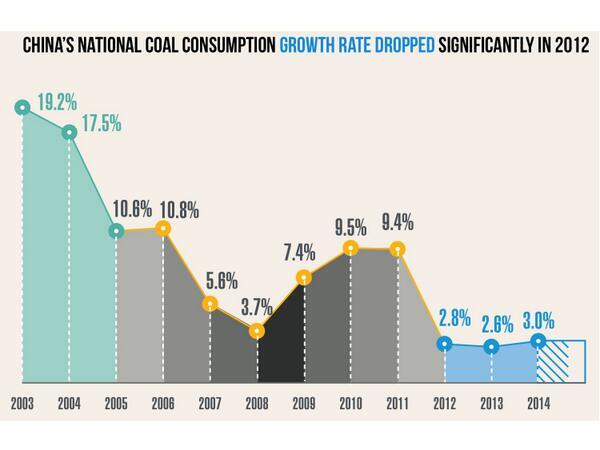
A report from Greenpeace charts slowing growth in China’s coal use.

Through much of its history, Greenpeace has been big on what I call “woe is me, shame on you” messaging on the environment. As I explained at a TEDx event in Portland, Ore., over the weekend, fingerpointing (including Greenpeace’s) is appropriate in many instances, but doesn’t work well with human-driven global warming. The blame game too often ends up resembling a circular firing squad.

This is why “The End of China’s Coal Boom,” a valuable new report from Greenpeace’s East Asia office, is so refreshing and worth exploring. I was led to it by a Twitter item from the group’s outgoing director, Phil Radford, that focused on a telling graphic:

View image on Twitter

via A Green Group Sees Hope in ‘The End of China’s Coal Boom’ – NYTimes.com – NYTimes.com.

Enhanced by Zemanta
15/04/2014

China in numbers: beans means trouble as commodity markets highlight rising credit risks | The Times

500,000 . . . is the total tonnage of soya bean cargoes on which Chinese importers have defaulted recently, unsettling markets already nervous about the world’s second biggest economy.

Soya bean meal is unloaded at Fangchenggang

Those defaults look alarming. Commodity markets can provide livid symptoms of an economic malaise and the numbers seem to offer evidence of rising credit risk in China. The country’s first corporate bond default earlier in the year merely sharpened sensitiv-ity to any sign of contagion.

Shipping industry sources in Singapore and Tokyo believe that there are six soya bean cargoes at Chinese ports that cannot be unloaded and the same number still at sea. Their total value is somewhere around £180 million, which makes this China’s highest-stakes soya bean default since 2004. This in a country that imports nearly two thirds of all the soya beans traded worldwide.

Explanations are focused on China’s tightening credit markets and the inability of soya bean buyers to secure the necessary letters of credit from banks. It does not take much of a leap to wonder what that type of credit contraction is having on an economy that has been fuelled lately by an epic creation of new credit.

As with other vulnerable sectors in China, the companies that process soya beans have been making losses: suddenly the banks are unprepared to take risks on them and the cargoes have been stranded.

The defaults have highlighted other market distortions that go far beyond the inability of an oilseed processor to turn a profit from a hill of beans. Trading companies have routinely used soya bean cargoes, in common with shipments of copper and other commodities, as collateral to secure cheap financing for potentially more lucrative deals and businesses. Because the interest payable on letters of credit is low and the payment terms generous, some have sold the product itself at a loss simply to get their hands on the cash.

The reality of these defaults, though, is that they are probably a good thing — or at least part of a well-intentioned plan. Beijing has been uncharacteristically relaxed about these defaults for the same reason that it has been uncharacteristically relaxed about internet giants such as Alibaba infuriating the banks by introducing innovative financial products. Beijing knows it has to reform the financial sector, realises that it will face huge resistance and is looking for leverage. Creating a series of micro crises forces China’s banks to become better at what they are supposed to do. Defaults (on soya beans and bonds) have been noisily paraded in state media to show the banks that they are expected to start pricing risk accurately and coldly.

via China in numbers: beans means trouble as commodity markets highlight rising credit risks | The Times.

Enhanced by Zemanta
15/04/2014

How a Chinese Company Built 10 Homes in 24 Hours – China Real Time Report – WSJ

Chinese companies have been known to build major real-estate projects very quickly. Now, one company is taking it to a new extreme.

Suzhou-based construction-materials firm Winsun New Materials says it has built 10 200-square-meter homes using a gigantic 3-D printer that it spent 20 million yuan ($3.2 million) and 12 years developing.

Such 3-D printers have been around for several years and are commonly used to make models, prototypes, plane parts and even such small items as jewelry. The printing involves an additive process, where successive layers of material are stacked on top of one another to create a finished product.

Winsun’s 3-D printer is 6.6 meters (22 feet) tall, 10 meters wide and 150 meters long, the firm said, and the “ink” it uses is created from a combination of cement and glass fibers. In a nod to China’s green agenda, Winsun said in the future it plans to use scrap material left over from construction and mining sites to make its 3-D buildings.

Winsun says it estimates the cost of printing these homes is about half that of building them the traditional way. And although the technology seems efficient, it’s unlikely to be widely used to build homes any time soon because of regulatory hurdles, Mr. Chen said.

The Chinese firm isn’t the first to experiment with printing homes. Architects in Amsterdam are building a house with 13 rooms, with plans to print even the furniture. The Dutch architect in charge of the project said on the project’s website it would probably take less than three years to complete.

via How a Chinese Company Built 10 Homes in 24 Hours – China Real Time Report – WSJ.

Enhanced by Zemanta
15/04/2014

Massive China shoe factory strike rolls on as offer falls flat | Reuters

Thousands of workers at a giant Chinese shoe factory shrugged off an offer for improved social benefits on Tuesday, prolonging one of the largest strikes in China in recent years amid signs of increased labor activism as the economy slows.

Yue Yuen Industrial Holdings

Yue Yuen Industrial Holdings (Photo credit: Wikipedia)

The industrial unrest at Yue Yuen Industrial (Holdings), now stretching to around ten days and sparking sporadic scuffles with police, has centered on issues including unpaid social insurance, improper labor contracts and low wages. Workers have demanded improved social insurance payments, a pay rise and more equitable contracts.

“The factory has been tricking us for 10 years,” said a female worker inside a giant industrial campus in Gaobu town run by Yue Yuen in the southern factory hub of Dongguan in the Pearl River Delta. “The Gaobu government, labor bureau, social security bureau and the company were all tricking us together.”

A spokesman for Yue Yuen said the firm, which makes shoes for the likes of Nike, Adidas, Reebok, Asics and Converse with a market capitalization of some $5.59 billion, had agreed to an improved “social benefit plan” on Monday, while stressing the business impact had been “mild” so far.

“Basically, the terms that we announced yesterday was after a very thorough internal analysis and calculation and considering all the factors including the affordability from the factory perspective,” the spokesman told Reuters by phone.

via Massive China shoe factory strike rolls on as offer falls flat | Reuters.

Enhanced by Zemanta
11/04/2014

All you need to know about business in China | McKinsey & Company

A lot of people view China business as mysterious. Relax. Consumers behave pretty much the same everywhere. Competition is pretty much the same everywhere. You just need to ignore the hype and focus on the basic fact that in China today, there are six big trends (exhibit). That’s it. Six trends shape most of the country’s industries and drive much of China’s impact on the Western world. They are like tectonic plates moving underneath the surface. If you can understand them, the chaotic flurry of activity on the surface becomes a lot more understandable—and even predictable.

Coauthors Jeffrey Towson and Jonathan Woetzel discuss China’s six megatrends with Nick Leung, the managing partner of McKinsey’s Greater China office.

These trends move businesses on a daily basis. They’re revenue or cost drivers that show up in income statements. Deals, newspaper headlines, political statements, and the rising and falling wealth of companies are mostly manifestations of these six trends, which aren’t typically studied by economists and political analysts. In fact, we happen to think that Chinese politics or political economics are wildly overemphasized by some Westerners in China. So let’s tell a story about each of these megatrends, with some important caveats. They’re not necessarily good things. They’re not necessarily sustainable. For every one of them, we can argue a bull and a bear case. Most lead to profits or at least revenue. Some may be stable. Some lead to bubbles that may or may not collapse. We are only arguing that they are big, they are driving economic activity on a very large scale, and understanding them is critical to understanding China and where it’s headed.

via All you need to know about business in China | McKinsey & Company.

Enhanced by Zemanta
11/04/2014

Chinese civil society: Beneath the glacier | The Economist

AGAINST a powerful alliance of factory bosses and Communist Party chiefs, Zeng Feiyang cuts a frail figure. Mr Zeng, who is 39, works from a windowless office in Panyu, on the edge of the southern city of Guangzhou, where he runs a non-governmental organisation (NGO) called the Panyu Migrant Workers’ Service Centre. For more than a decade his organisation has battled against the odds to defend the rights of workers in the factories of Guangdong province. For his troubles, Mr Zeng has been evicted from various premises, had his water and electricity cut off, and been constantly harassed by local officials and their thugs. Then last autumn he received a call from one such official. “The man asked if I wanted to register the NGO,” he says. “I was very surprised.”

Over the past three years other activists at unregistered NGOs have received similar phone calls from the authorities about the sensitive issue of registration, an apparently mundane bit of administrative box-ticking which in fact represents real change. China has over 500,000 NGOs already registered with the state. The number comes with a big caveat. Many NGOs are quasi-official or mere shell entities attempting to get government money. Of those genuine groups that do seek to improve the common lot, nearly all carry out politically uncontentious activities. But perhaps 1.5m more are not registered, and some of these, like Mr Zeng’s, pursue activism in areas which officials have often found worrying.

These unregistered NGOs are growing in number and influence. They are a notable example of social forces bubbling up from below in a stubbornly top-down state. The organisations could be a way for the Communist Party to co-opt the energy and resources of civil society. They could also be a means by which that energy challenges the party’s power. And so their status has big implications. Guo Hong of the Sichuan Academy of Social Sciences in Chengdu calls the liberalisation of NGO registration laws “the partial realisation of freedom of association”. Just as economic liberalisation in the early 1980s had a profound material effect, so these latest moves could have a profound social one.

via Chinese civil society: Beneath the glacier | The Economist.

Enhanced by Zemanta
11/04/2014

In China, Xi’s Anticorruption Drive Nabs Elite, Low Ranks Alike – Businessweek

Chinese President Xi Jinping’s anticorruption campaign has lasted longer, gone deeper, and struck higher than many analysts and academics had expected. Xi has been so zealous that since late last year retired Communist Party leaders including ex-President Jiang Zemin have cautioned him to take a more measured pace and not be too harsh, say Ding Xueliang, a professor of social science at the Hong Kong University of Science & Technology, and Willy Lam, an expert on elite politics at the Chinese University of Hong Kong.

Chinese President Xi Jinping in Berlin on March 28

Xi is cracking down on the army and the police at the same time, something no leader has done before, says Ding. Gu Junshan, a lieutenant general in charge of logistics for the People’s Liberation Army (PLA), has been charged with bribery, embezzlement, and abuse of power, the official Xinhua News Agency reported on March 31. He will be tried in military court.

China’s former top cop and security czar Zhou Yongkang is under investigation for corruption, say Ding and Lam. When asked at a March 2 press conference whether Zhou was under suspicion, a government spokesman avoided a direct answer, saying, “Anyone who violates the party’s discipline and the state law will be seriously investigated and punished, no matter who he is or how high ranking he is.” He added what seems to be a veiled confirmation: “I can only say so much so far. You know what I’m saying.”

More than 180,000 party officials were punished for corruption and abuse of power last year, according to the Central Commission for Discipline Inspection, the party’s watchdog. While most were low-level officials—or “flies,” as Xi has put it—they also included senior party members—“tigers,” in Xi’s words. Thirty-one senior officials were investigated by the commission last year: Eight had their graft cases handed over to prosecutors. The remaining 23 are still being investigated.

via In China, Xi’s Anticorruption Drive Nabs Elite, Low Ranks Alike – Businessweek.

Enhanced by Zemanta
11/04/2014

And the Award for Best Chinese Film Goes to… – China Real Time Report – WSJ

And the winner is…no one.

That was the message from the China Film Directors’ Guild, which declined to hand out its two top prizes—best picture and best director—for 2013, citing a lack of high-quality contenders.

“What China’s film industry needs now is not to be coddled, but to hold itself to a higher standard,” said director Feng Xiaogang, chairman of the guild’s nine-director awards jury.

China’s box office has been booming in recent years, growing from a mere 950 million yuan ($153 million) in 2002—when China first began allowing modern theater chains—to 21.6 billion yuan last year. But an increase in quality hasn’t followed the increase in revenue, directors and many industry experts say.

Decades ago, many film directors resolutely gave up their artistic ideals to save the Chinese film market from going bankrupt and devoted themselves to the flood of commercial films,” Mr. Feng said at the awards ceremony Wednesday night in Beijing, which was aired live on state television.

Prominent Chinese director Jia Zhangke’s “A Touch of Sin,” which won best screenplay at last year’s Cannes film festival and has been critically celebrated, wasn’t eligible for consideration for the awards because Mr. Jia’s company couldn’t provide the guild a legal copy of the film on DVD or online. This film didn’t make it to China’s big screens because it hasn’t been approved by censors.

via And the Award for Best Chinese Film Goes to… – China Real Time Report – WSJ.

Enhanced by Zemanta
11/04/2014

China’s soaring potential a springboard for budget airlines | Reuters

The chairman of Spring Airlines requires his employees to use both sides of a sheet of paper before throwing it away and even removed most of the bulbs lighting the corridor to his office – all part of his quest to save money.

A Spring Airlines crew member sells food onboard an Airbus A320 aircraft near Shanghai July 6, 2012. REUTERS/Aly Song

China’s first low-cost airline has been profitable since 2006, its first full year of operation, but the budget aviation market is about to get a lot more competitive as the government moves to promote low-cost travel to meet a surge in demand from an increasingly wealthier population.

Over the last 18 months, Spring has been joined by two new competitors. China’s big state-backed carriers are also looking at launching budget carriers, a strategy industry executives say would be an additional boon to plane makers Airbus Group (AIR.PA) and Boeing Co. (BA.N).

The Civil Aviation Administration of China (CAAC) plans to add nearly 80 new airports by 2020, including a $14.5 billion second airport in the capital Beijing, and is urging other airports to build new terminals and convert existing facilities to handle budget airlines.

The initiative, industry observers say, would usher in a new era for low-cost carriers (LCCs) in a country where one in four people travelled by air in 2013. That number is set to rise to almost the whole population in the next two decades, according to Airbus executives, with China to replace the United States as the world’s largest aviation market during the same period.

via China’s soaring potential a springboard for budget airlines | Reuters.

Enhanced by Zemanta
Law of Unintended Consequences

continuously updated blog about China & India

ChiaHou's Book Reviews

continuously updated blog about China & India

What's wrong with the world; and its economy

continuously updated blog about China & India