08/12/2019
Myanmar President U Win Myint (R) meets with visiting Chinese State Councilor and Foreign Minister Wang Yi in Nay Pyi Taw, Myanmar, Dec. 7, 2019. (Xinhua/U Aung)
NAY PYI TAW, Dec. 7 (Xinhua) — Myanmar President U Win Myint met here Saturday with visiting Chinese State Councilor and Foreign Minister Wang Yi with both sides pledging to strengthen high-level exchanges to push bilateral ties to a new high.
The Myanmar president expressed gratitude to China for its long-term support for Myanmar’s sovereignty, dignity and socio-economic development.
He hoped that both sides will seize the 70th anniversary of the establishment of their diplomatic relations next year as an opportunity to consolidate and deepen mutual political trust, speed up the joint construction of the Belt and Road, comprehensively press forward the building of the China-Myanmar Economic Corridor, expand cooperation in sectors including economy and trade, education, health, and enhance cooperation and coordination in regional and international issues so as to further advance the comprehensive strategic cooperative partnership between the two countries.
The president also hoped that China would continue to support Myanmar in pressing forward the ongoing national reconciliation and peace process.
For his part, the Chinese state councilor said China and Myanmar are neighbors linked by rivers and mountains enjoying a “baobo” (brothers and relatives) friendship. Both countries advocate and practise the Five Principles of Peaceful Coexistence, setting an example of equality and mutually beneficial cooperation between countries.
He pledged that China will continue to firmly support Myanmar’s efforts in pursuing a development path suited to its own national conditions, protecting its legitimate rights and national integrity in the international arena and maintaining its overall development and stability. China also appreciates Myanmar’s firm support for China on issues bearing on its core interests and major concerns, he said.
As the two countries will celebrate 70 years’ diplomatic ties next year, China is willing to join hands with Myanmar to sum up experiences in bilateral cooperation in the past years while planning for future development of bilateral ties and carrying out a series of celebration activities, Wang said.
The Chinese state councilor said China is ready to strengthen high-level exchanges with Myanmar in the new year to push the bilateral comprehensive strategic cooperative partnership to a new high.
Source: Xinhua
Posted in "baobo" (brothers and relatives) friendship, Belt and Road (B&R), boost, China alert, China-Myanmar Economic Corridor, Chinese State Councilor and Foreign Minister Wang Yi, Five Principles of Peaceful Coexistence, Myanmar, Myanmar President, new high, pledge, ties, Uncategorized |
Leave a Comment »
06/12/2019
Chinese Vice President Wang Qishan meets with the head of Japan’s national security council Shigeru Kitamura in Beijing, capital of China, Dec. 6, 2019. (Xinhua/Huang Jingwen)
BEIJING, Dec. 6 (Xinhua) — Chinese Vice President Wang Qishan on Friday met with the head of Japan’s national security council Shigeru Kitamura.
Not only close neighbors, China and Japan are also major economies in Asia and the world, said Wang, pointing out that the two countries both face huge tasks of domestic development and bear important responsibilities for world peace and development.
Wang said the two sides should use the important consensus of the leaders of the two countries as a guide, and move the bilateral relationship forward with wisdom and vision.
He called on the two countries to learn from history, take the overall situation into consideration, gain a clear understanding of common interests, and maintain the focus in developing ties with a long-term perspective.
Wang also encouraged the two sides to work together to create a favorable environment for the two countries’ high-level exchanges in the next stage.
Kitamura said that since last year, bilateral relations have developed positive momentum and seen close high-level contacts. Japan is ready to make full preparations for future exchanges between the two countries’ leaders.
Source: Xinhua
Posted in China alert, Chinese Vice President Wang Qishan, head of Japan's national security council, Japan, Shigeru Kitamura, Uncategorized |
Leave a Comment »
03/12/2019
BEIJING, Dec. 2 (Xinhua) — China has selected 30 outstanding grass-roots police officers, plus five awardees of special respect and 35 for nomination awards.
The list was selected in a campaign jointly launched by the Publicity Department of the Communist Party of China Central Committee and the Ministry of Public Security in August this year.
The campaign was aimed at encouraging police across the country to work hard to maintain political security and social stability and to improve public understanding of the police work, according to a joint statement by the two departments.
The five awardees of special respect include a group of police officers in east China’s Zhejiang Province who risked their own lives in evacuating vehicles and personnel trapped in a tunnel after fire broke out.
They also include police officers who died on duty – one of them was guiding vehicles on an icy road in Fujian Province, southeast China, but was hit by an out-of-control heavy truck while trying to save passengers nearby.
The 30 outstanding police officers include criminal police, police with special duties, anti-drug police, police who remove explosives, plainclothes police, among others, who have worked diligently for years under dangerous circumstances.
They also include officers who have worked seemingly ordinary jobs but have demonstrated extraordinary perseverance or devotion in serving the public. Officers who have worked in difficult situations for a long time, such as the gobi desert and prisons with criminals living with HIV/AIDS, have also been selected.
Also on the list are some officers who actively seek innovations to incorporate the Internet, satellite and other new technologies into police work.
In addition, several female officers who have worked at a prison or as a forensic expert have received the award.
Source: Xinhua
Posted in award, China alert, female officers, forensic expert, Fujian Province, grass roots, Ministry of Public Security, officers, outstanding, Police, Prison, Publicity Department of the Communist Party of China Central Committee, selects, Uncategorized, zhejiang province |
Leave a Comment »
03/12/2019
BEIJING, Dec. 2 (Xinhua) — The Chinese government has decided to suspend reviewing applications to visit Hong Kong by U.S. military ships and aircraft starting Monday, foreign ministry spokesperson Hua Chunying said.
China will also take sanctions against some U.S. non-governmental organizations (NGOs) for their role in the disturbances in Hong Kong, Hua said at a press conference.
The NGOs include the National Endowment for Democracy, National Democratic Institute for International Affairs, International Republican Institute, Human Rights Watch and Freedom House.
A lot of facts and evidence have shown that the aforementioned NGOs supported anti-China rioters in Hong Kong in various ways, abetted their extreme and violent criminal behavior and incited separatist activities for “Hong Kong independence”, Hua said, adding that these organizations bear major responsibilities for Hong Kong’s chaotic situation and should be sanctioned and pay their price.
The spokesperson said the United States has seriously violated the international law and basic norms governing international relations, and interfered in China’s internal affairs by signing the so-called Hong Kong Human Rights and Democracy Act of 2019 into law despite China’s firm opposition.
“China urges the U.S. to correct its mistake and stop meddling in Hong Kong affairs or interfering in China’s other internal affairs by any word and act,” Hua said.
China will take further necessary actions in accordance with the development of the situation to firmly defend the stability and prosperity of Hong Kong and safeguard national sovereignty, security and development interests, she said.
Source: Xinhua
Posted in "Hong Kong independence", Aircraft, China alert, Freedom House, Hong Kong, Hong Kong Human Rights and Democracy Act of 2019, Human Rights Watch, International Republican Institute, military ships, National Democratic Institute for International Affairs, National Endowment for Democracy, NGOs, sanctions, suspends, U.S., Uncategorized, visits |
Leave a Comment »
02/12/2019
(Reuters) – Asian companies dominate the market for electric vehicle (EV) batteries and they are expanding their production capacity in Europe, China and the United States in a fight to win lucrative contracts from global automakers.
Some carmakers worry, however, there won’t be enough batteries for all the EVs they plan to launch in the coming years and a bitter row between South Korea’s SK Innovation and LG Chem risks exacerbating the potential shortfall.
Below are details of the world’s leading EV battery makers with details of their customers and expansion plans:
CATL
China’s Contemporary Amperex Technology (CATL), the world’s biggest EV battery maker, counts BMW (BMWG.DE), Volkswagen (VOWG_p.DE), Daimler (DAIGn.DE) – which makes Mercedes cars – Volvo, Toyota Motor Corp (7203.T) and Honda Motor Co (7267.T) among its customers.
The company emerged as a major force partly thanks to Beijing’s policy of only subsidising vehicles equipped with Chinese batteries in the world’s biggest EV market. Beijing is phasing out EV subsidies next year.
CATL, which operates factories in China, is building its first overseas plant in Germany and is considering a U.S. factory.
PANASONIC CORP (6752.T)
Japan’s Panasonic, a supplier of U.S. EV pioneer Tesla (TSLA.O), said it has installed equipment to ramp up production at Tesla’s Nevada plant to 35 GWh from its current production of around 30 GWh as of late October. Panasonic has said it is investing about $1.6 billion in the factory.
Panasonic also produces EV batteries in Japan, China and plans to shift some of its plants to a new joint venture with Toyota. Panasonic’s clients also include Honda and Ford Motor Company (F.N).
For a graphic of expansion plans: tmsnrt.rs/35tFmOL
BYD CO LTD (002594.SZ)
China’s BYD, which is backed by U.S. investor Warren Buffett, is also one of the world’s biggest EV battery makers. It mainly uses them in-house for its own cars and buses. BYD said last year it is was considering cell production in Europe.
LG CHEM LTD (051910.KS)
The South Korean firm was an early industry mover, winning a contract to supply General Motor’s (GM.N) Volt in 2008. It also supplies Ford, Renault (RENA.PA), Hyundai Motor (005380.KS), Tesla, Volkswagen and Volvo.
It is investing 3.3 trillion won ($2.8 billion) to build and expand production facilities near Tesla’s plant in Shanghai. It has a joint venture (JV) in China with Geely Automobile Holdings (0175.HK), which makes Volvos, and is in talks with other carmakers about JVs in major markets.
The firm is considering building a second U.S. factory in addition to its facility in Michigan and is expanding its plant in Poland.
SAMSUNG SDI CO LTD (006400.KS) Samsung SDI an affiliate of South Korean tech giant Samsung Electronics (005930.KS), has EV battery plants in South Korea, China and Hungary, which supply customers such as BMW (BMWG.DE), Volvo and Volkswagen. Samsung SDI is investing about 1.2 billion euros ($1.3 billion) to expand its factory in Hungary though the EU is investigating whether Budapest’s financial support complies with the bloc’s state aid rules.
Samsung started production last year on the Hungary plant, which will produce batteries for 50,000 EVs a year.
SK INNOVATION CO LTD (096770.KS) LG Chem’s cross-town rival SK Innovation supplies batteries to Volkswagen, Daimler and Kia Motors (000270.KS), as well as Jaguar Land Rover [TAMOJL.UL] and Ferrari (RACE.MI).
An oil refiner that came to the battery industry late, SKI is investing about $3.9 billion to build three plants in the United States, China and Hungary, with a goal of expanding its annual production capacity to 33 GWh by 2022.
SKI currently operates one battery factory in South Korea, with a capacity of 4.7 GWh annually.
It set up a joint venture with Beijing Automotive Industry Corporation (BAIC) of China in August 2018 and another Chinese partner. It is in talks with Volkswagen about another battery JV and is building a $1.7 billion factory in the U.S. state of Georgia, not far from Volkswagen’s Chattanooga plant.
Source: Reuters
Posted in automakers, batteries, battery, Beijing Automotive Industry Corporation (BAIC), Beijing’s, biggest, BMW, BMW (BMWG.DE), Budapest’s, BYD, BYD CO LTD (002594.SZ), Chattanooga, China alert, Chinese, Contemporary Amperex Technology (CATL), contracts, Daimler, Electric vehicle, equipped, Europe, EV pioneer, Factory, Ferrari (RACE.MI), firm, Ford, Ford Motor Company (F.N), Geely Automobile Holdings (0175.HK), General Motor’s (GM.N), Georgia, Germany, global, Honda Motor Co (7267.T), Hungary, Hyundai Motor (005380.KS), industry mover, Japan, Japan’s, Kia Motors (000270.KS), LG Chem, LG CHEM LTD (051910.KS), Makers, Mercedes, Michigan, Nevada, Panasonic, PANASONIC CORP (6752.T), Plant, Poland, policy, Renault (RENA.PA), Rover [TAMOJL.UL], Samsung Electronics (005930.KS), SAMSUNG SDI CO LTD (006400.KS), Shanghai, SK Innovation, SK INNOVATION CO LTD (096770.KS), South Korea, South Korean, subsidising, Tesla (TSLA.O), Toyota Motor Corp (7203.T), U.S., U.S. investor, Uncategorized, United States, vehicles, Volkswagen, Volkswagen (VOWG_p.DE), Volt, Volvo, Warren Buffett, world's |
Leave a Comment »
29/11/2019
BEIJING, Nov. 28 (Xinhua) — China has started the design of Fengyun-5 meteorological satellites and the third generation polar orbit meteorological satellite observation system, according to the Science and Technology Daily Thursday.
The new satellites and observation system will conduct high-precision global 3D atmospheric detection, the report quoted Zhang Peng, deputy director of National Satellite Meteorological Center (NSMC) as saying.
China has launched a total of 17 Fengyun meteorological satellites, with seven currently in orbit. With an increasing demand for meteorological satellite data, China plans to launch another nine Fengyun satellites before 2025.
Fengyun-5 satellites will be low-orbit meteorological satellites with a network of comprehensive observation satellites, special-purpose observation satellites and constellations for extreme weather monitoring.
They will be the successor of the Fengyun-3 satellites currently in service and are expected to completely replace them by 2035.
The planned meteorological satellites, including Fengyun-5 satellites in polar orbit and Fengyun-6 satellites in geostationary orbit, will better support meteorological disaster prevention and enhance global meteorological services, the report quoted Yang Jun, director of NSMC as saying.
Source: Xinhua
Posted in Beijing, China alert, design, Fengyun-5, meteorological, National Satellite Meteorological Center (NSMC), new, observation system, plans, polar orbit, satellites, Science and Technology Daily, third generatio, Uncategorized |
Leave a Comment »
29/11/2019
BEIJING, Nov. 28 (Xinhua) — A spokesperson for China’s Ministry of National Defense on Thursday slammed U.S. warships and military aircraft’s willful and repeated trespassing into the adjacent waters and airspace of China’s islands and reefs in the South China Sea.
The trespassing hurts regional peace and stability, harms China’s sovereignty and security, and endangers the lives of frontline officers and soldiers of both sides, spokesman Ren Guoqiang said at a press conference, calling it “a highly dangerous provocation.”
“We demand that the United States immediately stop such infringement upon China’s interests,” Ren said, adding that the Chinese military is always on high alert and will take all necessary measures to resolutely safeguard national sovereignty, security and development interests.
Source: Xinhua
Posted in Beijing, China alert, Military aircraft, Ministry of National Defense, slams, South China Sea, trespassing, U.S., Uncategorized, warships |
Leave a Comment »
27/11/2019
Chinese President Xi Jinping holds a welcome ceremony for Suriname’s President Desire Bouterse before their talks at the Great Hall of the People in Beijing, capital of China, Nov. 27, 2019. (Xinhua/Yue Yuewei)
BEIJING, Nov. 27 (Xinhua) — China and Suriname on Wednesday decided to upgrade their relationship to a strategic partnership of cooperation.
The announcement came as Chinese President Xi Jinping held talks with Surinamese President Desire Bouterse at the Great Hall of the People in Beijing.
During the talks, Xi said Suriname is one of the first Caribbean countries to establish diplomatic relations with China. The relations can be considered a model of friendly relations and equal treatment between countries of different sizes.
The development of bilateral ties is in an important historical period, and China is willing to work with Suriname to take the opportunity of the Belt and Road cooperation to uplift the ties to new heights, said Xi.
Xi stressed that the two countries should maintain support on issues involving each other’s core interests and major concerns.
Xi called on the two sides to deepen cooperation in areas such as infrastructure construction, agriculture, forestry, fisheries, communications and energy, and explore cooperation in new areas such as new energy, digital economy, tourism and ocean economy.
“China encourages more capable Chinese companies to invest in Suriname,” said Xi.
Noting that Suriname is one of the countries with the largest overseas Chinese population in the Caribbean area, Xi said it is necessary to promote cultural exchanges, facilitate personnel exchanges and strengthen cooperation in areas such as education and law enforcement. China will also send a medical expert panel to Suriname.
The two sides should maintain communication and coordination on global issues, practice multilateralism, build an open world economy and safeguard the common interests of both countries and all developing countries, said Xi.
China is willing to continue to speak out from a sense of justice for Suriname on multilateral occasions and work together with the international community including Suriname to constructively participate in the multilateral process on global climate issues, he said.
Xi added that China has always respected the right of Latin American people to choose their own development path and supported the process of Latin American integration and the handling of regional issues through dialogue and consultation.
China is willing to work with Latin America to promote the construction of the Belt and Road and deepen China-Latin America cooperation by the principles of equal treatment and mutual benefit, said Xi.
Bouterse extended congratulations on the 70th founding anniversary of the People’s Republic of China, and said under Xi’s leadership, socialism with Chinese characteristics will be a success and will bring benefits to the Chinese people and people around the world.
Underscoring the historic and political significance of his visit, Bouterse said Suriname will firmly uphold the one-China principle and support China’s national reunification.
He said Suriname is grateful for China’s help in his country’s economic and social development, and ready to work with China to enhance exchanges at all levels, cement political mutual trust, expand economic and trade cooperation, deepen people-to-people exchanges and take the joint construction of the Belt and Road as an opportunity to upgrade bilateral strategic relations.
Suriname stands ready to work with China to safeguard multilateralism, international law and basic norms of international relations, Bouterse said.
After the meeting, Xi and Bouterse witnessed the signing of several cooperation documents.
Source: Xinhua
Posted in 70th anniversary of the founding of the People's Republic of China (PRC), 70th founding anniversary, Belt and Road (B&R), Caribbean area, China alert, China-Latin America cooperation, Chinese President Xi Jinping, education, largest, Latin America, law enforcement, medical expert panel, Overseas Chinese, People's Republic of China, Population, Suriname, Surinamese President, Uncategorized |
Leave a Comment »
27/11/2019
- But Washington still commands more diplomatic influence, analyst says
- Beijing extends its reach as its interests grow abroad and as Taipei loses allies
China has 276 embassies, consulates and other missions around the world, surpassing the US with 273 missions, according to a global index. Photo: AP
China has overtaken the United States to have the biggest number of diplomatic outposts around the world, as its international ambitions and economic interests expand.
According to the 2019 Global Diplomacy Index, released by the Lowy Institute in Australia on Wednesday, China has 276 embassies, consulates and other missions globally, surpassing the US with 273 missions. France was third on 267.
Bonnie Bley, the index report’s lead researcher, said that while a country’s total did not equate to diplomatic influence, “diplomatic infrastructure is still important”
“China’s newly held lead serves as a telling metric of national ambition and international priorities,” Bley said.
Beijing has 169 embassies or high commissions, while Washington has 168. However, China had 96 consulates while the US had 88, suggesting that Beijing’s diplomatic expansion was closely linked to its economic interests, she said.
Beijing bulks up diplomacy budget as China extends global reach
Renmin University international relations professor Shi Yinhong said China had close and growing trade and investment ties with many developing countries, especially those taking part in the Belt and Road Initiative, increasing the need for consulates.
“One of the consulates’ main goals is to serve the citizens and businesses located in those countries,” Shi said.
Beijing has also expanded its reach at Taipei’s expense. Since 2016, when the index was first published, Taiwan’s total number of embassies fell from 22 to 15, the biggest drop among the 61 places ranked.
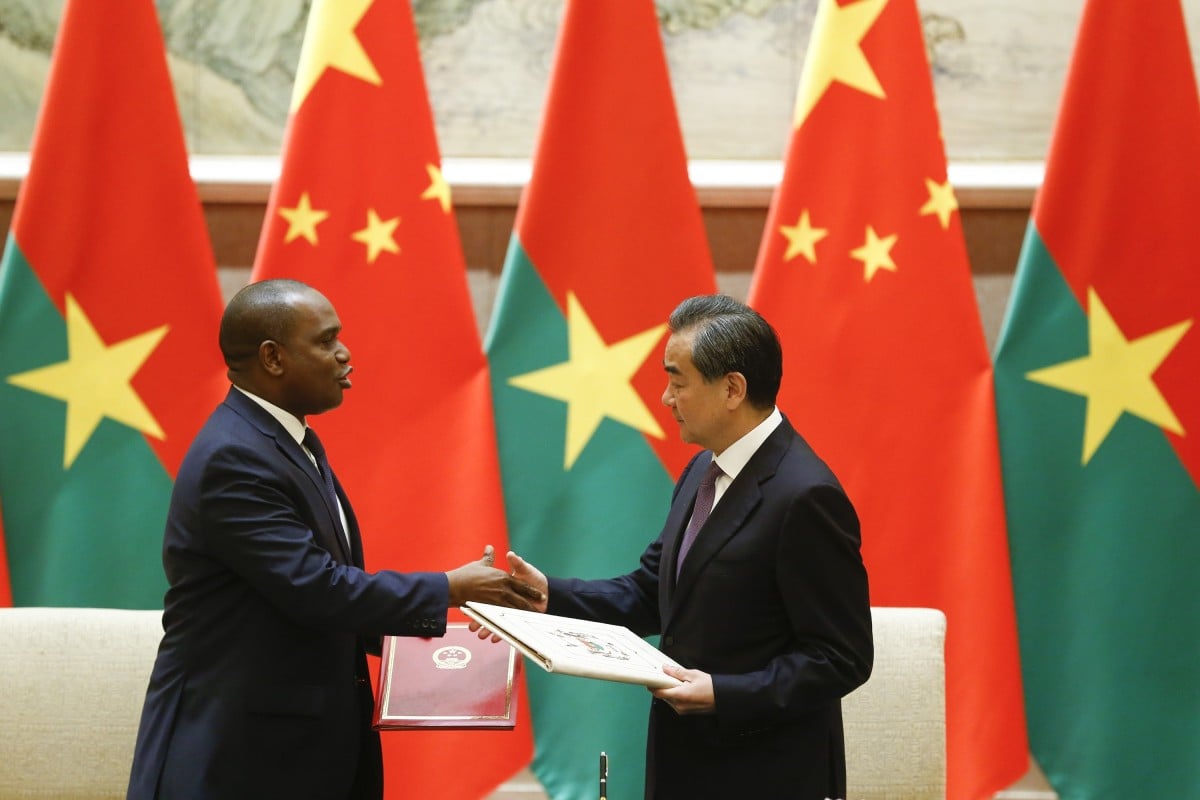
China opened five new embassies – in El Salvador, Burkina Faso, Gambia, São Tomé and Príncipe and the Dominican Republic – countries that severed official diplomatic ties with Taiwan. This directly contributed to China’s lead over the US, the report said.
Beijing’s diplomatic expansion also comes as the US, under the administration of President Donald Trump, is taking an “America first” approach to foreign policy.
Sri Lanka rejects fears of China’s ‘debt-trap diplomacy’ in belt and road projects
Trump has sought to cut funding to the US State Department and the White House has not appointed US ambassadors for at least 17 countries, including Brazil and Egypt, according to the American Foreign Service Association.
“Even though the US has a strong diplomatic base but it is not so proactive any more. It has fewer consulates and fewer foreign service workers,” Shi said.
“For the long term, China is in a more advantageous position.”
But a country’s diplomatic ability and influence did not rest on the number of foreign service postings and the US still held more international diplomatic sway than China, he added.
Some of China’s biggest diplomatic missions include Islamabad in Pakistan, Washington and London.
Source: SCMP
Posted in 2019 Global Diplomacy Index, American Foreign Service Association, “America first”, Beijing, belt and road projects, biggest, boast, Brazil, Burkina Faso, China alert, commands, diplomatic, Dominican Republic, Egypt, Gambia, influence, Islamabad, London, network, Pakistan, President Donald Trump, Renmin University, São Tomé and Príncipe, São Tome, Sri Lanka, Taipei, Uncategorized, United States, US State Department, Washington, White House, world’s |
Leave a Comment »
26/11/2019
Japanese Prime Minister Shinzo Abe meets with Chinese State Councilor and Foreign Minister Wang Yi in Tokyo, Japan, Nov. 25, 2019. (Xinhua/Du Xiaoyi)
TOKYO, Nov. 25 (Xinhua) — Japanese Prime Minister Shinzo Abe and Chinese State Councilor and Foreign Minister Wang Yi on Monday agreed that both sides should work together to further improve bilateral ties and strengthen people-to-people exchanges.
Japan and China have witnessed frequent high-level exchanges and positive progress in the improvement of bilateral relations recently, said Abe, adding that the Japanese side is eagerly looking forward to Chinese President Xi Jinping’s state visit next spring and believes that it will be a major opportunity for promoting bilateral relations in the new era.
A stable Japan-China relationship is the cornerstone of peace and prosperity in Asia, and is also crucial to addressing current global challenges. Japan is ready to work with China to usher in a new future of bilateral relations, he said.
Japan welcomes the launch of the high-level consultation mechanism on people-to-people exchanges between the two countries and stands ready to work with China to continuously boost the affinity between the two peoples and properly handle sensitive differences so as to create a favorable atmosphere and conditions for the improvement and development of bilateral relations, he added.
Abe also said he is looking forward to further in-depth communication with Chinese leaders on bilateral ties during his visit to China next month to attend the China-Japan-ROK (Republic of Korea) leaders’ meeting.
Wang, for his part, said that with the political guidance of the two leaders and joint efforts of both sides, China-Japan relations have returned to the right track and have seen a sound momentum of improvement and development. The top leaders of the two countries had a successful meeting in Osaka in June and reached important consensus on building bilateral relations that meet the requirements of the new era.
The China-Japan relations have gone through twists and turns and the present situation has not come easily and should be doubly cherished, Wang said.
The two sides should push for continuous improvement and development of China-Japan relations from a longer-term and broader perspective, he said.
He called on the Japanese side to meet China halfway, take more positive actions, properly manage and handle differences so as to create a favorable atmosphere and conditions for the proposed major political and diplomatic agenda of the two countries.
The improvement and development of China-Japan relations not only conform to the interests of the two countries and peoples but also has great positive significance to regional peace and stability, injecting stability into the current world situation which is full of uncertainty, said Wang.
The Chinese side welcomes Abe to attend the China-Japan-ROK leaders’ meeting in China next month. China is willing to work with Japan to give full play to the role of the high-level consultation mechanism on people-to-people exchanges, usher in a new era of exchanges between our peoples, localities and youth, and create a brighter future for bilateral relations, he said.
Source: Xinhua
Posted in agree, Asia, China alert, China-Japan-ROK (Republic of Korea), Chinese President Xi Jinping's, Chinese State Councilor and Foreign Minister Wang Yi, cornerstone, improve ties, Japan, Japan-China relationship, Japanese Prime Minister, Japanese Prime Minister Shinzo Abe, Osaka, peace, people-to-people exchanges, prosperity, State visit, Tokyo, Uncategorized |
Leave a Comment »




 CHINDIA ALERT: You'll be living in their world, very soon