Archive for ‘China alert’

19/05/2012

* The world turned upside down: how workers are moving from PIIGS to BRICS

The Times: “The eurozone was dreamland for the formerly impoverished fringe of southern Europe. To share the same currency as the powerful Germans and French was a sure sign that the bad times — of dusty villages emptied of menfolk — were over. They bought German cars, borrowed money to build villas and said farewell to centuries of emigration.

BRICS counties. BRICS - Brazil, Russia, India,...

BRICS counties. BRICS – Brazil, Russia, India, People’s Republic of China, South Africa. Português: As Potências regionais. (Photo credit: Wikipedia)

Now, as dreamland turns to nightmare, young Portuguese, Spaniards and Greeks are on the move again, travelling in search of work and security to countries they had previously treated with contempt or indifference. People from the PIIGS — Portugal, Ireland, Italy, Greece and Spain — are heading for the BRICs — Brazil, India and China but not Russia — as the global turmoil creates a new trend: reverse migration.

The movement of peoples began in earnest at the outset of the financial crisis three years ago, as the strong-growth cultures became a magnet not only for European adventurers but for well-educated native-born emigrants returning home. The rapid unravelling of the PIIGS has, however, made this an act of desperation for many. Across the globe millions of people are on the move as who is rich, who is poor, who is up, who is down is defined anew. Remarkably, at least 10,000 Portuguese have left for Angola. …Angola was a Portuguese colony for three hundred years, a supplier of slaves to the mercantile class in the 17th century. Today it is Africa’s second-largest oil producer and while not exactly a BRIC — two thirds of its population live on £1.30 a day — it has an energy that has drained from its former colonial master.

Brazil has become a natural destination for the Portuguese — and the Spanish. In Madrid, a website, Pepas y Pepes, has been set up to guide would-be emigrants. Even its name is a sad echo, adapted from a famous Spanish film called ¡Vente a Alemania, Pepe! — Come to Germany, Pepe! — which was inspired by the exodus after the Spanish Civil War. … A Barcelona businessman, Jordi Camps, has set up a travel company in China, China a la Carta. “Here you can smell growth,” he says. “It is sad to hear the news from Spain.”

There are two trends unfolding in the world. The first is that many hundreds of thousands who emigrated from what was once called the developing world to Europe and the United States are now being drawn back by the resurgent economies of their homelands. … Nowadays it is an eerily quiet place with giant razor-wired pens all empty of Mexican illegals. Instead, as the US economy wobbles uncertainly, Mexicans are heading home for work. For the first time since the Great Depression more Mexicans are leaving the US than entering it — and most of them are finding jobs.

There is huge reverse migration, too, by overseas Chinese and Indians. Almost 135,000 Chinese students returned home in 2009-10 after finishing their education abroad, an increase of 24.7 per cent. Zhang Peizhuo, a 45-year-old chemical researcher who stayed in Britain for 12 years after graduating there, has now gone back to China, in part because of government incentives. “Huge growth potential and increasing government subsidies have made returning home to start a business an attractive option for many overseas Chinese,” he said.

According to the recruitment company Kelly Services India, as many as 300,000 Indian professionals are expected to return to their homeland in the next four years: “Hype or reality, people do believe that the BRICs are the future and that there are a lot more job opportunities in India than elsewhere.” …

via The world turned upside down: how workers are moving from PIIGS to BRICS | The Times.

See also: https://chindia-alert.org/economic-factors/

19/05/2012

* How China’s 300m microbloggers are shaking the system

The Times: “There was a time when a hardline editorial in the Beijing Daily could strike fear into Chinese hearts. These days, such clumsy propaganda draws a stream of sarcasm from the country’s 300 million or so microbloggers. …

Welcome to the world of the Twitter-like Sina Weibo — weibo means microblog — which has become one of the greatest threats to Communist Party supremacy. With 20 million followers, the most popular microblogger is the actress Yao Chen, whose musings, like “the traffic is good today” or “I recommend that documentary” are hardly incendiary. But many more want to weigh in on touchier topics … It is clashes like these that are reframing the battle for control of information.

Concerns have intensified as China approaches its once-a-decade change of leadership in a state of political turmoil not seen for 20 years. What Beijing wants is stability, a smooth transfer of power and a public convinced that everything is improving. The microbloggers ensure that it will have to achieve that against a backdrop of scrutiny, mockery and even defiance.

For a regime that has long prided itself on its control of information, the huge numbers who follow the most popular microblogs are a potent reminder of diminishing influence. In common with the most followed people on Twitter, which is banned by Chinese censors, the most popular weibos have readerships that dwarf the circulation of the largest newspapers.

“It has given a voice to 300 million Chinese and that has never happened before,” said Zhan Jiang, a professor of journalism at the Beijing Foreign Studies University. “It has taken on the role of spreading information when news is breaking and that is a big challenge to the Government and media.” As the Government is quickly recognising, sheer size of readership is not the real problem. The war being lost by the authorities, said Hu Xingdou, of the Beijing University of Technology, involves the sophistication of the information in the public domain, the speed of its flow and the vibrant debate. “Weibo has started the enlightenment in China and promoted social progress,” he said. “It is pushing the Government to disclose more, exposing more truths and allowing people to play a role in politics. We should thank God for giving weibo to China: without it, our prospects would not be good.”

Some bloggers talk about 2012 as the year in which Beijing might finally lose control of information. But they also fear that some of the most influential weibos are being quietly shut down — an attempt, said one, to test the “arrogant and stupid idea” that information can still be controlled. The 140-character weibo offers far more scope for provocative content than a 140-letter Tweet. Official data is ridiculed, corruption is outed and the contradictions of the system laid bare. When officials tried to bury news of a fatal train crash in southern Wenzhou last year, it was the exposure via weibo that forced the authorities to change tactics immediately.

“The more powerful weibo has become, the more use it could be to the central government if they thought about it,” said Francis Cheung, a China economist at CLSA Securities. “They are still thinking of weibo as something that can be controlled. In reality it is a new media that is telling Beijing more about what is going on around the country than it ever knew before.”For now, the Government appears to be resorting to tried and tested strategies: it is insisting that users register with their real names and has made it a crime to spread false rumours. Some believe these measures could kill the weibo phenomenon, others are convinced the genie is out of the bottle.

A large part of the power of weibo, which is hosted by Sina, the state-owned ISP, is its resilience. When words are blocked by the censors, codes and puns evolve within minutes to get around the ban. Premier Wen Jiabao becomes known as “teletubbies” while the deposed Chongqing party secretary, Bo Xilai, becomes “tomato”.

This week, weibo users were on form when the National Bureau of Corruption Prevention said that 72.7 per cent of Chinese were satisfied with government progress on fighting corruption. The derision went viral. “Public opinion poll? Did they conduct it inside the Politburo? Poor old public opinion — raped once again,” wrote one user.

“Weibo is doing something in China that is very different from what microblogs are doing in the West,” said Mr Hu. “It has become a means of making sure that people’s constitutionally guaranteed rights are actually upheld.”

via How China’s 300m microbloggers are shaking the system | The Times.

19/05/2012

* Rich in kindness

China Daily: “Billionaire behind major philanthropic projects says there’s always more to do.

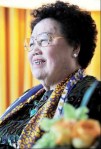
Entrepreneur and philanthropist Chan Laiwa, also known as Chen Lihua, is no stranger to lists of the world’s richest people, from Forbes to Hurun. But the self-made billionaire finds there is “so much” beyond wealth. “While wealth does come through our hard work and efforts, it is not the ultimate goal and is not above everything,” Chan, 71, says in her Manhattan hotel room the day before she was honored at an April gala as one of Time magazine’s 100 Most Influential People for 2012.

Such sentiments might seem standard from any rich person concerned with public image, but Chan in person – sincere, humble and thoughtful – makes people around her feel at ease. She impresses most with her passion for art, particularly of sandalwood, a medium she has loved since she was a girl. Born into a family of Manchu, the ethnic group that led Chinas last imperial dynasty, the Qing 1644-1911, Chan spent most of her childhood in the Summer Palace in Beijing. She is a descendant of a noble Manchu family of the Yellow Banner Clan, some members of which were ministers of state under the Qing emperor.

Chan’s childhood home was furnished with red sandalwood, a material used in the emperors’ palace in bygone times. “As I grew older, I felt the need to preserve this important part of Chinese culture,” recalls Chan, who opened a furniture factory in the 1980s and began making old-style pieces modeled after those from Beijing’s Palace Museum, more widely known as the Forbidden City.

In 1999, Chan fulfilled a childhood dream by investing in a $16 million red sandalwood museum in the capital. The thousands of treasures displayed there include a scale model of a corner tower in the Forbidden City, a reproduction of the memorial gateway carved with 320 dragons from Longquan Temple in Shanxi province, and a number of intricate furniture pieces and sculptures.

She made her fortune in the 1990s through a series of real estate ventures involving her Fu Wah International Group, the Hong Kong company fashioned out of Chan’s furniture store. The businesswoman later moved to Beijing for more opportunities. Chan was recently voted among Time magazines 100 Most Influential People in the World for 2012.

via Rich in kindness|People|chinadaily.com.cn.

19/05/2012

* Hitching his Starwood to China

China Daily: “CEO of one of world’s biggest five-star chains says future is written in Chinese.

When Frits van Paasschen first visited China as a backpacker, staying in basic accommodation and traveling on crowded buses and trains, little did he imagine that two decades later, he would be returning as the boss of a five-star hotel chain. The senior executive retains vivid memories of those days, traveling the length and breadth of the country and leaving via the Karakoram Highway from China to Pakistan, clinging precariously to the roof of a pick-up truck.

Nowadays, van Paasschen flies business class on regular visits to China from his New York head office – and stays in the luxury properties of the St Regis, Westin, Sheraton and Le Mridien hotels that make up the Starwood portfolio.Van Paasschen is president and CEO of Starwood, one of the largest hotel management groups in the world which is adding to its China portfolio at a phenomenal rate: this year alone will see 23 new properties open – roughly one every fortnight – bringing the total to 100.

The country is considered to be so important that last year the boss flew the entire senior management team to China for a months visit; executive meetings were held wherever they happened to be on their grand China tour. “If a picture is worth a thousand words, then a visit is worth ten thousand,” says van Paasschen.  …

“Literally one of the high points was being on the top floor of what will be the St Regis in Shenzhen on the 100th floor of that building, looking out and toward Hong Kong and seeing that the Shenzhen side looks snazzier and more well developed than the New Territories of Hong Kong.

“When I am asked about the future I say I can’t read it, it is written in Chinese!  …

via Hitching his Starwood to China|Last Word|chinadaily.com.cn.

15/05/2012

* Carr: China concerned by Australia-US military ties

BBC News: “China has raised concerns over growing military ties between Australia and the US, Australian Foreign Minister Bob Carr said as he visited Beijing.

Chinese officials had told him that “the time for Cold War alliances has long since passed”, he told reporters. The US has recently started rotating troops through bases in Australia.

On Monday Mr Carr met counterpart Yang Jiechi. He is also due to meet Vice Premier Li Keqiang to discuss a China-Australia free trade deal. China is a major trading partner for Australia and about a quarter of all Australian exports now go to China. But Australia’s key security partnership is with the US. Last month the first contingent of some US marines to be stationed in Darwin arrived; the US will eventually deploy a 2,500-strong force in northern Australia by 2017.”

via BBC News – Carr: China concerned by Australia-US military ties.

Related article: 

10/05/2012

* Marine forces of China, Thailand to hold joint training

China Daily: “Marine forces of China and Thailand will hold a joint military training in south Chinas Guangdong province from May 9 to 29, sources with Ministry of National Defense said Tuesday.

Garuda as national symbol of Thailand

Garuda as national symbol of Thailand (Photo credit: Wikipedia)

The training, codenamed Blue Commando-2012, will be conducted in Zhanjiang and Shanwei of the province in line with an agreement reached by the two countries navies, according to the ministry’s information office. The training will be the second of its kind by the two navies marine forces since 2010, and it will feature anti-terrorism and increase mutual understanding of the two forces.”

via Marine forces of China, Thailand to hold joint training|chinadaily.com.cn.

It takes two to tango. So it is with the US trying to ‘surround’ China with alliances or naval exercise with Australia, India, Philippines and (see other post) with Singapore.  In the meanwhile, China is holding exercises or reaffirming military alliances with Russia and Thailand.

Related articles and posts:

10/05/2012

* U.S. plans 10-month warship deployment to Singapore

Strait of Malacca from globe at Field Museum

Strait of Malacca from globe at Field Museum (Photo credit: Wikipedia)

Reuters: “The first of a new class of U.S. coastal warships will be sent to Singapore next spring for a roughly 10-month deployment, the Navy said on Wednesday, spotlighting a move that may stir China’s fears of U.S. involvement in South China Sea disputes.

Deployment of the shallow-draft ship “Freedom” will help refine crew rotations, logistics and maintenance processes to maximize the classs value to U.S. combat commanders, Rear Admiral Thomas Rowden, the Navys director of surface warfare, told reporters.”Well be deploying the ship for about 10 months in the spring of next year” to Singapore, he said in a teleconference. “In the meantime, were prepping her for success in the execution of that deployment.

“Singapore is strategically located along the Strait of Malacca, the chief link between the Indian and Pacific Oceans through which flows about 40 percent of world trade. The government has discussed hosting up to four such U.S. “Littoral Combat Ships,” or LCS, on a rotational basis at its naval facilities. Both countries have said the deployment stops short of a basing agreement.”

via U.S. plans 10-month warship deployment to Singapore | Reuters.

It takes two to tango. So it is with the US trying to ‘surround’ China with alliances or naval exercise with Australia, India, Philippines and with Singapore.  In the meanwhile, China is holding exercises or reaffirming military alliances with Russia and Thailand (see other post).

Related articles and posts:

09/05/2012

* China: The world’s cleverest country?

BBC News: “China’s results in international education tests – which have never been published – are “remarkable”, says Andreas Schleicher, responsible for the highly-influential Pisa tests.

These tests, held every three years by the Organisation for Economic Co-operation and Development, measure pupils skills in reading, numeracy and science. Pisa tests – the Programme for International Student Assessment – have become the leading international benchmark. The findings indicate that China has an education system that is overtaking many Western countries. While there has been intense interest in Chinas economic and political development, this provides the most significant insight into how it is teaching the next generation. …

“Even in rural areas and in disadvantaged environments, you see a remarkable performance. “In particular, he said the test results showed the “resilience” of pupils to succeed despite tough backgrounds – and the “high levels of equity” between rich and poor pupils. …

In an attempt to get a representative picture, tests were taken in nine provinces, including poor, middle-income and wealthier regions. The Chinese government has so far not allowed the OECD to publish the actual data.But Mr Schleicher says the results reveal a picture of a society investing individually and collectively in education. On a recent trip to a poor province in China, he says he saw that schools were often the most impressive buildings. He says in the West, it is more likely to be a shopping centre. “You get an image of a society that is investing in its future, rather than in current consumption.

“There were also major cultural differences when teenagers were asked about why people succeeded at school.

“North Americans tell you typically its all luck. Im born talented in mathematics, or Im born less talented so Ill study something else.

“In Europe, its all about social heritage: My father was a plumber so Im going to be a plumber.

“In China, more than nine out of 10 children tell you: It depends on the effort I invest and I can succeed if I study hard.”They take on responsibility. They can overcome obstacles and say Im the owner of my own success, rather than blaming it on the system.”

via BBC News – China: The worlds cleverest country?.

To anyone who knows something about Chinese history, the results are not surprising at all.  If, for over 1,500 years anyone – peasant, labourer, artisan, or scholar – who passed the right exams can become a magistrate, civil servant or governor; then passing exams and studying for them becomes ingrained, part of the tacit cultural norm. And despite two major revolutions, one to overthrow imperialism and the other to lift the masses, exams still play a key role in success. It is no surprise that eight of the nine top CCP leaders are engineers by training.

Related articles:

09/05/2012

* China, Singapore to build 100 bln yuan high-tech zone

Xinhua: “The construction of a 100-billion yuan (16 billion U.S. dollars) high-tech zone was jointly launched Tuesday in southwest China’s Sichuan province by the provincial government and a Singapore company.

The Singapore-Sichuan High-tech Innovation Park, planned to cover 10.34 square kilometers and house 120,000 residents in Gaoxin district and Tianfu district in Chengdu, capital of Sichuan, is expected to attract an investment of 100 billion yuan from 2012 to 2020. Under the guidance of Sichuan government authorities, the project will be operated by the Singapore-Sichuan company Sino-Singapore Chengdu High-Tech Innovation Park Development Company Ltd., with a registered capital of 297 million U.S. dollars, jointly invested by Singapore state-owned company Temasek Holdings and Chengdu High-tech Investment Group, said Tang Hua, deputy director of the development administration of Gaoxin district. …

The park will mainly focus on eight industries including information technology, service outsourcing, digital media, biomedicine, environmental protection, precision machinery, finance and training, Tang said.The park is expected to have 120,000 to 150,000 employees as a new platform for China, Singapore and other countries to invest in western China, said Lim Swee Say, minister of Prime Ministers Office, advisor of Singapore-Sichuan Trade and Investment Committee, secretary-general of Singapore National Trade Union Congress.”

via China, Singapore to build 100 bln yuan high-tech zone – Xinhua | English.news.cn.

Yet another sign of China’s determination to reduce reliance on foreign hi-tech.

Related articles:

08/05/2012

* China’s first deep-water rig to drill in South China Sea

Xinhua: “The first deep-water drilling rig developed in China will be put into service in

 the South China Sea on Wednesday, the countrys largest offshore oil producer said Monday.

The sixth-generation semi-submersible CNOOC 981 will begin operations in a sea area 320 kilometers southeast of Hong Kong at a water depth of 1,500 meters, China National Offshore Oil Corp. It will be the first independent deep-water oil drilling by a Chinese company, marking “a substantial step” made by the country’s deep-sea oil industry, CNOOC said. About 70 percent of oil and gas reserves in the resource-rich South China Sea is contained in 1.54 million square km of deep-water regions, or sea areas with depths of over 300 meters. However, most of China’s current offshore oil exploration is conducted less than 300 meters below the surface.

The South China Sea is estimated to have 23 billion to 30 billion tonnes of oil and 16 trillion cubic meters of natural gas, accounting for one-third of Chinas total oil and gas resources.”

via Chinas first deep-water rig to drill in South China Sea – Xinhua | English.news.cn.

Another instance of China continuing to reduce reliance on Western hi-tech.
 
Related post:
Law of Unintended Consequences

continuously updated blog about China & India

ChiaHou's Book Reviews

continuously updated blog about China & India

What's wrong with the world; and its economy

continuously updated blog about China & India