Chindia Alert: You’ll be Living in their World Very Soon
aims to alert you to the threats and opportunities that China and India present. China and India require serious attention; case of ‘hidden dragon and crouching tiger’.
Without this attention, governments, businesses and, indeed, individuals may find themselves at a great disadvantage sooner rather than later.
The POSTs (front webpages) are mainly 'cuttings' from reliable sources, updated continuously.
The PAGEs (see Tabs, above) attempt to make the information more meaningful by putting some structure to the information we have researched and assembled since 2006.
Guests unveil the English and French editions of a compilation of President Xi Jinping’s discourses on the Belt and Road Initiative during a launch ceremony in Beijing, capital of China, April 24, 2019. (Xinhua/Zhang Yuwei)
BEIJING, April 24 (Xinhua) — The English and French editions of a compilation of President Xi Jinping’s discourses on the Belt and Road Initiative were published Wednesday.
The book contains 42 articles from September 2013 to July 2018 by Xi, also general secretary of the Communist Party of China Central Committee.
The new editions were translated and published by the China Foreign Languages Publishing Administration and the Foreign Languages Press.
Chinese President Xi Jinping (R) and his Chilean counterpart Sebastian Pinera hold talks ahead of the Second Belt and Road Forum for International Cooperation in Beijing, capital of China, April 24, 2019. (Xinhua/Rao Aimin)
BEIJING, April 24 (Xinhua) — Chinese President Xi Jinping and his Chilean counterpart Sebastian Pinera held talks in Beijing on Wednesday ahead of the Second Belt and Road Forum for International Cooperation.
China and Chile should take joint pursuit of the Belt and Road Initiative as a new opportunity to deepen political mutual trust and pragmatic cooperation, and push the China-Chile comprehensive strategic partnership to a new level, Xi said.
Xi said the two countries should promote the upgrading of bilateral trade and investment, and strengthen cooperation in areas such as mining, clean energy, telecommunication, e-commerce, technological innovation and Antarctic science.
Efforts should be made to better hold a series of celebrations next year that will mark the 50th anniversary of China-Chile diplomatic relations, and boost people-to-people ties, he said.
China supports Chile in hosting the UN climate change summit and Asia-Pacific Economic Cooperation (APEC) Economic Leaders’ Meeting this year, and will work with Chile to push forward the construction of the Free Trade Area of the Asia-Pacific and uphold multilateralism as well as the multilateral trading system, said Xi.
The nature of cooperation between China and Latin American and Caribbean countries is South-South cooperation, and the two sides should continue to support and help each other, complement each other with respective strengths, pursue win-win cooperation, so as to achieve common development and rejuvenation, and jointly forge a community with a shared future between China and Latin America, he said.
Pinera said Chile and China had achieved marked progress in bilateral relationship since the two countries established diplomatic ties.
Chile supports joint pursuit of the Belt and Road Initiative to enhance connectivity among regions, Pinera said.
Chile hopes to learn from China’s achievements in innovation-driven development and green development, and expand bilateral cooperation in such areas, he said.
Pinera also noted that Chile would enhance coordination and cooperation with China on regional and multilateral affairs, and continue to play an exemplary role in promoting relations between Latin America and China.
After the talks, the two leaders witnessed the signing of bilateral cooperation documents.
Quake hits area around Hualien at 1.01pm, followed by aftershocks
Tremors send residents fleeing and rattle buildings more than 100km away in Taipei
A magnitude 6.1 earthquake hit the area around Hualien in Taiwan on Thursday. Photo: CNA
A magnitude 6.1 earthquake rocked eastern Taiwan at 1.01pm on Thursday, sending panicked residents rushing onto the streets and shaking buildings 115km (71 miles) away in the island’s capital, Taipei.
The quake’s epicentre was just over 10km northwest of the city of Hualien, at a depth of 18.8km, the island’s Central Weather Bureau said, adding that a 4.1 quake was reported 17 minutes later.
At least 17 people were injured, and a 12-storey building in Taipei was left leaning to one side, but there were no reports of major property damage.
Two Malaysian tourists – a man and a woman – were injured by falling rocks at Taroko National Park in Hualien county, with both being airlifted to a hospital in the city. Ten people in Taipei and five in New Taipei City also suffered injuries.
Train services on Taipei’s subway were suspended as were the airport subway to Taoyuan International Airport and most other metro and train systems in various parts of Taiwan, especially those around eastern and northern Taiwan, for safety inspections, the island’s cabinet said.
Taiwan Power Company said operations were normal at the island’s first and second nuclear power plants in northern Taiwan and asked the public to stay calm.
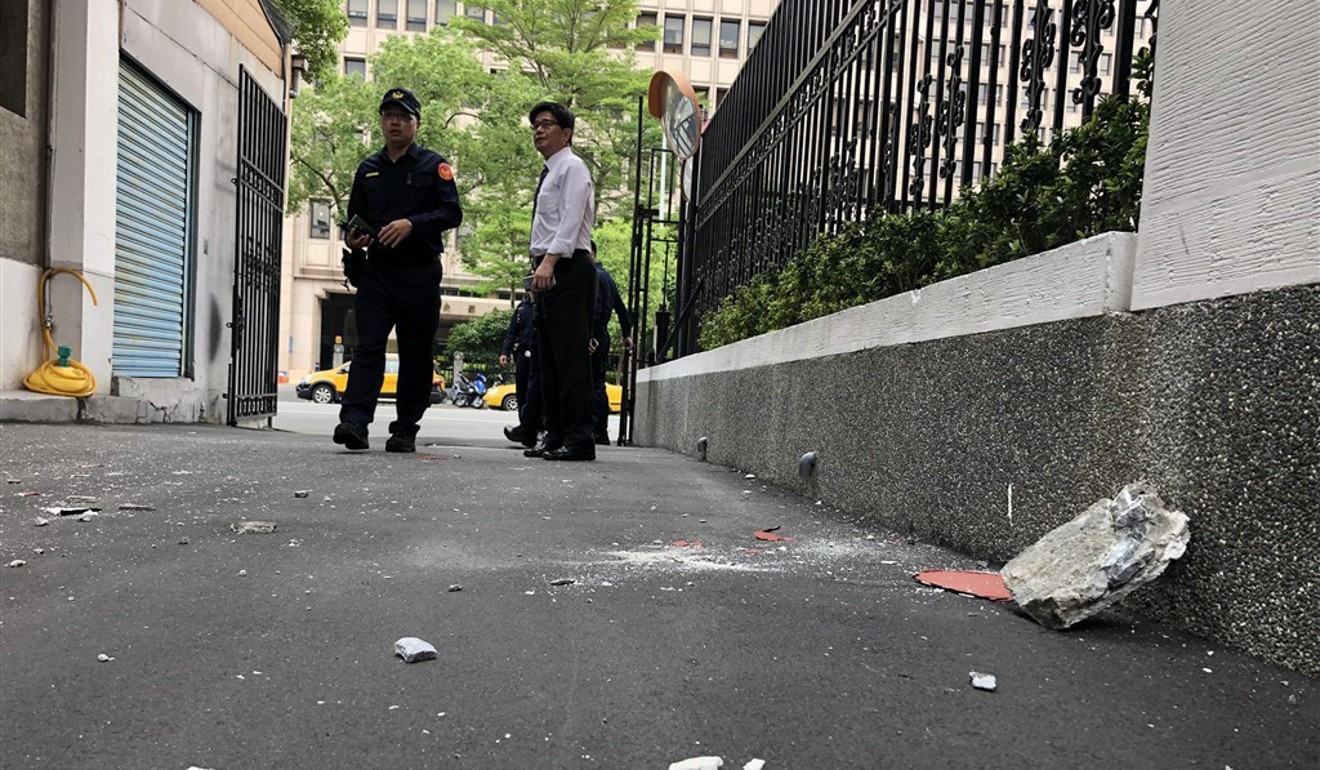
Debris outside the Legislative Yuan, in Taipei, after a magnitude 6.1 earthquake hit the area around Hualien. Photo: CNA
Share:
The strong quake sent high-rise buildings swaying in Taipei, with a number of households and offices reporting fallen objects.
“I was so panic and tried to find some place for shelter after the quake rocked for a moment. It seemed like the building was going to collapse. All the books were shaken off the shelves and glasses shattered all over the floor,” a resident of Taipei’s bustling Ximending district said.
The Daan District Office in Taipei reported that a ceiling had fallen into the middle of its office, but nobody was injured.
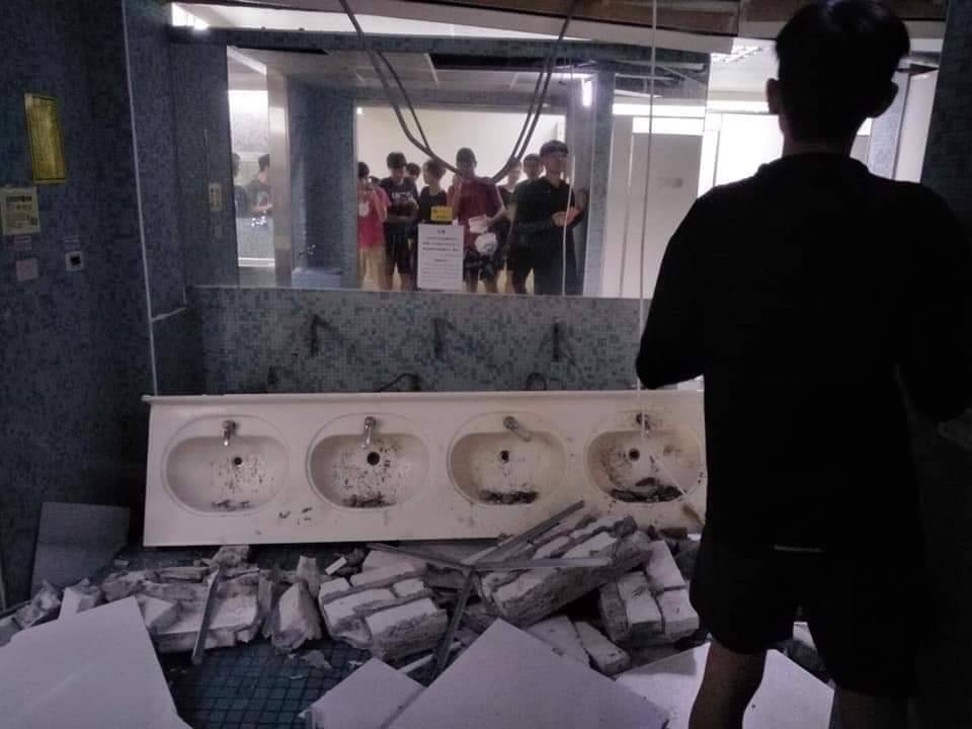
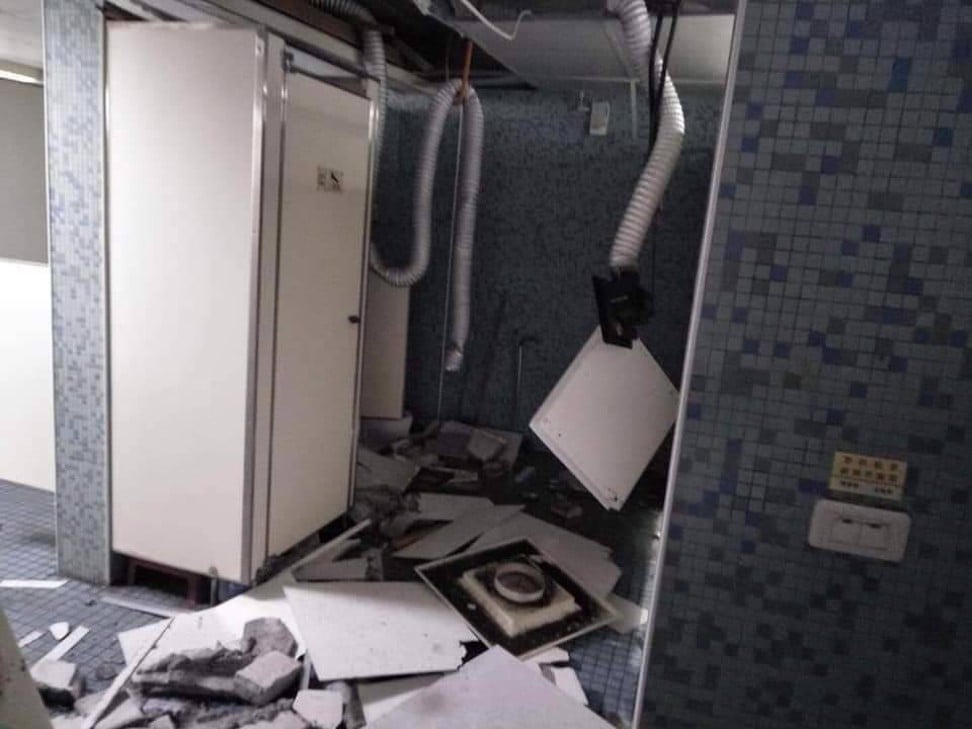
The quake damaged a bathroom in a men’s dormitory at Taiwan Normal University. Photo: Handout
A building on Changan East Road in Taipei was reported to have tilted to one side, prompting residents to flee into the street.
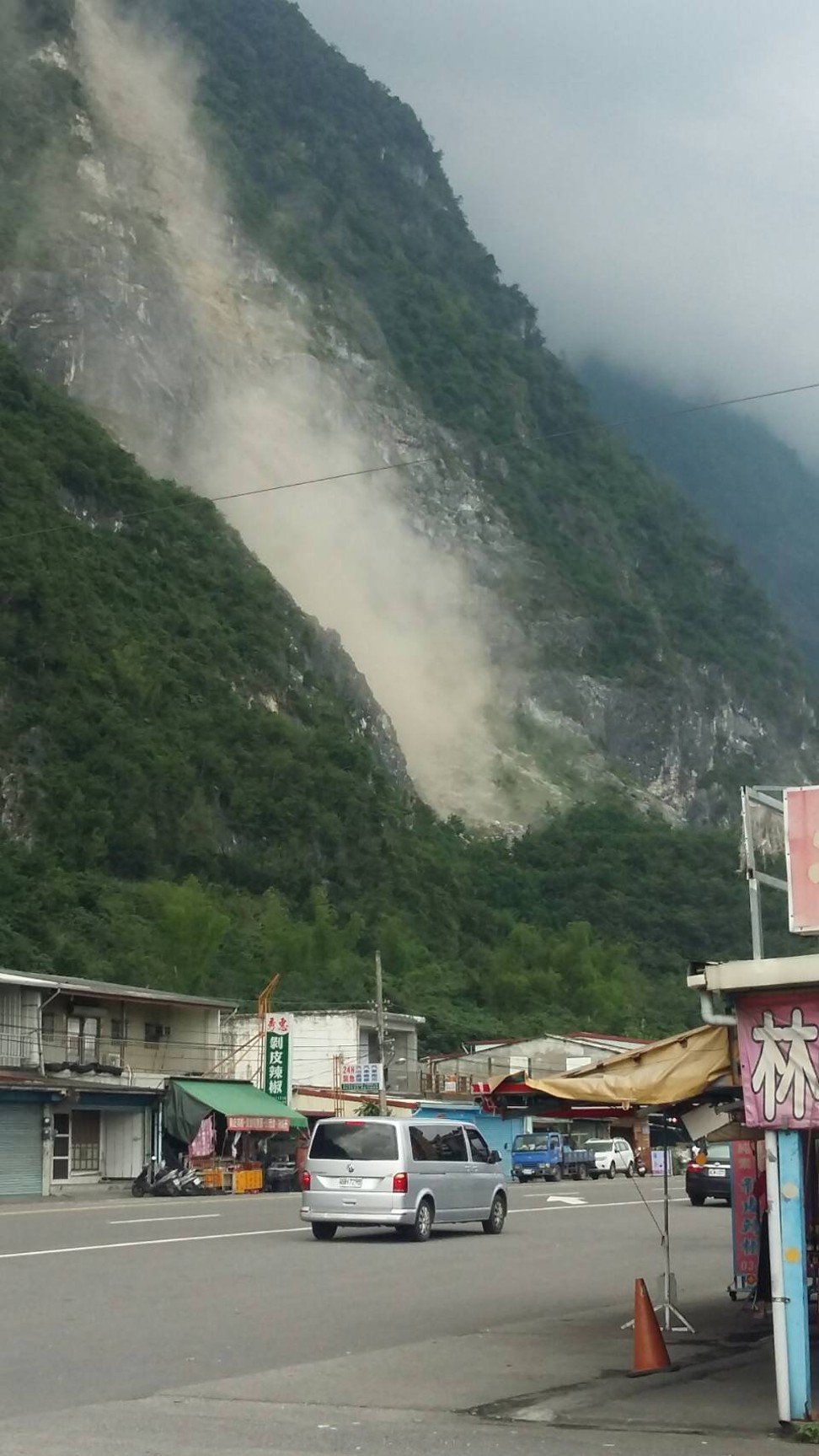
Taiwanese television stations ran footage showing overturned furniture in homes and offices and at least one landslide along the mountainous and lightly populated east coast.
A bathroom at a Taiwan Normal University dormitory in Taipei was damaged in Thursday’s quake. Photo: Handout
Elsewhere in Taiwan, part of the Suao-Hualien Highway collapsed but there were no injuries, the National Fire Agency said.
Near the epicentre in Hualien, more cases of damage were reported, including several supermarkets where items were shaken off shelves.
A resident said he was taking an afternoon nap when the earthquake shook.
“I felt as if my heart was spilling out of my mouth and was so panicked that I could hardly move, but I managed to rush to the street,” he said, adding that aftershocks were rocking the area.
Workers at Hualien’s main railway station were struggling to clear a flooded lobby after several water pipes burst in the quake, county authorities said.
Operations remain unaffected at Taiwan’s hi-tech industrial estates, including Hsinchu Science Park.
A landslide near Hualien. Photo: Handout
Taiwan is on the string of seismic faults around the Pacific Ocean known as the “Rim of Fire” and is frequently rocked by tremors, including a 1999 quake that killed more than 2,300 people.
An earthquake in Hualien in February last year killed 17 people when four buildings partially collapsed. That quake hit two years to the day after a residential building in the southwestern city of Tainan collapsed in an earthquake, killing 115 people.
Stiff penalties like those given to drink-drivers needed to make people wake up to the risks, newspaper says
Commentary comes after woman who died in high-speed crash is found to have used her phone 34 times in 30 minutes
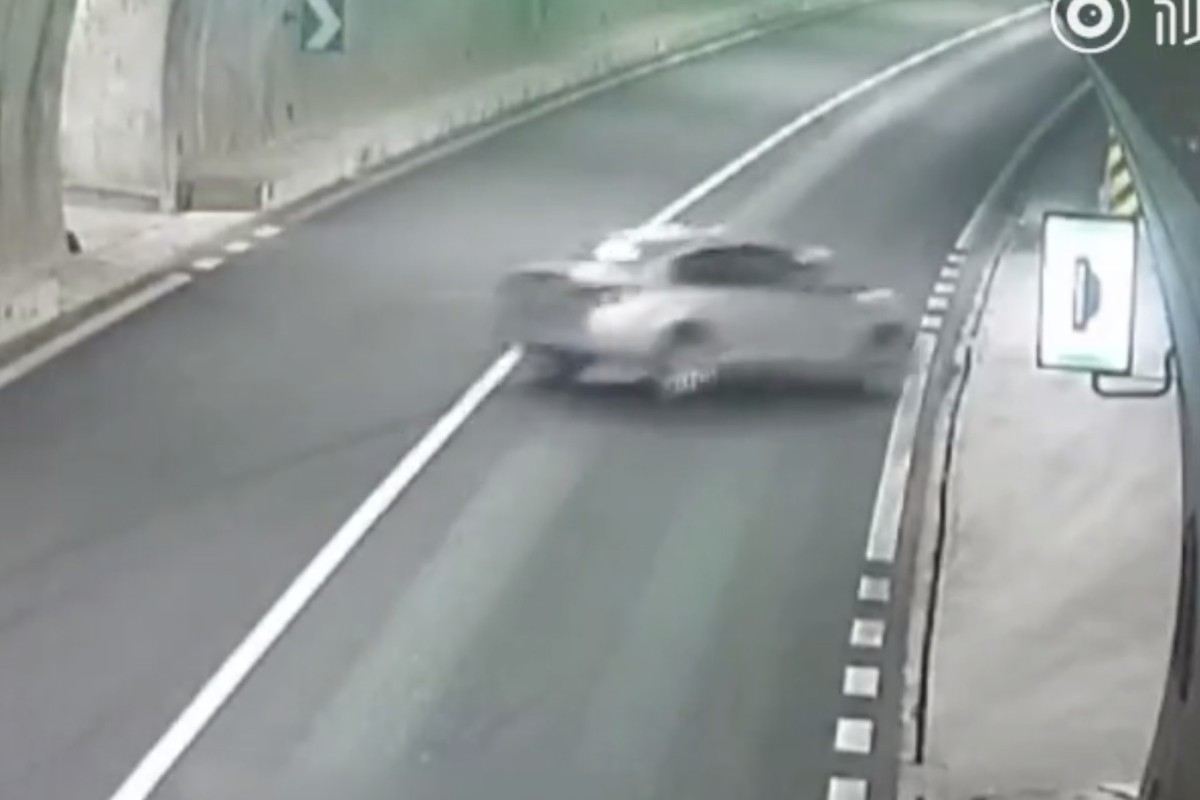
The fatal crash in Fujian province was caught on surveillance camera and the footage was shown by Pearvideo.com. Photo: Weibo
The death of a woman in a high-speed car accident who is believed to have been sending messages on her phone at the time of the crash has sparked calls in the Chinese media for harsher punishments for reckless driving.
“Death or causing death as the result of driving when using a phone is a very serious consequence of people becoming slaves to mobile phones,” Beijing Youth Daily said in a commentary on Thursday.
“To reverse the harm caused by this behaviour, they must be punished in line with the punishments for drink-driving.”
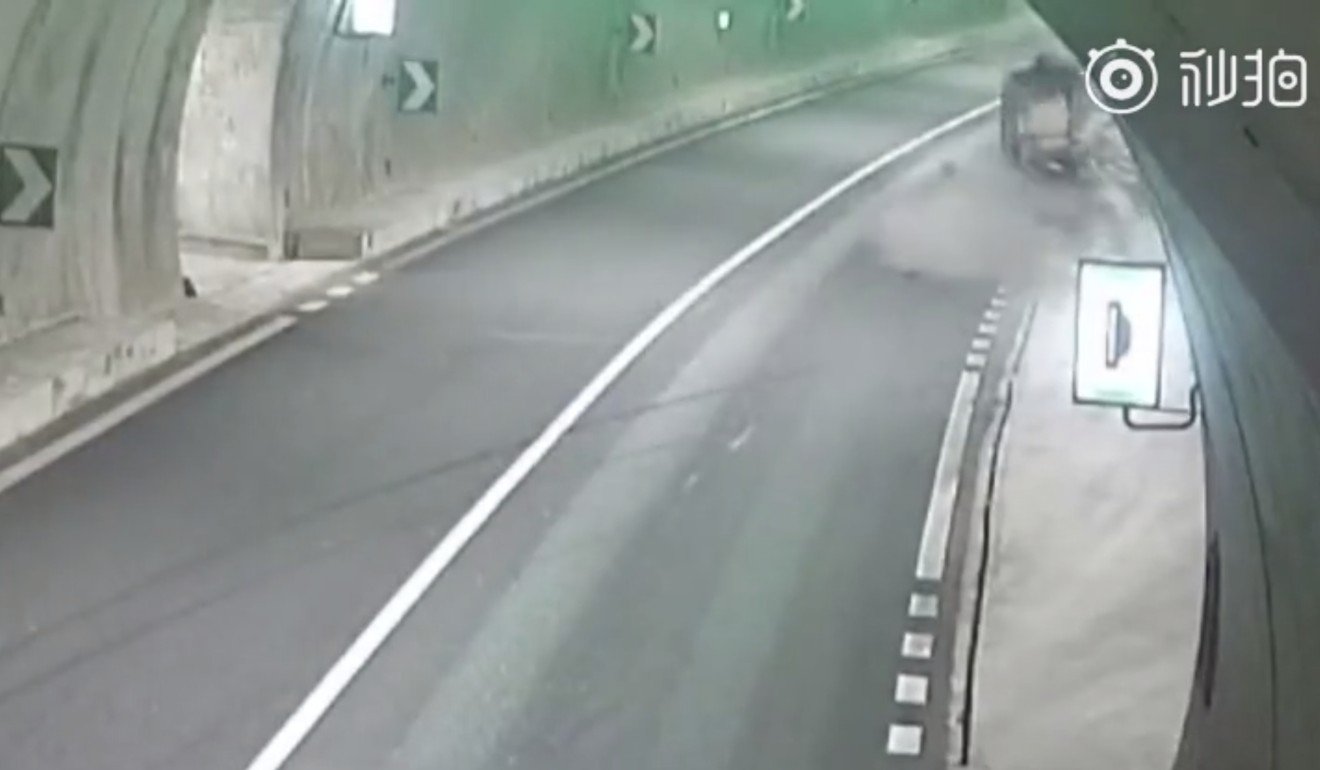
The article came after Pearvideo.com on Sunday published footage from a surveillance camera of the fatal accident in southeast China’s Fujian province. The film shows the woman’s car speeding through a tunnel before veering on to the wrong side of the road and crashing into a wall. It then flips over and bursts into flames.
The victim is believed to have been using her phone at the time of the crash. Photo: Weibo
A police officer interviewed in the video said the driver, who was not identified, had not been wearing a seat belt at the time of the accident and had been observed speeding, cutting in and out of lanes and using her phone 34 times in just 30 minutes.
“I think all four factors contributed to her accident,” he said. “But the fundamental ones were speeding and using a mobile phone when driving.”
Five children killed as driver crashes into group crossing road
The video report said the woman sent a total of 16 text and voice messages from behind the wheel, one of which said that she was driving at 120km/h (75mph).
While drink-driving is a criminal offence in China – with a maximum penalty of six months’ detention, loss of licence and a five-year ban – the top punishment for using a phone while behind the wheel is a 200 yuan (US$30) fine and the loss of two licence points. Drivers start with 12 points and can be suspended from driving if they lose them all.
The film shows the car crashing into a wall before flipping over and bursting into flames. Photo: Weibo
According to a Ministry of Transport survey cited by Beijing Youth Daily, people are 2.8 times more likely to have an accident if they make a phone call while driving and 23 times more likely if they look at their handset.
While the strict enforcement of drink-driving laws has helped to change motorists’ behaviour, using a phone behind the wheel is still widely regarded as acceptable behaviour, the commentary said.
“I don’t know how many disasters like the woman in Sanming [a city in Fujian] are needed to alert people,” it said.
“[But] amending the road traffic safety law to make [the offence of] driving while using a mobile phone equivalent to that of drink-driving and implementing corresponding penalties can … help to reduce the devastating consequences.”
A commentary on Gmw.com, the website of the official Guangming Daily newspaper, also called for the offence to be criminalised.
People know the risks but disregard them because the legal consequences are very small, it said.
Accident happened about 7.20am at residential development in Hengshui, Hebei province, authorities say
Injured pair said to be in stable condition in hospital
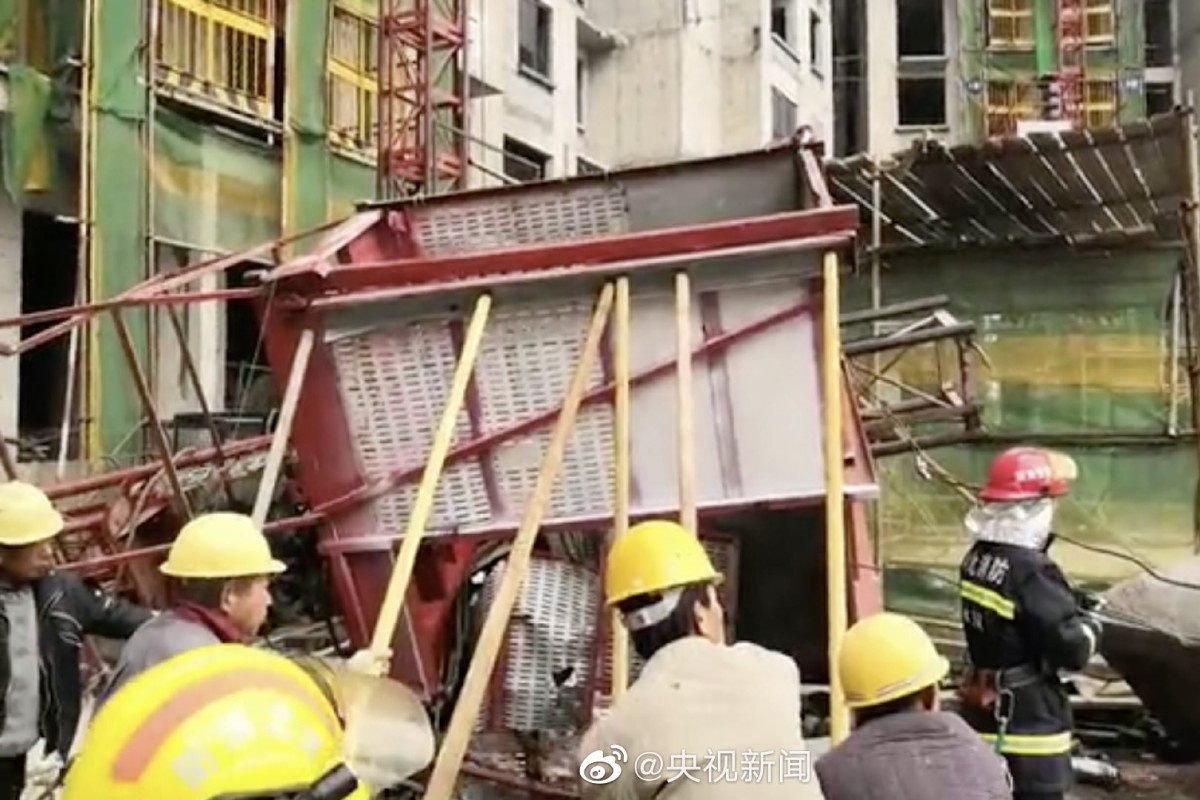
Eleven people were killed when a lift fell at a construction site in Hengshui, Hebei province. Photo: Weibo
Eleven people were killed and two others seriously injured when a lift fell at a construction site in northern China on Thursday morning, municipal authorities said.
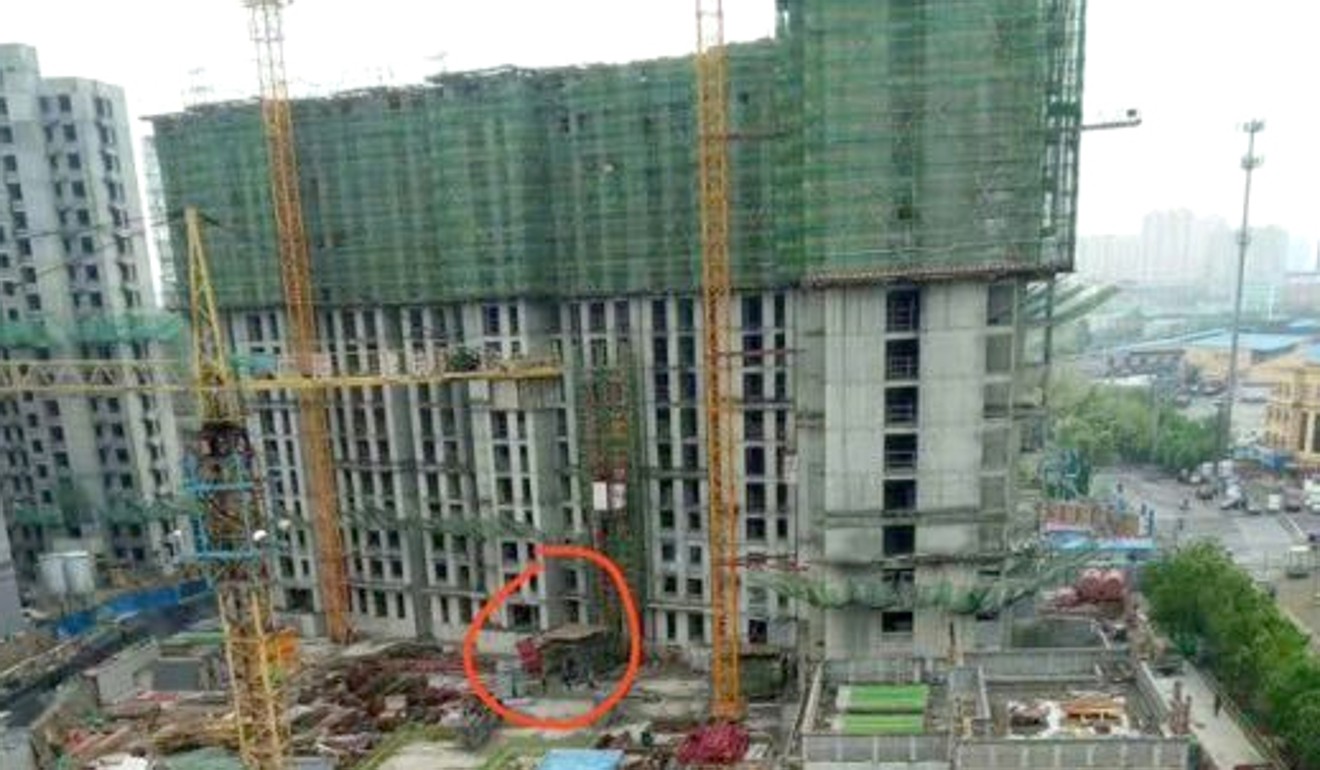
The accident happened at about 7.20am on the site of the Jade Huating compound, a residential property development under construction in the Taocheng district of Hengshui, Hebei province, according to a statement issued by the city government.
The two people hurt were being treated at a local hospital and in a stable condition, it said.
Police, work safety officials and construction authorities have begun an investigation to determine the cause of the accident, the statement said.
The accident happened at about 7.20am on the site of the Jade Huating compound. Photo: Weibo
A witness was quoted by The Beijing News as saying the crash happened in a matter of seconds.
“I heard a big bang and saw the lift had fallen,” the witness said. “Then six or seven ambulances arrived on the scene.”
Kindergarten flattened by falling debris from building site
The housing project is being developed by Hengshui Youhe Real Estate Development.
The firm said on WeChat earlier this month that the project was making good progress thanks to “reasonable construction with maximum efficiency”, despite work having to be suspended several times for environmental reasons. The post was later deleted.
At the first day of the forum in Beijing, Chinese Finance Minister Liu Kun said China aims to make the Belt and Road initiative sustainable and to prevent debt risks.
Last year, Foreign Minister Wang Yi said in a speech Belt and Road was not a “geostrategic concept” but was part of efforts to build “a community with a shared future for mankind together with countries around the globe.”
Leaders from 37 countries and dozens of officials are due to attend the three-day summit, including Russian President Vladimir Putin and Italian Prime Minister Giuseppe Conte.
Western governments, and particularly the US, are increasingly wary of China’s growing influence.
The US, which has fought a trade war with China over the past year, has been particularly critical of the project.
Vice President Mike Pence said in a speech last year China was using “debt diplomacy” to expand its influence around the world.
Debt trap?
Other countries that are set to benefit from the project also seem to be growing more cautious.
Sri Lanka, Malaysia and Pakistan have all expressed concerns about the programme. Recipient countries worry about debt accumulation and increased Chinese influence.
Tom Rafferty, China economist at The Economist Intelligence Unit, said China is using this week’s summit to “reposition and, it hopes, revive the initiative after it lost its way in 2018 amid project delays and a slowdown in associated lending.”
Mr Rafferty said the Chinese government “wants to convince the international community that the Belt and Road Initiative is inclusive and policy concessions in areas such as debt sustainability” are likely.
WASHINGTON (Reuters) – A French warship passed through the strategic Taiwan Strait this month, U.S. officials told Reuters, a rare voyage by a vessel of a European country that is likely to be welcomed by Washington but increase tension with Beijing.
The passage, which was confirmed by China, is a sign that U.S. allies are increasingly asserting freedom of navigation in international waterways near China. It could open the door for other allies, such as Japan and Australia, to consider similar operations.
The French operation comes amid increasing tensions between the United States and China. Taiwan is one of a growing number of flashpoints in the U.S.-China relationship, which also include a trade war, U.S. sanctions and China’s increasingly muscular military posture in the South China Sea, where the United States also conducts freedom of navigation patrols.
Two officials, speaking on condition of anonymity, said a French military vessel carried out the transit in the narrow waterway between China and Taiwan on April 6.
One of the officials identified the warship as the French frigate Vendemiaire and said it was shadowed by the Chinese military. The official was not aware of any previous French military passage through the Taiwan Strait.
The officials said that as a result of the passage, China notified France it was no longer invited to a naval parade to mark the 70 years since the founding of China’s Navy. Warships from India, Australia and several other nations participated.
China said on Thursday it had lodged “stern representations” with France for what it called an “illegal” passage.
“China’s military sent navy ships in accordance with the law and the rules to identify the French ship and warn it to leave,” defence ministry spokesman Ren Guoqiang told a regularly scheduled media briefing, while declining to say if the sailing had led to the withdrawal of France’s invitation to the parade of ships this week.
“China’s military will stay alert to firmly safeguard China’s sovereignty and security,” he said.
Colonel Patrik Steiger, the spokesman for France’s military chief of staff, declined to comment on an operational mission.
The U.S. officials did not speculate on the purpose of the passage or whether it was designed to assert freedom of navigation.
MOUNTING TENSIONS
The French strait passage comes against the backdrop of increasingly regular passages by U.S. warships through the strategic waterway. Last month, the United States sent Navy and Coast Guard ships through the Taiwan Strait.
The passages upset China, which claims self-ruled Taiwan as part of its territory. Beijing has been ramping up pressure to assert its sovereignty over the island.
Chen Chung-chi, spokesman for Taiwan’s defence ministry, told Reuters by phone the strait is part of busy international waters and it is “a necessity” for vessels from all countries to transit through it. He said Taiwan’s defence ministry will continue to monitor movement of foreign vessels in the region.
“This is an important development both because of the transit itself but also because it reflects a more geopolitical approach by France towards China and the broader Asia-Pacific,” said Abraham Denmark, a former U.S. deputy assistant secretary of defence for East Asia.
The transit is a sign that countries like France are not only looking at China through the lens of trade but from a military standpoint as well, Denmark said.
Last month, France and China signed deals worth billions of euros during a visit to Paris by Chinese President Xi Jinping. French President Emmanuel Macron wants to forge a united European front to confront Chinese advances in trade and technology.
When recycling businesses gravitated to Malaysia, a black economy went with them
Some countries treat China’s ban as an opportunity and have been quick to adapt
For years, China was the world’s leading destination for recyclable rubbish, but a ban on some imports has left nations scrambling to find dumping grounds for growing piles of waste. Photo: AFP
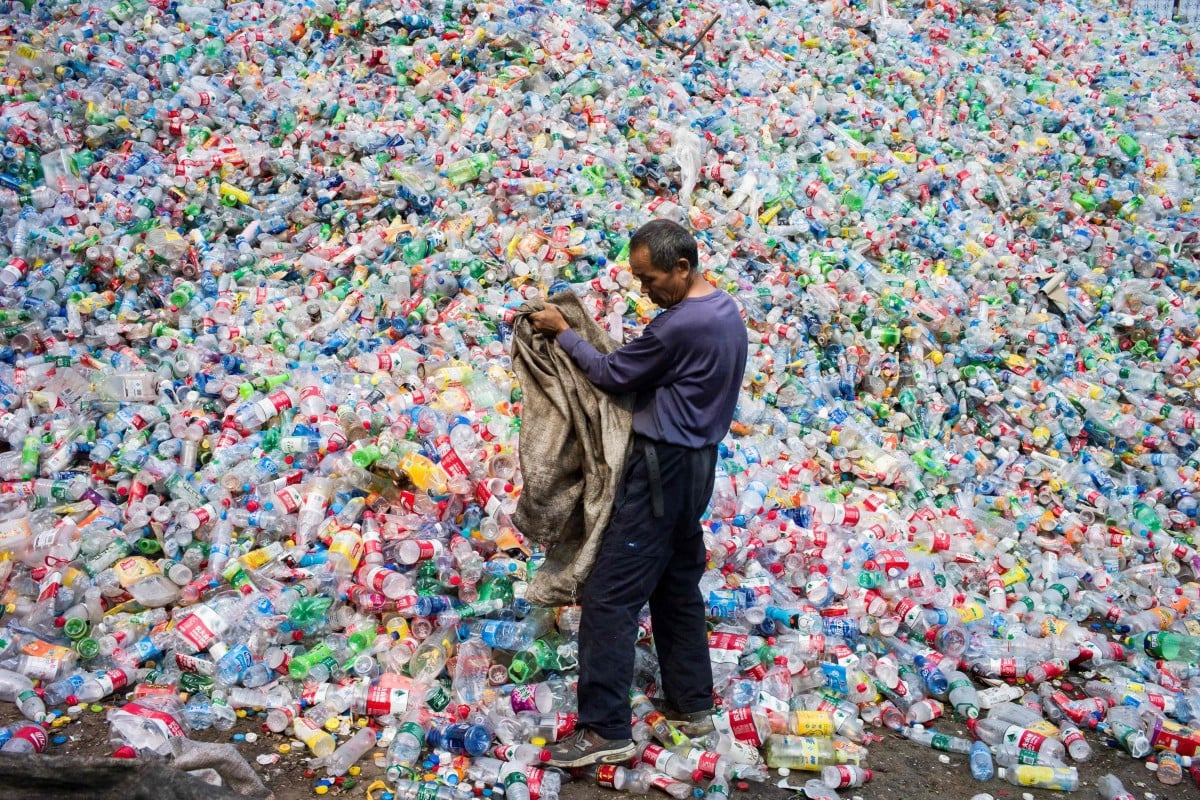
From grubby packaging that engulfs small Southeast Asian communities to waste that piles up in plants from the US to Australia, China’s ban on accepting the world’s used plastic has thrown recycling efforts into turmoil.
For many years, China took the bulk of scrap plastic from around the world, processing much of it into a higher quality material that could be used by manufacturers.
But, at the start of 2018, it closed its doors to almost all foreign plastic waste, as well as many other recyclables, in an effort to protect its environment and air quality, leaving developed nations struggling to find places to send their waste.
“It was like an earthquake,” Arnaud Brunet, director general of Brussels-based industry group The Bureau of International Recycling, said.
“China was the biggest market for recyclables. It created a major shock in the global market.”
Instead, plastic was redirected in huge quantities to Southeast Asia, where Chinese recyclers have shifted.
With a large Chinese-speaking minority, Malaysia was a top choice for Chinese recyclers looking to relocate, and official data showed plastic imports tripled from 2016 levels to 870,000 tonnes last year.
China to collect applications for scrap metal import licences from next month, trade group says
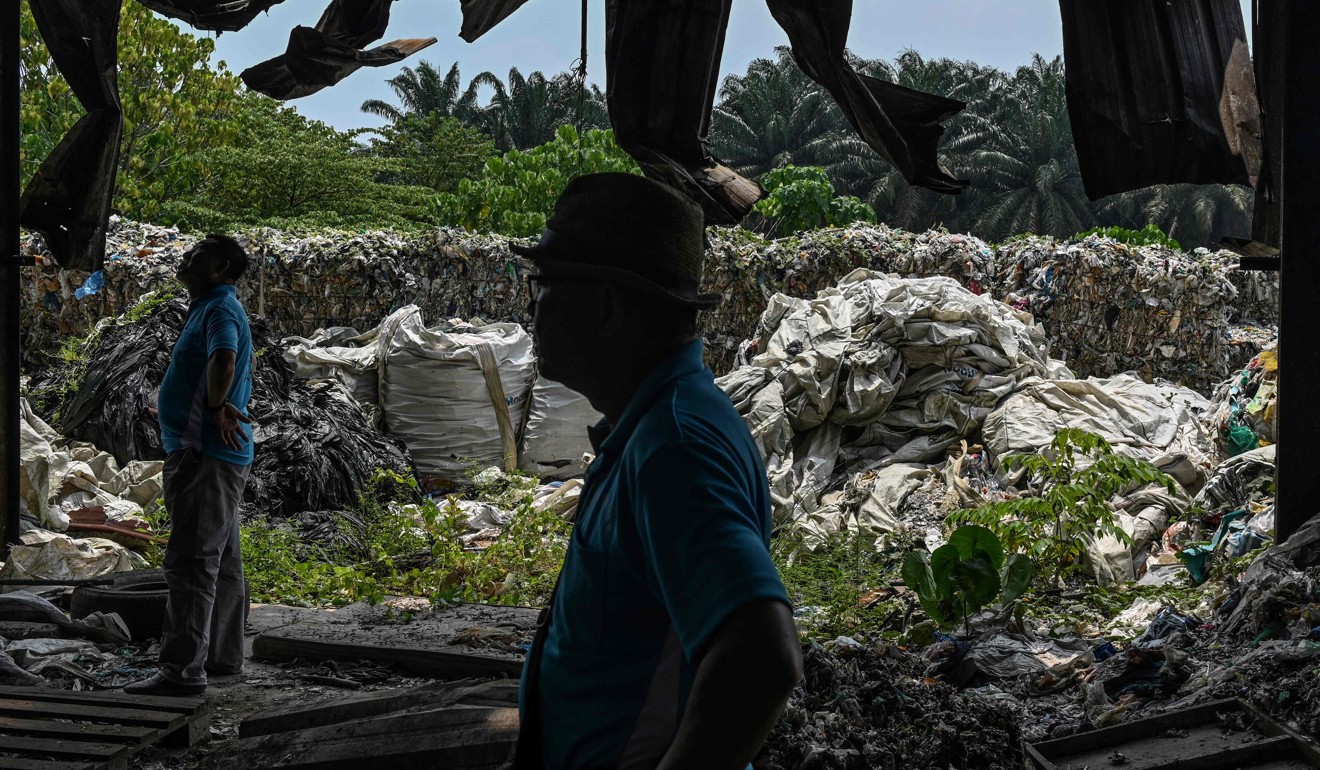
In the small town of Jenjarom, close to Kuala Lumpur, plastic processing plants appeared in large numbers, pumping out noxious fumes around the clock.
Huge mounds of plastic waste, dumped in the open, piled up as recyclers struggled to cope with the influx of packaging from everyday goods, such as foods and laundry detergents, from as far afield as Germany, the US, and Brazil.
Residents soon noticed the acrid stench over the town – the kind of odour that is usual in processing plastic, but environmental campaigners believed some of the fumes also came from the incineration of plastic waste that was too low quality to recycle.
“People were attacked by toxic fumes, waking them up at night. Many were coughing a lot,” resident Pua Lay Peng said.
“I could not sleep, I could not rest, I always felt fatigued,” the 47-year-old added.
Representatives of an environmentalist NGO inspect an abandoned plastic waste factory in Jenjarom, outside Kuala Lumpur in Malaysia. Photo: AFP
Pua and other community members began investigating and, by mid-2018, had located about 40 processing plants, many of which appeared to be operating without proper permits.
Initial complaints to authorities went nowhere but they kept up pressure, and eventually the government took action. Authorities started closing down illegal factories in Jenjarom, and announced a nationwide temporary freeze on plastic import permits.
Thirty-three factories were closed down, although activists believed many had quietly moved elsewhere in the country. Residents said air quality had improved but some plastic dumps remained.
Chinese recycling expert breeds thousands of flies to turn kitchen waste into cash
In Australia, Europe and the US, many of those collecting plastic and other recyclables were left scrambling to find new places to send it.
They faced higher costs to have it processed by recyclers at home and in some cases resorted to sending it to landfill sites as the scrap piled up so quickly.
“Twelve months on, we are still feeling the effects but we have not moved to the solutions yet,” said Garth Lamb, president of industry body Waste Management and Resource Recovery Association of Australia.
Some have been quicker to adapt to the new environment, such as some local authority-run centres that collect recyclables in Adelaide, South Australia.
The centres used to send nearly everything – ranging from plastic to paper and glass – to China but now 80 per cent is processed by local companies, with most of the rest shipped to India.
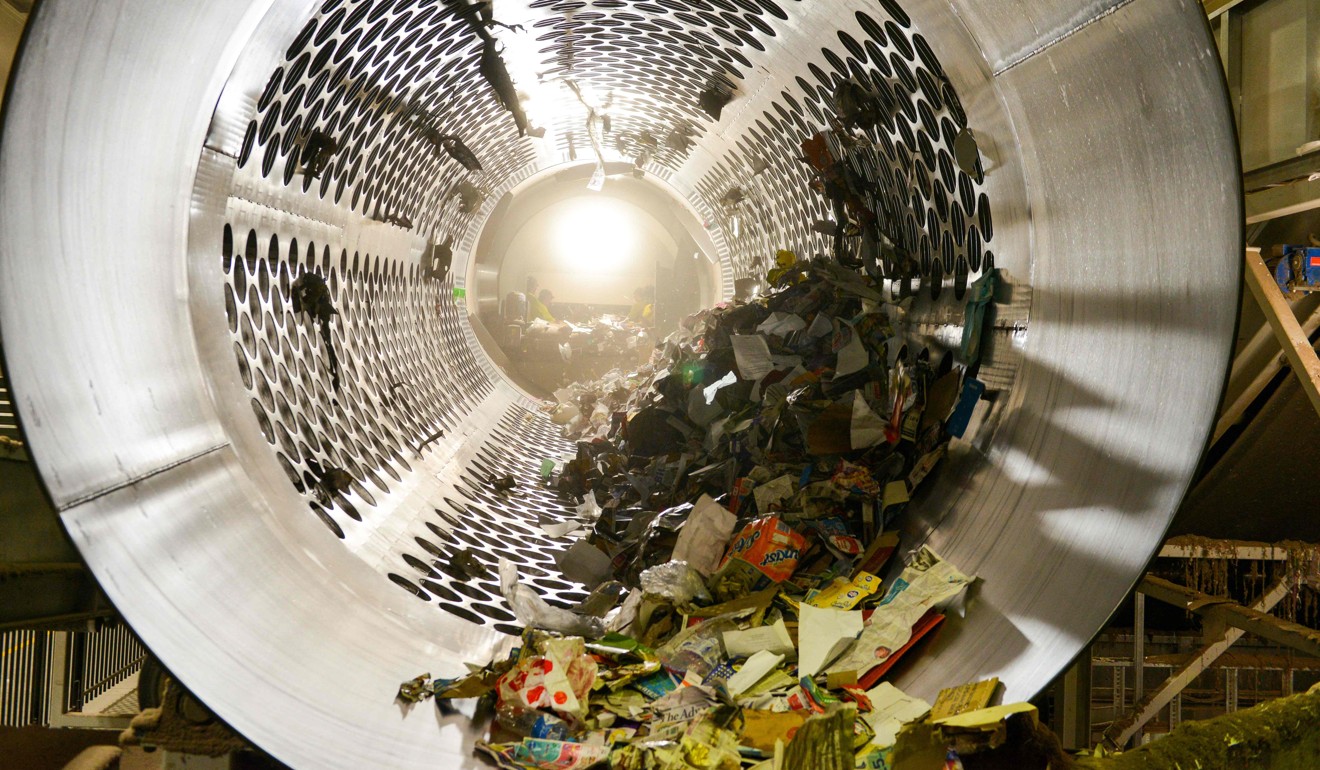
Rubbish is sifted and sorted at Northern Adelaide Waste Management Authority’s recycling site at Edinburgh, a northern suburb of the city of Adelaide. Photo: AFP
“We moved quickly and looked to domestic markets,” Adam Faulkner, chief executive of the Northern Adelaide Waste Management Authority, said.
“We’ve found that by supporting local manufacturers, we’ve been able to get back to pre-China ban prices.”
In mainland China, imports of plastic waste dropped from 600,000 tonnes per month in 2016 to about 30,000 a month in 2018, according to data cited in a recent report from Greenpeace and environmental NGO Global Alliance for Incinerator Alternatives.
Once bustling centres of recycling were abandoned as firms shifted to Southeast Asia.
How China’s plastic waste ban has left Japan to deal with mountains of trash
On a visit to the southern town of Xingtan last year, Chen Liwen, founder of environmental NGO China Zero Waste Alliance, found the recycling industry had disappeared.
“The plastic recyclers were gone – there were ‘for rent’ signs plastered on factory doors and even recruitment signs calling for experienced recyclers to move to Vietnam,” she said.
Southeast Asian nations affected early by the China ban – as well as Malaysia, Thailand and Vietnam were hit hard – have taken steps to limit plastic imports, but the waste has simply been redirected to other countries without restrictions, such as Indonesia and Turkey, the Greenpeace report said.
With only an estimated nine per cent of plastics ever produced recycled, campaigners said the only long-term solution to the plastic waste crisis was for companies to make less and consumers to use less.
Greenpeace campaigner Kate Lin said: “The only solution to plastic pollution is producing less plastic.”
BEIJING (Reuters) – China’s Ministry of Foreign Affairs said on Tuesday it has lodged representations with the United States over its decision to end waivers on sanctions on Iranian oil imports.
China is Iran’s largest crude oil customer, with total imports last year of 29.27 million tonnes, or about 585,400 barrels a day, roughly 6 percent of China’s total oil imports, according to customs data.
“The decision from the U.S. will contribute to volatility in the Middle East and in the international energy market,” Geng Shuang, a ministry spokesman, told a news briefing.
Washington has announced that all Iran sanction waivers will end by May, causing crude oil prices to rise and pressuring importers to cut their Iranian imports to zero.
China was one of eight global buyers that won exemptions to import crude oil last November.
Some of China’s key refineries are configured to process the Iranian crude and refinery officials say Iranian oil typically yields better margins compared similar grades from rival suppliers such as Saudi Arabia.
State-owned Sinopec Group and China National Petroleum Corp both produce oil in Iran, having spent billions of dollars on oil fields such as Yadavaran and North Azadegan. They have been sending the oil from the fields to China.
BEIJING, April 21 (Xinhua) — Representative shadow play works from around China will be displayed from April 28 to 30 during the art week in Huazhou District of Weinan City, northwest Shaanxi Province, which is dubbed the “home of shadow play.”
Co-organized by the Prince Kung’s Palace Museum in Beijing and provincial and municipal authorities in Shaanxi, the event will also include academic forums and performances of intangible cultural heritage music, dances, and Chinese operas.
Shadow play, also known as shadow puppetry, dates back to the Han Dynasty around 2,000 years ago. Performers hold cowhide-carved figures between a source of light and a translucent curtain, make movements of the figures for storytelling, and add drum sounds and Chinese opera to accompany the movements.
Chen Xiaowen, the deputy curator of the museum, said at a press conference in Beijing that they will try to organize more state-level shadow play events in Weinan and establish a special committee for the art form in the city.





 CHINDIA ALERT: You'll be living in their world, very soon