Archive for ‘China alert’

15/04/2019

What does the world’s largest single-building airport terminal look like?

The busiest airport in the world in terms of passenger numbers is in Atlanta, Georgia and no 2 is in Beijing, both with tens of millions more passengers every year than their nearest rivals.

So it might come as a surprise to hear that a new airport, set to open later this year, with what officials claim is the world’s largest terminal housed in a single building, is also in the Chinese capital.

This will give Beijing a breathtaking flight capacity, surpassing London’s six airports.

Until now the impressive structure has been under wraps but China Correspondent Stephen McDonell went along to have a look.

Source: The BBC

13/04/2019

Political advisors propose stepping up cultivation of preschool teachers

CHINA-BEIJING-WANG YANG-CPPCC-MEETING (CN)

Wang Yang, a member of the Standing Committee of the Political Bureau of the Communist Party of China (CPC) Central Committee and chairman of the Chinese People’s Political Consultative Conference (CPPCC) National Committee, presides over a biweekly session on stepping up the cultivation of preschool teachers, in Beijing, capital of China, April 12, 2019. (Xinhua/Li Tao)

BEIJING, April 12 (Xinhua) — Chinese political advisors during a consultation session Friday offered proposals on stepping up the cultivation of preschool teachers.

The biweekly session held by the National Committee of the Chinese People’s Political Consultative Conference (CPPCC), China’s top political advisory body, was presided over by Wang Yang, a member of the Standing Committee of the Political Bureau of the Communist Party of China (CPC) Central Committee and chairman of the CPPCC National Committee.

Wang stressed the importance of stepping up the cultivation of preschool teachers, who assume the dual functions of child care and education and play an important role in promoting the healthy growth of children and sound development of preschool education.

While hailing achievements China has made in preschool education since the 18th National Congress of the CPC, political advisors at Friday’s event said preschool education is still a weak point in China’s education system. Its development remains unbalanced and inadequate and still lacks of quality preschool teachers as well as easily accessible, affordable kindergartens.

Some political advisors proposed that the government should fulfill its responsibility in promoting preschool education development, and meanwhile, give full play to the role of the market.

They called for a substantial increase of funds to be allocated by the government for preschool education as well as innovating the mechanism of funding for preschool education, and encouraging running of kindergartens with social resources.

China should increase the number of university students who are enrolled to free preschool education programs and foster more quality professional kindergarten teachers, according to the political advisors.

They said a system for preschool teachers to receive regular training should be established, and the systems governing their qualification, promotion and pay should be reformed, among the country’s efforts to create an atmosphere where preschool teachers are well respected.

They also called for stepping up legislation regarding preschool education, to provide legal guarantee for preschool teachers.

Source: Xinhua

13/04/2019

Chengdu attracts 22 overseas investment projects

CHENGDU, April 12 (Xinhua) — Chengdu, a major city in southwest China, showed its attraction to investors as it signed 22 investment contracts with overseas companies on Friday.

The investment projects involve manufacturing such as electronics, aviation, automobiles and equipment, and services including financing, logistics, elderly care and vocational training. The total value of these deals is around 3.39 billion U.S. dollars.

The signing foreign companies include Slovakian aircraft producer Aerospool, French company AREP with expertise in city planning and construction, Germany’s BMW, and U.S. firm Baxter.

Chengdu, capital of Sichuan Province, is a major economic powerhouse in China’s western region. The city has attracted investment projects from 285 of the world’s top 500 companies.

Source: Xinhua

13/04/2019

IOC awards Xinhua certificate in recognition of international news agency

(SP)CHINA-BEIJING-IOC-XINHUA NEWS AGENCY-CERTIFICATE

Anthony Edgar (L), chairman of the IOC Press Commission and director of the Media Operations Department, presents the certificate to Yan Wenbin, vice president of Xinhua News Agency, in Beijing, on April 12, 2019. The International Olympic Committee (IOC) officially awarded Xinhua News Agency a certificate in recognition of its status as an international news agency here on Friday. (Xinhua/Cao Can)

BEIJING, April 12 (Xinhua) — The International Olympic Committee (IOC) officially awarded Xinhua News Agency a certificate in recognition of its status as an international news agency here on Friday.

On behalf of IOC President Thomas Bach, Anthony Edgar, chairman of the IOC Press Commission and director of the Media Operations Department, presented the certificate to Yan Wenbin, vice president of Xinhua News Agency, at a ceremony held at Xinhua’s headquarters in Beijing.

Yan expressed appreciation to the IOC for its trust, saying Xinhua’s coverage of the Olympic Games has entered a new stage after becoming an international news agency recognized by the IOC.

“Xinhua will strengthen cooperation with the IOC more closely, report on the Olympic Movement more comprehensively, objectively and truthfully, and play a more important role in promoting the progress and development of the Olympic cause in China and the world,” said Yan.

Speaking at the handover ceremony, Edgar said that the IOC attaches great importance to Xinhua News Agency and has high expectations on Xinhua in promoting the Olympic Movement across the globe in the future.

“The designation of Xinhua as an IOC recognized international news agency is a recognition of the importance and global reach of Xinhua’s domestic, regional and global news and sports coverage. It is a recognition of the role Xinhua now plays – and will play in the future of producing the best possible coverage of the Olympic Games, the IOC and the Olympic Movement,” he said.

Source: Xinhua

13/04/2019

Premier Li proposes multiple measures for future China-CEEC cooperation

CROATIA-DUBROVNIK-LI KEQIANG-CHINA-CEEC-MEETING

Chinese Premier Li Keqiang (front) attends the eighth leaders’ meeting of China and Central and Eastern European Countries (CEEC) in Dubrovnik, Croatia, April 12, 2019. (Xinhua/Shen Hong)

DUBROVNIK, Croatia, April 12 (Xinhua) — Chinese Premier Li Keqiang on Friday proposed a series of measures to promote cooperation between China and Central and Eastern European Countries (CEECs).

Li made the proposal when addressing the eighth China-CEEC leaders’ meeting in the Croatian city of Dubrovnik.

Li noted that Chinese President Xi Jinping recently made successful visits to three European countries, injecting new impetus into deepening development of the China-European Union (EU) comprehensive strategic partnership.

As part of the China-EU relations, the China-CEEC cooperation mechanism has been conducive to promoting European integration process and advancing the China-EU ties, the premier said.

Members of the mechanism stick to the principles of mutual respect and equal treatment, uphold the spirit of openness and inclusiveness, follow international rules and EU laws and regulations, and respect the responsibilities and obligations that EU members among the 16 CEECs need to fulfill, Li said.

The cooperation mechanism attaches equal importance to trade and investment, and combines economic cooperation with people-to-people exchanges, having not only promoted common development but also facilitated Europe’s balanced development, said Li.

The mechanism has become a major pillar for China-EU comprehensive cooperation, he added.

Noting that the leaders’ meeting takes “Building new bridges through openness, innovation and partnership” as its theme, Li called for making the bridge of openness broader, the bridge of innovation clearer, and the bridge of partnership more solid.

On future development of the China-CEEC cooperation, Li called for jointly defending multilateral trade system, upholding such basic principle as openness, transparency, inclusiveness and non-discrimination, and sticking to the direction of trade liberalization.

On expanding trade volume, Li said China is willing to import more high-quality agricultural products from the CEECs and make it easier for such products to be exported to China.

Calling for joint efforts to build the Belt and Road, the premier said China is willing to enhance the alignment between its development strategies and those of the CEECs, stick to the principles of extensive consultation, joint contribution and shared benefits, and better draw on complementary advantages, so as to achieve win-win results and common prosperity.

Urging greater efforts to boost innovation cooperation, Li said China is willing to work with the 16 countries to conduct joint research, expand scientific and technological exchanges, and cultivate growth points through innovation cooperation.

The premier also stressed the importance of jointly safeguarding a fair, just and non-discriminatory market environment.

Li also called for continued efforts to promote cooperation in the fields of small and medium-sized enterprises (SMEs) and industrial park building, adding that China and the CEECs have held cross-border matching events of SMEs, and launched a website for the SMEs coordination mechanism.

Calling for stepped-up efforts to conduct people-to-people exchanges, Li said China and the CEECs should take the Year of Education and Youth Exchange as an opportunity to enhance exchanges and cooperation among universities and colleges and promote mutual understanding and friendship between young people.

Announcing that China will host the ninth China-CEEC leaders’ meeting in 2020, Li said he expects CEEC leaders to attend the meeting and jointly sketch out a new blueprint for the China-CEEC cooperation.

On their part, CEEC leaders said, after the launch of the cooperation mechanism, the CEECs and China have seen their pragmatic cooperation bearing remarkable fruits, political mutual trust continuously strengthened, trade and investment rapidly growing, and cooperation in fields including education, tourism and culture continuously deepened.

The cooperation mechanism has continuously shown new vigor and vitality and become an important cross-region cooperation platform featuring openness, inclusiveness, mutual benefits and win-win results, they said.

The mechanism has not only boosted economic growth of each country and enhanced the wellbeing of their people, but also effectively promoted the overall EU-China relations, they said.

All sides are ready to take this meeting as an opportunity to fully support the implementation of CEEC-China cooperation projects, further promote connectivity and infrastructure building, actively participate in the joint building of the Belt and Road, continuously expand trade volume, jointly safeguard multilateralism and free trade, increase personnel exchanges, and expand exchanges and cooperation at local levels and in fields including tourism, health, sports, and think tanks, the CEEC leaders said.

After the meeting, China and the CEECs jointly published The Dubrovnik Guidelines for Cooperation between China and Central and Eastern European Countries, and the leaders witnessed the signing of more than 10 cooperation agreements.

Greece was accepted as a full member of the China-CEEC cooperation mechanism, according to a decision made by the meeting.

Later on Friday, Li and Croatian Prime Minister Andrej Plenkovic met the press after the leaders’ meeting.

Both leaders spoke highly of the new progress made in the China-CEEC cooperation and called the meeting efficient, pragmatic, fruitful and successful.

Speaking to reporters, Li said, faced with the current complicated international situations, all sides should work to safeguard multilateralism and free trade.

As a cross-regional cooperation platform, the China-CEEC cooperation mechanism now serves as an important part of and a beneficial supplement to the China-EU cooperation, Li said.

Source: Xinhua

13/04/2019

China’s trade boom and building frenzy of ports help home-grown producers corner the world market of containers and cranes

  • Shanghai Zhenhua Heavy Industries now exports quay cranes, gantry cranes to more than 300 ports in 100 countries, with 70 per cent of the global market
  • China International Marine Containers Group (CIMC), took a little more than a decade to become the world’s largest maker of shipping containers
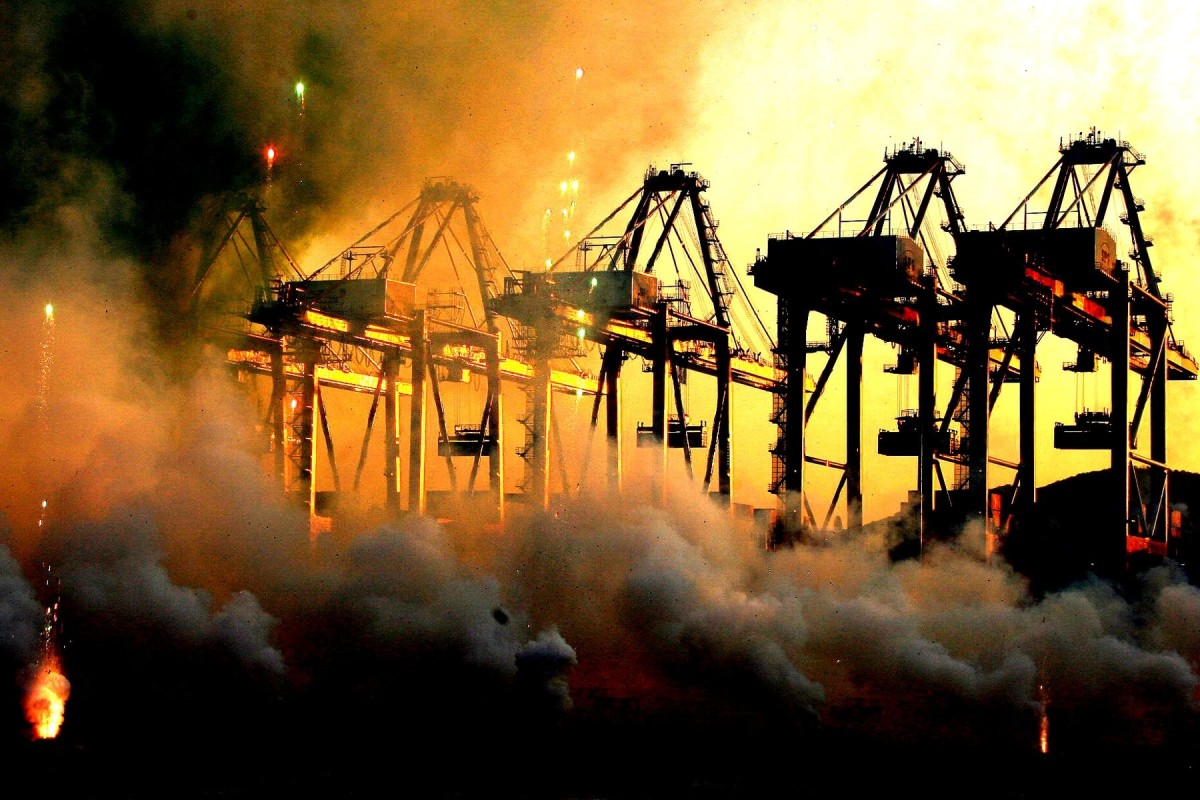
Quay cranes along a berth at the Yangshan deep-water port in Shanghai on September 14, 2011. Shanghai Zhenhua Heavy Machineries, established in 1992, has grown along with the explosive development of China’s ports to control 70 per cent of the global market for cranes, loaders and lifting equipment used in ports. Photo: Xinhua
The explosive growth of China’s container ports has turned one of the most important vendors in shipping into a best-in-class industry leader, whose cranes can now be found in 300 wharves in 100 countries, with 70 per cent of the global market share.
Shanghai Zhenhua Heavy Industries, a unit of China’s state-run construction behemoth China Communications Construction Company, makes quay cranes, gantry cranes, loaders and stackers used for loading and unloading shipping containers. It also developed the infrastructure for the automated berths in Phase IV of Shanghai’s Yangshan port, and in Qingdao.
Its net profit jumped 47.6 per cent last year to 443 million yuan, while sales was little changed at 21.8 billion yuan (US$3.25 billion).

“It is a major showcase of China’s manufacturing capability,” said Sun Can, a Chuancai Securities analyst. “The company has its own technologies and is a powerful player in the global port machinery industry.”

Why China now has six of the world’s 10 busiest container ports
Established in 1992, the company was formerly known as Zhenhua Port Machinery for its speciality in making lifting equipment on the harbourfront. Taking advantage of China’s low wages, Zhenhua quickly carved out a big chunk of the global market share by selling machines at lower prices than its competitors.
The company’s former chief executive Guan Tongxian, a confessed workaholic known for his hard-driving working ethic, retired at the age of 76 in 2009, the same year that the company renamed itself to reflect its forays into marine transport and installations, as well as the construction of special steel structures including the Las Vegas Ferris wheel, the San Francisco-Oakland Bay Bridge and Norway’s Hardangerfjord bridge.
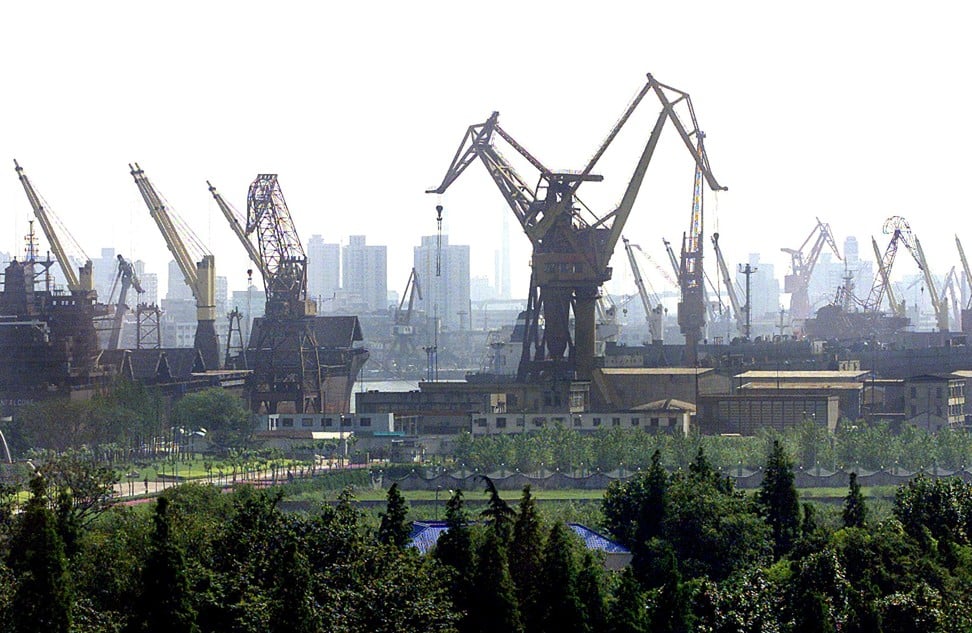
Rows of gantry cranes standing along the Huangpu River in Shanghai on 26 June 2002. A consortium of Chinese domestic banks provided a 17 billion yuan (US$2 billion) credit line toward the construction of Shanghai's Yangshan deep-sea container port. Photo: AFP
Rows of gantry cranes standing along the Huangpu River in Shanghai on 26 June 2002. A consortium of Chinese domestic banks provided a 17 billion yuan (US$2 billion) credit line toward the construction of Shanghai’s Yangshan deep-sea container port. Photo: AFP

Listed on the Shanghai exchange in 1997, Zhenhua’s shares have risen 41 per cent in the past 12 months, ending 2.1 per cent lower at 4.46 yuan on Friday. All three analysts who cover the stock recommend their clients either “buy” or “accumulate” the stock, expecting Zhenhua to be a major winner in China’s megaplan to build infrastructure along the old Silk Road in its Belt and Road Initiative (BRI).

Another major company that has emerged with China’s rising tide was China International Marine Containers (Group), or CIMC, a unit of the state-run conglomerate China Merchants Group. Established in 1980, the company took a little more than a decade to dominate the global industry, becoming the world’s largest maker of shipping containers since 1996.

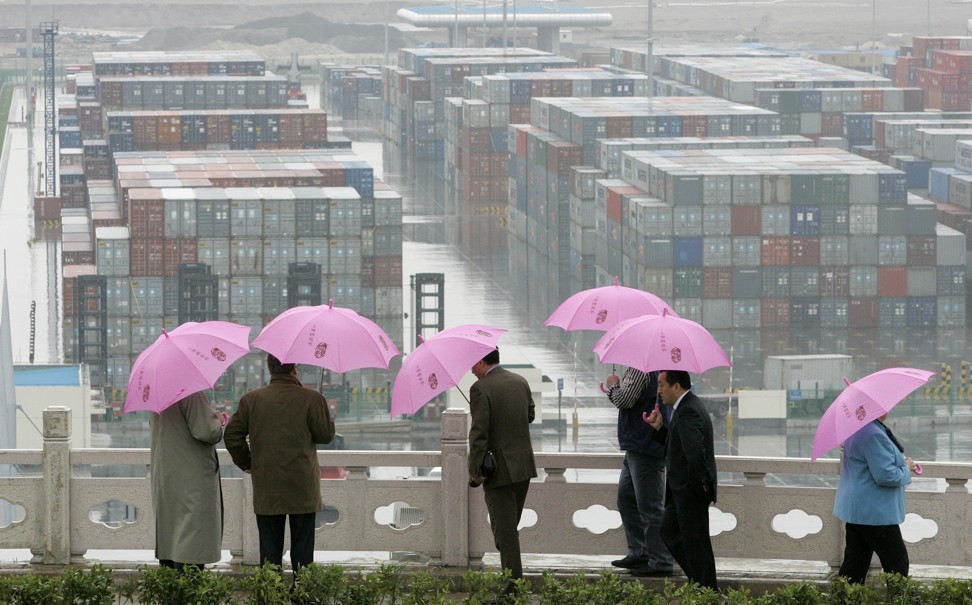
Visitors look at rows of containers at the Yangshan deep water port in Shanghai on April 6, 2006. Photo: AP

Guosen Securities said in a research report that CIMC would face lower profit margin this year amid rising raw material costs and fiercer competition from global rivals.

Its shares have risen 43.7 per cent in the past 12 months on the Shenzhen exchange to 15.20 yuan as of Friday.

Source: SCMP

13/04/2019

Indonesia 2019 elections: How many Chinese workers are there?

Incumbent president Joko Widodo at a campaign rallyImage copyrightGETTY IMAGES
Image caption President Joko Widodo has welcomed investment from China to help fund an ambitious infrastructure agenda

Indonesia is going to the polls on 17 April for presidential and nationwide elections.

The presidential campaign has been mainly fought over jobs and the economy against a backdrop of rising nationalism.

President Joko Widodo, who is seeking re-election, has embarked on an ambitious infrastructure push. To do it he has welcomed Chinese investment and accepted loans and partnerships with foreign companies.

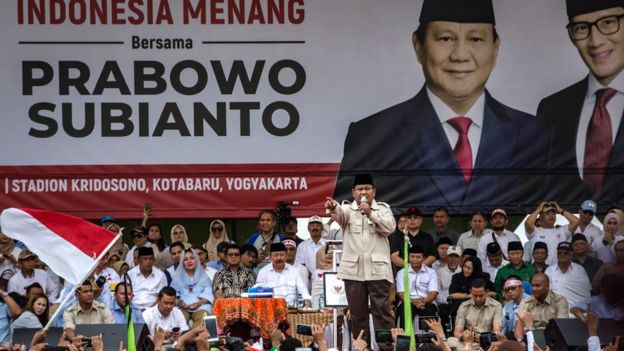
His rival, former military general Prabowo Subianto, has accused the president of selling out the country to foreigners, and opposition lawmakers are claiming Indonesia is facing an influx of Chinese workers.

A long and occasionally violent history of anti-Chinese sentiment means these are contentious issues, especially in an election year.

Social media is king in Indonesia and in the lead-up to the vote it has been awash with rumours over rising numbers of Chinese workers in the country.

But what does the data show? We’ve taken a look into the figures behind China’s growing role in Indonesia.

Online rumours

In January this year a video showing thousands of workers protesting at an industrial park in Morowali on the island of Sulawesi was widely shared on social media.

The video claimed that these were Indonesian workers demonstrating against Chinese migrants who were earning higher salaries and taking local jobs.

However, the manpower minister dismissed the claims, posting on Twitter that the protest in the video was about wages and not Chinese workers, and the police arrested a suspect accused of spreading false information.

Other widely shared social media posts have shown images of Chinese tourists at airports with alarming captions claiming them to be illegal workers flooding into the country.

And last month, a steel manufacturer in Java was forced to clarify how many Chinese nationals they employed after a video claiming to show foreign workers leaving the factory when viral.

What is Prabowo saying?

On the campaign trail Mr Prabowo hasn’t directly referred to Chinese workers but has taken aim at the president’s changes to foreign worker regulations, which aim to speed up the process of foreign worker applications to Indonesia.

He has said “we are not anti-foreigner but we need to take care of our own people, if we open our door to foreign workers, then what is left for us?”

Opposition presidential candidate General Prabowo at a rallyImage copyrightGETTY IMAGES

Mr Prabowo has also suggested that Indonesia could learn from other countries.

“The United States wants to make a wall to keep them out. In Australia people who try to enter are sent to remote islands,” he said during a speech ahead of the campaign.

What does the data show?

China is Indonesia’s third largest source of foreign direct investment behind Singapore and Japan, according to the Indonesian government agency overseeing investment.

These figures show Chinese firms have invested almost $10bn (£7.6bn) in Indonesia since 2014.

Some of these big Chinese-backed projects have run into serious difficulties.

A $6bn project to build high-speed train between Jakarta and the nearest city, Bandung, has been plagued by delays.

In North Sumatra, environmentalists are fighting in the courts to stop a $1.6bn hydroelectric dam supported by the Bank of China that they say threatens to wipe out a critically endangered species of orangutan.

While on the island of Borneo, a Chinese state-owned company is set to build hydropower plants worth almost $18bn.

Indonesia hopes to attract $60bn in investment from China, but it is unlikely to get that much, says Fung Siu, an Asia specialist at the Economist Intelligence Unit.

These Chinese-backed projects often seek to employ Chinese labour as a way to cut costs and increase efficiency.

Where are Indonesia’s foreign workers from?

The most accurate way of measuring the number of registered foreign workers in Indonesia is to look at the number of permits issued.

China receives the most foreign worker permits and the numbers are rising – doubling since 2013.

But the total of just over 30,000 issued in 2018 is substantially less than the millions claimed by some.

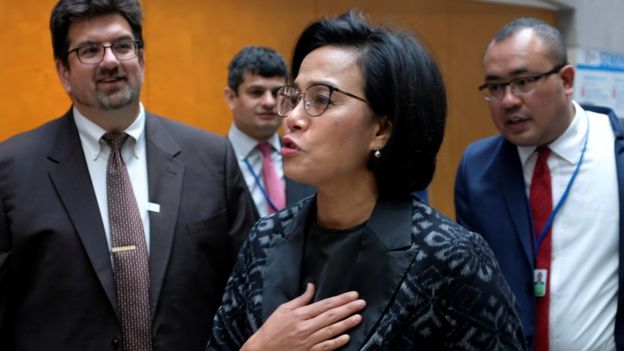
Indonesian Finance Minister Sri MulyaniImage copyrightREUTERS
Image captionIndonesian Finance Minister Sri Mulyani says the current administration has allocated more funds for infrastructure projects than previous governments.

The World Bank estimates that overall, foreign workers made up a fraction, just 0.06%, of Indonesia’s workforce in 2016, significantly less than Singapore, Malaysia and Thailand.

However, there may well be many more Chinese workers in Indonesia than the official tally of work permits suggests, although it’s difficult to know how many.

The Confederation of Indonesian Workers’ Union (KSPI) claims low-skilled Chinese workers are coming in on tourist visas in their hundreds of thousands.

The government also says Indonesian workers benefit from the training they receive from the highly skilled Chinese labour, who eventually return home leaving the local teams to take over.

So, while the available data shows foreign workers from China and elsewhere make up a fraction of the total workforce in Indonesia, the issue remains a divisive and emotional one, easily stirred up during elections.

Source: The BBC

13/04/2019

China targets nuclear fusion power generation by 2040

HEFEI, China (Reuters) – China aims to complete and start generating power from an experimental nuclear fusion reactor by around 2040, a senior scientist involved in the project said, as it works to develop and commercialize a game-changing source of clean energy.

China is preparing to restart its stalled domestic nuclear reactor program after a three-year moratorium on new approvals, but at a state laboratory in the city of Hefei, in China’s Anhui province, scientists are looking beyond crude atom-splitting in order to pursue nuclear fusion, where power is generated by combining nuclei together, an endeavor likened by skeptics to “putting the sun in a box”.

While nuclear fusion could revolutionize energy production, with pilot projects targeting energy output at 10 times the input, no fusion project has up to now created a net energy increase. Critics say commercially viable fusion always remains fifty years in the future.

China has already spent around 6 billion yuan ($893 million) on a large doughnut-shaped installation known as a tokamak, which uses extremely high temperatures to boil hydrogen isotopes into a plasma, fusing them together and releasing energy. If that energy can be utilized, it will require only tiny amounts of fuel and create virtually no radioactive waste.

Song Yuntao, deputy director of the Institute of Plasma Physics at the Hefei Institute of Physical Science, said on Thursday that while technological challenges remain immense, the project has been awarded another 6 billion yuan in funding, and new construction plans are underway.

“Five years from now, we will start to build our fusion reactor, which will need another 10 years of construction. After that is built we will construct the power generator and start generating power by around 2040,” he said at the site, built on a leafy peninsula jutting into a lake.

China has been researching fusion since 1958, but at the current stage, it is still more about international cooperation than competition, Song said. The country is a member of the 35-nation ITER project, a 10-billion euro ($11.29 billion) fusion project under construction in France.

China is responsible for manufacturing 9 percent of ITER’s components, and is playing a major role in core technologies like magnetic containment, as well as the production of components that can withstand temperatures of over 100 million degrees Celsius (180 million degrees Fahrenheit).

ITER is scheduled to generate first plasma by 2025. A demonstration reactor will then be built, with the aim of creating 500 megawatts of power from just 50 megawatts of input, a tenfold return on energy.

Despite the critics who say dependable fusion energy is unrealistic, Song said he was confident breakthroughs are being made.

“Because we have a lot of technology now, a lot of challenges in plasma physics have been overcome, and I think this will speed up the entire process,” he said.

($1 = 6.7188 yuan)

($1 = 0.8859 euros)

Source: Reuters

11/04/2019

China urges relevant countries to offer fair business environment for enterprises

BEIJING, April 10 (Xinhua) — China on Wednesday urged relevant countries to offer a fair, just and non-discriminatory business environment for enterprises of various countries, including Chinese ones.

Foreign Ministry spokesperson Lu Kang made the remarks at a routine press briefing when asked whether Australia applies double standards on the cybersecurity issue.

Recently, a number of Australian media reported that relevant Australian law mandated communication enterprises install “backdoors” for the Australian government. Google, Apple, Amazon and other technology companies have expressed serious concern about the act, saying it threatens cybersecurity in Australia and the world.

While the Australian side previously claimed that the country does not want any company in its communications networks that have an obligation to any other government. For this reason, Australia banned Huawei from the 5G telecommunications network.

Noting China has been closely following the relevant developments, Lu said the communication market and international cooperation will be seriously affected when it forces enterprises to install “backdoors” by legislation, which builds its own security and interests on the basis of violating other countries’ security and the privacy of their citizens.

“As you can see, the business communities have expressed serious concern about this,” Lu said.

A puzzling thing is that on the one hand, relevant countries use cybersecurity and sensationalize the so-called “security threat” of other countries or enterprises with trumped-up charges. On the other hand, they are doing things that endanger cybersecurity, Lu said.

“I am just as interested as you are in what the Australian government would say,” said the spokesperson.

Emphasizing that China has always attached great importance to and firmly maintained cybersecurity, Lu said that the Chinese side is willing to continue to actively participate in international cooperation in cybersecurity and work with all parties to build a peaceful, secure, open, cooperative and orderly cyberspace.

Source: Xinhua

11/04/2019

Chinese State Councilor calls for enhanced production safety, fire control

CHINA-BEIJING-WANG YONG-PRODUCTION SAFETY-FIRE CONTROL (CN)

Chinese State Councilor Wang Yong (C, back) speaks at a meeting ahead of the central government’s tour of inspection on provincial governments in production safety and fire control in Beijing, capital of China, April 10, 2019. (Xinhua/Ding Haitao)

BEIJING, April 10 (Xinhua) — Chinese State Councilor Wang Yong stressed Wednesday that major accidents must be prevented and contained.

Efforts should be made to stabilize and improve production safety and fire control, Wang said at a meeting ahead of the central government’s tour of inspection on provincial governments in these fields.

The tour of inspection is an important institutional arrangement that focuses on the implementation of the central authorities’ decisions and plans in production safety and fire control, Wang said.

Local governments which failed to rectify their problems and saw recurring accidents will be strictly held accountable, Wang said.

A specific inspection will be held for work related to dangerous chemical products, while checks will be made in coal and non-coal mines, transport, construction and fire control.

Local governments should live up to their supervision duties and take effective prevention measures to fundamentally keep safety accidents from happening, Wang said.

Source: Xinhua

Law of Unintended Consequences

continuously updated blog about China & India

ChiaHou's Book Reviews

continuously updated blog about China & India

What's wrong with the world; and its economy

continuously updated blog about China & India