Chindia Alert: You’ll be Living in their World Very Soon
aims to alert you to the threats and opportunities that China and India present. China and India require serious attention; case of ‘hidden dragon and crouching tiger’.
Without this attention, governments, businesses and, indeed, individuals may find themselves at a great disadvantage sooner rather than later.
The POSTs (front webpages) are mainly 'cuttings' from reliable sources, updated continuously.
The PAGEs (see Tabs, above) attempt to make the information more meaningful by putting some structure to the information we have researched and assembled since 2006.
Video footage of woman fishing in a miniskirt and symbol of communist youth group deemed to violate law against ‘defiling revolutionary martyrs’
The woman was filmed in a miniskirt and red scarf. Photo: Weibo
Police in southwest China have detained a woman or “defiling revolutionary martyrs”after she appeared in a video wearing “bright, revealing clothes” and a Young Pioneers’ red scarf.
Footage of the woman, surnamed Tang, showing her fishing in a muddy field in Sichuan province was posted on the video-sharing website Kuaishou.com.
In one clip – which police said attracted three million views – she was dressed in a red blouse, white miniskirt and the red scarf traditionally worn by members of the under-14s Communist group.
Police in Rong county in Sichuan said Tang had deliberately dressed in “bright, revealing clothes” to “attract eyeballs, increase fans and video views”, and wearing the red scarf with such an outfit violated the Heroes and Martyrs Protection Law, which came into effect in May last year.
“The red scarf is a symbol of the Young Pioneers of China. It represents a corner of the red flag, dyed by the blood of martyrs,” the statement said.
Chinese artist gets naked with late father’s remains but is it art?
“Tang’s action has severely defiled what the red scarf stands for: patriotic martyrs, the honour of the young pioneers, and the patriotic sentiments of the people. It has had a bad social impact.”
Police said Tang had been given 12 days’ administrative detention on March 28 and fined 1,000 yuan (US$150). A man who shot the video footage was released with a warning.
The police statement caused heated debate on the social media platform Weibo.
Some supported the police for punishing “inappropriate behaviour”, while others questioned whether they had abused their power.
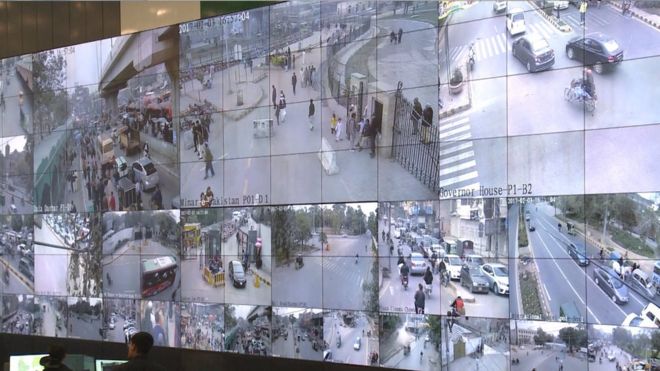
Image captionThe surveillance system was built to monitor Lahore’s streets following a series of terrorist attacks
Huawei removed wi-fi transmitting cards from a Pakistan-based surveillance system’s CCTV cabinets after they were discovered by the project’s staff.
Punjab Safe City Authority (PSCA) told BBC Panorama it had told the firm to remove the modules in 2017 “due to [a] potential of misuse”.
The authority said that the Chinese firm had previously made mention of the cards in its bidding documents.
But a source involved in the project suggested the reference was obscure.
A spokesman for Huawei said there had been a “misunderstanding”. He added that the cards had been installed to provide diagnostic information, but said he was unable to discuss the matter further.
The PSCA confirmed that the explanation it had been given was that wi-fi connectivity could have made it easier for engineers to troubleshoot problems when they stood close to the cabinets, without having to open them up.
Two people involved in Lahore’s project helped bring the matter to the BBC’s attention and have asked to remain anonymous. One said that Huawei had never provided an app to make use of the wi-fi link, and added that the cabinets could already be managed remotely via the surveillance system’s main network.
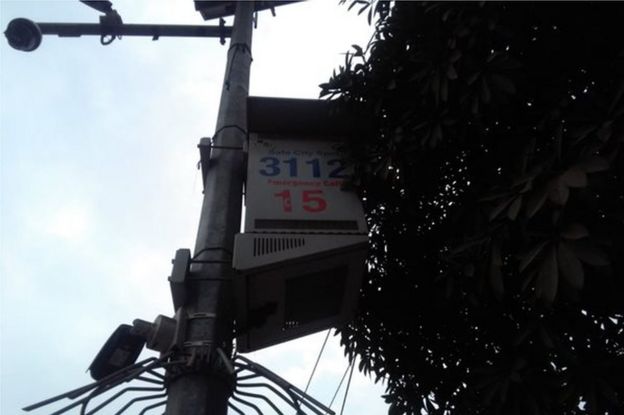
Image captionIt was suggested that a wi-fi link could have helped engineers troubleshoot problems without having to climb up and open the cabinets
A UK-based cyber-security expert said that it was not uncommon for equipment sellers to install extra gear to let them offer additional services at a later date.
But he added that the affair highlighted the benefit of oversight because if the authority had remained unaware of the cards’ existence, it could not have taken steps to manage any potential risk they posed.
“As soon as you give someone another method of remote connectivity you give them a method to attack it,” commented Alan Woodward.
“If you put a wi-fi card in then you’re potentially giving someone some other form of remote access to it. You might say it’s done for one purpose, but as soon as you do that it’s got the potential to be misused.”
There is no evidence that the cards created a vulnerability, and one of the sources involved confirmed that there had not been an opportunity to test if they could be exploited before the kit was removed.
‘Prompt response’
Lahore’s Safe City scheme was first announced in 2016 following a series of terrorist bombings.
It provides a vast surveillance network of cameras and other sensors, and a brand new communications system for the city’s emergency services
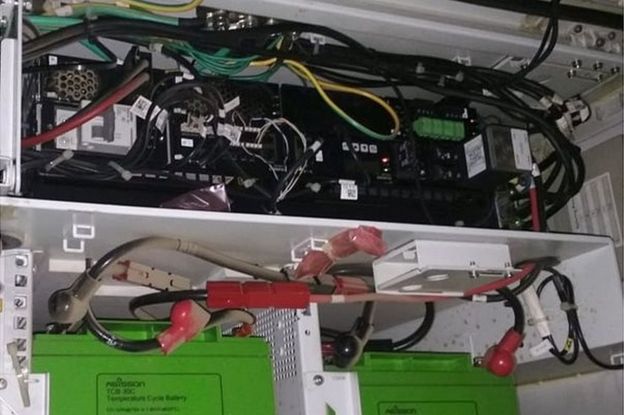
As part of the system, Huawei installed 1,800 CCTV cabinets, within which it placed the wi-fi modules behind other equipment.
Image captionThe cards were placed among other equipment in the cabinets
The PSCA’s chief operating officer told the BBC that Huawei had been “prompt” in its response to a request to remove them and had fully “complied with our directions”.
“It is always [the] choice of the parties in a contract to finalise the technical details and modules as per their requirements and local conditions,” added Akbar Nasir Khan.
“PSCA denies that there are any threats to the security of the project [and the] system was continuously checked by our consultants, including reputed firms from [the] UK.”
But there is no suggestion that this was related to Huawei’s involvement, and in any case the wi-fi modules would have been removed by this point. The PSCA has also denied anyone from its office had been involved.
BRUSSELS (Reuters) – Chinese Premier Li Keqiang and EU institution leaders meet in Brussels on Tuesday for an annual EU-China summit set to be overshadowed by differences over trade and investment.
After years of offering free access to its markets, the European Union has said it is losing patience with Beijing over the pace of liberalising reforms. It also has growing concerns over state-led Chinese companies’ dominance of some EU markets and acquisitions of strategic industries.
Like the United States, many EU countries want to crack down on industrial subsidies and forced technology transfers, although prefer dialogue to the trade war Washington has triggered.
The European Commission set out a 10-point action plan last month, seeing scope for greater cooperation in fields such as climate change, but demanding greater reciprocity, such as access for EU firms to Chinese public tenders.
“The old narrative is absolutely obsolete,” Commission Vice President Jyrki Katainen told Reuters.
Beijing and Brussels have been wrestling for weeks over the text of a joint declaration to be presented as the fruit of Tuesday’s summit between Li and Commission President Jean-Claude Juncker and European Council chiefDonald Tusk.
“China aims to have a feel-good summit, whereas we aim to have a meaningful summit, with a meaningful outcome,” Peter Berz, acting Asia director at the Commission’s trade section, told the European Parliament last week.
EU diplomats said on Monday negotiators had made some progress, but were still short of an agreed text. Talks would continue until the summit, due to start at 1 p.m. (1100 GMT).
China points to a new foreign investment law due to take effect at the start of 2020. It includes provisions to ban forced technology transfers and ensure foreign companies have access to public tenders.
EU officials say the law lacks detail and question how effective it will be in reality in protecting foreign firms.
Li wrote in a German newspaper on Monday that China wanted to work with the European Union on issues including trade and denied Beijing was trying to split the bloc by investing in eastern European states.
Buses from the North make return trip to China on Monday, according to South Korean media
Opening of Jian-Manpo border crossing had been delayed during heightened tension over sanctions on the North
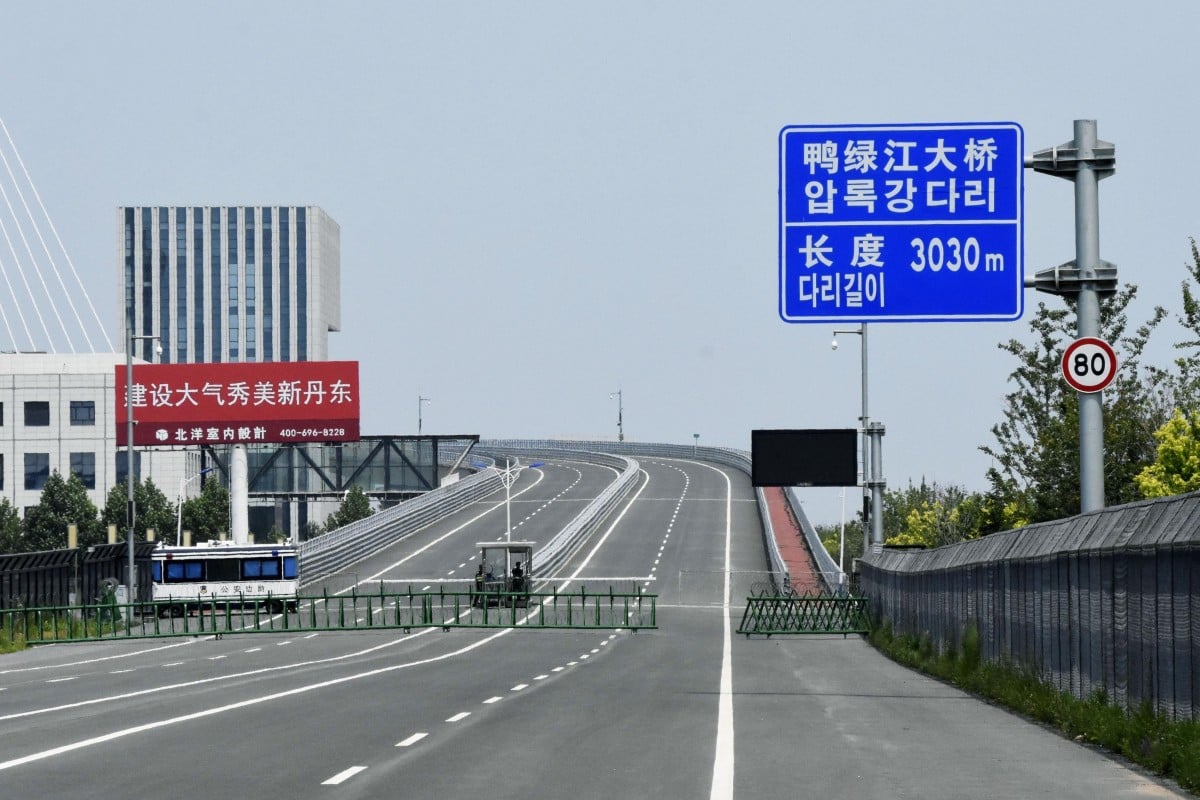
The bridge crosses the Yalu River on the border between China and North Korea. Photo: Kyodo
China and North Korea have finally opened a border bridge built between the two countries in 2016, in a potential boost to the North’s economy as Beijing tries to balance its concerns about its neighbour against ongoing international pressure for it to denuclearise.
A border checkpoint and bridge connecting the Chinese city of Jian with North Korea’s Manpo were open on Monday, following three years of delays since they were built.
Four buses crossed the border from North Korea in the morning and returned to the hermit kingdom about an hour later carrying about 120 people, who included tourists, according to South Korean media. It was not known whether the people travelled from North Korea or boarded the buses in China.
The bridge had remained closed on its completion in 2016, with Beijing taking a cautious approach at a time when it faced international scrutiny of whether it was fully implementing UN Security Council sanctions on the North.
to enforce the sanctions after a UN committee accused it and South Korea of being reluctant to enforce a ban on coal exports from the North.
But there has been a change in the status of the Jian-Manpo border crossing – built near to where Kim’s father, the former leader Kim Jong-il, was reported to have crossed the border in 2010 in a rare trip outside his country.
Kim’s second summit with Trump in February collapsed against a backdrop of continued economic struggles for North Korea. Beijing is wary of instability around the North Korean regime posing a threat to the security of China’s northeast, fearing an influx of refugees into one of its poorest regions.
North Korea’s trade has suffered to the extent that the Korea Development Institute said in February it had almost collapsed.
The North’s exports to China – which accounts for the bulk of its trade – plunged 87 per cent year-on-year in 2018, according to data compiled by South Korea’s Korea
International Trade Association, while there have been myriad other economic problems at a time when Kim has vowed to deliver on the economy.
In April last year, Kim announced that Pyongyang was moving away from its twin-track “byungjin” policy of developing nuclear weapons and the economy simultaneously to focus exclusively on rebuilding the economy.
Boo Seung-chan, adjunct professor at the Yonsei Institute for North Korean Studies in Seoul, said the bridge’s primary use would be to boost tourism in North Korea, which is not restricted by the UN sanctions.
“Tourism is the only sector left for the North Koreans to earn foreign revenue,” Boo said. “Besides, China can only offer its financial help through the tourism sector as it does not wish to violate UN sanctions.
“China’s Korean peninsula policy is to maintain the stability of the region. It may also be drawing a road map for when sanctions may be lifted, finding its means to accelerate its economic engagement to increase its sphere of influence.”
NEW YORK, April 6 (Xinhua) — Boosted by a growing middle class population, China’s culture and entertainment industry enjoys broader prospect and is creating enormous opportunities, a group of business leaders from the United States and China said here Saturday.
Chinese society today has a growing appetite for the intellectual strength of art and music, Joseph Polisi, president emeritus and chief China officer at the Juilliard School, a renowned performing arts conservatory in the United States, said at a panel in New York.
Themed “The human connection: China and America in culture and entertainment,” the panel is part of the ongoing annual conference held by the Committee of 100 (C100), a premier U.S. organization of Chinese-American leaders from different fields.
The demand of “Chinese audiences are growing in size for western music,” he said, adding that Chinese parents have a greater request for orchestral musical training programs resulting in Chinese children being able to engage in sophisticated musical works at a young age.
Polisi, who is also an accomplished bassoonist, said that Juilliard is establishing a campus in Tianjin. Slated to open in fall 2019, the Tianjin campus offers audition-based programs on pre-college and graduate levels.
U.S. businesses have much to gain by accessing the Chinese market with the growth of the Chinese middle class and the emergence of dynamic forces including the nation’s Generation Z, small-town and rural dwellers, noted the panelists.
Their growing demand for a better life and high-quality goods will create new business opportunities.
Ben Wood, founder of Studio Shanghai Architectural Firm, who has spent 22 years in China, said bringing popular culture to China through the rapid rise of the middle class is among others behind his business success.
Gong Yu, founder and CEO of China’s leading online entertainment platform iQiyi, said his company delivers content to 200 to 300 million users daily, a remarkable achievement made in a span of only nine years thanks to the broader picture of China’s rapid development. He is confident that there will be more Chinese culture and entertainment production going global since more Chinese young people are willing to be dedicated in the industry.
Now China is home to the world’s biggest middle-income group comprised of some 400 million people, and the number is still on the rise. The country is evolving from the world’s workshop to becoming a major consumer of goods and services instead.
BEIJING, April 7 (Xinhua) — China saw 112 million domestic tourist trips during the three-day tomb-sweeping holiday, up 10.9 percent from last year’s holiday, according to the Ministry of Culture and Tourism.
The tourism revenue reached 47.9 billion yuan (about 7.1 billion U.S. dollars) during the holiday which lasts from Friday to Sunday, up 13.7 percent, according to the ministry.
While tourists still favor sites of natural scenes, an increasing number of people chose to visit history museums, martyrs’ memorial halls and memorial sites of revolution during the holiday, the ministry said in a report, adding that the online ticket sales at such spots across the country saw a year-on-year increase of 55.2 percent.
The Tomb-sweeping Day, or Qingming Festival, is an important occasion for Chinese people to honor their ancestors. Many also spent the three-day holiday on leisure travel.
AMMAN, April 7 (Xinhua) — Li Chengwen, ambassador for China-Arab States Cooperation Forum Affairs of China’s Foreign Ministry, refuted on Sunday the criticism that China’s Belt and Road Initiative (BRI) will create so-called “debt trap” for some participating countries.
“China is trying to find mechanisms to avoid the ‘debt trap,'” Li said during a session on the second day of the World Economic Forum on the Middle East and North Africa 2019 held in the Dead Sea area of Jordan.
The Chinese envoy was responding to the criticism directed at the BRI by some people in the United States and Europe ahead of the second Belt and Road Forum for International Cooperation, due to be hosted by China later this month in Beijing.
The initiative, proposed by China in 2013, aims at building a trade and infrastructure network connecting Asia with Europe and Africa along the ancient trade routes of the Silk Road to seek common development and prosperity.
As of July 2018, more than 100 countries and international organizations had signed Belt and Road cooperation documents with China, extending the initiative’s scope from the Eurasian continent to Africa, Latin America and the Caribbean, and the South Pacific region.
Li pointed out that no participating country has complained of falling into the so-called “trap” of Chinese loans.
“The Belt and Road Initiative aims to increase the economic prosperity of a country. It does not aim at expanding the political and geographical authority of China in the world,” he said.
Many participants at the forum in Jordan agreed with Li’s comments.
“If you keep your interest first, you will not find China an unfair partner,” said Shandana Gulzar Khan, Pakistan’s parliamentary secretary for commerce. “But it depends on how well you do your homework.”
In Pakistan, a major BRI participating country, the China-Pakistan Economic Corridor has created tens of thousands of jobs and revived the economy of an entire region, Khan noted.
Speaking at the session, He Wenping, a research fellow of the Institute of West-Asian and African Studies, Chinese Academy of Social Sciences, echoed Li’s remarks.
“The biggest worry on the ‘debt-trap diplomacy’ should come from China’s side, not from outside. It is tax payers’ money,” the Chinese professor said.
“China is not waving the ‘China First’ flag,” she said.
The upcoming Belt and Road forum to be held in Beijing later this month could be an opportunity to kickstart a “second phase” of the initiative, she added.
Aerial photo taken on April 7, 2019 shows a villager selecting tea leaves at a tea planting base in Baogai Town of Hengnan County, central China’s Hunan Province. Tea planting bases are built in Baogai to provide jobs for local villagers as a method of poverty alleviation in recent years. (Xinhua/Cao Zhengping)
The mainland government will also seek to create a level playing field for businesses, most of which are privately-owned, in terms of market entry and regulation
Small and medium-sized firms are vulnerable to trade disputes and an economic slowdown even though they contribute the majority of growth and employment
China plans to make it easier and cheaper for businesses to access credit through subsidies and certain bank loans, according to a comprehensive policy guidelines jointly released by the Central Committee and the State Council on Sunday. Photo: Alamy
China will “remove all sorts of unreasonable barriers and restrictions” to help small and medium-sized enterprises which are seen as vital to help employment and economic growth amid the trade war with the United States.
Beijing plans to make it easier and cheaper for businesses to access credit through subsidies and certain bank loans, according to a comprehensive policy guidelines jointly released by the Central Committee of the Communist Party of China and the State Council on Sunday.
The mainland government will also seek to create a level playing field for businesses, most of which are privately-owned, in terms of market entry and regulation.
“Small and medium-sized enterprises is an dynamic power for national economic and social important and is critical for expanding employment, improving people’s livelihood, and to foster innovation,” the guidelines said. “For now, they are facing problems of rising production costs, difficulty in obtaining credit and insufficient capabilities to innovate – these issues demand high attention.”
China will “remove all sorts of unreasonable barriers and restrictions, trying to ensure fair competition and provide sufficient market in terms of market entry, licensing, bidding and the military-civil infusion,” it added.
While most of the policies are not completely new, the move to pull them together into a larger policy document, which will serve as a guideline for local authorities, shows China’s intention to stabilise the domestic economic situation as its trade disputes with the US continues.
Beijing has also designed a variety of financial policy tools, including targeted required reserve ratio cuts and the use of small and medium-sized enterprise loans as collateral for medium-term lending facilities granted by the central bank, meaning banks will have more incentives to offer financing.
To further boost lending, it will also offer some exemptions for interest received from value added tax, while also providing tax breaks for small firms and start-ups, a lower social security contribution ratio and an increase in government procurement, according to the guidelines.
Small and medium-sized enterprises is an dynamic power for national economic and social important and is critical for expanding employment, improving people’s livelihood, and to foster innovation.New guidelines
The need for the Chinese government to support small businesses became even more obvious last summer when it began its trade was with the US. Small private businesses are more vulnerable to trade disputes and an economic slowdown than state-owned enterprises, which are often bigger and enjoy favourable treatments from the government and banks, even though they contribute the majority of growth and employment.
Employment is the top priority on the agenda of Premier Li Keqiang this year, as shown in his government work report revealed last month. China has vowed to create 11 million new urban jobs this year and cap the surveyed urban unemployment rate at 5.5 per cent.
Morgan Stanley economists noted that China’s real gross domestic product growth may slow to 6.2 per cent in the first quarter.
“The main drag is slower investment growth, led by property construction and manufacturing [capital expenditure] amid still-subdued export and business sentiment,” Morgan Stanley economists Robin Xing, Jenny Zheng and Zhipeng Cai said.
The National Bureau of Statistics is due to release the first quarter economic data on April 17.
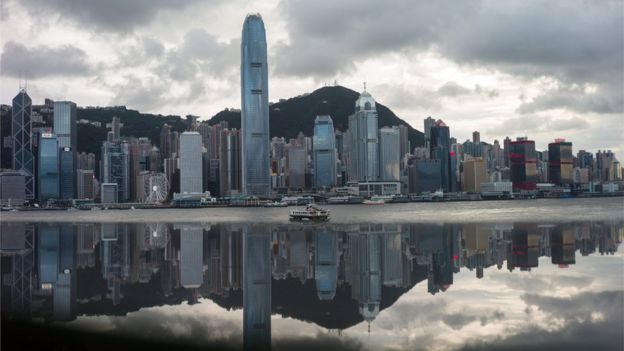
Image copyrightREUTERSImage captionHong Kong is part of China but has its own judicial system
The Hong Kong government has proposed changes to extradition laws that could allow transferring suspects to mainland China for trial. The move has further fuelled fears of erosion of the city’s judicial independence amid Beijing’s increasing influence.
The Hong Kong government will also consider extradition requests from Taiwan and Macau after the new changes.
Officials say the change is needed so that a murder suspect can be extradited to Taiwan for trial, and that mainland China and Macau must be included in the change to close a “systematic loophole”.
Hong Kong’s leader Carrie Lam has pushed for the amendments to be passed before July.
What are the changes?
The changes will allow for extradition requests from authorities in mainland China, Taiwan and Macau for suspects accused of criminal wrongdoings, such as murder and rape.
The requests will then be decided on a case-by-case basis.
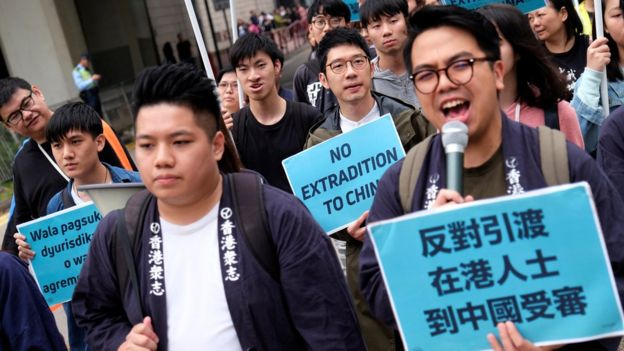
Image copyrightREUTERSImage captionOver 100,000 protesters took to Hong Kong streets to rally against the government’s proposal.
Several commercial offences such as tax evasion have been removed from the list of extraditable offences amid concerns from the business community.
Hong Kong officials have said Hong Kong courts will have the final say whether to grant such extradition requests, and suspects accused of political and religious crimes will not be extradited.
Why is this controversial?
There has been a lot of public opposition, and critics say people would be subject to arbitrary detention, unfair trial and torture under China’s judicial system.
“These amendments would heighten the risk for human rights activists and others critical of China being extradited to the mainland for trial on fabricated charges,” Sophie Richardson of Human Rights Watch said in a statement.
Lam Wing Kee, a Hong Kong bookseller said he was abducted and detained in China in 2015 for selling books critical of Chinese leaders and charged with “operating a bookstore illegally”.
During a recent protest against the government proposal, Mr Lam said he would consider leaving the territory before the proposal was passed.
“If I don’t go, I will be extradited,” he said. “I don’t trust the government to guarantee my safety, or the safety of any Hong Kong resident.”
Though some pro-Beijing politicians eager to defend China, dispute the criticism of its judicial system.
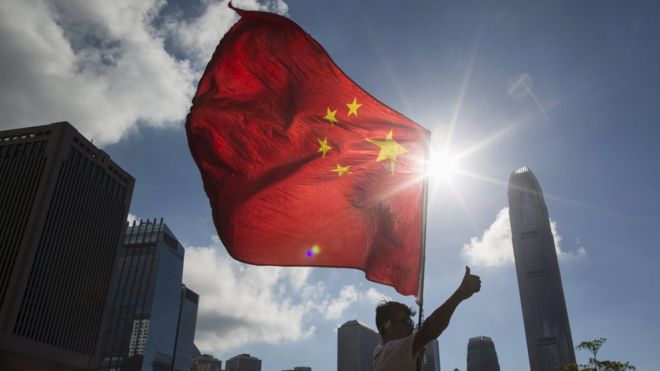
Image copyrightEPAImage captionHong Kong and China – one country, two systems
The changes have also attracted opposition from the Hong Kong business community over concerns they may not receive adequate protection under Chinese law.
The proposal has already sparked a legal challenge from Hong Kong tycoon Joseph Lau, who was convicted in absentia in a corruption case in Macau in 2014.
Macau’s government has not been able to have Mr Lau extradited because of a lack of extradition agreement between Hong Kong and Macau, but that will become possible if Hong Kong’s legislature decides to amend the extradition laws.
His lawyers argue in a 44-page submission to Hong Kong’s courts that the Macau trial was marred by “serious procedural irregularities that rendered the trial incompatible with internationally mandated standards of fairness”.
Every citizen can request a judicial review like Mr Lau has done, but it’s the High Court that decides whether this will be granted. Most observers say there is little chance Mr Lau’s request will be successful.
Why the change now?
The latest proposal has come after a 19-year-old Hong Kong man allegedly murdered his 20-year-old pregnant girlfriend, while holidaying in Taiwan together in February last year. The man fled Taiwan and returned to Hong Kong last year.
Taiwanese officials have sought help from Hong Kong authorities to extradite the man, but Hong Kong officials say they cannot comply because of a lack of extradition agreement with Taiwan.
Image copyrightGETTY IMAGESImage captionUnder Xi Jinping, Beijing is seeking increasing control over Hong Kong
“Are we happy to see a suspect that has committed a serious offence staying in Hong Kong and we’re unable to deliver justice over the case?” Mrs Lam said on 1 April while responding to media questions.
She added that mainland China and Macau were included in the proposed change to address a “loophole” in current laws.
Isn’t Hong Kong part of China anyway?
A former British colony, Hong Kong is semi-autonomous under the principle of “one country, two systems” after it returned to Chinese rule in 1997.
The city has its own laws and its residents enjoy civil liberties unavailable to their mainland counterparts.
Hong Kong has entered into extradition agreements with 20 countries, including the UK and the US, but no such agreements have been reached with mainland China despite ongoing negotiations in the past two decades.
Critics have attributed such failures to poor legal protection for defendants under Chinese law.





 CHINDIA ALERT: You'll be living in their world, very soon