Archive for ‘China alert’

04/04/2019

Chinese vice premier meets IPPF Director General

CHINA-BEIJING-SUN CHUNLAN-IPPF-MEETING (CN)

Chinese Vice Premier Sun Chunlan(R) meets with Alvaro Bermejo, director-general of the International Planned Parenthood Federation (IPPF), in Beijing, capital of China, April 3, 2019. (Xinhua/Rao Aimin)

BEIJING, April 3 (Xinhua) — Chinese Vice Premier Sun Chunlan met with Alvaro Bermejo, director-general of the International Planned Parenthood Federation (IPPF), on Wednesday.

Sun spoke highly of the good relationship between China and the IPPF, and expressed a willingness to deepen cooperation with the federation in such areas as family planning, reproductive health, and aging populations in developing countries.

Bermejo said he appreciates China’s achievements in family planning, and the federation is willing to consolidate cooperation with China, participate in the Belt and Road Initiative, and support China’s bigger role in global population development.

Source: Xinhua

04/04/2019

Manila accuses Beijing of violating its sovereignty as South China Sea dispute rages on

  • Philippines’ foreign ministry weighs in on controversy over presence of Chinese fleet near contested Thitu Island
  • Manila has ‘consistently manifested its … objections or concerns over illegal, tension-raising or coercive activities’, statement says
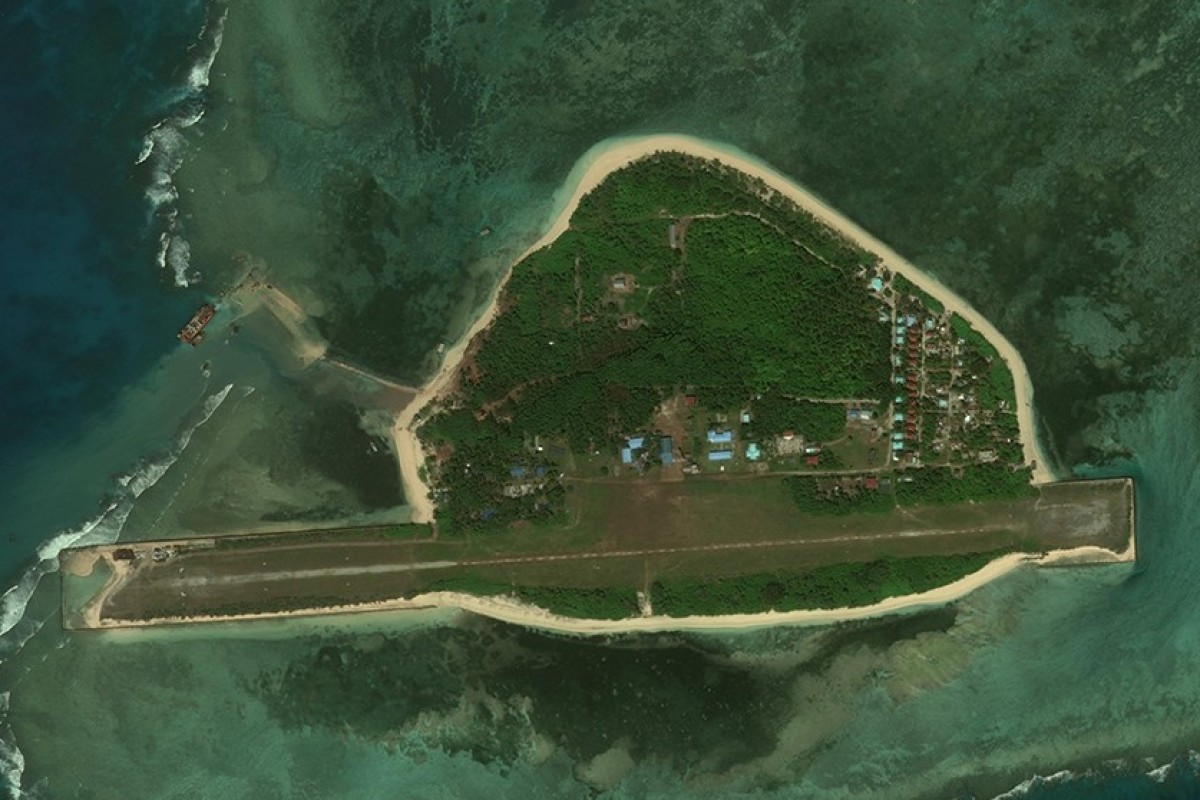
The Philippines is angry about the presence of a Chinese fleet close to Thitu Island in the South China Sea. Photo: AMTI
The Philippines’ foreign ministry on Thursday accused Beijing of violating its sovereignty and jurisdiction by allowing hundreds of vessels to sail close to an island claimed by Manila in the South China Sea.
The statement came just three days after Philippine Defence Minister Delfin Lorenzana
described China’s growing presence in the disputed waters as “very concerning”, saying on a trip to Washington that it was encroaching on the Philippines’ exclusive economic zone.
The conflict relates to the presence of up to 
200 Chinese vessels near Thitu Island

, which Manila calls Pag-asa, in the disputed Spratly Islands.

The Department of Foreign Affairs in Manila said the Philippines “has consistently manifested its position on Pag-asa … and its objections or concerns over illegal, tension-raising or coercive activities, through diplomatic actions … and in meetings with the Chinese side”.
The statement said Thitu is part of the Kalayaan island group – the local name for the Spratlys – and an integral part of the Philippines, over which it has sovereignty and jurisdiction.

“The presence of Chinese vessels near and around Pag-asa and other maritime features in the KIG is illegal,” it said.

US, Philippines in talks on rocket system to deter Beijing

“Such actions when not repudiated by the Chinese government are deemed to have been adopted by it,” it said. “The presence of Chinese vessels within the KIG, whether military, fishing or other such will thus continue to be the subject of appropriate action by the Philippines”.

The foreign ministry said earlier it had filed a diplomatic protest about the presence of more than 200 Chinese vessels near Thitu between January and March.

Satellite images captured in February by the Asia Maritime Transparency Initiative under the Washington-based Centre for Strategic and International Studies show almost 100 Chinese ships apparently hampering Philippine construction work on Thitu.

The fleet, dispatched from the nearby Subi Reef, includes naval and coastguard vessels, as well as dozens of fishing boats.

Manila was planning to upgrade its military facilities on Thitu, including the construction of an airstrip, but the project was suspended because of the Chinese interference.

The defence chiefs of the US and the Philippines reaffirmed their security alliance on Monday in Washington. As well as agreeing to boost cooperation, the US promised to increase its support for Manila’s military modernisation – a move seen as a response to Beijing’s increasingly assertive posturing in the South China Sea.

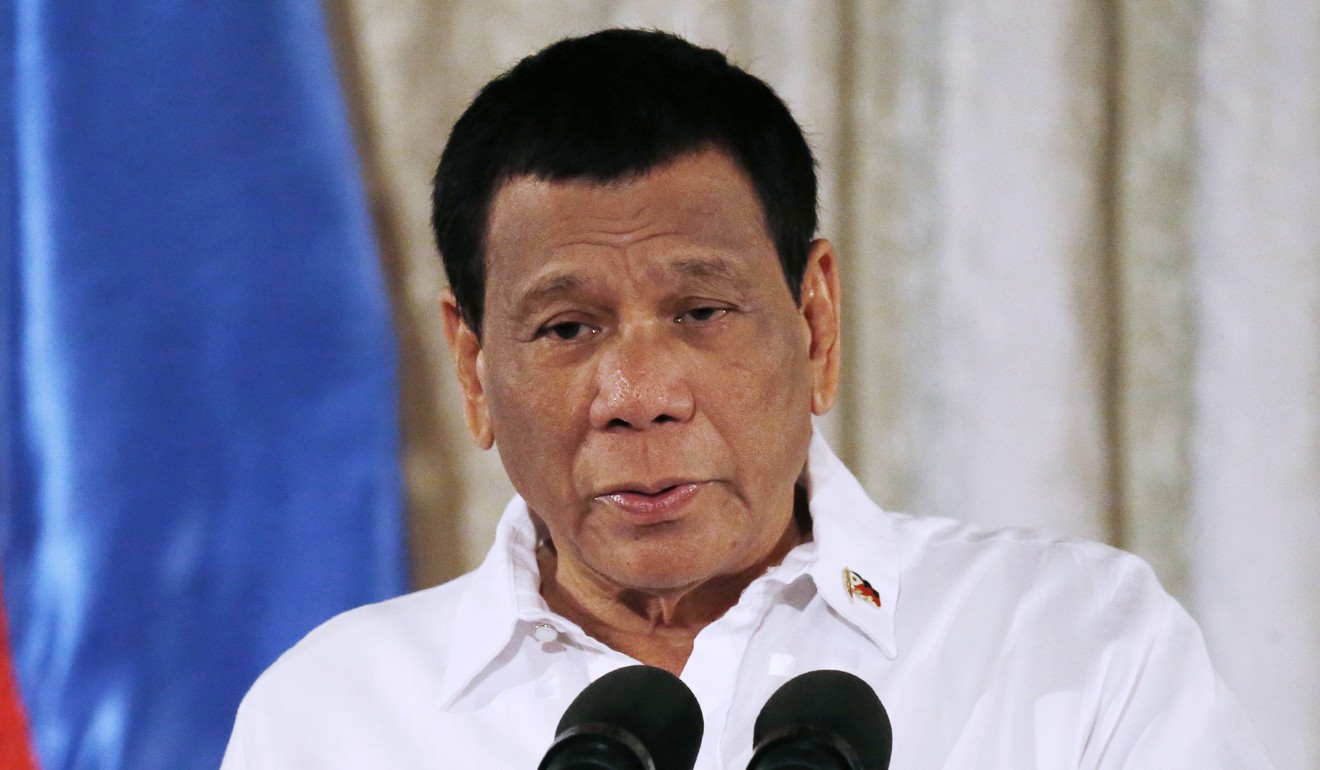
Philippine President Rodrigo Duterte says he will not confront China over the South China Sea dispute as doing so would end in war. Photo: AP
Despite the statements from his ministries,

Philippine President Rodrigo Duterte

said on Wednesday that Beijing wanted to be friends with Manila and that he would not confront China over their competing claims in the South China Sea because it would end in war.

The foreign affairs department in Manila also sought to sound a positive note in its statement, saying the maritime dispute was not the “sum total” of Philippines-China relations, and should not exclude mutually beneficial cooperation in other fields.
US more likely than Philippines to end up in ‘shooting war’
A day after the two nations wrapped up their latest meeting on the South China Sea, Chinese foreign ministry spokesman Geng Shuang said on Thursday the two sides had reaffirmed their differences but would continue to seek a resolution.
“China looks forward to working with the Philippines to make active efforts to safeguard the overall interests of China-Philippines cooperation and peace and stability in the South China Sea,” he said.
Hong Kong-based military expert Song Zhongping said the presence of the Chinese vessels near Thitu was a clear statement of Beijing’s intent.

“Beijing believes Thitu Island is Chinese territory, so any work there should be done by China, not the Philippines,” he said.

It also wanted to stop Manila “opening the door to dangerous people” he said, referring to the Southeast Asian nation’s announcement about allowing the US access to five more of its military bases.

Source: SCMP

02/04/2019

Xi calls for closer cultural exchanges between China, Pacific island countries

BEIJING, April 1 (Xinhua) — Chinese President Xi Jinping on Monday extended congratulations on the launch ceremony of the 2019 Year of Tourism for China and Pacific Island Countries, calling for closer cultural and personnel exchanges.

In a congratulatory message to the event, which was held in Apia, capital of Samoa, Xi noted that China and Pacific island countries have a time-honored tradition of friendly exchanges.

They are good friends who treat each other with sincerity and mutual respect, good partners who work together to pursue common development and win-win cooperation, and good brothers who understand and learn from each other, said the president, adding that they set a model for all countries treating each other as equals regardless of their sizes.

Xi recalled that in November last year, he held a collective meeting with leaders of Pacific island countries in Papua New Guinea (PNG), and they agreed to elevate their countries’ relations to a comprehensive strategic partnership featuring mutual respect and common development, opening a new chapter in the interaction between China and Pacific island countries.

The Chinese president emphasized that the tourism year is an important consensus he reached with leaders of Pacific island countries in their PNG meeting.

Xi expressed the hope that the two sides seize the opportunity to expand cultural and personnel exchanges, boost practical cooperation, deepen mutual understanding, and consolidate the public support for their comprehensive strategic partnership, so as to bring more benefits to the peoples of both China and the Pacific island countries.

Source: Xinhua

02/04/2019

China’s new relay satellite to help video calls possible with space station

BEIJING, April 1 (Xinhua) — A new relay satellite launched late Sunday night will allow videos calls to be made between China’s future space station and the ground and provide data transmission and control services for various spacecraft.

The Tianlian II-01 satellite was sent to an orbit at an altitude of 36,000 km by a Long March-3B carrier rocket from the Xichang Satellite Launch Center in southwest China’s Sichuan Province at 11:51 p.m. Beijing Time on Sunday.

The satellite, developed by the China Academy of Space Technology (CAST) under the China Aerospace Science and Technology Corporation, will provide data transmission services for satellites operating on medium- and low-Earth orbit and monitoring and control support for the launch of spacecraft.

“The Tianlian II-01 ushered in the construction of a new generation of the relay satellite system for China,” said Zhang Peng, commander in chief of the research team of the satellite from CAST.

From 2008 to 2016, China launched four relay satellites to form the Tianlian I system, making China the second country in the world to establish a relay satellite system which is able to cover the whole world. The system can provide global real-time information transmission.

As the first satellite of China’s second-generation relay satellite system, Tianlian II-1 is compatible with the Tianlian I system, but its transmission speed and volume and coverage area have been greatly improved, according to Zhang.

Source: Xinhua

02/04/2019

Chinese president meets The Elders delegation

CHINA-BEIJING-XI JINPING-THE ELDERS-DELEGATION-MEETING (CN)

Chinese President Xi Jinping meets with The Elders delegation, led by its chair, former president of Ireland Mary Robinson, in the Great Hall of the People in Beijing, capital of China, April 1, 2019. (Xinhua/Rao Aimin)

BEIJING, April 1 (Xinhua) — President Xi Jinping on Monday met with The Elders delegation, led by its chair, former president of Ireland Mary Robinson, in the Great Hall of the People.

During their meeting, Xi said the world today was facing unprecedented changes, while the prospect of international cooperation, as well as solutions to global challenges and the future of human society were being thought on by more and more insightful people.

“We advocate cultivating the awareness of a community with a shared future for humanity, and better building and caring our common home planet,” Xi said, adding that every country bore a responsibility for the future of mankind.

China is a major developing country, but it never evades its due international responsibilities. China seeks cooperation with win-win results and helps developing countries realize common progress during its own development process, he said.

He said China had always pursued a right approach to justice and interests by putting justice before interests, and given selfless help to African countries when it was still very poor.

The Belt and Road Initiative proposed by China is “for mutual benefit and win-win cooperation with all the countries,” Xi said.

At present, many countries have felt pressure and worries from the impact of unilateralism, but the voice of the international community in support of multilateralism has remained the dominant force.

It is important to ensure that existing multilateral processes do not stall and what has been achieved is not reversed, Xi said, reiterating China’s commitment in maintaining international nuclear non-proliferation regime and strengthening international cooperation on climate change and other multilateral agendas.

“China always holds an open attitude towards the reform of multilateral institutions,” Xi said, stressing that the reform should be discussed by all the relevant countries and accommodate the legitimate concerns of all parties in accordance with universally recognized rules, serving the common interests of majority countries.

China-proposed Belt and Road Initiative is a major contribution to multilateralism and international cooperation, Xi stressed, adding that China and other participating countries have upheld the principle of consultation and collaboration for shared benefits in the past five years and created many new modes of cooperation.

Xi stressed that major countries should shoulder special responsibilities as the relations between major countries concern global strategic stability.

China has been committed to promoting coordination between major countries and looked forward to harmony among major countries, with no conflict or confrontation but mutual respect and win-win cooperation, Xi said.

Calling China-U.S. ties one of the most important bilateral ties in the world, Xi said he hoped the United States could meet China halfway, manage differences and expand cooperation and jointly promote China-U.S. relations based on coordination, cooperation and stability so as to provide more stable and expectable factors to the world.

This year marks the 70th anniversary of the founding of the People’s Republic of China (PRC). Xi said it was Chinese people’s choice to adhere to the leadership of the Communist Party of China (CPC).

The CPC has led the Chinese people in tireless struggle and scored remarkable achievements in many areas, said Xi, adding that China had kept improving its development path and made unremitting efforts towards the “two centennial goals.”

“China running its own affairs well is in itself a contribution to the world,” President Xi said.

Mary Robinson, chair of The Elders and former president of Ireland, Ban Ki-moon, co-deputy chair, former Secretary-General of the United Nations and chairman of the Boao Forum for Asia, as well as former President of Mexico Ernesto Zedillo also spoke on behalf of The Elders.

They congratulated on the 70th anniversary of the founding of the PRC and the success China had achieved in economic and social development, and spoke highly of the country’s efforts made in environmental protection, poverty eradication and the work on ethnic minorities.

China has played a responsible and constructive role at a crucial moment when multilateralism is faced with challenges, they said, adding that China had always adhered to the purposes and principles of the UN Charter and taken part in the cause of peace and development in Africa.

Saying that Xi’s speeches on international occasions had sent positive messages, they called on countries to uphold the multilateral system with the United Nations at its core and enhance multilateral cooperation in areas of international and regional stability and climate change.

The Elders, initiated by former South African President Nelson Mandela in 2007, is an international non-governmental organization consisting of former leaders of countries and important international organizations. Its goal is to promote the resolution of conflict via dialogue and work on solutions for global problems such as poverty and disease.

Earlier Monday, Yang Jiechi, a member of the Political Bureau of the Central Committee of the Communist Party of China and director of the Office of the Foreign Affairs Commission of the CPC Central Committee, also met the delegation.

Source: Xinhua

02/04/2019

China, France to beef up partnership in financial innovation

BEIJING, April 1 (Xinhua) — China and France have signed a Memorandum of Understanding on bilateral cooperation in financial innovation recently, the country’s top securities watchdog said Monday.

Both parties will share information and strengthen cooperation in the development trend of financial technologies and relevant policies for regulation, the China Securities Regulatory Commission (CSRC) said in a statement on its website.

The two countries’ securities regulators also achieved consensus on enhancing green finance cooperation and exploring ways to advance connecting the two countries’ capital markets, according to the statement.

Source: Xinhua

02/04/2019

China, New Zealand agree to deepen comprehensive strategic partnership

CHINA-BEIJING-XI JINPING-NEW ZEALAND-JACINDA ARDERN-MEETING (CN)

Chinese President Xi Jinping (R) meets with New Zealand Prime Minister Jacinda Ardern at the Great Hall of the People in Beijing, capital of China, April 1, 2019. (Xinhua/Rao Aimin)

BEIJING, April 1 (Xinhua) — Chinese President Xi Jinping met with New Zealand Prime Minister Jacinda Ardern in Beijing Monday. They agreed to continuously enrich the China-New Zealand comprehensive strategic partnership based on the principles of mutual trust and mutual benefit.

During their meeting at the Great Hall of the People, Xi first expressed sincere condolences to New Zealand for the deadly shootings in Christchurch two weeks ago, saying that Ardern’s visit to China at a moment that her country was facing a special important agenda showed the great importance she and the New Zealand government attached to bilateral ties.

China has always viewed New Zealand as a sincere friend and partner, Xi said, adding that China-New Zealand ties, established 47 years ago, had always been at the forefront among relationships between China and Western countries.

He called on both countries to continue to deepen the bilateral comprehensive strategic partnership based on the principles of mutual trust and mutual benefit.

China stands ready to work with New Zealand to maintain the bilateral ties as a “front-runner” in relations between China and Western countries, Xi said.

Under the new circumstances, the two countries need to further deepen mutual understanding and trust and respect each other’s core interests and major concerns in the spirit of openness, inclusiveness and seeking common grounds while reserving differences, he said.

Xi called on both sides to expand substantial cooperation.

China will support capable enterprises to invest in New Zealand, while New Zealand needs to provide a fair, just and unbiased business environment for Chinese enterprises, he said.

He also called for the speeding up of negotiations on the upgrade of the bilateral free trade agreement.

China welcomes New Zealand to participate in the Belt and Road construction, Xi said, encouraging both countries to enhance cooperation in international affairs, jointly strive for an open world economy and uphold multilateralism and multilateral trading.

China attaches importance to climate change and is willing to work with New Zealand to promote the sustainable development of Pacific island countries, the president said.

He also encouraged both countries to enhance exchanges in areas including education, culture, youth and science and technology, and to host a successful China-New Zealand Year of Tourism in 2019.

Ardern thanked Xi for extending condolences over the deadly shooting incident, and expressed condolences for the loss of life in a chemical plant blast in Jiangsu Province in late March.

Noting the long history of friendship between New Zealand and China, Ardern said her country attached great importance to ties with China and was proud that the country led in many areas in developing ties with China.

Ardern said she agreed with Xi’s comments on the relations between the two countries, and looked forward to strengthening the New Zealand-China comprehensive strategic partnership and deepening bilateral economic and trade cooperation and people-to-people exchanges after this visit.

She reiterated New Zealand’s adherence to the one-China policy.

New Zealand pursues an independent foreign policy and firmly supports multilateralism and free trade, Ardern said, adding that the country had long supported the Belt and Road Initiative and participated in the Asian Infrastructure Investment Bank.

She said New Zealand would send a high-level delegation to the second Belt and Road Forum for International Cooperation to be held later this month in Beijing.

New Zealand is ready to enhance cooperation and coordination with China on major international issues including climate change, the prime minister said.

Ardern arrived in Beijing on Sunday for a two-day visit to China. This is her first official visit to China since becoming New Zealand’s prime minister in October 2017.

Source: China Daily

02/04/2019

Patriot games: Xi Jinping’s dream of Chinese World Cup begins with thousands of footballing toddlers

  • President wants China’s provinces to develop world-class talent from early age
  • Game’s national governing body revealed plans for 10,000 kindergartens
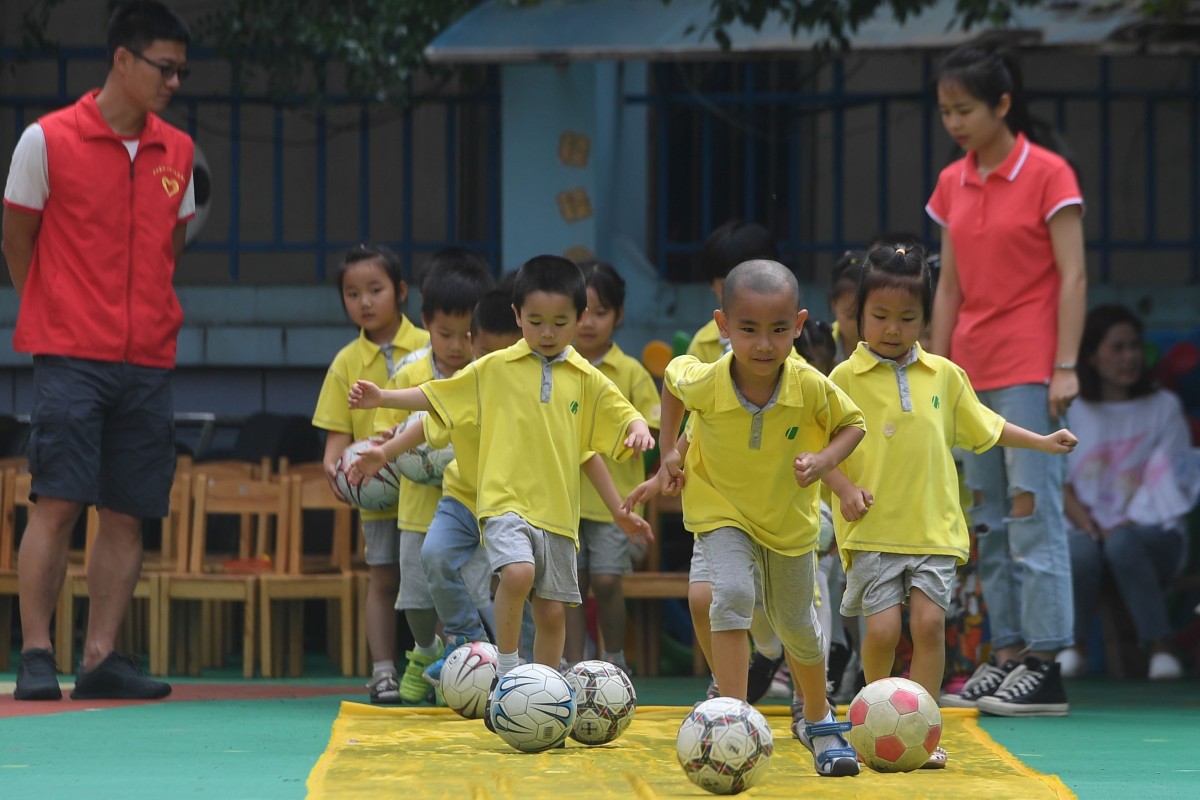
Xi Jinping’s hopes for China as a world footballing force begin with children such as pupils at the Central Kindergarten in Changxing county, eastern Zhejiang province. Photo: Xinhua
President Xi Jinping has vowed to make China a world footballing force and is prepared to go to great lengths to do it, sending thousands of toddlers to “football-focused” kindergartens.
China, which has a population of 1.4 billion but has underachieved in football, will kick the kindergartens scheme off this year, state media said.
Xinhua news agency, quoting education ministry officials, said that “each provincial-level region” will have 50 to 200 football-focused kindergartens.
“The pilot programme aims to cultivate interest in football in children and create an atmosphere favourable for football culture to grow,” Xinhua said, citing a ministry directive.
“Various physical activities tailored for kids will be held, during which children are encouraged to run, jump, climb, throw and shoot balls.”

Li Jianli, director of a kindergarten in the Chinese capital, told the Global Times: “We have soccer coaching for kids who are over five and many other kindergartens in Beijing run soccer programmes, too.”

In October, the Chinese Football Association announced plans for 10,000 kindergartens across the country.

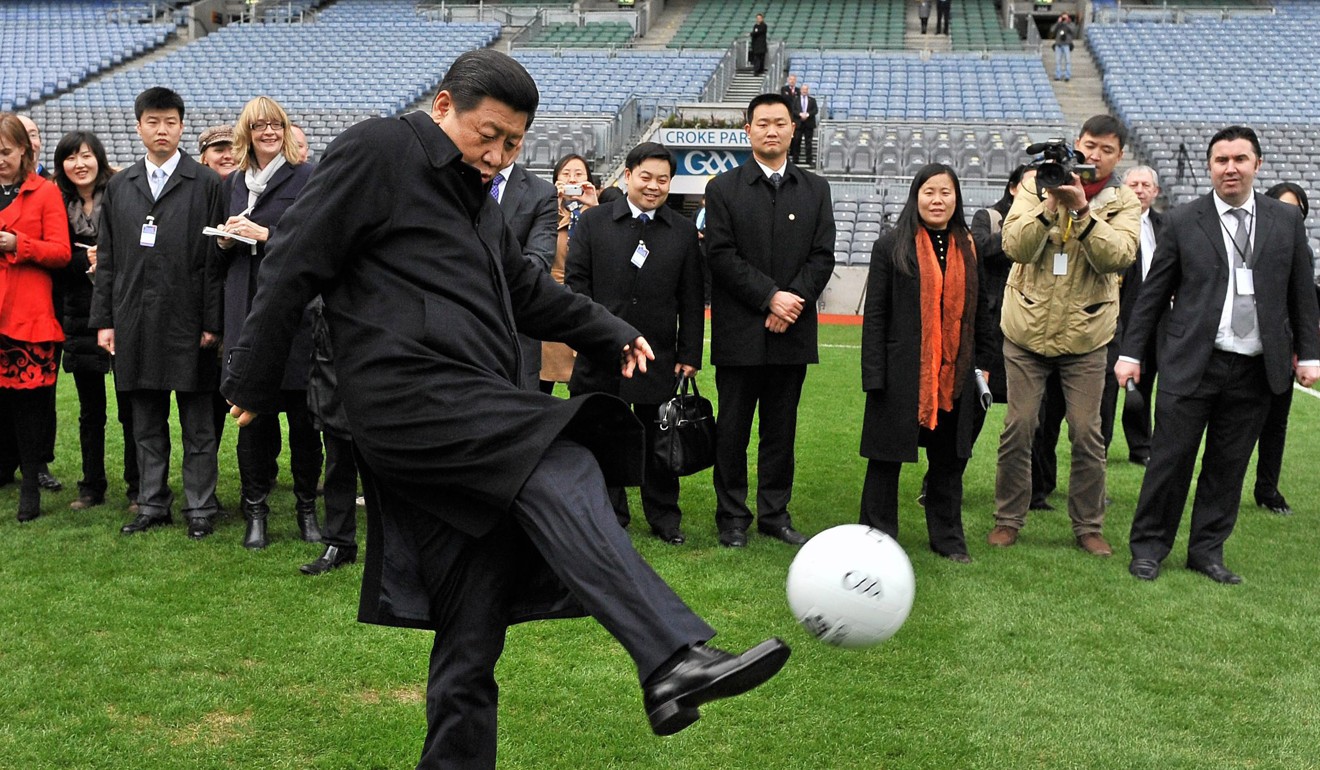
Football-fan president Xi has expressed ambitions for China’s Dragons to qualify for, host and win the World Cup.

Chinese Football Association wants naturalised players to have ‘patriotic feelings’ and learn about the party

So far, China has qualified for the World Cup only once, in 2002, when the team failed to win a point or score a goal.

China languishes at 72nd in the Fifa world rankings, between North Macedonia and El Salvador, and have lost their last three matches on the trot.

The government is dedicating resources to grass roots football, but a study recently revealed how the game was awash at the lower levels with unqualified coaches.

President Xi Jinping wants a generation of Chinese toddlers to aspire to play football on the world’s biggest stage. Photo: AP
02/04/2019

Gas explosion injures 66 at funeral in China after cooking canisters leak

  • Two people under criminal detention after guests suffer serious burns
  • Initial investigation finds the blast was caused by leakage from liquefied gas being used by a chef
Chairs were left strewn as people fled after the explosion. Photo: Weibo
Two people have been detained after more than 60 were injured in northern China on Sunday when gas canisters being used to cook for them at a funeral exploded.
Sixty-six people suffered burns in the blast, which an initial investigation found was caused by leakage of liquefied gas from tubes that were worn out, the local government said on Tuesday.
A cook was using the gas at around noon to prepare food for funeral guests gathering in a village in Bazhou, Hebei province, when a gas leak triggered an explosion, according to a government statement on WeChat, China’s most popular social media platform.

Some of the injured had sustained serious burns but none were critically injured, the statement said.

An unspecified number of people have been held responsible for the incident, and two of these were under criminal detention, it said.

Korean BBQ gas tank explodes in China, killing one and injuring 10

In a video showing the explosion’s aftermath, posted by ifeng.com, people can be seen running to vacate the scene as dozens of chairs lie scattered on a road in the village where two lines of dinner tables had been set up for guests, with cooking equipment and two gas canisters alongside.

In September, five people died after a liquefied gas tank exploded in a residential building in Hebei’s Baoding city, official media reported.

A total of at least 80 people were killed and over 900 were injured in blasts related to the commonly used cooking fuel last year, according to a report by Gas Explosion, a WeChat public account specialising in data analysis of such incidents.

Source: SCMP

02/04/2019

Chinese teacher suspected of poisoning children’s porridge

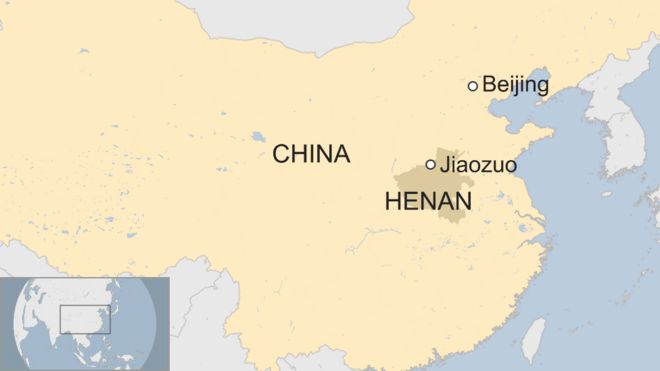
Map locator

A teacher at a kindergarten in central China has been detained by police on suspicion of poisoning 23 children, officials say.

The children were rushed to hospital after eating their morning porridge at the kindergarten in Jiaozuo city, Henan province, state media reported.

Preliminary investigations revealed the food contained high levels of sodium nitrite.

Police said a motive for the suspected poisoning was not yet clear.

However, Chinese media quoted police sources as saying the teacher had wanted to take revenge on a colleague.

The children began vomiting and fainting after eating their breakfast at the kindergarten last Wednesday, the Beijing News said. Police only reported the incident on Monday.

One parent said he was alerted by the school and arrived at hospital to find doctors had pumped his child’s stomach.

One child is still seriously ill and seven others are being treated in hospital, state run Xinhua news agency said. The other 15 were discharged.

According to local media, the school has been temporarily closed and the children distributed to other kindergartens.

Sodium nitrite is often used as a food additive for curing meat but can be toxic in high amounts.

Source: The BBC

Law of Unintended Consequences

continuously updated blog about China & India

ChiaHou's Book Reviews

continuously updated blog about China & India

What's wrong with the world; and its economy

continuously updated blog about China & India