Archive for ‘China alert’

31/03/2019

UK fashion brands battle for China’s growing market

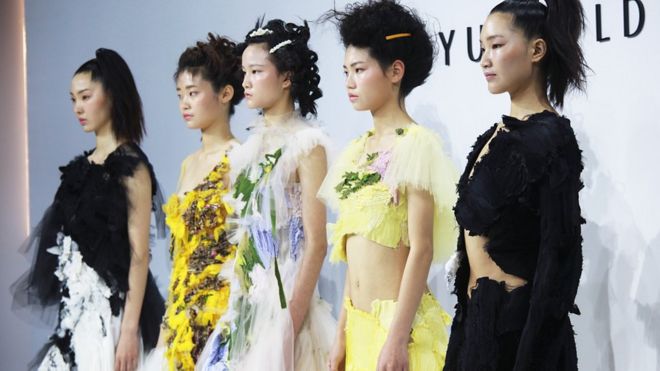
Caroline Hu collection at the BoF China Prize at Shanghai Fashion Week 2019Image copyrightGETTY IMAGES
Image captionModels wear designs by Caroline Hu, winner of the Business of Fashion (BoF) China Prize 2019 held during Shanghai Fashion Week

Over the next week Shanghai Fashion Week will fill the city with models, designers and buyers. The show is becoming a key route into China but the lucrative market remains difficult to navigate.

London-based fashion designer Roksanda Ilincic says she admires the adventurous spirit of her Chinese customers.

They’re experimental with a taste for clothes that are “vibrant and sculptural yet feminine”, she adds.

“The Chinese market really resonates with those parts of my DNA.”

For the first time Ms Ilincic is taking part in Shanghai Fashion Week, joining a wave of other foreign brands in search of exposure and crucial business contacts.

Observers say Shanghai Fashion Week, which runs until 3 April, buzzes with young talent and commercial potential.
Models at Shanghai Fashion WeekImage copyrightGETTY IMAGES
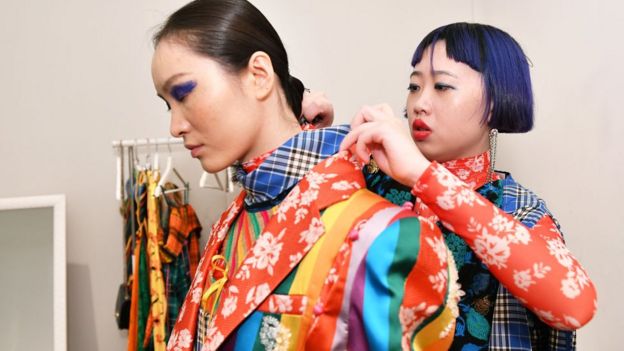
Image captionDesigner Qiu Shuting (right) dresses a model in her Shuting Qiu collection at the BoF China prize in Shanghai

Launched in 2003, it’s not one of the top four shows – London, Paris, New York and Milan – but its importance has grown alongside China’s economic rise.

“In Asia, there’s an emerging market where lots of the money is spent on Shanghai,” says Tianwei Zhang of Women’s Wear Daily (WWD) .

Many will skip Tokyo’s fashion week in favour of Shanghai “because there’s more money here”, he adds.

Last year, a report by consultancy Bain showed that Chinese spending accounted for one-third of the global luxury market – itself worth 260bn euros ($292bn; £223bn). In 2018, the country’s luxury goods market posted its second straight year of 20% growth, Bain said.

Western brands have long eyed the potential of China’s growing middle class, seeking to find their way into the lucrative – but sheltered – market. Securing business partners and buyers is crucial.
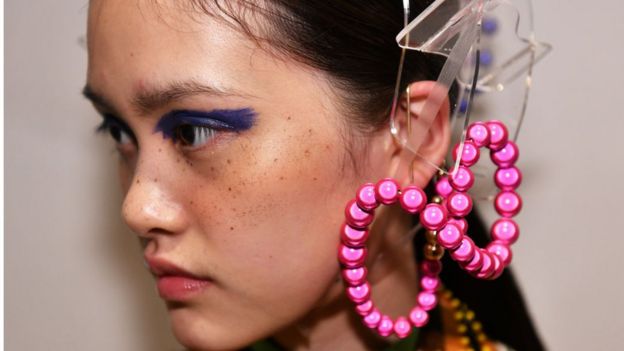
Model at Shanghai Fashion WeekImage copyrightGETTY IMAGES
Image captionA McKinsey-BoF report said China will overtake the US as the world’s largest fashion market in 2019

The British Fashion Council (BFC) is one group helping UK designers make inroads in China – from finding a space, to negotiating contracts or licensing arrangements.

BFC chief executive Caroline Rush says that while businesses can do it alone “the norm is to go in with a Chinese partner”. The group is in Shanghai this week to build its network.

It wants to plug into independent retailers across China that reach their customers through social platforms like WeChat and Weibo, and often sell through those channels directly.

“We’re also looking at partners that can help them open retail stores and the big e-commerce players that can help them in terms of mass distribution,” Ms Rush says.

The BFC is hosting a trade showcase with Roksanda Ilincic and Peter Pilotto in Shanghai, two brands Ms Rush describes as part of London’s “new guard”.
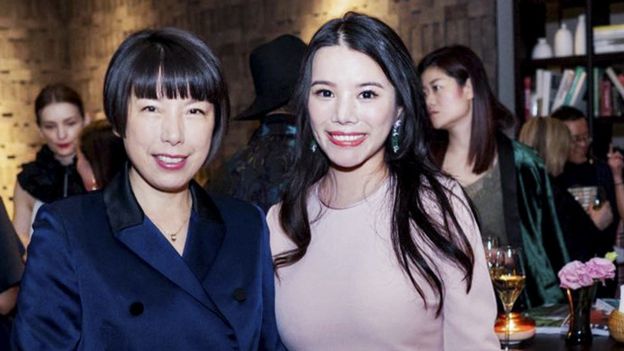
Editor in chief of Vogue China Angelica Cheung and Chinese fashion investor Wendy YuImage copyrightBRITISH FASHION COUNCIL
Image captionVogue China editor in chief Angelica Cheung with fashion investor and chief executive of Yu Holdings Wendy Yu at Shanghai Fashion Week

From buyers to fashion writers, industry figures routinely say Chinese consumers are drawn to the “creativity” of British design.

Among them is Yvonne Gan, chief executive of The Balancing, a chain of Shanghai boutiques, which sell top names including Britain’s Stella McCartney, Victoria Beckham and Anya Hindmarch.

Ms Gan says 40% of total investment in the latest collections was spent on British brands. Chinese labels accounted for just 5%: “Local design is not as creative as British designers [and] also quality is not comparable.”

Still, British firms are competing in a crowded market, trying to please the Chinese consumer – and not all of them get it right.

high-profile stumble from Dolce & Gabbana over an ad campaign widely seen as offensive led to a severe backlash in China with several retailers pulling the firm’s products.

Meanwhile, Burberry drew some criticism for missing the mark over its latest Chinese New Year campaign.

Other British brands have struggled to gain traction in China. Marks & Spencer left the market in 2017, New Look withdrew last year and Topshop has had troubles with local partners.
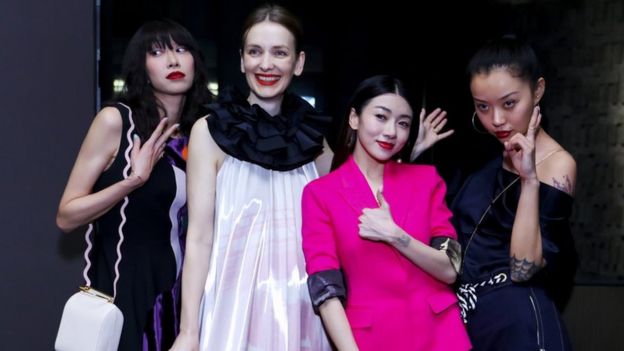
Yoyo Liu, Roksanda Ilincic, Yvonne Ching, Mia KongImage copyrightBRITISH FASHION COUNCIL
Image captionYoyo Liu, with designer Roksanda Ilincic, Yvonne Ching, Mia Kong at Shanghai Fashion Week

Irene Yu, senior director of merchandising at Chinese accessories retailer Pedder Group says Chinese consumers are “very fashion savvy”.

“They are sophisticated, well-travelled and demanding in quality and newness.”

Pricing is also a concern. While wealth is rising, hefty import taxes drive the cost of Western luxury labels beyond the reach of many.

“British fashion designers are still at a slightly higher price point,” WWD’s Mr Zhang says.

He says while spending power is rising, Chinese consumers are not yet as willing to spend on designer clothes as they are on shoes and accessories.
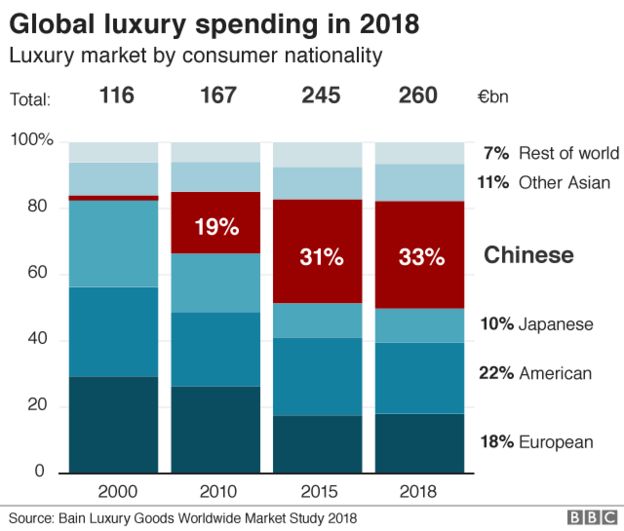
Global luxury spending breakdown

The competitive threat from local talent is also mounting.

There are big names like Angel Chen and Shushu/Tong, along with emerging designers like Caroline Hu and 8on8, all set to gain plenty of attention in Shanghai.

“There are more and more upcoming Chinese designers taking the international stage,” says Pedder Group’s Ms Yu. “They give a fresh perspective.”

Source: The BBC

31/03/2019

China plant explosion kills seven; second blast in Jiangsu province this month

BEIJING (Reuters) – A plant explosion in China’s Jiangsu province has killed seven people, state media reported on Sunday, 10 days after a blast at a pesticide plant killed 78 people in the province and triggered a nationwide safety inspection campaign.

Sunday’s blast involved a container of scrap metal that caught fire in a metal-molding plant in a bonded area in the city of Kunshan, state news agency Xinhua said.

The cause of the blast which killed seven people and injured five others was under investigation, Xinhua said.

The plant is owned by Kunshan Waffer Technology Corp Ltd., a Taiwan-based manufacturer of magnesium alloy injection molding products and aluminium alloy die castings.

Kunshan, about 70 km (43 miles) west of Shanghai, is home to more than 1,000 technology companies and manufacturers, including many Taiwanese firms.

The incident follows a deadly blast on March 21 at a chemical park in the city of Yancheng, also in Jiangsu province, that killed 78 people and focused attention on safety at small chemical firms.

China last week launched a month-long, nationwide inspection campaign into hazardous chemicals, mines, transportation and fire safety, saying authorities needed to absorb lessons from the Yancheng disaster.

China has clamped down on scrap metal imports as part of an environmental campaign against “foreign garbage”, tightening supply sources for metal producers, as it aims to cut solid waste imports by the end of 2020.

The country has a history of major work safety accidents which often trigger inspection campaigns aimed at rooting out violations and punishing officials for cutting corners or shirking their supervisory duties.

Source: Reuters

26/03/2019

Xi, Macron agree to forge more solid, stable, vibrant China-France partnership

FRANCE-PARIS-CHINA-XI JINPING-MACRON-TALKS

Chinese President Xi Jinping (L) holds talks with his French counterpart Emmanuel Macron at the Elysee Palace in Paris, France, March 25, 2019. (Xinhua/Xie Huanchi)

PARIS, March 26 (Xinhua) — Chinese President Xi Jinping and his French counterpart, Emmanuel Macron, on Monday agreed to carry forward the high-level ties between the two countries and forge a more solid, stable and vibrant China-France comprehensive strategic partnership on a new starting point in history.

The consensus was reached during the talks between Xi and Macron at the Elysee Palace in Paris.

Xi said that great changes have taken place in the international situation, but the China-France relations have always kept developing on a high level and in a sound and stable way.

He said that since President Macron took office, the bilateral ties have reached a new high in just less than two years, with many new outcomes achieved.

This year is of special commemorative significance, as it marks the 55th anniversary of China-France diplomatic ties, the 100th anniversary of the Chinese Work-Study Movement in France, and also the 70th anniversary of the founding of the People’s Republic of China, Xi said.

“Knowing the past can help people judge today and move on better,” he said.

The world is undergoing major changes rarely seen in a century, and humanity stands at a crossroads, and for China, France and Europe, they also come to a critical stage of development, the Chinese president said.

“China is willing to work with France to inherit the past and create the future, enable our close and enduring comprehensive strategic partnership to continue leading the way, and make more historic contributions to building an open, inclusive, clean and beautiful world that enjoys lasting peace, universal security and common prosperity,” Xi said.

TRUST, COOPERATION AND FRIENDLY SENTIMENTS

The Chinese president proposed that in order to develop the relations between China and France in a sound way, the two countries should have political mutual trust, practical cooperation and friendly sentiments between the two peoples.

“Under the new situation, the two sides should do much better in those three aspects, and continue to explore the way for major countries to get along with each other, which should feature independence, mutual understanding, foresight, mutual benefit and win-win outcomes,” Xi said.

“In politics, we should not only build a strong ‘dam’ of mutual trust, but also a ‘lighthouse’ of ideal,” he said.

He suggested that the two countries deepen communication and exchanges in an all-round way and on various levels, fully leverage the roles of all institutional dialogues, and increase the exchanges between governments, legislative bodies, political parties and armed forces.

The two sides should insist on respecting and accommodating each other’s core interests and major concerns, pursue harmony in diversity, and seek common ground while reserving differences, Xi said.

He urged the two countries to strengthen cooperation under the United Nations (UN), the Group of 20 and other multilateral frameworks, push for the implementation of the Paris agreement on climate change and the 2030 Agenda for Sustainable Development, take practical action to safeguard multilateral trading regime and uphold the basic norms governing international relations as underpinned by the purposes and principles of the UN Charter.

On practical cooperation between China and France, Xi said the two countries should not only explore the “source of flowing water” in market, but also facilitate the “river channels” in policies.

The two sides should deepen cooperation in nuclear energy, aviation, aerospace and other traditional sectors, and expedite cooperation in emerging areas including scientific and technological innovation, agriculture, finance and elderly care, Xi said.

President Macron has on many occasions expressed the willingness of carrying out practical cooperation with China on the Belt and Road Initiative (BRI), which China appreciates, Xi said, adding that the two sides need to earnestly implement the BRI-related demonstration projects in third-party markets.

He asked the two countries to provide more support and convenience for bilateral trade and investment.

Noting that China has newly approved its foreign investment law, Xi pledged that the country will continue to greatly relax market access, optimize business environment, strengthen intellectual property rights protection, and create a new pattern of high-level opening-up.

“We welcome more French businesses to invest and develop in China, and in the meantime, we hope the French side offers fair, open and non-discrimination treatment for Chinese businesses to invest in France,” Xi said.

On people-to-people and cultural exchanges, Xi called for enhancing both intergovernmental cooperation and non-governmental contacts.

The two countries should fully use the China-France high-level people-to-people and cultural exchange mechanism, and promote cooperation in culture, tourism, language, youths and at local level, he said.

Xi also asked the two countries to well organize the commemorative activities on the 55th anniversary of China-France diplomatic ties and the 100th anniversary of the Chinese Work-Study Movement in France, and to host a culture and tourism year in each other’s country in 2021.

Calling China and the European Union (EU) two major forces, markets and civilizations of today’s world, Xi said China attaches importance to Europe’s strategic status and role, and has always regarded deepening China-EU relations as a diplomatic priority.

China supports France in continuing to play a leading role in the process of Europe’s uniting for self-improvement, and hopes France exerts a more positive influence in pushing forward China-EU ties, Xi said.

The Chinese president also urged both sides to accelerate the negotiations on a China-EU investment treaty, and initiate a joint feasibility study on the China-EU free trade agreement at an early date.

Macron said since France and China forged diplomatic relations 55 years ago, the two sides have always respected each other, which allowed them to conduct extensive and productive cooperation.

Noting that the keynote of France-China comprehensive strategic partnership is cooperation, the French president extended his country’s congratulations to the People’s Republic of China for its huge achievements since its founding 70 years ago, and said that France is committed to being China’s reliable and assured strategic partner, and is willing to join efforts with China to build a balanced, stable, safe and prosperous world.

France has full confidence in the future of France-China relations, Macron said, pledging to boost cooperation with China in such fields as aviation, aerospace, nuclear energy, agriculture, finance, scientific research, automobile manufacturing and elderly care, and to align France’s Industry of the Future initiative with Made in China 2025.

France stands ready to actively participate in the second Belt and Road Forum for International Cooperation and the second China International Import Expo (CIIE), Macron said, adding that his country supports vigorously promoting bilateral exchanges and cooperation in education, culture, sports, tourism, military and defense affairs.

Speaking highly of China’s important leading role in tackling climate change and multilateral affairs such as peacekeeping, Macron stressed that France deems protectionism unacceptable.

France and China have a lot of common ground in international affairs and have maintained close communication and coordination, he said.

France and China, as well as the EU and China, can work together in advancing more global agenda, improving global governance system, and protecting multilateralism and free trade, he added.

The French president also pledged to actively push forward the EU-China cooperative relations, saying his country holds that the EU’s connectivity strategy and the BRI should be docked with each other.

After their talks, the two leaders witnessed the exchange of bilateral cooperation documents including third-party markets cooperation, and met the press together.

Macron held a grand welcome ceremony for Xi at the Arc de Triomphe before the talks.

Xi arrived in Paris from the southern French city of Nice on Monday to continue his trip to the country. Two French fighter jets escorted Xi’s plane as it flew from Nice to Paris.

It is the second state visit by Xi to the European country in five years.

France is the final stop of Xi’s three-nation Europe tour, which has already taken him to Italy and Monaco.

Source: Xinhua

26/03/2019

China, Egypt to further enhance defense cooperation

EGYPT-CAIRO-SISI-WEI FENGHE-MEETING

Egyptian President Abdel-Fattah al-Sisi (R) meets with visiting Chinese State Councilor and Minister of National Defense Wei Fenghe (L) in Cairo, Egypt, March 25, 2019. (Xinhua)

CAIRO, March 25 (Xinhua) — Egyptian President Abdel-Fattah al-Sisi pledged to further enhance defense cooperation with China during his meeting with visiting Chinese State Councilor and Minister of National Defense Wei Fenghe on Monday.

During the meeting, Sisi recalled the long-standing China-Egypt relation during which the two sides had achieved fruitful results from their cooperation in all fields and highlighted China’s contribution to world peace.

He hailed China’s great achievements in its development, saying that Egypt firmly supports the Belt and Road Initiative and expects to enhance cooperation in the field of infrastructure construction with the Chinese side.

Sisi also expressed his hope that the two sides can further enhance defense cooperation and conduct more cooperation in the fields of counter terrorism, joint military drills, armed forces buildup as well as defense industry.

Noting that the friendship between China and Egypt has a long history, Wei highlighted the comprehensive strategic partnership between the two countries, adding that it has gone deeper and achieved pragmatic results.

Wei said that China appreciates Egypt’s important role in international and regional issues, supports Egypt’s efforts to defend its independence and sovereignty, adding that China is ready to enhance cooperation and work together with Egypt to promote the Belt and Road Initiative to achieve better and faster development of bilateral relations.

Under the leadership of the two heads of state, the military cooperation between China and Egypt has achieved fruitful results. “We are willing to work together with the Egyptian armed forces to implement important consensus between the two leaders and develop a higher level of relations between the two armies,” Wei said.

Wei also met with Egyptian Defense Minister Mohamed Zaki on Sunday.

Source: Xinhua

26/03/2019

EU leaders hold out olive branch to Chinese ‘rival’ with hint they are open to Belt and Road Initiative

  • Angela Merkel says Europe is still keen to participate in infrastructure scheme despite concerns about spread of Chinese influence
  • EU Commission chief Jean-Claude Juncker seeks to reassure Chinese leader Xi Jinping that view of China as ‘strategic rival’ is a compliment
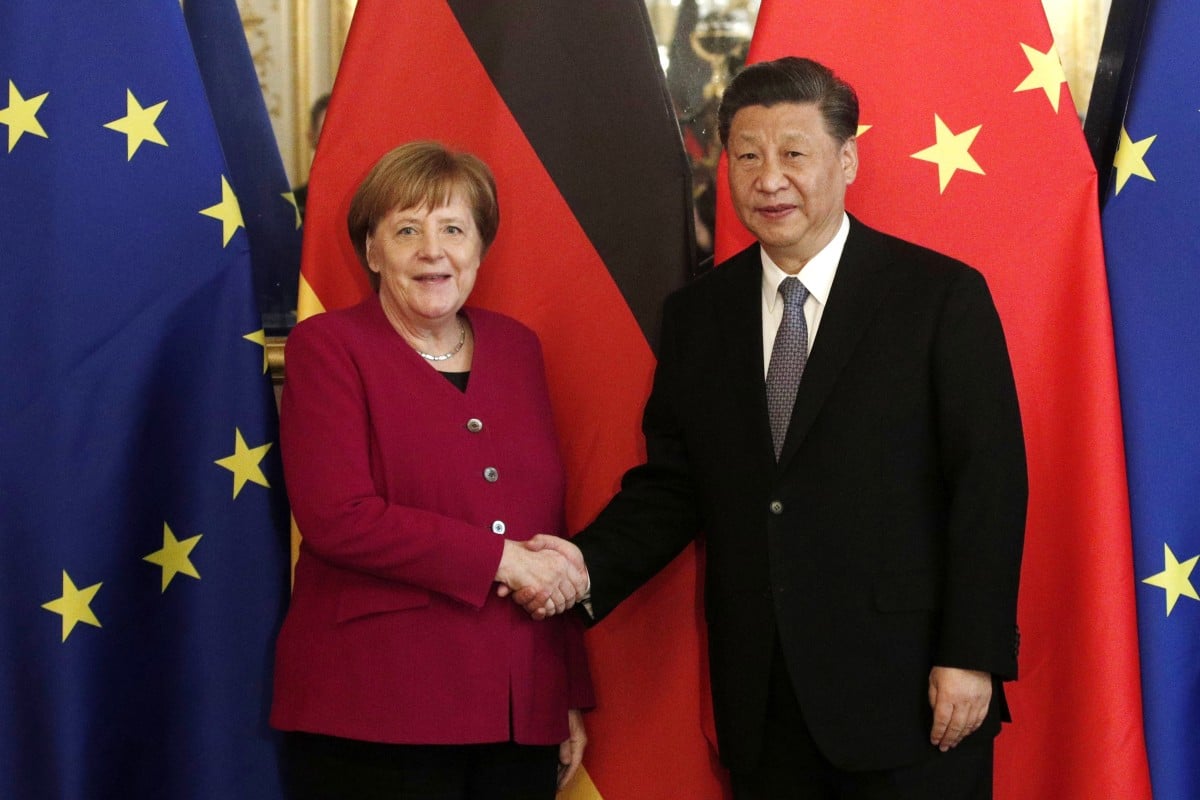
Xi Jinping and Angela Merkel and the Paris meeting. Photo: EPA-EFE

European leaders sought to reassure China over trade and cooperation on Tuesday by suggesting they were still open to joining China’s Belt and Road Initiative.

French President Emmanuel Macron, who is hosting his Chinese counterpart Xi Jinping on the final leg of his European tour, had invited German Chancellor Angela Merkel and European Commission President Jean-Claude Juncker to the meeting in Paris, where the four stressed their support for multilateralism and the pursuit of cooperation between major powers.

The visit took place amid growing European scepticism about China’s influence and follows a decision by Brussels to brand China a “systemic rival” in a policy paper earlier this month.

The scheme has caused increased concern in the West about the extent to which it will help spread Chinese influence, especially since Italy became the first G7 economy to join the project over the weekend.

But Merkel stressed it was an important project that Europeans still wanted to participate in.

She continued: “We, as Europeans, want to play an active part and that must lead to a certain reciprocity and we are still wrangling over that a bit.

“We are seeing the project as a good visualisation of interaction, interrelation and interdependence.”

Xi also said China’s process of opening up its economy to the world had allowed the country to achieve in the space of 40 years what the Europeans had managed over the course of the industrial revolution.

“We will continue to open up,” he said, “and to make the world a better open economy.”

“The Belt and Road Initiative has enriched the world’s multilateral system, we welcome all countries, including France, to join,” Xi said.

The US has also put increasing pressure on European countries to block the Chinese tech giant Huawei, which it sees as a security threat, from playing a role in European communications networks.

Despite her support for Xi’s stance on multilateralism, Merkel was still keen to express support for America’s role in upholding global order.

“The triangle between EU, China and US is very important. Without the US, we will not be able to have multilateralism. Our relations from the European side are obviously very important,” Merkel said.

However, she also noted that the trade war between the US and CHina was “hitting our German economy” and disturbing the balance.

Source: SCMP

26/03/2019

How a Chinese firm fell victim to intellectual property theft

Frank Liu, head of Intco in Shanghai?
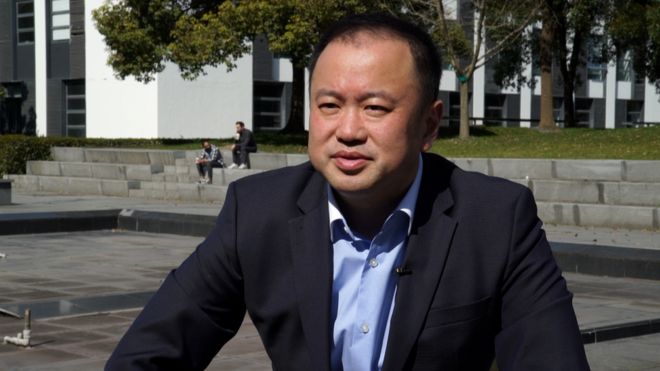
Image captionFrank Liu says his company Intco was the victim of intellectual property theft

There was no break in, no hold up. No glass was smashed. But the factory on the outskirts of Shanghai was the scene of a very modern crime. Someone stole a hoard of intellectual property.

“A couple of years ago one of my IT managers copied ten thousand pages of my entire company’s profile,” Frank Liu told me. His company Intco has been around for 25 years.

He told me the stolen download included “our technology information, our customer list, our purchasing and supply information. Everything.”

Intco is a business that makes medical devices, skirting boards and photo frames. I visited its offices at a business park in Shanghai, and a factory that sits either side of a tree-lined road south of the city.

The company recycles polystyrene waste sent to China from all over the world. Then, using heat moulding and imprinting techniques, it turns it into an array of products which end up on the floors of houses in Brazil or Russia, or hanging on walls displaying photos in the US and Britain.

“We actually have the record of how he stole it,” Mr Liu told me. “He just sold it to establish another company, as his investment.”

Mr Liu feels he has no recourse. He told me he went to the police but nothing happened. He said he still intends to pursue it.

His story is increasingly common here, for both local businesses and foreign firms.

Top officials from the US and China will hold their next round of trade talks this week and protecting intellectual property (IP) is a key demand for Washington. They argue American and other foreign companies in China have endured decades of theft and infringement.

Reacting to pressure

China has taken some steps to address the problem. The country only established copyright laws in the 1980s, but things have progressed relatively quickly since then.

China now has specialist IP courts, albeit – like every aspect of the judicial system – subservient to the ruling Communist Party. They are supposed to settle cases within 12 to 18 months.

Their creation was not due solely to outside pressure from foreign firms.

Chinese business figures like Mr Liu have also called for the country’s legal system to better protect the innovators and entrepreneurs who have turned China into much more than the “copycat” economy it was once labelled.

Benjamin Qiu, an IP lawyer with US law firm Loeb & Loeb, told me that the Chinese are now just as litigious as foreign firms.

Foreign firms are just as likely to win a case – a good case, Mr Qiu added – as domestic plaintiffs. In the past few years Lego and New Balance have both won high-profile cases against copycat manufacturers.

There is no doubt that the trade war with the US has sped up the pace of reform in China.

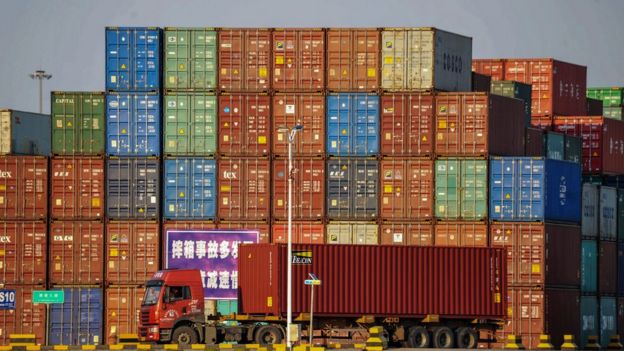
A truck transports a container next to stacked containers at a port in Qingdao in China's eastern Shandong province on October 12, 2018.Image copyrightGETTY IMAGES

President Xi Jinping recently led lawmakers, at their annual gathering in Beijing, in approving new rules for foreign investors.

The Foreign Investment Law states that the transfer of technology from foreign investors to any domestic partner must be voluntary. China has always defended this highly contentious practice by insisting it’s part of an agreed commercial arrangement.

The new law also bars government officials from passing on details of foreign investors IP.

A new era?

Now though comes the hard part – enforcement.

Mr Qiu told me the next step is “detailed regulation coming out after this law, and we want to see actual cases in local courts and also from enforcement agencies.”

If that follows, then he thinks “potentially the foreign IP owners will have more to protect [them] in China.”

Both the EU and American Chambers of Commerce welcomed the new law, but both also criticised what they said was ambiguity in the legislation. The Americans also had concerns that it was rushed through without proper consultation.

Many foreign companies have been stung over the years in China. Most have found the lure of the massive market, or what was once rock bottom labour costs, irresistible.

Some though feel the risk is too high.

A fruit industry executive recently told me his firm wanted to buy new conveyor belts for their farms in China, but the European manufacturers said no. They feared their systems would be copied here, and they’d be wiped out.

Mr Liu can’t do that. He is Chinese and wants to stay in China. But he has taken steps to try to prevent another IP theft.

Production line at an Intco factory in Shanghai
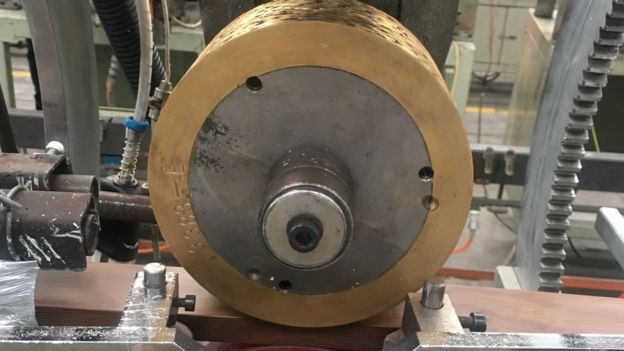
Image captionProduction line used to create photo frames at an Intco factory in Shanghai

He is chief executive of the company he founded, but this year he told me he’s changing his title to include head of research and development. Because he can’t trust anyone else with the firms’ commercial secrets.

Protecting original ideas, techniques and information in China – “it’s a human right” he told me.

Source: The BBC

26/03/2019

Chinese smartphone firms jazz up products, seize turf in home market from Apple

SHANGHAI (Reuters) – Smartphone retailers in China say it’s a tough sell of late with consumers reluctant to upgrade, put off by chill economic winds.

Even so domestic brands led by Huawei have made big strides, wooing consumers with top-notch hardware and innovative features as they move upmarket in the $500-$800 price range. The result: a loss of share in a key segment for Apple Inc and fresh price cuts for iPhones by Chinese retailers.

“Of those people who are upgrading, there are many switching from Apple to Chinese brands but very few switching from Chinese brands to Apple,” said Jiang Ning, who manages a Xiaomi store in the northern province of Shandong.

Huawei Technologies Co Ltd, Xiaomi Corp, Oppo and Vivo once sought to grab share in the world’s biggest smartphone market with value-for-money devices, but consumer demand for better phones has prompted strategic rethinks.

“People are more attached to their phone than ever and have higher expectations for the function and experience it offers. The response has been constant upgrading of hardware specs,” Alen Wu, global vice president at Oppo, told Reuters.

He Fan, CEO of Huishoubao which buys and resells used phones, said he has seen a consumer shift to Huawei from Apple, driven by the Chinese love of selfies and emphasis on camera quality. Huawei has had a tie-up with German camera maker Leica since 2016.

“Huawei’s cameras have become noticeably better than Apple’s in that they suit the tastes of Chinese consumers more,” he said.

Compared to dual-cameras common in most smartphones, Huawei’s P20 Pro device boasts three rear-facing cameras, with the additional one improving zoom capabilities.

It is one of several new devices in its P20 and Mate 20 lines, which helped Huawei’s share of the $500-$800 segment in China surge to 26.6 percent last year from 8.8 percent, data from research firm Counterpoint shows.

Apple, by contrast, saw its share of the segment tumble to 54.6 percent from 81.2 percent, also hurt by its decision to move even further upmarket with the iPhone X series.

“Most Chinese smartphone buyers are not ready to shell out beyond $1,000 for a phone,” said Neil Shah, research director at Counterpoint. “This left a gap in the below-$800 segment, which Chinese vendors grabbed with both hands.”

Shipments of phones priced above $600 in China grew 10 percent in 2018, data from research firm Canalys shows. By contrast, the overall market shrunk 14 percent, marking a second year of contraction.

OVERSEAS GAINS

The weaker cachet for Apple in China was underscored this month when several major retailers simultaneously cut iPhone prices for a second time this year.

A 64GB iPhone 8 sold at Suning.com Co Ltd now costs 3,899 yuan ($580), roughly 25 percent less than it did in December. That’s also lower than its $599 price tag in the United States, where iPhones typically cost less to buy than in China. Most iPhone models through to the iPhone 8 series have seen prices in China cut, albeit not equally.

In earnings too, it seems to be a tale of divergent fortunes. Apple’s October-December revenue from the Greater China region fell by about a quarter from a year earlier. Greater China currently accounts for 15.6 percent of its overall revenue.

Huawei, the world’s No. 2 smartphone maker, has estimated revenue for 2018 rose 21 percent, which analysts attribute in large part to robust smartphone sales.

More broadly, fewer sales for Apple means fewer customers for its App Store and media streaming services. The shift to higher-end phones by Chinese brands has also meant greater inroads in overseas markets.

Huawei’s shipments in Europe jumped 55 percent in the latest quarter and it now has 23.6 percent market share, according to Canalys. That’s not far behind Samsung Electronics and Apple which saw small declines in shipments.

OPPO, VIVO

If Huawei is taking the lion’s share of turf that Apple once had in China, Oppo and Vivo – brands owned by electronics hardware conglomerate BBK – are the newest threats.

In June, Vivo launched the Nex which starts from 3,898 yuan ($610) and in July, Oppo launched the Find X, priced at 4,999 yuan ($755).

The models mark the first time the brands have priced a phone above $600, a sharp departure from their roots selling $300-$500 models to young consumers in second-tier cities.

The devices came with features unavailable in the iPhone, including under-the-glass fingerprint sensors and “notchless” displays, both of which increase the size of usable screen.

Xiaomi too is going upmarket, announcing in January it would split off its low-budget Redmi range of phones into a sub-brand. In doing so, it is taking a leaf out of Huawei’s book which has for years sold cheaper devices under the Honor brand, helping differentiate its products.

Redmi will target international markets and e-commerce sales, while the flagship Xiaomi brand will target China and offline retail markets, company founder Lei Jun told reporters.

Last month, Xiaomi unveiled the Mi 9, its latest flagship device with a price tag of 2,999 yuan ($450). But the company also said it might be the last time a Xiaomi flagship phone would be priced under 3,000 yuan.

“Xiaomi’s flagship series phones were once always set at 1,999 yuan,” said Lei. “This was a contributing factor to our rise, but it also became an obstacle to our growth,” he said.
Source: Reuters
22/03/2019

Chinese president arrives in Italy for state visit

ITALY-ROME-XI JINPING-ARRIVAL

Chinese President Xi Jinping (L) and his wife Peng Liyuan disembark from the airplane upon their arrival in Rome, Italy, on March 21, 2019. Xi arrived in Rome Thursday for a state visit to Italy to map out the future of the bilateral relationship and move it into a new era. (Xinhua/Wang Ye)

ROME, March 21 (Xinhua) — Chinese President Xi Jinping arrived in Rome Thursday for a state visit to Italy to map out the future of the bilateral relationship and move it into a new era.

It is the first visit by a Chinese head of state to the European nation in 10 years.

Two Italian fighter jets escorted Xi’s plane as it entered the country’s airspace.

Xi and his wife, Peng Liyuan, were greeted by senior Italian government officials at the airport.

While delivering a written speech upon arrival, Xi said that the China-Italy relations have withstood the test of time and international vicissitudes since the two countries forged diplomatic ties 49 years ago.

Upholding the principle of mutual respect, trust and benefit, China and Italy have constantly promoted their friendship and cooperation, setting an example of developing bilateral ties between two countries of different social systems, cultural backgrounds and development stages, Xi said.

The practical cooperation between the two countries has yielded fruitful results, bringing tangible benefits to the two peoples, said Xi, adding that the bilateral cultural and people-to-people exchanges are rich and colorful, and have enhanced mutual understanding and friendship.

The Chinese president noted that he is looking forward to meeting the Italian leaders to jointly draw the blueprint for the future development of bilateral relations.

“I believe with the concerted efforts of both sides, the China-Italy comprehensive strategic partnership will enjoy a better tomorrow,” Xi said.

Italy is the first stop of Xi’s three-nation Europe tour, which will also take him to Monaco and France.

Source: Xinhua

22/03/2019

Seven dead after man drives car into crowd in central China

  • Motorist kills six as he ploughs into passers-by, before being shot dead by police
A man drove a car into a crowd on Friday morning, killing six and injuring seven in Hubei province. Photo: Thepaper.cn
Police in central China shot dead a man who drove a car into a crowd on Friday morning, killing six and wounding six others, including children, Chinese media reported.
The police received calls at around 6am about someone driving into pedestrians in the township of Taiping in Hubei province. Officers shot the driver dead, taking the death toll to seven.
The Zaoyang municipal government, which administers Taiping, said the motorist was 44-year-old restaurant owner Cui Lidong.

A police investigation into the incident was under way.

A video published by news portal Thepaper.cn shows several people lying on the ground as an ambulance arrives at the scene.

One witness identified only as Wang said the car ploughed randomly into pedestrians and other vehicles, the Beijing News reported.

Another witness said: “There were bodies everywhere on the street.”

The reports prompted debate online about whether the incident was yet another case of “revenge on society”, where the suspect lashes out at the public to settle personal scores or draw attention to a dispute.

There have been several such revenge cases in recent years, including car crashes, knife attacks and bombings in which the victims were mostly pedestrians or schoolchildren.

In March, police in Tangshan, Hebei province, arrested a man for attacking several pupils outside a primary school. In September 2018, a driver crashed a car into a crowd in central China before attacking pedestrians with a knife and shovel, killing 11 and wounding 44.

Source: SCMP

22/03/2019

China chemical blast death toll rises to 47

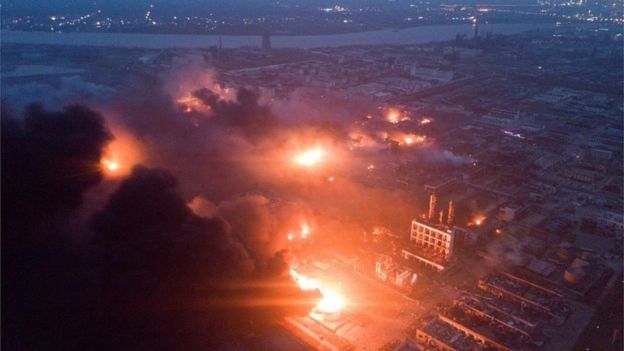
The death toll in a huge blast at a chemical plant in eastern China has jumped to 47, with 90 badly injured, according to state news agency Xinhua.

The powerful explosion followed a fire at the factory which produces fertiliser.

China’s earthquake administration reported a tremor equivalent to 2.2-magnitude at the time of the blast.

The death toll makes it one of the country’s worst industrial accidents in recent years.

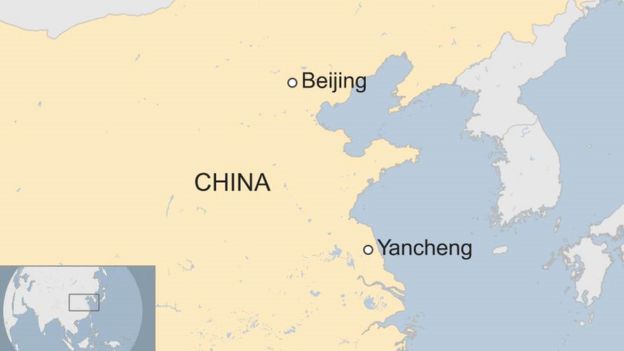
The blast happened at about 14:50 local time (06:50 GMT) on Thursday at a plant in Yancheng, run by Tianjiayi Chemical.

According to Xinhua, a total of 640 people were sent to hospital. Many were in critical condition and dozens had severe injuries, the agency reports.

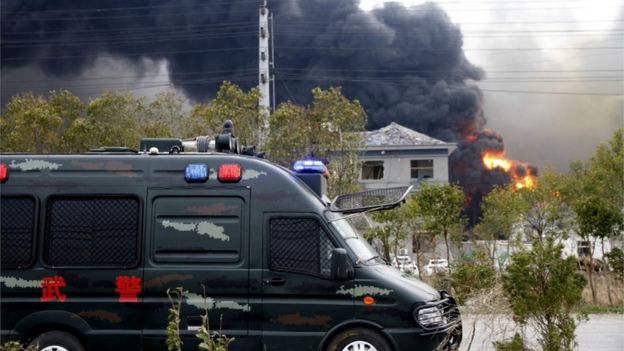
Overhead view of the Tianjiayi Chemical plant on fire with smoke billowingImage copyrightREUTERS
Image captionThe scale of the destruction is clear
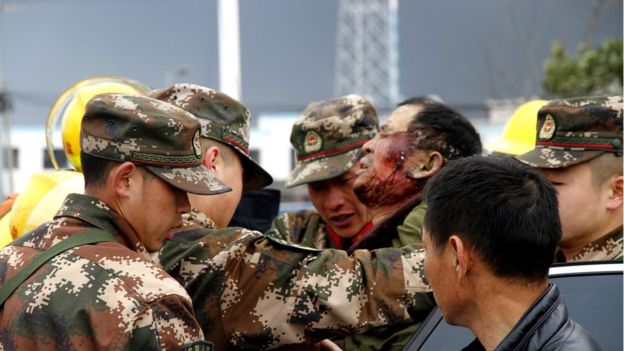
Armed police officers carry an injured man after an explosion at a chemical industrial parkImage copyrightGETTY IMAGES
Image captionHundreds were injured in the explosion, which was reportedly started by a fire at the plant

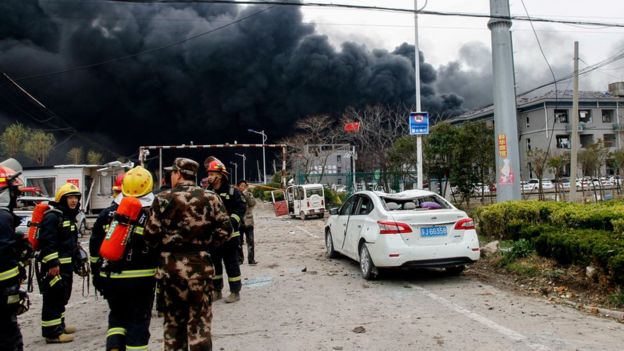
Images of the site showed a fireball exploding, billowing clouds enveloping the area, injured people, and damage to buildings.

The blast was so powerful that it knocked down factory buildings some distance away, trapping workers, according to local media.

Staff at the Henglida Chemical Factory, 3km (1.8 miles) from the explosion, said its roof collapsed as they fled, and windows and doors were blown out.

Provincial authorities said firefighters had to be brought in from across the province.

The fire was brought under control at around 03:00 local time on Friday, state TV said.

Police at the site of the explosionImage copyrightGETTY IMAGES
Image captionThe cause of the accident is under investigation

One woman, who gave her surname as Xiang, said she had been concerned about safety and pollution levels at the plant for some time.

“We knew we’d be blown up one day,” said told AFP.

Reuters quoted local officials as saying there had been no abnormalities detected at the site before the blast, but that the province would be conducting emergency inspections of other chemical producers and warehouses.

A police van in front of a house with blown out windows, the factory on fire in the background, in Yancheng, ChinaImage copyrightREUTERS
Image captionThe blast blew out windows of buildings across a wide area

Industrial accidents ranging from factory fires to mining disasters are common in China, often due to poorly enforced safety standards.

The biggest accident in recent years was the August 2015 Tianjin explosion, which killed more than 160 people and injured nearly 1,000.

The exact cause of Thursday’s explosion is still under investigation. Tianjiayi Chemical, founded in 2007, has received six government penalties in the past over waste management and air pollution, according to the South China Morning Post.

President Xi Jinping has called for an “all-out effort” to aid the injured and said authorities must learn lessons from the blast prevent future accidents.

Yancheng, China

Source: The BBC

Law of Unintended Consequences

continuously updated blog about China & India

ChiaHou's Book Reviews

continuously updated blog about China & India

What's wrong with the world; and its economy

continuously updated blog about China & India