Chindia Alert: You’ll be Living in their World Very Soon
aims to alert you to the threats and opportunities that China and India present. China and India require serious attention; case of ‘hidden dragon and crouching tiger’.
Without this attention, governments, businesses and, indeed, individuals may find themselves at a great disadvantage sooner rather than later.
The POSTs (front webpages) are mainly 'cuttings' from reliable sources, updated continuously.
The PAGEs (see Tabs, above) attempt to make the information more meaningful by putting some structure to the information we have researched and assembled since 2006.
Li Zhanshu, chairman of the Standing Committee of the National People’s Congress (NPC), meets with Speaker of the Czech Chamber of Deputies Radek Vondracek in Beijing, capital of China, Nov. 7, 2019. (Xinhua/Ding Haitao)
BEIJING, Nov. 7 (Xinhua) — Chinese top legislator Li Zhanshu met with Speaker of the Chamber of Deputies Radek Vondracek in Beijing on Thursday.
Li, chairman of the Standing Committee of the National People’s Congress (NPC), said China and the Czech Republic have traditionally enjoyed friendly ties, and China’s further opening-up will bring greater opportunities for cooperation between the two countries.
Li called on China and the Czech Republic to uphold mutual respect, mutual trust and mutual benefit to push the strategic partnership between the two countries to new heights.
The NPC stands ready to work with the parliament of the Czech Republic, he said.
Vondracek said the Czech Republic is willing to seize the important opportunity provided by China’s development and further opening-up, enhance high-level exchanges, promote practical cooperation and explore the Chinese market. The Czech Republic will continue to uphold the one-China principle, he said.
French leader calls for restraint and says he raised the topic ‘on several occasions’ during his visit
Two sides find common ground on need to defend free trade and fight climate change as Donald Trump starts process of pulling US out of Paris Climate Agreement
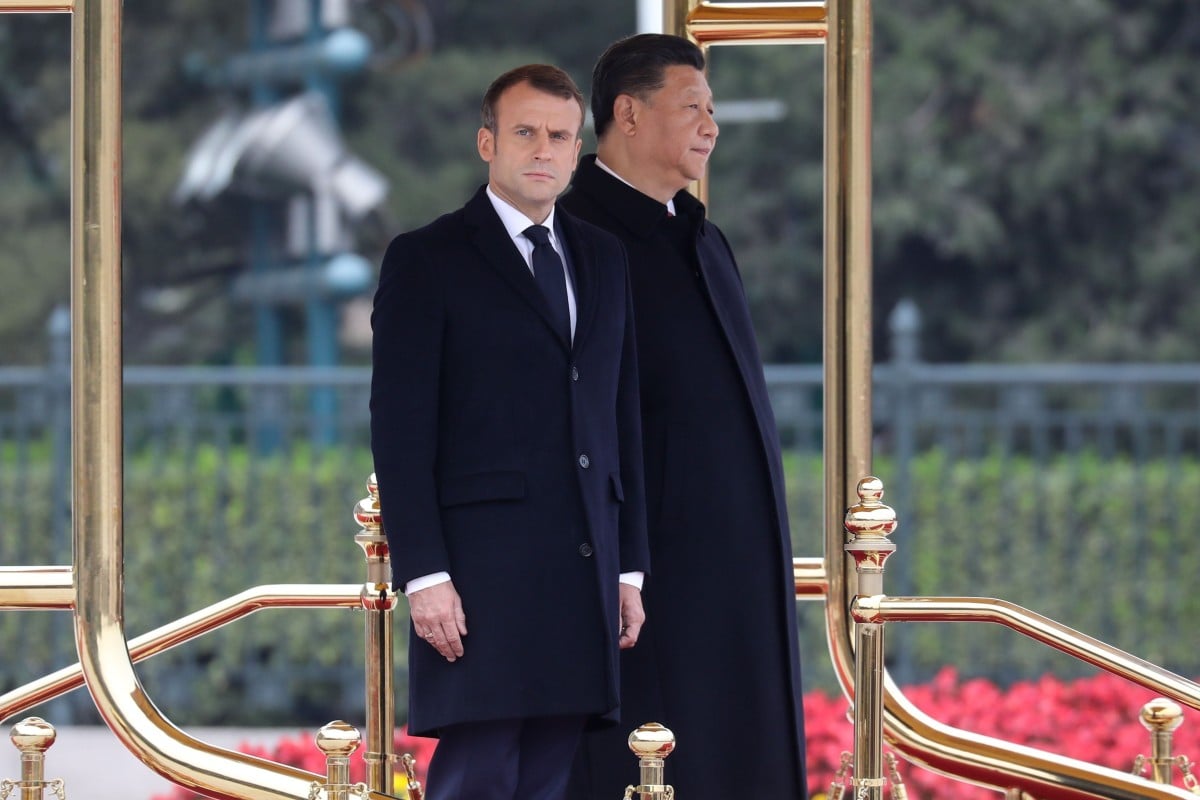
Xi Jinping and Emmanuel Macron at a welcome ceremony ahead of their talks in Beijing on Wednesday. Photo: AFP
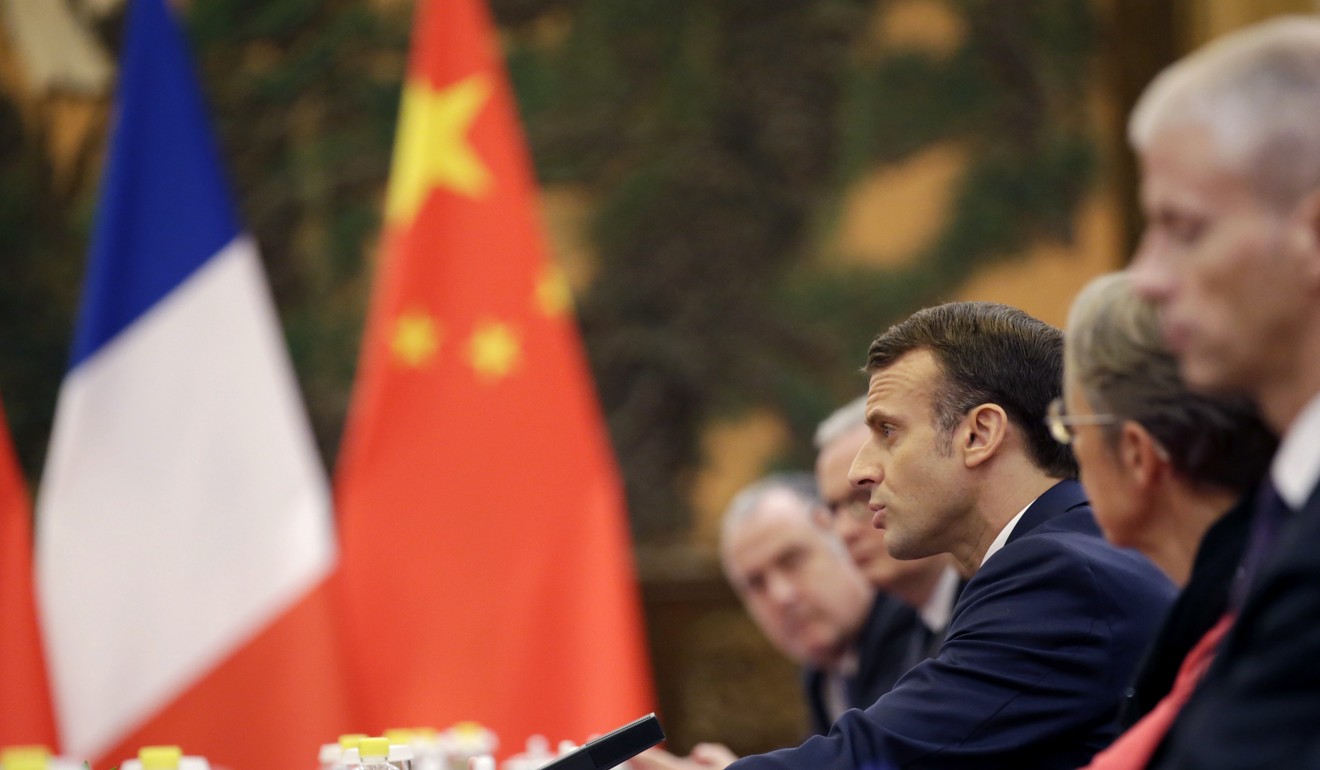
French President Emmanuel Macron said he raised human rights and the Hong Kong situation during his talks with his Chinese counterpart Xi Jinping on Wednesday.
Macron’s visit to China concluded with pledges to work together on climate change, but the French leader also said he also called for a de-escalation of the situation in the city through dialogue after months of protests.
Macron, who had promised to raise “taboo” topics during the visit, told a press conference: “I obviously raised this with President Xi Jinping on several occasions.
“We have repeatedly called on the parties involved to [engage in] dialogue, to show restraint, to de-escalate.”
The discussion followed Xi’s meeting with Hong Kong’s embattled Chief Executive Carrie Lam Cheng Yuet-ngor in Shanghai on Monday, where he expressed “high trust” in her and “fully affirmed” support for her response to the unrest that has gripped the city since June.
Earlier the French and Chinese leaders had restated their commitment to protect free trade and pledged their continued support for the Paris Agreement as the United States begins the process of formally withdrawing from the global climate deal.
Macron expressed “regret” over “some countries’ negative attitude” towards environmental protection and the fight against climate change and pledged to work with China to halt the loss of biodiversity.
The French president’s office also released a statement on Wednesday that reaffirmed France and China’s joint support for the “irreversible” Paris Agreement.
Macron points to common ground with China on tariffs and climate action
With the European Union, China and Russia backing the pact, he added, “the isolated choice of one or another is not enough to change the course of the world. It only leads to marginalisation.”
The two countries also agreed to work together to develop joint nuclear power projects and signed a series of contracts worth US$15 billion.
The deals covered aeronautics, energy and agriculture, including approval for 20 French companies to export poultry, beef and pork to China.
An additional action plan released after the talks said French utility giant EDF and China General Nuclear Power should be encouraged to cooperate on projects in China or third countries, citing the joint efforts by the two companies to build nuclear reactors at the Hinkley Point C station in Britain as an example.
The two sides also committed to signing a contract for the construction of a nuclear fuel recycling plant in China, which would involve French energy giant Orano, by January 31.
Xi took what appeared to be a veiled swipe at the United States, which is still embroiled in a protracted trade war and other confrontations with Beijing.
“We advocate for mutual respect and equal treatment, and are opposed to the law of the jungle and acts of intimidation,” Xi said.
“We advocate for openness, inclusion and for mutually beneficial cooperation, and are opposed to protectionism and a zero-sum game.”
Macron said China and the European Union should work in partnership as the world became more unstable, calling on the two sides to further open up market access.
“We call again for trade multilateralism to respond to distortions that have appeared in the global economy, which have led to a profound rise in inequalities and imbalances that explain the surge of challenges to the international systems,” he said.
“China and Europe also share the same views that the trade war only leads to loss.”
Macron kicks off China visit with deal to protect wine and cheese from counterfeiting
Chinese state news agency Xinhua said the two countries agreed to work together to push forward with plans to assemble Airbus’s A350 model in China.
Meanwhile, Beijing Gas Group and French utility firm Engie will collaborate on a liquefied natural gas terminal and storage in the northern city of Tianjin, while France’s Total will set up a joint venture with China’s Shenergy Group to distribute liquid nitrogen gas by truck in the Yangtze River Delta.
The two countries also agreed to reach an agreement by the end of January 2020 on the cost and location of a nuclear fuel reprocessing facility to be built by Orano, formerly known as Areva.
Wu Libo a professor and director of the Centre for Energy Economics and Strategies Studies at Fudan University, said there was “great potential” for further cooperation between the two countries on nuclear energy.
“France has many useful experiences in the operation and management of nuclear power plants and its plants have long-term safe and stable operation records,” she said.
The two sides agreed to work together on joint nuclear power projects. Photo: AP
Jiang Kejun, a senior researcher at the Energy Research Institute of China’s National Development and Reform Commission, said China’s cooperation with France would add credibility to potential third-country projects.
“China has advanced third-generation technology but it’s still a new member in the nuclear power market, while France has developed nuclear energy for a long time, and its EPR reactors – a technology designed and developed in France – are in business operation,” he said.
Jiang said possible markets for the joint projects included Argentina and India, while some Middle Eastern states – such as Saudi Arabia and Qatar – had expressed interest in nuclear energy.
China’s ambassador hits out at Macron’s team for backing ‘hypocritical’ EU stance on Hong Kong
Tong Jiadong, professor of international trade at Nankai University, said that the deals between the two sides helped show that France and China could work together to counteract US unilateralism.
“Objectively speaking, this will form, or at least imply, an opposition to US unilateralism,” Tong said. “China hopes the cooperation between these two countries produces demonstrable effects for other EU member states.”
Ding Chun, a professor of European Studies at Fudan University, said he did not think the EU wanted to “choose a side” between the US and China.
But Ding continued: “If we are talking about free trade and multilateralism, there’s no doubt that the EU and China share a common view and can balance Donald Trump’s unilateralism.”
Chinese Premier Li Keqiang addresses the 22nd China-ASEAN (10+1) leaders’ meeting in Bangkok, Thailand, Nov. 3, 2019. (Xinhua/Zhai Jianlan)
BANGKOK, Nov. 3 (Xinhua) — Chinese Premier Li Keqiang on Sunday called on China and ASEAN to uphold multilateralism and free trade, resist risks and realize common development at the 22nd China-ASEAN (10+1) leaders’ meeting in Bangkok.
Since China and ASEAN established dialogue relations, they have brought benefits to each other and the wider region, Li said, adding that China always supports ASEAN’s central role in East Asian cooperation.
Noting that the mounting downward pressure on the global economy brings new severe challenges, Li said China and ASEAN countries should jointly uphold multilateralism and free trade, withstand risks and realize common development.
The premier said China and ASEAN countries should stick to the principle of shared benefits and win-win outcomes, and speed up the work to upgrade economic and trade cooperation.
He called for an early conclusion of the negotiations on the Regional Comprehensive Economic Partnership (RCEP) so as to lay the foundation for East Asia’s economic integration, and the implementation of the China-ASEAN Free Trade Area Upgrade Protocol to promote trade and investment liberalization and facilitation.
Li said China and ASEAN countries should enhance strategic mutual trust and safeguard peace and stability in the region.
The Code of Conduct (COC) in the South China Sea is an upgraded version of the Declaration on the Conduct of Parties in the South China Sea (DOC). Last year, China proposed that all parties should try to finish the COC talks in three years. The first reading of the single draft negotiating text of the COC in the South China Sea has been completed ahead of schedule, and the second reading has been launched.
Li said he hopes all sides will actively carry forward the consultations according to the previously agreed timetable, meet each other halfway, and safeguard peace and stability in the South China Sea.
The premier also said China and ASEAN countries need to carry forward their friendship from generation to generation, and stay ready to enhance people-to-people and cultural exchanges in such areas as media, health, education and tourism.
China is willing to train 1,000 administrative health staff and technical professionals in the following three years for ASEAN and will support projects such as the China-ASEAN Young Leaders Scholarship, said the premier.
Stressing that China will unswervingly pursue the path of peaceful development and an opening-up strategy of mutual benefit, Li said China is willing to synergize the Belt and Road Initiative with the development strategies of ASEAN as a whole and its members as well.
He urged to accelerate the construction of the existing economic corridors, promote infrastructure connectivity cooperation, as well as support the building of the Brunei Darussalam Indonesia Malaysia Philippines East ASEAN Growth Area.
Li encouraged innovation cooperation in the areas including digital economy, artificial intelligence, big data and cyber security, and the establishment of a China-ASEAN partnership on blue economy to enhance maritime exchanges and cooperation.
Thailand’s Prime Minister, also the rotating chair of ASEAN, Prayut Chan-o-cha, Philippine President Rodrigo Duterte, Brunei’s Sultan Haji Hassanal Bolkiah, Indonesian President Joko Widodo, Malaysian Prime Minister Mahathir Mohamad, Vietnamese Prime Minister Nguyen Xuan Phuc, Myanmar’s State Counselor Aung San Suu Kyi, Singaporean Prime Minister Lee Hsien Loong, Lao Prime Minister Thongloun Sisoulith and Cambodian Prime Minister Samdech Techo Hun Sen attended the meeting. Li and Prayut co-chaired the meeting.
At the meeting, ASEAN leaders expressed congratulations on the 70th anniversary of the founding of the People’s Republic of China, saying that the ASEAN-China partnership is the most dynamic one in all the partnerships ASEAN has forged.
Speaking highly of the new cooperation progress over the past year, the leaders said their countries would like to take an active role in building the Belt and Road, expand cooperation in areas of inter-connectivity, science and technology innovation, e-commerce, smart cities and blue economy, and increase two-way investment.
They also expressed the hope that the ASEAN-China trade volume can exceed 1 trillion U.S. dollars at an early date.
The leaders also applauded the new progress made in the COC negotiation, saying that their countries would like to maintain the momentum and advance the process.
During the meeting, China and ASEAN agreed to make an action plan to implement The Joint Declaration on China-ASEAN Strategic Partnership for Peace and Prosperity (2021-2025), issued statements on the Belt and Road Initiative, smart cities and media exchanges, and announced that the year 2020 will be the year of China-ASEAN digital economy cooperation.
Li arrived in Bangkok late on Saturday for an official visit to Thailand and a series of events including the 22nd China-ASEAN (10+1) leaders’ meeting, the 22nd ASEAN-China, Japan and South Korea (10+3) leaders’ meeting, and the 14th East Asia Summit.
Image copyright DYFED-POWYS POLICEImage caption Trade in some species, including some types of crocodiles, is banned outright
People buying animal “souvenirs” have been warned they must check they are legal after police seized a number of crocodile skulls imported from China.
Police are investigating the finds after searching two properties in Machynlleth, Powys, on Wednesday.
Dyfed-Powys Police and North Wales Police said they had found “numerous” skulls across the searches.
Animal trade charity Traffic said importers and buyers must make sure they had the correct permits.
Richard Thomas, from Traffic, said some people would buy things such as skulls as a “talking point”.
Trade in some species, including some types of crocodiles, is banned outright, but others can be bought and sold as long as the exporting country issues permits.
The Convention on International Trade in Endangered Species of Wild Fauna and Flora is the main worldwide agreement controlling trade in wild animals and plants, and is signed by more than 180 countries.
In 2016, the UN estimated that the annual value of illegal wildlife trade was between $7bn-$23bn (£5.4bn-£17.8bn).
Traffic said demand for such items as horns, ivory, bones and skins was “driving unprecedented wildlife population declines”.
BANGKOK (Reuters) – Leaders from China and Southeast Asia states called for swift agreement on what could become the world’s largest trade bloc at a regional summit on Sunday, but new demands from India left officials scrambling to salvage progress.
Hopes of finalising the Asia-wide Regional Comprehensive Economic Partnership (RCEP), which is backed by China, have been thrown into doubt at the summit of the Association of Southeast Asian Nations (ASEAN) in Bangkok, Thailand.
Summit host Thailand said late on Sunday that the deal could be signed by February 2020. Thailand had previously said it aimed to conclude negotiations by the end of the year.
New impetus to reach agreement has come from the U.S.-China trade war, which has helped knock regional economic growth to its lowest in five years.
“The early conclusion of RCEP negotiations will lay the foundation for East Asia’s economic integration,” said a statement from China’s foreign ministry after Premier Li Keqiang met Southeast Asian leaders.
But Indian Prime Minister Narendra Modi did not even mention the RCEP deal in opening remarks at a meeting with Southeast Asian leaders and instead spoke only of reviewing the existing trade agreement between ASEAN and India.
Nor did Modi mention the trade bloc, whose 16 countries would account for a third of global gross domestic product and nearly half the world’s population, in Twitter posts after meeting Thai and Indonesian leaders.
RELATED COVERAGE
Asia trade bloc deal possible by February 2020 – Thai spokeswoman
An Indian foreign ministry official later told a media briefing “Let’s take all the RCEP questions tomorrow.”
Southeast Asian countries had hoped at least a provisional agreement could be announced on Monday.
But India has been worried about a potential flood of Chinese imports. A person with knowledge of New Delhi’s negotiations said new demands were made last week “which are difficult to meet.”
TRADE WAR IMPACT
Negotiators were meeting into the evening on Sunday to try to come to an agreement, Thai government spokeswoman Narumon Pinyosinwat told reporters on Sunday.
“We don’t have a conclusion yet. Once there is one, it would be announced,” she said. “Commerce ministers are still discussing outstanding issues. The signing is expected around February next year.”
Thai Prime Minister Prayuth Chan-ocha told the formal opening of the ASEAN summit on Sunday that the 16 nations in the potential trade bloc ought to come to agreement this year to stimulate economic growth, trade and investment.
He highlighted the risks of “trade frictions” and “geo strategic competition” in the region.
Some countries have raised the possibility of moving ahead without India on forming a bloc that also included Japan, South Korea, Australia and New Zealand.
But Thai commerce minister Jurin Laksanawisit told Reuters on Sunday that India had not pulled out.
Another advantage for Southeast Asian countries from having relative heavyweight India in the trade pact would be less domination by China.
Longstanding rivals China and India, which fought a border war in 1962, clashed verbally in recent days over India’s decision to formally revoke the constitutional autonomy of the disputed Muslim majority state of Kashmir.
The U.S. decision to send a lower level delegation to the summits this year has raised regional concerns that it can no longer be relied on as a counterweight to China’s increasing regional might.
Instead of President Donald Trump or Vice President Mike Pence, the United States will be represented by Commerce Secretary Wilbur Ross and White House national security adviser Robert O’Brien.
At the summit, China’s Premier Li said China was ready to work with countries in the region for long term peace and stability in the South China Sea, where neighbours reject Beijing’s sweeping maritime claims.
BEIJING, Nov. 1 (Xinhua) — China welcomes and attaches great importance to French President Emmanuel Macron’s upcoming state visit and his attendance at the second China International Import Expo, Chinese State Councilor and Foreign Minister Wang Yi said Friday.
Wang made the remarks when holding a telephone conversation with Emmanuel Bonne, diplomatic counselor to Macron, adding that Macron’s visit will mark another highest level of strategic communication between the two countries’ heads of state.
France and China should, through this visit, speak in one voice to uphold multilateralism and maintain the authority of the United Nations (UN) so as to create positive energy for the world, Wang said.
This is the responsibility that should be assumed by China and France as two permanent members of the UN Security Council as well as the proper content of the comprehensive strategic partnership between the two countries, he added.
China is willing to make all necessary preparations together with France to ensure fruitful results of Macron’s visit, he said.
Bonne thanked China for its delicate preparations for Macron’s visit, and said France is willing to closely coordinate with China to deepen mutually beneficial cooperation in various fields, ensure that the visit will achieve complete success and make new progress in advancing the France-China comprehensive strategic partnership.
Kremlin says project highlights the growing closeness between the two countries
Military observers argue cooperation between the two sides helps provide counterbalance to American military might
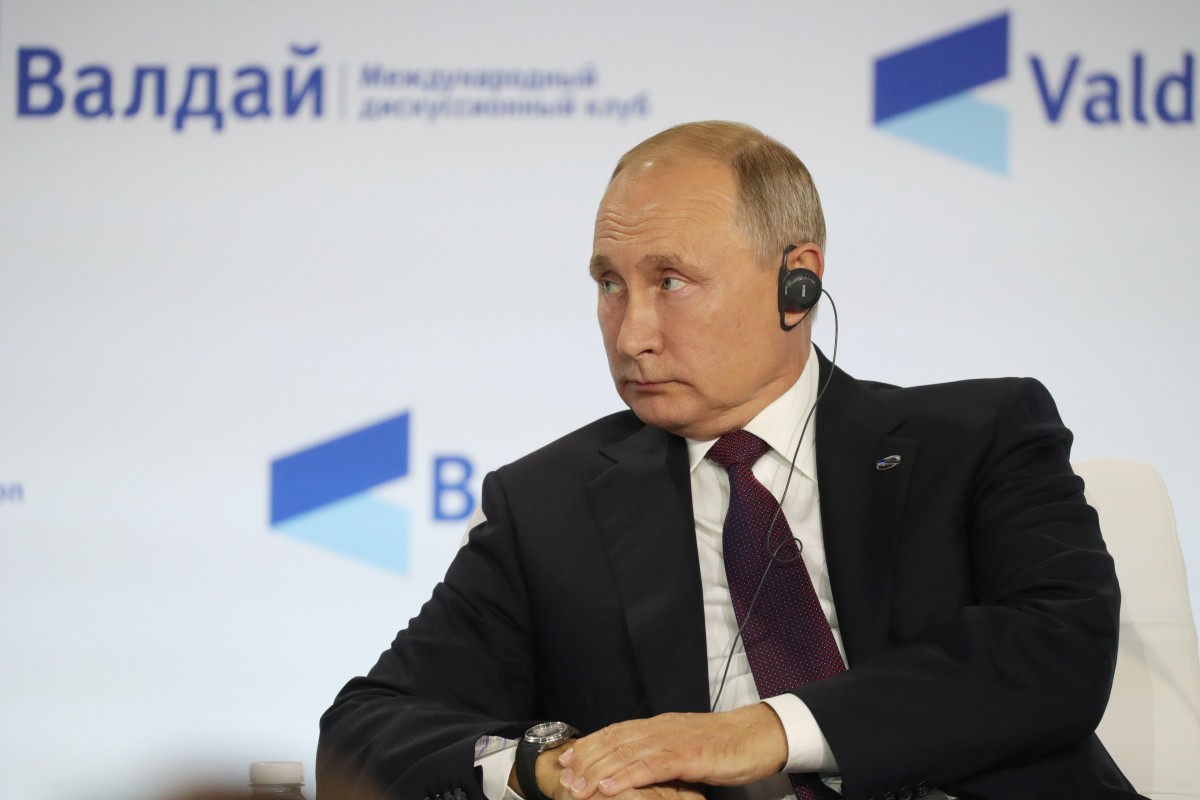
Vladimir Putin disclosed the project at a forum in Sochi. Photo: Sputnik/AFP
Russia is helping China to build an early warning system to counter missile attacks, Vladimir Putin said on Thursday.
Speaking at an international affairs conference in the resort town of Sochi, he said Moscow was helping China increase its missile defence capability, Russian state-owned news agency Sputnik reported.
“This is a very serious endeavour that will fundamentally and radically increase the defence capability of the People’s Republic of China because only the United States and Russia have such a system at present,” the Russian leader said.
Kremlin spokesman Dmitry Peskov declined to say when the system would be operational, but told reporters on a conference call that the move highlighted Russia’s close ties with China.
“Russia has special relations with China of advanced partnership … including the most sensitive [areas] linked to military-technical cooperation and security and defence capabilities,” Peskov said.
Macau-based military observer Antony Wong Dong said Putin’s remarks indicated that military cooperation between Beijing and Moscow may have evolved from the previous “model alliance” to a “real alliance” with the US as their common target.
“Such changes will likely further fuel the strategic arms race, which is already evident from the missile tests [that we have witnessed] and the recent military parade,” said Wong in a reference to the grand parade held in Beijing on Tuesday when China celebrated the 70th anniversary of the founding of the People’s Republic.
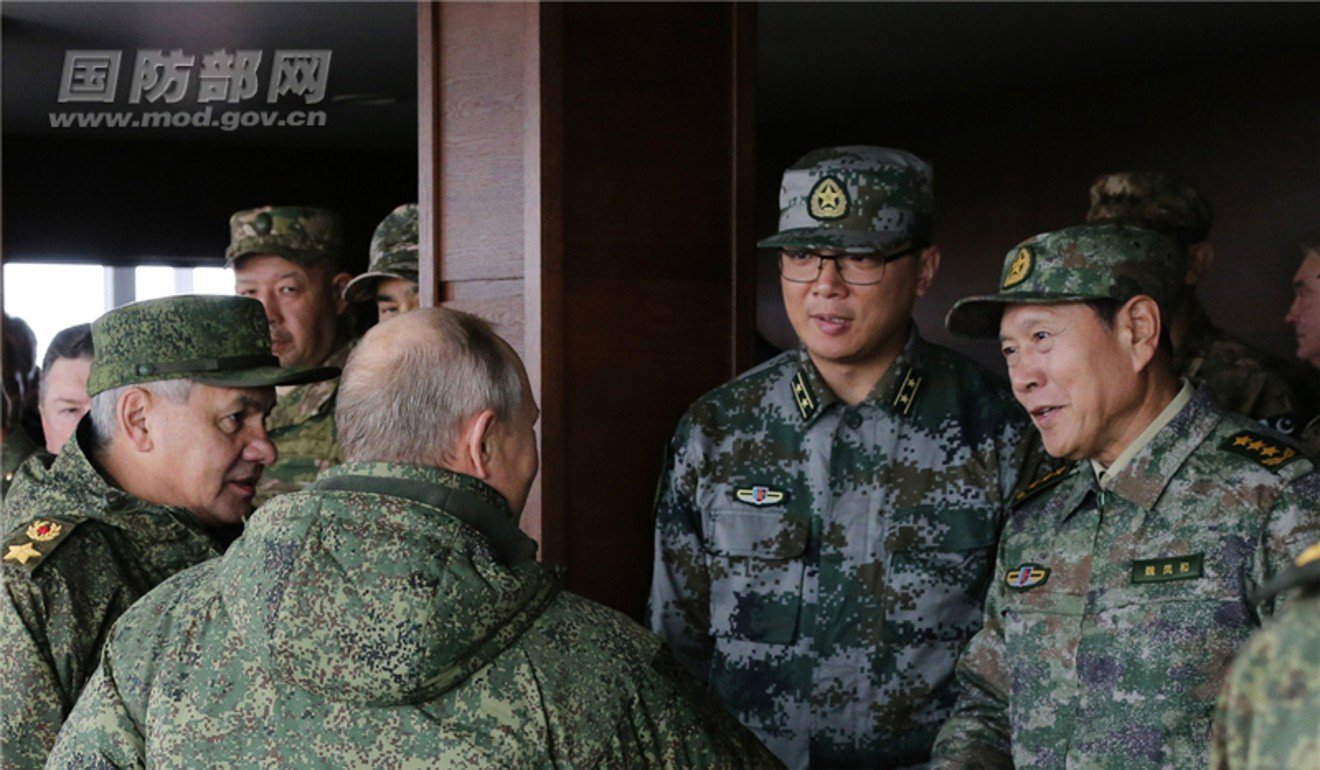
Russian President Vladimir Putin welcomes China’s defence minister Wei Fenghe (right) to a base in Orenburg at the start of a joint exercise. Photo: Handout
Hong Kong-based military analyst Song Zhongping said the system would help Beijing and Moscow set up a joint early ballistic missile network to counter “American global hegemony”.
“If the US wants to attack China [with its ICBMs], their missiles are likely to be launched from the Arctic, and that will be covered by Russia’s early warning system, and that means Moscow will have the capability to alert Beijing,” said Song who added that the Chinese military could provide reciprocal help to Russia.
Beijing-based military expert Zhou Chenming said Putin’s remarks served as a veiled warning to US President Donald Trump who has taken the unilateral step of withdrawing from the Intermediate Range Nuclear Forces Treaty, a cold war-era pact signed between the US and Russia in 1987.
“Joint cooperation will help both Russia and China to save costs because early warning ballistic missile systems are very expensive,” Zhou said,
However, he said Moscow was unlikely to share its most advanced technologies with China.
“For example, Russia’s missile defence system just covers Moscow and St Petersburg, so China’s network will properly just cover Beijing, Tianjin, Hebei province, the Yangtze River Delta area, the Greater Bay Area in South China, as well as a number of key cities in the centre.”
Putin also told the forum that the two countries would continue to work together on space exploration.
Last month, the Ministry of Defence of the Russian Federation announced that Moscow and Beijing have developed a plan for cooperation between military departments for next year and 2021.
Last month 1,600 members of the Chinese military arrived at a Russian training base in the Orenburg oblast for a large-scale joint training exercise.
Black market imports from China, confusing regulations and pollution concerns are undermining India’s fireworks industry
Industry sources say Diwali sales this year were down by 30 per cent
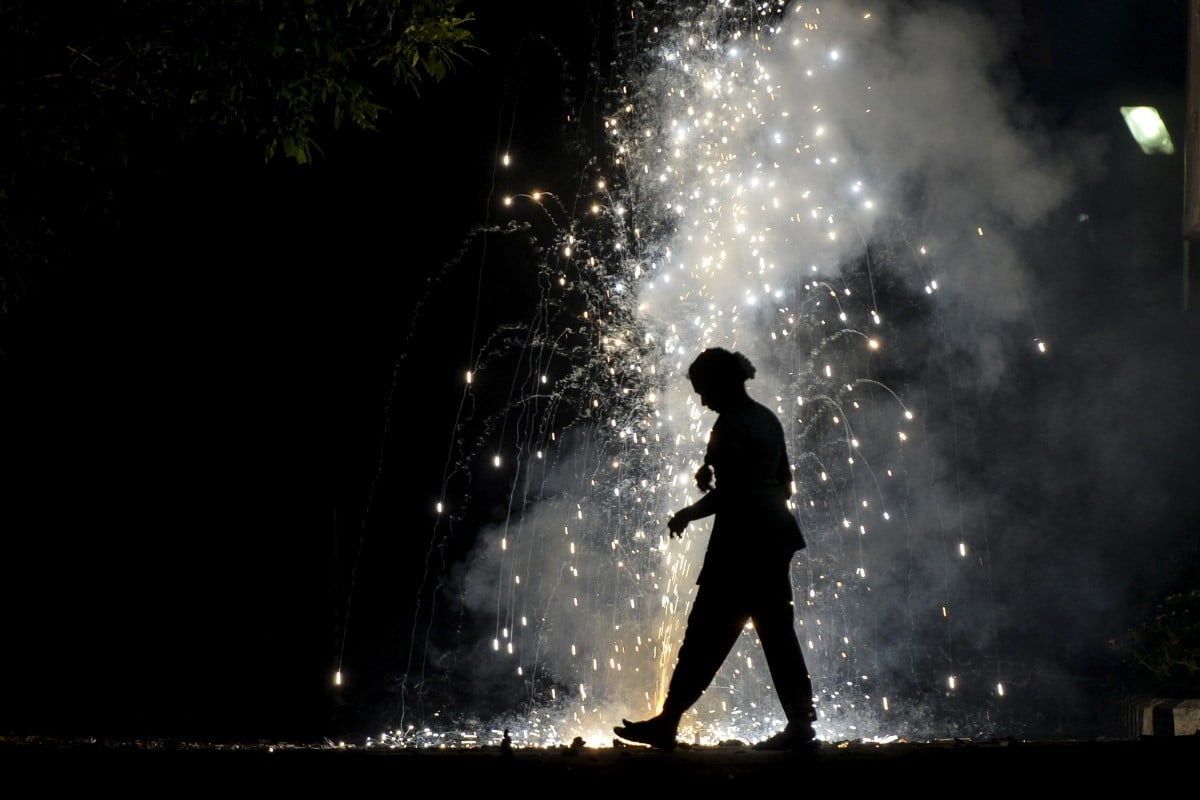
A woman is silhouetted by lit firecrackers during Diwali celebrations in Chennai. Photo: AFP
Arumugam Chinnaswamy set up his makeshift booth selling firecrackers in a Chennai neighbourhood a week ahead of Diwali, the Hindu festival of lights, with great expectations of doing a brisk trade.
Yet a week later, he has been forced to pack up more than half his stock in the hope he’ll have better luck next year.
“Four years ago, I sold firecrackers worth 800,000 rupees (US$11,288) on the eve of Diwali alone. This year, the sales have not even been a quarter of that,” said Chinnaswamy, 65, painting a grim picture that will be recognised by many in the Indian fireworks industry.
Chinnaswamy buys his firecrackers in Sivakasi, an industrial town in the southern Indian state of Tamil Nadu that produces more than 90 per cent of the country’s fireworks.
Sivakasi’s dry climate has helped to make it the firework capital of India and many production facilities in the town have been in the business for close to a century. For the most part, the industry has resisted mechanisation and still deals in handmade products. Its 1,100-plus manufacturing units provide jobs for 800,000 mostly uneducated workers and its diligent labour force have earned the town the nickname of ‘Little Japan’.
A worker lays firecrackers in an outdoor yard at a manufacturing unit involved in the production of firecrackers ahead of the Hindu festival of Diwali, in Sivakasi. Photo: AFP
But this reputation is under threat, struggling under the weight of an anti-pollution campaign, regulatory uncertainty and the arrival of cheap black-market Chinese imports. Irregular monsoons and a slowdown-induced cash crunch have not helped matters either.
Industry figures estimate the Diwali sales of India’s 80 billion-rupee firecracker industry took a 30 per cent drop this year.
A TOXIC PROBLEM
With pollution in Indian cities among the worst in the world, the government has come under pressure to do something about the nation’s toxic air – a problem that becomes more acute during Diwali due to the toxic fumes emitted when celebratory fireworks are set off. This Diwali, for instance, many areas in New Delhi recorded an Air Quality Index (AQI) of 999, the highest possible reading (the recommended limit is 60).
That makes the fireworks industry seem like an easy target when it comes to meeting government air quality targets.
Trouble began brewing in October last year when the Supreme Court banned the manufacture of traditional fireworks containing barium nitrate, a chief polluter. That decision put a rocket under the industry, as barium nitrate is cheap and is used in about 75 per cent of all firecrackers in India.
Factories in Sivakasi responded with a four-month shutdown protest that decimated annual production levels by up to a third.
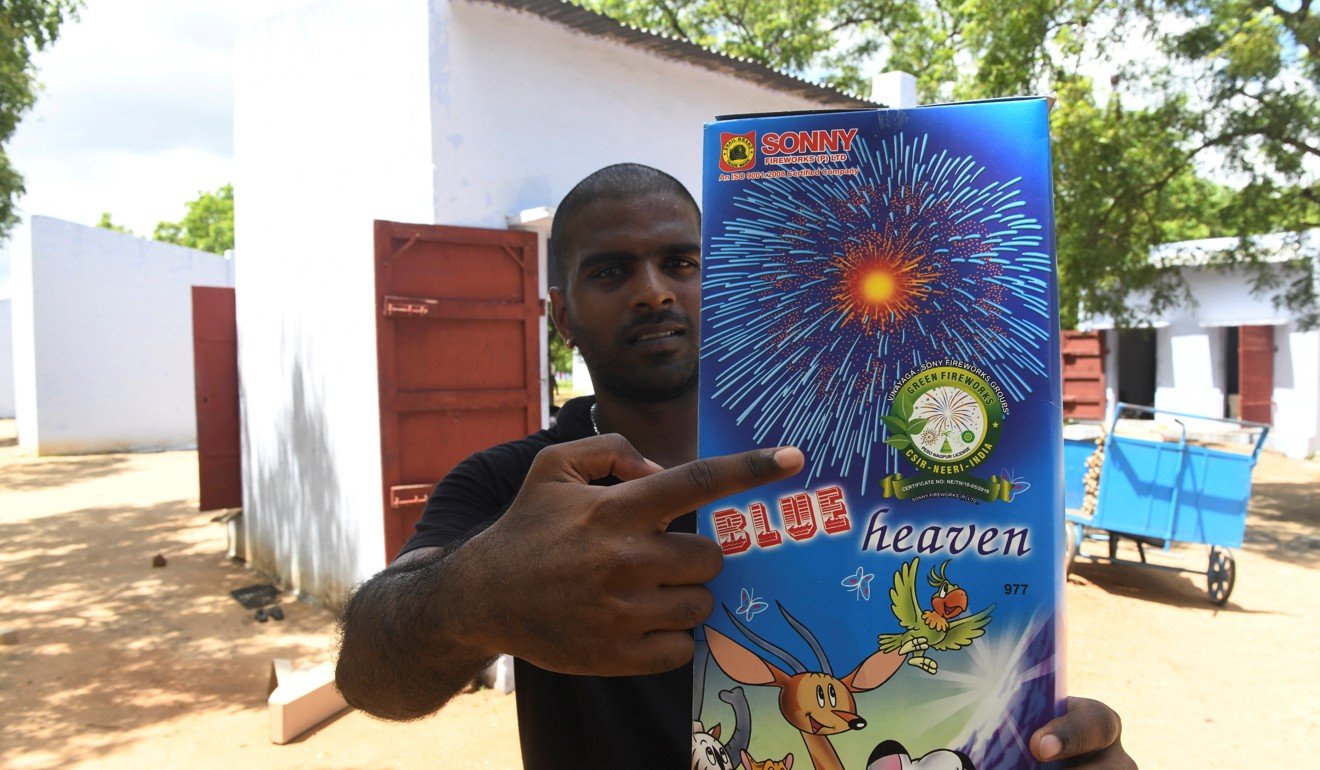
A seal denotes environment friendly ‘Green Fireworks’ at a manufacturing unit in Sivakasi. Photo: AFP
Apparently realising it had overstepped the mark – and that enforcing the Supreme Court regulations would be next to impossible – the government stepped in to rescue the industry, offering its assistance in the manufacture of environment-friendly crackers containing fewer pollutants, but it was too little, too late.
“The Supreme Court verdict was simply Delhi-centric with the vague idea of [cracking down on] urban pollution. It lacked any on-the-ground knowledge of the fireworks industry,” said Tamil Selvan, president of the Indian Fireworks Association, which represents more than 200 medium and large manufacturers.
Singapore travellers give Hong Kong a miss over Diwali long weekend
“Fireworks are low-hanging fruit for the anti-pollution drive as the industry is unorganised. Could the government or judiciary place a similar blanket ban on more pollution-causing industries like automobiles, plastics or tobacco?” asked Selvan.
CHINESE COMPETITION
The industry has also been hit by a flood of cheap Chinese firecrackers that are smuggled into the country on the black market.
In September, the country’s federal anti-smuggling agency, the Directorate of Revenue Intelligence, cautioned various government departments that huge quantities of Chinese-produced firecrackers had reached Indian soil in the lead up to Diwali.
But industry sources complain they have seen little action from the government to combat the problem.
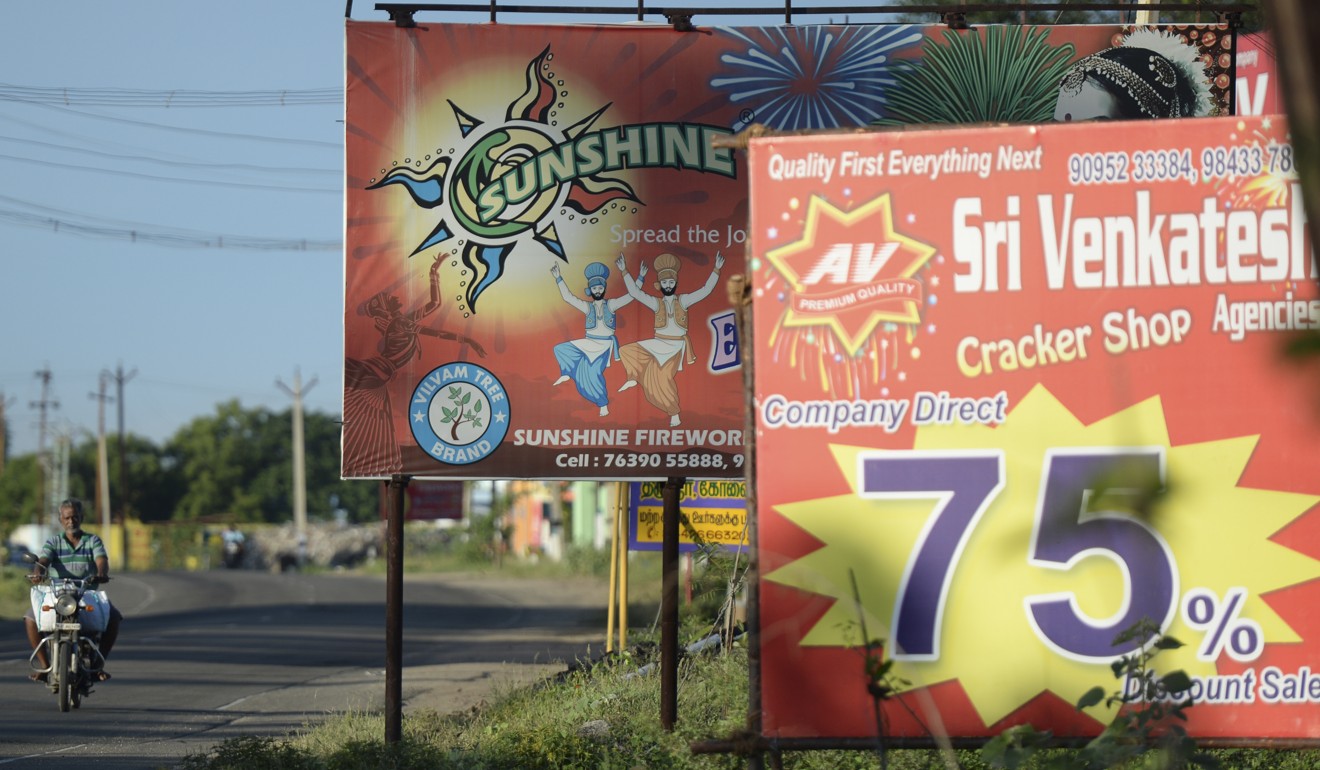
An advert for firecrackers ahead of the Hindu festival of Diwali, in Sivakasi. Photo: AFP
Legally, Indian manufacturers can neither import nor export firecrackers. The Indian firecracker industry is the second-largest in the world after China’s.
Raja Chandrashekar, chief of the Federation of Tamil Nadu Fireworks Traders, a lobbying body, said low-end Indian-manufactured firecrackers such as roll caps and dot caps – popular among children – had struggled to compete with Chinese-made pop pops and throw bombs.
“Despite our repeated complaints to government bodies, Chinese firecrackers find a way into India, particularly in the northern parts. This is severely affecting our business,” said Chandrashekar.
While more Chinese fireworks might be entering India, the effect has been to undermine the industry, resulting in fewer sales overall.
FIZZLING OUT?
The Sivakasi fireworks industry faces other problems, too. Not least among these is the use of child labour, which had been rampant until a government crackdown a few years ago, and the practice of some factories to operate without proper licences and with questionable safety standards.
But despite the darker aspects of the industry, its role goes beyond merely helping Diwali celebrations go with a bang every year.
India is crazy about gold. But can the love last as prices skyrocket?
“The livelihoods of over five million people who are indirectly involved in the business, in areas such as trade and transport, depend on the survival of the industry,” said Chandrashekar.
That survival looks increasingly in question. Dull sales of fireworks have been reported in major cities including New Delhi, Mumbai, Bangalore and Hyderabad, though exact numbers can be hard to come by due to the unregulated nature of the industry and unreliable numbers shared by manufacturers.
So great has the resultant outcry been that some cynics even wonder whether the industry is struggling as much as it claims or whether it is part of a ploy by manufacturers to gain more government concessions and avoid any further crackdown.
“These firecracker manufacturers lie through their teeth about the Diwali sales for self-serving motives such as tax avoidance. The overall business is healthy,” said Vijay Kumar, editor of the Sivakasi-based monthly magazine Pyro India News.
“Though there was a 30-40 per cent shortage in annual production, all the manufactured products have been sold this year. No large stockpile is left with any manufacturer.”
Customers buy firecrackers on the eve of the Hindu festival of Diwali in Amritsar. Photo: AFP
Still, regardless of the manufacturers’ motives, the result of the industry’s struggles has been that street sellers like Chinnaswamy have fewer fireworks to sell – and they are struggling even to sell those.
Chinnaswamy says people are confused about the government’s anti-pollution drive and about what firecrackers are now legal and this has discouraged them from buying. Despite the government’s effort to promote “green crackers” he says these are too hard to come by to be a ready solution, at least for this year.
“There was no clarity on what type of firecrackers, whether green crackers or otherwise, can be set off and at what time of the day. Many consumers even asked me whether or not the conventional firecrackers are totally banned while there was much misinformation floating about on social media,” said Chinnaswamy.
Shaking his head, all he can do is hope that next year his Diwali goes with more of a bang.
Chinese President Xi Jinping and US President Donald Trump set to meet on the sidelines of the Apec summit in Chile next month, a source says
The two state leaders are expected to sign an interim trade deal ‘if everything goes smoothly’
Chinese President Xi Jinping and US President Donald Trump have met twice already over the course of the 16-month trade war. Photo: AP
Chinese President Xi Jinping and US President Donald Trump are tentatively expected to meet on November 17 with the aim of signing an interim trade deal, a source briefed on the arrangements told the South China Morning Post.
The two leaders are expected to come face-to-face immediately after the Asia-Pacific Economic Cooperation (Apec) summit in Santiago, Chile, with a trade truce signed “if everything goes smoothly”, said the person, who declined to be identified.
Trade envoys from Beijing and Washington are still finalising the text for the two leaders to sign, but both sides have expressed optimism that Trump’s so-called phase one trade deal can be completed in time for the meeting.
Trump said on Monday that negotiations on the interim deal were running “ahead of schedule”.
“We are looking probably to be ahead of schedule to sign a very big portion of the China deal, and we’ll call it phase one but it’s a very big portion,” Trump said. “That would take care of the farmers. It would take care of some of the other things. It will also take care of a lot of the banking needs.
“So we’re about, I would say, a little bit ahead of schedule, maybe a lot ahead of schedule,” the president said, adding the deal would “probably” be signed.
Top trade negotiators for the two countries – US Treasury Secretary Steven Mnuchin, US trade representative Robert Lighthizer and Chinese Vice-Premier Liu He – spoke by telephone last Friday. The Office of the US Trade Representative released a statement after the call saying that the two sides “made headway on specific issues” and “are close to finalising some sections of the agreement”.
China’s official Xinhua News Agency said on Saturday negotiators have “agreed to properly resolve core concerns of each other” and had “basically completed technical discussions about parts of the text”. In particular, China would lift the current ban on US poultry imports and recognise the American public health certification system for meat product imports, Xinhua said.
The top trade envoys are expected to hold another conference call in the near future.
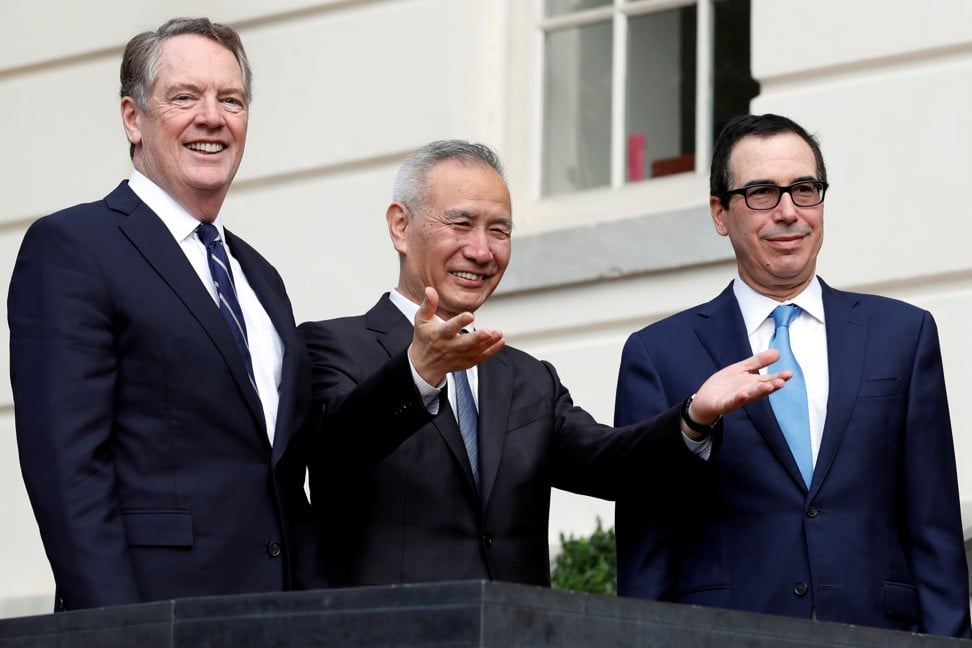
China’s Vice-Premier Liu He between US trade representative Robert Lighthizer (left) and US Treasury Secretary Steve Mnuchin during trade negotiations in Washington this month. Photo: Reuters
Taoran Notes, an account on Chinese social media platform WeChat run by the official Economic Daily newspaper, wrote over the weekend that Beijing and Washington had moved a step closer to agreement on a “temporary deal”.
“According to past experiences and practises, the negotiation will enter the stage of translation and legal review after the technical completion of the text,” the account said.
Geng Shuang, a Chinese foreign ministry spokesman, said that technical negotiations about part of the deal were finished but deputy-level talks were ongoing. “China hopes both sides can find a trade solution based upon mutual respect and benefits,” Geng said at a regular press conference on Tuesday.
If it goes ahead as planned, the summit between Trump and Xi in Chile next month would be the third time the two leaders have sat down to talk about ending the nearly 16-month-long trade war.
Last December, the two leaders met on the sidelines of the G20 Leaders’ Summit in the Argentinian capital Buenos Aires and agreed to a three-month tariff truce to allow time for the countries’ trade envoys to work out a comprehensive deal. But the talks collapsed in early May with the US blaming China for reneging on promises it made in negotiations, while China blamed the US for attempting to infringe on its economic sovereignty.
The pair met again in late June in the Japanese city of Osaka, where they agreed to restart trade negotiations.
A minor ceasefire was reached in October when Beijing promised to buy US$40 billion to US$50 billion worth of American agricultural products in exchange for Washington postponing indefinitely a tariff increase on US$250 billion of Chinese goods to 30 per cent from 25 per cent on October 15.
Analysts expect fresh 15 per cent duties on about US$160 billion of Chinese imports – including popular products like smartphones and consumer electronics – that are due to go into effect mid-December will also be postponed if a deal is signed, though this has not been officially confirmed.
The interim deal is also expected to contain a provision on intellectual property protection, a key US demand. China has taken steps to improve IP protection, including setting up a system to punish and compensate instances of infringement, and improve settlement disputes. But how well these measures will be implemented remains in question.
China and the US would also agree to avoid allowing currency devaluations to gain trade advantages, codifying a commitment both countries made as part of a G20 agreement several years ago. A currency agreement – similar to provisions in the yet-to-be-ratified US-Mexico-Canada Agreement – could pave the way for the US to remove its designation of China as a “currency manipulator”.
The deal may include a new dispute resolution mechanism to ensure both sides live up to commitments. The system, which will give both sides equal standing, would replace a contentious US-proposed enforcement mechanism that was a key reason for trade talks breaking down in May after China felt the demands too intrusive and one-sided. It is unclear how effective the proposal would be, but the US has insisted since talks began that a similar mechanism be implemented to ensure China did not backslide on promises as it had in the past.
In addition to large purchases of farm products, the interim agreement may contain commitments by China to buy US-built aircraft and energy products, particularly liquefied natural gas.
China will also agree to lift foreign ownership limits on Chinese financial firms under the deal, changes which are already underway.
However, the interim deal will not address broader US complaints about China’s economic model, particularly allegations that foreign firms are treated unfairly and heavy government subsidies favour some domestic industries. Nor will it contain any break for telecommunications equipment maker Huawei and other Chinese tech companies that were blacklisted by the US on national security concerns.
LANZHOU, Oct. 26 (Xinhua) — Dunhuang Academy China and Peking University have signed an agreement to establish a research center for Dunhuang studies, aiming to nurture more high-level research talent in the area.
Rong Xinjiang, a professor with Peking University, and Zhao Shengliang, the head of the Dunhuang Academy, will be the directors of the new center.
With a focus on the documents of Dunhuang and grottoes art, Dunhuang studies is an emerging interdisciplinary subject that covers areas such as history, geography, archeology and art.
The Dunhuang Academy, located in northwest China’s Gansu Province, administers the Mogao Grottoes, a renowned UNESCO World Heritage site that showcases the cultural integration and mutual learning among different civilizations along the ancient Silk Road.
The Mogao Grottoes are home to a priceless collection of Buddhist artwork — more than 2,000 colored sculptures and 45,000 square meters of murals — in 735 caves carved along a cliff by ancient worshippers.
Peking University is a pioneer of Dunhuang studies in China, with scholars of its predecessor beginning research in the area in the early 20th century.








 CHINDIA ALERT: You'll be living in their world, very soon