Archive for ‘China alert’

16/02/2019

Water diversion project transfers 20 bln cubic meters of water, benefits 53 million people

ZHENGZHOU, Feb. 15 (Xinhua) — The middle route of China’s South-to-North Water Diversion Project has transferred 20 billion cubic meters of water, benefiting over 53 million residents along the route.

The Construction and Administration Bureau of South-to-North Water Diversion Middle Route Project said that, as of Friday, the project has transferred 20 billion cubic meters of water since the project started in December 2014.

Thanks to the project, over 53 million residents in central China’s Henan Province, northern China’s Hebei Province, Beijing and Tianjin have bid farewell to unsafe drinking water.

So far, 37 cities and counties and 83 waterworks in Henan have received transferred water as planned, while 11 new waterworks have been built up, with the beneficiaries in the province increasing by nearly one million.

Aimed at increasing water safety and improving the water ecology and environment along the route, the middle route project has been carrying water through canals and pipes from the Danjiangkou reservoir in central China’s Hubei Province to Henan, Hebei, Beijing and Tianjin since 2014.

The project has also helped prevent the falling of underground water levels in the North China Plain. Meanwhile, test results have shown that the good water quality of the source of the middle route project has also ensured drinking water safety for residents.

Source: Xinhua

16/02/2019

As the clock ticks, there’s a path to a ‘win-win’ outcome in US-China trade talks

  • Ankit Panda writes that a meeting between Donald Trump and Xi Jinping could result in a way out of the impasse, at least temporarily
PUBLISHED : Saturday, 16 February, 2019, 6:02pm
UPDATED : Saturday, 16 February, 2019, 6:04pm

The usual cast of characters were back at the negotiating table, trying to find a way to stem another round of US tariff increases that were stayed in December after the Buenos Aires G20 meeting between US President Donald Trump and Chinese President Xi Jinping.

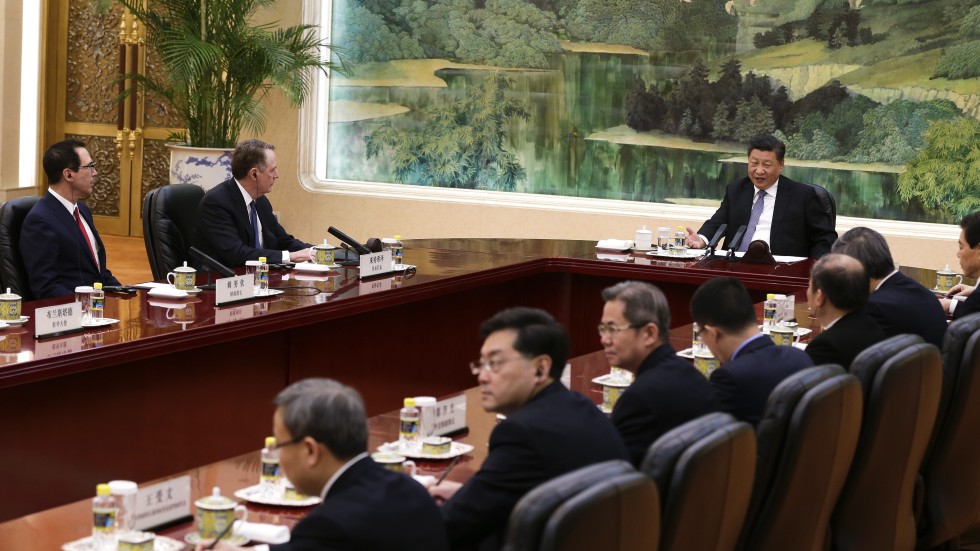
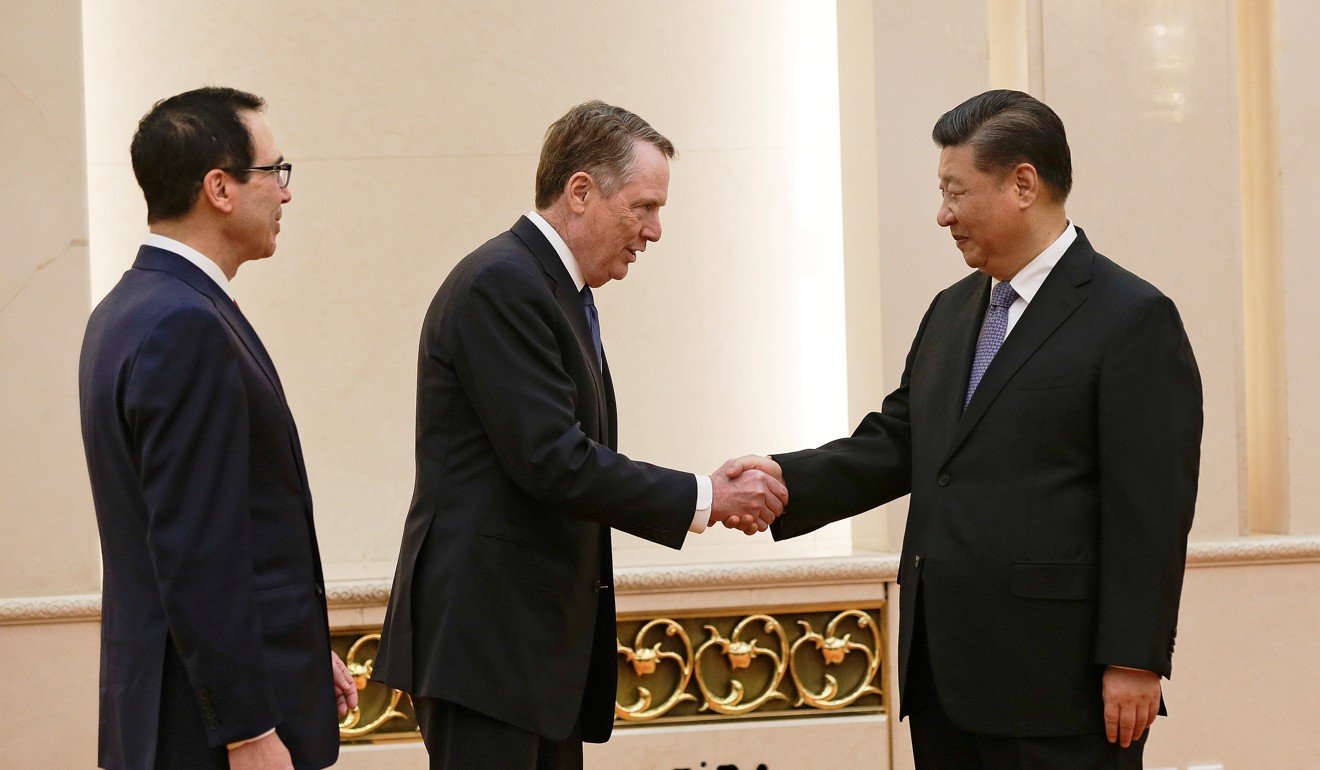
US Treasury Secretary Steven Mnuchin and Trade Representative Robert Lighthizer were back in Beijing, where they again sat across the table from Vice-Premier Liu He, China’s lead trade negotiator. The US delegation also met Xi himself at the end of the talks on Friday.

Both nations said they had made progress to settle their disputes, but admitted there were still difficult issues to deal with. Negotiators will continue the talks in Washington next week.

The stakes are clear and the clock is ticking. The two sides need to arrive at an understanding by March 2, the day on which Trump has said he will move forward with an increase in tariffs.

At least that was the idea. In recent days, Trump has made multiple remarks that suggest the March deadline is anything but absolute. He has hinted he would be open to pushing it back if he sensed that a deal was around the corner. Reports have even suggested the White House is considering another 60-day extension of the tariff truce.

“They’re showing us tremendous respect,” Trump said of China’s attitude in the negotiations, adding that talks were “going along very well”. With Trump slated to travel to Asia at the end of the month for a second summit with North Korean leader Kim Jong-un in Hanoi, the prospect of a second meeting between him and Xi – right before the anticipated deadline – is very real. What’s slowly slipping through the cracks in this process is a sustainable and long-term agreement on structural reform in China, which is what’s been at the centre of the Trump administration’s trade grievances.

Already articulated US concerns cover a broad range of Chinese practices. The ideal short-term measures the American side would like to see include unconditional market access for US firms in China; a less insulated environment for state-owned enterprise decision making; greater regulatory transparency; and fairer legal protections for American businesses in China.

As with so many aspects of the Trump administration’s foreign policy, the US president’s personality is taking over the process, leaving his deputies who are doing the negotiating in a disadvantageous position. For China, the obvious answer then becomes not to discuss the nuances of what kinds of structural reform might be necessary with Lighthizer, but to simply get Xi in the room with Trump.

This mirrors the lesson that North Korea’s Kim has taken away over the course of nearly a year of negotiations with the US. Instead of expending any serious diplomatic capital in a detail oriented negotiation with the secretary of state or the president’s special representative, the key is to simply meet Trump and work out high-level arrangements mano a mano.

In this climate, we can’t expect a real resolution on the core issues. Everything from American misgivings about Beijing’s interventionist industrial policies that protect Chinese enterprises to broader structural shifts in the nature of the US-China economic relationship since the turn of the century are on the table today – and they’ll stay there.

Xi and Trump may well find a temporary way out of the impasse, giving global investors the runway necessary to avert the panic that would likely ensue if the US pushed ahead with a tariff increase on US$200 billion in Chinese goods. Even if China doesn’t quite give the United States a down payment on structural reforms, Xi can promise Trump that he will chip away at the trade deficit while leaving untouched the issues that a more detail oriented negotiator like Lighthizer might zero in on.

If there is a “win-win” outcome here, it would be for Trump and Xi to find an agreeable arrangement that would allow the US president to walk away looking tough to his base while leaving China’s core, long-term industrial policy trajectory unharmed. That would strip away any remaining negotiating leverage the US side might have within the trade war, and it’s not unlikely.

Source: SCMP

16/02/2019

Hong Kong seizes $1m worth of rhino horn at airport

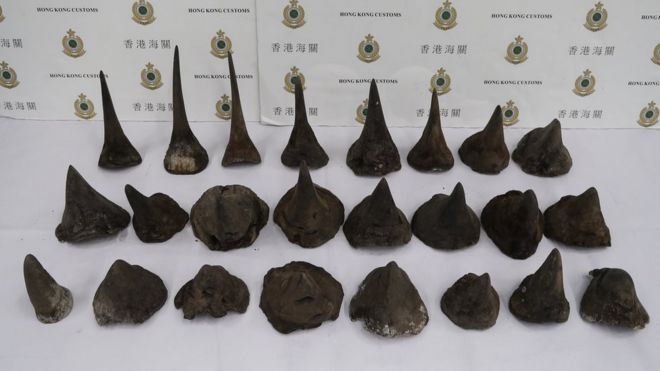
Photo released by Hong Kong Customs and Excise Department of seized rhino hornsImage copyrightAFP/GETTY
Image captionThe haul accounts for 20% of Hong Kong’s rhino horn seizures in five years

Airport authorities in Hong Kong have arrested two men smuggling a record number of suspected rhino horns worth $1m (£780,000) on Thursday.

Some 24 severed rhino horns weighing 40kg (88lb) were found in the bust – Hong Kong’s largest ever seizure.

The alleged smugglers were in transit to Ho Chi Minh City in Vietnam from Johannesburg in South Africa.

Customs officials said the illegal haul was brazenly transported through the terminal in two cardboard boxes.

The airport incident comes just two weeks after Hong Kong seized a record eight tonnes of pangolin scales and more than 1,000 elephant tusks.

A local environmental group said Thursday’s rhino horns accounted for 20% of the total amount of Hong Kong’s rhino horn seizures since 2013.

Hong Kong is a known transit point for the illegal wildlife trade, and conservation groups have urged the authorities to crack down on smuggling.

Rhino horn is used in China and Vietnam in some traditional medicine, despite containing little more than keratin, the same protein that makes human hair and fingernails.

The demand for rhino horn has fuelled wildlife poaching, particularly in South Africa, which is home to about 80% of the world rhino population.

Conservation groups say the number of rhinos killed has been gradually decreasing since 2014, but more than 1,000 rhinos continue to be killed in South Africa every year.

Source: The BBC

16/02/2019

Bank lending for ‘real economy’ key to boost China growth – central bank official

SHANGHAI (Reuters) – China should encourage its banks to support smaller, private firms in the real economy, rather than forced lending or policies such as quantitative easing, a state newspaper quoted a central bank official as saying on Saturday.

“The central bank doesn’t wish to use administrative methods to require banks (to lend),” Sun Guofeng, head of the monetary policy department at the People’s Bank of China (PBOC), told the Financial News, a bank publication.

“It wants to establish positive encouragement mechanisms though monetary policy tools to encourage banks to actively increase their support for the real economy, especially towards smaller and privately-owned firms,” Sun said.

The comments come a month after Sun wrote a commentary in which he argued that problems with timely capital replenishment, bank liquidity gaps and poor rate “transmission” are three major constraints on banks’ supply of credit.


In the interview with the Financial News, Sun said monetary policy transmission had “noticeably improved”, showing that steps to enhance transmission mechanisms had been effective.

He said the central bank would increase the strength of innovation in monetary policy tools.

Perpetual bond issuance “is only one breakthrough” in reducing capital constraints on banks, Sun said, adding that “other methods” could be used in the future.


He said that quantitative easing was neither necessary nor possible at the moment, noting that under China’s financial system the significance of the central bank buying Chinese treasury bonds on the secondary market is limited, and that the PBOC is barred from buying the instruments on the primary market.

China’s banks made the most new loans on record in January following a series of moves to boost lending as authorities try to prevent a sharp slowdown in the world’s second-largest economy.

Source: Reuters

15/02/2019

Seizing on Huawei’s troubles, Samsung bets big on network gear

SEOUL (Reuters) – Samsung Electronics is pouring resources into its telecom network equipment business, aiming to capitalize on the security fears hobbling China’s Huawei, according to company officials and other industry executives.

Those efforts include moving high-performing managers and numerous employees to the network division from its handset unit, two Samsung sources said.
Potential customers are taking notice of Samsung’s efforts to reinvent itself as a top-tier supplier for 5G wireless networks and bridge a big gap with market leader Huawei and industry heavyweights Ericsson and Nokia.
French carrier Orange’s chief technology officer, Mari-Noëlle Jégo-Laveissière, visited Japan last year and was impressed with the pace of 5G preparations using alternative equipment makers including Samsung, a company representative told Reuters.

Orange, which operates in 27 markets and counts Huawei as its top equipment supplier, will run its first French 5G tests with Samsung this year.

Underscoring the growing importance of the business, South Korean Prime Minister Lee Nak-yeon visited Samsung’s network division in January. In a closed-door meeting during that visit, Samsung heir Jay Y. Lee asked for government help with recruiting high-level engineers.
Huawei is battling allegations by the United States and some other Western countries that its equipment could enable Chinese spying and should not be used in 5G networks, which will offer higher speeds and a host of new services.
Australia and New Zealand have joined the United States in effectively barring Huawei from 5G, and many other countries, especially in Europe, are considering a ban. Huawei denies that its gear presents any security risk.
Its woes have presented Samsung with a rare opportunity. Telecom firms would ordinarily stick with their 4G providers for 5G upgrades as they can use existing gear to minimize costs, but many firms may now be under political pressure to switch.

“We’re bolstering our network business to seize market opportunities arising at a time when Huawei is the subject of warnings about security,” said one of the Samsung sources.

The sources, who did not disclose specific figures for the employee moves, declined to be identified as they were not authorized to speak on the matter.

Keen to seek new growth, particularly as sales of its mainstay chips and smartphones have begun to drop, Samsung plans to invest $22 billion in 5G mobile technology and other fields over three years. It declined to break down how much will go to 5G and the other areas – artificial intelligence, biopharma and automotive electronic parts.

“Samsung is focused on building trust with our partners and leading the global 5G markets, regardless of other companies,” it said in an emailed statement to Reuters.

Asked about Samsung’s big push into network equipment, Huawei said in a statement that it welcomed competition in the market.

INDIA OPPORTUNITY

In India, Samsung is now in talks with Reliance Jio to upgrade its network to 5G, looking to build on what has perhaps been its biggest network success – becoming the key supplier for the upstart carrier.

“We don’t think 5G is far away in India,” a Samsung official with direct knowledge of the matter told Reuters. He declined to be named due to the sensitivity of the matter.

Samsung’s clients include U.S. firms AT&T Inc, Verizon Communications Inc and Sprint Corp and it has 5G network contracts with all three, though it was not clear how extensive those contracts are. It also sells to South Korean carriers and has partnered with Japanese mobile carriers to test its 5G equipment.

In many cases, Samsung supplies only small pieces of networks. According to market tracker Dell’Oro Group, the South Korean firm holds just 3 percent of the global telecom infrastructure market compared with 28 percent for Huawei.

Its network business made 870 billion won ($775 million) in operating profit last year, according to Eugene Investment & Securities. Filings show Nokia’s network business made about 1.2 billion euros ($1.4 billion) while Ericsson’s network operations made 19.4 billion Swedish crowns ($2.1 billion). Figures for Huawei were not available.

FINDING THE PEOPLE

One major hurdle for Samsung will be attracting talent amid a dearth of software engineers in South Korea.

“We need more software engineers and want to work with the government to find that talent,” Lee was quoted as saying by government officials at his meeting with the prime minister.

Samsung’s network business unit employs roughly 5,000 people, according to a government official in the southern city of Gumi where Samsung operates its manufacturing plants.

Kim Young-woo, an analyst at SK Securities, expects Samsung to hire 1,000-1,500 people for 5G network equipment this year. Samsung declined to comment on network employee levels and hiring plans.

But Samsung’s bet remains risky as the long-term nature of telecom network investment means change comes slowly.

Sweden’s Ericsson and Finland’s Nokia, which acquired the remnants of once-powerful network equipment companies Alcatel-Lucent and Nortel, have as yet seen little sales growth from Huawei’s problems, company executives said.

Both are in cost-cutting mode, even in the face of the 5G opportunity and the problems confronting their biggest rival.

Indeed, some network operators in Europe are warning that a Huawei ban – now under consideration in France, the UK, Germany and other countries – could push back deployment of 5G by as much as three years.

Others warn Samsung may struggle to develop a global sales and support organization.

“The way telcos purchase products and services from their suppliers demand a lot of time and resources, which is why Ericsson and Nokia have around 100,000 employees and Huawei almost twice as many,” said Bengt Nordstrom, CEO of telecom consultancy Northstream.

But Samsung is taking the long view. In December, it agreed to extend its Olympic partnership with the International Olympic Committee through to 2028 and expand its sponsorship to 5G technology.

The company did not want to leave its sponsorship spot open to Chinese rivals, a separate source with knowledge of the matter said.

“If Samsung dropped the top mobile sponsorship for the Olympic games beyond 2020, then who would have taken that spot? It would only have been China, Huawei.”

($1 = 1,122.8000 won)

Source: Reuters

15/02/2019

China closes its Everest base camp to tourists

Everest view from Tibetan sideImage copyrightGETTY IMAGES
Image captionMore and more people want to see the world’s tallest peak

China has closed the base camp on its side of Mount Everest to visitors who don’t have climbing permits.

Authorities have resorted to the unusual move to deal with the mounting waste problem at the site.

The ban means tourists can only go as far as a monastery slightly below the 5,200m (17,060ft) base camp level.

More people visit the mountain from the southern side in Nepal, but over the past years numbers have been rising steadily on the Chinese side as well.

The Chinese base camp, located in Tibet, is popular as it is accessible by car – whereas the Nepalese camp can only be reached by a hike of almost two weeks.

The world’s highest peak has been struggling with escalating levels of rubbish for years, as the number of visitors rises.

The Chinese Mountaineering Association says 40,000 visited its base camp in 2015, the most recent year with figures. A record 45,000 visited Nepal’s base camp in 2016-7 according to Nepal’s Ministry of Forests and Soil Conservation.

Everest view from Tibetan sideImage copyrightGETTY IMAGES
Image captionTourists are still allowed to go as far as the Rongbuk monastery

Ordinary tourists will only be banned from areas above Rongbuk monastery, which is around 5,000m above sea level, according to China’s state news agency Xinhua.

Mountaineers who have a permit to climb the 8,848m peak will still be allowed to use the higher camp.

In January, authorities announced that they would limit the number of climbing permits each year to 300.

On Chinese social media, claims have spread in recent days that its base camp will be permanently closed to tourists – but Xinhua cited officials denying that.

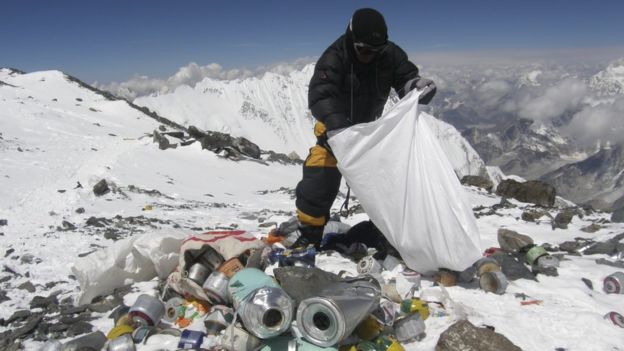
Nepalese sherpa picking up trash on EverestImage copyrightGETTY IMAGES
Image captionThe temperature and high altitude make clean-up efforts on Everest a tough task

The official announcement about the closure was made in December, on the website of the Tibetan authorities.

It stated that three clean-up operations last spring had collected eight tonnes of waste, including human faeces and mountaineering equipment climbers had left behind.

This year’s clean-up efforts will also try to remove the bodies of mountaineers who have died in the so-called death zone above 8,000m, where the air is too thin to sustain life for long.

Due to the cold and high altitude, these bodies often remain on the mountain for years or even decades.

Source: The BBC

15/02/2019

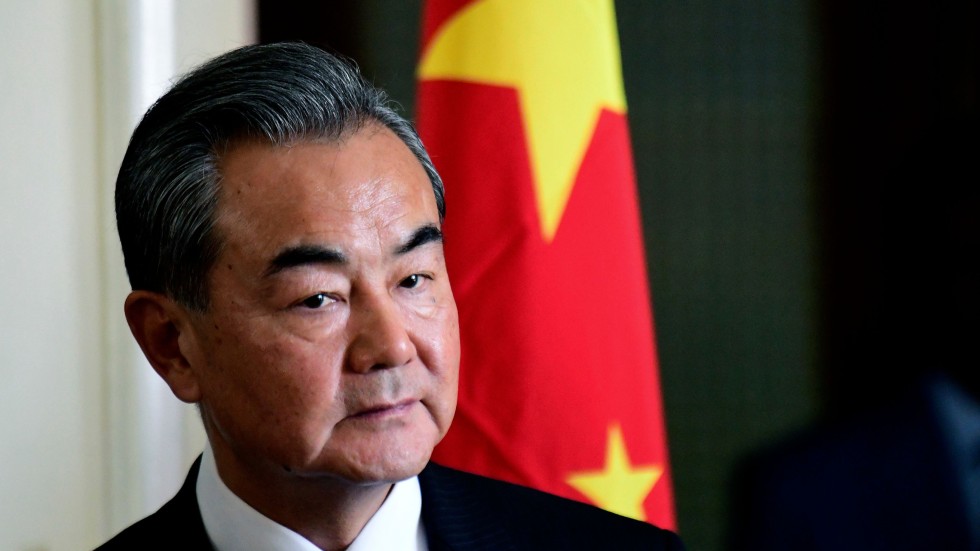
Chinese Foreign Minister Wang Yi holds talks in Thailand ahead of general election

  • Official will meet his opposite number Don Pramudwinai in Chiang Mai
  • Wang likely to discuss investment projects under Beijing’s ‘belt and road’ plan
PUBLISHED : Friday, 15 February, 2019, 7:17pm
UPDATED : Friday, 15 February, 2019, 7:17pm

9 Feb 2019

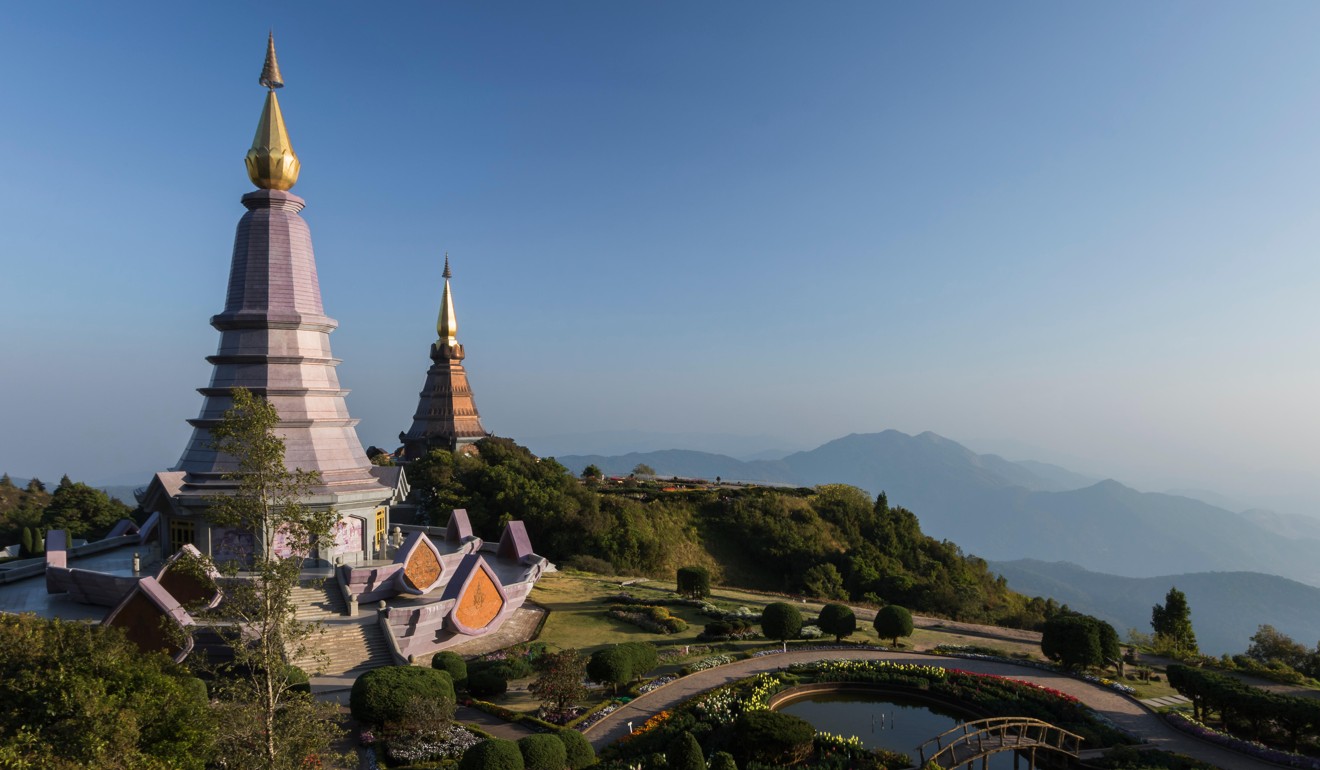
Chinese Foreign Minister Wang Yi arrived in Thailand on Friday for high-level talks likely aimed at reassuring Beijing about its investments in the Southeast Asian country ahead of a long-delayed general election, analysts said.

During his two-day trip to the northern city of Chiang Mai, Wang will meet his counterpart Don Pramudwinai, Thailand’s ministry of foreign affairs said on its website.

Zhang Mingliang, a Southeast Asian affairs specialist at Jinan University, said China was concerned the upcoming poll might have an impact on its interests.

“The recent events regarding the sudden changes to Thailand’s prime ministerial candidate could affect the country’s political stability and affect its relationship with China,” he said.

He was referring to the fact that on Wednesday, Thailand’s Election Commission asked the constitutional court to dissolve the Thai Raksa Chart, a political party allied with the powerful Shinawatra clan, for putting forward Princess Ubolratan as candidate for prime minister.

The move came just days after Thai King Maha Vajiralongkorn, Ubolratan’s younger brother, issued a royal decree denying her bid to become prime minister hours after her name was submitted.
Zhang said that only by ensuring the political stability of Thailand could China’s interests in the country and Southeast Asia as a whole be protected.

“In the past, political instability meant Thailand’s leaders were unable to attend foreign events such as meetings with Asean and China,” he said.

“If there is political stability in Thailand … that can aid its contribution to Asean and its ties with China.

“China’s relationship with Thailand is the best among the Asean nations, with the least conflict of interests,” he said.

Concerns over China’s overseas investments are growing and there have been accusations that Beijing is using them to gain political leverage.

China and Thailand reached an agreement in 2017 for the construction of Thailand’s first high-speed rail line. Once completed it will run from Bangkok to Nong Khai on the Thai border with Laos.

The line is seen as a key project under the “Belt and Road Initiative”, Beijing’s plan to connect China with countries across Asia, the Middle East and Africa.

Elections in Southeast Asia have proved troublesome for the initiative, however. Soon after being re-elected as prime minister of Malaysia last year, Mahathir Mohamad’s government cancelled the China-funded US$20 billion East Coast Rail Link. Officials later backtracked on the decision, leaving its future in the air.

Xu Liping, a specialist in Southeast Asian studies at the Chinese Academy of Social Sciences, said that Thailand, as this year’s chair of Association of Southeast Asian Nations, has a crucial role to play in promoting China’s relationship with other members of the group.

“Ensuring the continuity of China-Thailand ties after the elections in March will also be on the agenda in Wang’s meeting,” he said.

Meanwhile, China’s top diplomat Yang Jiechi, a member of the Communist Party Politburo, travelled to Germany on Friday to attend the Munich Security Conference, which runs until Sunday.

Source: SCMP

15/02/2019

Chinese FM to visit Thailand for strategic consultation

BEIJING, Feb. 14 (Xinhua) — Chinese State Councilor and Foreign Minister Wang Yi will travel to Thailand for strategic consultation from Feb. 15 to 16, Foreign Ministry spokesperson Hua Chunying said Thursday.

Wang will make the trip at the invitation of Thai Foreign Minister Don Pramudwinai, Hua said at a daily press briefing.

Source: Xinhua

15/02/2019

China Focus: Qomolangma reserve bans ordinary tourists in core zone

LHASA, Feb. 14 (Xinhua) — Mount Qomolangma National Nature Reserve in China’s Tibet Autonomous Region has banned ordinary tourists from entering its core zone to better conserve the environment of the world’s highest mountain.

But for travelers who have a climbing permit, the mountaineering activities will not be affected, according to the reserve which was set up in 1988.

Covering an area of around 33,800 square km including a 10,312-square km core zone, the reserve is home to one of the world’s most vulnerable ecosystems.

Recently, a report went viral online claiming the Qomolangma base camp was “permanently closed due to heavy pollution.” But local authorities denied the claim.

Kelsang, deputy director with the reserve’s administration, said ordinary tourists are banned from areas above Rongpo Monastery, around 5,000 meters above sea level. A new tent camp will be set up nearly two km away from the original one.

Between each April and October, villagers from Dingri County usually set up black tents at the foot of Mount Qomolangma, providing tourists accommodation as a means of earning money.

Though ordinary visitors can’t go beyond the monastery, it won’t affect them from appreciating the mountain.

“The new tent camp for ordinary tourists can still allow them to clearly see the 8,800-meter-plus mountain,” Kelsang said.

Travelers who have a climbing permit can go to the base camp at an altitude of 5,200 meters. Kelsang said the mountaineering activities have been approved by the regional forestry department.

Decades after the epic climb to the world’s peak, Tibetans at the foot of Mount Qomolangma have conquered poverty by receiving professional and amateur mountaineers and tourists, who have also posed an environmental challenge to the mountain.

To conserve the environment surrounding Mount Qomolangma, China carried out three major clean-ups at an altitude of 5,200 meters and above last spring, collecting more than eight tonnes of household waste, human feces and mountaineering trash.

This year, the clean-up will continue, and the remains of mountaineering victims above 8,000 meters will be centrally dealt with for the first time.

Meanwhile, the number of people who stay at the base camp will be kept under 300.

Currently, there are 85 wildlife protectors in the reserve, and 1,000 herders have part-time jobs patrolling and cleaning up garbage.

“These measures aim to strike a balance between various demands such as environmental protection, local poverty relief, mountaineering and education,” said Wang Shen, county chief of Dingri at the mountain foot.

Source: Xinhua

15/02/2019

Beijing unveils plan to transform vacated “Steel City”

BEIJING, Feb. 14 (Xinhua) — The Beijing municipal government has published a plan to transform a vacated industrial site in its western suburb into a city landmark by 2035, as part of the preparation for the Beijing 2022 Winter Olympics.

The new area, on the basis of the Shougang Park, a former steel plant relocated to neighboring Hebei Province in 2010, covers an area of 22.3 square km, according to the plan released Wednesday by the city’s development and reform commission.

“Building on the existing facilities, we will create a distinct community composed of museums, industrial incubators and leisure facilities,” said Hong Jiyuan, deputy director of the commission.

Sports facilities including a ski site and a training center are under construction in the park for the Winter Olympics. The facilities will be used after the Games to host international events and exhibitions, according to the plan.

Beijing is also building more lakes, forest parks and waterscapes in the area to create an eco-friendly demonstration space.

Shougang Group will cooperate with enterprises both at home and abroad to rejuvenate the old industrial area, said Wang Shizhong, deputy general manager of the company, adding that Beijing’s first 5G network and an artificial intelligence industrial park will be established there.

Source: Xinhua

Law of Unintended Consequences

continuously updated blog about China & India

ChiaHou's Book Reviews

continuously updated blog about China & India

What's wrong with the world; and its economy

continuously updated blog about China & India