Chindia Alert: You’ll be Living in their World Very Soon
aims to alert you to the threats and opportunities that China and India present. China and India require serious attention; case of ‘hidden dragon and crouching tiger’.
Without this attention, governments, businesses and, indeed, individuals may find themselves at a great disadvantage sooner rather than later.
The POSTs (front webpages) are mainly 'cuttings' from reliable sources, updated continuously.
The PAGEs (see Tabs, above) attempt to make the information more meaningful by putting some structure to the information we have researched and assembled since 2006.
GUANGZHOU, Feb. 4 (Xinhua) — Migrant worker Liao Guiren was more than excited to take a bullet train on his Spring Festival journey back home, the first time for the middle-aged man.
Each year during the past two decades, the 45-year-old had to endure an exhausting eight-hour bus ride from his workplace in south China’s Guangdong Province to his hometown in the city of Guigang in Guangxi Zhuang Autonomous Region, for a large annual family gathering.
But this year, the bullet train cut his travel time to less than three and a half hours.
“The traffic jams on the roads during the holiday must be worse,” Liao said when having his ticket checked at the railway station in Guangdong’s Zhongshan. “The expressways back home must be more crowded than the railway station.”
Liao said it was no easy job to buy the bus ticket back home during the festival. “I used to line up for hours at the station for tickets, and the prices often ticked up due to high demand.”
However, it took Liao a couple of minutes to buy the train ticket back home on his smartphone this year.
Liao is among a growing number of Chinese travelers who have benefited from a more convenient and efficient way to return home during the Spring Festival travel rush in recent years.
It is estimated that the annual travel rush that lasts 40 days will see 413 million railway trips across the country, up 8.3 percent from the previous year.
To meet the growing demand, China has been expanding its railway network at an unprecedented pace for decades, with the total operational length of high-speed railways reaching 29,000 km by the end of last year.
One of the country’s major newly-built railways is the Guangzhou-Shenzhen-Hong Kong Express Rail Link, which started service last year and links Hong Kong with more than 40 cities on the Chinese mainland via direct rail services.
“The railway makes it more convenient for those working in Hong Kong to return to the mainland for family gatherings,” said Siu Kin-Po, head of the Guangzhou center of the Hong Kong Federation of Trade Unions.
SMARTER TRAVEL
Liao has taken trains several times, but it was his first time to use a self-service machine to check in at the railway station.
Liao followed the instructions on the machine that explicitly explains what to do.
He put both his ticket and ID card onto the slot of the machine and waited for the facial recognition system to identify his face before the gate opened to let him pass. The whole process took less than 10 seconds.
A total of 595 self-service check-in machines have been deployed at the railway stations in Guangdong, Hunan and Hainan to streamline the check-in process, according to China Railway Guangzhou Group Co. Ltd.
Other smart technologies such as virtual reality and smart navigation machines have also been used in Chinese railway stations to help travelers ease the pressure during the travel rush.
“Smart technologies have made the rail services more fun and convenient,” Liao said. “I want to take bullet train again next year when I go home.”
BEIJING, Feb. 4 (Xinhua) — China’s railway system continued to see a surge in passengers on Monday, the Lunar New Year’s eve, as Chinese rushed home for family gathering.
Chinese railway network is expected to see 5.48 million trips on Sunday, up 3.6 percent year on year. Nearly 270 extra trains will be put into service to meet the booming travel demand.
About 9.3 million train trips were made on Saturday, up 5.4 percent year on year.
The Spring Festival travel rush started from Jan. 21 and will last till March 1, during which railway trips are expected to hit 413 million in total, up 8.3 percent from a year ago.
Air travel demand also boomed in recent weeks. From Jan. 21 to Feb. 3, China Eastern Airlines sent almost 2 million passengers, up 8 percent year on year.
According to the Chinese zodiac calendar, the Year of the Pig starts on Feb. 5, and the public holiday associated with it lasts from Feb. 4 to 10.
Hundreds of millions of Chinese return to their hometowns for family gathering during the holiday.
UNITED NATIONS, Feb. 4 (Xinhua) — China firmly opposes mercenary activities in Africa, and will always support African nations’ pursuit of peace and prosperity, Chinese Ambassador to the United Nations Ma Zhaoxu said Monday.
Mercenary activities are a threat to peace and stability in African countries, and China calls for greater international efforts to address the problem, said Ma as Chinese President Xi Jinping’s special envoy at a UN Security Council high-level debate on mercenary activities in Africa.
BEIJING, Feb. 4 (Xinhua) — A total of 197 million people took part in winter tourism from November 2017 to March 2018, according to an annual report released by the China Tourism Academy recently.
Winter tourism refers to tourist activities related to ice and snow.
The cost associated with winter tourism has been decreasing while the public shows increasing interest in participating, said Han Yuanjun, editor-in-chief of the report.
Winter tourism is conducive to rural vitalization and local economic transformation, the report said.
Winter tourism has been booming in China since Beijing won its bid in 2015 to host the 2022 Winter Olympic Games. Local governments of Beijing and the provinces of Hebei, Jilin and Heilongjiang have unveiled policies to promote winter tourism.
ULAANBAATAR (Reuters) – Mongolia has extended school winter holidays in the world’s coldest capital and many families have sent children to live with relatives in the vast, windswept grasslands to escape choking smog and respiratory diseases such as pneumonia.
The temperature is expected to drop to minus 32 degrees Celsius (minus 26F) in Ulaanbaatar on Monday night, as residents burn coal and trash to try to keep warm and concentrations of smog particles known as PM2.5 routinely exceed 500 mg per cubic meter, 50 times the level considered safe by the WHO.
Mongolia, a former Soviet satellite landlocked between Russia and China, has invested public money and foreign aid to tackle pollution, but improvement has been slow, with residents saying inaction has been compounded by a corruption scandal that has paralyzed parliament.
In a crowded township more than 40 miles from Ulaanbaatar, Jantsandulam Bold’s five grandchildren are breathing more easily after fleeing the capital.
“Fresh air and sun are most important for kids to grow healthy and robust,” says Jantsandulam, 57, making milk tea for her grandchildren in her home, a thickly padded felt hut known as a “ger”, or in Russian, a “yurt”.
“This little one had flu when he came here but the fresh air has treated him well,” she said, pointing at her five-year-old grandson.
The children are nearing the end of a two-month break, with schools due to reopen next Monday.
About 60 percent of Mongolia is covered by grassland, where the mining of copper, gold, coal and other minerals provides employment, while the Gobi desert envelops the South. But almost half the population live in Ulaanbataar.
Reuters calculations based on U.S. Embassy data show annual average PM2.5 concentrations hit 100 micrograms in Ulaanbaatar in 2018. They soared to 270 in December. PM2.5 in China’s most polluted city of Shijiazhuang stood at an average 70 micrograms last year, down 15.7 percent from 2017. The World Health Organisation recommends a concentration of no more than 10 micrograms.
The WHO said 80 percent of Ulaanbaatar’s smog was caused by coal burning in “ger” districts, where thousands of rural migrants, used to a nomadic lifestyle, have pitched huts. It estimates air pollution causes more than 4,000 premature deaths a year.
A joint study by the U.N. International Children’s Emergency Fund (UNICEF) and Mongolia’s National Centre for Public Health said children living in one smog-prone district of Ulaanbaatar had 40 percent less lung function than those living in the countryside.
“Air pollution aggravates respiratory diseases and children under five are most vulnerable as their organs are still not mature,” said Bolormaa Bumbaa, a doctor at Bayangol District’s Children’s hospital in Ulaanbaatar.
Families have already set up a pressure group known as Moms and Dads Against Smog, but after the protests they organized in Ulaanbaatar were ignored, the group decided to focus on encouraging residents to take action to protect themselves, said Mandakhjargal Tumur, a group coordinator.
“I don’t believe the government will do enough to reduce pollution in coming years,” she said. “That’s why we are now focusing on raising awareness.”
At the Bayangol hospital, Ulzii-Orshikh Otgon, 34, was forced to bring her 10-month-old daughter Achmaa in with pneumonia for the second time in a month.
“I believe it’s because of the pollution,” she said, adding that home air purifiers did little to help.
“Just by opening the door, our home fills with smog,” she said while breastfeeding Achmaa in the waiting room.
Doctors advised her to take her children out of Ulaanbaatar but she has no relatives in the countryside and rent is expensive.
“Decision makers have said for years they are fighting pollution,” she said. “They just wasted billions of tugriks on useless stoves and processed coal, which don’t change anything.”
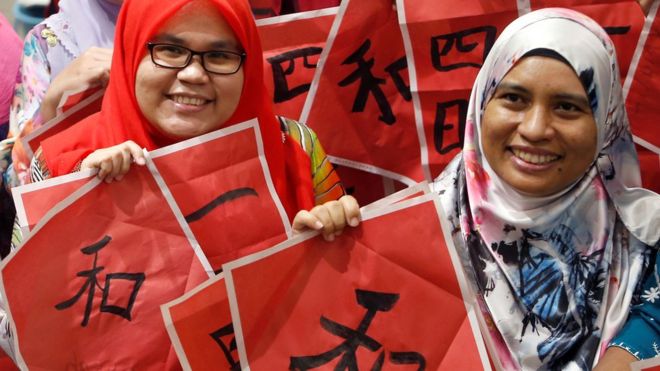
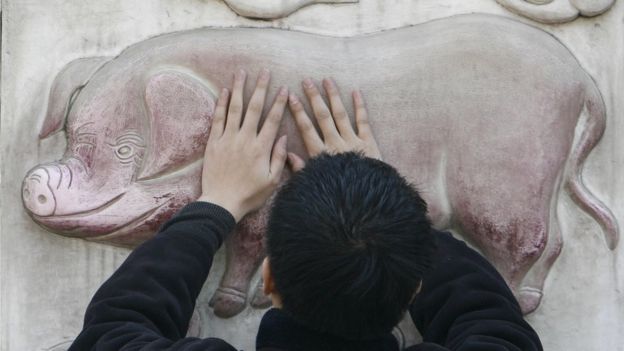
Image copyrightREUTERSImage captionMuslim teachers attend a Chinese calligraphy event in Kuala Lumpur, Malaysia to mark the Year of the Pig
Communities around the world are gearing up to celebrate the lunar new year, which this time ushers in the Year of the Pig.
New Year celebrations usually mean the animal is depicted everywhere – in decorations, toys, gifts and advertising.
But the pig, the last animal on the Chinese zodiac calendar, is considered unclean by Muslims and a sin to consume. So does this cause problems for people celebrating lunar new year in Muslim-majority countries in South East Asia?
Like most Chinese-Malaysian families, the lunar new year is serious business for the Chow family, who live in the sleepy town of Batu Pahat in Johor, Malaysia.
This year is particularly significant because Chow Yoon Kee, his wife Stella and their daughter were all born in pig years.
“We will display lots of lucky pig ornaments at home and of course, have our relatives, friends, workers and neighbours over to visit, no matter what race or religion. Celebrations are for all,” said Mr Chow, a floor manager at a local biscuit factory.
He isn’t worried about his celebrations offending fellow residents as he believes there is no sign of new year controversy.
“There was a lot of fuss last year,” he recalls, when it was the Year of the Dog, also seen as impure animals by some Muslims.
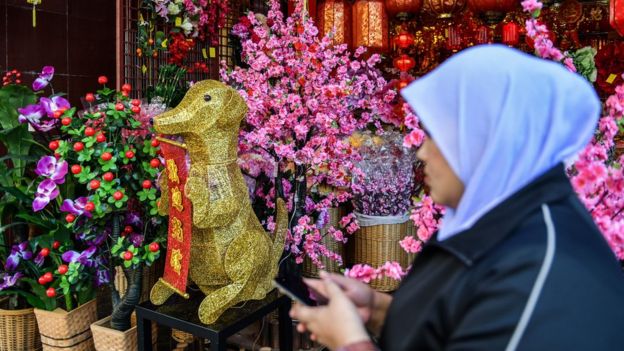
Image copyrightAFPImage captionMalaysian authorities trod cautiously last year, being careful not to overdo the canine decorations
Malaysia is multicultural but the official religion is Islam, and there have been increasing reports of intolerance towards activities and actions considered insulting to Muslims.
So many shops and merchants avoided using images of dogs in fear of offending Muslim communities.
But Mr Chow feels local authorities have overlooked the feelings of the Chinese community, who actually celebrate the holiday.
“Malaysia is a country made up of many races, it isn’t just Malay Muslims. We have Chinese and Indian communities too, as well as other religions like Christianity, Hinduism, Taoism and Buddhism so we should be respecting each other’s beliefs and celebrations.”
But he adds that “the spirit of censorship” did not seem to carry on into the pig year.
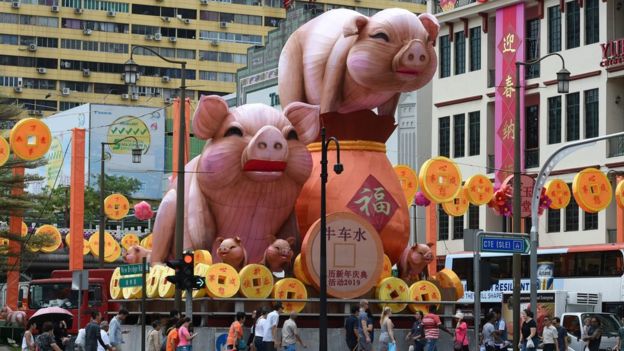
Image copyrightAFPImage captionThat’s some pig! Celebrations are under way in Chinatown, Singapore
Each animal of the Chinese zodiac is believed to have its own unique traits and qualities. Those born in the year of the pig are said to be intelligent, compassionate and loyal.
Does it matter if one’s zodiac animal isn’t welcome?
“There’s absolutely no reason to worry,” said Kuala Lumpur-based Feng Shui consultant Joey Yap. He told the BBC there didn’t seem to be any sensitivities around celebrations in Malaysia this year, compared to last.
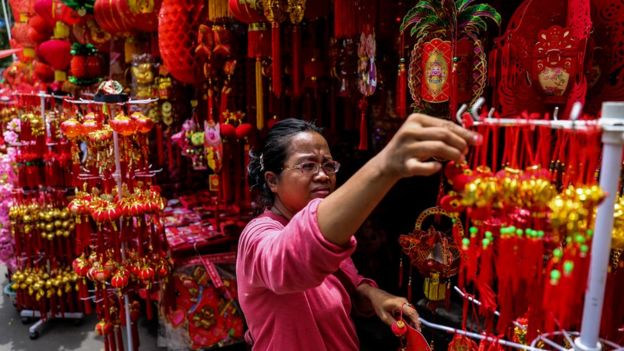
Image copyrightGETTY IMAGESImage captionRed decorations galore in Jakarta’s Chinatown
“Pigs will be fine,” he said, adding that whether you display objects or not “does not affect one’s personal luck”.
“Colours, emblems; they all aren’t important. In reality, one’s luck all boils down to one’s actions, so embrace positivity,” he said.
‘The first pigs Muslims can eat’
Even though it’s the world’s most populous Muslim nation, the lunar new year is a national holiday in Indonesia. Public celebrations are widely accepted – lanterns, colourful parades and performances are often seen in many cities.
Merry Olivia in Jakarta said her Muslim friends welcomed the image of pigs.
Image copyrightDAPUR MAMA LOEImage captionBaker Valeria Rita says her special cookies were a holiday hit with Muslim customers
“I grew up with many Indonesian Muslims so I know pigs will not make them feel uneasy,” she said, adding that the creatures looked more “festive” than other zodiac animals.
“If you compare pigs with snakes, pigs are more adorable so people would rather buy decorations embellished with them. Not many people in Jakarta like snakes.”
Baker Valeria Rita was rolling out special treats in time for the new year: pig shaped cookies with sweet pineapple jam fillings.
She said the response had been really good. “Orange or tangerine is a popular symbol for the lunar new year. This year, we decided to create pig-shaped treats and the quota for pre-orders was full within two weeks.”
Many of her customers are also Muslim.
“They buy my cookies for Chinese colleagues and friends who celebrate the holiday. Some also order for themselves because they like the pigs,” she said, sharing a joke made by her best friend, also a Muslim. “My goodies were the first pigs Muslims are allowed to eat.”
‘I don’t want to offend’
But it’s a different situation for 24-year-old Rangga Sastrajaya, from Bogor city. He bought pig toys and decorations but remains cautious in displaying them openly as he feels many Indonesians still do not accept cultural diversity.
“I could wear pig shirts or display pig-themed decorations at home but I will be quite careful in showing them off in public because I do not want to offend anyone,” he admitted.
Image copyrightAFPImage captionWill the new year spirit provoke widespread resentment among conservative Muslims?
But there are those who condemn the festivities. Forum Muslim Bogor (FMB), a conservative Islamic organisation in West Java, released a letter demanding the cancellation of festivities. They said it was “inappropriate” for Muslims because it could “undermine Islamic faith”.
Their actions follow other groups like Pemuda Pancasila (PP) and the Malayan Persatuan Forum Komunikasi Pemuda Melayu (PFKPM), who previously condemned the celebrations by Chinese communities.
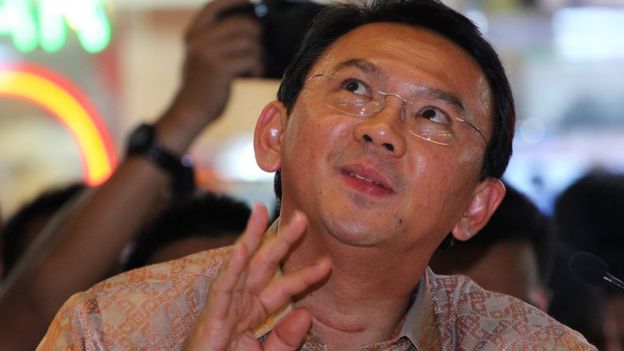
Image copyrightGETTY IMAGESImage captionIn 2017 Chinese-Christian Jakarta governor Basuki Tjahaja Purnama was jailed for blasphemy against Islam
Analyst Thung Ju-Lan from the Indonesian Institute of Science considers such sentiments the “impact of intolerant and political narratives”, the same kind which rocked Jakarta two years ago.
“It is the impact of the gubernatorial election in Jakarta, in Ahok’s case. The same sentiment has been spreading,” she told the BBC.
“The problem of intolerance continues because we have narrow understandings of what is actually happening. The more we do not understand, the more intolerant we are.”
In the case of celebrating the lunar new year, many Indonesian Muslims feel it is “more religious than cultural”.
But one politician has spoken out in defence of the Chinese community. Religious Affairs Minister Lukman Hakim Saifuddin encouraged beliefs of people from different cultures, faiths, and traditions to be respected.
“Regardless of what people understand about such celebrations, I invite all to respect tradition,” he said.
To counter China’s rapidly slowing economic growth, the Chinese government has returned to the policy playbook that worked well in the past: spending money on large infrastructure projects.
The National Development and Reform Commission (NDRC), China’s top economic planner, has accelerated its review process and approved 27 infrastructure projects with a total expected investment of 1.48 trillion yuan (US$219.43 billion) since the start of 2018, of which 16 worth around 1.1 trillion yuan were approved since the start of November.
Concerns were raised over a return to the debt-fuelled infrastructure investment binge that caused Beijing to halt approval of such projects in 2017, however, the need to stabilise the economy, which Beijing’s highest decision-making body set as the government’s top priority in July, took precedent.
We review the top 10 infrastructure projects by expected investment value that China has approved since the start of 2018, each costing over 50 billion yuan (US$7.41 billion).
The total investment for the 10 projects is projected at 1.158 trillion yuan over the next six years, or about 78 per cent of all newly approved infrastructure investment since the start of 2018.
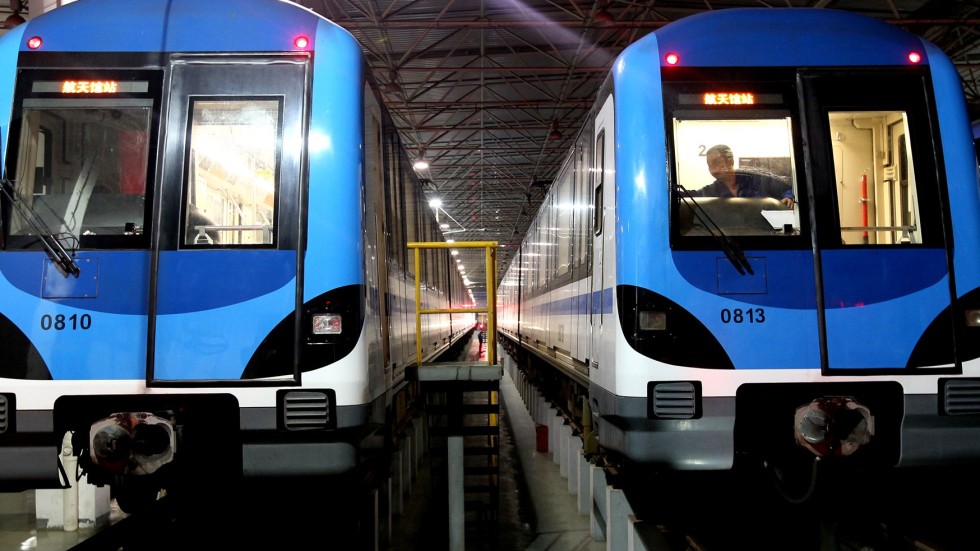
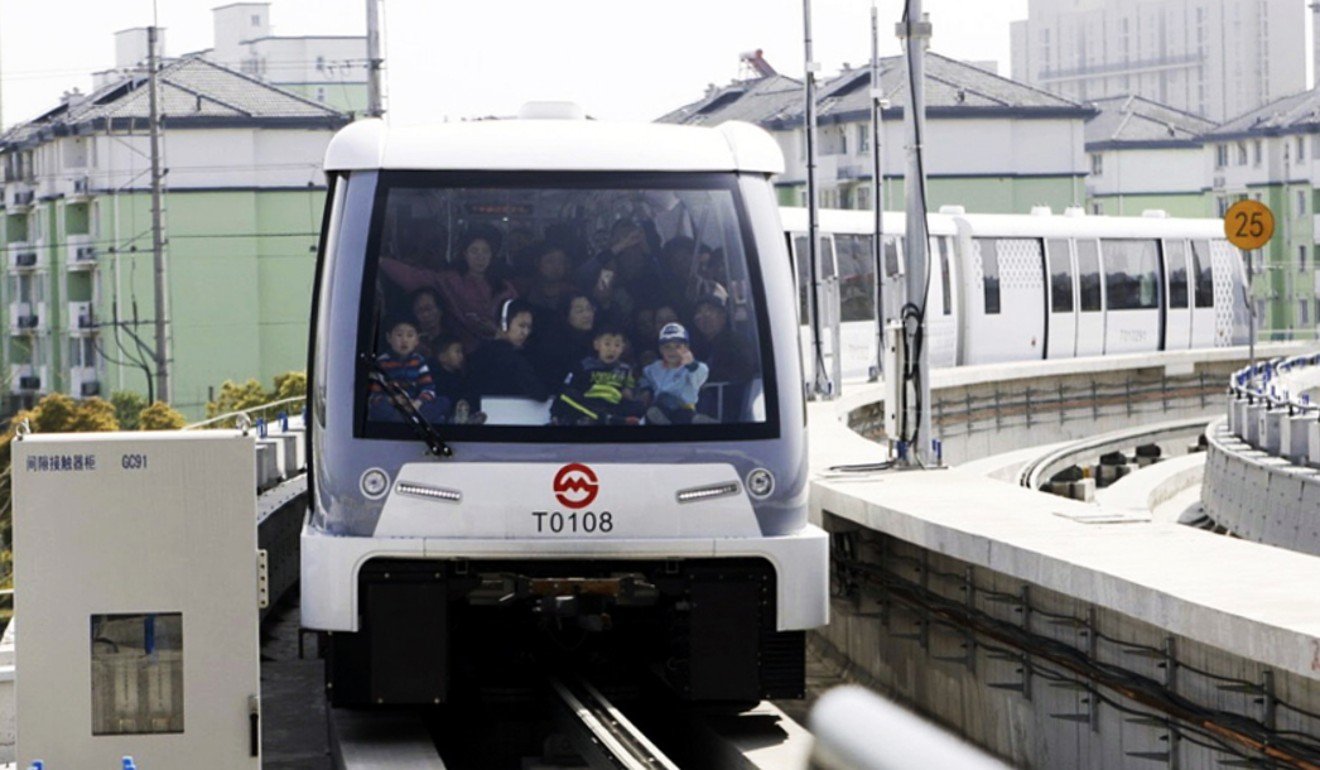
Nine rail projects including six subway lines and three intercity railways will be constructed from 2018 to 2023.
The projects are estimated to total 286km and will cost 298.35 billion yuan. The network is aimed at creating better connections between the financial hub’s two airports and two major railway stations.
2. Intercity Railway along the Yangtze River in Jiangsu province (US$34.35 billion)
Eight regional intercity railways will be built in a metropolitan cluster along the Yangtze River in Jiangsu Province, a move to shorten commuting time from Nanjing, the capital city of Jiangsu province, to other districts and cities within the province.
Some of the lines will also connect Nanjing to municipalities in the neighbouring Anhui Province.
Construction of the intercity lines are estimated to cost about 231.7 billion yuan, with the construction running until 2025.
Four metro lines plus four urban express lines will be constructed in the central Chinese city of Wuhan, with a total investment estimated at 146.9 billion yuan.
The NDRC said that the projects will support Wuhan’s urban layout and ease the city’s traffic congestion.
A circle line with 37 stops starting from Wuchang railway station tops the investment plan, which alone will cost 58.39 billion yuan (US$8.66 billion).
The construction will run from 2019 to 2024.
4. Intercity Rail Network in Eastern Guangdong (US$14.86 billion)
The intercity rail network in eastern Guangdong province, with a total investment of 100.2 billion yuan (US$14.86 billion), will facilitate connections between the cities of Shantou, Shanwei, Chaozhou, and Jieyang.
Construction on three rail lines totalling 320km started construction in 2018, with work on four others totalling 140km will start “at the right time”, according to the NDRC.
No specific completion date was mentioned by the state planner.
5. Suzhou Urban Rail Transit (US$13.84 billion)
Construction on four new urban transit lines in Suzhou was expected to start last year and finish in 2023.
Total investment is estimated at around 93.32 billion yuan (US$13.84 billion).
Among the four new lines, a 41km line will connect the city to Shanghai.
Seven urban rail transit lines, including the extension of three existing lines and four new lines, are due to be constructed in Changchun from 2019 to 2024.
The project is part of the government’s strategy to revitalise China’s northeastern provinces and boost the development of the city’s new districts.
The investment for the new projects is estimated at 71.14 billion yuan.
7. Xi’an-Yan’an High Speed Rail (US$8.18 billion)
A planned high speed rail connecting the Shaanxi provincial cities of Xi’an and Yan’an, the birthplace of Chinese Communist Party’s revolution, will also stop off at Chinese President Xi Jinping’s hometown of Fuping, located in the centre of the province.
The project will cost 55.16 billion yuan and will be completed within four and a half years.
8. Hangzhou Urban Rail Transit (US$8.3 billion)
An additional budget of 56.01 billion yuan has been granted for the already approved Hangzhou urban rail transit project.
Some 41.98 billion yuan (US$6.22 billion) of the new investment is for the new airport express from Wushan West station to Hangzhou International Airport.
According to the NDRC, it aims to better connect Hangzhou’s urban rail lines to the airport and to Hangzhou West railway station, a planned new station that is part of the infrastructure upgrade for the 2022 Asian Games which will be held in the city.
9. Chongqing-Qianjiang High Speed Rail (US$7.93 billion)
China’s first railway tunnel under the Yangtze River – the high speed rail link between Chongqing and Qianjiang – will be completed in the next five and half years at a cost of 53.5 billion yuan.
As a major section of the Xiamen-Chongqing high speed rail line, the Chongqing-Qianjiang section covers 265km and will allow speeds of up to 350km/h.
A total investment of 51.7 billion yuan will be put into two intercity railways in Guangxi province, with one from the capital city Nanning to the southeastern city of Yulin, and the other from Nanning to the southwestern city Chongzuo.
The track network is to be completed by 2023 and will connect regional towns with a total population over 500,000.
A tea farmer picks tea leaves at Zhouya Village of Doujiang Township in Sanjiang Dong Autonomous County, south China’s Guangxi Zhuang Autonomous Region, Feb. 3, 2019. The local spring tea goes on market every year before and after “Lichun”, literally meaning the beginning of the spring. Lichun is the first of the 24 solar terms of the Chinese lunisolar calendar, which falls on Feb. 4 this year. (Xinhua/Gong Pukang)
BEIJING, Feb. 3 (Xinhua) — The Chinese government has decided to grant a three-year-long tax benefit to inspire self-employment and support small companies to hire more people in need.
Under a decision jointly announced Saturday by the Ministry of Finance, State Taxation Administration and other governmental departments, people in need who start a business can have 12,000 yuan (about 1,790 U.S. dollars) deducted from their families’ annual share of taxes over three years.
The preferential treatment will target those registered as needy, jobless for more than half a year, on subsistence allowances or recent graduates from higher educational institutions.
The decision allows provincial-level governments to raise tax relief by 20 percent at most, depending on the needs of the region.
Companies who have hired the needy and paid social insurances for them can also enjoy tax deductions to the tune of 6,000 yuan per person a year for three years.
Local governments at provincial levels can lift tax relief by 30 percent at most according to local conditions.
The tax deduction mainly covers value-added tax, urban maintenance and construction tax, educational surcharge and individual income tax and will be effective from Jan. 1, 2019 to Dec. 31, 2021.
A separate statement, which was jointly issued Saturday by the Ministry of Finance, the State Taxation Administration and the Ministry of Veterans, said that self-employed veterans can also enjoy all the preferential treatments.
Companies who have hired veterans can also enjoy tax deduction to the tune of 6,000 yuan per person a year for three years. Local governments at provincial levels can lift tax relief by 50 percent at most according to local conditions.
DOHA, Feb. 3 (Xinhua) — Qatari Emir Sheikh Tamim Bin Hamad al-Thani’s recent visit to China has been welcomed by analysts and businessmen from both sides.
“The visit to China by Emir Tamim opened a new era of cooperation between the two countries with impressive results,” analyst Nabil al-Mrir told Xinhua.
“A number of Memorandums of Understanding (MoUs) were signed during the visit including one on strategic dialogue between the governments of Qatar and China,” al-Mrir added.
“The visit drew a roadmap to boost strategic partnership between the two countries in political, economic, investment, energy, technology and security cooperation domains,” he said.
The analyst noted that Qatar is one of the biggest liquefied natural gas (LNG) producers in the world, and China is one of the biggest importers of LNG.
“The expansion of cooperation in production and consumption of LNG between the two countries will be beneficial for both of them,” he said.
Analyst Hassan al-Ali told Xinhua that the visit of the emir of Qatar to China is very important especially in the light of the ongoing blockade imposed on his country.
In early June in 2017, Saudi Arabia, the United Arab Emirates, Egypt, and Bahrain imposed a blockade on Qatar and cut all the diplomatic ties and transport links with Qatar, accusing it of supporting terrorist groups.
Qatar vehemently denied the accusations.
“Doha needs to boost cooperation and trade exchange with various countries to change its economic development mode from reliance on oil and gas export to a diversified one,” al-Ali said.
He pointed out that Qatar needs technologies and experience of China which has great potentials in management and production.
“The results of the visit will give a push to the economic development in Qatar quickly,” the analyst added.





 CHINDIA ALERT: You'll be living in their world, very soon


COMMENTS: