Archive for ‘China alert’

13/12/2018

China-Qatar visa exemption agreement to take effect later this month

CHINA-BEIJING-WANG YI-QATAR-DEPUTY PM-STRATEGIC DIALOGUE MECHANISM-MEETING (CN)

Chinese State Councilor and Foreign Minister Wang Yi (R) and Sheikh Mohammed bin Abdulrahman Al Thani, deputy prime minister and minister of foreign affairs of Qatar, co-chair the first meeting of a China-Qatar inter-governmental strategic dialogue mechanism in Beijing, capital of China, Dec. 12, 2018. (Xinhua/Ding Haitao)

BEIJING, Dec. 12 (Xinhua) — An agreement on mutual exemption of visas between China and Qatar will take effect from Dec. 21, the two countries announced Wednesday in Beijing.

The announcement came as State Councilor and Foreign Minister Wang Yi and Sheikh Mohammed bin Abdulrahman Al Thani, deputy prime minister and minister of foreign affairs of Qatar, co-chaired the first meeting of a China-Qatar inter-governmental strategic dialogue mechanism in Beijing.

The two sides hope to take this opportunity to bolster cooperation in tourism and expand people-to-people exchanges.

This year marks the 30th anniversary of the establishment of diplomatic relations between China and Qatar. Wang said it is of great importance to initiate an inter-governmental strategic dialogue mechanism between the two countries.

“China stands ready to work with Qatar to push bilateral ties towards another 30 years of faster development,” said Wang. He proposed the two sides use the opportunity of jointly pursuing the Belt and Road Initiative to synergize their development strategies and carry out win-win cooperation in in fields including energy, high and new technology, investment, finance.

Wang also introduced the measures taken and results achieved by Xinjiang Uygur Autonomous Region in combating violence, terrorism and extremism.

While calling terrorism a common threat to humanity, Mohammed said Qatar supports the measures taken by China in safeguarding national security and stability, and stands ready to strengthen cooperation in security and anti-terrorism.

13/12/2018

Xi holds talks with Ecuadorean president, eyeing steady development of bilateral ties

CHINA-BEIJING-XI JINPING-ECUADOR-PRESIDENT-TALKS (CN)

Chinese President Xi Jinping (L, front) holds a welcoming ceremony for Ecuadorean President Lenin Moreno Garces ahead of their talks at the Great Hall of the People in Beijing, capital of China, Dec. 12, 2018. (Xinhua/Li Tao)

BEIJING, Dec. 12 (Xinhua) — President Xi Jinping on Wednesday held talks with Ecuadorean President Lenin Moreno at the Great Hall of the People in Beijing, calling for the healthy and steady development of the bilateral ties.

Recalling his state visit to the South American country in 2016, Xi said the healthy and steady development of China-Ecuador ties goes with not only the fundamental interests of the two countries and peoples but also the trend of peace, development and win-win cooperation.

During the 2016 visit, the two countries established a comprehensive strategic partnership, ushering in a new chapter for the bilateral relationship, Xi said.

Xi said he appreciates President Moreno’s commitment to deepening the friendly cooperation between the two countries since Moreno took office last year.

Xi stressed that the two sides should increase interactions to intensify their strategic communication and coordination and exchange experience on governance, so as to enhance mutual understanding and support for each other’s path of development and continue backing each other firmly on issues involving their core interests and major concerns.

Noting that Ecuador’s participation in the construction of the Belt and Road is welcomed by the Chinese side, Xi expects the two sides to jointly promote cooperation in areas such as infrastructure, production capacity, agriculture, information technology, new energy and environmental protection.

“China welcomes Ecuador to actively explore the Chinese market and share opportunities brought by China’s development,” Xi said.

China’s financing cooperation with Ecuador is conducted on the basis of equality, mutual benefit and business principles, without attaching any political condition, said Xi.

Noting that the Chinese government requires Chinese enterprises in Ecuador to abide by local laws and regulations and run business fairly in the market, Xi expects the Ecuador side to create a good investment environment and protect their legitimate rights and interests.

He called for closer people-to-people and technology exchanges, urging both sides to carry out law enforcement cooperation to guarantee normal exchanges of personnel, economy and trade.

Xi also said China will continue to support Ecuador’s post-earthquake reconstruction and its disaster prevention work.

China and Ecuador have same or similar positions on major international and regional issues, said Xi, calling on the two sides to collaborate closely to safeguard multilateralism, promote reform of the global governance system and defend the legitimate rights and interests of developing countries.

Moreno expressed gratitude for China’s assistance on Ecuador’s economic and social development, especially for the help offered after Ecuador was hit by an earthquake in 2016.

Moreno said Ecuador is ready to actively take part in the Belt and Road Initiative and expand bilateral cooperation in various fields.

He welcomed and appreciated China’s financing cooperation with Ecuador and expects to expand exports to China. Moreno also expressed the will to enhance coordination and collaboration with China in multilateral affairs such as UN Sustainable Development Goals.

After the talks, the two leaders witnessed the signing of several cooperation documents, including a memorandum of understanding on jointly promoting the construction of the Belt and Road.

13/12/2018

Submit China encourages mechanized agriculture with new measure

CHINA-MECHANIZED AGRICULTURE (CN)

A reaper harvests wheat in Pingyi County of Linyi City, east China’s Shandong Province, May 30, 2018. China has decided to boost mechanized farming and the upgrading of agricultural machinery, according to the State Council’s executive meeting chaired by Premier Li Keqiang on Wednesday. The meeting said that quickening the work as required by the country’s rural vitalization strategy would provide essential support for China to achieve agricultural modernization, allow farmers to increase their income and further expand the domestic market. (Xinhua/Wu Jiquan)

BEIJING, Dec. 12 (Xinhua) — China has decided to boost mechanized farming and the upgrading of agricultural machinery, according to the State Council’s executive meeting chaired by Premier Li Keqiang on Wednesday.

The meeting said that quickening the work as required by the country’s rural vitalization strategy would provide essential support for China to achieve agricultural modernization, allow farmers to increase their income and further expand the domestic market.

The work must be advanced to meet the needs of developing scale farming appropriately. During the process, farmers’ wishes must be respected while the roles of the market are exploited. Grassroots creativity must be valued so that the work can proceed smoothly, it said.

The meeting also listed several crops whose production and harvest could depend more on mechanized farming. They are rice, wheat, corn, potato, oilseed rape, cotton and sugarcane.

In the meeting, it was said that farmers engaged in mechanized farming would be subsidized equally no matter if the machinery they purchase is from Chinese or foreign brands.

Financial institutions were encouraged to use mortgage loans to finance such purchases while local governments were called on to support the work through financial discounts.

The meeting stressed that advanced agricultural machinery and mechanized farming techniques should be further promoted.

It also urged enterprises to quicken innovation on agricultural equipment, double their efforts to develop complete sets of equipment and improve the quality of farming equipment suitable for major cash crops.

It said that small plots of farmland could be consolidated when possible so as to broaden the use of farming equipment and that various cooperatives need to be established to facilitate the sharing of agricultural machinery.

It was stated in the meeting that smart farming based on the application of modern information and communication technologies shall be advanced.

13/12/2018

Xi reiterates China’s adherence to multilateralism, opening-up

CHINA-BEIJING-XI JINPING-FORUM-FOREIGN DELEGATES-MEETING (CN)Chinese President Xi Jinping (C, front row) poses for a group photo with foreign delegates attending the just concluded 2018 Imperial Springs International Forum held in Guangzhou, ahead of a meeting with them at the Great Hall of the People in Beijing, capital of China, Dec. 12, 2018. (Xinhua/Wang Ye)

BEIJING, Dec. 12 (Xinhua) — President Xi Jinping reiterated on Wednesday that China will adhere to the path of multilateralism and open its door wider to the world.

Xi made the remarks when meeting with foreign delegates attending the just concluded 2018 Imperial Springs International Forum held in Guangzhou, south China’s Guangdong Province.

He briefed the delegates on achievements of China’s reform and opening-up during the past 40 years and important measures of a new round of opening-up at a higher level, expounded on China’s relations with the world, and listened to the delegates’ remarks.

Xi said this year’s Imperial Springs International Forum coincides with the 40th anniversary of China’s reform and opening-up.

The forum, held on Dec. 10 in southern China’s Guangzhou, gathered some 200 former world leaders, renowned scholars and business elites to discuss the theme of advancing reform and opening-up, promoting win-win cooperation.

“The past 40 years have witnessed tremendous achievements in China’s development and remarkable improvement of people’s livelihood, from shortage to abundance, from poverty to moderate prosperity,” Xi said.

China’s reform and opening-up drive is people-oriented, Xi stressed, adding that a distinctive feature of the country’s economy in the new era is the shift from rapid growth to high-quality development, from quantitative expansion to qualitative growth.

“For more balanced and full development, we must further deepen reform and expand opening-up,” said the Chinese president.

During the Boao Forum for Asia annual conference in April, Xi announced a series of measures to expand the country’s opening-up, including substantially easing market access, creating a more attractive investment environment, strengthening intellectual property protection and actively expanding imports.

At the opening ceremony of the first China International Import Expo in Shanghai, Xi announced new measures to further expand opening-up.

“China will adhere to the path of multilateralism, and open the door wider to the world,” Xi said.

Saying China’s economy has maintained overall stability and steady progress, Xi noted that the goal of “making people well-off” pushes the important potential for the country to achieve further growth.

With the increasing income, Chinese people’s pursuit of a high-quality life will bring about greater consumer demand, Xi said. “We are firmly confident in the long-term positive fundamentals of China’s economic development, as well as in the mid- to high-speed economic growth bringing the economy to a medium-to-high level.”

Noting that China’s role as an active defender and contributor to international rules has been acknowledged by the international community, Xi said China’s reform and opening-up is all-round, and the country’s development is an opportunity for the whole world.

“The practice of China’s reform and opening-up has fully proven that only by win-win cooperation can a country achieve long-term development,” he said.

Xi stressed that the Belt and Road Initiative, which originates from China and belongs to the world, is aimed at building a new platform for win-win cooperation for the international community.

He reiterates the principle of extensive consultation, joint contribution and shared benefits in promoting cooperation under the Belt and Road Initiative.

“China’s overseas investment and cooperation in capacity building and infrastructure construction have driven industrialization of the countries concerned and promoted local people’s livelihood and economic and social development,” said Xi.

Xi said the Chinese side sincerely hopes that all countries will join the Belt and Road partnership and deliver more benefits for all people.

He said China’s efforts to promote and build a new type of international relations and a community with a shared future for humanity are also aimed at achieving win-win cooperation among all countries.

Noting that China’s reform and opening-up has left a glorious chapter in history, Xi said the policy will also enable China to score new achievements in the next 40 years that will deeply impress the world.

The foreign delegates, including former Latvian President Vaira Vike-Freiberga, said that China’s reform and opening-up have brought about tremendous changes in China and had a major positive impact on the world.

They advocated developing inter-state ties on the basis of enhancing mutual trust and win-win cooperation, urging all sides to maintain world peace, promote common growth and oppose unilateralism, isolationism and protectionism.

The foreign delegates also praised the Belt and Road Initiative, saying it yielded tangible benefits for many countries.

12/12/2018

China’s hacking against U.S. on the rise – U.S. intelligence official

NEW YORK (Reuters) – A senior U.S. intelligence official said on Tuesday that Chinese cyber activity in the United States had risen in recent months, targeting critical infrastructure in what may be attempts to lay the groundwork for future disruptive attacks.

“You worry they are prepositioning against critical infrastructure and trying to be able to do the types of disruptive operations that would be the most concern,” National Security Agency official Rob Joyce said at a Wall Street Journal cybersecurity conference.

Joyce, a former White House cyber adviser for President Donald Trump, did not elaborate. A spokeswoman for the NSA said Joyce was referring to digital attacks against the U.S. energy, financial, transportation and healthcare sectors.

The comments are notable because U.S. complaints about Chinese hacking have to date focussed on espionage and intellectual property theft, not efforts to disrupt critical infrastructure.

China has repeatedly denied U.S. allegations it conducts cyber attacks.

Joyce’s remarks coincide with U.S. prosecutors preparing to unveil as early as this week a new round of criminal hacking charges against Chinese nationals. They are expected to charge that Chinese hackers were involved in a cyber espionage operation known as “Cloudhopper” targeting technology service providers and their customers, according to people familiar with the matter.

The U.S. Congress is looking into the allegations of increased Chinese hacking activity.

Senior officials from the Department of Homeland Security and Justice Department are scheduled to testify Wednesday morning at a Senate Judiciary Committee hearing on “China’s Non-Traditional Espionage Against the United States: The Threat and Potential Policy Responses.”

12/12/2018

China’s Tencent Music raises nearly $1.1 billion in U.S. IPO

NEW YORK/HONG KONG (Reuters) – China-based music streaming company Tencent Music Entertainment Group (TME.N) said it raised close to $1.1 billion in its U.S. initial public offering (IPO) after pricing its shares at the bottom of its targeted range.

The music arm of gaming and social network giant Tencent Holdings Ltd (0700.HK) priced its American Depositary Receipts (ADRs) at $13 per share, at the low end of its indicated $13 to $15 per share range, it said in a filing with the Hong Kong stock exchange.

The IPO values Tencent Music at $21.3 billion and shows how companies are defying a bout of market volatility with flotations.

Tencent Music sold 41 million ADRs, while existing shareholders sold a further 40.9 million, the filing said.

Tencent Music’s IPO tops off a bumper year for U.S. listings by Chinese companies, with $7.9 billion raised before Tencent Music’s debut, Refinitiv data showed.

That is the highest amount since 2014, the year of Alibaba Group Holding Ltd’s (BABA.N) record $25 billion IPO.

Tencent Music’s U.S. IPO is the fourth largest among Chinese firms this year by deal value. Video streaming company iQiyi Inc (IQ.O) leads with its $2.4 billion listing, followed by online group discounter Pinduoduo Inc (PDD.O) at $1.6 billion and electric vehicle maker NIO Inc (NIO.N) at $1.15 billion.

Returns for investors have been mixed, with the 31 Chinese IPOs in 2018 down an average of around 11 percent as of Dec. 10, according to data provider Dealogic.

With streaming apps QQ Music, KuGou, Kuwo as well as karaoke app We Sing, Tencent Music is China’s largest online music platform boasting more than 800 million active users monthly.The firm is often compared with Spotify Technology SA (SPOT.N) but offers more socially interactive services that make it profitable while its Swedish counterpart is not.

Tencent Music initially planned to launch the deal in October but postponed because of a sell-off in global markets roiled by a U.S.-China trade war and fears of slowing global growth.

Tencent Music reported a 244 percent profit jump for January-September to $394 million. By comparison, Spotify lost a net $520 million.

Morgan Stanley, Bank of America, Deutsche Bank, Goldman Sachs and JPMorgan are the lead sponsors of Tencent Music’s deal.

Tencent Music is due to begin trading on the New York Stock Exchange on Wednesday under the symbol “TME” (TME.N).

12/12/2018

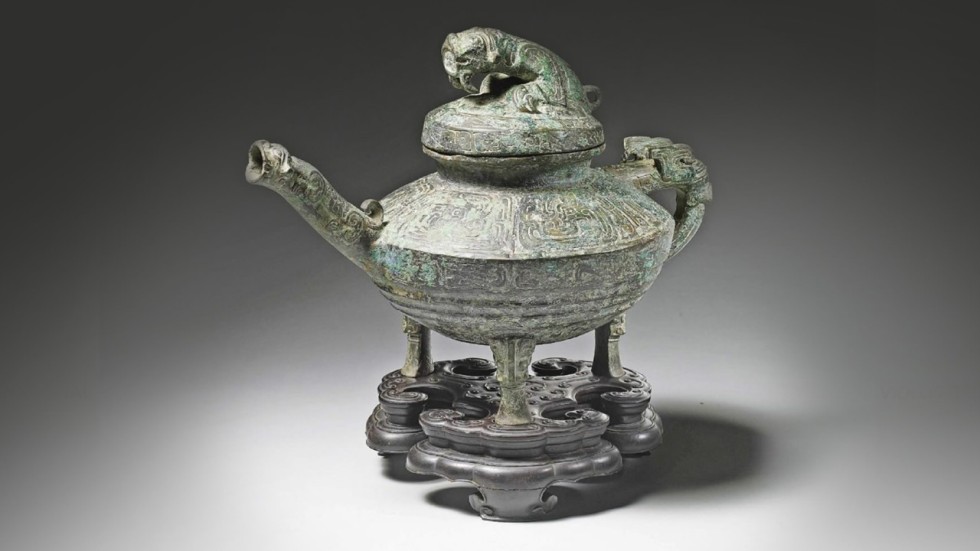
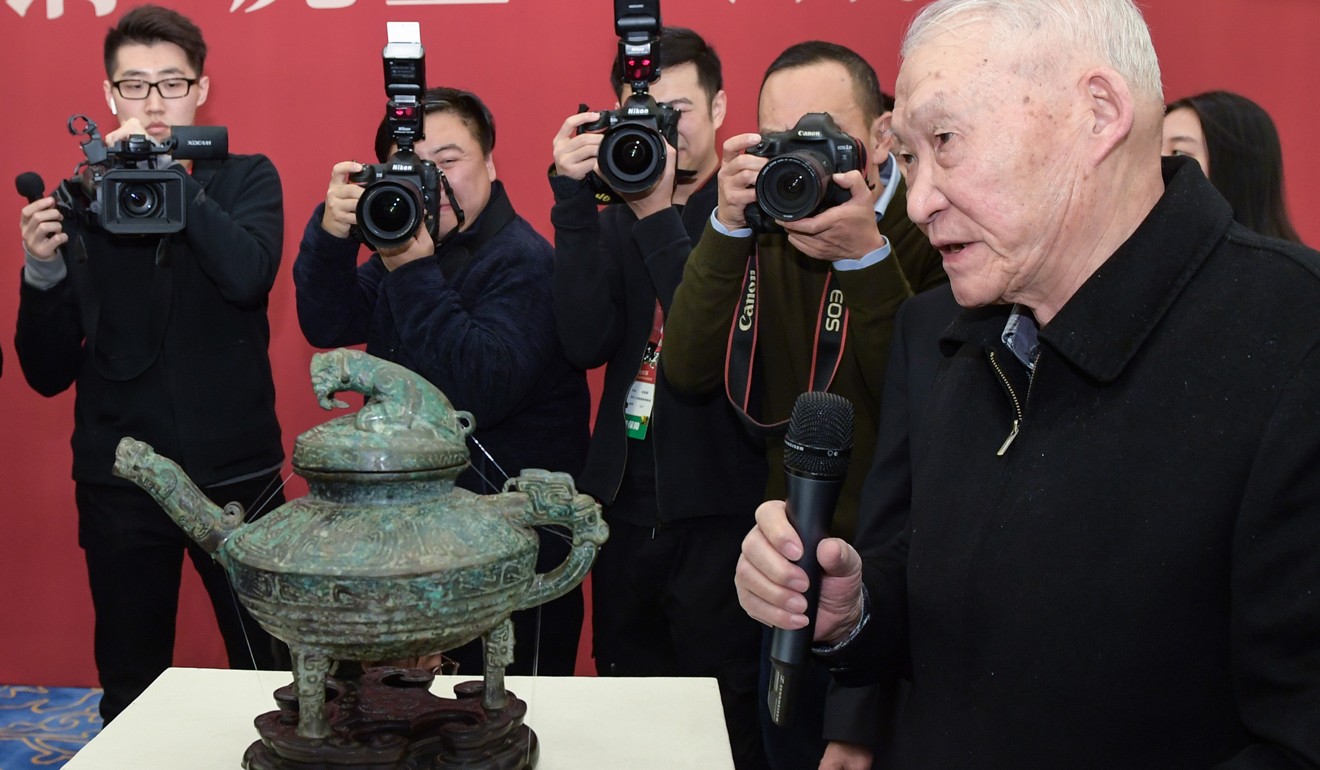
Ancient bronze vessel looted from Old Summer Palace in 1860 returned to China

  • The 3,000-year-old relic was sold at auction in Britain for US$515,000 in April but the buyer decided to donate it to the Chinese government
  • It was taken by a British Royal Marines captain and had been in the possession of his descendants. Now it’s on display at a museum in Beijing
A 3,000-year-old bronze vessel that was taken from the Old Summer Palace in Beijing has been returned to China after more than a century overseas, according to the State Administration of Cultural Heritage.

On Tuesday, it was formally placed on display at the National Museum of China in the capital, where it is now part of the permanent collection.

The ancient relic was sold at auction in Britain for £410,000 (US$515,000) on April 11, but was donated to the Chinese government with no strings attached on April 28 after the unknown buyer had a change of heart.

A representative from Canterbury Auction Galleries, which sold and helped to return the item, told news site Thepaper.cn the buyer had recognised the deep significance of lost artefacts for Chinese.

After it was donated, the vessel was kept at the Chinese embassy in London before it was formally handed back to the cultural heritage administration on September 21.

The ceremonial vessel dates back to the Western Zhou Dynasty (1046-771BC) and is decorated with miniature tigers on its spout, handle and lid. It is believed to be one of only seven such vessels, five of which are held in museums.

It was taken by British Royal Marines captain Harry Evans during the ransacking of the Old Summer Palace by Anglo-French troops in 1860, and had been in the possession of his descendants before it was auctioned.

The auction of the rare artefact was strongly opposed by the Chinese government, which had been working to get it returned to China, but Canterbury Auction Galleries went ahead with the sale.

Unveiling the new museum exhibit, Liu Yuzhu, head of the administration, said Chinese historical artefacts lost overseas were an important part of China’s cultural heritage.

China views the loss of these relics as a potent source of national humiliation and as a reminder of the destruction inflicted by foreign armies. The government estimates that more than 10 million historical items were taken from China during its so-called century of humiliation between 1849 and 1949, when the country was repeatedly invaded by foreign powers.

In recent years, Beijing has led numerous high-profile campaigns aiming to get its stolen artefacts returned from overseas, as a symbol of the country’s growing economic and political clout.

Many objects remain in the world’s most prestigious museums, including the British Museum and the Palace of Fontainebleau in France, as well as in private collections.

But billionaire Chinese collectors have snapped up many items in recent years, including a porcelain “chicken cup” that was bought for US$36.3 million at an auction in Hong Kong in 2014.

12/12/2018

In Vietnam, anguished mothers search in vain for the children they have lost to China’s booming ‘buy-a-bride’ trade

  • In the borderlands, most people have a story of bride trafficking – from kidnapped cousins and disappeared wives to vanished daughters

Vu Thi Dinh spent weeks scouring the rugged Vietnamese borderland near China after her teenage daughter vanished with her best friend, clutching a photo of the round-faced girls that she now fears have been sold as child brides.

The anguished mother showed everyone she met the snap of the 16-year-old friends Dua and Di in white and red velvet dresses, the words “Falling Into You” printed above their picture.

They went missing in February during an outing in Meo Vac, a poor mountainous border zone that is a stone’s throw from China. Their mothers fear they were sold in China on one of the world’s most well-trodden bride trafficking circuits.

“I wish she would just call home to say she is safe, to say ‘please don’t worry about me, I’m gone but I’m safe,’” said Dinh, bursting into tears.

I wish she would just call home to say she is safe
VU THI DINH

She is among countless mothers whose daughters have disappeared into China where a massive gender imbalance has fuelled an unregulated buy-a-bride trade. Most people in this part of Vietnam have a story about bride traffi

High-school students talk of kidnapped cousins. Husbands recall wives who disappeared in the night. And mothers, like Dinh, fear they may never see their daughters again.

“I warned her not to get on the backs of motorbikes or meet strange men at the market,” she says from her mud-floored home where she expectantly keeps a wardrobe full of her daughter’s clothes.

She has not heard from Dua since she went missing, unable to reach her on the mobile phone she bought just a few weeks before she disappeared.
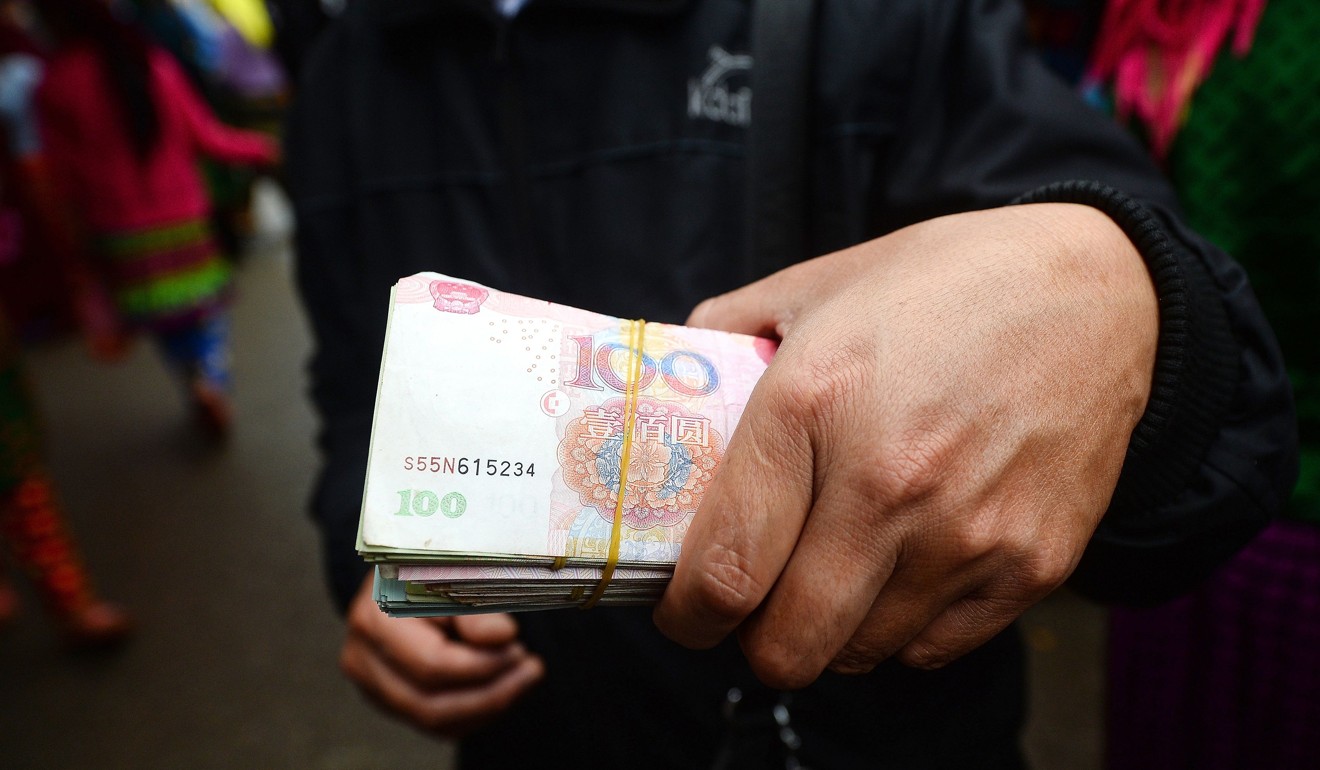
The victims come from poor communities and are often tricked by boyfriends and sold, kidnapped against their will or moved across the border by choice for marriage or the promise of work.

Like many of the missing, Dua and Di are from the Hmong ethnic minority, one of the country’s poorest and most marginalised groups.

Traffickers target girls at the busy weekend market, where they roam around in packs dressed in their Sunday best, chatting to young men, eyeing the latest Made-in-China smartphones or shopping for lipstick and sparkly hair clips. Or they find them on Facebook, spending months courting their victims before luring them into China.

It is a sinister departure from the traditional Hmong custom of zij poj niam, or marriage by capture, where a boyfriend kidnaps his young bride-to-be from her family home – sometimes with her consent, sometimes not.

Others are enticed by the promise of a future brighter than that which awaits most girls who stay in Ha Giang: drop out of school, marry early and work the fields.

“They go across the border to earn a living but may fall into the trap of the trafficking,” said Le Quynh Lan from the NGO Plan International in Vietnam.

Vietnam registered some 3,000 human trafficking cases between 2012 and 2017. But the actual number is “for sure higher”, said Lan, as the border is largely unregulated.

Ly Thi My never dreamed her daughter would be kidnapped, since the shy Di rarely went to the market or showed much interest in boys.

Just two weeks after that photo shoot with Dua, the giggling girls went for a walk in the rocky fields near their homes. They never came back.

“We think she was tricked and trafficked as a bride, we don’t know where she is now,” said My.

Her worst fear is the teenagers are now child brides or have been forced to work in brothels in China where there are 33 million more men than women because of a long-entrenched preference for male heirs.

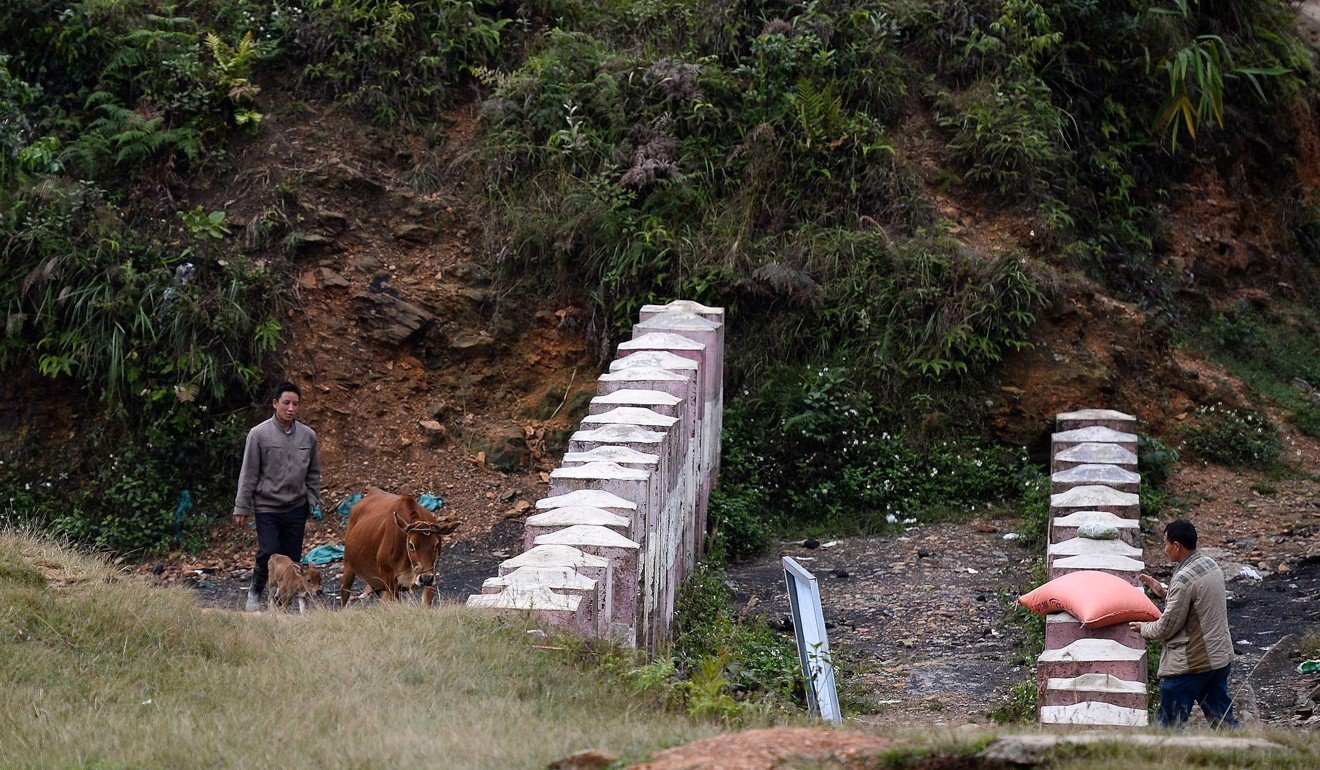
The trip across the 1,300-kilometre border is an easy one, said Trieu Phi Cuong, an officer with Meo Vac’s criminal investigations unit.

“This terrain is so rugged, it’s very hard to monitor,” he said at a border crossing marked by waist-high posts near where a Vietnamese man was selling a cage of pigeons to a customer on the China side.

Many victims don’t even know they’ve crossed into China – or that they’ve been trafficked.
Lau Thi My was 35 and fed up with her husband, an abusive drunk, when she grabbed her son and headed to the border.

She went with a neighbour who promised her good work in China, but she fell prey to traffickers.

My was separated from her son and sold three times to different brokers before a Chinese man bought her as a wife for about US$2,800.

“He locked me up several times, I hated him,” said My, who fled after 10 years by scrabbling together enough money for the journey home.

She is now back with her Vietnamese husband – still a drinker – in the same home she escaped a decade ago, a smoke-filled lean-to where her dirt-streaked grandchildren run about. But she is desperate for word from her son.

“I came back totally broken … and my son is still in China, I miss him a lot,” she said.

12/12/2018

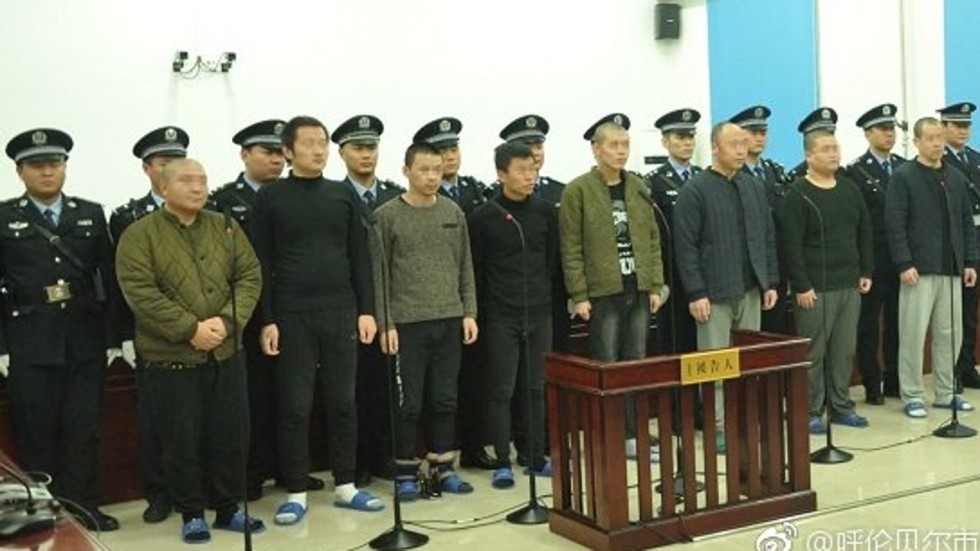
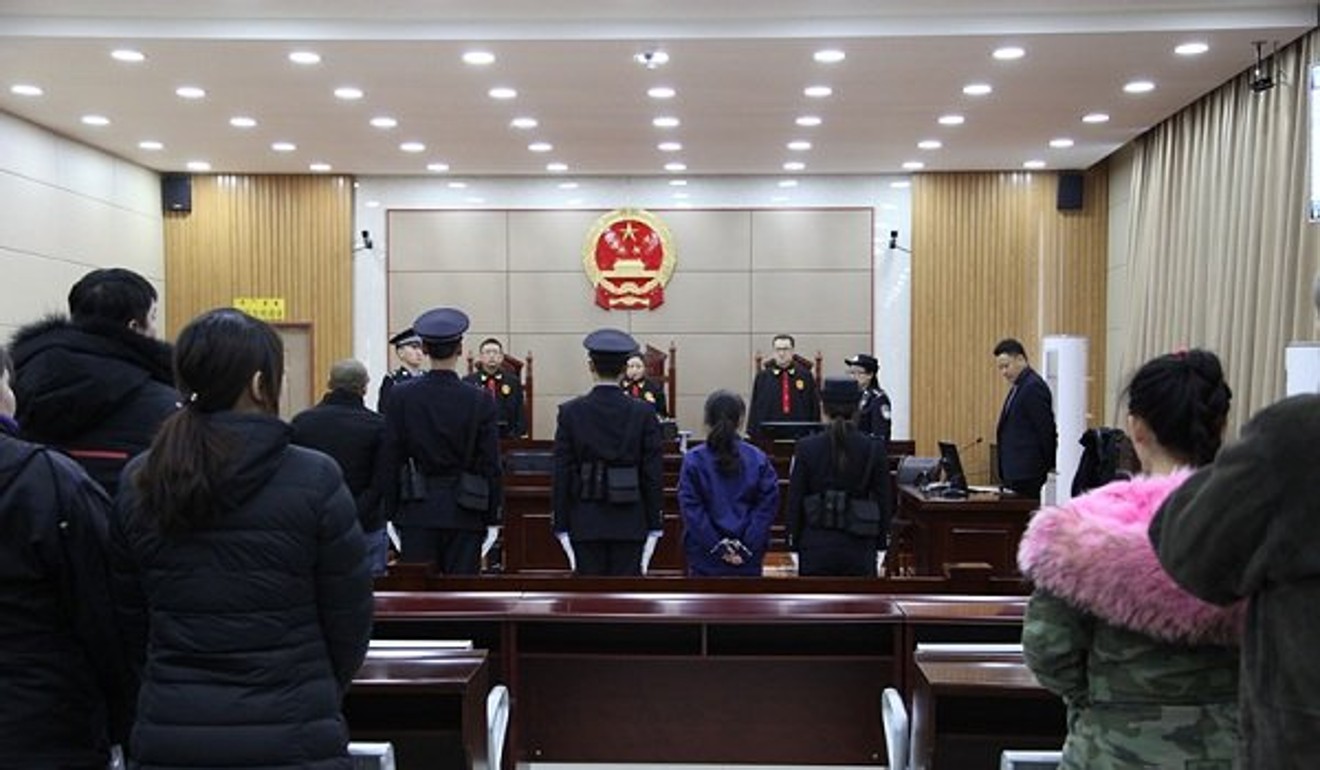
Chinese loan shark who raped victim among 18 jailed for gang crime

Wang Yinan was one of 19 people convicted of various gang-related crimes in Hulunbuir in the Inner Mongolia autonomous region, Beijing Youth Daily reported on Tuesday.

Wang and eight of his associates were tried in the city on Monday charged with illegally providing loans of between 10,000 yuan (US$1,450) and 30,000 yuan to people via a smartphone app since September 2017.

Those who failed to keep up with their repayments were subjected to physical assault, including being made to stand naked in the snow, the report said. One victim was raped as punishment, it said, without providing any further details of the crime.

Wang’s associates were each sentenced to between one and nine years in prison.

The trials followed a nationwide crackdown on organised crime launched at the start of the year.

Among the others given prison sentences on Monday were Lee Yongbin, who led a group of hired thugs that intimidated people involved in construction conflicts and worked as debt collectors for loan sharks, the report said.

Members of the gang were also charged with “creating public disturbances”, the court heard.

Lee was sentenced to 5½ years in prison, and his associates to between 10 and 30 months.

12/12/2018

Book series revealing Japanese Kwantung Army crimes in NE China published

SHENYANG, Dec. 11 (Xinhua) — A volume of books collecting Japanese Kwantung Army secret military files from the early 1930s was published by the September 18 Incident History Museum in Shenyang on Tuesday.

The files, from the second day after the “Sept. 18 Incident” in 1931 to December 1935, were written by the Kwantung Army stationed in northeast China and presented as military reports.

Edited into 20 volumes, it includes more than 560 files, totaling about 9,000 papers.

These historical files serve as comprehensive records of the process that the Japanese Kwantung Army started the “Sept. 18 Incident” and the war of aggression against China.

The files which were edited in chronological order record the Japanese Kwantung Army’s attacks in a number of northeastern Chinese cities including Harbin, Qiqihar, Shenyang, Changchun and Jilin, said Fan Lihong, chief editor of the book and curator of the museum.

The Kwantung Army reported details of the scale, plans, as well as casualties of warfare in northeast China to its superior army, according to Fan.

“The reports were submitted by the Kwantung Army from the second day after Sept.18, 1931 to the end of 1935 without interruption to ensure the central Japanese army knew the progress of the war in northeast China,” Fan said.

“These reports have been well preserved and can serve as authoritative historical evidence, which reflect the Kwantung Army and Japanese army’s crimes in northeast China.”

On Sept. 18, 1931, the Japanese Kwantung Army bombarded Shenyang under the excuse of explosions that occurred on the South Manchuria Railway.

Since the “Sept. 18 Incident,” China waged a war against Japanese aggression for 14 years and finally won the first full victory against foreign invasion since the Opium War in 1840 at the cost of over 35 million military and civilian casualties.

Law of Unintended Consequences

continuously updated blog about China & India

ChiaHou's Book Reviews

continuously updated blog about China & India

What's wrong with the world; and its economy

continuously updated blog about China & India