Chindia Alert: You’ll be Living in their World Very Soon
aims to alert you to the threats and opportunities that China and India present. China and India require serious attention; case of ‘hidden dragon and crouching tiger’.
Without this attention, governments, businesses and, indeed, individuals may find themselves at a great disadvantage sooner rather than later.
The POSTs (front webpages) are mainly 'cuttings' from reliable sources, updated continuously.
The PAGEs (see Tabs, above) attempt to make the information more meaningful by putting some structure to the information we have researched and assembled since 2006.
QINGDAO, China (Reuters) – Warships from India, Australia and several other nations arrived in the eastern Chinese port city of Qingdao on Sunday to attend a naval parade, part of a goodwill visit as China extends the hand of friendship despite regional tensions and suspicions.
China on Tuesday will mark 70 years since the founding of the People’s Liberation Army Navy, where it will show off new warships including nuclear submarines and destroyers at a major review in the waters off Qingdao.
China says warships from about a dozen nations are also taking part – one diplomatic source with direct knowledge said it was 13 countries in total – and the PLA is putting its best foot forward to welcome them.
India, which has been at odds with China over their disputed land border and Beijing’s support for India’s regional rival Pakistan, has sent stealth guided-missile destroyer the “INS Kolkata” to take part, along with a supply ship.
“We bring to you one of the best ships that we have made. It is the pride of the nation and the navy, and we are very happy to be here,” Captain Aditya Hara told reporters on the dockside after disembarking from the ship in Qingdao.
A source familiar with the situation told Reuters the “Kolkata” had sailed through the Taiwan Strait to get to Qingdao, a sensitive waterway that separates China from self-ruled Taiwan, claimed by Beijing as sacred Chinese territory.
“We headed on a direct route and we are very happy that we were facilitated by the PLA Navy and they ensured that we had a safe passage to Qingdao,” Hara said, when asked if they had sailed via the Taiwan Strait.
Australia, a close U.S. ally, has sent the “HMAS Melbourne” guided-missile frigate to Qingdao, though officials declined to make the captain available for interview.
China and Australia have sparred over Australian suspicions of Chinese interference in the country’s politics and Australia’s banning of China’s Huawei Technologies Co Ltd from supplying equipment for its planned 5G broadband network.
Japan has also sent a destroyer to Qingdao, in the first visit of a Japanese navy ship to China since 2011, according to Japanese media.
Ties between China and Japan, the world’s second and third-largest economies, have been plagued by a long-running territorial dispute over a cluster of East China Sea islets and suspicion in China about Japanese Prime Minister Shinzo Abe’s efforts to amend Japan’s pacifist constitution.
But they have sought to improve relations more recently, with Abe visiting Beijing in October, when both countries pledged to forge closer ties and signed a broad range of agreements including a $30 billion currency swap pact.
The other countries taking part include China’s close friend Russia, and three countries which have sparred with China over competing claims in the disputed South China Sea: Vietnam, Malaysia and the Philippines.
Pakistan, a very close Chinese ally, is not on the list of countries officials have provided which are sending ships to the parade.
Vijay Keshav Gokhale is expected to meet Chinese deputy foreign minister Kong Xuanyou and Foreign Minister Wang Yi during two-day visit
Beijing’s refusal to sanction a Pakistani militant leader and its belt and road push in the disputed Kashmir region have strained ties
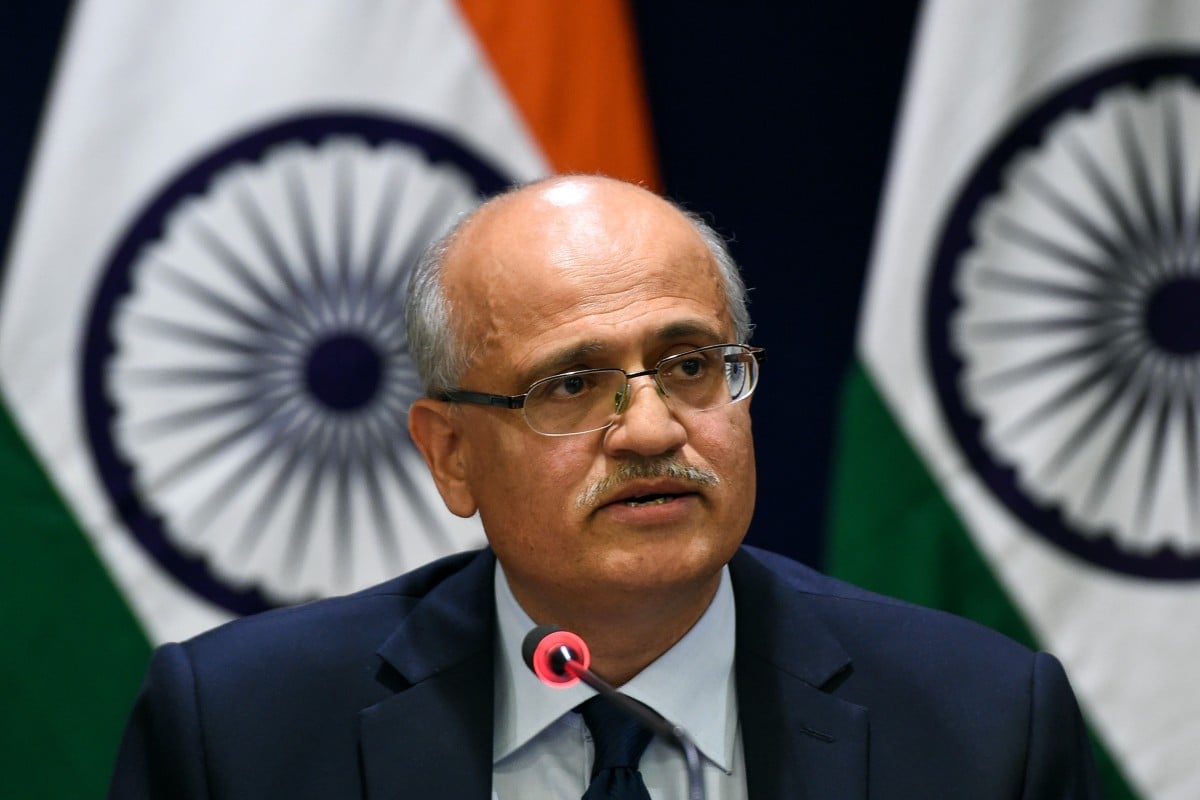
Indian Foreign Secretary Vijay Keshav Gokhale will visit China as part of “regular exchanges” between the two countries. Photo: AFP
Indian Foreign Secretary Vijay Keshav Gokhale will travel to Beijing on Sunday amid tensions between India and China over Beijing’s refusal to sanction a Pakistani militant leader and its infrastructure push in the disputed Kashmir region.
Gokhale’s two-day visit is part of “regular exchanges” between the two nations, the Indian embassy in Beijing said on Saturday.
During his stay, Gokhale is expected to meet Chinese deputy foreign minister Kong Xuanyou and Foreign Minister Wang Yi.
He will return to India on Monday, three days before the second Belt and Road Forum begins in the Chinese capital. Forty foreign leaders will attend the summit on Beijing’s global trade and infrastructure scheme, the “Belt and Road Initiative”, but India is not taking part.
Wang on Friday called on India, and other countries sceptical of the initiative, to join up, dismissing claims that it is a geopolitical tool. He also said China was ready to hold a leaders’ summit with India like the informal meeting held between Chinese President Xi Jinping and Indian Prime Minister Narendra Modi in Wuhan, Hubei province last year.
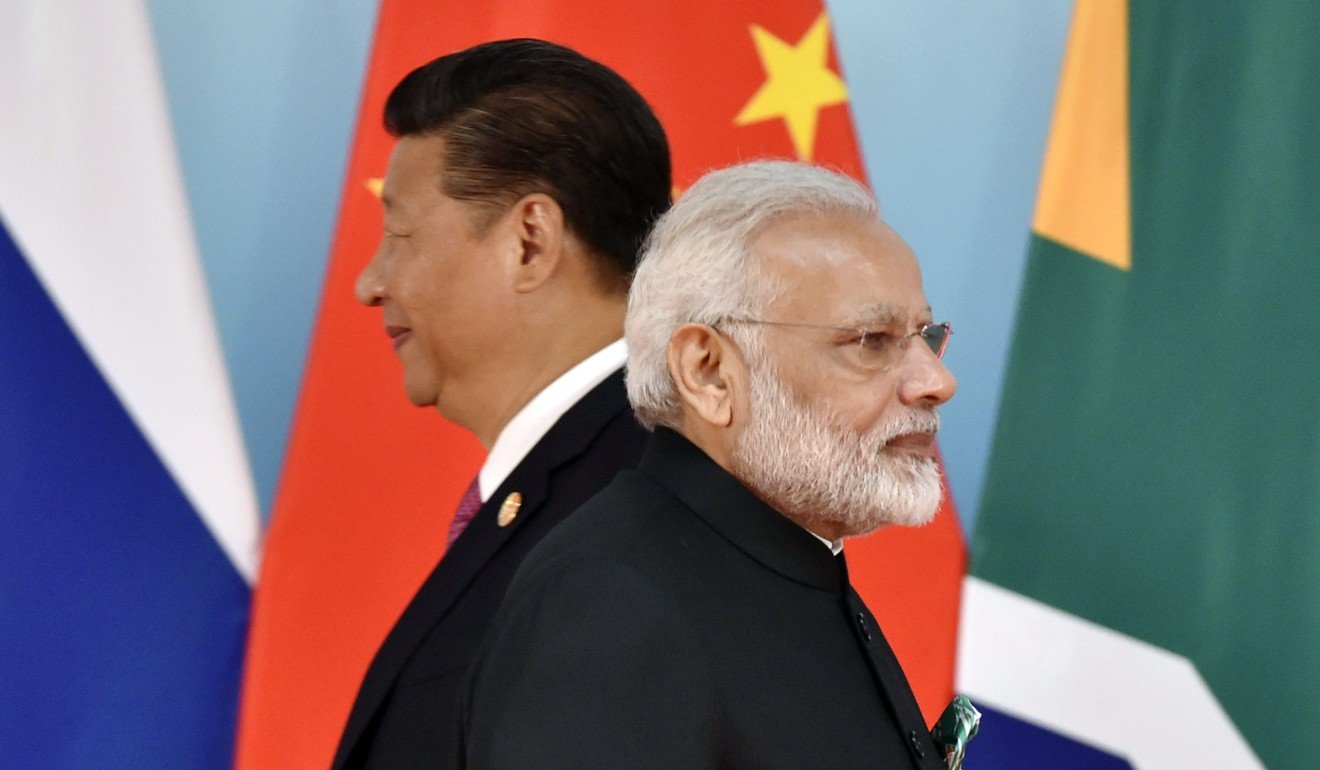
A summit between Xi Jinping (left) and Narendra Modi in Wuhan last year was seen as a breakthrough in China-India relations after the Doklam border dispute. Photo: AFP
Gokhale visited Beijing in February last year, and the Wuhan summit happened two months later. That meeting was seen as a breakthrough in the
after a 73-day military stand-off over the Doklam plateau.
But the progress was overshadowed in February after a terror strike on Indian security forces in the Jammu and Kashmir province, which killed 40 Indian soldiers. The Pakistan-based Jaish-e-Mohammed group claimed responsibility for the attack. India has long wanted to designate its leader, Masood Azhar, as a terrorist under international law, but China has opposed the move.
During a visit to Pakistan in March, Kong said Beijing and Islamabad were all-weather strategic partners and would support each other on issues to do with their core interests.
What ‘Wuhan spirit’? Kashmir suicide attack reopens Modi’s China wound
Wang Dehua, head of the Institute for South and Central Asia Studies at the Shanghai Municipal Centre for International Studies, said China and India were looking to prevent their bilateral relations from deteriorating further.
“Both nations will elaborate on their stance on this matter, and China will probably deliver a message that the China-India relationship should not be affected by the dispute over Masood Azhar,” he said. “The positive sentiment out of Wuhan has been affected, and the two sides are seeking ways to continue the spirit of that informal summit.”
Du Youkang, director of Fudan University’s Pakistan Study Centre in Shanghai, said preparations for another informal summit of the nations’ leaders would only begin after India’s general election was over. Polling is being held in seven phases ending on May 19.
Gokhale’s trip would mainly be a chance to see how the two nations can push forward bilateral ties amid their disputes, Du said.
In addition to Azhar, India is also dismayed that some of China’s belt and road projects pass through the Pakistan-administered section of the disputed Kashmir region.
But Wang told reporters on Friday that the initiative did not target any third country, and that relations between China and India had improved after the Wuhan summit.
Amazon plans to shut its online store in China that allows shoppers to buy from local sellers as it downsizes operations in the country.
The firm said it would no longer run the domestic marketplace from July, but Chinese shoppers will still be able to order goods from Amazon’s global store.
It will also continue to operate its cloud business in China.
The retail retreat comes as Amazon faces tough competition from local rivals Alibaba and JD.com.
Reuters first reported Amazon’s plans to close its domestic marketplace in China by mid-July to focus on more lucrative businesses selling overseas goods and cloud services. Amazon’s profitable cloud computing division hosts huge swathes of the corporate world on its data servers.
A spokesperson for the company said in a statement that it was “working closely with our sellers to ensure a smooth transition and to continue to deliver the best customer experience possible”.
Consumers accessing Amazon Chinese web portal, Amazon.cn, after 18 July will see a selection of goods from its global store, Bloomberg reported.
Amazon bought Joyo.com, a Chinese books, music and video retailer, for $75m (£57.4m) in 2004. It rebranded the company as Amazon.cn in 2007.
But it has struggled to compete with dominant players JD.com and Alibaba’s Tmall marketplace in China.
Women make up nearly half of India’s 900 million voters, but they are still poorly represented in the country’s law-making bodies. One political party is trying to correct the balance by nominating 41% female candidates. The BBC’s Geeta Pandey travelled to the state of West Bengal to see how they are faring.
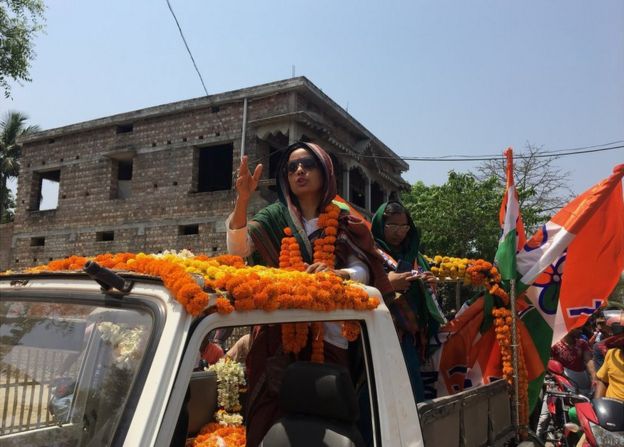
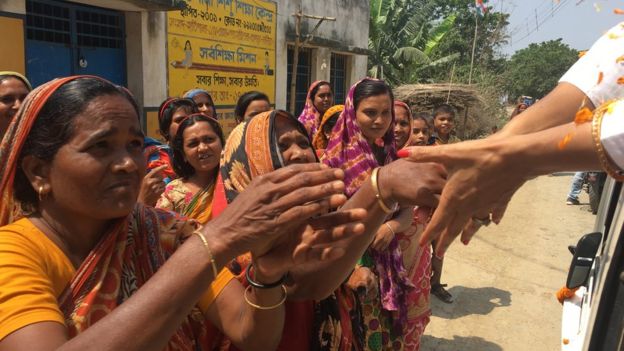
On a bright sunny morning, as an open jeep decorated with bright yellow and orange flowers hurtles along the dirt track from one village to the next, women in colourful saris and men rush to greet Mahua Moitra.
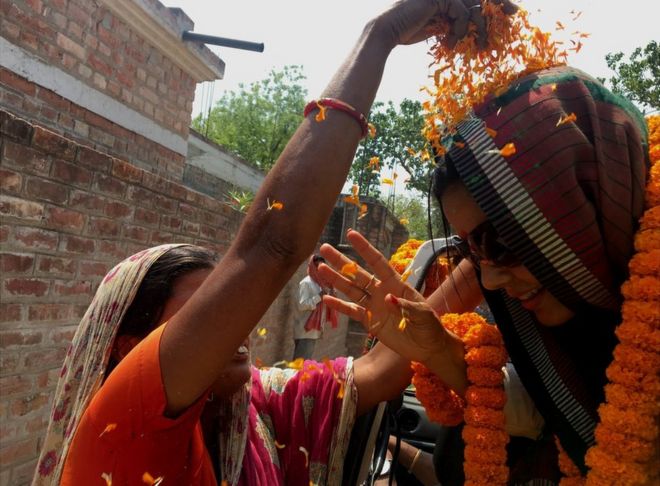
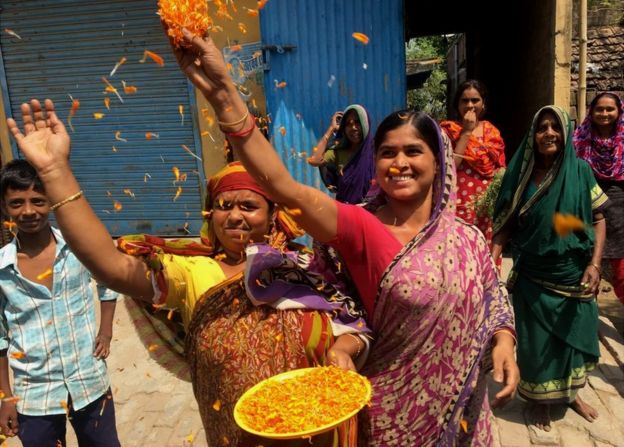
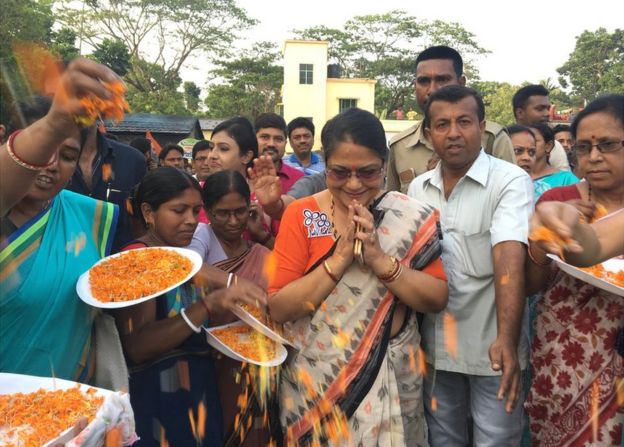
They shower bright orange marigold petals on her, place garlands around her neck and many reach out to shake and kiss her hands. She waves at them, greeting them with her palms joined: “Give me your blessings.”
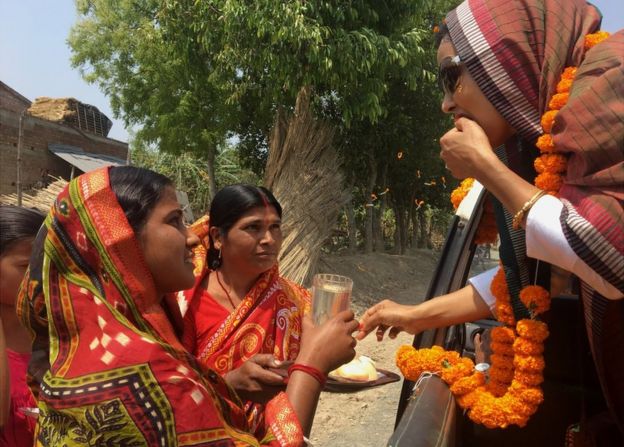
Young men and women whip out their smartphones to take photos and selfies. On the way, she’s offered coconut water and sweets.
Ms Moitra, who is contesting the general election as a candidate of the state’s governing Trinamool Congress Party (TMC), is campaigning in her constituency Krishnanagar.
Image caption On the campaign trail, women offer coconut water and sweetsImage caption Supporters throw marigold petals at Mahua Moitra
In one village, party workers tell her about an old man who’s too ill to come to meet her, so she walks to his home to greet him.
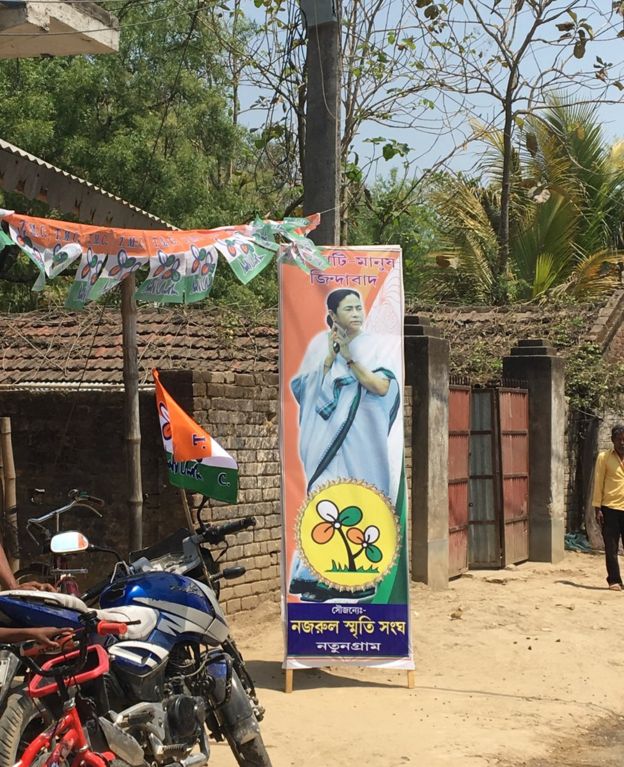
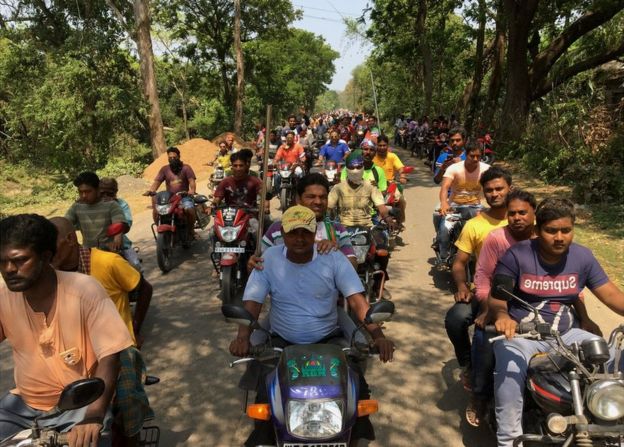
Her jeep is followed by dozens of bikes and their riders, all young men, chanting slogans like “Long live Trinamool Congress, Long live Mamata Banerjee.”
The loud, colourful procession is led by a small truck, fitted with loudspeakers, from which announcements asking people to vote for Ms Moitra are played on a loop.
With the election season well under way in India and political leaders criss-crossing the length and breadth of the country, addressing rallies, I’m travelling across the country to see if the high-decibel campaigns are addressing the real issues that actually affect millions of people. One of them is getting more women into parliament.
A bill to reserve 33% of seats for women in parliament and regional assemblies has been pending since 1996, so the decision by the TMC – led by West Bengal Chief Minister Mamata Banerjee – to give 41% of her party nominations to women has created a huge buzz.
Image caption Ms Moitra quit her banker’s job in London to return to India and enter politics
Ms Banerjee, who set up the TMC in 1998 after falling out with the Congress party, is a feisty politician who was named one of Time magazine’s 100 most influential people in the world in 2012.
Her female candidates, says my BBC Bengali colleague Subhajyoti Ghosh, are an “interesting mix” of career politicians and first-timers. They include actors, doctors, a tribal activist and the 25-year-old widow of a recently-murdered politician.
Ms Moitra, the TMC’s national spokesperson and a member of the state assembly since 2016, is among 17 women who have made it to the party’s list of 42 general election nominees.
A former investment banker with JP Morgan, she gave up a well-paying job in London in 2009 to return to the heat and dust of Indian politics.
Her decision left her family aghast. Her parents, she told me, thought she was “insane”. Some party workers too had their doubts – “she’s a memsahib”, they said at the time, “she won’t survive”.
Image caption Mamata Banerjee was named one of Time magazine’s 100 most influential people in the world in 2012But she has survived – and thrived. In 2016, she won the Karimpur assembly seat that no non-Left party had won since 1972 and has now set her eyes on the national parliament.
She’s agreed to let me follow her on the campaign trail, so for two days I’ve been a “fly on the wall” – standing behind her in her jeep, travelling in her car, watching her strategise with party workers, aides and confidants.
The previous evening, I had watched her be the chief guest at a college cricket match and address a gathering at the local market in Plassey.
A four-hour drive from Kolkata, Plassey is the site of the famous 1757 battle between the British East India Company and the local ruler supported by the French.
Image caption Her jeep is followed by dozens of supporters on bikesImage caption Many women reach out to shake hands with Ms Moitra
“What’s the point of saying you killed all those terrorists in Pakistan? It’s not important who you killed in Pakistan or how many. What’s important is you failed to protect our soldiers.”
She talks about how the government has failed to create jobs and accuses the BJP of trying to divide Hindus and Muslims.
“You have taken away our livelihoods and you’re trying to teach us about [the Hindu god] Ram and [Muslim saint] Rahim? I don’t have to write my religion on my forehead,” she declares to loud claps from her supporters.
Elections in the past were to change the government, she says, but this election is to save the constitution of India. “It is no ordinary vote.”
Her main rival is the BJP’s Kalyan Chaubey, a former footballer who played in goal for India. So drawing a football analogy, she declares: “I’m an A-league centre-forward player, stop my goal if you can. I am here to win.”
Kakoli Ghosh Dastidar, a founder member of the TMC and two-term MP, says to nominate so many women is part of a “continuous process” followed by Mamata Banerjee because “you can’t develop a society without uplifting the status of its women”.
In the last general election in 2014, she points out that the party nominated 33% women and 12 of their 34 MPs in the outgoing lower house were women.
Ms Banerjee, she says, believes that gender sensitive laws will come only if more women are in power.
At a campaign rally that Dr Ghosh Dastidar addresses in Kumhra Kashipur village in her constituency Barasat, women are seated in the front rows.
Their opinion though is divided over whether having more women in parliament will actually benefit other women.
Image caption Dr Kakoli Ghosh Dastidar is among the founder members of the TMC and a two-term MP
Supriya Biswas says it’s easier if their MP is a woman because then it’s easier to approach her. “For, who can understand a woman better than a woman?”
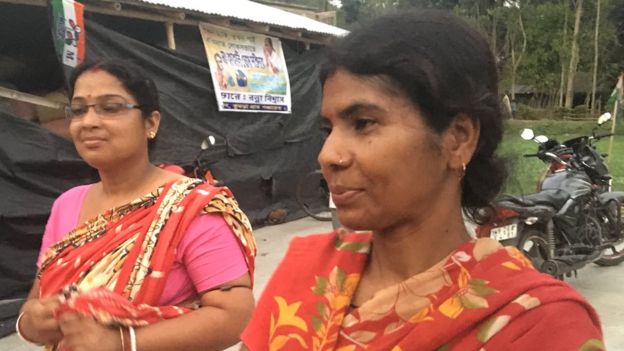
Archana Mallick and Meena Mouli, who live just across from the rally ground, point to the broken roads near their homes and complain about poor medical facilities in their village. They say that the candidate’s gender is “inconsequential” and what’s important is “who works for our benefit”.
Saswati Ghosh, professor of economics at Kolkata’s City College, says that politics in India is “still very patriarchal” and it’s “absolutely necessary” to elect more women MPs.
“It is important to have more women in lawmaking bodies because I think after a certain number, you’ll reach the threshold level and that will lead to change. I don’t know if 33% is the magic number that will change the quality of discourse, maybe 25% can do the trick?”
Image caption Archana Mallick and Meena Mouli say a candidate’s gender is “inconsequential”
Critics, however, question whether celebrities are the right candidates to bring about that change.
Prof Ghosh says actors and celebrities make for “winnable candidates” and that’s why all parties choose them even though sometimes they may not be the right candidates to reach that threshold.
But, she says that Ms Banerjee is a strong leader who’s regarded by many women as “a role model who inspires more women to come into politics”.
And that’s something that many Indians think the country sorely needs.
In their manifestos, the main opposition Congress party has promised to pass the women’s reservation bill, if elected to power. So has the ruling Bharatiya Janata Party, although it had made similar promises in its last manifesto and did nothing about it.
By allotting 41% seats to women, Ms Banerjee has shown that one doesn’t need to set artificial quotas to elect more women.
India has suspended trade across the Line of Control in Jammu and Kashmir with effect from Friday. The Ministry of Home Affairs issued the order to this effect on Thursday.
INDIAUpdated: Apr 18, 2019 20:20 IST
HT Correspondent
Hindustan Times, New Delhi
The Home Ministry said reopening of Line of Control trade will be revisited after placing a stricter regulatory and enforcement mechanism in place.(HT file photo)
India suspended trade across the Line of Control in Jammu and Kashmir over concern that the route was being misused by Pakistan-based elements to smuggle weapons, narcotics and fake currency, the Ministry of Home Affairs said on Thursday. New Delhi said the Centre will revisit the decision to suspend LoC trade at Jammu and Kashmir’s Salamabad and Chakkan-da-Bagh after putting in place a stricter regulatory and enforcement mechanism.
Cross-LoC trade is meant to facilitate exchange of goods of common use between local populations across the LoC in Jammu & Kashmir. The trade is allowed through two Trade Facilitation Centres located at Salamabad, Uri, District Baramulla and Chakkan-da-Bagh, District Poonch. The trade takes place four days a week. The Trade is based on Barter system and zero duty basis.
The home ministry decision comes after the federal anti-terror probe agency National Investigation Agency told the government that a “significant number of trading concerns engaged in LoC trade” were linked with banned terror organisations involved in fuelling terrorism”.
“Investigations have further revealed that some individuals, who have crossed over to Pakistan, and joined militant organizations have opened trading firms in Pakistan. These trading firms are under the control of militant organizations and are engaged in LoC trade,” a home ministry statement said.
The home ministry said there were also inputs to indicate the LoC route is likely to be misused to a “much larger extent” to evade higher duties after India withdrew the most favoured nation to Pakistan.
Relations between India and Pakistan have been under strain since Pulwama terror attack in February when 40 jawans of the Central Reserve Police Force were killed on Jammu-Srinagar highway.
The cross-LoC trade between Jammu and Kashmir and Pakistan-occupied Kashmir had resumed on Tuesday after nearly two weeks. The trade and travel across the LoC had been suspended on April 1 in the wake of heavy shelling from the Pakistani side. Three people including a Border Security Force officer, a woman and a five-year-old girl died in Poonch.
The relation between India and Pakistan has been under strain since Pulwama terror attack in February when 40 jawans of the Central Reserve Police Force were killed on Jammu-Srinagar highway.
Trade and travel across the LoC had been suspended on April 1 in the wake of heavy shelling from the Pakistani side. Three people including a Border Security Force officer, a woman and a five-year-old girl died in Poonch.
The cross-LoC trade between Jammu and Kashmir and Pakistan-occupied Kashmir had just resumed on Tuesday after nearly two weeks.
NEW DELHI (Reuters) – India’s Supreme Court agreed on Tuesday to consider a petition from a Muslim couple to allow women into mosques, seeking to overturn a centuries-old practice that largely bars women from the places of worship.
Women are not allowed inside most mosques in India although a few have separate entrances for women to go into segregated areas.
The petitioners, Yasmeen Peerzade and her husband Zuber Peerzade, said that women were allowed to enter mosques during the time of the Prophet Mohammad.
“Like men, women also have the constitutional rights to offer worship according to their belief,” they said in their petition.
“There should not be any gender discrimination and allow Muslim women to pray in all mosques,” they said.
The court last year lifted a ban on the entry of women of menstrual age at a Hindu temple in southern India saying it was a violation of their right to worship.
The Muslim couple referred to the temple ruling, which angered conservative Hindus, as a precedent to support their call for women to be allowed to pray at mosques.
A representative of a prominent organisation of Islamic scholars, the Jamiat Ulema-e-Hind, was not immediately available for comment.
The petition comes at a sensitive time for relations been minority Muslims and the majority Hindu community.
Some members of Prime Minister Narendra Modi’s Hindu nationalist ruling party have been accused of stirring communal animosity as the party seeks a second term in a staggered general election now underway.
Supreme Court judge S.A. Bobde said the court will examine the couple’s request at length.
The court in 2017 ruled as unconstitutional a law which allows Muslim men to divorce their wives simply by uttering the word “talaq”, which means divorce in Arabic, three times.
This year, the government issued an executive order making instant divorce an offence punishable with up to three years in jail.
Beijing also rejected the report that the US, the UK and France asked China to lift the technical hold on Azhar by April 23, failing which they will move a formal resolution for discussion, vote and passage at the UN Security Council (UNSC).
WORLDUpdated: Apr 17, 2019 15:31 IST
Indo Asian News Service
Beijing
China on Wednesday said the issue of blacklisting Pakistan-based terrorist Masood Azhar at the UN panel was heading towards a settlement and asked the US not to force through its own resolution on the matter.(AP)
China on Wednesday said the issue of blacklisting Pakistan-based terrorist Masood Azhar at the UN panel was heading towards a settlement and asked the US not to force through its own resolution on the matter.
Beijing also rejected the report that the US, the UK and France asked China to lift the technical hold on Azhar by April 23, failing which they will move a formal resolution for discussion, vote and passage at the UN Security Council (UNSC).
“On the issue of the listing of Masood Azhar, China’s position remains unchanged. We are also having communication with relevant parties and the matter is moving towards the direction of settlement,” Chinese Foreign Ministry spokesperson Lu Kang said here.
Asked to elaborate further, Lu did not answer clearly.
“The matter is now moving in the direction of settlement. As to the specifics for the discussion in the 1267 committee, there are clear procedures and regulations regarding UNSC and its subsidiary bodies. We think members should follow and abide by such procedures.”
He was responding to a question whether anything was achieved after China claimed “positive progress” on the issue of declaring Azhar a terrorist.
China in the past has put four technical holds on the resolutions by India, the US, the UK and France to ban Azhar at the UN 1267 sanctions committee.
Beijing’s latest technical hold came last month after Azhar’s outfit claimed responsibility for the deadly attack in Jammu and Kashmir that killed 40 Indian military personnel in February.
This prompted the US to draft a new resolution and take it directly to the Security Council for an informal discussion. Beijing slammed the move, saying this will complicate matters when some progress has already been achieved.
Lu again reiterated it when asked if China will support such a resolution in the Security Council.
“Regarding what you said relevant parties are forcing a new resolution through the Security Council. We firmly oppose that. In relevant discussions, most members expressed that this issue should be discussed within the 1267 committee and they don’t hope to bypass the 1267 committee to handle the issue.
“We hope the relevant country can respect the opinions of most members of the Security Council to act in a cooperative manner and to help resolve this issue properly within the framework of the 1267 committee,” he added.
Asked if Beijing has been set a deadline of April 23 to lift the technical hold on resolution banning Azhar at the 1267 committee, Lu said: “I don’t know from where you get such information, but the Security Council and it’s subsidiary bodies like the 1267 committee, they have clear rules of procedures and you have to seek clarification from those sources.”
“China’s position is very clear. This issue should be resolved through cooperation and we don’t believe that any efforts without the consensus of most members will achieve satisfying results.”
MUMBAI (Reuters) – India’s gold smugglers have slowed their operations over worries their shipments will be caught up in seizures of cash, bullion, booze and drugs that are aimed at controlling vote-buying in the country’s national elections, industry officials told Reuters.
In India, political parties and their supporters often offer money or goods in exchange for votes. The Election Commission, which monitors the polls, tries to prevent this by setting up highway checkpoints to seize cash, gold, liquor and other high-value items that candidates avoid mentioning in their expenses due to a cap on the amount they can spend.
Last month in Mumbai, in one of the biggest seizures since the current election was announced on March 10, the Directorate of Revenue Intelligence seized 107 kg of gold, worth about 300 million rupees ($4.3 million).
The slowdown in smuggling has boosted gold imports at banks in the world’s second-biggest buyer of the precious metal, allowing them to charge a premium over global prices.
“After a big seizure in Mumbai, smuggling has gone down drastically. Grey market operators don’t want to take the risk during the election period,” Anantha Padmanabhan, chairman of All India Gem and Jewellery Domestic Council (GJC) told Reuters.
India’s Election Commission as of April 14 has seized $365 million in cash, liquor, gold, drugs and other goods over the last month, more than double the $172 million confiscated in the last election cycle in 2014.
(GRAPHIC – Drugs, gold, cash, alcohol: The gifts that buy votes (JPG), tmsnrt.rs/2D7Z2w5)
The random checking of vehicles and seizures have made it nearly impossible for smugglers and other “grey market” operators to move cash and gold from one place to another, said the head of the bullion division at a Mumbai-based private bank.
“This is helping banks. Our gold business has improved in the last few weeks,” he said.
Gold smuggling surged in India after the government raised the import duty to 10 percent in August 2013. Grey market operators – businesses that smuggle gold from overseas and sell it in cash to avoid the duties – got a further boost in 2017 when India imposed a 3 percent sales tax on bullion.
The grey market operators can sell gold at discounts to prevailing market prices as they evade paying the 13 percent tax, said Harshad Ajmera, a gold wholesaler in Kolkata.
But this week, even in the cash market, gold was sold at the market price, said Ashok Jain, proprietor of Mumbai-based gold wholesaler Chenaji Narsinghji.
Dealers were charging a premium of up to $2.50 an ounce over official domestic prices, the highest in nearly five months.
Up to 95 tonnes of gold was smuggled into India in 2018, according to the World Gold Council, although India’s Association of Gold Refineries and Mints and other industry bodies put the figure at more than twice that.
Election Commission rules makes it mandatory for people to show valid documentation if they are carrying more than 50,000 rupees ($722) in cash, or else it could be seized. This rule has been hurting the jewellery industry, especially in rural areas where more than half of gold is bought in cash.
The limit of 50,000 rupees is “too low for the jewellery industry” as even a small 20-gram (0.7-ounce) gold chain costs more than that, said Padmanabhan of GJC.
“Demand has fallen due to the cash restrictions. We have requested that the Election Commission raise the limit.”
BJP’s Meenakshi Lekhi had complaints to the Supreme Court that the words attributed by Rahul Gandhi to the Supreme Court in the Rafale case had been “made to appear something else”.
INDIAUpdated: Apr 15, 2019 14:06 IST
HT Correspondent
New Delhi
Supreme Court will next hear the case on April 23(AFP file photo)
Congress president Rahul Gandhi has been told by the Supreme Court to explain his remarks during the Lok Sabha campaign where he attributed comments to the top court which had ruled on the admissibility of three sets of documents in the Rafale review petition.
The bench said Gandhi had incorrectly attributed “views, observations and findings” in the Rafale case to the top court. Gandhi has been given till next Monday to come up with his explanation. The court, however, has not issued a formal notice to him yet.
“We also make it clear that this court had no occasion to record any such views or make observations in as much as what was decided by this court was the legal admissibility of certain document to which objections were raised,” the bench headed by Chief Justice of India Rajan Gogoi said.
BJP lawmaker Meenakshi Lekhi had last week filed a contempt petition against the Congress president for his attacks on Prime Minister Narendra Modi that she said, “replaced his personal statement as Supreme Court’s order “ and tried to create prejudice.
Watch: ‘Chowkidar chor’ vs ‘SC’s contempt’: Rahul, Nirmala face off on Rafale order
‘Chowkidar chor’ vs ‘SC’s contempt’: Rahul, Nirmala face off on Rafale order
Defence Minister Nirmala Sitharaman slammed Congress president Rahul Gandhi over his remarks on Supreme Court’s decision related to Rafale documents
Gandhi, who was in Amethi to file his nomination papers, had reacted to this setback to the government, saying: “Now the Supreme Court has made it clear that ‘chowkidarji’ (watchman) has committed a theft… I want to directly challenge that the Supreme Court has stated that you have indulged in corruption.”
The BJP and its top leaders had taken umbrage at the Congress president’s remarks, accusing him of wildly exaggerating and misquoting the court’s observations and the context. Defence Minister Nirmala Sitharaman had said Rahul Gandhi’s statement was contempt of contempt of court and was the Congress’s attempt to “perpetrate their own lies”.
Her party later filed a formal complaint against Gandhi with the Election Commission, charging him of lying. The Congress party wants to “perpetrate their own lies”. She further added that Gandhi’s comments are not based on the facts.
In her petition before the Supreme Court, Meenakshi Lekhi had complained that “the words used and attributed by him (Gandhi) to the Supreme Court in the Rafale case has been made to appear something else. He is replacing his personal statement as Supreme Court’s order and trying to create prejudice.”
The government’s April 2015 decision to buy 36 Rafale warplanes has been at the heart of the Congress-led opposition campaign against Prime Minister Narendra Modi and the ruling BJP-led national coalition. The $8.7 billion government-to-government deal replaced the previous United Progressive Alliance (UPA) regime’s decision to buy 126 Rafale aircraft, 108 of which were to be made in India by state-owned Hindustan Aeronautics Ltd (HAL).
The deal has become controversial with the Opposition, led by the Congress, claiming that the price at which India is buying Rafale aircraft now is Rs 1,670 crore for each, three times the Rs 526 crore, the initial bid by the company when the UPA was trying to buy the aircraft. It has also claimed the previous deal included a technology transfer agreement with HAL. The NDA has not disclosed details of the price.








 CHINDIA ALERT: You'll be living in their world, very soon