Chindia Alert: You’ll be Living in their World Very Soon
aims to alert you to the threats and opportunities that China and India present. China and India require serious attention; case of ‘hidden dragon and crouching tiger’.
Without this attention, governments, businesses and, indeed, individuals may find themselves at a great disadvantage sooner rather than later.
The POSTs (front webpages) are mainly 'cuttings' from reliable sources, updated continuously.
The PAGEs (see Tabs, above) attempt to make the information more meaningful by putting some structure to the information we have researched and assembled since 2006.
NEW DELHI (Reuters) – India’s aviation safety regulator may ask Boeing (BA.N) to set up simulators in India to train pilots on the 737 MAX planes once it clears the aircraft as safe for flying, a senior official with direct knowledge of the matter told Reuters.
The 737 MAX, the fastest-selling plane in Boeing’s history, has been grounded the world over since March in the aftermath of two fatal crashes in five months that killed 346 people.
India’s Directorate General of Civil Aviation (DGCA) will also conduct an independent inspection of the grounded planes once they are cleared for flying by the U.S. regulator, the Federal Aviation Administration (FAA).
“Once FAA re-certifies it and says these issues have been resolved then we will evaluate whether what they are saying is right or wrong … We will carry out our own inspections,” the official said, adding that it is unlikely the planes will fly in Indian skies until next year.
Boeing is making software changes and drawing up a new pilot training plan, and will need to conduct a key certification test flight to get the FAA’s approval before it can put the planes back in the air. Some federal officials expect the test flight to be conducted in October.
“Later this year India will send a team. We would like to take a look at their flight data, some simulators will also be required for training pilots,” the official said, adding it may ask Boeing to have simulators in India.
Indian carrier SpiceJet (SPJT.BO) has about a dozen Boeing 737 MAX planes in its fleet and a total of 155 on order – among the largest single orders for the narrow-body plane.
Boeing has delivered some 385 737 MAX jets globally before the March grounding and has roughly 5,000 orders for the aircraft, a more fuel-efficient version of the manufacturer’s best-selling single-aisle 737 series.
SRINAGAR/NEW DELHI (Reuters) – Authorities in Indian Kashmir have arrested nearly 4,000 people since the scrapping of its special status last month, government data shows, the most clear evidence yet of the scale of one of the disputed region’s biggest crackdowns.
Muslim-majority Kashmir, claimed by both India and Pakistan, has been in turmoil since India stripped its portion of the region of its autonomy and statehood on Aug. 5, leading to clashes between security forces and residents and inflaming tension with Pakistan.
India said the removal of the status that its part of Kashmir has held since independence from Britain in 1947 would help integrate it into the Indian economy, to the benefit of all.
In an attempt to stifle the protests that the reform sparked in Kashmir, India cut internet and mobile services and imposed curfew-like restrictions in many areas.
It has also arrested more than 3,800 people, according to a government report dated Sept. 6 and seen by Reuters, though about 2,600 have since been released.
A spokeswoman for India’s interior ministry did not respond to a request for comment. Neither did Jammu and Kashmir police.
It was not clear on what basis most of the people were being held but an Indian official said some were held under the Public Safety Act, a law in Jammu and Kashmir state that allows for detention for up to two years without charge.
The data for the first time shows the extent of the detentions, as well as indicating who was picked up and where.
More than 200 politicians, including two former chief ministers of the state were arrested, along with more than 100 leaders and activists from an umbrella organisation of pro-separatist political groups.
The bulk of those arrested – more than 3,000 – were listed as “stone pelters and other miscreants”. On Sunday, 85 detainees were shifted to a prison in Agra in northern India, a police source said.
Rights group Amnesty International said the crackdown was “distinct and unprecedented” in the recent history of the region and the detentions had contributed to “widespread fear and alienation”.
“The communication blackout, security clampdown and detention of the political leaders in the region has made it worse,” said Aakar Patel, head of Amnesty International India.
‘RIGHT TO LIFE’
India says the detentions are necessary to maintain order and prevent violence, and points to the relatively limited number of casualties compared with previous bouts of unrest.
The government says only one person is confirmed to have died compared with dozens in 2016, when the killing of a militant leader sparked widespread violence.
“The right to life is the most important human right,” India’s national security adviser Ajit Doval told reporters recently.
The report contains data from the 13 police districts that make up the Kashmir Valley, the most populous part of the Himalayan region where the main city of Srinagar is located.
The largest number of arrests have been in Srinagar, the data shows, at nearly 1,000. Earlier unrest often centred in rural areas.
Of the detained political leaders, more than 80 were from the People’s Democratic Party, formerly in coalition in Jammu and Kashmir state with the ruling Bharatiya Janata Party.
About 70 are from the National Conference, which has for years dominated politics in Indian Kashmir, and more than a dozen from India’s main opposition Congress party.
Police also arrested more than 150 people accused of association with militant groups fighting Indian rule.
An Indian official said it was likely that more than 1,200 people were still held, including all the high-profile politicians and separatists mentioned in the report, while dozens more are being arrested every day.
In the 24 hours before the report was compiled, more than two dozen people were arrested, mainly on suspicion of throwing stones at troops, the data showed.
The data did not include those under informal house arrest, nor people detained in a round-up of separatists that began in February after a bomb attack by a Pakistan-based militant group on Indian troops.
Days before India’s move to strip Kashmir of special status, one prominent separatist leader told Reuters that more than 250 people with links to the movement were already in detention.
BEIJING, Sept. 11 (Xinhua) — Premier Li Keqiang on Wednesday expressed his expectation for the Japanese economic community to seize the opportunities of China’s opening up, increase investment in China and expand bilateral cooperation areas to promote more achievements in trade and the economy.
Li made the remarks in a meeting with a delegation from Japan’s business community, led by president of the Japan-China Association on Economy and Trade Shoji Muneoka, chair of the Japan Chamber of Commerce and Industry Akio Mimura, and Nobuyuki Koga, chairman of the Board of Councilors of the Japan Business Federation.
China-Japan relations have returned to the right track since last year thanks to the joint efforts of the two sides, and the trade and economic cooperation between the two countries has been steadily advanced and the prospects for bilateral cooperation are broad, said Li.
When China-Japan relations encountered difficulties, the Japanese economic community made important efforts and contributions to maintain their healthy and steady development as well as accelerate pragmatic cooperation between the two countries, the Chinese premier said.
According to Li, China and Japan are two of the world’s major economies, and should give full play to their complementary advantages and work together to deepen cooperation, which will not only benefit the two countries, but also conducive to regional and global economy, as well as the prosperity and stability of the world.
Noting that economic globalization is irreversible, and economic and trade exchanges should not be blocked by national borders, Li pointed out that promoting the healthy development of globalization is the way of progress.
“China has always firmly upheld the multilateral trading system with the World Trade Organization at its core and promotes the liberalization and facilitation of trade and investment,” Li said, stressing China will unswervingly promote all-round opening up, and strive to optimize the business environment.
China welcomes the Japanese economic community to seize the opportunity brought forth by China’s opening up and increase investments in China, expand cooperation areas, and promote more cooperation achievements in trade and economic areas between the two countries, he said.
While expressing congratulations on the 70th anniversary of the founding of the People’s Republic of China, the Japanese economic delegation said that Japan and China have witnessed progress in bilateral ties since last year, and close high-level exchanges have facilitated the two countries’ economic and trade cooperation.
The Japanese economic community firmly supports free trade and hopes China and the United States will resolutely resolve their trade disputes through negotiation, they said.
Speaking highly of China’s efforts in promoting trade and investment liberalization, expanding market access and improving the business environment, they said that the Japanese economic community is willing to boost cooperation with the Chinese side in science and technology innovation, climate change, health care and third-party markets.
They also expressed their expectation of concluding the negotiations for the Regional Comprehensive Economic Partnership (RCEP), a proposed free trade agreement between the 10 ASEAN (the Association of Southeast Asian Nations) members and Australia, China, India, Japan, South Korea and New Zealand, by the end of the year.
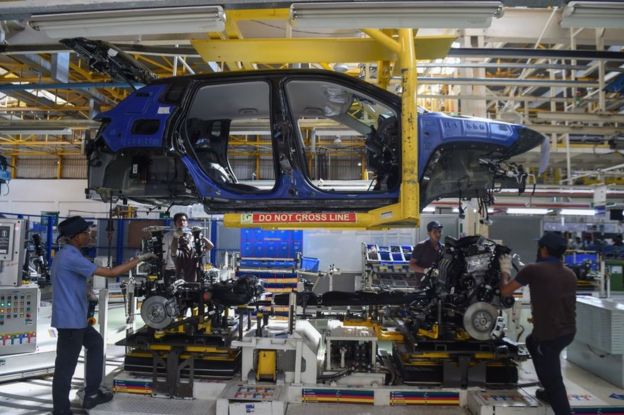
India’s second-biggest manufacturer of commercial vehicles, Ashok Leyland, is suspending production at several units from five to 18 days in September, triggering fears that the slump in the automotive sector shows no sign of letting up. The BBC’s Nitin Srivastava reports.
Ram Mardi is worried he may lose his job. He works for a company that makes spare parts for cars and heavy vehicles in Jamshedpur, an industrial city in eastern India. But he has worked only 14 days in August.
“We had a comfortable life until recently. Now, it’s hard to arrange food or pay for the children’s education,” Mr Mardi says.
The factory he works at temporarily suspended production for half of the month to reduce inventory in the face of shrinking demand.
Industry heavyweights such as Maruti, Tata Motors and Mahindra & Mahindra have all announced production cuts over the past several months.
Image copyright GETTY IMAGESImage caption India’s automotive industry employs some 35 million people
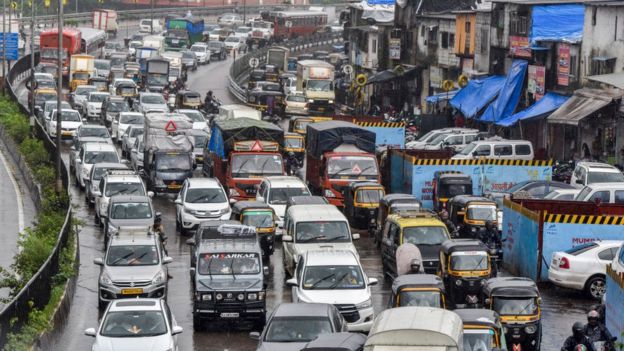
India’s economy is facing a slowdown. It grew at 5% in the quarter ending June 2019 – its lowest in five years. This – along with a drop in private investment and a banking crisis that has made it hard to access credit – has weakened consumer demand.
The Indian government is also pushing for a transition to electric vehicles over the next decade, which some experts believe, has contributed to falling vehicle sales.
As the automotive industry declined for the 10th month in a row in August, car sales dropped by 41% – the steepest fall in two decades.
The industry is one of India’s biggest, considering it employs some 35 million people, directly or indirectly, and contributes more than 7% to the country’s GDP.
By some estimates, more than 100,000 workers, many of them contractual, have lost their jobs so far. Now fears are rising that if demand continues to fall, forcing lower production, more jobs could disappear.
Small and medium businesses – thousands of ancillary units that supply to the big manufacturers – have been hit the hardest. And daily wage labourers such as Mr Mardi are the most vulnerable.
And employers are also concerned. “I have never had so much trouble keeping my factory up and running”, says Sameer Singh, who heads a family-owned business in Jamshedpur that makes spare parts for vehicles.
“My employees are jobless for a few weeks and I feel for them. If this continues they may move out, perhaps find another job. But I can’t even look out for a job. My life starts and ends here”.
Mr Singh says it’s also been hard for business owners, companies and consumers to borrow money because banks have tightened credit lines after a spike in bad loans in recent years dented their balance sheets.
Image copyright GETTY IMAGESImage caption Car sales in India have dropped to their lowest in 20 years
“The fall [in production] is so large and so dramatic that it has affected every single product – two-wheelers, car, commercial vehicles,” says Sanjay Sabherwal, member of the Automotive Component Manufacturers Association of India, an industry body.
Auto executives have been demanding tax cuts and easier access to financing for manufacturers, sellers and consumers. The government recently announced a slew of measures – this includes a delay in increasing the registration fees for new vehicles and asking banks to lower interest rates on loans for cars and two-wheelers.
But, will that be enough? That is hard to say with experts calling this the worst downturn to ever hit India’s automotive industry.
NEW DELHI (Reuters) – India will only sign a 16-member Asia-Pacific trade pact if its local industry is protected and if the deal would not lead to indiscriminate imports, the trade minister said on Wednesday.
Talks are ongoing to negotiate the China-initiated Regional Comprehensive Economic Partnership (RCEP), Piyush Goyal said, without specifying whether India would sign the deal in 2019.
New Delhi had asked South Korea and Japan to review free trade agreements with India, he added.
Image copyright APPLEImage caption The iPhone 11 Pro is said to last four hours more than before, while the Pro Max is said to last five hours longer
Apple has unveiled its iPhone 11 range of handsets, featuring more cameras and more battery life. But will it be enough to capture one of the world’s only growing smartphone markets?
Samsung has traditionally held dominance in the Indian “premium smartphone” segment, which refers to mobiles that cost 40,000 rupees (£451; $558) or more.
But this year, for the first time ever, Apple surged ahead of the Korean electronics giant in India. It swept up 41.2% of the premium smartphone market in the second quarter of 2019, according to research firm International Data Corporation.
“The Indian smartphone market is a game of changing fortunes,” technology journalist Mala Bhargava told the BBC. “There isn’t a company, no matter how dominant a position it commands, that can afford to sit idle.”
Apple’s latest mobile phones – the iPhone 11, 11 Pro and 11 Pro Max – will be available in India from 27 September.
And the iPhone 11, Ms Bhargava added, is primed to find success in the Indian market.
In recent months, Apple dropped its price for the iPhone 11’s predecessor, the iPhone XR, from 73,900 rupees to 53,900 rupees. The 20,000 rupee price drop was significant enough to make an impact.
“Consumers in India are known to be discount and deal-oriented,” Ms Bhargava said. “Seeing the iPhone as an aspirational product, many snapped up the mobile once prices were slashed.”
Media caption WATCH: Taking a slowfie with the iPhone 11
This, she said, is also what gave Apple the lead for the first time in India in the smartphone market.
The latest iPhones feature more cameras than before and a processor that has been updated to be faster while consuming less power. There are two Pro models, which the company said would last between four to five hours longer than their XS predecessors.
The entry-level iPhone 11 is the “perfect successor” to the iPhone XR, Ms Bhargava said.
It will start at a price of 64,900 rupees – which is not drastically higher than what the iPhone XR currently sells for.
“The discounted iPhone XR played a big part in bolstering sales in India, so it’s likely that with such a price for the iPhone 11, the company can really extend its market share,” she added.
Image copyright APPLEImage caption The entry-level iPhone 11 is said to last up to one hour longer than the earlier XR
Apple also launched the iPhone 11 Pro and iPhone 11 Pro Max, which at 99,990 rupees and 109,900 rupees a piece, will not be a key attraction as consumers will find that unaffordable.
“But at the same time, this gap could still benefit the company, leaving the field open for older iPhones and for the new iPhone 11 to increase Apple’s share in the country,” Ms Bhargava said.
The company is still selling the iPhone XR, along with the older iPhone 8, which will give consumers more choices and prices to choose from.
“With the sales of smartphones falling in the rest of the world, Apple can’t help but look to consolidate its position in India – it is almost the only market growing at an enthusiastic pace,” she added.
In the second quarter of 2019, 36.9 million handsets were shipped in India – up 9.9% from last year.
In comparison, the premium global smartphone market collapsed 8% in the first quarter this year, with much of the decline pushed by a 20% drop in Apple’s shipments.
“India still has millions of first-time phone buyers,” said Ms Bhargava, “and many of those who have been using budget phones are read to buy something better.”
He is expected to join a trilateral dialogue with his counterparts from Pakistan and Afghanistan, and observers say he may try to mediate in Kashmir dispute
Trip also includes a stop in Nepal that could pave way for a visit by Xi Jinping
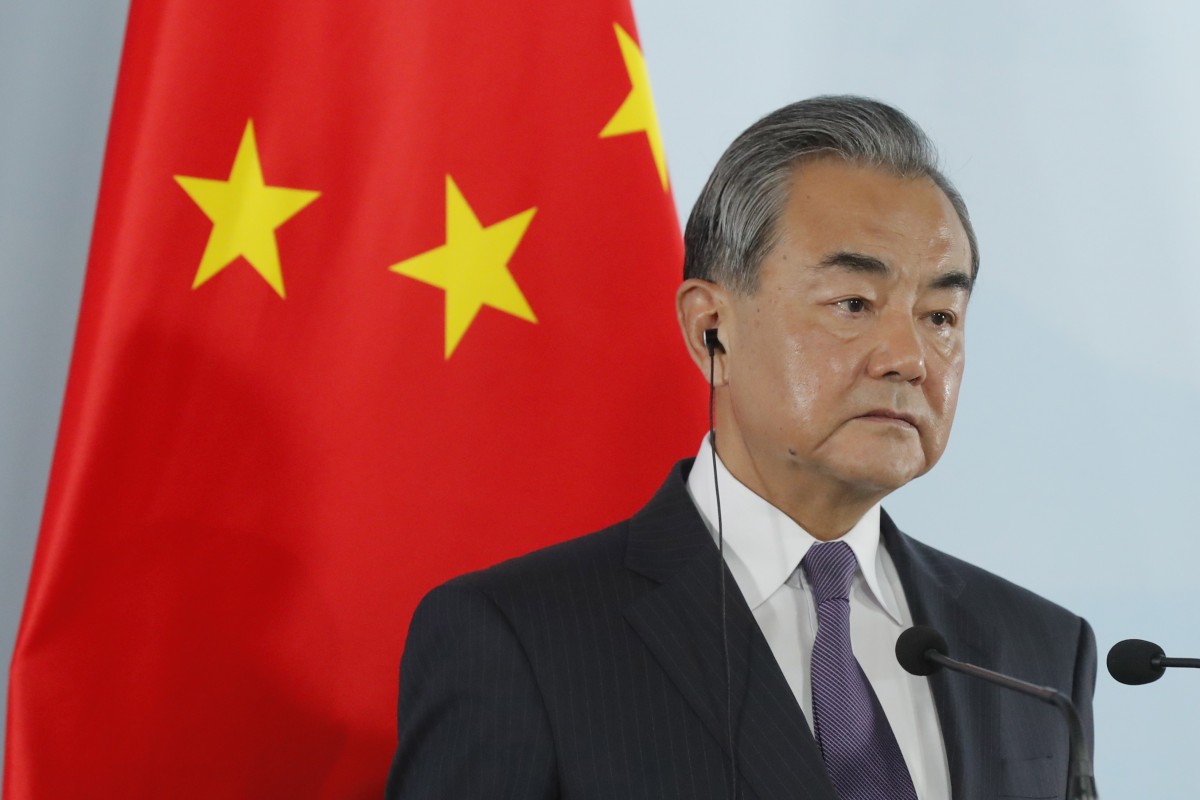
Chinese Foreign Minister Wang Yi may try to act as a negotiator in the Kashmir dispute. Photo: EPA-EFE
Chinese Foreign Minister Wang Yi began a four-day trip to Pakistan and Nepal on Saturday, amid escalating tensions between Islamabad and New Delhi over
Wang was expected to join a trilateral dialogue with the foreign ministers of Pakistan and Afghanistan in Islamabad, foreign ministry spokesman Geng Shuang said on Friday. He will also travel to Nepal.
Beijing has criticised India’s decision last month to strip the Jammu and Kashmir autonomous state of its special status and break it into two federally controlled territories, calling it “unacceptable”.
China also formally backed Pakistan’s request for the United Nations Security Council to hold “closed consultations” on the revocation of the state’s autonomy.
Meanwhile, observers say the Chinese foreign minister could attempt to act as a negotiator in the complex border dispute.
“Wang might try to play a role to mediate between the two sides to resolve the crisis,” said Wang Dehua, head of the Institute for South and Central Asia Studies at the Shanghai Municipal Centre for International Studies. “This has been China’s long-held position on the issue.”
Pang Zhongying, an international relations researcher at Ocean University of China in Qingdao, agreed.
“[Indian Prime Minister] Narendra Modi has visited China a couple of times and it is likely [Chinese President] Xi Jinping will visit India soon,” he said. “If Xi is to visit India later this year, China may try to contain its differing views with India on Kashmir.”
Modi has proposed an informal summit with Xi later this year that may be held in the religious hub of Varanasi, Modi’s parliamentary constituency. New Delhi said in May that Indian officials were working with the Chinese side to finalise the details, but Beijing has yet to confirm Xi’s visit.
India dismisses Beijing’s concerns over Kashmir because ‘it won’t have any impact on China’
Wang Yi was also due to visit India later this month for border talks, but the trip had to be postponed at the request of New Delhi because of scheduling problems, Hindustan Times reported, citing China’s foreign ministry.
The row over Kashmir has escalated in the past month. Pakistani Prime Minister Imran Khan said on Friday that Islamabad would make the fullest possible response to New Delhi’s actions in disputed Kashmir and that the global community would be responsible for any “catastrophic” aftermath.
Since Modi withdrew special rights for Indian-administered Kashmir on August 5, India has flooded the Kashmir valley with troops, restricted the movements of residents and cut off communication.
Both India and Pakistan claim the whole of Kashmir, which was partitioned between the two following the end of British rule in 1948, and they have subsequently fought wars over the territory.
China has its own territorial dispute with India over the part of Kashmir it controls. In early August, Chinese foreign ministry spokeswoman Hua Chunying
and said it was not binding. Beijing later appeared to soften its rhetoric, with Hua calling for a solution through dialogue and negotiation, without criticising either side.
The Chinese foreign minister will also visit Nepal, where he is expected to meet his counterpart, the president and prime minister. The trip could pave the way for an expected visit by Xi to Nepal.
Indian Prime Minister Narendra Modi told his country’s space scientists he was proud of a programme that had come so near to putting a probe on the Moon.
Contact with Chandrayaan-2 was lost moments before its Vikram module was due to touch down at the lunar south pole.
The fate of the craft is not yet known, but Mr Modi said there would be further opportunities.
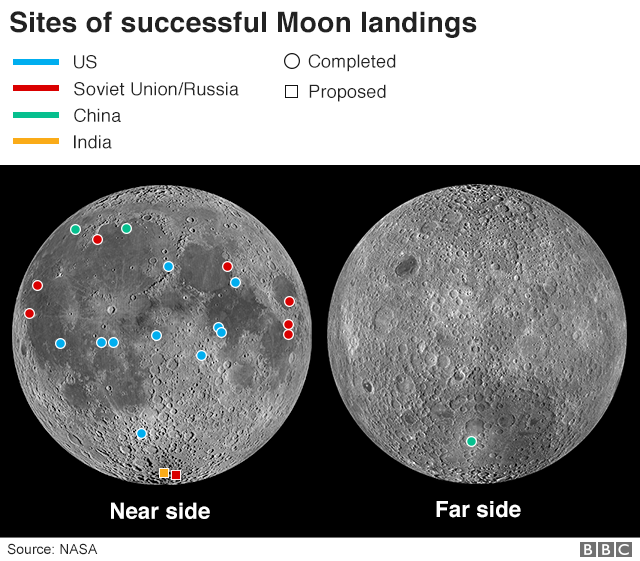
India would have been the fourth nation to make a soft landing on the Moon.
“The best is yet to come in our space programme. India is with you,” said Mr Modi.
The Chandrayaan-2 approached the Moon as normal until an error occurred about 2.1km (1.3 miles) from the surface, officials said.
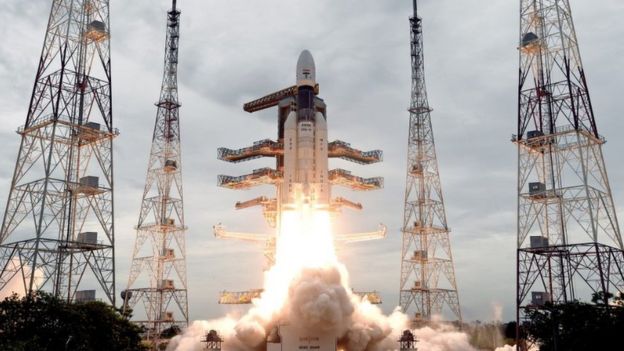
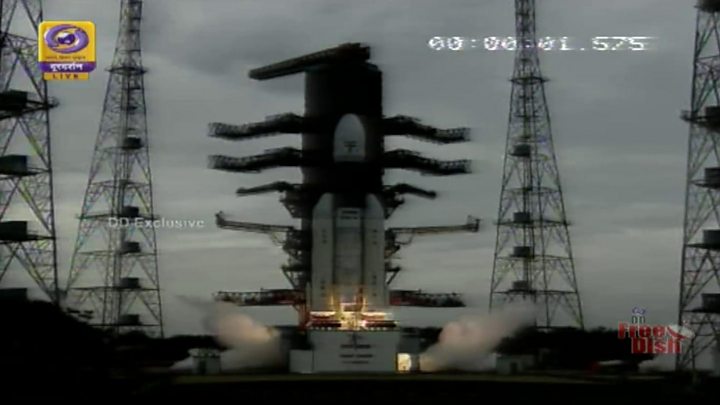
Image copyright ISROImage caption The mission’s lift-off was broadcast live to an audience of hundreds of millions
India’s Space Research Organization (Isro) said it lost contact seconds before the ship was expected to land.
The country’s first Moon mission – Chandrayaan-1, in 2008 – carried out the first and most detailed search for water on the lunar surface using radars.
What happened?
Chandrayaan-2 entered the Moon’s orbit on 20 August and was due to make a controlled descent to the surface early on Saturday, Indian time, over a month after it first took off.
Staff at mission control were glued to the screens at Isro’s Bangalore space centre as the spacecraft made its descent towards the surface.
The control room burst into applause during the so-called rough breaking phase of the descent, with Prime Minister Modi watching the action from behind a glass screen.
Isro chairman Kailasavadivoo Sivan announced to staff that the ship’s initial descent had been “normal,” and that the mission’s data would be analysed.
Mr Sivan had earlier described the final descent as “15 minutes of terror”.
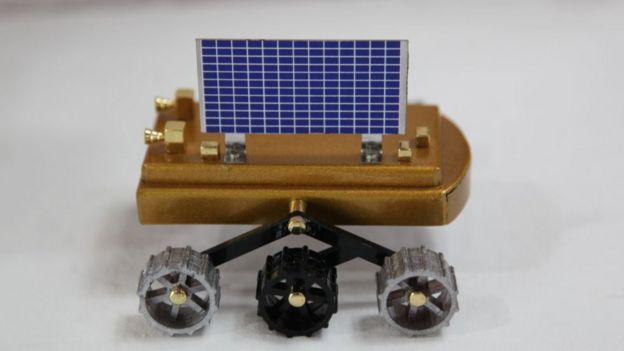
The rover (called Pragyan – wisdom in Sanskrit) had the capacity to travel 500m from the lander in its 14-day life span, and would have sent data and images back to Earth for analysis.
The mission would have focused on the lunar surface, searching for water and minerals and measuring moonquakes, among other things.
Why would it have been significant?
A soft landing on another planetary body – a feat achieved by just three other countries so far – would have been a huge technological achievement for Isro and India’s space ambitions, writes science writer Pallava Bagla.
He adds that it would also have paved the way for future Indian missions to land on Mars, and opened up the possibility of India sending astronauts into space.
For the first time in India’s space history, the interplanetary expedition was led by two women – project director Muthaya Vanitha and mission director Ritu Karidhal.
Media caption Is India a space superpower?
It is also a matter of national pride – the satellite’s lift-off in July was broadcast live on TV and Isro’s official social media accounts.
The mission has also made global headlines because it’s so cheap – the budget for Avengers: Endgame, for instance, was more than double at an estimated $356m. But this isn’t the first time Isro has been hailed for its thrift. Its 2014 Mars mission cost $74m, a tenth of the budget for the American Maven orbiter.
Image copyrigh tGETTY IMAGESImage caption Chandrayaan-2 is a three-in-one mission comprising an orbiter, a lander and a six-wheeled rover
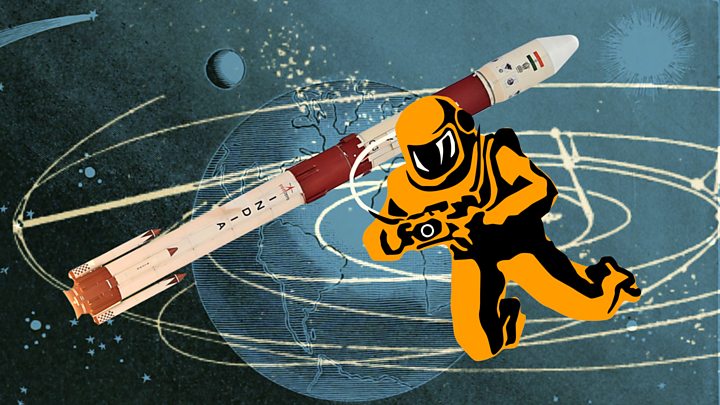
India’s second Moon mission will see the country’s space agency attempt to land a rover on the lunar surface on 7 September. Science writer Pallava Bagla explains how it will reach the Moon and why it is significant.
Why is this mission unique?
Costing $150 million, Chandrayaan-2 will carry forward the achievements of its predecessor Chandrayaan-1 which was launched in 2008 and discovered the presence of water molecules on the parched lunar surface.
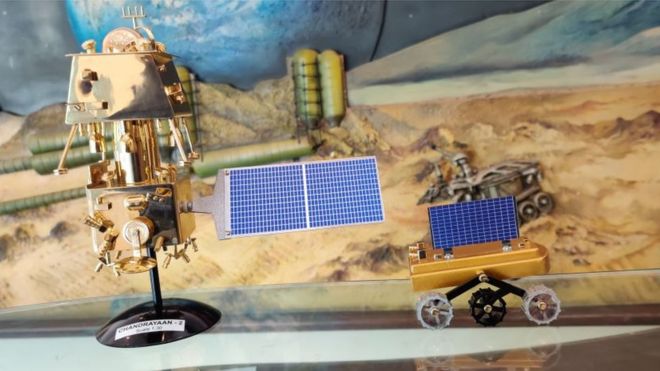
Chandrayaan-2 is a three-in-one mission comprising an orbiter, a lander named Vikram and a six-wheeled rover named Pragyaan.
It was launched on 22 July, a week after its scheduled blast-off, which was halted due to a technical snag.
It entered the Moon’s orbit nearly a month later in a tricky operation, completing a series of manoeuvres before its lander was cut loose on 2 September.
Media caption The successful launch of India’s Moon mission
Now, on 7 September, a little after midnight India local time (1800 GMT), the lander which contains the rover will be sent hurtling down to the lunar surface where it is expected to make a landing near the South Pole of the Moon.
The last 15 minutes of the mission, when the Vikram lander will attempt to autonomously guide itself down to the lunar surface with no support from ground control, has been described as “15 minutes of terror” by the head of the Indian Space Research Organisation (Isro), Dr K Sivan.
If India does succeed in touching down with the Vikram lander intact, it will become the fourth country to do so after the US, Russia and China.
More importantly for Indians, it will mean the nation’s flag will reach the Moon intact.
How will it land on the Moon?
The Moon may be Earth’s closest neighbour, but landing on it is a very tricky operation.
It has no atmosphere worthy of the name, which means parachutes cannot be used to slow the lander’s descent to the surface. The only option therefore is to go in for what is called a “powered descent”.
This means that the velocity of the lander is steadily reduced with its own rocket engines.
The lander will be moving horizontally across the surface of the Moon as it descends. The rocket engines must bring that horizontal movement to a stop whilst at the same time controlling the rate of descent to near zero just before the moment of touchdown.
This is known as a “soft landing”.
Before the final approach, both the orbiter and lander would have surveyed the Moon to find a “sweet spot” with no craters and boulders where it can land.
If the lander does not function properly it could crash land on the Moon surface, like its predecessor Chandrayaan-1 – though this was an intentional crash landing as in 2008 India had not yet mastered how to perform a soft landing.
Media caption Is India a space superpower?
Either way, once the landing happens and the lunar dust that may have been kicked up settles, the ramp opens up and the rover is very gently wheeled out.
The rover will then “Moon walk” at the princely speed of one centimetre per minute. It can travel a maximum of 500m (1,640ft) from the lander.
Both the lander and rover are powered with solar batteries and carry three instruments apiece.
What will the lander do?
The lander will, among other things, measure Moon quakes in its vicinity and do a thermal profile of the lunar “soil”. Meanwhile, the rover will further analyse the lunar soil.
The rear wheels of the rover are imprinted with the national emblem – the Ashoka Chakra – and the Isro logo, which means a permanent mark of India’s visit will be left on the surface of the Moon.
But the extreme temperatures on the Moon’s surface are a real challenge to the mission.
Image copyright GETTY IMAGESImage caption The rover will “Moon walk” at a speed of one centimetre per minute
When the Sun shines, the lunar temperature can cross 100C and when it sets the temperature can drop to -170C.
As their batteries must be recharged with sunlight, the nominal life of both the rover and lander is expected to be one lunar day, since Isro is not sure if they can survive the ultra-cold temperatures of the long cold lunar night which lasts 14 days.
Both will send back photos of each other so the first Indian “selfies” from the lunar surface are expected soon after they land.
Why is the South Pole of the Moon significant?
The South Pole of the Moon is still a largely unexplored area, and India is targeting a spot that no other landing craft has reached so far. The mission will attempt to soft land its rover and lander in a high plain between two craters – Manzinus C and Simpelius N – at a latitude of about 70° south.
Most earlier missions including the Apollo manned missions targeted the equatorial region of the Moon.
Isro says the lunar South Pole is especially interesting because the surface area that remains in shadow here is much larger than that of the Moon’s North Pole. This means that there is a possibility of water in areas that are permanently shadowed.
In addition, the South Pole region has craters that are cold traps and contain a fossil record of the early Solar System.
This unexplored region is also especially important because in the near future, possibly by 2024, the US space agency Nasa aims to place boots back on the Moon through its Artemis Mission, and wants to target landing near the South Pole.
India’s mission will therefore give the Americans much needed data of this unchartered territory.
Why will the orbiter circle the Moon for a year?
The Chandrayaan-2 orbiter is expected to circle the Moon for a further year.
During that time, it will map lunar minerals, take high resolution photos and search for water on the lunar surface in the most detailed fashion till date by any lunar craft, using an infra-red imager and radars.
Image copyright GETTY IMAGESImage caption The imprints of India’s national emblem and the Isro logo will be left on the Moon by the rover
The high resolution camera will help make a digital terrain map of the moon
It will also analyse the thin lunar atmosphere.
There is also the possibility that the orbiter may last longer than a year, as Isro says it has made suitable savings in fuel. But once its fuel runs out, the orbiter will become a long-lasting Indian-made lunar satellite.
ISLAMABAD (Reuters) – Pakistan would not use nuclear weapons first, Prime Minister Imran Khan said on Monday, amid tensions with arch-rival India after New Delhi revoked the special status of its part of the disputed Kashmir region.
“We both are nuclear-armed countries. If these tensions increase, the world could be in danger,” Khan said, addressing members of the Sikh religious community in the eastern city of Lahore. “There will be no first from our side ever,” he said.
The foreign ministry’s spokesman subsequently said on Twitter that the comments were being taken out of context and did not represent a change in Pakistan’s nuclear policy.
“PM was simply reiterating Pakistan’s commitment to peace and the need for both nuclear states to demonstrate responsible behaviour,” spokesman Mohammad Faisal said on his official Twitter account.
Tension remains high in Kashmir, where security forces have used tear gas against stone-throwing protesters and the valley remains under lockdown after Indian Prime Minister Narendra Modi’s decision to withdraw special rights for the Muslim-majority state on Aug. 5.
By stripping Indian-controlled Kashmir of its special status, New Delhi blocked the region’s right to frame its own laws and allowed non-residents to buy property there. Delhi said the change would help Kashmir’s development, to the benefit of all, but its move angered many residents of the region and was strongly condemned by Pakistan.
Khan has so far focused on a global diplomatic campaign condemning India’s actions, accusing Modi of committing human rights violations and atrocities in the valley.
He has also said frequently that any misadventure between two nuclear-armed nations could endanger the world.
Muslim-majority Kashmir has long been a flashpoint between India and Pakistan. Both countries rule parts of Kashmir while claiming it in full. Two of the three wars they have fought have been over it.
Also on Monday, Islamabad gave a consular access to an Indian who was given a death sentence for spying by a Pakistani military court, which the International Court of Justice asked Pakistan to review in mid-July.
“Pursuant to the decision of the International Court of Justice, Pakistan provided consular access on 02 September, 2019 to India for Commander Kulbhushan Jadhav, Indian spy, serving Indian Naval officer,” a Pakistani foreign office statement said.
The statement said that at India’s request, there was no restriction on the language of communication and the access was recorded, which continued for two hours.
An Indian external affairs ministry statement said “Jadhav appeared to be under extreme pressure to parrot a false narrative to bolster Pakistan’s untenable claims.” It said Delhi would wait for a detailed report to determine the extent of conformity to the ICJ directives.







 CHINDIA ALERT: You'll be living in their world, very soon