Archive for ‘India alert’

17/01/2019

‘One step ahead of Pak, giving them befitting reply’: Northern Army chief

Lt General Ranbir Singh said 2018 was a great year for the security forces as more than 250 terrorists had been killed, 54 were caught alive and another 4 had surrendered to them.

INDIA Updated: Jan 17, 2019 16:58 IST

Ravi Krishnan Khajuria
Hindustan Times, Jammu
lt general ranbir singh,pakistan ceasefire violation,kalai bridge
Northern Army Commander Lt Gen Ranbir Singh said that the Indian Army has been giving a befitting response to the Pakistani ceasefire violations.(HT Photo)

The Northern Army commander Lt Gen Ranbir Singh on Thursday said the Indian Army was one step ahead of Pakistan and was giving a befitting reply to every single ceasefire violation by the neighbouring country.

Talking to media after inaugurating a bridge at Kalai in Poonch district, General Singh said, “We are one step ahead of Pakistan and are giving befitting reply to them.”

“2018 has been a great year for the security forces, more than 250 terrorists were killed, 54 were caught alive, and 4 surrendered to the forces,” he said.

When asked about the increased ceasefire violation by Pakistani forces since January 1 this year and the elimination of five Pakistani soldiers by Indian forces in retaliation in the last few days, Gen Singh said the answer lies in the query itself.

On Thursday, Pakistani army again resorted to heavy firing in Jhangar, Laam, Pukherni and Peer Bhadreshwar areas of Rajouri district, prompting the Indian Army to retaliate in equal measure.

On Tuesday, Pakistan killed BSF’s assistant commandant in sniper firing on the international border in Hiranagar sector of Kathua district on Tuesday.

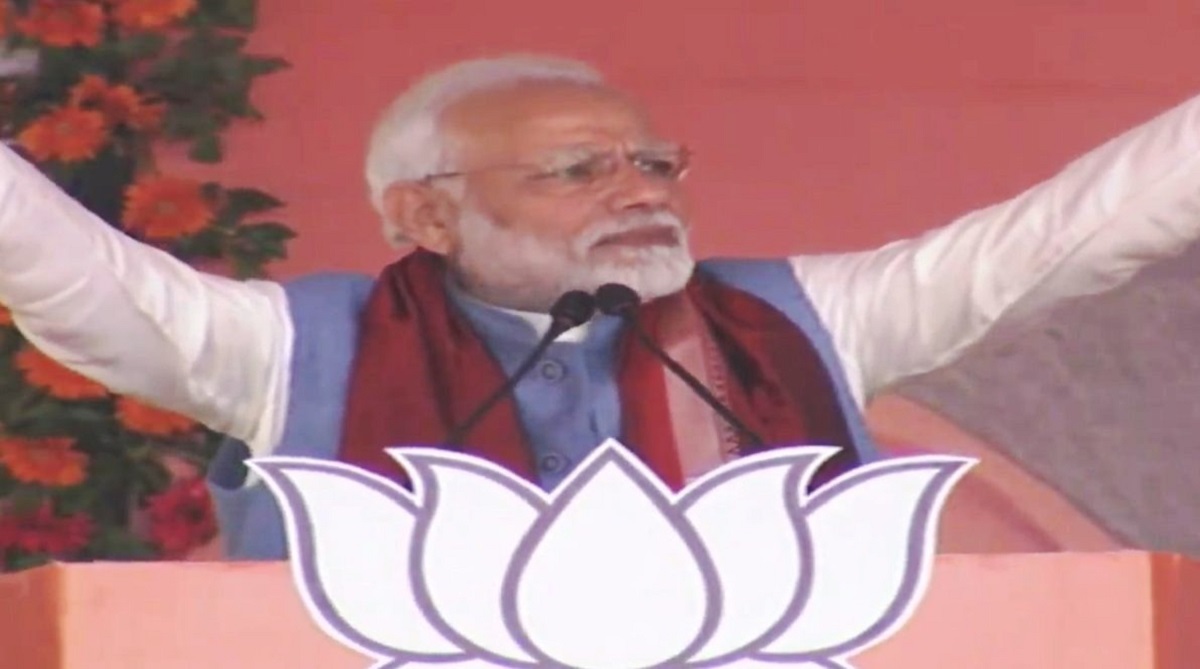
Notably, PM Narendra Modi is scheduled to visit the border district of Samba on February 3 to kick-start the BJP’s election campaign in the state.

Despite repeated calls for restraint and adherence to the 2003 ceasefire agreement to maintain peace and tranquility, Pakistani troops have been indulging in ceasefire violations including BAT attacks, sniper attacks and planting IEDs inside Indian territory to kill Indian personnel.

Meanwhile, General Ranbir Singh dedicated the Kalai Bridge to the country on Thursday. The bridge spans over the Suran River and connects Kalai area to Chandak area in Poonch district.

During the inauguration function, the Army Commander addressed the gathering of Army, GREF and local residents and said the Kalai bridge is an important milestone towards enhancing the road communication and for socio-economic development of the area.

The bridge is an important strategic asset as it will enhance the movement of military equipment and troops in a faster timeframe. The Indian Army and BRO has been working towards infrastructure development in the remote and far-flung areas of the state and have been improving road connectivity.

The bridge will reduce traffic congestion in the city and reduce the inconvenience caused to the people specially while moving towards Budha Amarnath Shrine in Mandi as it reduces the travelling time considerably.

Also watch:

First Published: Jan 17, 2019 15:17 IST

Source: Hindustan Times
16/01/2019

India woman makes historic ascent of ‘banned’ sacred peak

Dhanya SanalImage copyrightDHANYA SANAL
Image captionDhanya Sanal was the first woman to scale the peak

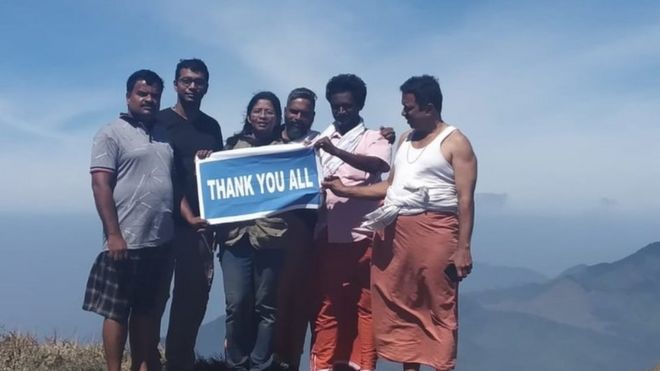
An Indian woman has climbed a mountain, where only men were allowed until now for religious reasons.

Dhanya Sanal’s ascent to the summit of Agasthyakoodam in southern Kerala state came after a court ruling in November.

Local tribespeople oppose women climbing it because of a statue of a Hindu sage on top they say is celibate.

Ms Sanal, 38, told the BBC she had not been stopped by locals or protesters. Campaigners say it’s a victory in the fight to end gender discrimination.

Ms Sanal said she had been “ready to turn back” if tribespeople stopped her, but while she did encounter protesters, she said they had not prevented her from continuing her trek.

In November, the high court in Kerala ruled that women could trek to the 1,868m (6,128ft) peak. The court said that restrictions on trekking could not be based on gender after a women’s group petitioned the court.

The group welcomed Ms Sanal’s climb.

“We have moved one step ahead in ending gender discrimination in Kerala,” Divya Divakaran, one of its members, told the BBC.

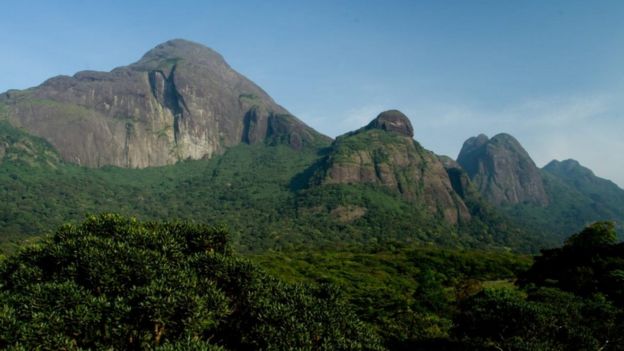
Agasthyakoodam mountainImage copyrightSALI PALODE
Image captionAgasthyakoodam is the second highest peak in Kerala

Located within a biosphere reserve in India’s Western Ghats, Agasthyakoodam is the second highest peak in Kerala.

The high court rejected the claim made by tribespeople, who live at the foothills, that the verdict hurt their beliefs.

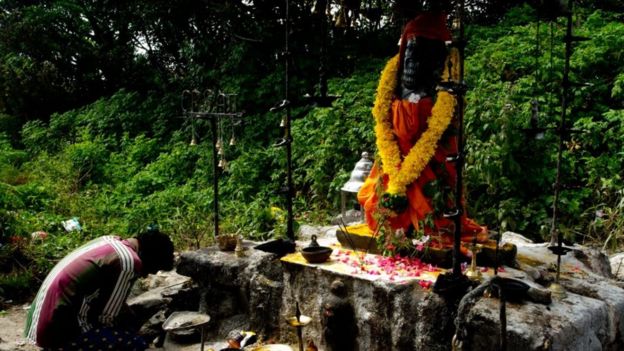
They had said they worshipped the sage, Agastya, and did not want women in the vicinity of his idol as that amounted to disrespecting his celibacy.

The terrain is steep and rocky and the trail is inside a thick forest. Trekkers often take two or three days to scale the peak.

“It is extremely tough terrain that demands extra physical fitness,” Ms Sanal told the Times of India newspaper.

She was the only woman in a group of 100 trekkers. The group was accompanied by two female forest officials.

Officials told the BBC that more than 100 women had registered for treks in the coming weeks.

A local offering prayer to the idol of sage AgastyaImage copyrightSALI PALODE
Image captionLocal tribespeople revere the sage whose idol is at the peak

Earlier this month, two women made history in Kerala by entering a prominent Hindu shrine, following months of protests against their entry.

The Sabarimala temple was historically closed to women of “menstruating age” – defined as between 10 and 50. Devotees believe that the deity is an avowed bachelor and the ban was in keeping with his wishes.

Hinduism regards menstruating women as unclean and bars them from participating in religious rituals.

The women’s entry to the shrine prompted massive protests across Kerala.

One of the two women is recovering in hospital after her mother-in-law allegedly attacked her for entering the temple.

Source: BBC

16/01/2019

Exclusive – Modi’s party wants expansionary economic policy ahead of India election

NEW DELHI (Reuters) – Indian Prime Minister Narendra Modi’s ruling party is in favour of an expansionary economic policy and does not consider the government’s plan to keep the fiscal deficit to 3.3 percent of GDP as “sacrosanct”, a party spokesman told Reuters.

Ahead of a general election that must be held by May and after a string of losses in recent state polls, the government run by Modi’s Bharatiya Janata Party (BJP) has announced several stimulus measures for the countryside where millions of farmers are grappling with low crop prices. Other fiscal moves have been aimed at helping small businesses.

The measures are likely to be a drain on finances in Asia’s third-biggest economy, though the Modi administration is expected to get the Reserve Bank of India to agree to transfer an interim dividend of 300-400 billion rupees (£3.36 billion-£4.51 billion) to the government by March, Reuters reported last week quoting sources.

Weak consumer spending and the fragile farm sector have already been a drag on economic growth, creating a headache for Modi as he struggles to meet ambitious job creation targets.

India lost 11 million jobs last year, with around 83 percent in rural areas, according to independent think-tank the Centre for Monitoring Indian Economy, as operational costs surged for small businesses. Those costs were boosted by the launch of a national sales tax in 2017 and the economic impact of an earlier ban on high value currency notes.

SPONSORED

ADVERTISING

“There’s a demand, there’s a debate – all my colleagues are saying what’s the need of keeping the fiscal deficit in check when there is a distress in a particular sector,” said Gopal Krishna Agarwal, the economic affairs spokesman for the Hindu nationalist BJP, referring to the farm sector.

“Even think-tanks associated with us are talking in this sense. Very few people domestically are talking about fiscal prudence. Only foreign think-tanks are talking fiscal prudence, fiscal prudence. I strongly believe an expansionary policy can benefit the party,” he said in an interview on Tuesday night.

India’s 10-year benchmark bond yield IN071728G=CC rose 4 basis points to 7.53 percent after the news, its highest since Jan. 8 on worries about the fiscal deficit. The rupee INR=D4 also weakened to 71.23 to the dollar from its previous close of 71.03.

Agarwal, a chartered accountant who is a director at state-run Bank of Baroda (BOB.NS) and a member of a government committee on small and medium-sized businesses, said Modi was aware of his party colleagues’ thinking but that no final decision had been taken.

D.S. Malik, a spokesman for the Ministry of Finance, did not respond to calls and emails seeking comment. Finance Minister Arun Jaitley, who is in the United States for a medical check-up, said in a Facebook post on Tuesday that India’s “fiscal discipline during the past five years has been amongst the best as compared to any preceding period”.

NEED TO REACH LANDLESS

Agarwal said the government understands that farmers are in distress and that directly transferring money to their bank accounts was an option to help them out. He said the government was, however, trying to figure out how to distribute funds to landless tillers to make sure any such transfer programme was effective and didn’t just benefit those with land.

The government is studying a programme launched by the eastern state of Odisha under which farmers with landholdings of up to 5 acres would get cash assistance to buy seeds, pesticides, fertilisers and pay for labour. Sharecroppers, who cultivate rented land will also get the benefits, which include life insurance coverage.

Agarwal said Modi and many financial institutions were not in favour of waiving farm loans, as done by states recently won by the main opposition Congress party, because doing so mainly helps banks and not so much farmers in duress.

“There’s definitely a suggestion to give interest-free loans to farmers. Banks won’t have to pay, it has to be incorporated into the budget,” he said.

“And what’s the so sacrosanct issue about keeping the fiscal deficit at less than 3.5 percent? If you don’t adopt an expansionary economic policy, then the government alone can’t create demand by just spending on infrastructure. It has to come from both public and the private sector. The economy will grow only when demand will be created.”

He said increasing the income tax exemption limit for individuals was also being considered for the interim budget to be presented on Feb. 1 by Jaitley.

William Foster, vice president at Moody’s Investors Service, said that it expects the country’s fiscal deficit to slip to 3.4 of GDP this fiscal year ending March 31 due to revenue shortfalls from goods and services tax, lower excise duty and below-target receipts from sale of government assets.

“Increased expenditure on income transfers, farm loan waivers or other forms of subsidies would weigh further on government finances,” Foster told Reuters.

Reporting by Krishna N. Das and Aftab Ahmed; Additional reporting by Suvashree Dey Choudhury; Edited by Martin Howell

Source: Reuters

16/01/2019

49 people injured on day one of Jallikattu festival in Tamil Nadu

Nearly 500 bulls and a similar number of “tamers” were involved on the opening day of the festival in Madurai on Tuesday.

INDIA Updated: Jan 16, 2019 16:15 IST

jallikattu,Jallikattu festival,Bull taming festival
A villager attempts to control a bull during Jallikattu in Coimbatore.(PTI File Photo)

Forty-nine people were injured on the first day of the traditional Jallikattu festival in Tamil Nadu that has attracted the ire of animal activists, officials said Wednesday.

Nearly 500 bulls and a similar number of “tamers” were involved on the opening day of the festival in Madurai, said S Natarajan, district collector of the city.

“Forty-nine people were injured yesterday. Nine were taken to hospital for minor injuries,” he told AFP.

Wednesday’s festivities will see almost double the number of bulls and competitors in the ring, Natarajan added.

The Supreme Court outlawed Jallikattu in 2016 after a plea by animal rights groups but Tamil Nadu insisted Jallikattu was a crucial part of its culture and identity.

Growing tensions in the state capital Chennai, and other cities, led Prime Minister Narendra Modi to issue an executive order that the centuries-old festival go ahead.

During the festival in Tamil Nadu bulls festooned with marigolds are released from pens and men try to grab their horns to win prizes such as scooters and whitegoods.

Critics say the bulls are fed alcohol and chilli powder is thrown in their faces to agitate them before the clash. Organisers insist the animals are not mistreated.

Source: Hindustan Times
16/01/2019

Indra Nooyi to lead World Bank?

Indra Nooyi, 63, stepped down as PepsiCo’s chief in August 2018 after leading the company for 12 years.(File Photo: Xinhua/Ting Shen/IANS)

India-born Indra Nooyi, the former CEO of global beverage giant PepsiCo, is being considered by the White House for the new World Bank president, according to a leading American daily.

Indra Nooyi, 63, stepped down as PepsiCo’s chief last August after leading the company for 12 years.

She “has been courted as an administration ally by Ivanka Trump, the president’s eldest daughter who is playing a role in the selection of a nominee,” the The New York Times said.

The report, which cited several people familiar with the process, said the decision-making process for the top post at the World Bank is “fluid and in its initial stages and early front-runners and candidates often fall off the radar, or withdraw from consideration, before the president (Donald Trump) makes his ultimate pick”.

It is unclear whether Nooyi would accept the nomination if chosen by the Trump administration.

The first daughter, who has tweeted that she views Nooyi as a “mentor + inspiration”, has floated her name as a potential successor.

World Bank’s current president Jim Yong Kim had earlier this month announced that he would step down from his post in February to join a private infrastructure investment firm. His unexpected departure came nearly three years before the end of his term.

The NYT report said that the process of choosing Kim’s successor is being overseen by Treasury Secretary Steven Mnuchin, acting chief of staff Mick Mulvaney and Ivanka, whose role in the process was announced by the White House Monday.

Ivanka’s “role in the process drew some criticism from ethics watchdogs Monday, which said it could pose a conflict of interest for the president’s daughter to be involved in international economic matters when she has not completely divested from her assets,” the report said.

The group was expected to begin the interview process Tuesday, in order to present President Trump with recommendations for a nominee.

Nooyi joined Trump’s business council, which was disbanded after many chief executives quit following the president’s comments blaming “many sides” for white supremacist violence in Charlottesville, in August 2017.

The report, however, added that negative comments made by Nooyi after the 2016 election, during which she did not publicly endorse any candidate, are seen as a potential roadblock to her nomination.

Following Trump’s win, she said at the NYT’s DealBook conference in 2016 that “Our employees are all crying. And the question that they’re asking, especially those who are not white: ‘Are we safe?’ Women are asking: ‘Are we safe?’ LGBT people are asking: ‘Are we safe?’ I never thought I’d have had to answer those questions”.

A spokesman for PepsiCo had told Fortune magazine that “Mrs. Nooyi misspoke. She was referring to the reaction of a group of employees she spoke to who were apprehensive about the outcome of the election. She never intended to imply that all employees feel the same way”.

In a surprise move, World Bank President Jim Yong Kim announced earlier this month that he would step down from his position on February 1, much before the end of his term in 2022.

Apart from Nooyi, other candidates being considered for the position of World Bank head are under secretary of the Treasury for International Affairs David Malpass and president of the Overseas Private Investment Corporation Ray Washburne.

The US president cannot install the World Bank leader, who must be approved by the bank’s board, but has traditionally placed his nominee in the job.

Trump has already faced harsh criticism for appointing his daughter as a senior White House advisor.

Ivanka is a successful businesswoman, fashion designer, author and reality television personality. She has her own line of fashion items, including clothes, handbags, shoes, accessories which are available in all major US departmental stores.

Source: The Statesman
15/01/2019

Kumbh Mela: Millions of Indians begin holy dip

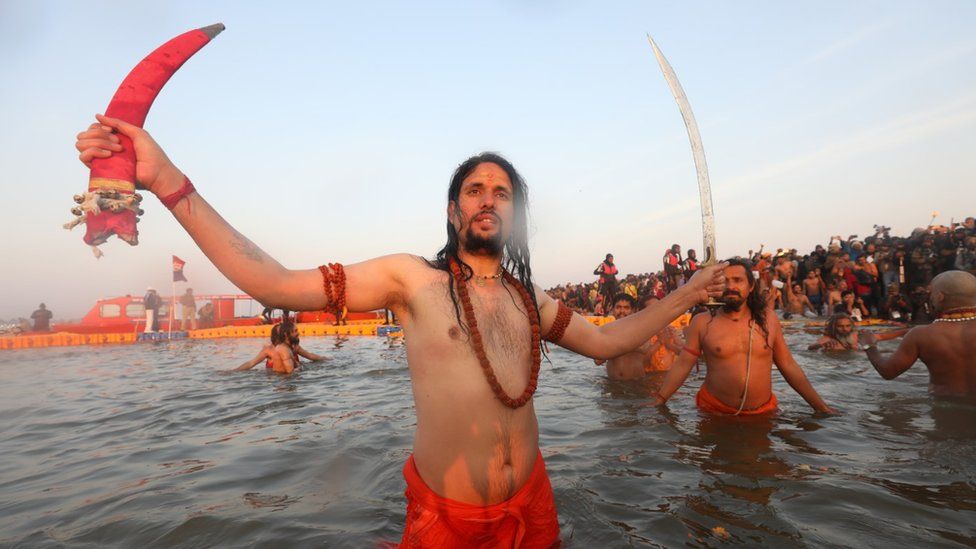
Hindu holy men taking a dip at the SangamImage copyrightANKIT SRINIVAS

Millions of people have taken to the waters at the confluence of India’s sacred Ganges and Yamuna rivers at the Kumbh Mela festival – humanity’s largest gathering.

At least 15m people are expected on the first day alone. Officials project about 120m visitors over 49 days.

Hindus believe bathing at the rivers will cleanse their sins and bring salvation.

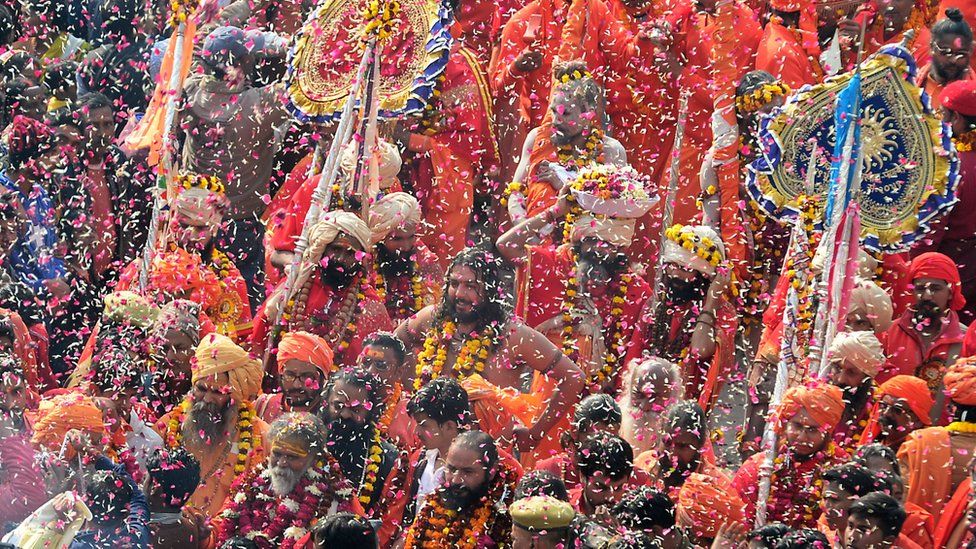
The holy men were among the first procession to arrive early Tuesday.

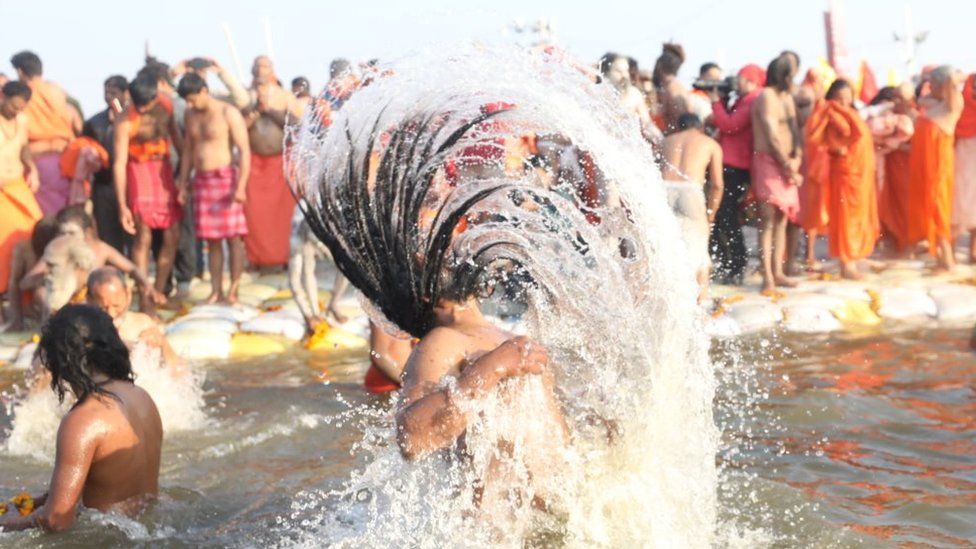
Sadhus – or ascetics – smeared ash on their bodies as they came out of the water and chanted “Har Har Gange”, or “Mother Ganges”, and danced while posing for photographers.

Hindu holy men taking a dip at the SangamImage copyrightANKIT SRINIVAS

The Naga sadhus are the biggest draw of the festival – held in the northern city of Allahabad, recently renamed Prayagraj – and can be counted on to arrive in massive colourful processions.

At the last Kumbh in 2013, female ascetics were allowed to bathe at the confluence of the rivers – known as the Sangam – for the first time. A few hundred transgender people already bathed on Tuesday morning.

More than a million foreign pilgrims will also take part in the festival, senior administration official Rajeev Rai told the BBC.

He and other organisers have been preparing for more than a year for the event, which dwarfs the annual Hajj pilgrimage to Islam’s holiest sites in Saudi Arabia.

“Last minute preparations are on. All the religious sects have been allocated time for their processions and bathing rituals,” Mr Rai said. “We have devised a traffic plan to ensure there’s no overcrowding. The mela area is open only to pedestrians,”

The mela (meaning “fair” in Hindi) has been held in Allahabad for centuries now, but it has grown into a mega event in the past two decades.

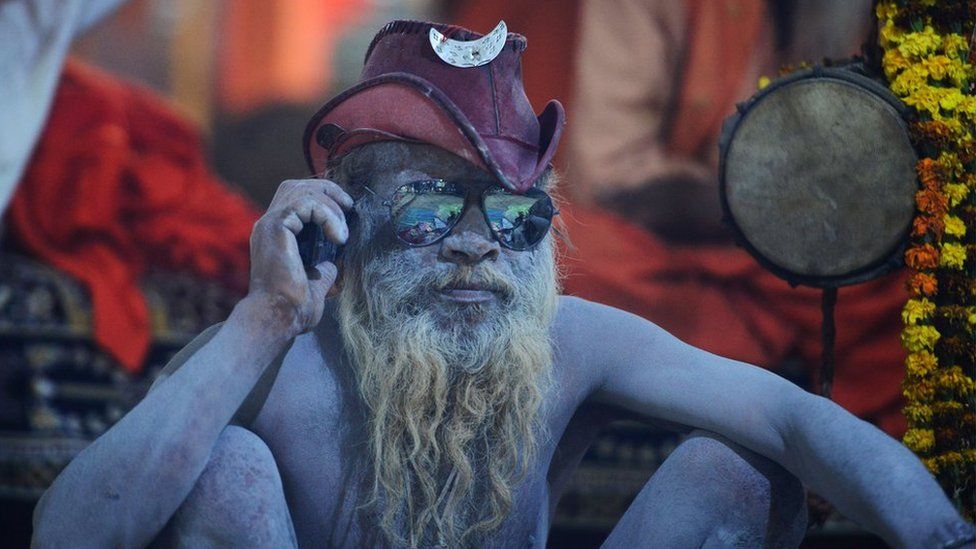
An Indian sadhu (Hindu holy man) sits inside his tent as he use his mobile phone during the Kumbh Mela festival area in Allahabad on January 13, 2019Image copyrightGETTY IMAGES

This year the gathering will be particularly huge and many believe India’s Hindu nationalist government has organised it with an eye on key general elections due in the summer.

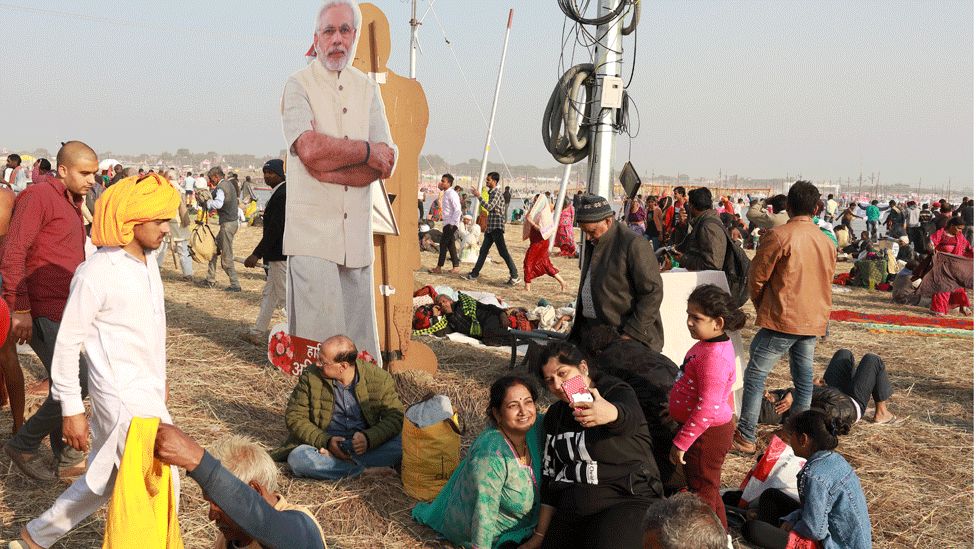
Massive billboards of Prime Minister Narendra Modi dot Allahabad city and the mela ground. Huge cardboard cut-outs have been placed strategically at the bathing areas.

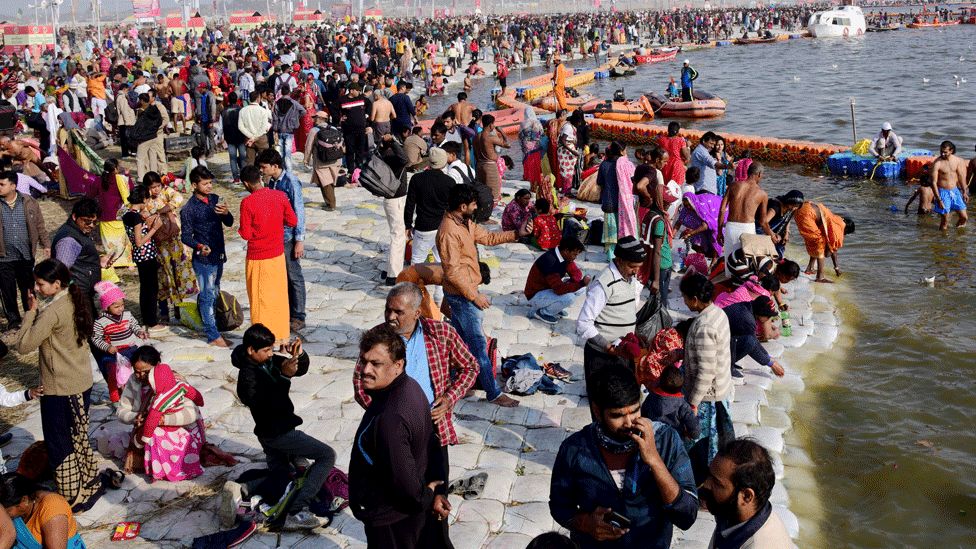
Crowds on the banks of the river in AllahabadImage copyrightANKIT SRINIVAS

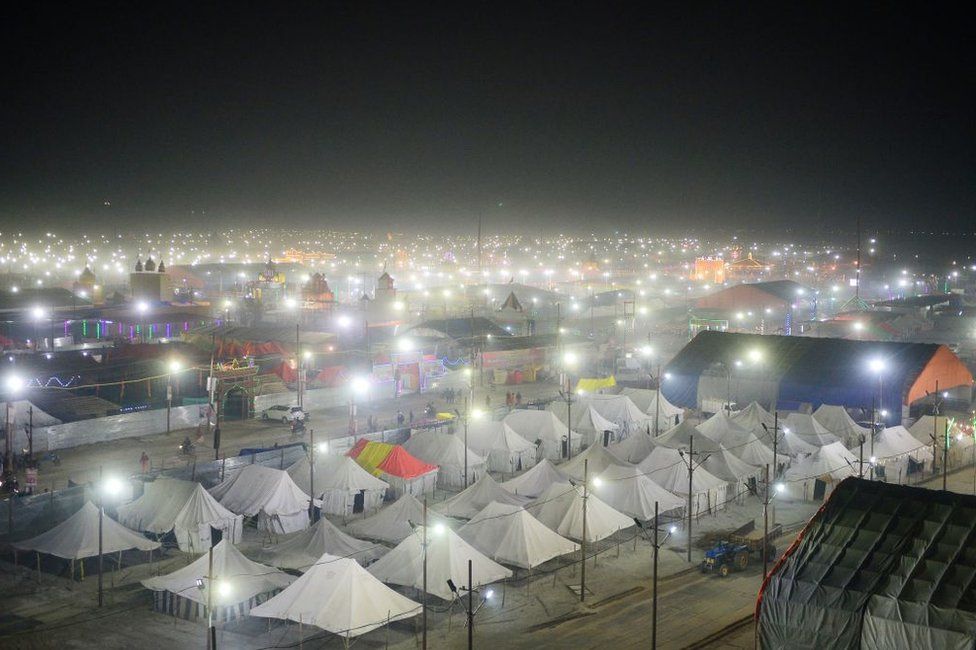
A temporary tent city, spread over 32 sq km (12 sq miles) has been set up to accommodate the masses, complete with hundreds of kilometres of new roads. Hospitals, banks and fire services have been set up just for the festival, along with 120,000 toilets.

Hundreds of new train services are running to and from Allahabad to tackle the rush of pilgrims and more than 30,000 police and paramilitaries have been deployed to provide security and manage the crowds.

In the run up to the festival, religious sects have held daily processions marked by much pomp and show.

The transgender akharaImage copyrightANKIT SRINIVAS

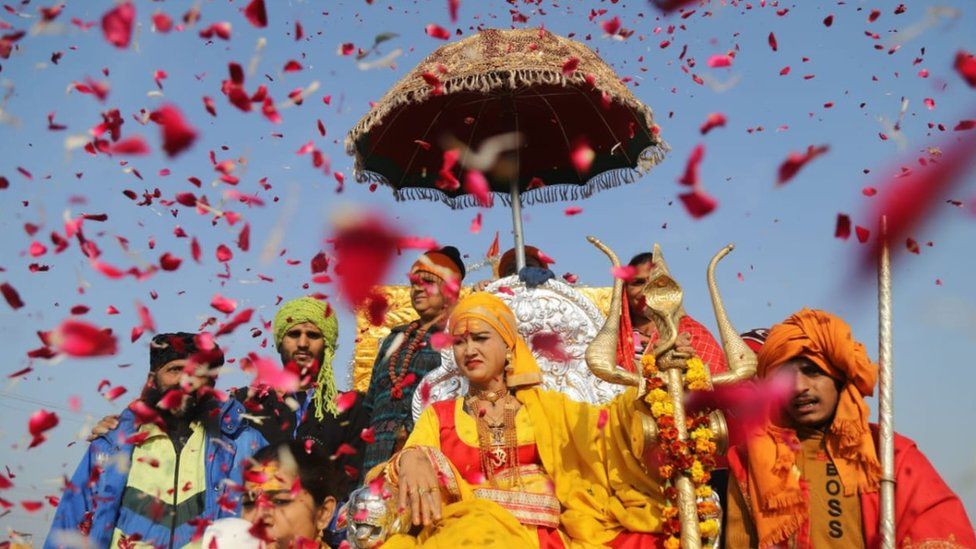
At one such procession on Sunday night, there were elephants, camels and horses. Brass bands and drummers played, as religious leaders sitting atop several vehicles threw marigold flowers to thousands of devotees.

On Monday – a day before the official start of the festival – tens of thousands of pilgrims bathed at the Sangam. Some then lit clay lamps and floated them along with flowers in the Ganges.

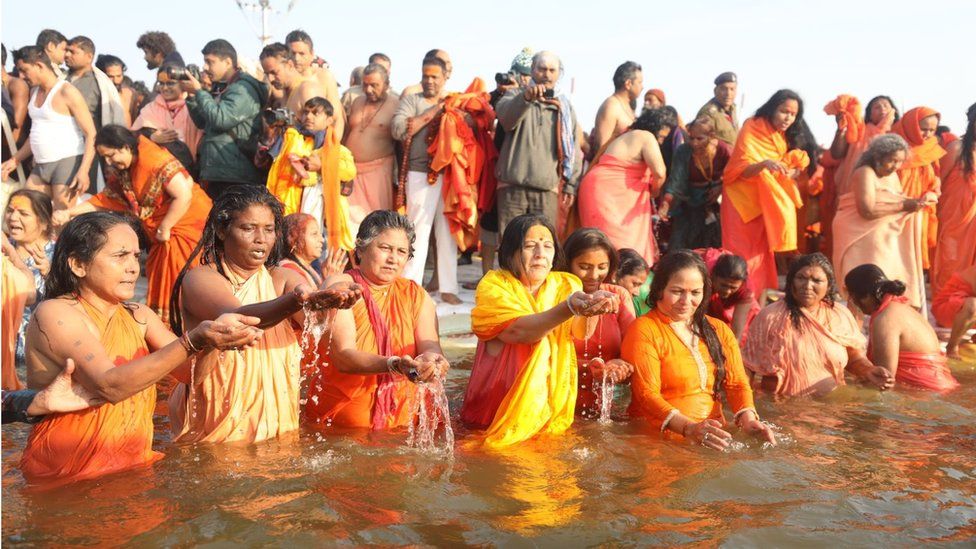
Women taking a dip at the SangamImage copyrightANKIT SRINIVAS
Presentational white space
People sit near a cardboard cut-out of Narendra ModiImage copyrightANKIT SRINIVAS

The atmosphere at the mela is festive, and the authorities have announced a calendar of music and dance performances. But there’s plenty of impromptu entertainment taking place by the roadside, with children performing rope tricks and shows by drummers and ballad singers.

Most pilgrims, however, say they are here to “answer the call of Mother Ganges”.

“We believe that bathing here will destroy our sins,” farmer Pramod Sharma said.

“The waters here have regenerative properties. Bathing here can cure your ailments. It also removes obstacles from your way,” Shahbji Raja said.

15/01/2019

Indian woman alleges assault by mother-in-law for defying temple ban

KOCHI, India (Reuters) – One of two Indian women who entered an ancient Hindu hill temple in southern India this month in defiance of a centuries-old ban on women of menstruating age alleged she was beaten up by her mother-in-law on Tuesday, police said.

Kanaka Durga, 39, a civil servant, suffered injuries to her head and had to be hospitalised, police said. She claims she was attacked only minutes after she returned to her home from spending a month at undisclosed locations fearing attacks by conservative Hindu groups, police said.

“We received a complaint from Kanaka Durga alleging that she was attacked by family members of her husband when she returned home after entering the temple,” said Jaya Mani, officer in charge of Perinthalmanna police station in Malappuram district, which is in the state of Kerala where the Sabarimala temple is located.

Police were investigating, Mani said.

SPONSORED

A second police source said Durga had alleged she was assaulted by the mother-in-law. The mother-in-law had denied the allegation, he said.

Durga did not return calls seeking comment. The family members, including Durga’s mother-in-law, could not be reached for comment.

The Sabarimala temple has been the site of tension since India’s Supreme Court ruled in late September to end a ban on women and girls aged from 10-50 from entering.

The temple refused to abide by the ruling and subsequent attempts by women to visit were blocked by thousands of devotees.

That was until Bindu Ammini, 40, a law lecturer at Kerala’s Kannur University, and Durga finally succeeded in entering the temple on Jan. 2 through a side entrance in the middle of the night. Some other women have claimed they have got into the temple since then.

Their entry sparked widespread protests and a day-long strike in Kerala led in part by members of India’s ruling Bharatiya Janata Party.

“The attack is a natural reaction of the family members, who are strong believers of the temple’s customs and rituals,” Ammini said.

“Her friends told me that her family members were angry with her action. They have unleashed their anger when they saw her.”

15/01/2019

Rahul Gandhi’s swipe at PM Modi over award, Smriti Irani returns compliment

Prime Minister Narendra Modi was the first recipient of the Philip Kotler Presidential award on Monday.

INDIA Updated: Jan 15, 2019 14:43 IST

HT Correspondent
HT Correspondent
Hindustan Times, New Delhi
Rahul Gandhi,Congress,Narendra Modi
Congress president Rahul Gandhi has been relentless in his attacks on Prime Minister Narendra Modi over a range of issues.(REUTERS FIle Photo))

Congress president Rahul Gandhi today took a swipe at Prime Minister Narendra Modi who received the Philip Kotler Presidential award on Monday saying he wanted to “congratulate” him on winning “the world famous” prize that has no jury and has never been given out before.

The award focuses on the triple bottom-line of ‘people, profit and planet’. It will be offered annually to the leader of a nation, a statement from the Prime Minister’s Office said. According to the award citation, Modi was selected for his “outstanding leadership for the nation”.

Rahul Gandhi

@RahulGandhi

I want to congratulate our PM, on winning the world famous “Kotler Presidential Award”!

In fact it’s so famous it has no jury, has never been given out before & is backed by an unheard of Aligarh company.

Event Partners: Patanjali & Republic TV 🙂https://thewire.in/business/modi-wins-first-ever-philip-kotler-presidential-award-but-what-is-it-exactly 

Modi Wins ‘First-Ever’ Philip Kotler Presidential Award – But What Is it?

Top BJP leaders praised the PM for winning a prize with no disclosed jury or process – from a marketing group whose organisers ducked questions, calling it “a very confidential award”.

thewire.in

9,074 people are talking about this

The Congress chief’s dig at the PM evoked a sharp response from Union textiles minister Smriti Irani who accused the Gandhi family of conferring Bharat Ratna awards on its members.

15/01/2019

Past governments ruled India like Sultans, says Modi in Odisha

He also attacked the state government under Naveen Patnaik and said the benefits meant for the people should reach them on time and must not be used as an election tool.

IANS | Bhubaneswar | 

Prime Minister Narendra Modi on Tuesday attacked previous governments at the Centre for ruling the country like their “Sultanates”, neglecting its rich heritage.

“Past governments ruled like Sultans and neglected our rich heritage. They ignored our glorious civilisation and failed to pay attention to their preservation,” said Modi while addressing a public meeting in Balangir town in Odisha.

“This criminal error will always stick to the parties, who the country gave the opportunity to run governments for decades. Surprisingly, they have not taken lessons from this,” he added.

He also attacked the state government under Naveen Patnaik and said the benefits meant for the people should reach them on time and must not be used as an election tool.

This was Modi’s third visit to the state in the past three weeks and showed the importance that the Bharatiya Janata Party (BJP) was attaching to the state ahead of the general and assembly elections.

The Prime Minister said his government was committed to conserving and preserving the country’s rich cultural heritage.

He said his government has been constantly making efforts to bring back the idols stolen from the temples in India.

He also attacked the parties for opposing the International Yoga Day and the construction of the Statue of Unity.

“Some parties were against organising the International Yoga Day. These are the people who did not promote yoga. These people neither understand India nor tourism,” he added.

“They raised questions on erecting the statue of Sardar Vallabhbhai Patel. But, after becoming the world’s tallest statue, it has generated jobs for people residing around the structure.

“They were also against changing the names of islands in Andaman and Nicobar islands,” said Modi.

He said the central government has cancelled around six crore fake ration cards, gas connections, scholarships with wrong names, grabbing pension under wrong names over the last four years.

“We plugged these leakages, saving crores of rupees. All ration cards have been digitised and around 80 per cent of them have been linked with Aadhaar,” said the Prime Minister.

“The middlemen used to loot the money meant for poor. We have stopped this. We ensured everyone gets what they deserve,” he added.

The Prime Minister said there are people who are angry because he has put a stop to their loot and corruption.

Highlighting the developmental works being carried out by the Centre in the state, he attacked the Odisha government for failing to utilise the District Mineral Foundation (DMF) fund in the mineral bearing areas.

“Odisha has Rs 4,000 crore in its DMF Fund which has remained unutilised so far. What has happened to the government? It is in deep slumber. The government of Odisha should ensure that the benefits reach the tribal people.

“Do not wait for the elections. Ease the problems of people, elections will keep coming,” said Modi.

He said the central government has allocated over Rs 20,000 crore for the development of Railways in Odisha in the last four years alone, which is five times more than the allocation by the previous government.

In a month, development projects worth more than Rs 20,000 crore have been either inaugurated or initiated in Odisha, said Modi.

14/01/2019

Kumbh Mela: How to plan a festival for 100m people

Indian devotees shower flower petals on Hindu holy men during a religious procession towards the Sangam area during the 'royal entry' for the upcoming Kumbh Mela festival in Allahabad on January 2, 2019Image copyrightGETTY IMAGES
Image captionDevotees have been gathering in Allahabad for days

India’s Kumbh Mela festival is billed as the world’s biggest gathering of people.

Between now and March organisers expect about 120 million pilgrims to bathe at the Sangam – the confluence of the Ganges, the Yamuna and the mythical Saraswati rivers.

Hindus believe that doing so will cleanse them of their sins and help them attain “moksha”, setting them free from the cycle of birth and death.

So how does one prepare for a gathering of humanity so mammoth it can be seen from outer space?

The mela (Hindi for fair) is held in the northern city of Allahabad (recently renamed Prayagraj) every 12 years.

On Tuesday, when the festival formally begins, officials are preparing for 15 to 20 million visitors. But the biggest test they face will be on 4 February when 30 million are expected to attend for the most auspicious bathing day. The festival ends on 4 March.

Tents are pitched on the banks of Sangam, the confluence of the Ganges, Yamuna and mythical Saraswati rivers, for the upcoming Kumbh Mela festival in Allahabad on January 9, 2019.Image copyrightGETTY IMAGES
Image captionThe budget for the festival is about $400m

This year’s festival is an “ardh Kumbh” – a “half-size” version that falls mid-way between two Kumbhs – but there’s nothing diminutive about it. In fact, it’s much bigger than the last full Kumbh held in 2013.

Where does everyone stay?

A vast tent city has been built on the mudflats of the river delta and thousands of officials are working round the clock to ensure the festival runs as smoothly as possible.

“We’ve been working for more than a year,” senior administration official Rajeev Rai said when I met him in his office a few days ago.

Law of Unintended Consequences

continuously updated blog about China & India

ChiaHou's Book Reviews

continuously updated blog about China & India

What's wrong with the world; and its economy

continuously updated blog about China & India