Archive for ‘India alert’

14/01/2019

Millions expected to throng Indian city for world’s largest religious festival

PRAYAGRAJ, India (Reuters) – Pilgrims from across the world are gathering in India for the Kumbh Mela, a heady mix of spirituality, politics and tourism that begins on Tuesday, garnering extra attention ahead of a general election in the Hindu-majority country this year.

During the eight-week festival at Prayagraj in the northern state of Uttar Pradesh, authorities expect up to 150 million people, including a million foreign visitors, to bathe at the confluence of the Ganges, the Yamuna, and a mythical third river, the Saraswati.

Devout Hindus believe that bathing in the waters of the Ganges absolves people of sins and bathing at the time of the Kumbh Mela, or the “festival of the pot”, brings salvation from the cycle of life and death.

“Belief is what brings us here, to bathe in the waters despite the cold,” said Ram Krishna Dwivedi, making his way back from the shore dressed in flowing white robes.

More than 80 percent of India’s 1.3 billion people are Hindus, many of them deeply religious despite an increasingly Westernized middle class.

SPONSORED

ADVERTISING

On Tuesday, millions of pilgrims, led by naked, ash-smeared ascetics, some of whom live in caves, will plunge themselves into the cold waters during the first Shahi Snan, or Royal Bath, that begins at around 4 a.m. (2230 GMT).

With less than 24 hours until the festival starts, the last of the arriving ascetics paraded towards temporary ashrams, or monasteries, built of corrugated iron and canvas, many bedecked with fairy lights, on the east bank of the Ganges.

Pilgrims poured in to the site, which is closed to traffic around bathing days, carrying bundles on their heads, while vendors peddled balloons and candy floss, as security men stood guard, with priests and police seated side-by-side.

Authorities have set up temporary bridges, 600 mass kitchens and more than 100,000 portable toilets in a pop-up city at the confluence of the rivers, which is known as the sangam.

Those with cash can stay at luxury campsites on the river banks that offer ayurvedic spas and yoga, and cost up to 32,000 rupees ($455) a night.

Most pilgrims make do with more modest lodgings, sleeping in big communal tents or out in the open.

“I don’t know where I will stay yet, but you do not often get to meet these saints and sadhus,” said Rajendra Singh, a retired soldier and now a security guard, who came by bus from the state capital, Lucknow, about 200 km (124 miles) away.

On Monday, a small fire broke out at one of the camps, though there was no report of any casualty, according to Reuters partner ANI. Authorities later warned pilgrims about open fires.

POLITICAL PILGRIMAGE

This year’s event comes at a critical time for Modi’s Hindu nationalist Bharatiya Janata Party (BJP), expected to face a tough contest in a general election due by May.

It lost power in three key states in assembly elections in December, and will want to avoid a similar result during the general election in Uttar Pradesh, a state of 220 million where a good showing can often decide the outcome.

Slideshow (16 Images)

The state’s chief minister, Yogi Adityanath, is a firebrand Hindu priest from the BJP, who has championed policies that play to the party’s core Hindu base.

This year Adityanath has transformed a smaller Ardh, or “half” Kumbh Mela, into a full version of the festival.

He has also lobbied to build a Hindu temple on the site of a former mosque, and renamed several cities with Hindu names – including Prayagraj, which was Allahabad until October.

Modi and his rival, opposition Congress leader Rahul Gandhi, are both expected to attend the festival before it wraps up in March.
13/01/2019

Ram Rahim Singh: India guru guilty of journalist’s murder

  • 11 January 2019
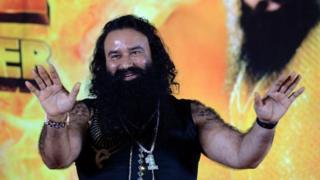
Gurmeet Ram Rahim SinghImage copyrightAFP
Image captionGurmeet Ram Rahim Singh is already serving a 20-year prison sentence for rape

An Indian guru who is already in jail for rape has been convicted for the 2002 murder of a journalist.

Gurmeet Ram Rahim Singh, leader of the Dera Sacha Sauda sect, was given a 20-year sentence in 2017 for raping two female followers.

He will be sentenced for the murder on 17 January.

Newspaper editor Ram Chander Chhatrapati was shot dead after exposing abuse at Dera’s headquarters in the north-western city of Sirsa.

Three other men were also convicted of Chhatrapati’s murder – Kuldeep Singh, Nirmal Singh and Krishan Lal.

Image captionSecurity was stepped up in the wake of his 2017 conviction

The self-styled holy man appeared at the court in Panchkula in Haryana state through a video link from his prison.

During the trial, security was stepped up across the state and in parts of Punjab – where most of Dera’s followers live.

Violence erupted after the sect leader’s rape conviction in August 2017, which resulted in the deaths of 38 people.

Soon afterwards, about 50 other women came forward with their own allegations about sexual abuse in the sect.

‘The complete truth’

Ram Rahim Singh, 51, had long painted himself as a pious spiritual leader, encouraging followers all over the world to take vows of abstinence and celibacy.

But this facade started to slip in 2002, with the publication of a letter in a local newspaper.

The article was written by an anonymous follower of Ram Rahim Singh, and published by Mr Chhatrapati in his Hindi-language newspaper Poora Sach – “The Complete Truth”.

It described instances of sexual abuse at the sect.

Anshul Chhatrapati, the late editor’s son, told The Print that his colleagues warned his father at the time to be careful, because “someone will shoot you one day”.

To this, he reportedly replied: “A real reporter takes the bullet, not a shoe.”

Five days later, on 24 October 2002, Dera Sacha Sauda followers shot Mr Chhatrapati outside his home.

Less than a month later, Mr Chhatrapati died – but the letter published in Poora Sach had already sparked a major investigation into abuse at the sect.

Anshul, who was 21 when his father died, took over the running of the newspaper, and pushed for rape and murder charges to be brought against Ram Rahim Singh.

“My father sacrificed his life for truth,” he said in the 2017 interview. “I could not have let his sacrifice go waste.”

13/01/2019

Rivals unite in Indian state in bid to beat Modi in elections

NEW DELHI/MUMBAI (Reuters) – Two political rivals in the northern Indian state of Uttar Pradesh will form an alliance in a bid to defeat Prime Minister Narendra Modi’s Bharatiya Janata Party (BJP) in national election scheduled for May, leaders of the parties said.

The Samajwadi Party (SP) and the Bahujan Samaj Party (BSP), both of whom command large support bases among Uttar Pradesh state’s working class and are led by former chief ministers, will contest the election as a team, they said.

Uttar Pradesh is India’s most populous state and accounts for about a sixth of all members of the parliament, the highest by a single state. Barring a couple of exceptions in the 1990s, the party winning the most number of seats there has helped form the federal government.

Out of the 80 seats in the state, SP and BSP will nominate candidates for 38 seats each, BSP chief Mayawati Das said at a joint press conference with SP chief Akhilesh Yadav on Saturday.

They will not contest the other four seats, which include two that have historically been held by the country’s main opposition party, Congress.

Congress, which ruled India for nearly four decades since its independence from Britain in 1947, has also been working to build a “grand alliance” with other parties ahead of the polls.

Mayawati, however, said Congress would not be a part of the BSP-SP alliance in Uttar Pradesh. “We can surely stop the BJP from coming to power with this alliance with SP,” she said.

On Friday, Yadav had told news channel NDTV: “We can give Congress two seats they have always held”, referring to the constituencies from where Congress President Rahul Gandhi and his mother Sonia Gandhi have contested in the past.

Mamata Banerjee, head of Trinamool Congress party and chief minister of eastern India’s West Bengal state who has been pushing to create a mega alliance of regional parties to defeat the BJP, welcomed the announcement in a tweet.

“I welcome the alliance of the SP and the BSP for the forthcoming Lok Sabha elections,” Banerjee tweeted.

Akhilesh Yadav, Chief Minister of the northern state of Uttar Pradesh and Samajwadi Party (SP) President, addresses a news conference before resigning from his post in Lucknow, India, March 11, 2017. REUTERS/Pawan Kumar

“Let us cherish the ‘idea of India’ for which our freedom fighters laid down their lives. Our people and our great institutions must strive to remain “independent”, in the true sense of the word.”

OPPOSITION GETS A FILLIP

Opposition parties across the country received a fillip last month, when India’s ruling party lost power in three states and dealt Modi his biggest defeat since he took office in 2014.

The BJP, SP and BSP contested against each other during the state elections in March 2017, which the BJP comfortably won, but political analysts say a BSP-SP alliance could affect the ruling party’s prospects.

The BJP had a 40 percent vote share in the state polls, the BSP and SP put together accounted for 44 percent. To be sure, voting patterns could be different when the world’s largest democracy goes to polls.

The BJP, however, is confident of winning elections in Uttar Pradesh. “We will win 74 out of the 80 seats in Uttar Pradesh,” president Amit Shah said in a televised address on Friday.

Despite the strategic significance and having been ruled by different parties since independence, Uttar Pradesh remains one of India’s most backward states.

It is notorious for its crime rate and unlicensed gun use, has below-average literacy levels, an abysmally low human development index and worrying levels of population growth.

13/01/2019

2019 Lok Sabha Elections: Congress drops a bombshell, to contest all 80 seats in UP

Amethi is Congress president Rahul Gandhi’s parliamentary constituency and Rae Bareilly is that of UPA chairperson Sonia Gandhi.

SNS Web | New Delhi | 

Breaking the suspense over its election plans in the state of Uttar Pradesh for the upcoming 2019 Lok Sabha elections, the Congress on Sunday announced that it will be fielding candidates on all the 80 Lok Sabha seats.

This was informed by senior party leader Ghulam Nabi Azad, who is also the Leader of Opposition in the Rajya Sabha.

“We will fight all 80 seats in Uttar Pradesh in the Lok Sabha elections. We are fully prepared. And just like the Congress emerged the number one party in Uttar Pradesh in 2009 Lok Sabha elections, it will happen again in 2019,” said Azad while interacting with the media in UP capital Lucknow.

Also Read: Mayawati, Akhilesh Yadav announce BSP-SP alliance for 2019 Lok Sabha polls | Slam ‘arrogant’ BJP

“We had earlier also said that we are ready to walk with every party that wants to defeat the BJP. But we can’t force anyone. They have (SP-BSP) closed this chapter, so we will continue this fight to defeat the BJP on our own,” he added.

On Saturday, the Bahujan Samaj Party (BSP) and Samajwadi Party (SP) had officially announced their alliance ahead of the 2019 Lok Sabha elections, keeping the Congress out.

While BSP and SP will contest on 38 Lok Sabha seats each, they have left two seats for other parties. “We have left Amethi and Rae Bareilly for Congress, which is not part of our alliance,” Mayawati had said addressing the media at Lucknow’s Hotel Taj on Saturday.

Amethi is Congress president Rahul Gandhi’s parliamentary constituency and Rae Bareilly is that of UPA chairperson Sonia Gandhi.

“BSP and SP are not going to get any benefit from an alliance with Congress. Our experience is that we do not get votes on seats we leave and they go to the BJP. Congress benefits from us but honest parties like us do not get any benefit,” Mayawati had said, drawing attention to the BSP’s alliance with the Congress in 1996 and SP’s in 2017.

Azad was speaking after a meeting at the party’s state headquarters in Lucknow.

12/01/2019

The men who stay awake so India’s rich can sleep

  • 11 January 2019
Ranjit Singh
Image captionRanjit Singh goes on foot patrols every night with his torch

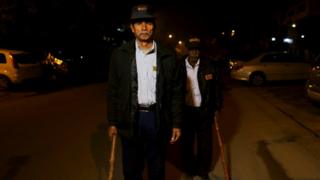
On a dimly-lit street, they look like lone warriors against unknown threats. From afar, their shadows loom over suburban Noida, a newly-gentrified satellite city on the outskirts of India’s capital, Delhi.

Heavy silence blankets the area, broken only by the occasional shrill blast from a whistle.

Two men, dressed in dark blue jackets and caps with the word “security” sewn in bright yellow, have just begun their nightly patrol.

“I have stopped thieves from stealing cars,” 55-year-old Khushi Ram, who goes by a first name only, says with pride. “And then I handed them over to the police.”

He and Ranjit Singh, 40, are security guards. But they are not protecting banks, brightly-lit jewellery stores or corporate offices.

They protect more than 300 posh homes every night – and they do this by going on foot patrol for hours.

“I like my job because I feel like I’m doing something for the public,” Khushi Ram says.

It is bitingly cold and as they rub their hands together to spark some warmth, they breathe out – and it blends easily with the dense smog hanging in the air.

Walk through any of the grid-like neighbourhoods that make up the bulk of Delhi’s residential housing for the middle and upper classes, and you will see many such security guards whose jobs are a halfway point between a watchman and a police officer.

Ranjit Singh and Khushi Ram
Image captionKhushi Ram (L) and Ranjit Singh say they are proud of their job

They can be seen sitting on plastic chairs at the entrance to a neighbourhood, logging details as vehicles enter and exit; or patrolling the blocks through the night while tapping their wooden sticks on the ground – a familiar sound that is both tedious and reassuring.

They are part of India’s informal and often invisible workforce, which runs into hundreds of millions by some estimates. Many informal workers end up in jobs that are crucial to city neighbourhoods, from domestic workers to security guards.

“Everybody in the neighbourhood – from small children to the elderly – depends on us for their safety,” says Ranjit. “This is always on my mind when I am patrolling and it pushes me to do my best.”

Khushi Ram
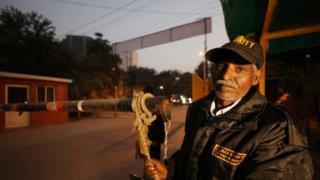
Image captionThey protect more than 300 homes every night

Ranjit’s weapon is a torch. And Khushi Ram has a whistle slung around his neck.

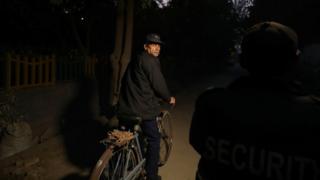
The two men divide the sprawling block – lined with metal and wooden gates that stand in front of two and three-storey homes – between them and set off. Often, they walk and occasionally, they cycle.

They cautiously stop in front of every house and examine it through the gates before walking past.

The two men did not think they would be checking gates and streets in a neighbourhood they could never afford to live in when they left their villages in search of greener prospects.

Presentational grey line

The invisible workforce – stories about the unorganised workers at the heart of India’s economy

Presentational grey line

Ranjit is from the eastern state of Bihar and Khushi Ram is from the northern state of Uttar Pradesh – both are largely rural and among India’s poorest states.

Many of the guards I spoke to say they moved to Delhi in search of a government job, hoping to work for the police or the railways. These jobs are coveted because they come with benefits and tenure. Some of them even harboured dreams of joining the Indian Army.

But they ended up filling a different gap.

An acute shortage of policemen in India, where there is about one officer for every 1,000 people, has meant that many of these guards have become de-facto protectors across neighbourhoods.

Ranjit Singh
Image captionEach neighbourhood in Noida has five or six such security guards

“We work with the police to keep residents safe,” says Ranjit, who moved to Delhi two years ago. He was immediately hired by a local contractor to guard the neighbourhood in Noida.

Local police have also benefited from the work of such guards, seeing as there are about five or six of them in each residential block. “We consider them an extra force,” says Ajay Pal Sharma, a senior police officer in Noida. The crime rate in the Noida, he adds, decreased by 40% in 2018 compared with the year before.

“This is partly because of our relationship with the guards, who have a lot of manpower, so we try and work closely with them.”

Mr Sharma adds that his precinct has also trained some of the guards in recent years, as the bulk of them do not receive any formal training.

He said they have taught the guards to watch out for car thieves and suspicious activity.

The guards also keep their ears open for stray dogs – they say barks from them signal something worth investigating.

Khushi Ram
Image captionKhushi Ram says he has handed over car thieves to the police

Khushi Ram moved to Delhi more than 20 years ago and has been doing the same job ever since.

He says that most people in the neighbourhood respect him, but others tend to look down on this line of work. “Some get nasty because they see us as a lowly-paid person who doesn’t deserve respect.”

His first pay check was for 1,400 rupees (about $20; £15.50). Now, he earns 9,000 rupees a month. “The increase in pay is not much, considering how basic living costs constantly go up when you live in cities,” he says. “I can barely survive with this income, but I don’t have any other skill so I have to continue.”

A job like this lies at the bottom of India’s booming private security industry, which employs about eight million people. An industry report estimates that by 2020, there will be more than 11 million.

The demand is driven by expanding cities, new businesses and a stretched police force.

Khushi Ram
Image captionA job as a neighbourhood guard is at the bottom of a large private security industry

But guards like Ranjit and Khushi Ram represent 65% of the industry, which is still unregulated. They have no promise of career growth and pay increases are sporadic and far from guaranteed.

“I employ 200 guards and pay them the best I can. But the problem is that people don’t want to pay a lot,” says Himanshu Kumar, who owns a small private security firm that stations guards in residential areas.

He says that many see these guards as chowkidars, a term for villagers who voluntarily patrol the streets in exchange for food and money.

“But cities are different,” Mr Kumar says. “You have to pay more because the job is tougher. Unfortunately, people’s attitudes have not changed.”

Ranjit Singh and Khushi Ram
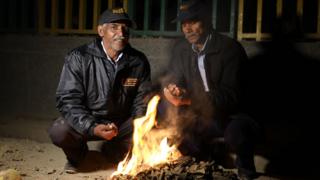
Image captionRanjit Singh and Khushi Ram work in the biting cold in winter and sweltering heat at other times of the year

It is a winter night in Delhi, and the air is leaden with pollution. As Ranjit and Khushi Ram walk, they cough frequently.

The job requires that they walk for at least five to six hours every night and sometimes, they stop to make a fire to warm themselves.

There is no relief in the summer either as sweltering temperatures persist through the night.

It can be a pretty thankless job, says Ranjit, who only gets to see his family once a year since they still live in Bihar.

“In an ideal world, I would be paid more for this job but the pay is so low that I want to quit,” he says.

“It is harder than you think – to stay awake when the rest of the city sleeps.”

12/01/2019

Rivals unite in Indian state in bid to beat Modi in elections

NEW DELHI/MUMBAI (Reuters) – Two political rivals in the northern Indian state of Uttar Pradesh will form an alliance in a bid to defeat Prime Minister Narendra Modi’s Bharatiya Janata Party (BJP) in national election scheduled for May, leaders of the parties said.

The Samajwadi Party (SP) and the Bahujan Samaj Party (BSP), both of whom command large support bases among Uttar Pradesh state’s working class and are led by former chief ministers, will contest the election as a team, they said.

Uttar Pradesh is India’s most populous state and accounts for about a sixth of all members of the parliament, the highest by a single state. Barring a couple of exceptions in the 1990s, the party winning the most number of seats there has helped form the federal government.

Out of the 80 seats in the state, SP and BSP will nominate candidates for 38 seats each, BSP chief Mayawati Das said at a joint press conference with SP chief Akhilesh Yadav on Saturday.

They will not contest the other four seats, which include two that have historically been held by the country’s main opposition party, Congress.

Congress, which ruled India for nearly four decades since its independence from Britain in 1947, has also been working to build a “grand alliance” with other parties ahead of the polls.

Mayawati, however, said Congress would not be a part of the BSP-SP alliance in Uttar Pradesh. “We can surely stop the BJP from coming to power with this alliance with SP,” she said.

On Friday, Yadav had told news channel NDTV: “We can give Congress two seats they have always held”, referring to the constituencies from where Congress President Rahul Gandhi and his mother Sonia Gandhi have contested in the past.

Mamata Banerjee, head of Trinamool Congress party and chief minister of eastern India’s West Bengal state who has been pushing to create a mega alliance of regional parties to defeat the BJP, welcomed the announcement in a tweet.

“I welcome the alliance of the SP and the BSP for the forthcoming Lok Sabha elections,” Banerjee tweeted.

Akhilesh Yadav, Chief Minister of the northern state of Uttar Pradesh and Samajwadi Party (SP) President, addresses a news conference before resigning from his post in Lucknow, India, March 11, 2017. REUTERS/Pawan Kumar

“Let us cherish the ‘idea of India’ for which our freedom fighters laid down their lives. Our people and our great institutions must strive to remain “independent”, in the true sense of the word.”

OPPOSITION GETS A FILLIP

Opposition parties across the country received a fillip last month, when India’s ruling party lost power in three states and dealt Modi his biggest defeat since he took office in 2014.

The BJP, SP and BSP contested against each other during the state elections in March 2017, which the BJP comfortably won, but political analysts say a BSP-SP alliance could affect the ruling party’s prospects.

The BJP had a 40 percent vote share in the state polls, the BSP and SP put together accounted for 44 percent. To be sure, voting patterns could be different when the world’s largest democracy goes to polls.

The BJP, however, is confident of winning elections in Uttar Pradesh. “We will win 74 out of the 80 seats in Uttar Pradesh,” president Amit Shah said in a televised address on Friday.

Despite the strategic significance and having been ruled by different parties since independence, Uttar Pradesh remains one of India’s most backward states.

It is notorious for its crime rate and unlicensed gun use, has below-average literacy levels, an abysmally low human development index and worrying levels of population growth.

08/01/2019

China deploys vehicle-mounted cannons in Tibet along border with India

China has either deployed or plans to induct cutting-edge weaponry for its land border troops to use. Last August, China said it was building rockets for its artillery brigades that will be propelled by the “electromagnetic catapult” technology and can be used in the high altitude plateaus of the TAR.

WORLD Updated: Jan 08, 2019 16:41 IST

Sutirtho Patranobis
Sutirtho Patranobis
Hindustan Times, Beijing
China,China army,China forces
China has equipped its forces in Tibet, which has a long border with India, with new vehicle-mounted howitzers to improve combat capability at high altitudes, reports sourced from the People’s Liberation Army (PLA) said on Tuesday.(Reuters File Photo)

China has equipped its forces in Tibet, which has a long border with India, with new vehicle-mounted howitzers to improve combat capability at high altitudes, reports sourced from the People’s Liberation Army (PLA) said on Tuesday.

It is the same cannon used by an artillery brigade during the 73-day Sino-India border standoff at Doklam (Donglang in Chinese), a state media report said, indicating that since then it has been inducted in high-altitude brigades on a wider scale in the border areas of the Tibet Autonomous Region (TAR).

The deployment comes at a time with China’s border issues, with India and Bhutan, remain unresolved and “…challenged by pro-Tibet independence forces and terrorists,” an analyst told the state media.

The deployed weapon is said to be the rarely seen PLC-181 vehicle-mounted howitzer cannons, capable of firing and then rapidly changing positions. It is said to be a new addition in the arsenal of the PLA ground forces (PLAGF).

The information was first released on a social media app by the PLAGF, saying the PLA in the Tibet Military Command is equipped with the new howitzer, which Chinese military analysts said is supposed to be the PLC-181 vehicle-mounted howitzer.

Song Zhongping, a military expert, told the nationalistic tabloid Global Times the howitzer has 52-caliber cannon with a range of over 50 kilometres and shoots laser-guided and satellite-guided projectiles.

“It will boost the high-altitude combat capability of the PLA in Tibet,” Song said.

“As part of military training in 2019, an artillery brigade in the Tibet Military Command ordered soldiers to take part in a military skills competition at a training ground on the Qinghai-Tibet Plateau 3,700 meters above sea level,” the report said.

Video from the China News Service on Sunday shows soldiers engaged in military boxing, standstill shooting and firing in motion, as well as assembling guns on the snowfields to improve their attack capability.

The information about the new deployment comes within days of President Xi Jinping commanding China’s armed forces to be ready for combat and be prepared for unexpected crisis and war.

The armed forces should have enhanced awareness of danger, crisis and war, Xi told a meeting of the central military commission (CMC), the top military organisation in the country of which he is the chairperson.

The deployment is not to provoke neighbours but defensive in nature, Zhao Gancheng, director of the Centre for Asia-Pacific Studies at the Shanghai Institute for International Studies told the Global Times.

China has either deployed or plans to induct cutting-edge weaponry for its land border troops to use.

Last August, China said it was building rockets for its artillery brigades that will be propelled by the “electromagnetic catapult” technology and can be used in the high altitude plateaus of the TAR.

Calling the innovation “unprecedented”, the report said the catapult-propelled rockets, which can hit targets beyond 200 km, will be more powerful and effective than conventional artillery guns.

07/01/2019

Exclusive: RBI expected to pay India government up to $5.8 billion interim dividend – sources

NEW DELHI (Reuters) – India’s central bank, having changed management last month following a clash with the government, is likely to transfer an interim dividend of 300-400 billion rupees ($4.32 billion-$5.8 billion) to the government by March, according to three sources with direct knowledge of the matter.

The dividend could help Prime Minister Narendra Modi’s administration bridge a widening budget deficit following a drop in tax collections, and would come after the government pushed the RBI for the additional funds ahead of a national election due by May.

Former finance ministry official Shaktikanta Das was appointed as the new governor of the Reserve Bank of India (RBI), following resignation of Urjit Patel last month amid tensions over the dividend payout and other issues.

The government and RBI have now appointed a panel to look into the issue around the sharing of the RBI’s reserves.

“We are absolutely sure that an interim dividend of more than 300 billion rupees would be paid before March end,” one of the sources told Reuters.

The RBI did not respond to an email seeking comment, while the Finance Ministry declined to comment.

The funds are crucial to meet the fiscal deficit target of 3.3 percent of the GDP for the financial year ending in March, as the government’s revenue shortfall may be as high as 1 trillion rupees, according to two finance ministry officials who declined to be named.

The RBI could make a final decision on the dividend by the time Jaitley presents the government’s budget on Feb. 1, the sources said.

07/01/2019

Centre clears 10 per cent reservation for economically weaker sections

The Narendra Modi government is ready with a bill to introduce 10 per cent reservation for economically backward sections. The constitution amendment bill will be introduced in parliament tomorrow, the last day of the Winter Session.

Hindustan Times, New Delhi

Upper caste reservation,PM Narendra Modi
Modi government has cleared 10 per cent reservation for economically weaker upper castes (Photo | Hindustan Times )

The government has cleared a 10 per cent quota in jobs and educational institutions for the economically weaker sections, sources told Hindustan Times after a Cabinet meeting chaired by Prime Minister Narendra Modi. The government is ready with a Constitution amendment bill which will be introduced in parliament tomorrow, the last day of the Winter Session.

The decision comes months before the government’s tenure is to end in a few months and the country is headed into election mode.

The bill seeks to amend two constitutional provisions, Articles 15 and 16, which prohibit discrimination on any grounds in jobs and admissions to educational institutions.

People who have an annual income less than 8 lakh, own less than 5 acre farm land, have house smaller than 1,000 sq feet in a town or a 100 sq yard house in notified municipal area would qualify for the proposed quotas.

The move, a BJP leader hinted, would come in handy to deal with reservation demands from communities that had been demanding that they be counted as other backward classes, or OBCs that have 27 per cent quota for government jobs and admission to educational institutions.

It would also help the national coalition led by the BJP to consolidate its the upper caste vote, considered one of the three crucial pillars of the BJP’s support base. The other backward classes (OBC), and the new Dalit sub-castes who shifted loyalties, are considered the other two pillars.

Already, the BJP, which had gone to great lengths to neutralise the dilution of the SC/ST atrocities law last year, had ended up antagonising the upper castes far beyond what it had anticipated. In the recent assembly elections where it lost three states to the Congress, there had been anecdotal evidence that the upper castes had, in some cases, shifted.

Dalit leader and junior social justice minister Ramdas Athawale had earlier supposed reservation for upper castes, arguing that since quotas could not be ended, parliament should give 25 per cent reservation to the upper castes.

“I welcome wholeheartedly reservation given to economically… Now the ceiling will be raised from 50 to 60 per cent… Parliament is very much empowered to raise this ceiling,” BJP MP and Udit Raj said.

07/01/2019

Kashmir-centric politicians churn out pro-militant formulas before elections

Top separatist, Syed Ali Shah Geelani, calls the slain terrorists “martyrs” and publicly offers tributes to them.

SP Sharma | Jammu | 

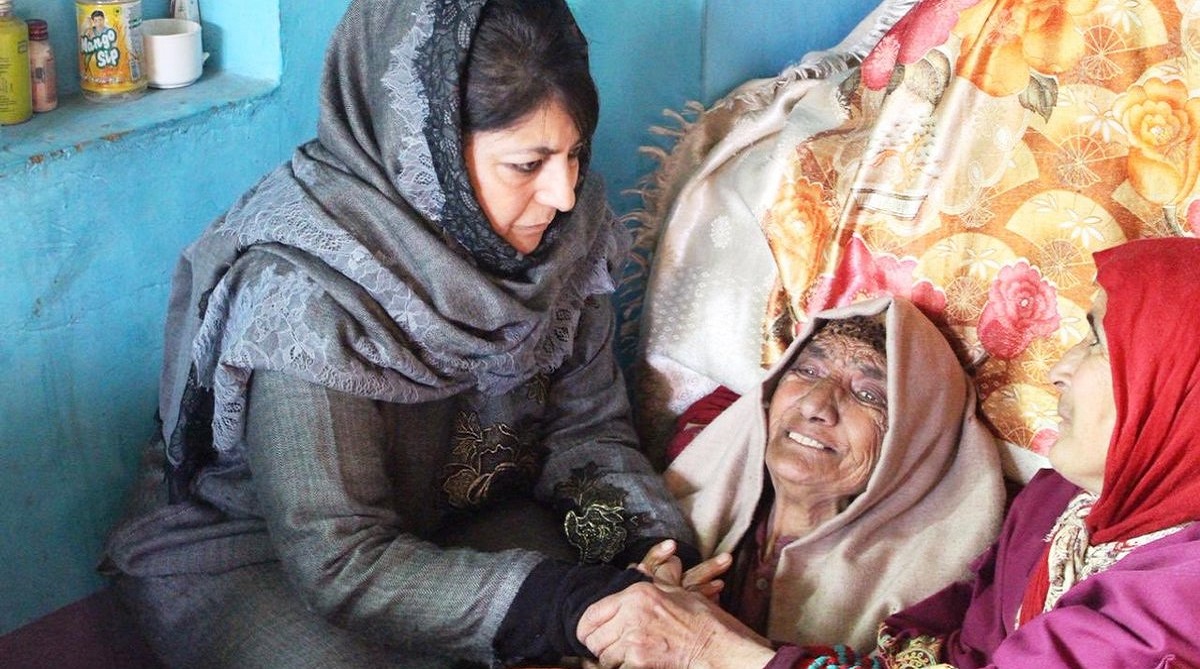
Provoked by Mehbooba Mufti’s visits to families of slain terrorists on the eve of the general elections, the Kashmir-centric political leadership has started churning out their respective formulas to tackle militancy in Jammu and Kashmir.

It is expected that elections for the state assembly might be held simultaneously with that of the Lok Sabha.

The latest to join the chorus is the BJP backed Sajjad Lone who has demanded a policy “laced with dignity” for the return of militants in the mainstream. Lone, who is himself a former separatist, and was a minister in Mehbooba’s government from the quota of BJP, told media persons in Srinagar that the government should take steps for a dignified return of terrorists in the mainstream. However, he did not elaborate his formula.

Mehbooba has come under fire from her rivals who are also trying to placate the terrorists.

The Hizbul Mujahideen (HM) operations commander, Riyaz Naikoo, who is among the most wanted terrorists, has in a video clip asked families of killed militants to “throw Mehbooba out if she comes to their homes.” He appealed to such families not to allow her inside their homes as her hands were soaked with the blood of militants whom she got killed when she was in power.

National Conference leader, Omar Abdullah, was the first to lock horns with Mehbooba with whom he exchanged a series of sarcastic tweets on the issue.

Sympathising with terrorists at the time of elections has become a part of the electoral campaign of the Kashmir-centric political parties. Mehbooba’s father, late Mufti Sayeed, had faced criticism outside the Valley as the first thing he did after becoming the chief minister with the support of BJP in 2015 was to ‘thank the separatists and Pakistan for allowing peaceful elections in J&K.’ He did not have a word of praise for the security forces that performed their duty even in harsh weather to maintain peace during the long-stretched phase wise polling.

Top separatist, Syed Ali Shah Geelani, calls the slain terrorists “martyrs” and publicly offers tributes to them. He is never heard criticising killing of innocent civilians or policemen by terrorists.

Pakistan leadership has also been adding fuel to the fire in Kashmir.

Separatist Mirwaiz Umar Farooq appreciated the recent statement of Pakistan PM Imran Khan on Kashmir during his interaction with Turkish President Recep Tayyip Erdogan.

Turkey has always been a strong supporter of the right to self-determination for the people of Jammu & Kashmir and an active member of the OIC contact group on Kashmir, said the Mirwaiz.

Law of Unintended Consequences

continuously updated blog about China & India

ChiaHou's Book Reviews

continuously updated blog about China & India

What's wrong with the world; and its economy

continuously updated blog about China & India