Chindia Alert: You’ll be Living in their World Very Soon
aims to alert you to the threats and opportunities that China and India present. China and India require serious attention; case of ‘hidden dragon and crouching tiger’.
Without this attention, governments, businesses and, indeed, individuals may find themselves at a great disadvantage sooner rather than later.
The POSTs (front webpages) are mainly 'cuttings' from reliable sources, updated continuously.
The PAGEs (see Tabs, above) attempt to make the information more meaningful by putting some structure to the information we have researched and assembled since 2006.
Prime Minister Narendra Modi on Sunday said that the Andhra Pradesh chief minister N Chandrababu Naidu was so fixated with the rise of his own son that he is creating an atmosphere for the sunset of the state.(Sonu Mehta/HT PHOTO)
Prime Minister Narendra Modi on Sunday said that the Andhra Pradesh chief minister N Chandrababu Naidu was so fixated with the rise of his own son that he is creating an atmosphere for the sunset of the state.
“The chief minister is so fixated with the rise of his own son, he does not realise how his policies and corruption can lead to sunset of the state. To set the son, he’s creating atmosphere for the sunset of the state. His only priority is his own son. He has forgotten about the other sons and daughters of Andhra Pradesh,” Modi said.
Modi was addressing an interaction via video conferencing with BJP’s booth workers in Andhra Pradesh.
In his attack on the Andhra Pradesh chief minister, Modi invoked former Andhra Pradesh chief minister NT Rama Rao and referred to him as the true icon of Telugu pride.
At the same time, he said that this is not the first time that people in power in Andhra Pradesh are cheating people. “Those who have cheated NTR not once, but twice, what do you expect of them?” he said.
“Today those in power in Andhra Pradesh are so desperate to save their power that they betrayed Telugu interests and stabbed NTR in the back, for the second time,” he said, adding, “NTR never forgave Congress for hurting Telugu Pride and its betrayal of Telugu interests.”
“True tribute to NTR and what NTR stood for would be to vote out those who betrayed NTR’s values. Salute NTR’s memories and stand NTR’s legacy,” Modi said.
In a veiled criticism of the Andhra chief minister’s governance, Modi said, “Today I ask you, how is Telugu pride served by one family’s hold on power in AP? How is Telugu pride served by neglecting people and sacrificing their interests for power? How is Telugu pride served by lying and abusing Modi day and night just because you are worried you will lose power. How is Telugu pride served by daydreaming about becoming prime minister when you have failed as a CM.”
“Telugu pride can only be restored when you have respect for all the people of the state just like NTR did. Telugu pride can only be restored when you can speak for all the OBCs, the dalits, and tribals of Andhra Pradesh.
It can only be restored when you put the interests of AP above your own political interests and lust for power,” Modi said.
Modi invoked NTR once again and said that the former chief minister’s “dream of a Swarna Andhra Pradesh will be realized when every citizen of Andhra Pradesh enjoys the fruits of development and not just one family. Swarna Andhra Pradesh will be scripted by the youth power, of all Telugus.”
Image captionHarpreet Kaur wrote to the prime minister, requesting him to change the name of her village
Across the northern Indian states of Haryana and Rajasthan, many villages with “embarrassing” names have been pushing to get them changed for years now. BBC Punjabi’s Arvind Chhabra talks to some of the people who have been leading this campaign.
“My village’s name is Ganda [meaning dirty or ugly in Hindi],” Harpreet Kaur wrote to Prime Minister Narendra Modi in 2016 in an attempt to officially change its name. She added that just the name of the village was enough to prompt humiliating taunts from whomever she met.
“The situation was so bad that even our relatives mock us relentlessly,” she said.
In 2017, Mr Modi directed authorities to change the village’s name. Today, the renamed village of Ajit Nagar stands proudly in the northern Indian state of Haryana.
The village council chief, Lakwinder Ram, said they had been trying for years to get the attention of the government and change the name. “When that didn’t work, we thought that perhaps a young person writing directly to Mr Modi might move him,” he said. “There was not a soul in the village who didn’t want the name to change.”
Locals say that Ganda got its name when a flood ravaged the area decades ago. An officer who visited in the aftermath of the disaster saw all the debris that had been swept in and remarked that it was extremely dirty or “ganda”. Since then, they say, the name just stuck.
Mr Ram added that the name of the village also drove away potential grooms since they did not want a bride from a village that had such a humiliating name. “We are extremely relieved now,” he said.
But Ganda is hardly a unique case.
Representatives from more than 50 villages have pestered the Indian government for a name change in the recent past. The reasons are varied – some names are seen as racist, others were just bizarre and a few more downright embarrassing for its inhabitants.
“The requests of some 40 villages have been accepted and implemented,” Krishan Kumar, a senior federal government official, said.
Among these, is a village called Kinnar which means transgender in Hindi. That became Gaibi Nagar in 2016.
And in the northern Indian state of Rajasthan, a village in Alwar district used to be called Chor Basai. But since the word chor means thief in Hindi, the village’s new name is now just Basai.
Image captionMughalsarai is located about 20km from the holy city of Varanasi in northern India
But the process to get the name of a village changed is not that easy.
To begin with, the state government must be convinced enough to take up the issue with the Indian government, which has the final authority.
But before they can grant the request, the government also has to get clearances from other official units including the railways and postal department as well as the Survey of India. This is to ensure that the new proposed name does not exist anywhere else in the country.
Image captionA sign board in Lula Ahir
For residents of Lula Ahir village in Haryana state – a derogatory term for a disabled person in Hindi- the process has been fraught with bureaucracy. They first wrote to the state government in 2016, unhappy with the village name.
“We wanted to change the name to Dev Nagar,” village council chief Virender Singh said.
They waited for a response for six months – only to receive a rejection letter since a village named Dev Nagar already exists somewhere else in the country.
Back at the drawing board, the village council decided to try once again with another name – Krishan Nagar. “We wrote to the administration again and kept following it up with them,” Mr Singh said. “But it just went from one department to another.”
In July, they thought their luck had changed when the state’s chief minister announced that the village had a new name. Instead, they found out that the decision hadn’t been formally implemented by the central government yet. Officials confirmed that the request is still “under process”.
“We have just been waiting and waiting ever since,” Mr Singh said with a shrug.
Speaking at a public rally in Jharkhand, PM Narendra Modi said loan waiver to farmers would have been an easier choice for the government if it only wanted their votes.
Ramnagar: Prime Minister Narendra Modi addresses during the Vijay Sankalp Samaroh at Ramnagar, in Silchar, Friday, Jan 4, 2019. (PTI Photo) (PTI1_4_2019_000203A)(PTI)
Prime Minister Narendra Modi launched a scathing attack on the Congress over its loan waiver promises in the recent state elections, accusing the party of misleading farmers.
“Farmers are a vote bank for the Congress but for us, farmers are our food providers. This is the difference between the Congress and the BJP,” the prime minister said.
Modi said that after being voted to power in 2014, the government has focused on reviving irrigation projects. “We launched the Prime Minister Irrigation Scheme. We revived 99 irrigation projects that were pending for 30-40 years…We are spending about Rs 90,000 crore on these projects.”
Also watch: PM Modi says Congress’ farm loan waiver not effective, farmers must be empowered
“Had I only wanted the votes of farmers, I could have also doled out Rs 1 lakh crore as loan waiver. It would have been easier. But we did not go for that…We are trying to change the old system,” he said.
PM Modi did not explicitly refer to the Congress’s loan waiver promises in the recent assembly elections in Rajasthan, Madhya Pradesh and Chhattisgarh. But the criticism of the Congress’s loan waiver promises, in these three states and elsewhere, has been a running theme in the prime minister’s speeches over the last few weeks.
The Congress, which snatched the three Hindi heartland states from the BJP in the state elections, says it has started delivering on its promise for a waiver of farm loans up to Rs 2 lakh. PM Modi has, in his recent speeches, made pointed references to the Congress’s track record on farm waivers and asserted that it wasn’t the farmers really, who benefited.
Speaking in Uttar Pradesh’s Ghazipur on December 29, PM Modi said, “They promised ‘loan lollipop’ to lakhs of farmers but waived off loans of merely a handful of them…Under the new (Congress) governments in Madhya Pradesh and Rajasthan, we can already see long queues of farmers seeking fertilizers and urea. They were also lathicharged. Those who do black marketing have come into play.”
Referring to Karnataka, PM Modi said, “While they managed to form the government through backdoor, they actually waived off loans of merely 800 farmers.”
In Jharkhand’s Palamu where PM Modi laid foundation stones for some projects, PM Modi pointed how no government in the past had bothered to start construction of the Uttar Koel dam that he said, could change the lives of the farmers in the region.
Mallya now becomes the first tycoon to be named an economic offender under the Fugitive Economic Offenders Act, 2018 – the new law that aims to prevent financial fraud.
SNS Web | New Delhi | January 5, 2019 3:54 pm
A special PMLA court on Saturday declared Vijay Mallya a fugitive economic offender paving the way for the government to confiscate his assets.
Mallya now becomes the first tycoon to be named an economic offender under the Fugitive Economic Offenders Act, 2018 – the new law that aims to prevent financial fraud.
The Special PMLA Court refused Mallya’s application to stay the order to give him some time to appeal. The request to declare Mallya a fugitive offender under the Act was filed by the Enforcement Directorate (ED) before the court in November 2018.
According to the Fugitive Economic Offenders Act, 2018, a “fugitive economic offender” means any individual against whom a warrant for arrest in relation to a Scheduled Offence has been issued by any Court in India, who has left India so as to avoid criminal prosecution or being abroad, refuses to return to India to face criminal prosecution.
The law was signed by the President in August 2018.
The special PMLA court will hear the case on the confiscation of the properties on 5 February.
On 10 December last year, London’s Westminster Magistrates’ Court ordered the extradition of the liquor baron to India, where the now defunct Kingfisher Airlines boss is wanted for alleged in financial irregularities and loan default amounting to an estimated Rs 9,000 crores.
Chief Magistrate Judge Emma Arbuthnot ruled that that there was “no sign of a false case being mounted against him”.
Mallya is wanted for loan default worth around Rs 9,000 crore to a consortium of 13 banks led by State Bank of India (SBI). He faces various charges brought by Central Bureau of Investigation (CBI) and the Enforcement Department (ED).
The 62-year-old has been on bail since his arrest on an extradition warrant in April last year, and the high-profile extradition trial had been going on since 4 December last year. A series of hearings have taken place in the last more than a year, though only seven days had been initially earmarked for it.
Following the UK court’s decision, the SBI had said that Mallya’s extradition to India will speed up the recovery of the loan amount.
“It (higher recovery of loans) is a possibility. The message is very loud and clear. What we have to understand is that it (extradition) is a message that you just can’t default and run away from the country,” SBI chairman Rajnish Kumar had told reporters in Mumbai.
In the world’s largest democracy, politicians are finding that they need to listen to women if they want power.
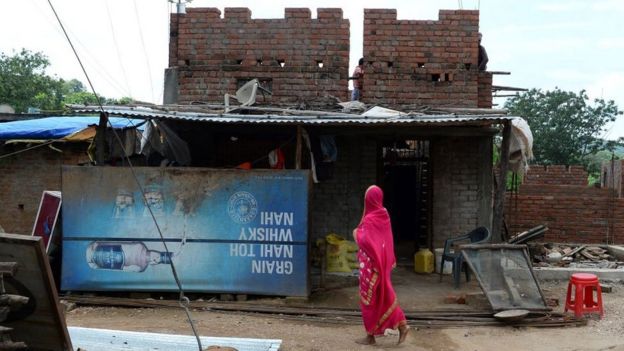
In northern India, some women had long complained that they were fed up with their husbands being drunk.
An alcohol ban brought in at their request has affected 100 million people in the state of Bihar.
The domestic violence, petty crime and wasted income that had long plagued their region fell soon afterwards, the state government claims.
Women-centric campaigns are playing an even bigger role in India’s upcoming national election, in a country of 1.3bn people.
Politicians offering free girls’ education, money to newlywed brides, and special women’s police stations scored highly in the recent regional polls.
The reason? In India’s male-dominated, conservative society, women voters are rapidly gaining ground.
Women voters
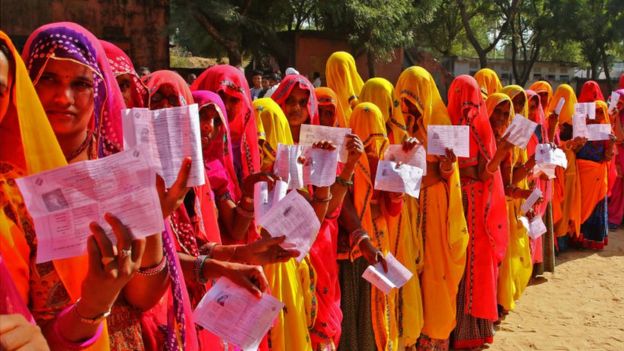
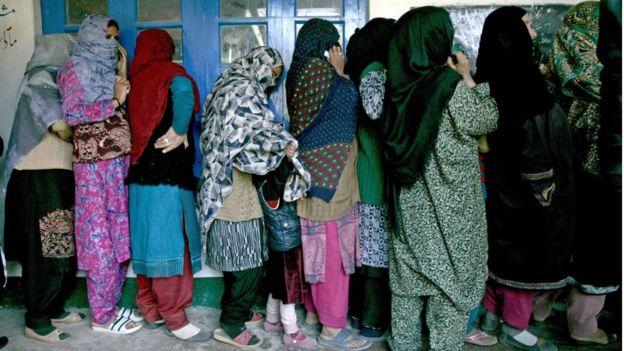
Image copyrightGETTY IMAGESImage captionWomen queue with their identity cards at the state elections in Rajasthan, December 2018
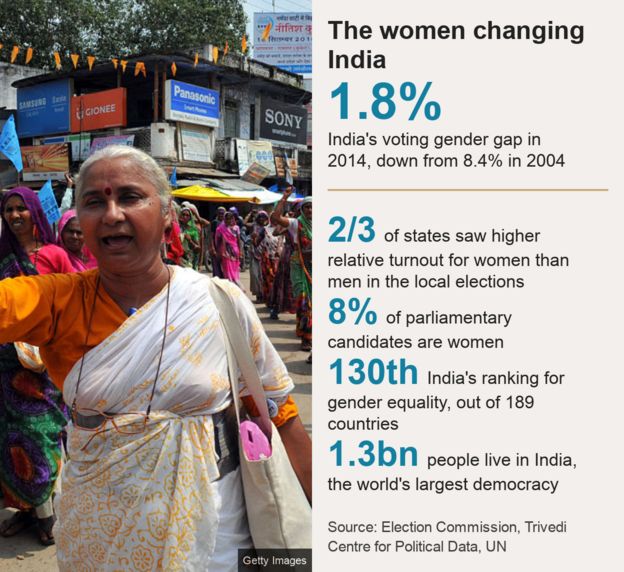
Ranked in the bottom third of countries for gender equality, India has long struggled to get women to the ballot box.
There are a number of reasons for this.
The gender gap in voting is partly because women traditionally have been less likely to register in the first place.
Even if they are registered, the idea of women leaving the household to vote is sometimes frowned upon, and they can face harassment and intimidation at the polls.
For decades, registered women voters’ turnout in elections lagged behind men’s by an average of 6-10%, reflecting their marginalisation in society and giving them less opportunity to shape policy.
There are also fewer women to start with. Sex-selective abortions, female infanticide and preferential treatment for boys in India, mean that there are only 943 women for every 1,000 men in the population.
However, one study found the police resources needed to enforce the alcohol ban meant there was less capacity to deal with violent crime.
Why are more women voting?
What has caused the sudden political mobilisation of women across India?
Increased female literacy and education have certainly brought more women to the polls.
But while progress on those measures has been slow, female voter turnout has shot up in just a decade.
A combination of personal factors and government intervention is likely to have contributed.
High-profile cases of violence against women have undoubtedly galvanised female voters to fight for rights and safety in their communities.
Image copyrightGETTY IMAGES
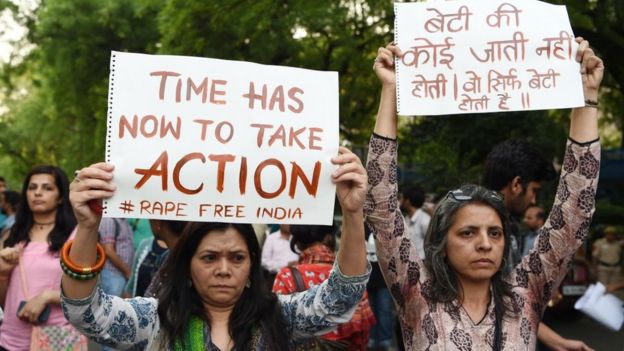
Protests erupted across the country earlier this year after rape cases in Uttar Pradesh, Jammu and Kashmir, and other states made headlines, while the #MeToo movement took hold from the autumn.
The Election Commission of India (ECI) is trying to tackle the violence and intimidation faced by women going to the polls.
It has tried to improve security at India’s more than 900,000 polling booths, meaning women can now vote in relative safety.
The ECI has also experimented with setting up separate women-only queues on election day, and establishing polling stations run entirely by women.
A groundbreaking general election
In 2019, voter turnout may be higher for women than men for the first time in an Indian national election.
This trend has many implications, not only for how politicians campaign, but also how they govern.
Since coming to power in 2014, Prime Minister Narendra Modi has made no secret of his desire to appeal to women voters.
Image copyrightGETTY IMAGES
For instance, he has introduced a scheme to provide cooking gas cylinders to millions of Indian households. His party claims this will stop women from breathing in harmful smoke or spending hours collecting fuel.
Another scheme aims to provide every household with a bank account. At least half of newly-opened accounts are registered to women, who have historically lacked access to modern banking.
Looking to the future
The path to female empowerment in India has been slow and prone to setbacks.
In politics, women make up just eight per cent of parliamentary candidates and only 11.5 per cent of eventual winners.
This may change. Women’s activism is putting pressure on political parties to pass the Women’s Reservation Bill, guaranteeing one-third of Parliamentary seats for women.
Similar quotas already exist in local-level politics, creating a “pipeline” of women running for high-level office.
Image copyrightGETTY IMAGESImage captionWomen cast their votes in the state of Jammu and Kashmir
With more women in charge, India’s political establishment would look much more like the population it represents.
Electing more women may benefit the country in unexpected ways as well: recent research links female politicians to higher growth and less corruption.
While gender equality in the world’s largest democracy is a long way off, the influence of women at the ballot box and in the corridors of power is already having a clear impact.
GUWAHATI, India (Reuters) – Indian rescuers trying to reach a group of miners trapped in a remote and illegal “rat-hole” coal mine are struggling to pump out water from the 370-foot-deep pit, further dimming their chances of survival more than three weeks into their ordeal.
The slow progress in the rescue efforts in the northeastern state of Meghalaya has been contrasted with the dramatic rescue of 12 Thai boys and their football coach from a flooded cave in July last year, which drew a massive international audience.
The mine became flooded after at least 15 miners went down the narrow pit on Dec. 13. Rat-hole mines killed thousands of workers in Meghalaya before India’s environmental court banned the practice in early 2014.
Many mines continued operation, despite the ban, requiring workers, often children, to descend hundreds of feet on bamboo ladders and dig coal out of narrow, horizontal seams.
“We are continuously engaged in our efforts but the terrain and conditions out here are extremely difficult,” Santosh Kumar Singh, an assistant commandant with the National Disaster Response Force (NDRF), told Reuters from the site.
Navy divers and NDRF personnel had not been able to reach the trapped miners, he said.
Rescuers are now placing their hopes on a huge pump from state miner Coal India Ltd that is being installed on a concrete platform near the mine.
One dead in Thailand as tropical storm uproots trees
India’s Supreme Court on Friday ordered the federal government and Meghalaya to file a report by Monday on the rescue operation. Meghalaya told the court on Thursday that nearly 86 people had been working on the rescue effort.
At its peak, the state produced coal worth $4 billion a year, or about a tenth of India’s total production.
While the Thailand drama got round-the-clock international media coverage, the trapped miners in Meghalaya are getting very little attention, even within India.
“Whole media, government and us, the common people, have completely ignored them,” one Twitter user, Rahul Sribastab, wrote. “The government, opposition and media have failed us.”
The Allahabad High Court had in 2010 trifurcated the disputed site, giving one portion each to Ram Lalla, Nirmohi Akhara and the original Muslim litigant.
SNS Web | New Delhi | January 4, 2019 12:21 pm
The Supreme Court on Friday set the date for hearing on the title suit in the Ayodhya case for 10 January.
A bench of Chief Justice Ranjan Gogoi and Justice Sanjay Krishan Kaul said that an appropriate bench will hear a batch of cross petitions challenging the 2010 Allahabad High Court judgment on the Ram Janmabhoomi-Babri Masjid land dispute title case and will decide the future course of the hearing.
The Allahabad High Court had in 2010 trifurcated the disputed site, giving one portion each to Ram Lalla, Nirmohi Akhara and the original Muslim litigant.
“Further orders will be passed by an appropriate bench on 10 January for fixing the date of hearing the matter,” the bench said on Friday.
The apex court also dismissed a PIL filed by an advocate Harinath Ram in November 2018 seeking to hear the Ayodhya matter on urgent and day to day basis.
Reacting to the development National Conference leader Farooq Abdullah said that the case should not have gone to the court and that Lord Ram belongs to the world.
“This(Ayodhya) issue should be discussed and sorted out across the table between people. Why to drag the issue to the Court? I am sure it can be resolved through dialogue. Lord Ram belongs to the whole world, not just Hindus,” he was quoted as saying by ANI.
The top court had on October 29 fixed the Ram Janmabhoomi-Babri Masjid land dispute cases for the first week of January next year before an appropriate bench.
On 12 November, the apex court had declined early hearing of petitions in the Ram Janmabhoomi-Babri Masjid title dispute case.
“We have already passed the order. The appeals are coming up in January. Permission declined,” the bench said while rejecting the request of early hearing of lawyer Barun Kumar Sinha, appearing for the Akhil Bharat Hindu Mahasabha.
The Supreme Court in a 2:1 verdict in October, declined to refer to a five-judge Constitution bench the issue of reconsideration of the observations in its 1994 judgement that a mosque was not integral to Islam that arose during the hearing of Ayodhya land dispute.
Clamour for a legislation to pave the way for the construction of the temple has since gained prominence.
But in an interview with ANI on 1 January 2019, Prime Minister Narendra Modi ruled out bringing an ordinance on the construction of Ram temple in Ayodhya before the judicial process is over.
“We have said in our party manifesto that a solution would be found to this issue under the ambit of the Constitution,” the Prime Minister said about the Ram temple issue in his interview to ANI.
He also suggested that the judicial process was being slowed down because of obstacles being created by the Congress in the Supreme Court – a charge he had levelled during one of the rallies in Rajasthan ahead of the elections in the state.
The two women had tried to enter the temple once before, in December, but were prevented from doing so by protesters.
Image copyrightGETTY IMAGESImage captionThe entry of two women into the Sabarimala temple sparked violent protests in Kerala
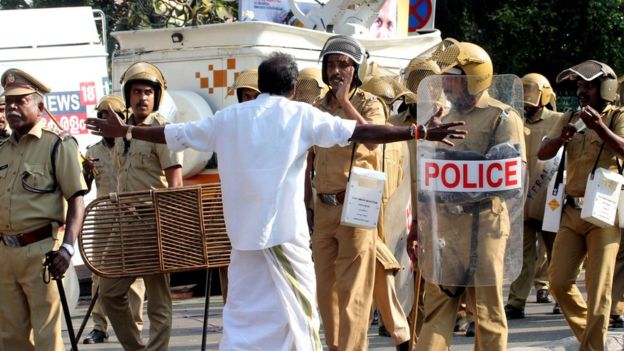
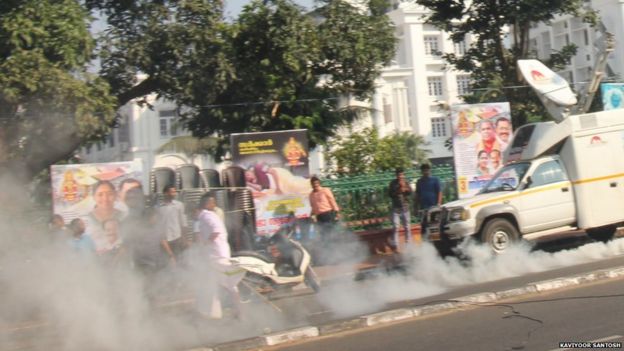
As news of their entry into the temple spread, violence broke out in several cities and towns as groups of protesters clashed with police, who fired tear gas to disperse crowds.
Police told news agency AFP that at least 15 people were injured after protesters hurled stones at them.
The Supreme Court decision to let women worship at the Sabarimala shrine came after a petition argued that the custom banning them violated gender equality.
But India’s ruling party, the Hindu nationalist Bharatiya Janata Party (BJP), has argued that the ruling is an attack on Hindu values.
The issue has become increasingly contentious in the run-up to India’s general election, scheduled for April and May. Critics have accused Prime Minister Narendra Modi of pursuing a religiously divisive agenda to court the BJP’s mostly-Hindu support base.
Hinduism regards menstruating women as unclean and bars them from participating in religious rituals – but most temples allow women to enter as long as they are not menstruating, rather than banning women in a broad age group from entering at all.
Image copyrightKAVIYOOR SANTOSHImage captionPolice used tear gas to break up protests
Protesters have consistently argued that the court ruling goes against the wishes of the temple’s deity, Lord Ayappa.
They say that the ban on women entering Sabarimala is not about menstruation alone – it is also in keeping with the wish of the deity, who is believed to have laid down clear rules about the pilgrimage to seek his blessings.
According to the temple’s mythology, Lord Ayyappa is an avowed bachelor who has taken an oath of celibacy and hence, women of a certain age are not allowed into the temple.
Two other women had managed to reach the temple’s premises in October, with more than 100 police protecting them from stone-throwing protesters as they walked the last 5km stretch to the shrine. But they were forced to turn around after a stand-off with devotees, just metres from Sabarimala’s sanctum.
NEW DELHI (Reuters) – India’s Supreme Court on Thursday ordered the government to list the steps it plans for the rescue of at least 15 miners trapped in a so-called “rat-hole” coal mine for three weeks in a remote hilly state, warning that “every second counts”.
The workers were ensnared on Dec. 13 when the illegal mine in the northeastern state of Meghalaya was flooded. Rescuers have so far only been able to find three helmets and two axes underground.
The country’s top court wondered why attempts to reach the miners had not yet been successful.
“Tell us by tomorrow, because for people who are trapped, every second counts,” Justice Arjan Kumar Sikri told the federal government, represented by Solicitor-General Tushar Mehta.
The Meghalaya government told the court that nearly 86 people were working on the rescue effort since Dec. 14, including employees of state-controlled Coal India Ltd, the world’s biggest miner of the fuel.
Kyrmen Shylla, Meghalaya’s disaster management minister, told Reuters both government and private agencies had been involved in the bid to reach the miners, many of whose family members have given up hope.
Rat-hole mining has killed thousands of workers in Meghalaya, including children, before India’s environmental court banned the practice in early 2014.
At its peak, the state produced coal worth $4 billion a year, or about a tenth of India’s total production.
Despite the ban, many mines continued operatihere, requiring workers, often children, to descend hundreds of feet on bamboo ladders and dig coal out of narrow, horizontal seams.
The unsuccessful rescue bid has drawn criticism of a lack of urgency shown by government agencies, particularly given the remote location of the mine, a journey to which can take more than five hours from the nearest commercial airport in Guwahati.
“Would we have cared more if the miners had not been at the fringes of national consciousness in the northeast?” senior journalist Vir Sanghvi asked on Twitter.
“I have not given up hope, but our response to this crisis shames us as a nation.”
Police intervene as members of Sabarimala Karma Samithi try to disrupt a celebratory meeting after two women entered Sabarimala Ayyapa temple, at the High Court Junction in Kochi in the Indian state of Kerala on January 2, 2019(AFP)
More than 100 people, including 38 policemen, were injured on Thursday as a shutdown to protest against the Kerala government for helping two women enter the Sabarimala temple turned violent at several places in the state.
In Thrissur, four workers of the BJP were stabbed while enforcing the shutdown call by Sabarimala Karma Samithi, an umbrella organisation of various pro-Hindutva groups, spearheading protests against the Supreme Court’s September 28 verdict, and Antarrashtriya Hindu Parishad (AHP).
The Bharatiya Janata Party is supporting the shutdown while the Congress-led UDF is observing a “black day” on Thursday. (Live updates)
Police in Pandalam, Kozhikode, Kasargode and Ottapalam baton charged at protesters as several party offices and houses were attacked throughout the state. In Kozhikode, police used tear gas to disperse protesters who tried to enforce the 12-hour shutdown.
New agency AFP reported journalists were assaulted in Palakkad during a march organised by the BJP and the Rashtriya Swayamsevak Sangh (RSS), the ideological mentor of Prime Minister Narendra Modi-led party.
The shutdown forced the state to a standstill as shops and other small businesses were closed in many places. Most bus services were halted and taxis were refusing to take passengers as some drivers, who said they feared they could be attacked.
Various universities, including Kerala, Mahatma Gandhi, Calicut and Kannur have deferred their examinations scheduled for Thursday.
It was the first time that women aged between 10 and 50 had set foot in the gold-plated temple nestled in a tiger reserve since the Supreme Court in September last year ordered the lifting of the ban on women of menstruating age entering the hilltop shrine.
The temple has refused to abide by the ruling and subsequent attempts by women to visit it had been blocked by thousands of angry devotees.
Bindu Ammini and Kanakadurga dressed in all black were escorted by police into the temple through a side gate early on Wednesday, catching the devotees off guard. The temple priests closed the shrine dedicated to the celibate Lord Ayyappa for purification rituals and protests against the women entering the temple erupted quickly.
A 55-year-old activist of the Samithi died after he was injured during a stone pelting incident in Pathanamthitta on Wednesday. Others have also been injured.
Kerala chief minister Pinarayi Vijayan defended helping the two women in gaining entry to the Sabarimala temple as he accused the Sangh Parivar of trying to incite trouble in the state.
Also watch: Two women below the age of 50 enter Sabarimala Temple
Vijayan said during a press conference it was his government’s constitutional obligation to help the two women and warned that troublemakers will be dealt with sternly.
“The Sangh Parivar is trying to sabotage the Supreme Court verdict. The real devotees are not against the verdict,” the chief minister said.
“Kanakadurga and Bindu were given protection after they sought security to visit the shrine. They were not airdropped. They visited shrine like normal devotees. None of the devotees protested,” he told reporters.
The BJP and held the chief minister responsible for the violence.