Archive for ‘India alert’

06/01/2017

The high economic costs of India’s demonetisation | The Economist

MOST economists might hazard a guess that voiding the bulk of a country’s currency overnight would dent its immediate growth prospects. On November 8th India took this abstruse thought experiment into the real world, scrapping two banknotes which made up 86% of all rupees in circulation. Predictably, the economy appears indeed to have been hobbled by the sudden “demonetisation”. Evidence of the measure’s costs is mounting, while the benefits look ever more uncertain.

At least the new year has brought a semblance of monetary normality. For seven weeks queues had snaked around banks, the main way for Indians to exchange their old notes for new ones or deposit them in their accounts. That is over, largely because the window to exchange money closed on December 30th. The number of fresh notes that can be withdrawn from ATMs or bank counters is still curtailed, but the acute cash shortage is abating, at least in big cities.

As data trickle through, so is evidence of the economic price paid for demonetisation. Consumers, companies and investors all wobbled in late 2016. Fast-moving consumer goods, usually a reliable growth sector, retrenched by 1-1.5% in November, according to Nielsen, a research group. Bigger-ticket items seem to have been hit harder. Year-on-year sales at Hero Motocorp, the biggest purveyor of two-wheelers, slid by more than a third in December.AdvertisementA survey of purchasing managers in manufacturing plunged from relative optimism throughout 2016 to the expectation of mild contraction. Firms’ investment proposals fell from an average of 2.4trn rupees ($35bn) a quarter to just 1.25trn rupees in the one just ended, according to Centre for Monitoring Indian Economy, a data provider. As a result, corporate-credit growth, already anaemic, has reached its lowest rate in at least 30 years (see chart).

All this amounts to “a significant but not catastrophic” impact, says Shilan Shah of Capital Economics, a consultancy. Annual GDP growth forecasts for the fiscal year ending in March have slipped by around half a percentage point, to under 7%, from an actual rate of 7.3% in the last full quarter before demonetisation. Other factors, such as the rise in the oil price and the surge in the value of the dollar after the election of Donald Trump, are also at play.

Whether the costs of the exercise justify the benefits depends, of course, on what those benefits are. In his speech announcing the measure, Narendra Modi, the prime minister, highlighted combating corruption and untaxed wealth. Gangsters and profiteers with suitcases full of money would be left stranded. But reports suggest that nearly 15trn rupees of the 15.4trn rupees taken out of circulation are now accounted for. So either the rich weren’t hoarding as much “black money” as was supposed, or they have proved adept at laundering it. The Indian press is full of tales of household staff paid months in advance in old notes, or of bankers agreeing to exchange vast sums illegally.

Fans of demonetisation point to three beneficial outcomes.

First, banks, laden with fresh deposits, will lend this money out and so boost the economy. Big banks cut lending rates this week (quite possibly nudged by government, the largest shareholder of most of them). But their lending recently has not been constrained by a lack of deposits, so much as by insufficient shareholder capital to absorb potential losses, and by the over-borrowed balance-sheets of many industrial customers.

Second, Indians will move from living cash in hand into the taxed formal economy. Mr Modi has recently promoted the idea of a cashless, or “less-cash”, India (not something mentioned at the outset), as one reason for demonetisation. Progress towards getting Indians to pay for things electronically is indeed being made, but from an abysmally low base.

The third upshot is the most controversial. Now that the demonetised bank notes are worthless, the government is intent on in effect appropriating the proceeds. The procedure requires trampling on the credibility of the Reserve Bank of India (RBI), the central bank, which must first agree to dishonour the promise, on all banknotes, to “pay the bearer” the value. If it does so, “extinguishing” the notes and its liability for them, it can transfer an equivalent amount to the government budget.

With so much cash handed in at banks, the amount remitted to government by the RBI might amount to perhaps 0.2-0.3% of GDP. Proceeds from a tax-amnesty scheme for cash-hoarders may swell the figure. Even so, it will not be enough to justify the costs of demonetisation—or even, perhaps, the damage to the reputation of the RBI, which is already facing questions about its independence. But having imposed the costs, Mr Modi will be keen to trumpet whatever benefits he can find.

Source: The high economic costs of India’s demonetisation | The Economist
04/01/2017

India’s double first in climate battle – BBC News

Two world-leading clean energy projects have opened in the south Indian state of Tamil Nadu.

A £3m industrial plant is capturing the CO2 emissions from a coal boiler and using the CO2 to make valuable chemicals. It is a world first.

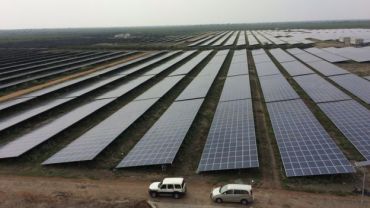
And just 100km away is the world’s biggest solar farm, making power for 150,000 homes on a 10 sq km site.

The industrial plant appears especially significant as it offers a breakthrough by capturing CO2 without subsidy.

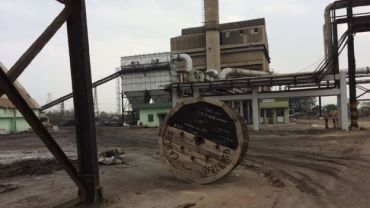
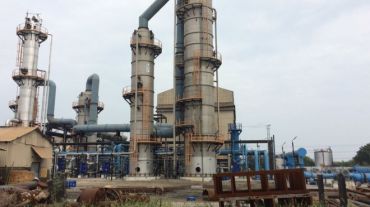
Built at a chemical plant in the port city of Tuticorin, it is projected to save 60,000 tonnes of CO2 emissions a year by incorporating them into the recipes for baking soda and other chemicals.

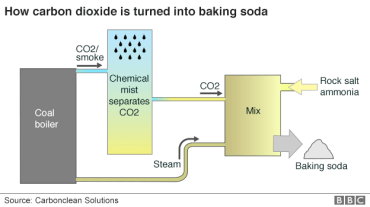
Here’s how it works:

The plant operates a coal-fired boiler to make steam for its chemical operations.CO2 emissions from the boiler’s chimney are stripped out by a fine mist of a new patented chemical.

A stream of CO2 is fed into the chemicals plant as an ingredient for baking soda and other compounds with many uses, including the manufacturing of glass, detergents and sweeteners.

Zero emissions

The owner of the chemicals plant, Ramachadran Gopalan, told a BBC Radio 4 documentary: “I am a businessman. I never thought about saving the planet. I needed a reliable stream of CO2, and this was the best way of getting it.”

He says his operation has now almost zero emissions. He hopes soon to install a second coal boiler to make more CO2 to synthesise fertiliser.

The chemical used in stripping the CO2 from the flue gas was invented by two young Indian chemists. They failed to raise Indian finance to develop it, but their firm, Carbonclean Solutions, working with the Institute of Chemical Technology at Mumbai and Imperial College in London, got backing from the UK’s entrepreneur support scheme.

Their technique uses a form of salt to bond with CO2 molecules in the boiler chimney. The firm says it is more efficient than typical amine compounds used for the purpose.

The plant is projected to save 60,000 tonnes of CO2 emissions a year

They say it also needs less energy, produces less alkaline waste and allows the use of a cheaper form of steel – all radically reducing the cost of the whole operation.

The firm admits its technology of Carbon Capture and Utilisation won’t cure climate change, but says it may provide a useful contribution by gobbling up perhaps 5-10% of the world’s emissions from coal.

Lord Oxburgh, former chairman of Shell, and now director and head of the UK government’s carbon capture advisory group, told the BBC: “We have to do everything we can to reduce the harmful effects of burning fossil fuels and it is great news that more ways are being found of turning at least some of the CO2 into useful products.”

Solar farm

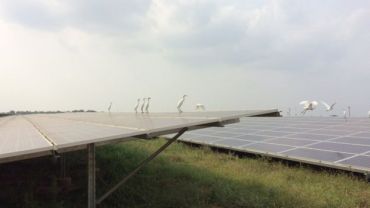
Meanwhile, the nearby giant Kamuthi solar plant offers a marker for India’s ambition for a rapid expansion in renewables.

The world’s largest solar farm at Kamuthi in southern IndiaIt is truly enormous; from the tall observation tower, the ranks of black panels stretch almost to the horizon.Prime Minister Modi is offering subsidies for a plan to power 60 million homes with solar by 2022 and aims for 40% of its energy from renewables by 2030.

For large-scale projects, the cost of new solar power in India is now cheaper than coal. But solar doesn’t generate 24/7 on an industrial scale, so India has adopted a “more of everything” approach to energy.

The firm behind the solar plant, Adani, is also looking to create Australia’s biggest coal mine, which it says will provide power for up to 100 million people in India. Renewables, it says, can’t answer India’s vast appetite for power to lift people out of poverty.

Will India stick to its renewables promises with Donald Trump as US president?And questions have been raised recently as to whether India will stick to its renewables promises now President-elect Donald Trump may be about to scrap climate targets for the US.

At the recent Marrakech climate conference, China, the EU and many developing countries pledged to forge ahead with emissions-cutting plans regardless of US involvement. But India offered no such guarantee.

Some environmentalists are not too worried: they think economics may drive India’s clean energy revolution.

Source: India’s double first in climate battle – BBC News

31/12/2016

5 Billionaire Families From India’s Powerful Parsi Minority – Briefly – WSJ

India’s Parsis are one of the most successful minority and migrant groups in the world. They make up less than 0.005% of India’s population but three out of the country’s top 10 billionaires.They fled Iran and settled in India in the 10th century and have since played an outsized role in the evolution of India’s economy as pioneers of trade and industry.

For centuries, prominent Parsis have shared their success through philanthropy – their religion encourages wealth creation as well as charity–so the names of top Parsi traders and industrialists are plastered on the hospitals, schools, libraries and streets of Mumbai and other cities.

A Wall Street Journal article looks at how the battle for control of the $100 billion Tata Group–which was founded and headed by Parsis – has caused a lot of stress and soul searching in the proud community. Three of the richest Parsi families – the Tatas, the Mistrys and the Wadias – are involved in the unusually ugly and public brawl which has now shifted to the courts.

Here are snapshots of those three Parsi families and two others that have made billions building the backbone of Indian industry.

1 Tata Head: Ratan Tata

Net worth:  $570 Million

Established: 1868

Industries: Software, steel, autos, hospitality, airlines

Companies: Tata Consultancy Services, Tata Motors, Jaguar Land Rover, Tetley Tea

2 Mistry Head: Pallonji Mistry (father of Cyrus Mistry)

Net worth:  $15 billion

Established: 1865

Industries: Property development, construction, energy

Companies: SP Real Estate, SP Infra, Eureka

3 Wadia Current leader: Nusli Wadia

Net worth:  $3 billion

Established: 1736

Industries: Textiles, property, food, health

Companies: Bombay Dyeing, Britannia, Go Airlines

4 Godrej Current leader: Adi Godrej

Net worth: $12 billion

Established: 1897

Industries: Consumer durables, retail, property

Companies: Godrej Consumer Products, Godrej Properties, Gorej Industries

5 Poonawalla Head: Cyrus Poonawalla

Net worth: $12 billion

Established: 1966

Industries: Biotech, vaccines

Companies: Serum Institute of India, Poonawalla Stud Farms

Source: 5 Billionaire Families From India’s Powerful Parsi Minority – Briefly – WSJ

Tags:
22/12/2016

Are India and Pakistan set for water wars? – BBC News

India is stepping up efforts to maximise its water use from the western rivers of the Indus basin, senior officials have told the BBC.

The move would involve building huge storage facilities and canals.

The three rivers flow through Indian-administered Kashmir but most of the water is allotted to Pakistan under an international treaty.

Experts say Delhi is using the water issue to put pressure on Pakistan in the dispute over Kashmir.Relations have deteriorated since a deadly militant attack on an Indian base in September. Pakistan denies any link to the attack.

Why India’s water dispute with Pakistan matters

Kashmir: Why India and Pakistan fight over it

Kashmir profiled

Indian Prime Minister Narendra Modi has said a government taskforce is finalising details of the water project, which he has made a priority.

“The ball has started rolling and we will see some results soon, most of them will be about building new storages in the basin,” one top official said on condition of anonymity.

Another senior official said: “We are quite familiar with the terrain as we have already built a number of structures there.

But he added: “We are talking about few years here.

“How much water is at stake?

India wants to “maximise” its use of water from the Indus, Chenab and Jhelum rivers. Millions of people in both countries depend on water in the rivers.

An official with India’s water resources ministry insisted that this action would be “well within” the terms of the Indus Water Treaty (IWT).

India began reviewing the treaty after the militant attack in Indian-administered Kashmir in September in which 19 soldiers were killed.Delhi accused Islamabad of being behind the attack and relations have plummeted, leading to a rise in cross-border tensions.

The IWT was signed in 1960 and allocated the three eastern rivers – the Ravi, Beas and Sutlej – of the Indus basin to India, while 80% of the three western ones – the Indus, Jhelum and Chenab – was allotted to Pakistan.

India says it has not fully utilised the 20% of water given to it in the three western rivers. Pakistan disputes this.

Officials in Delhi said the IWT allows India to irrigate 1.4 million acres of land using water from those rivers.

But they say only 800,000 acres are irrigated at present.

They added that the building of hydropower projects would also be accelerated.

India currently generates around 3,000MW of hydroelectricity from the western rivers, but the Indus basin is said to have a potential of nearly 19,000 MW.

How safe is the water treaty?


Pakistan is watching India’s moves closely.

India shares a heavily militarised international border with Pakistan

Speaking in an open debate of the United Nations Security Council on “water, peace and security” last month, Pakistan’s ambassador to the UN, Maleeha Lodhi, denounced any use of water as an “instrument of coercion and war”.

“The IWT is equally a good case study of what could go wrong if such agreements are not honoured or threatened by one of the state parties to be abrogated altogether.

“Water experts say the treaty seems to have at least survived because India is not talking about withdrawing from it.

But, they believe, maximising use of water from the western rivers in the Indus basin can still fuel tensions.

Islamabad is already unhappy with some of India’s existing water projects.It has asked the World Bank, which brokered the signing of the treaty between the two countries, for a court of arbitration to consider two Indian hydropower projects in the Indus basin.

India has objected to this move, prompting the bank to pause the dispute process while it tries to persuade the two countries to resolve their disagreements, fearing that otherwise the treaty itself could be in peril.

In 1987, Delhi suspended the Tulbul navigation project on the Jhelum river after Pakistan objected to it.But sources within India’s Water Resources Ministry say this project could now be revived.

“The decision to review the suspension signalled the Modi government’s intent to revive it irrespective of Pakistan’s protests,” the Times of India newspaper wrote.

“As an implication, India gets to control Jhelum water, impact Pakistan’s agriculture.

“What else could India do?

Some experts say India could also demand a review of the IWT.

“The review can be used to demand more rights over the western rivers,” says Himanshu Thakkar, a regional water resources expert with South Asian Network on Dams, Rivers and People.

Some water resources analysts believe Delhi will also have to be mindful of China before making any major move.

In September, Tibet blocked a tributary of the Yarlung Zangbo river (known as the Bramhaputra in India) as part of its most expensive hydro project, Chinese state-run news agency Xinhua reported.

The news came just when Indian media were suggesting that Delhi could pull out of the IWT.

“We need to remember that China is an upper riparian country in Indus and Bramhaputra basins and it is also Pakistan’s closest ally,” said Mr Thakkar.

Many experts agree that completing such huge and complex infrastructure projects may not be as swift as some Indian officials suggest.

Source: Are India and Pakistan set for water wars? – BBC News

21/12/2016

Your feedback much appreciated – revised

imgresI’ve been posting on this website for several years and have had over 70,000 visits from 181 countries and nearly 500 regular followers.  I would like your feedback. It will only take 5 minutes of your time.  Pls go to:

https://www.surveymonkey.co.uk/r/5MJZ5G9.

Many thanks in anticipation.

Tags: ,
16/12/2016

China upset as Dalai Lama meets President Pranab Mukherjee | Reuters

China expressed dissatisfaction on Friday after exiled Tibetan spiritual leader the Dalai Lama met President Pranab Mukherjee, saying it hoped India would recognise the Nobel Peace Prize winning monk as a separatist in religious guise.

Mukherjee hosted the Dalai Lama and other Nobel Peace laureates at a conference on children’s rights at the presidential palace on Sunday.

Those who attended, and spoke, included Princess Charlene of Monaco and the former president of East Timor, Jose Ramos-Horta.

The Indian government had ignored China’s “strong opposition and insisted” on arranging for the Dalai Lama to share the stage with Mukherjee, and meet him, Foreign Ministry spokesman Geng Shuang told a daily news briefing in the Chinese capital.

“China is strongly dissatisfied and resolutely opposed to this,” he said, adding that the Dalai Lama used the guise of religion to engage in separatist activities and China opposed any form of official contacts with him.China wanted India to recognise the “anti-China, separatist essence of the Dalai Lama clique and take steps to banish the negative impact of this incident” to avoid disrupting ties between the Asian giants, Geng said.

While the Dalai Lama has had private meetings with Indian leaders, Sunday’s conference was the first public event, said the political head of the Tibetan government in exile based in the hill town of Dharamsala.

“There are many European governments shying away from hosting His Holiness,” he told Reuters. “Here you have the president of India hosting His Holiness. I think is a powerful message to the world, and particularly to Beijing.”

China regards the Dalai Lama as a separatist, though he says he merely seeks genuine autonomy for his Himalayan homeland Tibet, which Communist Chinese troops “peacefully liberated” in 1950.

The Dalai Lama fled into exile in India in 1959 after a failed uprising against Chinese rule.

China also expressed displeasure with India this month over the visit to a sensitive border region of another senior Tibetan religious figure, the Karmapa Lama, Tibetan Buddhism‘s third-most-senior monk, who fled into exile in India in 2000.India is home to a large exiled Tibetan community.

Source: China upset as Dalai Lama meets President Pranab Mukherjee | Reuters

16/12/2016

More Trump-Branded Projects Set to Sprout Up Across India – India Real Time – WSJ

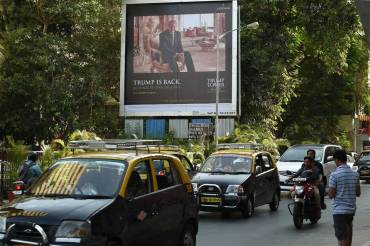
India is set to get more Trump-branded projects as local developers seek to capitalize on the brand.

A story from The Wall Street Journal Friday took a look at the many projects around the world connected to the U.S. President-elect Donald Trump, including those in India.

Unimark Group, a developer based in Kolkata, has tied up to rebrand a previously planned residential apartment building in the eastern city into a Trump-branded project.

The project is being redesigned to make it better and more luxurious to fit with Trump standards, said Dipanjan Ray, head of marketing at Unimark.

He said the project is still in planning stage, so they aren’t marketing it yet. When they do, he doesn’t doubt Mr. Trump’s election as the next U.S. president will help sales as it has elevated brand awareness in India.

“People were not so aware of Mr. Trump,” a year ago, Mr. Ray said. “He is well known to everybody right now.”

The Trump Organization has also signed up with developer M3M India Pvt. Ltd., to build a residential building in the bustling New Delhi suburb of Gurgaon, according to two people familiar with the matter. The deal was done prior to Mr. Trump’s election, according to both people, but has yet to be formally announced.

In April, Trump announced a tie-up with another developer Ireo to build an office building in Gurgaon. A spokesman for Ireo wouldn’t comment on the status of that project.

Panchshil Realty, a developer in the western Indian town of Pune, finished building the first Trump Towers in India earlier this year. The price tag for the fancy flats: $2.2 million and some are still available.

The developer had been planning another project with the Trump brand name. Sagar Chordia, a director at Panchshil, told The Wall Street Journal in November that he was planning to meet with officials at The Trump Organization to discuss a new residential project, named Trump Riverwalk.

Mr. Chordia met with Mr. Trump in the U.S. after his election, but said that they didn’t discuss any business. He wouldn’t discuss the latest status of Trump Riverwalk but said it doesn’t have plans to launch any new projects at the moment as the property market in India is a bit soft.In Mumbai, developer Lodha Group is building a 75-story Trump Towers which has three-and four-bedroom apartments with options for indoor Jacuzzis and automatic toilets. The flats are listed at around $1.3 million onward, and some are still unsold.

Source: More Trump-Branded Projects Set to Sprout Up Across India – India Real Time – WSJ

15/12/2016

India court bans liquor shops on highways – BBC News

India’s top court has ordered all liquor shops to shut down along state and national highways in an attempt to reduce drink driving and road accidents.

The court told the government to stop issuing new licenses and not renew the existing ones after 31 March.More than 146,000 people died last year in traffic accidents in the country.

About 5% – or 6,755 – deaths were due to cases where the driver was either drunk or had taken drugs.

Can India really halve its road deaths?

India crashes kill 146,133 in 2015

What Al Capone can teach India about prohibition”

(There should be) no liquor vends on national and state highways,” news agency AFP quoted Chief Justice TS Thakur, who headed the three-judge bench, as saying in his order on Thursday.The court also said that all liquor advertisements should be removed from the highways and shops selling alcohol must be located at least 500 metres (1,640 feet) away from them.

Campaigners say the large number of liquor shops located along the highways are “a great temptation and a distraction for road users”.

Alcohol is banned in four Indian states (Gujarat, Bihar, Manipur, Nagaland) and the union territory of Lakshadweep. There’s a partial ban on sale of alcohol in the south Indian state of Kerala.

Source: India court bans liquor shops on highways – BBC News

15/12/2016

PepsiCo CEO Indra Nooyi Is Latest Indian American to Sign Up to Help Donald Trump – India Real Time – WSJ

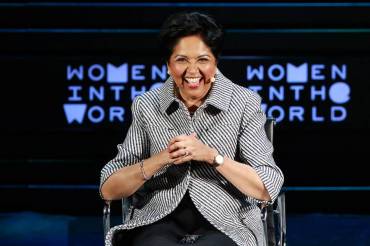
Chairman and CEO of PepsiCo. Indra Nooyi is the latest Indian American to be hand-picked by U.S. President-elect Donald Trump to advise him and help him run the country.

Ms. Nooyi’s appointment to his strategic and policy forum was announced Wednesday by Mr. Trump’s transition team as one of three new appointments to the 16-member group. SpaceX Corp’s Elon Musk and Uber Technologies Inc.’s Travis Kalanick were the other two appointments.

The forum will be called upon to meet frequently with Mr. Trump to discuss his economic agenda.“America has the most innovative and vibrant companies in the world, and the pioneering CEOs joining this Forum today are at the top of their fields,” Mr. Trump said in a news release. “My Administration is going to work together with the private sector to improve the business climate and make it attractive for firms to create new jobs across the United States from Silicon Valley to the heartland.”

Seema Verma, president and founder of SVC Inc. arriving at Trump Tower on November 22, 2016 in New York City.

Mr. Trump last month nominated Indian-American Seema Verma, CEO and founder of SVC Inc ., a U.S.-based health policy consulting company to serve as Administrator of the Centers for Medicare and Medicaid Services. “She has decades of experience advising on Medicare and Medicaid policy and helping states navigate our complicated systems,” he said.In November, Mr. Trump picked South Carolina Gov. Nikki Haley who is Indian in origin to serve as U.S. ambassador to the United Nations.

Ms. Nooyi, who was born in Chennai, India and later went to Yale University to study public policy and management, will have a direct line, along with others in the group, to Mr. Trump to advise him on economic policy, job creation and productivity, said the release.

Source: PepsiCo CEO Indra Nooyi Is Latest Indian American to Sign Up to Help Donald Trump – India Real Time – WSJ

14/12/2016

Pop-Up Restaurant at Everest Base Camp Aims for Peak of Fine Dining – India Real Time – WSJ

Chefs are trekking thousands of feet to prepare fancy food in the cold

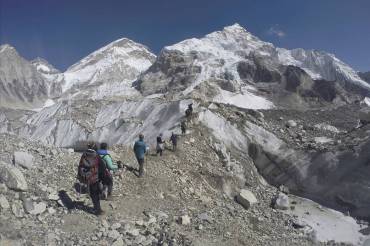
Trekkers pass through a glacier at the Mount Everest base camp, Nepal.

The peaks of fine dining just keep getting higher and higher.

A caravan of roving chefs and their 15 guests is currently making its way up the Himalayas toward the base camp at Mount Everest, where, 17,500 feet above sea level and amid the lashing winds and bone-penetrating chill of the Nepalese winter, food will be served.

The One Star House Party, as the project has been dubbed, is preparing 16 more such destination dining experiences, one a month, through 2018, though not all of the destinations are so extreme. Among the chefs involved is James Sharman, a onetime chef de partie at Noma, the influential, soon-to-close restaurant that put Copenhagen on the global culinary map.

The Nepal journey is costing its participants $1,050 each. Down jackets and sleeping bags are included. The group didn’t immediately respond to a request for the menu.

Everest Base Camp is, literally, a trek. Not a quick one, either. The group first flew from Nepal’s capital of Kathmandu to the tiny airstrip at Lukla, undertaking one of the most treacherous landings on the planet. From there they are walking, helped by porters, who are presumably carrying more than the usual amount of kitchen gear on their backs. Most travelers are advised to spend more than a week making their way up to base camp, to allow their bodies to adjust to the altitude.

On the way, the chefs have been collecting local flora for their mountaintop pantry.

Everest Base Camp is no stranger to haute cuisine. Adventurers scaling the great mountain with some of the more full-service expedition companies can enjoy sushi, pork chops and Peking duck alongside their protein bars and instant noodles. A few years ago Glenfiddich sponsored a whiskey tasting there, billed as the world’s highest, that was broadcast live online.

For more earthbound eaters in South Asia, there will be at least one more chance to join the One Star House Party. Their next destination, slated for January, is Mumbai. Reservations aren’t yet being taken.

Source: Pop-Up Restaurant at Everest Base Camp Aims for Peak of Fine Dining – India Real Time – WSJ

Law of Unintended Consequences

continuously updated blog about China & India

ChiaHou's Book Reviews

continuously updated blog about China & India

What's wrong with the world; and its economy

continuously updated blog about China & India