Archive for ‘India alert’

03/10/2016

India joins Paris Climate Change Agreement, submits instrument of ratification at UN headquarters – Times of India

With the US, China and now India signing the accord, other nations should not hesitate to join them. On any case, thes three account for the vast majority of the pollution, so even if no one else signs up, its good news for Mother Gaia.

India formally joined the Paris Climate Change Agreement by submitting its instrument of ratification+ at UN headquarters in New York on Sunday – the birth anniversary of Mahatma Gandhi.

The instrument of ratification was deposited by India’s permanent representative to the UN, Syed Akbaruddin.

By putting Gandhi seal on the climate deal, the country will now urge the global community to adopt ‘Gandhian way of life’ (shun extravagant lifestyles) to reduce their carbon footprints and protect the earth from adverse impact of climate change.

India will articulate its point vigorously during the next climate conference (COP22) at Marrakech in Morocco, beginning November 7.

“India had led from front to ensure the inclusion of climate justice and sustainable lifestyles in the Paris Agreement+ . We will put across this view based on Gandhian lifestyle in Morocco”, said environment minister Anil Madhav Dave.

Spelling out next course of action after India formally joined the Agreement, Dave said, “It is important that apart from emission cuts, we also focus on measures that involve broader participation. People in developed countries live extravagant lifestyles with high carbon footprint.

“Simple everyday changes in lifestyles, when practiced by a large number of people around the globe, collectively will make a huge impact”.

Source: India joins Paris Climate Change Agreement, submits instrument of ratification at UN headquarters – Times of India

03/10/2016

How has India changed a year after Dadri beef lynching? – BBC News

It has been a year since a Muslim man in northern India was lynched over rumours that his family had slaughtered a cow and eaten beef.

Hindus consider cows to be sacred, and for many, eating beef is taboo. The slaughter of cows is also banned in many Indian states.But Mohammad Akhlaq’s death sparked widespread outrage and contributed to changing the social and political discourse of the country. The BBC’s Ayeshea Perera looks at some of the most significant things that happened in India following his death.

The ‘intolerance’ furore

Image copyright AFP: The government began to be haunted by allegations of intolerance

Perhaps the largest fallout of Mohammad Akhlaq’s death in Uttar Pradesh state was the accusation of “intolerance” that began to haunt Prime Minister Narendra Modi’s ruling Hindu nationalist BJP.

Critics of the BJP have often accused it of being Hindu majoritarian in its outlook and of being hostile to ethnic and religious minorities, particularly Muslims. And this incident only strengthened those voices.

The fact that Mr Modi did not immediately condemn the incident, choosing to remain silent even as state party leaders jumped to the defence of the accused, caused even more anger.

It prompted an unprecedented movement by writers and poets who had been celebrated by the government – they started returning their prestigious Sahitya Akademi awards to protest at intolerance in India. More than 40 writers from all across the country returned their awards and were soon joined by a group of film makers who said they would not be “guilty of flattening diversity” in the country.

Leading writer Nayantara Sehgal, a niece of India’s first prime minister Jawaharlal Nehru, wrote that “… India’s culture of diversity and debate is now under vicious assault… The prime minister remains silent about this reign of terror. We must assume he dare not alienate evil-doers who support his ideology.

“But “intolerance” was not limited to returning awards – it found its way into popular discourse as well. Bollywood superstar Amir Khan also created a furore when he expressed concern over the “growing intolerance” in India. He was later joined by fellow star Shah Rukh Khan who said he “respected” people returning awards to protest against intolerance.

Later, the arrest of a student leader from India’s prestigious Jawarhalal Nehru University on sedition charges over a rally condemning the hanging of a man convicted of attacking the Indian parliament also sparked cries of “intolerance” on a massive scale.

The BJP loses Bihar

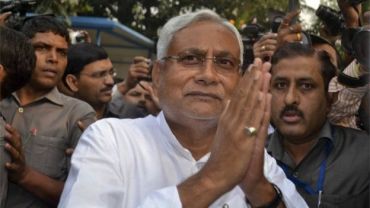
Image copyright AP: Nitish Kumar led an alliance which defeated PM Narendra Modi’s BJP in the Bihar polls

A second outcome that can be linked back to the Dadri killing is that the BJP went on to lose state elections in the neighbouring northern state of Bihar – a poll it was widely expected to win.Incumbent chief minister Nitish Kumar, who was on his second term, had already suffered a crushing defeat to Mr Modi’s party in the 2014 parliamentary elections, and another “Modi wave” was expected to sweep the state elections as well.

But in a masterstroke, Mr Kumar and his allies positioned themselves as a “secular” alliance, in direct opposition to the “communal” BJP.

The fact that Mr Modi and BJP party chief Amit Shah raised the sensitive issue of cow slaughter and consumption of beef during election rallies in the state also did not seem to help.

When Mr Kumar’s party won, it was called a “historic verdict” and hailed as proof that running a poll campaign along religious and ethnic lines would not bring results.

The rise of cow protection vigilante groups

Image copyright MANSI THAPLIYAL: These self styled cow protectors created headlines after they lay in wait for and then badly beat up a number of truck drivers transporting cattle for slaughter

The death of Mr Akhlaq seemed to put new focus on “cow protection” groups who took it upon themselves to ensure that cattle would not be slaughtered or consumed.

Mostly members of militant Hindu groups like the Bajrang Dal, Vishwa Hindu Parishad (World Hindu Council) and Shiv Sena, these self-styled cow protectors created headlines after they lay in wait for and then beat up a number of truck drivers transporting cattle for slaughter.

In another attack, two Muslim woman were beaten up after they were accused of carrying beef. And most significantly, in an incident which led to massive caste unrest, four low-caste Dalit men trying to skin a dead cow were thrashed by vigilantes in the western state of Gujarat.A video of the incident went viral and led to huge protests and an uproar in parliament.

After again being accused of silence, Mr Modi used a radio address almost a full month later to criticise vigilante attacks, saying such people made him “angry”, and any attacks must be investigated.

Eating as an act of defiance

Beef fry is an essential part of the diet in south India’s Kerala stateThe right to eat beef became another huge talking point in

Source: How has India changed a year after Dadri beef lynching? – BBC News

30/09/2016

The human and animal costs of India’s unregulated coal industry – BBC News

India is one of the largest producers of coal in the world and more than half of its commercial energy needs are met by coal.

But unregulated mining has caused serious health and environmental issues, and led to growing conflicts between elephants and humans.

In the coal-rich central state of Chhattisgarh, for example, fly ash has caused respiratory problems and serious illnesses like tuberculosis among people, but their troubles don’t end there.

Forests are being cleared for coal mining and wild elephants are entering villages in search of food and attacking people.

Photojournalist Subrata Biswas has documented the fallout of India’s dependence on coal.

“As thousands of acres of forest land are destroyed to mining, foraging elephants attracted by the crops in the fields often enter villages, resulting in an alarmingly high number of human-elephant conflict situations,” says Biswas.

Officials estimate elephants have been responsible for 8,657 incidents of property damage and 99,152 incidents of crop damage in Chhattisgarh between 2005 and 2014.

Image copyrightSUBRATA BISWAS

“We were sleeping when the elephants broke into our room. Somehow we managed to escape but I fractured my left leg when a large part of the wall fell on my leg. My husband saved my life,” says Rujri Khalkho, 70, whose home was damaged by a herd of wild elephants almost a year ago.

A compensation of 10,000 rupees ($149; £114) has not been enough to repair her house or pay for her medical care.

Image copyrightSUBRATA BISWAS

Deaths of elephants due to electrocution have become common in the state.In Dharamjaigarh, the most affected area, officials have recorded 30 elephant and 75 human deaths so far.

Image copyrightSUBRATA BISWAS

In 2009, Kanti Bai Sau, 40, lost her home and farm to an open-cast coal mine.

She was promised compensation of 200,000 rupees ($2,980; £2,290) and a job to a family member, but received neither. Her son died last year of respiratory complications.

“There is no fresh air to breath, fresh water to drink. Coal has usurped everything here.”
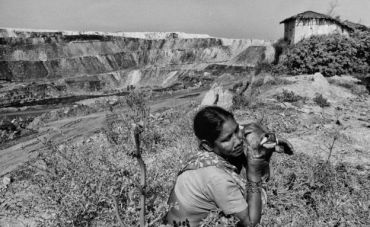
Image copyrightSUBRATA BISWAS

“We lived next to this mine for almost 10 years and watched helplessly as our wells went dry, forests disappeared and fields become unproductive,” says Girja Bai Chauhan.

“We have lost almost eight acres of our fields to the mine and authorities haven’t fulfilled a single promise they made while acquiring land. They sent us into a dark future and unhealthy environment to live and breathe in.”

Image copyrightSUBRATA BISWAS

Pipelines carry fly ash slurry from a local thermal power power plant in Korba to a fly ash pond.

Environment activists say that every year approximately 50 million tonnes of fly ash is generated by power plants in Chhattishgarh but not even the half of this amount have been reutilized to reduce the pollution from fly ash.

Fly ash is known to contain trace elements such as arsenic, barium and mercury among others, and unlined ponds like this could be polluting groundwater by leaching.

Image copyrightSUBRATA BISWAS

“The ash is everywhere. When the wind blows, everything is coated with a layer of white grey ash. The road, ponds, our houses, sometimes even our spectacles get coated with a fine layer of the ash,” says Biswas.

Image copyrightSUBRATA BISWAS

Rohit Rathia, 55, suffers from tuberculosis.He lives in a village next to an open cast mine where lung diseases such as coal workers’ pneumoconiosis (CWP), silicosis and tuberculosis have become common ailments.

Source: The human and animal costs of India’s unregulated coal industry – BBC News

29/09/2016

This Map Shows the Severity of India’s Pollution Problem – India Real Time – WSJ

A new map from the World Health Organization shows just how bad India’s air pollution problem is.

The interactive map, which shows the average levels of dangerous particulate matter in the air that can lodge in lungs and cause diseases, was made by the WHO in conjunction with the U.K.’s University of Bath.

It shows that 92% of the world’s population live in places where air quality is worse than the WHO’s recommended limits.Researchers used satellite data as well as information from ground stations to create the map. WHO data released in May showed that the city of Gwalior was India’s most polluted city, coming second in the world to Zabol in Iran.

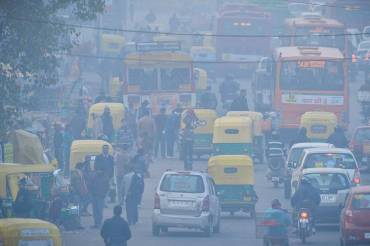
The map plots levels of particulate matter smaller than 2.5 micrometers in the air. The darker the red on the map, the higher the concentration. The PM2.5 pollutants, which come from dust, soot and smoke, can penetrate deep into the lungs and increase the risk of heart and lung diseases including asthma and lung cancer.

The map paints a dark swathe of red across northern India, meaning that the annual average PM2.5 levels are above 70. The country gets progressively lighter in color toward the south, indicating lower pollution levels. But not one spot of the country is green–indicating healthy air.

A man sifted through trash at a massive garbage site in New Delhi, Sept. 27, 2016. PHOTO: SAJJAD HUSSAIN/AGENCE FRANCE-PRESSE/GETTY IMAGES

India’s capital, New Delhi, is the 11th worst polluted in the world, with an annual average PM2.5 measurement of 122. Mumbai is another hotspot, with an average PM.2.5 level of 63.

The World Health Organization said that worldwide, around 3 million people a year die of causes linked to exposure to outdoor air pollution and that nearly 90% of those deaths occur in low- and middle-income countries.

In India, air pollution comes from a number of sources, including the burning of trash, the use of coal for cooking, factories and exhaust fumes. In some parts of the country, like Delhi, dust storms exacerbate the problem. The Delhi government has made efforts to reduce car use, but experts say more needs to be done.

“Fast action to tackle air pollution can’t come soon enough,” Flavia Bustreo, assistant director general at WHO said in the report. “Solutions exist with sustainable transport in cities, solid waste management, access to clean household fuels and cook-stoves, as well as renewable energies and industrial emissions reductions.”

Source: This Map Shows the Severity of India’s Pollution Problem – India Real Time – WSJ

28/09/2016

This Is How India Is Keeping Its Place as Asia’s Fastest-Growing Large Economy – India Real Time – WSJ

What a contrast! See pair of articles – this on on India, the other on China, both from WSJ.

India is on track to keep its spot as Asia’s fastest-growing large economy, the Asian Development Bank said Tuesday.

The Manila-based development lender expects the Indian economy to grow by 7.4% in the year that ends next March, keeping its earlier forecast unchanged in an update to its regional outlook.

The ADB lifted its forecast for China’s growth this calendar year slightly, to 6.6%, but it still expects India’s economic growth to broadly outpace its neighbors’ through 2017. (The comparison isn’t exact. India and other South Asian countries report economic data on a fiscal-year basis. China and others use calendar years.) In Asia, only Myanmar, which is opening up after decades of isolation but remains small by comparison, is expected to expand more quickly, at 8.4%.

The ADB said India’s growth prospects have been buoyed thanks to the enactment of “long-awaited structural reform.”

The bank lauded “strong progress” in restructuring Indian lenders’ balance sheets, which for years have been weighed down by bad loans. Large corporations are also finding ways to reduce debt, the bank said, which could also help resuscitate long-stagnant lending and investment.

Recent legislation that creates a national goods-and-services tax, the ADB said, is “a key step toward a much more integrated, productive economy.”

Other factors, the bank said, should keep Indian consumers spending.Government workers are due to receive a big boost to their pay and pensions, while abundant monsoon rains this summer will likely lift rural incomes.

There are risks, though, the ADB said.

Much of India’s recent growth has been driven by government spending. But that has slowed after a burst of public investment last year. New Delhi this financial year wants to shrink its budget deficit, but so far, it hasn’t raised as much money as expected from selling off stakes in state companies and other assets. That means expenditure may need to be reined in even further.Investment by private companies, meanwhile, has been “listless,” the ADB said.

Foreign direct investment in India has remained strong, the bank noted, and New Delhi has been raising limits on foreigners’ stakes in Indian enterprises. But the $63 billion flood of foreign investment seen last year “would be difficult to replicate,” the bank said.

Rapid price growth, too, could continue to weigh on Indian consumers and investors. Inflation in India, which the ADB forecasts at 5.4% this year, remains among the highest in Asia.The nation’s central bank is now actively mandated, for the first time in its history, to keep consumer inflation within a government-set range. “While this is a ground-breaking monetary policy reform, the target of 4% would seem somewhat ambitious,” the bank said.

Source: This Is How India Is Keeping Its Place as Asia’s Fastest-Growing Large Economy – India Real Time – WSJ

27/09/2016

What India’s Decision to Ratify Paris Climate-Change Pact Means – India Real Time – WSJ

India’s announcement that it would ratify the 2015 global agreement on climate change increases the chances that the pact will go into effect this year.

Source: What India’s Decision to Ratify Paris Climate-Change Pact Means – India Real Time – WSJ

25/09/2016

Culture: Chinese, Indian and Japanese

I’ve just finished watching a short six-part series featuring Joanna Lumley on her trip from near the northern-most tip to the southern-most island of Japan – http://www.itv.com/hub/joanna-lumleys-japan/2a4327a0001. If, like me, you have not been to Japan but are curious about that mysterious far eastern country, then this show is well worth investing six hours of your time.

But the reason I’m raising it here on my blog is that to me it shows in stark contrast the three cultures today: Chinese, Indian and Japanese.

The series illustrate, without a shadow of doubt, that the Japanese have somehow managed to retain most of its old traditions and culture while adopting much of (the best of ) Western culture.The two co-exist happily and without any visible friction.  For example, young girls in traditional kimono are shown visiting the famous cherry blossom festival, alongside Japanese in plain western clothing. Or modern, educated Japanese taking time off to do a multi-temple pilgrimage (see Lumley photo). 

The Chinese, in my opinion, have (certainly in urban areas) disbanded most of their traditional and culture – apart from a few national festivals – and adopted western customs and culture wholesale. Apart from a few speialist travelogue TV series on rural China (http://watchdocumentary.org/watch/wild-china-episode-01-heart-of-the-dragon-video_3a9158d41.html), any TV show on China reveals mainly western modernity.

And finally, my take on Indian culture is that it has not moved far from what has been prevalent over the centuries, apart from a thin veneer of western culture and customs such as car ownership (see India on Wheels – http://www.bbc.co.uk/programmes/b013q5y0) and western clothing or education for the upper class in the English language.

I would really like to hear from you, my blog readers, on this subject, hopefully based on personal experience rather than based on a TV programme!


23/09/2016

Guns and ghee | The Economist

TO MANY Indians, their country’s strategic position looks alarming. Its two biggest neighbours are China and Pakistan. It has fought wars with both, and border issues still fester. Both are nuclear-armed, and are allies with one another to boot. China, a rising superpower with five times India’s GDP, is quietly encroaching on India’s traditional sphere of influence, tying a “string of pearls” of alliances around the subcontinent. Relatively weak but safe behind its nuclear shield, Pakistan harbours Islamist guerrillas who have repeatedly struck Indian targets; regional security wonks have long feared that another such incident might spark a conflagration.

So when four heavily armed infiltrators attacked an Indian army base on September 18th, killing 18 soldiers before being shot dead themselves, jitters inevitably spread. The base nestles in mountains close to the “line of control”, as the border between the Indian and Pakistani-administered parts of the disputed territory of Kashmir is known. Indian officials reflexively blamed Pakistan; politicians and pundits vied in demanding a punchy response. “Every Pakistan post through which infiltration takes place should be reduced to rubble by artillery fire,” blustered a retired brigadier who now mans a think-tank in New Delhi, India’s capital.

Yet despite electoral promises to be tough on Pakistan, the Hindu-nationalist government of Narendra Modi has trodden as softly as its predecessors. On September 21st it summoned Pakistan’s envoy for a wrist-slap, citing evidence that the attackers had indeed slipped across the border, and noting that India has stopped 17 such incursions since the beginning of the year. Much to the chagrin of India’s armchair warriors, such polite reprimands are likely to be the limit of India’s response.

There are good reasons for this. India gains diplomatic stature by behaving more responsibly than Pakistan. It is keenly aware of the danger of nuclear escalation, and of the risks of brinkmanship to its economy. Indian intelligence agencies also understand that they face an unusual adversary in Pakistan: such is its political frailty that any Indian belligerence tends to strengthen exactly the elements in Pakistan’s power structure that are most inimical to India’s own interests.

But there is another, less obvious reason for reticence. India is not as strong militarily as the numbers might suggest. Puzzlingly, given how its international ambitions are growing along with its economy, and how alarming its strategic position looks, India has proved strangely unable to build serious military muscle.

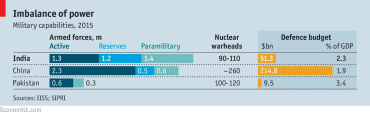
India’s armed forces look good on paper. It fields the world’s second-biggest standing army, after China, with long fighting experience in a variety of terrains and situations (see chart).

It has topped the list of global arms importers since 2010, sucking in a formidable array of top-of-the-line weaponry, including Russian warplanes, Israeli missiles, American transport aircraft and French submarines. State-owned Indian firms churn out some impressive gear, too, including fighter jets, cruise missiles and the 40,000-tonne aircraft-carrier under construction in a shipyard in Kochi, in the south of the country.

Yet there are serious chinks in India’s armour. Much of its weaponry is, in fact, outdated or ill maintained. “Our air defence is in a shocking state,” says Ajai Shukla, a commentator on military affairs. “What’s in place is mostly 1970s vintage, and it may take ten years to install the fancy new gear.” On paper, India’s air force is the world’s fourth largest, with around 2,000 aircraft in service. But an internal report seen in 2014 by IHS Jane’s, a defence publication, revealed that only 60% were typically fit to fly. A report earlier this year by a government accounting agency estimated that the “serviceability” of the 45 MiG 29K jets that are the pride of the Indian navy’s air arm ranged between 16% and 38%. They were intended to fly from the carrier currently under construction, which was ordered more than 15 years ago and was meant to have been launched in 2010. According to the government’s auditors the ship, after some 1,150 modifications, now looks unlikely to sail before 2023.

Such delays are far from unusual. India’s army, for instance, has been seeking a new standard assault rifle since 1982; torn between demands for local production and the temptation of fancy imports, and between doctrines calling for heavier firepower or more versatility, it has flip-flopped ever since. India’s air force has spent 16 years perusing fighter aircraft to replace ageing Soviet-era models. By demanding over-ambitious specifications, bargain prices, hard-to-meet local-content quotas and so on, it has left foreign manufacturers “banging heads against the wall”, in the words of one Indian military analyst. Four years ago France appeared to have clinched a deal to sell 126 of its Rafale fighters. The order has since been whittled to 36, but is at least about to be finalised.

India’s military is also scandal-prone. Corruption has been a problem in the past, and observers rightly wonder how guerrillas manage to penetrate heavily guarded bases repeatedly. Lately the Indian public has been treated to legal battles between generals over promotions, loud disputes over pay and orders for officers to lose weight. In July a military transport plane vanished into the Bay of Bengal with 29 people aboard; no trace of it has been found. In August an Australian newspaper leaked extensive technical details of India’s new French submarines.

The deeper problem with India’s military is structural. The three services are each reasonably competent, say security experts; the trouble is that they function as separate fiefdoms. “No service talks to the others, and the civilians in the Ministry of Defence don’t talk to them,” says Mr Shukla. Bizarrely, there are no military men inside the ministry at all. Like India’s other ministries, defence is run by rotating civil servants and political appointees more focused on ballot boxes than ballistics. “They seem to think a general practitioner can perform surgery,” says Abhijit Iyer-Mitra, who has worked as a consultant for the ministry. Despite their growing brawn, India’s armed forces still lack a brain.

Source: Guns and ghee | The Economist

23/09/2016

India signs deal for 36 French fighter jets to counter China, Pakistan squadrons | Reuters

India signed a deal to buy 36 Rafale fighter jets from France on Friday for around $8.7 billion, the country’s first major acquisition of combat planes in two decades and a boost for Prime Minister Narendra Modi‘s plan to rebuild an ageing fleet.

The air force is down to 33 squadrons, against its requirement of 45 to face both China, with which it has a festering border dispute, and nuclear-armed rival Pakistan.

French Defence Minister Jean-Yves Le Drian signed the agreement with his Indian counterpart, Manohar Parrikar, in New Delhi, ending almost 18 months of wrangling over terms between New Delhi and manufacturer Dassault Aviation.

India’s defence ministry said it would confirm the exact price later on Friday, but a ministry official said it was 7.8 billion euros ($8.7 billion).

Air force officials have warned for years about a major capability gap opening up with China and Pakistan without new state-of-the-art planes, as India’s outdated and largely Russian-made fleet retires and production of a locally made plane was delayed.

India had originally awarded Dassault with an order for 126 Rafales in 2012 after the twin-engine fourth-generation fighter beat rivals in a decade-long selection process, but subsequent talks collapsed.

Modi, who has vowed to modernise India’s armed forces with a $150 billion spending spree, personally intervened in April 2015 to agree on the smaller order of 36 and give the air force a near-term boost as he weighed options for a more fundamental overhaul.

The first ready-to-fly Rafales are expected to arrive by 2019 and India is set to have all 36 within six years.

Dassault Aviation said in a statement it welcomed the contract signing.

($1 = 0.8920 euros)

Source: India signs deal for 36 French fighter jets to counter China, Pakistan squadrons | Reuters

23/09/2016

Indian-Born Biologist Is Among MacArthur ‘Genius Grant’ Winners – India Real Time – WSJ

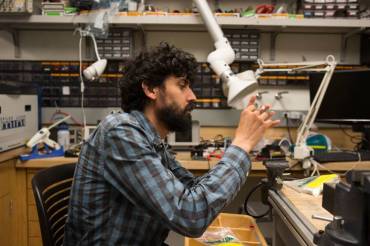
Manu Prakash grew up folding origami paper frogs and cranes in his hometown in northern India.

Indian-Born Biologist Is Among MacArthur ‘Genius Grant’ Winners

So it seemed natural for the 36-year-old Stanford University biologist to build an inexpensive microscope for the developing world that can be put together from a single piece of paper.“

I was inspired by tools like pencils, and what it takes to make those tools available to everyone,” he said. “The goal is to enable and inspire others to do science.”

His Foldscope, which costs less than $1 to produce and includes built-in lenses, is now used in 130 countries to help identify infectious diseases, among other things.

The gadget helped propel Mr. Prakash, along with 22 others, into the ranks of the MacArthur “genius” grant recipients, who are awarded a no-strings-attached $625,000 grant by the John D. and Catherine T. MacArthur Foundation for showing exemplary creativity in their fields.

Source: Indian-Born Biologist Is Among MacArthur ‘Genius Grant’ Winners – India Real Time – WSJ

Law of Unintended Consequences

continuously updated blog about China & India

ChiaHou's Book Reviews

continuously updated blog about China & India

What's wrong with the world; and its economy

continuously updated blog about China & India