Chindia Alert: You’ll be Living in their World Very Soon
aims to alert you to the threats and opportunities that China and India present. China and India require serious attention; case of ‘hidden dragon and crouching tiger’.
Without this attention, governments, businesses and, indeed, individuals may find themselves at a great disadvantage sooner rather than later.
The POSTs (front webpages) are mainly 'cuttings' from reliable sources, updated continuously.
The PAGEs (see Tabs, above) attempt to make the information more meaningful by putting some structure to the information we have researched and assembled since 2006.
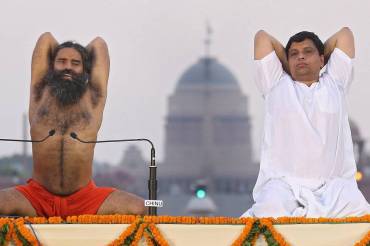
A yoga teacher clad in white robes and often seen meditating on the banks of the Ganges is the latest to join the billionaires club in India.
But Acharya Balkrishna is no ordinary yoga teacher. He controls Patanjali Ayurved Ltd., the consumer-products company founded by his guru, Baba Ramdev, and whose Ayurvedic soaps, shampoos and food supplements are increasingly becoming staples in middle-class Indian homes. Indians’ craze for the company’s Ayurvedic formulations has seen Mr. Acharya’s net worth skyrocket to $3.8 billion, according to Hurun’s India Rich List for 2016. That puts him at number 25 in Hurun’s list of richest Indians, ahead of industrialists like Ratan Tata, Adi Godrej and Anand Mahindra.
Such is the demand for Patanjali, which sells creams, cleaners and hair conditioners rooted in Ayurveda, India’s traditional system of medicine, that the world’s biggest consumer-products makers are tweaking their products to compete. India’s traditional system of medicine encourages therapies like yoga and believes everything from the common cold to diabetes can be fixed by certain herbs, foods and oils.
Colgate Palmolive last month launched a toothpaste flavored with basil, clove and lemon. L’Oréal SA in June launched a new range of shampoos infused with eucalyptus, green tea and henna, an Indian herb Patanjali also packs in its shampoo. Unilever PLC recently purchased an Ayurvedic hair-care company.
Mr. Balkrishna is a reclusive figure next to Mr. Ramdev, one of India’s best-known yoga teachers who founded Patanjali in 2006 and has since transformed it into a multi-million dollar consumer goods empire. Mr. Balkrishna controls the business because Mr. Ramdev has sworn off most trappings of wealth.
Messrs. Ramdev and Balkrishna are regularly seen practicing yoga on the banks of the Ganges in Haridwar, the Hindu holy city where Patanjali is based and where they run an ashram.
Ayurveda has produced other billionaires, too. The Burman family which runs Dabur India, another consumer-goods maker that draws inspiration from traditional Indian medicine, is 13th on Hurun’s India rich list.
Mukesh Ambani, the chairman of Reliance Industries, is the richest Indian with a net worth of $24 billion. Dilip Shanghvi, who heads generics-drug maker Sun Pharmaceutical Industries, is second with $18 billion in his kitty.
On Monday afternoon, a school bus was stopped in the Banashankari area in southern Bangalore. Three drunk men got into the bus and asked aloud: “Which child belongs to Karnataka and and which child belongs to Tamil Nadu?”
The 15-odd students, aged between 10 and 14, were stunned. Their school had asked them to leave early because the situation was tense, with violence and arson breaking out in many parts of the city.
“Luckily the driver handled it tactfully. He told the intruders that everyone was a native of Bangalore and that their families supported Karnataka on [water sharing with] Cauvery,” said a parent, not wanting to be identified.
Battle for access
By dusk, dark smoke had filled the Bangalore skies. Some 35 buses had been set on fire by protesters, just because the buses belonged to a travel agency whose owner is Tamil.
Is India facing its worst-ever water crisis?
India to ‘divert rivers’ to tackle droughtEarlier this month India’s Supreme Court ruled that Karnataka must release 12,000 cubic feet of water per second to Tamil Nadu from the Cauvery river until 20 September. Both states say they urgently need the water for irrigation and a battle about access to it has raged for decades.
Karnataka says water levels in Cauvery have declined because of insufficient rainfall
India’s water war
The Cauvery originates in Karnataka and flows through Tamil Nadu before joining the Bay of Bengal.
The dispute over its waters originated in the 19th Century during the British rule between the then Madras presidency (modern day Tamil Nadu) and the province of Mysore (now Karnataka).
Karnataka and Tamil Nadu have both argued that they need the water for millions of farmers in the region.
The Cauvery river water tribunal was set up in 1990 after the failure of several rounds of talks between the two states.
Dozens of meetings have been held to find a settlement to the century-old dispute.
In 2007, the tribunal ruled Tamil Nadu state would get 419bn cubic feet of water a year. Karnataka would get only 270bn.
Karnataka says water levels in the Cauvery have declined because of insufficient rainfall – 42% of the 3,598 irrigation tanks in the state are dry – and that it cannot therefore share water with Tamil Nadu. So Tamil Nadu went to the top court demanding 50,000 cubic feet of water per second.
When the Supreme Court on 2 September asked Karnataka to “live and let live”, the state softened and offered to release 10,000 cubic feet of water per second to Tamil Nadu every day for five days.
On 5 September however, the top court ordered Karnataka to release 15,000 cubic feet of water per second for 10 days. This ruling was later modified to 12,000 cubic feet of water per second until 20 September.
This would mean that nearly a quarter of the water now available in the Cauvery basin will flow into Tamil Nadu.
A truck from neighbouring Tamil Nadu set on fire in Bangalore
Tamil Nadu says it badly needs the river water for irrigation. Drought-hit Karnataka argues that most of the river water is now needed for drinking water supplies in Bangalore and some other cities, leaving no water for irrigation at all.
But even farmers in Tamil Nadu are unhappy with their share.P Ayyakannu, president of the local South Indian Rivers Interlinking Farmers Association, called it “akin to giving pigeon feed to an elephant”.
Rising violenceFeeling let down by the top court’s order, Karnataka is boiling.
The main city of Bangalore is the worst affected: the violence in the technology hub forced the closure of many offices and much of the public transport system. Police have imposed an emergency law that prohibits public gatherings, and more than 15,000 officers have been deployed across the city.
One person was killed when police opened fire on protesters on Monday evening. Buses and trucks bearing Tamil Nadu number plates have been attacked and set on fire. Schools and colleges are closing early and many businesses are shut.
A group of activists belonging to a fringe pro-Karnataka group assaulted an engineering student because he had ridiculed Kannada film stars for supporting the strike on Friday, by posting memes on Facebook. The student was hunted down and forced to apologise.
Across the border, in Tamil Nadu, petrol bombs were hurled at a popular restaurant owned by a resident of Karnataka in Chennai while the driver of a vehicle with Karnataka number plates was slapped and ordered to say “Cauvery belongs to Tamil Nadu”.
The latest violence brings back memories of the anti-Tamil riots in Bangalore in 1991 over the same issue.
Then, some 200,000 Tamils were reported to have left the city, after incidents of violence and arson targeting them.
There was a proposal in 2013 to set up a panel comprising representatives from the two warring states to resolve disputes over river water sharing.
But successive governments have dragged their feet on this, and the two leaders – Karnataka chief minister Siddaramaiah and his counterpart in Tamil Nadu, Jayaram Jayalalitha – have not reached out to each other to resolve the crisis. And with Delhi reduced to being a reluctant referee, the onus has fallen on the Supreme Court to crack the whip.
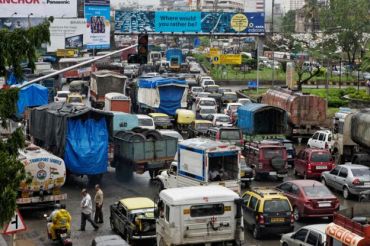
For a crash course in India’s car-crash culture, go to Mumbai. There are more accidents here than any other Indian city. You’ll witness a dangerous mix of pedestrians, scooters, cars, buses and lorries jostling through choked junctions. Many ignore both signals and the traffic police.Officers can do little about such rampant law-breaking.
“We can catch a maximum of two offenders at a time – maximum,” one shouts at me above the horns and revving engines at one particularly busy junction. “The rest,” he says flicking his wrist, “just go. There are no consequences.”
Mumbai: “A dangerous mix of pedestrians, scooters, cars, buses and lorries”
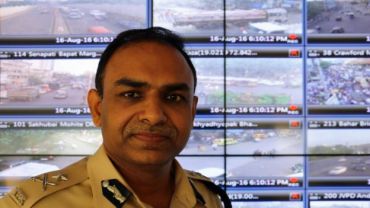
Mumbai’s commissioner of traffic police, Milind Bharambe, says this will soon end. From his cool office, flanked by monitors with live CCTV feeds of notorious accident spots, he explains how cameras will enforce the law electronically, targeting those who speed and run red lights. Combine that with the recent introduction of stiff new fines and within six months, he promises “a sea change” in driver behaviour.
Milind Bharambe, Mumbai’s commissioner of traffic police
But bad driving and weak enforcement are only part of the problem. Another aspect of it is the rapidly growing number of vehicles – a new one joins the chaos every 10 seconds. It adds up to almost 9,000 new vehicles a day, or more than three million a year.
This means that the streets are increasingly choked. It’s almost impossible to leave a safe distance between vehicles, and when space does open up, frustrated drivers often respond by putting their foot down.
Neal Razzall presents Fixing India’s Car Crash Capital on Crossing Continents, at 11:00 BST on Radio 4 – catch up on BBC iPlayer Radio
The problem is perhaps most acute in Mumbai, which is surrounded by water on three sides and has little room to grow. Officials here have in the past responded to the crush of cars by tearing out pavements to make room for more.”The government still thinks the major issue is ‘How do we move people in cars faster and quicker?'” says Binoy Mascarenhas from the pedestrian advocacy movement, Equal Streets. In reality, he says most journeys are local and, in theory, can be done on foot.
Pavements are often non-existent on Mumbai roads
In theory. He grew up in Mumbai, and used to walk to school. His daughter now goes to school in a car because it’s too dangerous to walk. Pavements, where they exist, are often in such a poor state people have to walk on the roads. No wonder then that pedestrians account for 60% of road deaths in Mumbai.
There are dangers outside the city, too.
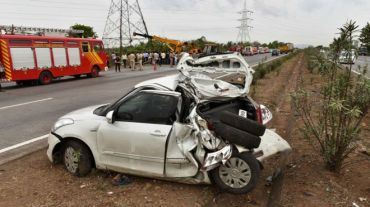
India’s first expressway, between the cities of Mumbai and Pune, opened in 2002. It has three wide lanes and room to move at high speed – a relief after the congestion of the city. But drive it with one of India’s few professional crash investigators, Ravi Shankar, and a quiet terror settles in. He’s studied thousands of crashes on this road and can point to dangers all around.
“There are small, man-made engineering problems that are actually killing people,” he says. Instead of rumble strips to warn drivers they’re at the road’s edge, there are black and yellow curb stones embedded into the concrete. Hit one of those, Shankar says, and your car can flip over. Then there are cliffs with no barriers, and guard-rails with tapered ends, which, he says, can send cars into the sky “like a rocket launcher”.
Things like this are happening all the time. The expressway is just 94km (58 miles) long but about 150 people die on it every year.
“That’s serious. That’s a very bad number,” Shankar says.
He and his colleagues at JD Research have identified more than 2,000 spots on the expressway where relatively simple engineering fixes, from better barriers to clearer signs, could save lives.Jump media playerMedia player helpOut of media player. Press enter to return or tab to continue.
“Road engineers are not serious about this problem,” Shankar says. “So we keep fighting with them on this point. How many deaths are you going to wait for, until you really understand that this is a serious concern?”
In this context, Prime Minister Narendra Modi‘s plan for the biggest expansion of roads in Indian history is unnerving. In the next few years he wants to pave a distance greater than the circumference of the earth and there’s a particular push to build highways and expressways.
Piyush Tewari, CEO of the safety charity Save Life India, says without putting the country on a “war footing”, including a complete overhaul of road safety legislation and a modern road-building code, Modi’s new roads will only add to the number of dead.
“Road crash deaths will increase at the rate of one death for every 2km of new road that is constructed. That’s the average death rate on Indian highways – one death every 2km, annually. So if we don’t fix any of this, if we’re constructing 100,000km of highways, 50,000 deaths is what the average maths tells us will be added to the total,” he says.
Image copyrightROLEX AWARDS/JESS HOFFMANImage captionPiyush Tewari believes the planned new roads could lead only to more fatalities
Modi’s government insists the new roads will be safer. “We are improving the road engineering; we are improving the traffic signal system; we are making crash barriers”, transportation minister, Nitin Gadkari, tells me.
There is progress in other areas too. When Mumbai’s commissioner of traffic police predicts a “sea change” in driver behaviour he is partly putting his faith in a new motor vehicle bill, now before parliament, which if passed would increase fines, toughen vehicle registration requirements and mandate road-worthiness tests for transport vehicles.
And earlier this year, a Good Samaritan Act came into effect which ended the crazy situation whereby people who helped crash victims could be held liable for the costs of treating them or even accused by police of causing the crash in the first place. That alone, campaigners say, will save thousands of lives.
More from the Magazine
When a road accident occurs, bystanders will usually try to help the injured, or at least call for help. In India it’s different. In a country with some of the world’s most dangerous roads, victims are all too often left to fend for themselves.
Save Life India estimates that half of all road deaths are the result of treatable injuries. That means 75,000 lives could be saved every year just with better medical care.
One man trying to save some of those lives is Mumbai neurosurgeon Dr Aadil Chagla, who is working with volunteers to build a series of clinics along Highway 66, south of Mumbai – many of them in rural areas – to prevent victims having to be driven for hours to the city.
The first is more than half-built. It looks out over rice paddies and lush hills, but Dr Chagla estimates it will be treating victims from “one or two crashes a day, every day”.
“If I can have an ambulance service and trauma centres every 50 to 100km run by the locals it would make huge difference to this entire highway – with or without government support,” he says.
Image captionDr Chagla’s as-yet-unopened clinic to treat victims of road accidents
Since Dr Chagla started practising in the 1980s, the number killed on India’s roads has increased by 300%.
“I waited all this time and nothing has really come through so it’s important that I should do something about it,” he says.
So if transportation minister Nitin Gadkari is to make good on his promise to cut road deaths from 150,000 to 75,000 per year in two years, it will be thanks in part to the efforts of volunteers.
The state corporation that owns the Mumbai-Pune Expressway, meanwhile, says it will reduce deaths to zero – yes, zero – by 2020. It has accepted the list of essential improvements identified by crash investigator Ravi Shankar and authorised them to be made and then audited by Save Life India.
But there’s a snag, which suggests India is not yet on a “war footing” when it comes to safety.
The state government owns the road, but a private company runs it in exchange for collecting tolls. The two sides dispute who should make the safety upgrades. The official in charge of the expressway says the work will be done, even if it requires litigation to recover the costs.
While the dispute drags on, 100,000 vehicles use the expressway every day in its current, dangerous state. In the past week, it claimed six more lives.
India-born innovator and scientist Ramesh Raskar has been awarded a $500,000 prize, one of the world’s largest single cash awards that recognizes invention.
The annual Lemelson-MIT prize, administered by the School of Engineering at the Massachusetts Institute of Technology, honors U.S. inventors who are mid-career and trying to improve the world through science and technology.Mr. Raskar is an associate professor at MIT’s Media Lab. He is known for his trailblazing work which includes the co-invention of an ultra-fast imaging camera that can see around corners, low-cost eye-care solutions and a camera that enables users to read the first few pages of a book without opening the cover.
“We are thrilled to honor Ramesh Raskar, whose breakthrough research is impacting how we see the world,” said Dorothy Lemelson, chair of the Lemelson Foundation, which funds the prize, in an MIT news release Tuesday.
Mr. Raskar hails from the Hindu pilgrimage town of Nashik in the western Indian state of Maharashtra. Despite living in the U.S., he has stayed connected to his native land through his work.In 2015, while his hometown was hosting the Kumbh Mela, a month-long Hindu bathing festival that draws millions of pilgrims, he collaborated with other innovators to launch so-called Kumbhathons–special innovation camps to incubate ideas for the development of smart cities in India. The Kumbhathon tried out innovative solutions to challenges like providing housing, sanitation and transportation to pilgrims during the festival.
That effort evolved into Digital Impact Square, or DISQ, an online platform and open lab in Nashik to encourage innovation.
“The world is our lab, and a co-innovation model that spans the globe is critical for any impact-driven research,” Mr. Raskar said in emailed answers to questions.
Mr. Raskar said his background helped with his work. “My upbringing does help there, growing up in a house without even a separate bedroom or working on a farm, living in mud houses without power or water during weekends and summer holidays,” he said.
The scientist plans to use a portion of his prize money to launch help young inventors innovate in multiple countries.
“Everyone has the power to solve problems and through peer-to-peer co-invention and purposeful collaboration, we can solve problems that will impact billions of lives,” Mr. Raskar said in the MIT news release.
The past winners of the Lemelson-MIT prize include Douglas Engelbart, inventor of the computer mouse; biologist Leroy Hood and Nick Holonyak, inventor of the light-emitting diode, or LED.
Air fares in India are the lowest in the world, according to a global transportation study, underscoring the intense competition between carriers in the South Asian country.
In India, it costs an average of just $2.27 to fly 100 kilometers (62 miles) on domestic routes on a budget airline and $2.67 on a full-service carrier, according to a survey conducted by Kiwi.com, a Czech Republic-based online travel agency.
The most expensive place to fly domestically is the United Arab Emirates where flights are 80 times costlier than India. It costs $181.38 for 100 kilometers on a budget airline in the UAE and $220.36 on a full-service airline, according to website’s 2016 Aviation Price Index, which analyzed more than one million flights worldwide.
Domestic budget airline fares in India are similar to those in Malaysia—the second least expensive country–which cost $2.32 per 100 kilometers. Fares on full-service carriers in the Southeast Asian nation are however more expensive, at $5.81 for a similar distance.
Indian fares are cheaper thanks to strong competition and comparatively lower jet fuel prices. The country also has a number of budget airlines, including InterGlobe Aviation Ltd.’s IndiGo and SpiceJet Ltd.
A Boeing Co. 737 aircraft operated by SpiceJet Ltd. approaches to land at Chhatrapati Shivaji International Airport in Mumbai, India, Oct. 26, 2015. Spicejet is among a number of budget carriers in India.
Prices in India have fallen as competition increased with the arrival of new carriers. Malaysia’s AirAsia Bhd. started a budget airline venture with India’s Tata Sons Ltd. while Singapore Airlines Ltd. began a full-service carrier with Tata Sons.
Russia is ranked third least expensive for domestic air travel, with prices at $7.02 for budget airlines and $6.32 for full-service, the survey showed.
On the steep side, Finland — where it costs $39.61 and $130.80 to fly 100 kilometers on a low-cost and a full-service airline respectively — is the second most expensive. Qatar is the third-most expensive costing $64.36 for a budget airline ticket and $85.31 for a full-service airline ticket for the same distance.
The website said China offered the least expensive international flights on both budget and full-service airlines, at $1.22 and $2.84 respectively for 100 kilometers of travel. International flights from Canada are the most expensive at $43.70 and $94.66 on low-cost and full-service airlines respectively.
“The Indians said they wanted to look at how we could continue to have a strong trading relationship and there was agreement that as we prepare to leave the EU, we should be exploring what that looks like,” the official said.
“Prime Minister Modi said that we had always been an important partner for India and nothing about leaving the European Union would change that.”
The two leaders were meeting on the sidelines of the G20 summit in the Chinese city of Hangzhou.
The two nuclear-armed neighbours have been moving to gradually ease long-existing tensions between them.
Leaders of Asia’s two giants pledged last year to cool a festering border dispute, which dates back to a brief border war in 1962, though the disagreement remains unresolved.
Meeting on the sidelines of the G20 summit in the eastern Chinese city of Hangzhou, Xi said relations had maintained a steady, healthy momentum, and should continue to increase mutual understanding and trust.
“We ought to respect and give consideration to each other’s concerns, and use constructive methods to appropriately handle questions on which there are disputes,” Xi said, in comments carried by China’s Foreign Ministry.
“China is willing to work hard with India the maintain the hard-won good position of Sino-India relations,” Xi added.
China’s Defence Ministry said last month that it hoped India could put more efforts into regional peace and stability rather than the opposite, in response to Indian plans to put advanced cruise missiles along the disputed border with China.
Indian military officials say the plan is to equip regiments deployed on the China border with the BrahMos missile, made by an Indo-Russian joint venture, as part of ongoing efforts to build up military and civilian infrastructure capabilities there.
China lays claim to more than 90,000 sq km (35,000 sq miles) ruled by New Delhi in the eastern sector of the Himalayas. India says China occupies 38,000 sq km (14,600 sq miles) of its territory on the Aksai Chin plateau in the west.
India is also suspicious of China’s support for its arch-rival, Pakistan.Modi arrived in China from Vietnam, which is involved in its own dispute with China over the South China Sea, where he offered Vietnam a credit line of half a billion dollars for defence cooperation.Modi’s government has ordered BrahMos Aerospace, which produces the BrahMos missiles, to accelerate sales to a list of five countries topped by Vietnam, according to a government note viewed by Reuters and previously unreported.
It’s been two years since India emerged as the world’s fastest-growing major economy, but the rapid expansion has done little to improve the lot of Ashok Kumar.
Parked up and sitting on the kerb, the 25-year-old truck driver is going nowhere fast. He is the sole breadwinner for the 13 people in his extended family and his monthly salary is stuck at $150.
With new, better-paid jobs hard to come by, Kumar lacks options. He fears becoming unemployed like his elder brother, who recently returned to their village in Uttar Pradesh after months of searching in vain for work.
Data out on Wednesday showed India’s economic growth slowed to 7.1 percent in the quarter to June, a 15-month low. That is faster than other major economies, but not fast enough to create enough new jobs to absorb all the one million people who join the workforce every month.
A government survey found that job creation fell by more than two-thirds in 2015. Analysts at HDFC Bank estimate that for every percentage point the economy grows, employment now adds just 0.15 of a percentage point – down from 0.39 in 2000.
It’s a major challenge for Prime Minister Narendra Modi, who has promised to create 250 million jobs over the next decade.
“For one job, there are at least 20 candidates,” said Kumar. “If you want the job, you can’t afford to bargain.”
Nearly two-thirds of India’s 1.3 billion people are under 35 years old. This rising demographic “bulge” will create the largest working-age population in the world. At the same time China, which has long curbed family size, will age as a society.
Whether this so-called demographic dividend will translate into the kind of economic gains seen in Japan and Korea, or lead to upheavals, depends on India’s ability to generate jobs.
Yet, despite average annual growth of 6.5 percent between 1991 and 2013, India added less than half the jobs needed to absorb new job seekers.
Under Modi, India has opened up further to foreign investment, hoping to generate more manufacturing jobs. A loan scheme for small businesses has been set up and there are plans for a $1.5 billion fund for startups.
Modi has also launched a programme to train over 4 million people in different skills in six years.Pronab Sen, country director for the International Growth Centre, a British-backed think tank, said such measures were “laudable”, but they aimed at boosting supply when more demand was needed.
“India has become a demand-starved economy,” Sen said. “If there is no demand, there will be no incentive to produce more which, in turn, will mean no new jobs.”
The level of desperation for work is staggering. In August, nearly half a million people, including post-graduates, applied for 1,778 jobs as sweepers in the city of Kanpur.
This was not a one-off. Last year, in Uttar Pradesh, 2.3 million people sought 368 low-level government jobs that required a primary education and ability to ride a bicycle.
Competition for such jobs has become fiercer as the public sector’s share in formal employment is declining.
Two years of drought has caused distress in farming, while the construction business has suffered a prolonged downturn – making work scarcer in the two sectors that employ the bulk of India’s unskilled workforce.
Satellite cities around the capital, like Greater Noida were, until recently, bustling with construction activity.
Now, Greater Noida’s skyline is dotted with half-built, abandoned, high-rises. Cranes and diggers stand idle.
In Delhi and the surrounding National Capital Region, housing starts fell 41 percent year-on-year in the first half of the year, according to consultancy Knight Frank. Across India, starts were down 9 percent from a year earlier.
Bhuwan Mahato, a contractor who supplies workers to construction projects around Noida, says demand for labour is down by at least 25 percent.
“I wish I hadn’t joined this business,” said Mahato, a 30-year-old migrant from the state of Bihar. “But, truthfully, there are no other opportunities, either.”
Delhi is India’s biggest megacity, home of the country’s central government and, according to new police data, way ahead of the competition in the quest to claim the title as the country’s capital of crime.
The National Crime Records Bureau released its statistics for 2015 on Tuesday and Delhi left everyone else in the dust.Around 25% of the nearly 670,000 crimes recorded in India’s 53 largest cities were committed in Delhi last year, even though the megacity only accounts for around 10% of their combined populations.
The financial capital Mumbai was a distant second, recording only about 6% of the crimes. Tech hub Bangalore claimed about 5% of the crimes and Chennai looked to be the safest of the top five major metros, accounting for only 2% of the crimes.
This is not because Delhi–home of more than 16 million souls–has the largest population. Even on a per capita basis, the capital shined when it came to crime.
Last year it brought home the gold in theft and insulting the modesty of women, beating all the other cities with populations of more than 1 million, according to the bureau’s data. In rape, only Jodhpur was worse. In the murder category, it was the bloodiest of the five major metros and well above average.
Delhi police attribute the high rate of crime in the city to their hard work. More and more cases are being registered every year as the force cracks down, said Taj Hassan, spokesman for the Delhi police.
“Delhi, being the national capital, witnesses a lot of law and order problems because people from all states live here,” he said. “The law and order situation is under control.”
More than previous years and in other cities, people are now being “encouraged to come forward and report” every incident of crime. “Not even a single complaint goes unnoticed,” he said.
There was, however, one area of hope.Surprisingly Delhi-ites were relatively law-abiding last year when it came to injuries caused by rash driving and road rage. Maybe the city’s notorious traffic is keeping cars from going fast enough to cause injury.
Maybe the city’s police force is too busy tracking down violent criminals to deal with bad drivers.
India’s Reliance Industries unveiled its new telecom network on Thursday, touting free calls and rock-bottom data prices that sent shares of established telecom players into a nosedive on fears of an all-out price war.
Reliance’s Chairman Mukesh Ambani, India’s richest man, told shareholders at the energy giant’s annual shareholder meet that services on the new network, dubbed Jio, would be available for free until Dec. 31 as it continues network tests. He did not say when the services would be launched commercially.
Reliance, one of India’s biggest business houses which gets most of its revenue from its sprawling oil and gas business, has in the recent years expanded into more consumer-facing markets such as retail and telecom as growth in its core business slows.
The company, which secured telecom airwaves in 2010, has so far invested more than $20 billion on building a nationwide network, and has pledged to offer affordable services to price-conscious Indian customers.
Ambani, who was interrupted by repeated rounds of applause as he took shareholders through Jio’s ambitious rollout plans, free countrywide roaming offering and more, vowed to “transform India from a high-priced data market to one with the lowest data rates anywhere in the world.
“Jio could make Reliance a big provider of telecoms and internet services across India – a nation of one billion mobile phone subscribers – and is a key plank of Ambani’s future strategy even though the business is unlikely to add significantly to consolidated profit any time soon.
Jio will effectively price one gigabyte of data at about 50 rupees for some users, about one-fifth of what rivals charge, Ambani said. Data charges will fall even further for heavier users, he said.
Ambani set a target of 100 million customers for Reliance Jio “in the shortest possible time”, without specifying.
Shares in India’s No. 1 wireless carrier Bharti Airtel Ltd dropped 6.3 percent on Thursday, while smaller rival Idea Cellular fell 10.5 percent, on fears that Jio’s aggressive rates will trigger a price war in the sector.
The incumbents have already started lowering data prices ahead of Jio’s entry.
Still, a telecom analyst, who declined to be named, said Jio would face challenges in luring low-spending phone users to its network.
Jio’s cheapest plan starts at 149 rupees and offers just 0.3 gigabytes of data and the company’s next plan up costs 499 rupees, while a majority of India’s phone users who still have basic phones spend less than 200 rupees a month on telecommunications services.
“It is definitely aggressive and will hurt the incumbents,” he said. “But it’s not like it’s going to push everyone else out of the market.”