Archive for ‘India alert’

28/02/2016

Delhi Chief Minister Arvind Kejriwal’s visit to Punjab — Kejriwal vows to curb mining mafia in Punjab – The Hindu

Alleging that a “mining mafia” in Punjab was extorting money from owners of stone crushing units, Aam Aadmi Party chief Arvind Kejriwal on Sunday vowed to put an end to the menace “within 24 hours” if his party comes to power in the 2017 Assembly election.

Delhi Chief Minister Arvind Kejriwal addresses the people at Dhilwan in Punjab on Sunday.

“I am shocked to know that legal crusher owners have to pay ‘goonda tax or jizya’ to the mining mafia in Punjab. I vow that within 24 hours of AAP’s coming into power, this will be curbed in the state,” Mr. Kejriwal, who is on a five-day tour of Punjab to reach out to voters ahead of the Assembly elections, said at a rally here.

Members of the business community, including owners of crushing units, on Sunday met Mr. Kejriwal and alleged that no action was being taken against the extortionists. They also claimed that false cases were being registered against them.

Mr. Kejriwal said once voted to power, AAP would set up a commission to review such cases and take action against officials who had lodged them.

Reacting to reports of a large number of posters which had sprung up in Jalandhar questioning his governance record, the Delhi Chief Minister hit out at the Akali Dal saying they had ruined the state during their 10-year rule.

“People know who has ruined his state for about 10 years and who is a failed CM,” he said.

Mr. Kejriwal also claimed that no government could have achieved in 65 years what his government had accomplished in one year in Delhi.

“What we have done in our one year rule in Delhi, I challenge that no state government could have done in the last 65 years. I am confident if Delhi goes to polls today, other parties will not be able to win even a single seat,” he said.

He also met people from different walks of life, including industrialists, advocates, shopkeepers and members of the Christian community.

Earlier, BJP workers led by district president Suresh Bhatia and Municipal Council president Naresh Mahajan, tried to gherao Mr. Kejriwal at Gandhi Chowk, but were stopped by police who resorted to mild lathi-charge, in which one person was injured.

Around 80 protesters were detained later released after the Delhi Chief Minister left, police said.

Earlier in the day, Mr. Kejriwal visited the Golden Temple and Durgiana Mandir in Amritsar.

Talking to media in Amritsar on Saturday night, he said he met various associations of traders who were not “happy” with the ruling government in Punjab because of “rampant corruption” in government departments. Moreover the state government had failed to “support” traders, he alleged.

Source: Delhi Chief Minister Arvind Kejriwal’s visit to Punjab — Kejriwal vows to curb mining mafia in Punjab – The Hindu

24/02/2016

U.S. Design Company Redesigns the Cycle Rickshaw to Make it ‘Sexy’ – India Real Time – WSJ

It is not quite reinventing the wheel, but one company is trying to overhaul an old-fashioned form of public transport–the cycle rickshaw.

Funded by the Asian Development Bank, Colorado-based Catapult Design has produced a new, flashy design for the vehicle — ubiquitous in Indian and other South Asian cities — that includes electrical assistance and gears for tricky hills.

Cycle rickshaws, or pedicabs, in South Asia provide backbreaking but vital work for the drivers who pedal passengers often on short “last mile” trips from other forms of transport to their final destination.

Dhaka, Bangladesh’s capital, has half a million cycle rickshaws alone, Bradley Schroeder, who is leading the $340,000 project to develop an open-source design of the pedicab, said. But the design hasn’t improved much in 40 years.

The ADB will spend $150,000 on manufacturing 60 prototype vehicles and testing them in Nepal’s capital Kathmandu, and Lumbini, a tourism hotspot in the Himalayan nation and the birthplace of Buddha, over the coming months.

Half of the new rickshaws will be pedal-only, and the rest will have built-in electrical assistance provided by a lithium-ion battery, the company said.

Most rickshaws are currently made from tubular steel and if they have electrical assistance, it is provided by a heavy car battery, Mr. Schroeder said. Exposed parts of the rickshaw’s mechanics mean that clothes such as saris can become caught and cause accidents.

The new design is made from stainless steel and the mechanics are fully enclosed and include gears. The lithium batteries are more lightweight and the electrics comply with European Union standards, he added. The vinyl cover on the rickshaw provides protection from the elements.

“We wanted to make the body very sexy,” Mr. Schroeder said. The designers talked about adding seatbelts but decided against it since the the speeds were so low.

The new cabs are more expensive – they will cost $750, compared with about $400 for an average rickshaw. That cost, Mr. Schroeder says, is a result of the reduced weight and the addition of smartphone vehicle-hailing and driver-evaluation technologies as well as touch screens that can deliver tour guides to passengers.

“Weight is everything in the pedicab industry,” Mr. Schroeder wrote in an emailed response. The lighter model will mean that the pedicab will have a top speed of 15.5 miles an hour, but, Mr. Schroeder wrote, “essentially the vehicle will go as fast as the wallah (driver) can pedal and since the vehicle is lighter and now has gears, the wallah should be able to go faster.”

The drivers of the rickshaws for the trial in Nepal will be taken from the existing pool of the cities’ rickshaw chauffeurs, Mr. Schroeder said.

His team spent several months interviewing drivers, owners and garages. “There are a lot of questions, it’s not always easy. But over time we win them over and they are happy,” he said.

“They live on the fringes of society and are very concerned about making money every day,” he said. “They can see their industry is in decline.’

But although the cycle rickshaw is steeped in tradition, its drivers aren’t resistant to change.

“If you show them a 3-D printed model of the design, they’re blown away,” Mr. Schroeder said.

After the trial, Mr. Schroeder hopes a bicycle, motorcycle or auto company picks up the unpatented design and uses it to manufacture the product.

Source: U.S. Design Company Redesigns the Cycle Rickshaw to Make it ‘Sexy’ – India Real Time – WSJ

23/02/2016

Angry victims heckle Haryana CM after Jat riots kill 19 | Reuters

A political ally of Prime Minister Narendra Modi was shouted down on Tuesday by a crowd angered by rioting in Haryana that destroyed businesses, paralysed transport and cut water supplies to metropolitan Delhi.

Photo

The chief minister of Haryana, Manohar Lal Khattar was heckled by local people in the town of Rohtak after they objected to his comments promising that they would receive compensation.

More than a week of unrest involving the Jat rural caste has challenged the authority of Modi, who was elected in 2014 with the largest majority in three decades but has publicly ignored the outburst of anger over a lack of jobs.

Although Jat leaders reached a deal late on Monday to end more than a week of protests that killed 19 people and injured 170, anger was still boiling among the victims whose livelihoods had been ruined.

Live TV pictures showed Khattar giving up his attempt to address angry people on the street. After retreating indoors to give an impromptu news conference, he repeated his promise of compensation only to be shouted down again.

Soon after Modi won national power, Khattar led his nationalist Bharatiya Janata Party to power in Haryana, a state of 25 million people, for the first time.

TRAIL OF DESTRUCTION

There was a trail of destruction through the town, one of several to be hit by Jat agitation to demand more government jobs and college places, with one Hyundai dealership gutted. Traders who staged an earlier sit-down protest said they had lost everything.

“I had two showrooms on the road; both were first looted and then set on fire. I have nothing left now,” Anil Kumar told Reuters Television.

Kumar appealed to Modi and to chief minister Khattar for compensation: “Are we not humans? Don’t our votes count? Why did they not have any mercy on us? Don’t we pay our taxes?”

Modi has remained silent through the worst social unrest of his 20 months in office. A senior government official said he would give a statement in due course to parliament, which convened for its budget session on Tuesday.

Finance Minister Arun Jaitley next week presents his annual budget. He is expected to announce big hikes in public sector pay that would make it hard to free up funds for investment without borrowing more money.

Thousands of troops were deployed to quell the protests, which flared on Monday near Sonipat when a freight train was torched and, according to reports, police shot dead three protesters. Jats also attacked buses in neighbouring Rajasthan.

Disruption has been huge, with at least 850 trains cancelled, 500 factories closed and business losses estimated at as much as $5 billion by one regional lobby group. India’s largest car maker, Maruti Suzuki, shut two factories at the weekend because its supply of components was disrupted.

The army on Monday retook control of a canal that supplies three-fifths of the water to Delhi, a metropolis with a population of over 20 million. A key sluice gate was reopened, but protesters sought to cut the water supply at another place.

“The canal was damaged by protesters and repair work will have to be done,” Delhi’s Water Resources Minister Kapil Mishra said. “The water crisis will continue for a few more days.”

Source: Angry victims heckle Haryana CM after Jat riots kill 19 | Reuters

20/02/2016

Leaders of Nepal and India mend fences after friction | Reuters

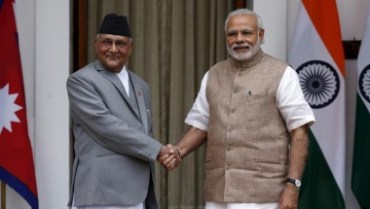
The leaders of Nepal and India have overcome mutual misgivings, India’s foreign secretary said on Saturday, after talks to ease tensions over Nepal’s recently-adopted constitution.

Nepal's Prime Minister Khadga Prasad Sharma Oli (L) shakes hands with his Indian counterpart Narendra Modi during a photo opportunity ahead of their meeting at Hyderabad House in New Delhi, India, February 20, 2016. REUTERS/Adnan Abidi

Prime Minister K.P. Oli visited New Delhi for talks with his Indian counterpart Narendra Modi after a months-long freeze in relations triggered by the grievances of plains dwellers in southern Nepal who have close historical ties to India.

Nepal, which moved from absolute to constitutional monarchy in 1990, made changes to its constitution to ensure greater participation of the Madhesi community in parliament.

But community leaders said the amendments failed to address their central fear that provincial borders would be redrawn in a way that would divide them.

“Our prime minister appreciated the progress made towards consolidation of constitutional democracy in Nepal,” Indian Foreign Secretary Subrahmanyan Jaishankar told a news briefing.

Source: Leaders of Nepal and India mend fences after friction | Reuters

20/02/2016

Pathankot Attack: Pakistan Begins Formal Police Investigation – India Real Time – WSJ

Pakistan has launched a formal police investigation into the alleged involvement of Pakistan-based militants in a deadly attack on an Indian air force base last month, senior government and police officials said Friday.

Six heavily-armed militants attacked the Pathankot air force base on Jan. 2, sparking a battle with Indian forces that lasted more than 40 hours, killed seven Indian security personnel and threatened to dismantle a tentative improvement in relations between Islamabad and New Delhi.

India suspected Pakistan-based Jaish-e-Mohammad, a U.S.-designated foreign terrorist group, was behind the Pathankot attack, and demanded Pakistan take action against the perpetrators.

Source: Pathankot Attack: Pakistan Begins Formal Police Investigation – India Real Time – WSJ

18/02/2016

Is India’s Freedom 251, a $4 Smartphone, Too Good to Be True? – India Real Time – WSJ

A little-known Indian company has announced grand plans to sell millions of made-in-India smartphones for less than $4 a piece, despite the fact that it has only been in the smartphone business for five months and has yet to build a factory.

Ringing Bells Pvt. started taking orders for its Freedom 251 phone on Thursday for 251 rupees ($3.67) each, or less than the price of a McDonald’s Big Mac in the U.S. The company has promised to deliver the phones by June 30–after it builds two manufacturing plants.

Social media lit up with discussion about the device–which the company says will have a four-inch display, 3.2-megapixel camera and 8 gigabytes of storage–after ads for the phone with the tagline “dreams will come true,” appeared in newspapers. Ringing Bells said its phones will have apps that help farmers check soil conditions and fishermen get weather reports.

The company’s website crashed Thursday and it stopped accepting orders for the device as it worked to upgrade its servers, the website said.

At a launch event in a public park Wednesday, thousands turned out to see company President Ashok Chadha unveil a poster-sized image of a phone under a shower of pyrotechnics and confetti. It was an impressive turnout considering only days earlier almost no one had even heard of him, his company or its phone.

Phones given to journalists to try looked as if the branding from another manufacturer had been covered up with white-out on the phone’s front. Indian flag stickers covered the rear. The phones used an Android operating system.

Mr. Chadha said the phone he was sharing was a “beta device.”

Ringing Bells said it would spend 5 billion rupees, or about $73 million, to build the factories. Mr. Chadha said the money will come from the family of Mohit Goel, one of the founders and directors of the company. Mr. Goel’s family owns a farming business, Mr. Chadha said. Attempts to reach Mr. Goel were unsuccessful.

Analysts said they couldn’t see how Ringing Bells could ever make money selling phones for $4.

If Ringing Bells follows through with its plans, the difficulties of setting up manufacturing operations in India could mean it runs into delays that could cause it to miss its June deadline, a spokeswoman for another Indian phone manufacturer said. She said setting up a new factory often takes up to a year.

The company aims produce hundreds of thousands of phones a month and take around 30% of the smartphone market within a year, Mr. Chadha said. Over 100 million smartphones were shipped by manufacturers to retailers in India last year, according to International Data Corp., a research company.

Despite the low price, Mr. Chadha said the company expects to make money on the phones. He said that making the phone using components imported from China would cost about 2,500 rupees per phone. India doesn’t make many components used in phones and other phone sellers in the country import their phones and components from elsewhere.

But Mr. Chadha said he expected to reduce costs through through “economies of scale,” tax breaks for local manufacturing, and other cost-cutting measures. “We are technocrats and have some understanding of international economics,” he said.

Ringing Bells says it will offer a smartphone with a 4-inch display, 3.2 megapixel camera and 8 gigabytes of memory for less than $4. The $33 smartphones powered by Mozilla Corp.’s Firefox operating system have a 3.5 inch display, 2 megapixel camera and 256 megabytes of storage.

Source: Is India’s Freedom 251, a $4 Smartphone, Too Good to Be True? – India Real Time – WSJ

16/02/2016

India and China Have Most Deaths From Pollution – China Real Time Report – WSJ

More than half of the 5.5 million deaths related to air pollution in 2013 happened in India and China, according to a new study.

About 1.4 million people in the South Asian nation and 1.6 million in its northern neighbor died of illnesses related to air pollution in 2013, researchers at the University of British Columbia in Canada said.

The Indian and Chinese fatalities accounted for 55% of such deaths worldwide, the study said.

Researchers studied risk factors for death and disease around the world and found that air pollution, both indoors and outdoors, was one of the leading contributors to global fatalities.

The inhalation of emissions from power plants, vehicles, the burning of crop stubble before replanting, and wood or open fires in homes are some of the leading causes of deaths from air pollution, the report said.

The number of premature deaths linked to air pollution worldwide will increase over the next two decades unless more aggressive targets are set to curb it, researchers studying India and China’s air said at a meeting Friday in Washington D.C.

A major contributor of poor air quality in India is linked to the burning of wood and cow dung for cooking and keeping warm, particularly in the winter months. These methods are popular among India’s rural and urban poor, who don’t have access to electricity or cleaner fuels.

Household air pollution from cooking with wood “is primarily a problem in rural areas of developing countries of the world,” said Michael Brauer, a professor at the University of British Columbia’s School of Population and Public Health, in Canada.

Over the past few months, levels of tiny insidious particles, known as PM 2.5, in the Indian capital New Delhi have often exceeded amounts deemed safe by the United Nations World Health Organization.

Taking their lead from Beijing, Indian authorities in January experimented with restricting cars on roads for two weeks in New Delhi to reduce emission levels. Delhi Chief Minister Arvind Kejriwal said Thursday the city would revive the restrictions for 15 days, starting April 15.

Scientists said vehicle emissions contribute only 20% to 40% of pollution in Delhi, saying other sources of the particulate matter include the burning of dung, rubbish and leaves and the use of diesel backup generators, which kick in when Delhi’s patchy electricity supply cuts out, as well as emissions from small-scale industries such as brick kilns.

A federal environmental court in New Delhi said Feb. 4 it wanted officials to improve air quality by asking authorities to reduce the number of traditional cremations that use wood to burn bodies, a widespread practice in majority Hindu India.

In China, outdoor air pollution from burning coal was found to be the biggest contributor to poor air quality, causing an estimated 366,000 deaths in the country in 2013. Scientists predict 1.3 million premature deaths will take place in China by 2030 if coal combustion remains unchecked.

“One of the unique things about air pollution is you cannot run, you cannot hide from it. We know that if you improve air quality everybody benefits, so from a health perspective reducing levels of air pollution is actually an incredibly efficient way to improve the health of the entire population,” Mr. Brauer said.

Source: India and China Have Most Deaths From Pollution – China Real Time Report – WSJ

12/02/2016

How India Helped Prove Einstein Right on Ripples and Gravity – India Real Time – WSJ

The discovery of gravitational waves announced Thursday has given momentum to Indian scientists hoping to be the first outside of the U.S. to host the device that detected the signals from the collision of two black holes.

Indian scientists contributed significantly to the decades long hunt for evidence of gravitational waves and in identifying that they were produced by the cosmic clash of black holes a billion light- years ago.

The discovery verifies an unproven portion of Albert Einstein’s Theory of General Relativity and, because the waves are largely unimpeded by matter, offers a new way for astronomers to probe formerly hidden corners of the universe. Einstein first suggestedthe existence of gravitational waves in 1916.

Around 30 Indians were part of a 1,000-strong team of researchers from 15 countries led by scientists at the California Institute of Technology and the Massachusetts Institute of Technology, that made the discovery using detectors at the Laser Interferometer Gravitational-Wave Observatory, or LIGO.

“I am so grateful for the major contributions, by Indian scientists working in India and abroad, that helped make this discovery and future discoveries possible,” said Kip Thorne, a Caltech theoretical physicist and co-founder of the LIGO project,  in a statement.

Indian data analysts developed and implemented techniques to find gravitational-wave signals amid noise and the country’s theorists computed the shapes of the signals, he added.

On Thursday, a tweet from the verified account of Indian Prime Minister Narendra Modi said he was “immensely proud that Indian scientists played an important role in this challenging quest.”

Source: How India Helped Prove Einstein Right on Ripples and Gravity – India Real Time – WSJ

10/02/2016

U.S. and India consider joint patrols in South China Sea – U.S. official | Reuters

The United States and India have held talks about conducting joint naval patrols that a U.S. defence official said could include the disputed South China Sea, a move that would likely anger Beijing, which claims most of the waterway.

An Indian Navy personnel gestures on the deck of the newly built INS Kochi, a guided missile destroyer, during a media tour at the naval dockyard in Mumbai, India September 28, 2015. REUTERS/Shailesh Andrade/Files

Washington wants its regional allies and other Asian nations to take a more united stance against China over the South China Sea, where tensions have spiked in the wake of Beijing’s construction of seven man-made islands in the Spratly archipelago.

India and the United States have ramped up military ties in recent years, holding naval exercises in the Indian Ocean that last year involved the Japanese navy.

But the Indian navy has never carried out joint patrols with another country and a naval spokesman told Reuters there was no change in the government’s policy of only joining an international military effort under the United Nations flag.

He pointed to India’s refusal to be part of anti-piracy missions involving dozens of countries in the Gulf of Aden and instead carrying out its own operations there since 2008.

The U.S. defence official said the two sides had discussed joint patrols, adding that both were hopeful of launching them within the year. The patrols would likely be in the Indian Ocean where the Indian navy is a major player as well as the South China Sea, the official told Reuters in New Delhi on condition of anonymity.

The official gave no details on the scale of the proposed patrols.

There was no immediate comment from China, which is on a week-long holiday for Chinese New Year.

China accused Washington this month of seeking maritime hegemony in the name of freedom of navigation after a U.S. Navy destroyer sailed within 12 nautical miles of a disputed island in the Paracel chain of the South China Sea in late January.

The U.S. Navy conducted a similar exercise in October near one of China’s artificial islands in the Spratlys.

Source: Exclusive: U.S. and India consider joint patrols in South China Sea – U.S. official | Reuters

08/02/2016

GDP data to show economy racing, realities less rosy | Reuters

India will release data on Monday showing it remains one of the fastest growing economies in the world, but economists are struggling to reconcile that rosy picture with ground realities like weak exports, investment, and flat corporate order books.

Labourers works at the construction site of a residential building in Mumbai, India, February 4, 2016. REUTERS/Shailesh Andrade

The median estimate from a Reuters poll of economists put GDP annual growth at 7.3 percent in the quarter through December, just below 7.4 percent in July-September.

If the data comes in line with expectations, it would be faster than 6.8 percent growth posted by China in the same quarter.

However, very few economists are ready to take the official data at face value, reckoning that it overestimates the pace of expansion in Asia’s third-largest economy.

“There are inconsistencies between the picture presented by new GDP series and many other tried and trusted real activity indicators,” said Rupa Rege Nitsure, group chief economist, L&T Finance Holdings, Mumbai.

Until a year ago, India was struggling to break out of the longest stretch of below 5 percent growth in a quarter of a century. But a change made a year ago to the method GDP is calculated transformed the lumbering South Asian giant overnight into one of the fastest growing major economies.

Yet, merchandise exports have been falling for the past 13 months. Rural spending is subdued on weak wage growth and two successive droughts.

Corporate order books are flat. While finished goods inventory to sales ratio is showing no improvement, raw material inventory to sales ratio has worsened.

With factories running nearly 30 percent below their capacity, firms are not in a hurry to invest in new plants and machinery. Festering problem of bad loans, meanwhile, has impeded credit flow and delayed full transmission of interest rate cuts.

There are some encouraging signs, however. Robust growth in indirect tax receipts suggest a nascent revival in manufacturing sector. Foreign direct investment is up. Low inflation, thanks largely to a crash in global commodity prices, has helped bolster urban demand.

Source: GDP data to show economy racing, realities less rosy | Reuters

Law of Unintended Consequences

continuously updated blog about China & India

ChiaHou's Book Reviews

continuously updated blog about China & India

What's wrong with the world; and its economy

continuously updated blog about China & India