Archive for ‘India alert’

14/12/2015

Japan, India agree on rail, nuclear deal | The Japan Times

Tokyo and New Delhi agreed to major deals Saturday, including the introduction of Japan’s bullet train technology to India and an agreement on nuclear cooperation.

The bilateral accord was reached during talks in New Delhi between Prime Minister Shinzo Abe and his Indian counterpart, Narendra Modi. “This enterprise will launch a revolution in Indian railways and speed up India’s journey into the future. It will become an engine of economic transformation in India,” Modi said after the talks, referring to the introduction of Japanese shinkansen technology in building a high-speed railway in India. “This project befits the start of a new era for (ties between) Japan and India,” Abe said.

The two countries also agreed on a civil nuclear cooperation pact. Sensitive negotiations had continued for five years on exporting Japan’s nuclear power plant technology to India, with one of the sticking points being whether Japan could ensure that its nuclear technology would not be diverted for military use. India, despite being a de facto nuclear weapons state, has not joined the Nuclear Non-Proliferation Treaty. “Japan is promoting (nuclear) nonproliferation, given the history of Nagasaki and Hiroshima, while India is outside the NPT framework but wants to cooperate on nuclear power generation,” one Japanese official said while noting Japan is the only country to have suffered atomic bombings.

Deputy Chief Cabinet Secretary Koichi Hagiuda, who accompanied Abe on the visit, told reporters after the talks that Japan’s cooperation under the bilateral civil nuclear pact will stop if India conducts a nuclear test. The two projects were the main points of focus of Abe’s three-day visit to India, which began Friday. Japan is keen to tap into India, with its 1.2 billion population, and forge closer ties in light of China’s growing political and economic clout in the region. Under a policy to elevate bilateral ties to what they now call a “Special Strategic and Global Partnership,”

Abe and Modi plan to boost security cooperation between the two nations and exchange views on regional issues such as the situation in the South China Sea, Japanese officials said. While Japan and India are not directly involved in the tensions in the South China sea, a key shipping route for oil and other imports, they are both concerned over the freedom of navigation in international waters. China claims almost the entire South China Sea and has competing territorial claims with Vietnam, the Philippines, Brunei, Malaysia and Taiwan. Beijing’s fast-paced and massive land reclamation work has made the smaller Asian claimants uneasy. Seeing India’s potential value to Japan, both on the economic and political fronts, Abe has touted the importance of strengthening bilateral ties to help maintain peace and stability in Asia. Abe’s latest trip to India is his third visit as prime minister. The shinkansen technology will be applied to a planned 500-km-long high-speed railway that will link Mumbai and Ahmedabad in western India and take roughly two hours.

Japan, which is seeking to spur its economy through infrastructure exports to Asia, is looking to play catch-up after losing out to China in its bid to secure a key high-speed railway contract in Indonesia in October. Construction of the Indian railway project, which is estimated to cost 980 billion rupees ($14.6 billion), will begin in 2017, with the aim of starting operations in 2023. Japan has sounded out India about a plan for Tokyo to provide yen loans on the premise that the railway contract will be given to a consortium of Japanese firms, a Japanese government source said.

The two leaders also signed others pacts, including one that allows the transfer of defense equipment to India and another on data protection, which allows the exchange of defense-related information. The moves reflect Tokyo’s desire to forge closer ties with New Delhi due to China’s muscle-flexing.

When Modi visited Japan last year, Abe vowed to extend ¥3.5 trillion in public and private investment and financing to India over five years for development. Japan also pledged a ¥50 billion loan to India for a public-private partnership infrastructure project.

Source: Japan, India agree on rail, nuclear deal | The Japan Times
10/12/2015

Why Delhi Doesn’t Have a Beijing-Style Response to Pollution – China Real Time Report – WSJ

The cities of Delhi and Beijing share a dubious honor as the world’s most-polluted capitals. But their response to dangerous levels of air pollution separates them.

Earlier this week, Beijing for the first time issued a red-alert for pollution, triggered when authorities forecast air-quality levels above 300 for at least three consecutive days.

On China’s government index, a measure of overall air quality, the maximum reading of 500, is described by the government as “severely polluted.” The Chinese administration immediately sent cars off the roads, shut factories and urged schools to close.

In Delhi, where air was similarly dirty, life went on as normal. The starkly different responses prompted some in the Indian capital to question why their government wasn’t taking Beijing-style measures to combat the smog. For sure, plans are underway in India to tackle the capital’s filthy air.

On Friday, Delhi’s government announced it would impose restrictions on the number of cars on its roads from Jan.1. Residents in the Indian city can look up air-pollution data on the website of The System of Air Quality and Weather Forecasting and Research, known as Safar, which uses data collected at 10 locations in the city. On that index, air quality in the city regularly hits “very poor” conditions when levels of PM 2.5 — insidious particles in the air including dirt, soot, smoke and liquid droplets — spike.

These tiny particles are thought to be particularly dangerous because they can lodge deeply in the lungs and cause inflammation, infection and lead to diseases including cancer. Readings on the Safar monitor are calibrated from “good” to “severe.” The Delhi Pollution Control Committee also publishes raw pollution data but doesn’t give qualitative readings alongside.

The U.S. Embassy, which measures pollution on monitors at its compound in the capital and around the country, warns the very young and elderly to remain indoors whenever air quality becomes what it calls hazardous. But none of the readings currently trigger alerts, or responsive action, by Delhi’s government. That’s because India is a democracy, said Ashwani Kumar, chairman of the Delhi Pollution Control Committee, an arm of the state government.

China, of course, is a one-party state. The idea that alerts should tell people to stay indoors when smog hits was  “absurd,” Mr. Kumar added, and people “should decide for themselves what to do with the pollution information.” However, he said the Delhi Pollution Control Committee does plan to introduce an app so that information is available to residents with smartphones. Less than 10% of Indians own a smartphone. It also proposes to install around 70 big screens in strategic locations around the city advising residents what they can do to reduce pollution, Mr. Kumar added. The idea of an environmental alert system is not alien to India.

Source: Why Delhi Doesn’t Have a Beijing-Style Response to Pollution – China Real Time Report – WSJ

30/11/2015

Smog chokes Chinese, Indian capitals as climate talks begin | Reuters

The capitals of the world’s two most populous nations, China and India, were blanketed in hazardous, choking smog on Monday as climate change talks began in Paris, where leaders of both countries are among the participants.

China’s capital Beijing maintained an “orange” pollution alert, the second-highest level, on Monday, closing highways, halting or suspending construction and prompting a warning to residents to stay indoors.

The choking pollution was caused by the “unfavourable” weather, the Ministry of Environmental Protection said on Sunday. Emissions in northern China soar over winter as urban heating systems are switched on and low wind speeds have meant that polluted air has not been dispersed.

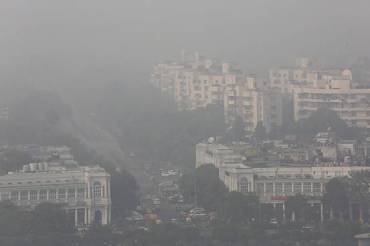
In New Delhi, the U.S. embassy’s monitoring station recorded an air quality index of 372, which puts air pollution levels well into “hazardous” territory. A thick smog blanketed the city and visibility was down to about 200 yards (metres).

Air quality in the city of 16 million is usually bad in winter, when coal fires are lit by the poor to ward off the cold. Traffic fumes, too, are trapped over the city by a temperature inversion and the lack of wind.

However, the government has not raised any alarm over the current air quality and no advisories have been issued to the public. Thirty thousand runners took part in a half marathon at the weekend, when pollution levels were just as high.

In Beijing, a city of 22.5 million, the air quality index in some parts of the city soared to 500, its highest possible level. At levels higher than 300, residents are encouraged to remain indoors, according to government guidelines.

The hazardous air underscores the challenge facing the government as it battles pollution caused by the coal-burning power industry and will raise questions about its ability to clean up its economy at the talks in Paris.

Chinese President Xi Jinping and Indian Prime Minister Narendra Modi are both in Paris and both were scheduled to meet U.S. President Barack Obama on Monday to give momentum to the two-week negotiations.

Source: Smog chokes Chinese, Indian capitals as climate talks begin | Reuters

24/11/2015

Modi woos investors in Singapore – The Hindu

Promising more reforms to make India more attractive for foreign investments, Prime Minister Narendra Modi on Tuesday assured investors that he would “carefully hold” their hands and expressed hope that the GST would be rolled out in 2016.

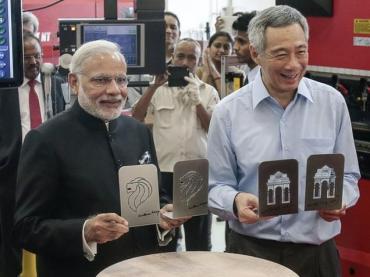
Prime Minister Narendra Modi and Singapore Prime Minister Lee Hsien Loong at the Institute of Technical Education College in Singapore on Tuesday.

Speaking at the India Singapore Economic Convention, Mr. Modi said India is exploring a potential partnership with Singapore’s Changi Airport for developments of two Indian airports and invited companies to join in building smart cities.

“In the last 18 months, the runways for the take-off of the economy have been made. Reforms are happening in a big way. They are now reaching to the last mile. Reform is to transform the system so that they perform. They aim at helping people realise their dreams. It means more charm on the faces and less forms in the offices. Efforts to deepen financial markets have been made,” he said.

‘Most open economy

The Prime Minister said his government began to liberalise FDI laws soon after coming to power last year and the latest round of FDI reforms have made India the “most open economy” in the world.

“We are also conscious of last mile operational issues in such matters and we are fine tuning the norms. Recently, we further eased FDI norms, after which India is the most open economy in terms of FDI,” he added.

While talking about 40 per cent increase in FDI and improvement in rankings like ease of doing business and world competitiveness index, Mr. Modi said, “Perceptions are turning into positive outcomes”.

“We are hopeful to roll out GST regime in 2016. The company law tribunal is being set up. FDI inflows have gone up by 40 per cent compared with previous year’s comparative period. Perceptions are turning into positive outcomes. FDI commitments are translating into reality,” he noted.

Modi also outlined 14 decisive steps taken to address regulatory and taxation concerns and said that India offers tremendous opportunities for investments, ranging from affordable housing to smart cities, railways to renewable energy.

Source: Modi woos investors in Singapore – The Hindu

15/11/2015

How Modi Dealt With Pointed Questions From the British Press – India Real Time – WSJ

Narendra Modi hasn’t given a news conference in India since becoming prime minister last year.

So when he arrived in the U.K. on Thursday and addressed the media with his counterpart, David Cameron, British reporters seized the opportunity to ask a few pointed questions.

Referring to recent incidents of religious violence, BBC correspondent Justin Rowlatt kicked off by asking Mr. Modi: “India is becoming an increasingly intolerant place. Why?”

Mr. Modi answered, in Hindi: “India is the land of Buddha. India is the land of Gandhi. And so, it is in our culture and blood that we don’t accept anything against the basic values of society.”

He continued: “For us, every incident is serious. We don’t tolerate it under any circumstances. Law takes strict action and will continue to do so. India is a vibrant democracy, and its constitution provides for the safety of people from all strata of society. We are committed to protecting freedom of thought.”

A little later in the news conference, Guardian reporter Nicholas Watt asked Mr. Cameron what he felt about the visit. “How comfortable do you feel welcoming Prime Minister Modi to this country given that for the first two years of your premiership he was not permitted to visit this country because of his record as chief minister of Gujarat?”

The U.K. distanced itself from Gujarat and Mr. Modi after religious riots in the state that killed more than 1,000 people, mostly Muslims, in 2002, when Mr. Modi was the state’s top official. Mr. Modi has denied wrongdoing and court investigations have said there isn’t enough evidence to prosecute him.

Mr. Watt then asked about Europe’s migrant crisis and the U.K.’s referendum on European Union membership before turning back to India.

“Prime Minister Modi, can I ask you: Tomorrow night you will obviously have a rapturous reception at Wembley Stadium. But there are a number of protesters out today who are saying—and I am wondering what you say to them—that given your record as chief minister of the state of Gujarat, you do not deserve the respect that would normally be accorded to the leader of the world’s largest democracy.”

Mr. Cameron answered by citing Mr. Modi’s “record and historic majority” in the Indian parliament after the 2014 election. Mr. Modi then said he was never denied entry to the U.K. The U.S. refused him a visa in 2005 based on his response to the riots but issued him one in 2014, after he became prime minister.

“To keep the record straight, I would like to give some information,” Mr. Modi said. “I came here in 2003 and received a big welcome and respect, and participated in several programs. The U.K. has never stopped me from coming here, has never imposed any restrictions. I couldn’t come here due to a lack of time. That’s a different issue. So this is a wrong perception. Please correct it.”

Mr. Modi then spoke on the British referendum and proceeded to take a question on trade and economic cooperation from an Indian reporter. He never directly addressed the last part of Mr. Watt’s question.

Source: How Modi Dealt With Pointed Questions From the British Press – India Real Time – WSJ

12/11/2015

LIVE: PM Modi arrives in UK – The Hindu

Indian Prime Minister Narendra Modi’s Air India aircraft made touchdown this morning at 10 a.m. in Heathrow for his long-awaited bilateral level visit to the United Kingdom — his first since becoming Prime Minister.

Prime Minister Narendra Modi and his British counterpart David Cameron with their delegations during talks at 10, Downing Street in London on Thursday. Photo: PMO

He was met at the airport by Hugo Swire, Minister of State for the Foreign Office, and Priti Patel, Minister for Employment and Diaspora Champion in the David Cameron government. His visit carries expectations for agreements and partnerships worth billions of dollars across defence, security, finance and sectors like education, research and health.

Mr. Modi is accompanied by a high power business delegation that included Cyrus P. Mistry, chairman, Tata Sons, Sunil Bharti Mittal, chairman, Bharti Enterprises Limited and N. Chandrasekaran, CEO and managing director of Tata Consultancy Services.

Mr. Modi will be greeted by a Guard of Honour at Westminster,which will be followed by delegation level talks at 10 Downing Street with Mr. Cameron. The two Prime Ministers will address a joint press conference after which Mr. Modi will deliver his speech in parliament. He will also garland the statue of Mahatma Gandhi in Parliament Square. The evening will see important agreements between the two country delegations finalised at Guildhall, City of London. Mr. Modi will stay the night at the Prime Minister’s country residence at Chequers.

The pomp and ceremony attached to the visit is expected to include a special tricolour flypast by the Red Arrows Royal Air Force (RAF) Aerobatic Team over the Buckingham Palace before the Prime Minister sits down for lunch with Queen Elizabeth II ahead of his mega diaspora address at the iconic Wembley Stadium in north London.

Source: LIVE: PM Modi arrives in UK – The Hindu

07/11/2015

Modi pledges 800 billion rupees in relief and development for Kashmir | Reuters

Prime Minister Narendra Modi pledged 800 billion rupees ($12.10 billion) in funds to bolster development and economic growth in Kashmir, a year after the worst flooding in more than a century destroyed half a million homes there.

Addressing several thousand people in a cricket stadium in the northern state’s capital of Srinagar, Modi said he wanted to go beyond helping flood victims. He promised to create jobs for Kashmiri youth by improving education and promoting industries, including tourism and cashmere wool.

“The biggest task at hand here is to find work for the youth of Kashmir and Ladakh … our youth should get the cheapest and the best education, and of global standards,” he said. Ladakh is another mountainous region in the north.

Saturday’s visit is Modi’s first this year to the disputed territory which has been plagued by militant violence for years. Nuclear-armed rivals India and Pakistan both claim Kashmir in full but rule it in part.

Violence in India’s only Muslim-majority region has eased significantly from levels in the 1990s, when armed revolt against Indian rule erupted.

Kashmiris have been protesting against a lack of central aid for last year’s floods that the state government estimates caused $16 billion of damage.

Security forces in Kashmir detained nearly 400 separatists on Friday to prevent them from holding an anti-government protest march during Modi’s visit.

Hours before Modi’s rally, in footage screened on national television, police detained an independent parliamentarian, Engineer Rashid, for protesting with black flags.

Security was tight with paramilitary forces and sharpshooters deployed, while schools and colleges were shut. Internet services were suspended hours before Modi arrived.

In his 40-minute speech, Modi highlighted progress, promising improved road and rail networks, as well as branches of India’s prestigious management and technology institutes.

“Kashmir has suffered a lot … the dreams of several generations have been shattered, but I have the confidence that my Kashmir will rise again,” he said.

Comparing the devastation from the floods to that in his home state of Gujarat after an earthquake in 2001, Modi said: “thousands died … homes were destroyed … nobody believed we would be able to rebuild so quickly.”

India accuses Pakistan of backing the separatist militants fighting security forces in Indian Kashmir. Pakistan denies that saying it only offers diplomatic support to Kashmir’s suppressed Muslims.

Source: Modi pledges 800 billion rupees in relief and development for Kashmir | Reuters

06/11/2015

India’s Consumers Are World’s Most Confident – India Real Time – WSJ

India might be facing a slow recovery, but consumers aren’t deterred, putting the country at the top of a confidence survey of major economies.

India came first for consumer confidence among 61 countries in the July-September period in the online survey conducted by New York-based research firm The Nielsen Company.

The country’s positive reading, which measures perceptions of local job prospects, personal finances and spending intentions, comes at a time when confidence declined in eight of the 14 countries in the Asia-Pacific region.

“Indian consumers continue to declare a resilient outlook in the face of uncertainty in the broader economy,” said Roosevelt D’Souza, senior vice president, Nielsen India Region.

Despite weak economic indicators, a poor monsoon and volatility in the job market, Indians’ belief in the fundamental prospects of the country’s economic future appear unshaken and the proportion of consumers who see brighter days ahead are growing, Mr. D’Souza said.

The Indian central bank’s softer interest rate regime and lower inflation are also likely to brighten the prospects of further improvement in consumer confidence, the survey shows.

This might be good news for the economy and consumer goods companies, who reported slow growth in their revenues for the past few quarters because of lower purchases by rural consumers.

China, India’s bigger neighbor and the world’s second-largest economy, ranked ninth in the survey, while the U.S. occupied second place.

The U.S. showed the biggest quarterly improvement of 18 points in the consumer confidence index, but China showed a decline of one point. Its economy has been racked in recent months by an unexpected slowdown and stock market rout.

Other Asian countries that found a place in the top 10 are the Philippines, Indonesia, Thailand.

Source: India’s Consumers Are World’s Most Confident – India Real Time – WSJ

06/11/2015

Xiaomi’s Big Bet on Indian Internet Revolution Starts to Pay Off – China Real Time Report – WSJ

The sales are a significant rise compared with the three million phones the company said it sold in its first year of business in India.

Xiaomi aims to sell 80 to 100 million smartphones this year and has been valued by investors at $46 billion. But increasing competition at home, from companies who mimic Xiaomi’s business model of selling high-end phones at low prices, will make it tough to meet its sales target. So the five-year-old startup is setting its hopes on growth in India. Xiaomi found success in China by combining razor-thin profit margins on hardware with glitzy product launches that helped build its fanbase.

The closely-held company needs to prove that it can export its business model to other countries to continue to justify its high valuation.

Xiaomi introduced its first model, the Mi 4i, outside China, at a launch in New Delhi in April. In August, it said it would begin assembling its entry-level Redmi 2 Prime in India.

Xiaomi’s recent success in India shows that its model can work there, said the company’s Vice President Hugo Barra. Since January, sales in the South Asian country increased 45% quarter-over-quarter, on average.

The firm’s Indian office is tweaking Xiaomi’s model of Internet flash sales, designed to boost demand and cut costs. During the company’s sale for the Hindu holiday Diwali, items were sold for as little as a rupee. “Some people bought a Mi TV for one rupee,” Mr. Barra said. One rupee is equal to $0.02. The heavily discounted deals meant that Xiaomi spent nothing on marketing. “This is an idea the India team came up with that you will see reused in other markets,” he said. The company still faces challenges in India.

While Xiaomi says it sold three million phones in its first year in India, market leader Micromax Informatics Ltd. says it sells three million phones a month. While the Chinese company relies mostly on online sales to cut costs, the majority of Micromax’s sales are in brick-and-mortar retail outlets, where most Indians still shop.

It remains unclear how much India can help bolster Xiaomi’s balance sheet. While smartphone sales are booming in India, the market is still tiny.

Xiaomi’s Mr. Barra says the company will slowly add to its catalogue of products in India, which currently includes phones and a handful of accessories like headphones and a fitness tracker. In China, Xiaomi sells everything from water purifiers to power strips.

Next up could be the company’s line of Internet routers, Mr. Barra said, which includes a model with six terabytes of storage.

“We are looking at bringing the router family to India,” he said. But don’t expect the smart bathroom scale to show up in India right away, or even the company’s newest gadget: a cut-price Segway-like device. “We carefully select things that will sell in India in good volumes. We have to be thoughtful and plan carefully.”

Source: Xiaomi’s Big Bet on Indian Internet Revolution Starts to Pay Off – China Real Time Report – WSJ

02/11/2015

The power of parity: Advancing women’s equality in India | McKinsey & Company

India has a larger relative economic value at stake from advancing gender equality than any of the ten regions analyzed in a recent McKinsey Global Institute report, The power of parity: How advancing women’s equality can add $12 trillion to global growth.

If all countries were to match the momentum toward gender parity of the fastest-improving countries in their region, $12 trillion a year could be added to global GDP. What’s more, India could add $700 billion of additional GDP in 2025, upping the country’s annual GDP growth by 1.4 percentage points (exhibit).

Our new report, The power of parity: Advancing women’s equality in India, reveals that about 70 percent of this “best in region” potential would come from raising women’s participation in India’s labor force by ten percentage points between now and 2025, bringing 68 million more women into the labor force—70 percent of them in just nine states. This will require bridging both economic and social gender gaps. To determine this, we have created a measure of gender equality for Indian states: the India Female Empowerment Index, or Femdex. Our analysis shows that scores vary widely, and India’s challenge is that the five states with the lowest gender inequality account for just 4 percent of the female working-age population; the five states with the highest inequality account for 32 percent.

Eight priority actions can help accelerate progress, including education and skill-building, job creation in key sectors, corporate policies to promote diversity, and programs to address deep-rooted mind-sets about the role of women in work.

Source: The power of parity: Advancing women’s equality in India | McKinsey & Company

Law of Unintended Consequences

continuously updated blog about China & India

ChiaHou's Book Reviews

continuously updated blog about China & India

What's wrong with the world; and its economy

continuously updated blog about China & India