Archive for ‘India alert’

21/10/2015

India’s Bharat Petroleum Wants to Use Gas Stations to Bring E-Commerce to Rural India – India Real Time – WSJ

Bharat Petroleum Corp. Ltd., India’s lumbering state-run fuel company, is planning use its nationwide network of 12,800 gas stations to deliver online retail to rural India.
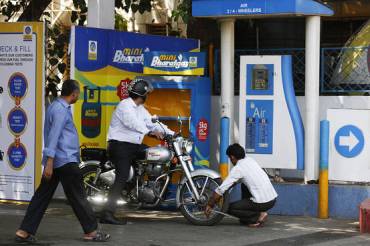
The oil refiner and retailer is hoping it can leverage its outlets and logistical staff across India to succeed as a latecomer to India’s ongoing online retail boom. It is upgrading its technology and logistics network to be able to sell farmers everything from fertilizer to smartphones.

The e-commerce push will begin December, with BPCL’s rural gas and cooking gas distributors starting to accept orders and payments online, said BPCL Chairman and Managing Director S. Varadarajan.  As early as next year, the company is also considering using its urban branches to sell and distribute groceries.

While the early movers in e-commerce in India such as Flipkart Internet Pvt. Ltd.’s flipkart.com, Jasper Infotech Pvt. Ltd.’s snapdeal.com and Amazon Seller Services Pvt. Ltd.’s amazon.in are still struggling to find cost-effective ways to reach the hundreds of millions of Indians who live outside the biggest cities, BPCL already has employees and properties throughout the country.

“About 30% of our retail outlets are in rural India,” Mr. Varadarajan said. Rural customers can shop online then “pick up stuff when they fill fuel at their local gas station.”

India’s state-run oil refiners are desperate to find new sources of revenues as the fall in oil price as well as increased competition from the private sector weigh on their sales.

BPCL’s retail ambitions are “a response to competition by improving margins,” said Deepak Mahurkar, head of PwC’s Oil & Gas Industry practice in India.

Analysts say that while BPCL does theoretically have unique access to much of India’s middle class, which uses its stations to refuel their cars and motorcycles, whether this traditionally slow-moving company can capture a corner of the rapidly-evolving online retail business remains to be seen.

BPCL has prime properties on the main streets and highways across the country, but few of its gas stations have the facilities or the staff to do more than pump gas. Many don’t even have running water in their bathrooms, much less the Internet connections, storage facilities and delivery technology a vibrant e-commerce company would require.

Diving into e-commerce would necessitate a big change in mindset for BPCL which is not used to worrying much about competition or consumers, said Anand Kumar Jaiswal, who heads the Centre for Retailing at IIM Ahmedabad, an Indian management school.

“I am really skeptical about it,” said Vishnu Kumar, an assistant vice president for research at Chennai-based broker Spark Capital Advisors (India) Pvt. Ltd.  “If I am a consumer I am not going to check with BPCL for a microwave.”

Even people within BPCL’s own network doubt the company can pull it off.

Sachin Shah, the manager of a company that delivers BPCL cooking gas cylinders to more than 20,000 customers in the southern city of Hyderabad, said the company will have to radically improve its logistics system to guaranteed delivery if it wants to sell more than gas cylinders and gas stoves

“If Bharat Petroleum doesn’t deliver, I will lose face,” he said.

BPCL’s Mr. Varadarajan said the company is confident it can deliver because it will use its best dealers and a new distribution system to get products to customers.

Source: India’s Bharat Petroleum Wants to Use Gas Stations to Bring E-Commerce to Rural India – India Real Time – WSJ

18/10/2015

Top African leaders to meet PM Modi in his trademark jacket

PM Narendra Modi has not only gained prominence across world for giving a personal touch in his diplomatic efforts but he is also famous for his impeccable dress sense. Prime Minister will take the diplomatic skills to new level when he will host a dinner for top African leaders later this month.

Top African leaders to meet PM Modi in his trademark jacket

According to a report in The Times of India, All of the 42 heads of state and government, who are attending the 3rd India-Africa Forum Summit, from Egyptian President Abdel Fattah el-Sisi to South African counterpart Jacob Zuma, will attend the dinner wearing Modi’s trademark jacket. They are specially designed by government agencies.

The bundi waistcoat that PM Modi made his own accessory will be at the heart of his latest bit of sartorial diplomacy. The sleeveless jackets will be available in several brilliant colours.

The African leaders will also be wearing unique ‘ikkat kurta’ (no pyjamas) being gifted to them by the government during their visit to India.

A senior African diplomat said to TOI that he was really impressed with the attention PM Modi was giving to the summit despite his hectic campaigning for Bihar elections.

Source: Top African leaders to meet PM Modi in his trademark jacket

18/10/2015

Sonia says Modi govt imposing its ideology on people – The Hindu

Congress president Sonia Gandhi on Saturday blamed the Modi government for the growing intolerance to intellectuals and communal tensions in the country. The government, she said, was anti-poor and corporate-friendly.

Congress president Sonia Gandhi at an election rally in Buxar, Bihar on Saturday. Photo: Ranjeet Kumar

“Ever since Narendra Modi came to power, the intellectuals are being harassed and an effort has been made to stoke communal tensions through rumours. The BJP is trying to enforce its own ideology on people. It is shameful,” she said at election meetings at Buxar and Chappra. Her comments refers to the recent lynching of a man at Dadri in Uttar Pradesh and writers returning their Sahitya Academy awards.

“Modiji, Hindu aur Musalmaan apas main ladte nahi, balki unko ladaya jata hai… kyunki communal jhagde band ho gaye toh kuch logo ki dukaandari band ho jayegi, aur yeh BJP se behtar kaun janta hai? [Mr. Modi, Hindus and Muslims don’t clash with each other but they are being pushed to do it … If communal clashes are being stopped, many people’s business will be closed, and who knows this better than the BJP?],” she said.

Ms. Gandhi said the Modi government worked only for big businesses and had no concern for the poor.

She said the Congress would not allow the Goods and Services Tax (GST) Bill to go through the Rajya Sabha as it was against the welfare of the people. “The UPA government wanted the GST law for the development of industry, but we are opposing it now for the welfare of the people,” she said.

“Mr. Modi speaks much but delivers little. Has he delivered on the tall claims made by him during the last Lok Sabha polls,” she asked. When the crowd yelled “no”, she said: “It is high time he understood the pain of the people.”

The government was silent when pulse prices were rising, farmers were committing suicide and unemployment among the youth was rising, she said.

Taking on Mr. Modi for alleging that the Congress had done little in the past 60 years of its regime, Ms. Gandhi said: “When we got freedom, we had nothing; but the Congress government did revolutionary works in education, health and employment in the past 60 years. We maintained the unity and integrity of the country and strengthened democracy.”

Source: Sonia says Modi govt imposing its ideology on people – The Hindu

15/10/2015

Indian Startup Seclore Gains Traction Amid High Profile Hacks – India Real Time – WSJ


Bad news for corporate hacking victims can be good news for information security firms. Just ask Vishal Gupta, founder and chief executive of Mumbai, India-based Seclore.

Amid a string of high profile breaches like those that have hit Sony Pictures, health insurer Anthem  and infidelity website Ashley Madison, Mr. Gupta’s firm has been quietly gaining clients in the U.S. and elsewhere.  Among them  are U.K.-based drug maker AstraZeneca PLC, Japanese electronics giant Panasonic Corp., German automotive company Daimler AG and U.S. cable firm Comcast Corp.

The company, while not as prominent as cybersecurity firms like FireEye Inc. or Palo Alto Networks Inc., targets an important but sometimes overlooked niche: locking down sensitive documents even when they are emailed outside clients’ networks. Seclore’s tools ensure that sensitive information like financial statements and  payroll information cannot be altered or printed if they are shared with unauthorized users via email.

Seclore, which has about 200 staff and was founded in 2009,  still has a small annual revenue base of around $10 million but Mr. Gupta said his startup has become profitable in the last three quarters, helped by a growing number of clients in the U.S.. Seclore has received some $7 million of investments from the likes of India-focused venture capital firms Helion Venture Partners and Ventureast.

Mr. Gupta said that while companies like Microsoft Corp. offer competing products, he considers his biggest challenge to be finding and keeping top talent in order to keep up with rising demand.

“Information security has truly become a boardroom topic,” Mr. Gupta said.

Source: Indian Startup Seclore Gains Traction Amid High Profile Hacks – India Real Time – WSJ

15/10/2015

Nobel Prize Winner Angus Deaton on the Chinese and Indian Miracles – China Real Time Report – WSJ

Angus Deaton, the economist who won a Nobel Prize this week, has spent much of his career trying to measure poverty and progress in India and China.

He won the Royal Swedish Academy of Sciences award in economics by devising systems to understand consumption and poverty using household surveys and number crunching.

“Deaton’s focus on household surveys has helped transform development economics from a theoretical field based on aggregate data to an empirical field based on detailed individual data,” the academy said.

His decadeslong deep dive into data on the poor, their spending habits and their health gave him a surprisingly upbeat assessment of human progress, largely owed to the great strides that have been made in China and India. His book, “The Great Escape: Health, Wealth, and the Origins of Inequality,” documented why the world is a better place to live than it used to be.

A recent World Bank report suggested that more than one billion people might have been lifted out of extreme poverty already this century. Most of that progress was in China and India.

Here are a few of the things Mr. Deaton said in his book about the massive shifts in China and India that are changing the world.

On what China and India have taught us … “China and India are the success stories; rapid growth in large countries is an engine that can make a colossal dent in world poverty.”

On infant mortality in India and China … “India’s decline in infant mortality has been remarkably steady–not at all responsive to changes in the rate of growth–and the absolute decline from 165 out of every 1,000 babies dying in the early 1950s to 53 in 2005-10, is actually larger in absolute numbers than the decline in China, from 122 to 22.”

On how Chinese and Indian bodies have evolved with the economy… “Indian children are still among the skinniest and shortest on the planet but they are taller and plumper than were their parents or grandparents … Indians too are now growing taller decade by decade, though not as quickly as happened in Europe, or indeed as is now happening in China, where people are growing at about (the now familiar figure of) a centimeter every decade. Yet the Indian escape is only half as fast–about half a centimeter a decade–and that figure is for men; Indian women are growing too, but at a much slower rate, so that it takes them sixty years to grow a centimeter.”

On a better measure showing how China and India have lifted the world … “Although China and India are only two countries, their rapid growth at the end of the century meant that around 40% of the world’s population lived in countries that were growing very rapidly … (Thus) the average country grew at 1.5% a year in the half century after 1960, but the average person lived in a country that was growing at 3%.”

On how long the miracle can continue …  “At least over the past half-century the fast-growing countries in one decade have tended not to repeat their performance in the next or subsequent decades. Japan used to be the place that had perpetually high growth, until it didn’t any more. India, now one of the most rapidly growing countries, seemed capable of only slow growth for much of its existence, not to speak of the half-century that preceded its independence, when there was no growth at all. China is the current long-run superstar, but by historical standards the longevity of its growth spurt is extremely unusual.”

On the difficulty of defining poverty …  “In India, as in any country where a substantial fraction of the population is poor, there are millions of people who are close to poverty, either just above or just below the line … We don’t really know where the line should be, yet its precise position makes a huge difference. To put it more brutally, the truth is that we have little idea what we are doing.”

Source: Nobel Prize Winner Angus Deaton on the Chinese and Indian Miracles – China Real Time Report – WSJ

06/10/2015

World Bank estimates show fall in India’s poverty rate – The Hindu

The World Bank has revised the global poverty line, previously pegged at $1.25 a day to $1.90 a day (approximately Rs. 130). This has been arrived at based on an average of the national poverty lines of 15 poorest economies of the world. The poverty lines were converted from local currency into U.S. dollars using the new 2011 Purchasing Power Parity (PPP) data.

The global poverty line, previously pegged at $1.25 a day, has been revised to $1.90 a day (nearly Rs.130).

In its latest report ‘Ending Extreme Poverty, Sharing Prosperity: Progress and Policies’, authors Marcio Cruz, James Foster, Bryce Quillin, and Phillip Schellekkens, note that world-wide poverty has shown a decline under these new estimates.

The latest headline estimate for 2012 based on the new data suggests that close to 900 million people (12.8 per cent of the global population) lived in extreme poverty.

With the Sustainable Development Goals adopted in September, seeking to end all forms of poverty world over, the World Bank Group has set itself the target of bringing down the number of people living in extreme poverty to less than 3 per cent of the world population by 2030.

Source: World Bank estimates show fall in India’s poverty rate – The Hindu

05/10/2015

India’s Competitive Ranking Surges on the Back of Modi Momentum – India Real Time – WSJ

India leapt 16 places to 55th position in the latest ranking of economies’ competitiveness released by the World Economic Forum Wednesday.

The Geneva-based think tank says India is a “bright spot” among larger emerging markets, which have shown a broader trend of either a decline or stagnation. It attributes the country’s big rise–which comes after five years of decline–to the election of Prime Minister Narendra Modi last year, which ignited optimism about the country’s limping policy changes.

“This dramatic reversal is largely attributable to the momentum initiated by the election of Narendra Modi, whose pro-business, pro-growth, and anti-corruption stance has improved the business community’s sentiment toward the government,” the WEF says in the report, which includes the Global Competitiveness Index 2015–2016 Rankings.

The ranking is based on the assessment of 140 countries on 12 parameters such as infrastructure, macroeconomic environment, institutions, health and education, among others.

The report says the quality of India’s institutions was judged more favorably in the latest ranking while its macro-economic stability has improved, with easing inflation and a gradual drop in the government’s budget deficit since its 2008 peak. Infrastructure has also improved, the report said.

“The fact that the most notable improvements are in the basic drivers of competitiveness bodes well for the future, especially the development of the manufacturing sector,” the report said.

However, India needs to improve its technological readiness: it is one of the least digitally connected countries in the world.Fewer than one in five Indians use the Internet regularly, and fewer than two in five own even a basic cell phone, according to the report.

The ranking of regional rival China has barely budged in the past six years as it has been dealing with rising production costs, an aging population and diminishing returns on the massive capital investments of the past three decades.

However, its 28th position–unchanged  from the previous year–is still much higher than India’s.

China remains by far the most competitive among larger emerging economies. “However, its lack of progress moving up the ranking shows the challenges it faces in transitioning its economy,” the report said.

Switzerland, Singapore and the U.S. were the top three ranked, unchanged from the previous year.

In Asia, Malaysia ranked 18th, up two places, Indonesia ranked 37th, down three notches while Thailand ranked 32nd, down one position.

Among the remaining BRICS group of countries, Brazil was at number 75, plummeting from 57 last year. The Russian Federation was at number 45, up from 53 and South Africa was at 49, better than 56 last year.

Source: India’s Competitive Ranking Surges on the Back of Modi Momentum – India Real Time – WSJ

05/10/2015

U.K.’s Marks & Spencer Is Aiming to Double India Store Count – India Real Time – WSJ

Marks & Spencer Group PLC said it is on track to double its store count in India in the next 15 months, an ambition that poses both risks and opportunities for the British retailer.

M&S has recently struggled in troubled markets such as Russia, Ukraine and Turkey and was forced to reconfigure its footprint in China, but India has emerged as a relative bright spot. Revenue climbed 23% last fiscal year.

“I think there is an instinctive understanding of M&S in India,” said the company’s head of international business, Patrick Bousquet-Chavanne.

M&S is in 21 cities in India so far, with a focus on large cities such as Mumbai, Delhi and Kolkata. Now, M&S is looking to deepen its exposure to India. It plans to open stores in less-developed cities, such as Vijayawada, Jalandhar and Vizag, during the current fiscal year ending in March, while also beefing up its footprint in larger cities.

The company—which operates in India through a joint venture with Reliance Industries Ltd., one of India’s largest companies—in early October will open its 50th store in India, in Mumbai’s Chhatrapati Shivaji airport.

Source: U.K.’s Marks & Spencer Is Aiming to Double India Store Count – India Real Time – WSJ

29/09/2015

Google’s Sundar Pichai Welcomes India’s Modi to Silicon Valley – India Real Time – WSJ

Before Indian Prime Minister Narendra Modi touches down in Silicon Valley at the weekend, one of his country’s most-successful sons has welcomed him to the U.S. tech hub.

Sundar Pichai, the Indian-born Google CEO, says in a video message that “there is tremendous excitement” about Mr. Modi’s arrival in the valley “among all Googlers” a shorthand for people who work at the search engine giant.

Mr. Modi will meet with Mr. Pichai and other Indian-born CEOs, including Satya Nadella of Microsoft Corp., during his valley visit and tour Google’s headquarters where he will look at inventions in healthcare and smartgrid technology. His visit comes after Chinese President Xi Jinping held a roundtable in Seattle with U.S. and Chinese CEOs including Tim Cook of Apple Inc. and Jeff Bezos of Amazon.com on Wednesday.

“The bond between India and Silicon Valley is strong. India has long been an exporter of talent to tech companies,” Mr. Pichai says in the two minute clip.

Raised in the southern city of Chennai and attending the legendary Indian Institute of Technology, Mr. Pichai became CEO of Google in August having started out at the company in 2004 as a semiconductor engineer after gaining a graduate degree from Stanford University and an M.B.A. from the University of Pennsylvania’s Wharton School. More In Google Who Is Google’s Sundar Pichai? Why Indian Managers Are Succeeding in Tech’s C-Suite Sundar Pichai to Lead Google, Now a Subsidiary of Alphabet, After Restructuring Tech Giants Help Track Nepal Earthquake Survivors as Communications Are Hit Google Executive Dan Fredinburg Killed in Everest Avalanche After Nepal Earthquake

“The products built by Indian graduates from IIT and other institutions have helped to revolutionize the world,” the Google chief adds.

But it is India that is now undergoing its own revolution, he continues. Mr. Pichai touches on Mr. Modi’s plans to digitize India and get 600 million people in remote areas connected to the Internet.

“We at Google as well as many others around the world are passionate about playing our part, there is no more important role for tech companies today than helping to connect the next billion Internet users,” he adds.

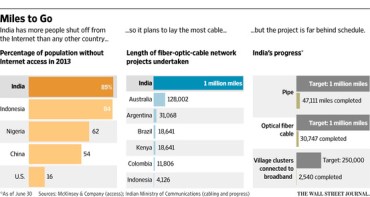
The prime minister’s Digital India plan is stuttering however. Up to June only 1% of the villages in the program had been connected to broadband via fiber optic cables.

The slow pace of the rollout of the Internet in India is among the main subjects raised for Mr. Modi in his upcoming Q&A at Facebook Inc. on Sunday.

Meghna Agarwal has asked how Facebook can help India in reaching remote areas “so that each one of the Indians has a voice of their own thus promoting equality and bridging the gap between the rich and the poor?”

Sumit Dhawan asked what Mr. Modi is doing to bring high speed broadband Internet to India.

In Mr. Pichai’s video, the CEO predicts that in the next few years, 50 million women and 20 million small businesses will get online for the first time. He promises Google will help India with products that work on low bandwidth and even offline as well as with investments in core infrastructure to help the Indians among them.

Source: Google’s Sundar Pichai Welcomes India’s Modi to Silicon Valley – India Real Time – WSJ

23/09/2015

Prime Minister Popularity and Voter Optimism Have Soared in India Under Modi, U.S. Think-Tank Survey Shows – India Real Time – WSJ

In the sixteen months since Prime Minister Narendra Modi won a landslide victory in national elections, he has faced policy setbacks, parliamentary roadblocks and electoral failure. These appear to have had little impact on support for him.

A new report by the U.S.-based think tank Pew Research Center says Mr. Modi remains overwhelmingly popular among Indians. Among those surveyed, 87% said they have a favorable opinion of Mr. Modi. Unpacking that statistic gives Mr. Modi greater reason to celebrate. His popularity is the highest among two crucial demographic groups: 18 to 29 year olds and rural Indians. Nine out of 10 people in each category gave the leader of the world’s largest democracy a thumbs up.

Mr. Modi’s undented approval ratings come at a time when his appeal among investors and analysts has lost some of its sheen. India-watchers complain big policy pronouncements have been few and slow to come, limiting India’s growth potential. Far from sharing that pessimism, a majority of Indians are upbeat about their country’ economic prospects, the survey showed. More than half of the respondents said they were happy with the direction of their country, up from 29% in 2013, toward the end of the Congress party’s decade-long tenure when the economic was stuttering and corruption scandals dogged the government. More than 90% of those surveyed by Pew said they had faith in government, up from 70% two years ago. These findings raise key political questions.

Some strategists wonder why, given his once-in-a-generation mandate, Mr. Modi hasn’t pushed for tougher, more-disruptive measures to accelerate growth. His government recently backtracked on a policy that would have made it easier to acquire land for infrastructure and industry because of protests by opponents in Parliament and fear of a backlash from rural voters.

Others argue Mr. Modi is playing the long game, seeking to build on his popularity to consolidate more political power at state and local levels rather than risking it at an early stage on controversial policies. Leaders of his Bharatiya Janata Party say they are planning for at least two five-year terms under Mr. Modi’s premiership during which they hope their party, whose political authority has grown sporadically since its inception in 1980, will achieve the kind of dominance Congress enjoyed in the decades after India won independence from British colonial rule in 1947.

Such a strategy – and Pew’s data – explains why Mr. Modi is the BJP’s star campaigner. In the state of Bihar where elections are scheduled to begin next month, the BJP has not announced a candidate for chief minister, the person who would run the state if the party won. Instead, posters and hoardings are plastered with Mr. Modi’s face. To be sure, the Bihar polls won’t be easy. Caste allegiances play an important role in the vote and the incumbent regional leader, Nitish Kumar, is seen as an effective leader for development. A recent opinion poll by the Hindi-language ABP News channel and Nielsen showed the BJP and Janata Dal (United)-led alliances are neck and neck.

Source: Prime Minister Popularity and Voter Optimism Have Soared in India Under Modi, U.S. Think-Tank Survey Shows – India Real Time – WSJ

Law of Unintended Consequences

continuously updated blog about China & India

ChiaHou's Book Reviews

continuously updated blog about China & India

What's wrong with the world; and its economy

continuously updated blog about China & India