Archive for ‘India alert’

23/09/2015

5 Things Modi Unpacks on Every Foreign Trip – WSJ

1 Be First (Sort Of)

People like to read about folks who come first, and Mr. Modi’s visits often claim this honor. Sometimes, such as his trip to Mongolia, because his visit is the first by an Indian prime minister. But in other cases, the firsts come with footnotes. For instance, Mr. Modi was the first Indian prime minister to visit Canada in 40 years on a “bilateral visit” in April, according to India’s foreign ministry.  Indian prime ministers have visited Canada in the past four decades, but on multi-lateral or other types of visit.  Another twist: Mr. Modi’s time in Australia in November followed a visit of Australia’s then-Prime Minister Tony Abbott to India a few months earlier. The exchange was thus described as the “first time Australian and Indian Prime Ministers have made reciprocal visits in the same year,” according to India’s Press Information Bureau. For his upcoming visit, expect Mr. Modi’s team to point out that he is the first Indian prime minister to visit Silicon Valley, because Mrs. Gandhi only went to Los Angeles.

2 Take Over a Stadium

In countries with a large Indian-origin population, Mr. Modi likes to make a big impression. Usually in a stadium packed with thousands of people and supported by a song-and-dance show. Mr. Modi has taken over such arenas in New York, Sydney and Toronto. In the upcoming visit, the big event will be at the SAP Center in San Jose, which is also nicknamed the “Shark Tank” because it hosts ice hockey team the San Jose Sharks. The SAP Center will host Madonna in October. The event’s organizers say they have received requests for around 45,000 passes, while SAP Center can seat only around 20,000 people.

3 Promise a Visa Freebie

One crowd-pleaser that Mr. Modi uses on trips abroad is to announce India will make it easier for foreigners to visit. In February 2014, before Mr. Modi came to power, India’s government pledged to give visas-on-arrival to people from 180 countries, up from 11 countries previously. The expanded list so far covers people traveling to India from the U.K., U.S. and China among others. Mr. Modi re-announced this step as evidence of India’s efforts to make it easier for people to visit. In New York, it got a lot of applause.  But, when some tourists tried to get a “visa-on-arrival”, they were asked to apply for it 72 hours in advance. This created confusion. In April, the Indian government changed the name to “e-tourist visas”, saying that tourists could apply for it online.

4 Snap a Selfie

During his overseas trips, Mr. Modi’s selfies with other leaders including Li Keqiang, the Chinese premier, have received a lot of attention online. Most recently, Mr. Modi took a selfie with ministers of the United Arab Emirates . From the upcoming trip, look out for selfies with Mark Zuckerberg, chief executive of Facebook Inc. who is meeting Mr. Modi, and other high-profile Silicon Valley execs.

5 Unveil or Visit a Gandhi Tribute

The icing on the cake of a good trip abroad for Mr. Modi is the unveiling of a bust or statue of Indian independence leader Mahatma Gandhi. Mr. Modi unveiled the bust of Gandhi in Hannover, Germany, and in Turkmenistan’s capital Ashgabat . He inaugurated a statue of Gandhi in Brisbane, Australia, and another in Bishkek, Kyrgyzstan. In China, Mr. Modi inaugurated the Center for Gandhian & Indian Studies at Shanghai’s Fudan University.  On his most-recent trip to the U.S. in September 2014, Mr. Modi visited a statue of Gandhi in Washington. Mr. Modi’s  U.S. hosts haven’t included a Gandhi unveiling for the upcoming trip however. The focus of the prime minister’s visit to Silicon Valley will be on technology, startups and innovation, said Khanderao Kand, convener of the Indo American Community of West Coast.

Source: 5 Things Modi Unpacks on Every Foreign Trip – WSJ

17/09/2015

How Modi’s Win Helped Boost India’s Ranks of Millionaires – India Real Time – WSJ

The ranks of the millionaires grew at a faster rate in India than anywhere else around the globe in 2014 thanks to the election of Prime Minister Narendra Modi and falling oil prices, according to a report on worldwide wealth.

After only marginal growth in 2013, India’s tally of high-net-worth individuals increased by 26.3% in 2014 compared with the previous year and with 17.5% in China and 8.2% in the U.S. over the same period, the data from consultants Capgemini and RBC Wealth Management, said.

High-net-worth individuals are defined as those with investible assets of more than $1 million.

The report says that the election of “a popular reform-minded prime minister” in May 2014 “had a positive effect on the economy and equity markets, boosting [high-net-worth-individual] gains.” More In Narendra-Modi

Mr. Modi’s win “helped to boost investor confidence and contributed to strong performance in the stock market,” the report’s authors said.

“Lower oil prices helped reduce the country’s budget deficit and retail inflation fell considerably,” they added. Still, in absolute numbers of very wealthy, India continues to lag behind. It had 1,975,000 people with $1 million to invest in 2014, compared with 4,682,000 in the U.S. and Canada and 8,901,000 in China.

The Asia Pacific region as a whole though, including India and China, had a higher number of millionaires than North America in 2014.

Source: How Modi’s Win Helped Boost India’s Ranks of Millionaires – India Real Time – WSJ

09/09/2015

Modi Tells Nervous Business Leaders the Global Shakeup Is India’s Time to Shine – India Real Time – WSJ

Prime Minister Narendra Modi called Indian business leaders to his official residence Tuesday to discuss how to bulwark the country as China’s slowdown continues to send shock waves through the global economy.

In the three-hour summit, executives and economists ran through a long-standing wish list that includes investing more in infrastructure, expediting government clearances and lowering capital costs. Some executives suggested an interest-rate cut was overdue from the central bank, and that domestic companies should be given more protection from inexpensive imports.

“We have to be cautious, while we take some bold steps on the economy to increase growth,” Rana Kapoor, chief executive of Yes Bank Ltd., told reporters after leaving the meeting. “At the same time, you have to make sure that India has a soft landing after the severe impact of the yuan devaluation.” There has been a jump in foreign direct investment in India this year. But the executives told Mr. Modi that local companies need to see long-delayed improvements in economic management before they can ramp up capital spending. “Domestic investment is at a standstill, and that’s largely because there is no demand,” said Jyotsna Suri, president of the Federation of Indian Chambers of Commerce and Industry.

Mr. Modi reiterated that the world-wide turbulence is an opportunity to highlight India’s resilient growth, vast domestic market and government policies geared toward promoting investment, Finance Minister Arun Jaitley said.

Source: Modi Tells Nervous Business Leaders the Global Shakeup Is India’s Time to Shine – India Real Time – WSJ

07/09/2015

India ranks low on inclusive growth, development in WEF report – The Hindu

Ranked in the bottom half of the 38 countries that make up our lower middle income bracket. India has been ranked very low, mostly in the bottom half, globally on most of the parameters for inclusive growth and development even as it fares much better internationally when it come to business and political ethics. India’s overall place in the Global Competitiveness Index 2014–2015 rankings is 71 out of 144 countries.

Growth and Development Report is the first inclusive report ever by World Economic Forum that assess countries’ efforts to foster economic growth that raises the living standards of entire societies.In a first of its kind global rankings, across different groups of countries in terms of their per capita income levels, the World Economic Forum (WEF) found that most countries are in fact missing major opportunities to reduce income inequality and same is the case with India. WEF said that the new study, which was conducted over the past two years, seeks to identify the various ways policymakers can drive economic growth and equity at the same time and assesses them on their relative success in implementing these measures. “Our message is unequivocally that leaders must pursue economic strategies that are at the same time pro-growth and pro-labour,” said the Geneva-based think tank known for its economic conclaves held in different parts of the world including in Davos, Switzerland and in India. India has mostly been ranked in the bottom half of the 38 countries that make up our lower middle income bracket.
Particularly disappointing is its position in terms of Fiscal Transfers, where it ranks 37th out of 38. It also ranks very low at 32nd for Tax Code and 36th for social protection. WEF said that another area that policymakers in India would need to prioritise improvement would be ‘Asset building and entrepreneurship’, in particular the Small business ownership, where India ranks bottom among its peers at 38th place. However, India does demonstrate ‘leadership’ in some areas, WEF said, while naming areas like corruption and rent where it comes 8th.

For business and political ethics, India ranks 12th, while it ranks 11th on the Financial intermediation of real economy investment pillar, which suggests that money invested in the economy generally gets directed towards productive uses. WEF said its first Inclusive Growth and Development Report present a new framework for assessing countries’ efforts to foster economic growth that raises the living standards of entire societies. “Around the world, no bigger policy challenge preoccupies political leaders than expanding social participation in the process and benefits of economic growth,” WEF said while releasing the report that covers 112 economies.

Source: India ranks low on inclusive growth, development in WEF report – The Hindu

03/09/2015

The Successful Indian Tech Companies You’ve Probably Never Heard Of – India Real Time – WSJ

The lofty valuations of India’s consumer-focused startups like Flipkart and Snapdeal have gotten a lot of limelight lately, but the country’s up and coming software product technology firms are also growing rapidly, says iSpirit Foundation, a Bangalore-based technology lobby group.

An index capturing the 30 most-valuable Indian software product-makers has risen by 28% in eight months since Oct. 30, a report released by iSpirit, which puts together the index, said Thursday. These companies, as estimated by iSpirit, were worth a total of $10 billion at the end of June. “There has been an acceleration since 2010 in the pace of creation of B2B (business-to-business) companies,” the report said.

More In Technology The Successful Indian Tech Companies You’ve Probably Never Heard Of Are You Addicted to the Internet? Take the Test Internet Addiction: How to Help Protect Your Children 5 Things to Know about Foxconn’s Ambitions in India Uber to Invest $1 Billion in India Indian techies and venture capitalists often rue that though Indians occupy top positions in global tech companies like Microsoft Corp.MSFT +3.55% and Oracle ORCL +2.05% Corp, the country hasn’t produced a major software firm up to the caliber of these multinationals.

In December, a Silicon Valley-based entrepreneurship trade body, the Indus Entrepreneurs, launched a program to help grow a select number of Indian product companies to become worth a billion dollars or more each. To help garner attention for software-product makers, iSpirit created its index last year. For this, it considered more than 300 Indian companies that make and sell software or provide applications that support other businesses. The index doesn’t include technology outsourcing firms like Infosys Ltd.500209.BY +3.56% and Tata Consultancy Services Ltd.532540.BY -0.08%, or consumer-oriented technology companies, like Flipkart and ANI Technologies Pvt Ltd.-owned Ola, a taxi-hailing application, which use technology to sell products to individuals. Companies included are firms like Bangalore-based InMobi Technology Services Pvt. Ltd., which competes with Google Inc.GOOGL +2.69% and Facebook Inc.FB +2.96% globally to provide a mobile advertising platform, and Delhi-based Wingify Software Pvt. Ltd, which analyses web-user data to enable companies to create more effective webpages.

Other companies are Capillary Technologies, which creates software that helps retailers manage customer data and counts shoemaker Nike NKE +1.91% and Pizza Hut among its customers, and Druva Software Pvt. Ltd., which provides data backup and other services to companies like Dell Inc. The index also has a few companies which have been around for more than two decades, such as Delhi-based Newgen Software Technologies Ltd, and accounting software-maker Tally Solutions Pvt. Ltd.

These software companies have also caught the eye of international investors in recent years. “There’s a consistent amount of capital going in…I wouldn’t say it’s a flood,” said Dev Khare, managing director of Lightspeed India Partners Advisors LLP, a venture-capital firm. Mr. Khare volunteers with iSpirit and helped put together the report on technology firms. In rupee terms, the 30 most-valuable companies as estimated by iSpirit were worth 655 billion rupees ($10 billion) at the end of June, versus 375 billion rupees at the end of October. The composition of the index has changed, to include some companies whose valuations have grown rapidly since the fall. To be sure, these valuations pale in comparison to that of Indian consumer companies. Flipkart alone was valued at $15 billion in May following a round of capital raising, up from $10 billion in December. Mr. Khare said that though consumer-focused tech companies have gotten a larger share of investor capital in recent years, historically, both consumer and software-product companies have provided good returns to investors. Many of the new Indian software companies are creating products for the tech consumer companies, such as software to manage customers who buy online, or software to manage logistics. Two-thirds of the 30 companies in the iSpirit index are based in India, while others are domiciled in Singapore and Silicon Valley. Most of the companies sell their products to clients globally. “As the conditions become more favorable, more capital will flow into these companies as well,” said Mr. Khare.

Source: The Successful Indian Tech Companies You’ve Probably Never Heard Of – India Real Time – WSJ

27/08/2015

Why India Stands to Benefit From China Slowdown and Global Reaction – India Real Time – WSJ

India’s economy has been insulated from the turmoil in emerging markets by a long-standing handicap: It isn’t an export powerhouse. For years, growth in India has been fueled more by domestic demand—not, as in China, by manufacturing goods for sale abroad. Now India’s resilient consumer spending is an advantage as demand decelerates almost everywhere else. It is luring companies to produce in India and, the government hopes, can help spark a belated industrial revolution in the country of 1.2 billion.

Jayant Sinha, India’s minister of state for finance, said this week the Chinese slowdown and its world-wide fallout could provide a chance for India to “take the baton of global growth.” Mumbai’s benchmark stock index ended Wednesday down 1.2%, having slid 8.5% in total since the People’s Bank of China moved to devalue the yuan on Aug. 11. The rupee has lost 3.4% since then. India hasn’t been rattled as badly as Brazil, Russia or South Africa. Its international reserves are ample, and it isn’t highly dependent on foreign capital to fund imports.

Source: Why India Stands to Benefit From China Slowdown and Global Reaction – India Real Time – WSJ

27/08/2015

India’s Hard-Working Expat Army – The Numbers – WSJ

Compared with expatriates from other countries, expats from India are younger, better-educated, harder-working and much more likely to be male. A new survey of people working far from home by the expat social group InterNations also suggests Indian expats are much more likely to pick a partner from home and less likely to settle in the country in which they currently work. While there is debate about exactly how expats differ from other migrant workers, any definition would have to include many of the millions of Indians who help run companies, build software and erect buildings across the globe. Indians have proven to be the highest ranked group of migrants to the U.S., in terms of education and pay. Indian-born leaders now run everything from Microsoft Corp. to Google Inc.
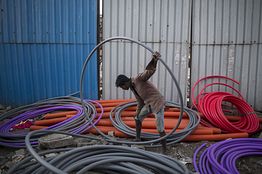
The InterNations survey of 14,400  self-declared expats living in 64 countries  offers some interesting insights into what India’s world-wide web of non-resident road warriors looks like. Here are a few numbers from the survey.

80% Around 80%, or four out of five, Indian expatriates who responded to the InterNations survey are male. That’s really lopsided. The average for all countries combined in the survey was about 47% male.

36.5 years Indians that took part in the survey were 36.5 years old on average. That is younger to the broader expat populace, which had an average age of 40.9 years. 45.2 hours Indian expats said they worked an average of

45.2 hours a week. While that is probably not enough overtime to get you to the top of Google like Sunder Pichai, it’s 3.2 hours more than the average expat.

92% More than 90% of those surveyed had a college degree or higher. On average only 83% of the world’s expats graduated from university. Data on Indians enrolled in U.S. schools show they are often more likely to go for advanced degrees. The education of globe-trotting Indians is also seen in their language abilities.

Close to half (48%) of the people surveyed said they could speak four or more languages. 9 out of 10 Compared with other expatriates,

Indians were much more likely to pick a partner from home. Around 89% of Indians in the survey said they were with someone from their home country. On average, expatriates around the world are usually more likely not to choose someone from home. Only 43% of those surveyed said they had a partner from their countries of origin.

12% Nearly a quarter of expats say they would consider settling in the country where they are currently working. For Indian expatriate workers, however, the number is just around one in eight.

Source: India’s Hard-Working Expat Army – The Numbers – WSJ

23/08/2015

Spectacular Images of Mars From India’s Most-Ambitious Space Mission – India Real Time – WSJ

Next month, India’s mission to Mars is expected to complete a year in orbit around the red planet and its photo album so far is out of this world.

The spacecraft, named Mangalyaan, Hindi for Mars craft, has already completed more than 100 orbits since it arrived at the planet on Sept. 24, 2014.

At a cost of $74 million, the Indian Space Research Organization’s mission to Mars was the cheapest of recent missions to Mars mounted by other space agencies.

The satellite is healthy and continues to “glean data,” Debiprasad Karnik, a spokesman for ISRO, said Friday.

Apart from a few days in June when it lost touch with Earth after moving behind the Sun in a phenomenon called “solar conjuncture,” Mangalyaan has remained in contact and been sending photographs taken by the Mars Color Camera back to scientists in India.

The photo above, taken in July, is of the Ophir Chasma, part of what the National Aeronautics and Space Administration describes as the largest canyon system in the solar system, known as the Valles Marineris.

NASA calls the geographical feature the Grand Canyon of Mars. At a length of more than 1,800 miles, it is almost 3.5 times the length of the Grand Canyon in Arizona. The walls of the chasma, that is described by the International Astronomical Union as “an elongate steepsided depression,” are multi-layered, the floor too contains large deposits of layered materials.

via Spectacular Images of Mars From India’s Most-Ambitious Space Mission – India Real Time – WSJ.

21/08/2015

India-Pakistan Talks Hang in the Balance Over Kashmir – India Real Time – WSJ

When rival neighbors India and Pakistan plan to meet, it often comes down to the wire – and this week is no exception.

Two days before Pakistan’s National Security Advisor Sartaj Aziz is scheduled to land in New Delhi for meetings with his Indian counterpart Ajit Doval, statements from India’s foreign ministry Friday morning cast doubt over whether the talks would actually take place.

The reason: another planned meeting between Mr. Aziz and separatists from the Indian state of Jammu and Kashmir at a reception at the Pakistan High Commission on Sunday.

Through a series of tweets, a televised interview and a media statement, India hardened its stand against Pakistan’s decision to consult with Kashmiri separatists. The Kashmir region lies at the center of decades of enmity between India and Pakistan. Both countries administer parts of the territory but claim it in full.

Vikas Swarup, spokesman for India’s foreign ministry, said in a tweet posted on his verified Twitter TWTR -6.19% account on Friday: “India has advised Pakistan yesterday that it would not be appropriate for Mr. Sartaz Aziz to meet with Hurriyat representatives in India,” referring to a group of Kashmiri separatists.

Pakistan says these men must be consulted before India and Pakistan hold discussions concerning Kashmir. India resists the involvement of groups that have clashed with the Indian establishment for decades, boycotting elections and stoking tensions in the Kashmir Valley. Security officials in New Delhi accuse them of facilitating militancy in the region and colluding with Pakistan-based terrorist groups.

If India cancels the hard-won meetings over the issue of Kashmiri separatists, it won’t be the first time. In July last year, Prime Minister Narendra Modi called off planned talks between the countries’ foreign secretaries after separatist leaders met with Pakistan’s ambassador to India, in defiance of New Delhi’s warnings not to do so. By cancelling the meet, Mr. Modi sought to set new ground rules of engagement between India and Pakistan – one Islamabad appears not to have been willing to accept.

Mr. Swarup repeated India’s concerns publicly Friday, taking a stand that could threaten the upcoming talks unless Pakistan yields. He said a meeting between separatists and Mr. Aziz “would not be in keeping with the spirit and intent” of an understanding between Mr. Modi and Pakistani Prime Minister Nawaz Sharif at a meeting in July – when the NSA talks were firmed up — “to jointly work to combat terrorism.”

His statements are a second warning shot, after Indian authorities in Jammu and Kashmir temporarily detained separatist leaders on Thursday in an apparent signal of New Delhi’s objections. But Pakistan has so far given no indication it’s in the mood to compromise. Pakistani foreign ministry officials said the reception would go on as scheduled.


The meetings may also fall apart over another disagreement: What will the two sides talk about?

Pakistan has said the dispute over Kashmir will figure on the agenda when the countries’ top security officials get together. India says the meetings will focus only on terrorism.

India accuses Pakistan of harboring militants who launch attacks on India and wants to press Pakistan further to take stern action against such groups. Pakistan denies allegations it backs militants, saying it too is grappling with terror against its citizens.

In recent days, Pakistan has stepped up efforts to draw attention to the Kashmir dispute, raising hackles in New Delhi. It pulled out of organizing a conference of Commonwealth countries that was scheduled to begin next month saying it didn’t want to host lawmakers from the Indian state of Jammu and Kashmir. Pakistan’s foreign ministry said on Thursday that Islamabad would “raise all issues during the meetings in India, including Kashmir.”

In an attempt to clarify its position, Mr. Swarup said in another tweet Friday that India has “sought confirmation of our proposed agenda for the NSA level talks” – a typically behind-the-scenes detail whose public declaration by Mr. Swarup points to the lack of trust and widening gulf between the two sides.

via India-Pakistan Talks Hang in the Balance Over Kashmir – India Real Time – WSJ.

20/08/2015

What Stands in the Way of Modi’s Digital India – The Numbers – WSJ

Indian Prime Minister Narendra Modi has grand plans to expand the reach of the Internet to his country’s most far-flung citizens.  But some big numbers stand in his way.

1.06 billion

The number of Indians who currently don’t have access to the Internet. India’s offline population is greater than that of China and Indonesia–home to the next two largest unconnected groups–combined.

1 million

The number of miles of fiber optic cable needed to connect 250,000 village clusters in India to the Internet, according to a committee set up to get the project into gear. The original plan estimated that 370,000 miles of cable would do the job.

1%

The proportion of clusters of villages that up to June 30 were fully connected to Internet services in community centers, hospitals and schools under the National Fiber Optic Network that was launched in 2011.

2013

The original deadline for completion of the network. The date has since been shunted back twice and now stands at 2019.

$11.2 billion

The revised budget for the fiber optic network. Almost four times what was originally planned.

via What Stands in the Way of Modi’s Digital India – The Numbers – WSJ.

Law of Unintended Consequences

continuously updated blog about China & India

ChiaHou's Book Reviews

continuously updated blog about China & India

What's wrong with the world; and its economy

continuously updated blog about China & India