Archive for ‘India alert’

15/12/2014

This Is What India’s Radio Cabs Are Doing to Make Women Safer – India Real Time – WSJ

Indian authorities and radio taxi operators in the national capital have stepped up security measures to ensure passenger safety in the aftermath of an alleged rape of a female passenger by a driver contracted to the international car booking service Uber Technologies.

Transport authorities in New Delhi have ordered radio fleet taxi companies and web-based operators to submit database of their drivers whose credentials need to be checked and have asked them to come up with a revised safety plan to be put in place by early next year, a Delhi police official, who did not wish to be named said Monday.

“A list of around 20,000 drivers has been submitted so far out of which the background details of more than 10,000 still need to be verified,” he said.

Last week, Delhi’s transport department barred Uber from operating its ride-hailing system in the national capital until it got the proper licenses. Uber on Thursday said it would suspend its service in the capital while it reviewed its screening processes. The department had stated that only six registered radio taxi companies would now be allowed to continue operating in New Delhi.

The cab operators in New Delhi, for their part, said they have certain safety rules in mind that they would submit by Dec. 31 to the transport department.

via This Is What India’s Radio Cabs Are Doing to Make Women Safer – India Real Time – WSJ.

14/12/2014

After Swacch Bharat, Modi wants ‘drug-free India’ – The Hindu

Voicing concern over the “devastating” drug addiction menace, Prime Minister Narendra Modi on Sunday said society as well as the government will have to work together to fight this problem and that a helpline would be set up soon to assist those seeking solutions.

In his third Mann Ki Baat programme on radio, he said the menace is a “national pain” but instead of the youth mired in the problem, drugs should be shunned.

He said drug addiction is “a malaise filled 3D — darkness, destruction and devastation — as it leads to the dark alleys of destruction and devastation“.

The Prime Minister said a thinking process should begin to ensure that the country is rid of this problem and added that he will try to involve celebrities from the cine world, sports and other fields to campaign for a “drug-free India”.

via After Swacch Bharat, Modi wants ‘drug-free India’ – The Hindu.

12/12/2014

Modi Gets International Yoga Day – India Real Time – WSJ

It’s probably not a stretch to say that Indian Prime Minister Narendra Modi just scored a win at the United Nations.

The international body Thursday declared June 21 the International Day of Yoga, something Mr. Modi called for in September in his maiden address to the U.N. General Assembly in New York.

”By changing our lifestyle and creating consciousness, it can help us deal with climate change,” he told the group of nations at the time. ”Let us work towards adopting an International Yoga Day.”  On Thursday, 177 countries co-sponsored the resolution to establish an international day of yoga, Pakistan, India’s neighbor and long-time rival did not join in doing so. Malaysia is also not sponsoring the event. Islamic clerics sparked controversy in 2008 after issuing a fatwa against yoga, because of its association with Hinduism.

via Modi Gets International Yoga Day – India Real Time – WSJ.

11/12/2014

The Vladimir Putin and Narendra Modi Agreements in Full – India Real Time – WSJ

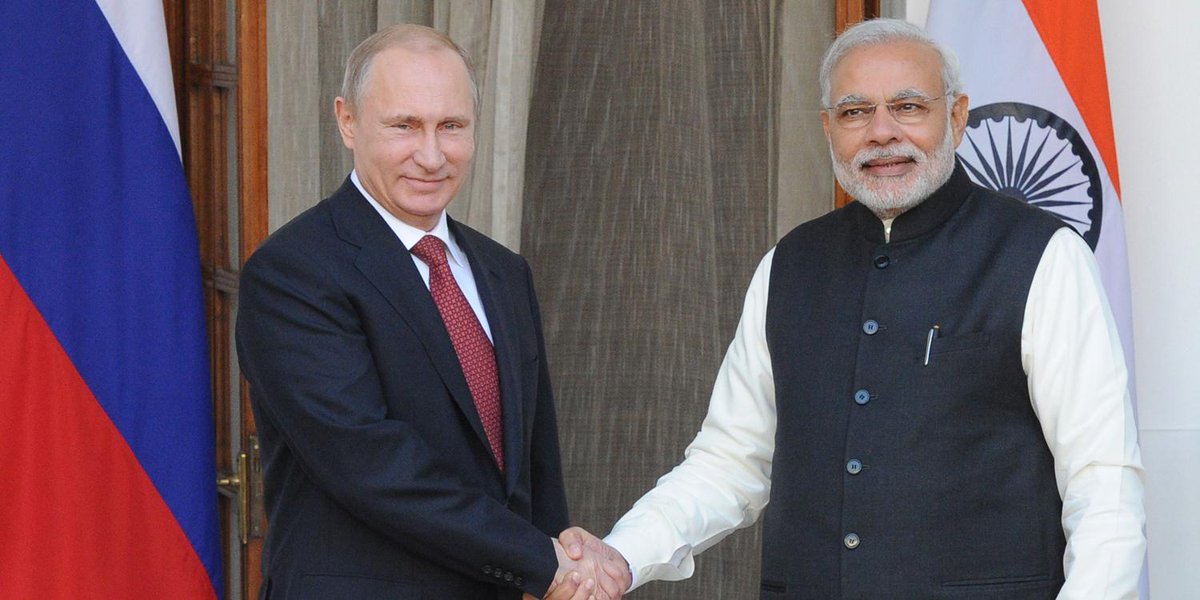
Indian Prime Minister Narendra Modi and Russian Prime Minister Vladimir Putin announced that their countries had signed 20 bi-lateral agreements including memorandums of understanding and commercial contracts on Thursday.

View image on Twitter

During Mr. Putin’s visit to India’s capital, the Russian leader said in a news conference that the documents placed an emphasis on trade and economic issues.

Eight of the agreements signed relate to nuclear power and energy production including a roadmap for bilateral cooperation in the civil nuclear energy sector over the next 20 years. Russia also agreed to supply “major equipment” to the Kudankulam nuclear power plant in Tamil Nadu.

India agreed to identify a second site apart from Kudankulam for Russian-designed nuclear power plants.

Mr. Modi said that they had “outlined an ambitious vision for nuclear energy” and would have “the highest standards of safety in the world.”

A list of the agreements signed is below as provided by India’s Ministry of External Affairs.

via The Vladimir Putin and Narendra Modi Agreements in Full – India Real Time – WSJ.

08/12/2014

Rs 5,160cr given to states to clean rivers – The Times of India

Centre has released Rs 5,160 crore to various states for implementation of pollution abatement works in rivers, Parliament was informed on Monday.

Minister of water resources, river development and ganga rejuvenation Uma Bharti said in Rajya Sabha that Rs 5,159.81 crore has been released by the Centre to states for implementation of pollution abatement works and a sewage treatment capacity of about 5,005 million litres per day has been created so far under NRCP and NGRBA programmes.

National River Conservation Plan (NRCP) and National Ganga River Basin Authority (NGRBA) programme cover polluted stretches of 42 rivers spread over 21 states at a sanctioned cost of Rs 11,362.85 crore.

To another question, the minister said conservation of rivers is an ongoing process and cleaning of Ganga and other rivers is taking time mainly due to the “large gap between sewage generation and availability of sewage treatment capacity…”

She said it is the responsibility of the state governments and local bodies concerned to set up proper facility for collection and treatment of sewage generated and ensuring that it is not discharged into the rivers.

The new NDA-government has set up an Integrated Ganga Conservation Mission — ‘Namami Gange’ for for rejuvenation of Ganga and its tributaries.

via Rs 5,160cr given to states to clean rivers – The Times of India.

07/12/2014

India Says Pollution Levels Need to Rise Further to Boost Growth – Businessweek

India said its pollution levels will need to increase in the years ahead to support its economic development and it won’t discuss limiting greenhouse-gas emissions at United Nations climate talks that began this week.

Environment Minister Prakash Javadekar also said the government is preparing to make a pledge on how India will develop cleaner forms of energy, though he stopped short of indicating when the country might take on the sorts of caps for emissions that the U.S., China and Europe are adopting.

“We have a need to grow, so our emissions will grow,” Javadekar said at a press conference in New Delhi today. He said the onus on reducing emissions should be on richer industrial nations most responsible for global warming to allow poorer countries “space for more development.”

The comments indicate the difficulty in bringing all of the 190 nations gathered at the UN climate talks in Peru this week into a deal that will cut back on the pollution blamed for driving up the Earth’s temperature. While India’s emissions are the third-highest in the world, 30 percent of its residents live in poverty, scraping by on 75 cents a day or less.

Javadekar spoke before departing for the UN talks in Lima, Peru, which run through next week. They’re aiming to put together the building blocks for a deal by the end of next year that would cut pollution in all nations from 2020.

India is under pressure to make its environmental goals more clear after China and the U.S. jointly agreed Nov. 12 to rein in fossil fuel emissions. It was the first time a big developing country said it would take on a mandatory limit on pollution.

via India Says Pollution Levels Need to Rise Further to Boost Growth – Businessweek.

07/12/2014

India Raises $278 Million From Sale of Stake in Steel Authority – Businessweek

India said the sale of a stake in state-run Steel Authority of India Ltd. will fetch $278 million, the first step in a push for $9.5 billion from share sales to help narrow the nation’s budget deficit to a seven-year low.

The disposal of a 5 percent holding in Steel Authority of India is set to generate about 17.15 billion rupees ($278 million) and the offer was more than two times oversubscribed, the Finance Ministry said in a statement today.

“This will give a lot of confidence to the government to come out with disinvestment in other companies,” said R. K. Gupta, managing director at New Delhi-based Taurus Asset Management Co., which oversees $710 million.

via India Raises $278 Million From Sale of Stake in Steel Authority – Businessweek.

07/12/2014

EU States Suspend Marketing of Drugs Tested at Lab in India – Businessweek

A European Union review of a contract lab in India hired by drugmakers to perform clinical trials pivotal to approval of certain generic medicines has led some member states to suspend marketing of those drugs.

The European Medicines Agency is reviewing findings GVK Biosciences, based in Hyderabad, India, didn’t comply with clinical practice standards, and the suspensions are a precaution until the review is finished, according to a statement yesterday from the agency. The EMA didn’t name the countries or the drugs being suspended, and its press representatives didn’t respond to a call and an e-mail after business hours.

The review is based on an inspection by the French medicine agency that raised concerns about the reliability of studies done at GVK Bio since 2008. The French agency inspected GVK Bio from May 19 to 23 and found falsification by at least 10 people between 2008 and 2013 of electrocardiograms in all of the nine trials they examined.

via EU States Suspend Marketing of Drugs Tested at Lab in India – Businessweek.

07/12/2014

India plans 5-fold increase in clean energy – Businessweek

India said Friday it was optimistic the world would reach an agreement to curb climate change, but said its actions would be focused on boosting its renewable power capacity five-fold rather than on cutting carbon emissions.

With hundreds of millions still mired in poverty and without access to electricity, India cannot afford to reduce greenhouse gas emissions at the expense of economic growth, Environment Minister Prakash Javadekar said before leaving this weekend for U.N. climate talks in Lima, Peru.

“Our growth cannot be compromised,” Javadekar said. “Poverty needs to be eradicated immediately. Poor people have aspirations. We must fulfill them. We must give them energy access. We cannot and nobody can question on this.”

He said he was optimistic industrialized nations would agree to shoulder more of the burden to reduce greenhouse gas emissions, given that they had been polluting with fossil fuels for decades before developing nations.

“That is the just regime,” he said.

The recent U.S.-China pact announcing new targets for fossil fuel use marked a positive step toward establishing this sort of equality, he said. In that pact, the U.S. said it would aim to bring down its per-capita emissions from about 20 tons while allowing China to raise its 8-9 tons per capita so that both reach a level of about 12 tons by 2030.

“They have accepted the differentiated responsibility and the need of time for growth,” Javadekar said.

India had already pledged to reduce its emissions intensity — how much carbon dioxide it produces divided by its GDP — rather than promising to cut overall emissions. However, Indian officials and scientists say it could easily go beyond the target set in 2009 of cutting emissions intensity by 20-25 percent below 2005 levels by 2020.

India’s preference for the per-capita emissions calculation also ignores the fact that around 400 million Indians still have no access to electricity at all, while hundreds of millions more are lucky to get a couple of hours a day. Experts worry that as India’s population continues to grow beyond 1.2 billion and more people become wealthy, its share of global emissions will skyrocket.

via India plans 5-fold increase in clean energy – Businessweek.

04/12/2014

Visas for travel: Common sense comes to India | The Economist

RED TAPE is the bane of frequent business travellers. Many places in the world require arduous and expensive visa applications for even the most routine travel. I have two passports just so I can juggle concurrent applications when necessary. But the best policy, for business travellers and tourists alike, is a less-restrictive visa regime. The Schengen Area has proven a huge boon to European travellers; this blog has long supported making it easier for people to travel abroad.

Now there’s some good news. India, a nation notorious for bureaucracy and red tape—not to mention the long queues outside its diplomatic missions of people hoping to visit the country (see picture above of India House in London)—has dramatically loosened its visa policies. Travellers from 43 nations, including Germany, Japan, Russia and America, will now be able to receive visas upon arrival. There are, unfortunately, some restrictions:

You have to apply online four days in advance, pay a $60 fee, and upload a passport photo and a scan of your passport.

It only works for the international airports in nine cities: Delhi, Mumbai, Chennai, Kolkata, Hyderabad, Bengaluru, Thiruvananthapuram, Kochi and Goa.

It is valid for 30 days, and you can only get two per year.

Narendra Modi‘s government has referred to the changes as being for a “tourist visa”. But the announcement makes clear the visa can be used for a “casual business visit”, and many Gulliver readers may decide that’s good enough for them.

The new policy is far from perfect, but it’s a step in the right direction and one that travellers should applaud. It will “send out a clear message that India is serious about making travel to the country easy,” Mahesh Sharma, the country’s tourism minister, said in a statement. That’s an encouraging attitude. If Mr Modi’s government can pull off more changes along these lines, travellers—and the Indian economy—should benefit greatly.

via Visas for travel: Common sense comes to India | The Economist.

Law of Unintended Consequences

continuously updated blog about China & India

ChiaHou's Book Reviews

continuously updated blog about China & India

What's wrong with the world; and its economy

continuously updated blog about China & India