Archive for ‘Chindia Alert’

21/12/2018

Sacred and political: world’s largest religious festival to kick off in India

NEW DELHI (Reuters) – Spirituality, politics and tourism: welcome to the Kumbh Mela, the world’s largest gathering of humanity, that begins next month in India.

Labourers work on an under-construction pontoon bridge spanning the river Ganga ahead of the “Kumbh Mela”, or the Pitcher Festival, in Allahabad, India, November 20, 2018. REUTERS/Jitendra Prakash

During the Kumbh Mela, to be held in Prayagraj in Uttar Pradesh, millions of pilgrims including naked, ash-smeared ascetics, will bathe at the confluence of the Ganges, the Yamuna, and a mythical third river, the Saraswati.

Devout Hindus believe that bathing in the waters of the Ganges absolves people of sins and bathing at the time of the Kumbh brings salvation from the cycle of life and death.

The government says about 100 million to 150 million people, including one million foreign tourists, are expected to attend over the eight-week festival period beginning on January 15, and the scale of the efforts to feed and house the pilgrims is immense.

Organisers are erecting temporary bridges, 600 mass kitchens, more than 100,000 portable toilets, and vast tents, each sleeping thousands of pilgrims at a time, in a pop-up city on the banks of the two rivers.

And yet, based on tradition, there shouldn’t be quite such a giant event next year – which is where politics and tourism promotion comes in.

The Kumbh Mela is traditionally held every three years in one of four cities along India’s sacred rivers, with one of the largest of those in Prayagraj. The next Kumbh Mela, meaning “festival of the pot”, was due to be held in the city in 2025.

But with a general election due by May in which the ruling Hindu nationalist Bharatiya Janata Party (BJP) faces a tough contest, the northern state of Uttar Pradesh has transformed a smaller Ardh, or “half” Kumbh Mela, into a full version of the festival.

The BJP controls both the federal and the Uttar Pradesh governments.

And this “half Kumbh” may by some measures end up being one of the biggest Kumbhs yet because of the state’s massive promotional efforts, especially as Prayagraj – which until recently was known as Allahabad – is seen as the holiest of the four sites.

Besides the upcoming election, the promotion coincides with an international charm offensive to improve the image of Uttar Pradesh, India’s most populous state of more than 220 million people with a reputation for poverty and violence.

But the state’s chief minister Yogi Adityanath, a Hindu monk who is close to Prime Minister Narendra Modi and has an eye for publicity, has also been driving support for any event that celebrates the dominance of Hindu culture in India, and marginalises the nation’s Muslim minority.

PLACE OF SACRIFICE

It was Adityanath who in October renamed Allahabad, a city of six million where there are nearly 800,000 Muslims, as Prayagraj, from its ancient name of Prayag meaning “place of sacrifice” in Sanskrit.

Allahabad is a Muslim name given to the city by a Mughal emperor in 1575.

“It is part of a Hindu nationalist agenda and is very worrying to us,” said Zafaryab Jilani, a senior member of the All-India Muslim Personal Law Board, that liaises with the government on Muslim affairs.

“There is no justification for changing these names.”

Neither side is expecting tensions to lead to violence during the festival, although a stampede at the last Kumbh Mela held in Allahabad in 2013, as it was then known, killed 42.

“Muslims have always respected the Kumbh. We will not challenge it in public,” Jilani said.

Officials do not expect clashes either, but have boosted the number of police on duty compared with previous events.

“People who are not involved will not come,” said a state official involved in the preparations. “This is not a problem for us.”

But he added: “To ensure security and safety, there will be five times the number of police officers compared to the previous Kumbh.”

Officials say the festival won’t be a “half” event by any means.

“This is the way we are taking it forward. There is nothing which is half,” said Awanish Kumar Awasthi, a senior official in charge of tourism in the Uttar Pradesh government.

The state government has promoted the Kumbh Mela at several tourism expositions in Europe, and has invited representatives of every country in the world to attend. Last Saturday, foreign diplomats visited Prayagraj to witness the set-up.

The festival has its roots in a Hindu tradition that says the god Vishnu wrested a golden pot containing the nectar of immortality from demons. In a 12-day fight for possession, four drops fell to earth, in the cities of Prayagraj, Haridwar, Ujjain and Nasik, who share the Kumbhs as a result.


21/12/2018

Crude refusal: China shuns U.S. oil despite trade war truce

SINGAPORE (Reuters) – China, the world’s top oil importer, is set to start 2019 buying little or no crude from the United States despite a three-month truce in a trade scrap between the two nations, with relatively high freight costs and political uncertainty choking demand.

That muted appetite means the United States, which became the world’s top oil producer this year as its shale output hit record levels, will continue to hold only a sliver of China’s market even as a wave of new refining capacity starts up there.

It also suggests that China is unlikely to use crude purchases to help plug a widening trade gap with the United States, which remains a core source of tensions between the world’s top two economies.

The U.S. trade deficit with Beijing hit a record $43 billion in October as its firms stockpiled inventory from China to avoid higher tariffs that may kick in next year.

“Chinese companies have little incentive to buy U.S. crude due to the wide availability of crude supplies today from Iran and Russia,” said Seng Yick Tee, an analyst at Beijing-based consultancy SIA Energy.

“Even though the trade tension between China and the U.S. had been defused recently, the executives from the national oil companies hesitate to procure U.S. crude unless they are told to do so.”

China stopped U.S. oil imports in October and November after the trade war intensified. It resumed some imports in December, but purchased just 1 million barrels, a minute portion of the more than 300 million barrels of total imports, Refinitiv data showed.

Chinese refineries that used to purchase U.S. oil regularly said they had not resumed buying due to uncertainty over the outlook for trade relations between Washington and Beijing, as well as rising freight costs and poor profit-margins for refining in the region.

Costs for shipping U.S. crude to Asia on a supertanker are triple those for Middle eastern oil, data on Refinitiv Eikon showed.

(GRAPHIC: China’s appetite for U.S. crude muted by high freight costs, competitive Mid East supplies – tmsnrt.rs/2GyFnJI)

A senior official with a state oil refinery said his plant had stopped buying U.S. oil from October and had not booked any cargoes for delivery in the first quarter.

“Because of the great policy uncertainty earlier on, plants have actually readjusted back to using alternatives to U.S. oil … they just widened our supply options,” he said.

He added that his plant had shifted to replacements such as North Sea Forties crude, Australian condensate and oil from Russia.

“Maybe teapots will take some cargoes, but the volume will be very limited,” said a second Chinese oil executive, referring to independent refiners. The sources declined to be named because of company policy.

A sharp souring in Asian benchmark refining margins has also curbed overall demand for crude in recent months, sources said.

(GRAPHIC: Singapore refining margins slump 50 pct in 3 ths amid demand growth concerns – tmsnrt.rs/2RhnHXv)

Despite the impasse on U.S. crude purchases, China’s crude imports could top a record 45 million tonnes (10.6 million barrels per day) in December from all regions, said Refinitiv senior oil analyst Mark Tay.

Russia is set to remain the biggest supplier at 7 million tonnes in December, with Saudi Arabia second at 5.7-6.7 million tonnes, he said.

China’s Iranian oil imports are set to rebound in December after two state-owned refiners began using the nation’s waiver from U.S. sanctions on Tehran.

21/12/2018

US charges ‘China government hackers’

  • 20 December 2018
FBI wanted posterImage copyrightFBI

The US justice department has indicted two Chinese men accused of hacking into the computer networks of companies and government agencies in Western countries.

The pair are allegedly part of a “hacking group” known as Advanced Persistent Threat 10, affiliated with China’s main intelligence service.

They have not been arrested.

The US and UK have accused China of violating an agreement relating to commercial espionage.

Zhu Hua and Zhang Shilong worked for a company called Huaying Haitai and in association with the Chinese Ministry of State Security, the US court filing says.

The Federal Bureau of Investigation (FBI) said that from at least 2006 until 2018, the two extensively hacked into computer systems with the aim of stealing intellectual property and confidential business and technological information from:

  • at least 45 commercial and defence technology companies in at least 12 US states
  • managed service providers (MSPs) and their government and commercial clients in at least 12 countries, including the UK, Brazil, Canada, Finland, France, Germany, India, Japan, Sweden, Switzerland, and the UAE, as well as the US
  • US government agencies

The FBI said they had also hacked into US Navy computer systems and stolen the personal information of more than 100,000 personnel.

FBI director Christopher Wray said the two men were at present “beyond US jurisdiction”.

‘Economic aggression’

Announcing the unsealing of the indictments, US Deputy Attorney General Rod Rosenstein said China had violated a 2015 agreement under which it had pledged to not engage in commercial cyber-spying.

Image captionUS Deputy Attorney General Rod Rosenstein: “We want China to cease its illegal cyber activities”

Mr Rosenstein said his department’s move had been co-ordinated with US allies in Europe and Asia to rebuff “China’s economic aggression”.

He added: “We want China to cease its illegal cyber activities.”

The UK government said it was joining allies in holding the Chinese government responsible for a global campaign targeting commercial secrets.

UK Foreign Secretary Jeremy Hunt said: “This campaign is one of the most significant and widespread cyber intrusions against the UK and allies uncovered to date, targeting trade secrets and economies around the world.

“These activities must stop. They go against the commitments made to the UK in 2015, and, as part of the G20, not to conduct or support cyber-enabled theft of intellectual property or trade secrets.”

Australia and New Zealand said they too held China responsible for the global hacking campaign and joined their “like-minded partners” in condemning the activity.


‘Chinese hackers return’

By Gordon Corera, security correspondent

This is the latest salvo in Washington’s attempt to pressure Beijing on a range of issues, with economic espionage one of the most high-profile.

US and UK officials are reluctant to name the companies that have been hit but they say the economic damage has been significant.

The hackers, officials say, work under the direction of China’s Ministry of State Security – one of the country’s intelligence organisations.

“It is organised more like a corporation than a gang,” one UK official says, adding that British intelligence has the highest level of confidence in their assessment of who was responsible.

The UK and US believe China is breaking a 2015 agreement not to steal commercial data to help its companies. There was a dip in activity after the deal was signed (which followed a period of pressure by Washington, including the indictment of Chinese military hackers and the threat of sanctions).

But US and UK sources both say that recently they have seen Chinese hackers return, now operating more stealthily, whereas in the past they were easier to spot.

Where the US has been vocal in recent months, this is the first time the UK has spoken out – perhaps because it has been concerned about risking trade ties and getting pulled into the Trump administration’s broader confrontation with Beijing.

UK officials say they have raised the matter privately a number of times with Beijing over the last two years, including during the prime minister’s visit earlier this year, and officials are keen to stress that they think the relationship with China is strong enough to allow them to address these issues without causing wider problems.

21/12/2018

China, Russia to boost military cooperation

BEIJING, Dec. 20 (Xinhua) — Chinese State Councilor and Minister of National Defense Wei Fenghe met with Deputy Defense Minister of the Russian Federation and Chief of Main Directorate for Political-Military Affairs of the Russian Armed Forces Andrey Kartapolov in Beijing Thursday.

Wei spoke highly of recent exchanges and cooperation between the two militaries.

“China is willing to work jointly with Russia, taking the opportunity of the 70th anniversary of diplomatic ties between the two countries next year to resolutely implement the consensus reached by the two heads of states and promote the two sides’ military cooperation to continuously score new achievements,” Wei said.

Kartapolov said Russia would strengthen cooperation with China in the military and other fields, and keep pushing the relationship between the two countries and their militaries to a new level.

21/12/2018

China, Germany should jointly safeguard free trade: FM spokesperson

BEIJING, Dec. 20 (Xinhua) — A Chinese foreign ministry spokesperson said Thursday that China and Germany have the responsibility to jointly safeguard free trade and multilateralism and avoid sending a negative signal that could affect investment environment and market confidence.

Foreign Ministry Spokesperson Hua Chunying made the remarks after Germany tightened rules on foreign investment in some sectors on Wednesday, adjusting the threshold for starting state security reviews of share purchases by non-EU investors to 10 percent of company shares in sectors such as critical infrastructures as well as defense-relevant and high-tech companies.

“While it is understandable to conduct necessary security scrutiny, it should not become a tool for advancing protectionism and creating new invisible barriers,” Hua said at a daily press briefing, also expressing opposition to discriminatory practices.

She called on the two countries to expand two-way opening-up so as to inject positive energy into bilateral high-level cooperation of mutual benefits and safeguard an open world economy.

20/12/2018

China says ‘resolutely opposes’ new U.S. law on Tibet

BEIJING (Reuters) – China denounced the United States on Thursday for passing a new law on restive Tibet, saying it was “resolutely opposed” to the U.S. legislation on what China considers an internal affair, and it risked causing “serious harm” to their

relations.

U.S. President Donald Trump on Wednesday signed into law the Reciprocal Access to Tibet Act.

The law seeks to promote access to Tibet for U.S. diplomats and other officials, journalists and other citizens by denying U.S. entry for Chinese officials deemed responsible for restricting access to Tibet.

Beijing sent troops into remote, mountainous Tibet in 1950 in what it officially terms a peaceful liberation and has ruled there with an iron fist ever since.

Chinese foreign ministry spokeswoman Hua Chunying told a daily briefing that the law “sent seriously wrong signals to Tibetan separatist elements”, as well as threatening to worsen bilateral ties strained by trade tension and other issues.

“If the United States implements this law, it will cause serious harm to China-U.S. relations and to the cooperation in important areas between the two countries,” Hua said.

The United States should be fully aware of the high sensitivity of the Tibet issue and should stop its interference, otherwise the United States would have to accept responsibility for the consequences, she added, without elaborating.

Rights groups say the situation for ethnic Tibetans inside what China calls the Tibet Autonomous Region remains extremely difficult. The U.N. High Commissioner for Human Rights said in June conditions were “fast deteriorating” in Tibet.

All foreigners need special permission to enter Tibet, which is generally granted to tourists, who are allowed to go on often tightly monitored tours, but very infrequently to foreign diplomats and journalists.

Hua said Tibet was open to foreign visitors, as shown by the 40,000 American visitors to the region since 2015.

At the same time, she said it was “absolutely necessary and understandable” that the government administered controls on the entry of foreigners given “local geographic and climate reasons”.

Tibetan rights groups have welcomed the U.S. legislation.

The International Campaign for Tibet said the “impactful and innovative” law marked a “new era of American support” and was a challenge to China’s policies in Tibet.

“The U.S. let Beijing know that its officials will face real consequences for discriminating against Americans and Tibetans and has blazed a path for other countries to follow,” the group’s president, Matteo Mecacci, said in a statement.

Next year marks the sensitive 60th anniversary of the flight into exile in India of the Dalai Lama, the highest figure in Tibetan Buddhism, after a failed uprising against Chinese rule.

China routinely denounces him as a dangerous separatist, although the Dalai Lama says he merely wants genuine autonomy for his homeland.

20/12/2018

Looking for China’s spies

The US has launched a crackdown on Chinese attempts to steal secrets.

American officials say the Chinese state is boosting its own companies.

But in the UK there’s no equivalent crackdown.

20/12/2018

Chinese Chamber of Commerce launched in Croatia

ZAGREB, Dec. 19 (Xinhua) — The Chinese chamber of Commerce in Croatia was launched here on Wednesday aiming to help Chinese companies doing business in Croatia and assist Croatian counterparts seek business opportunities in China.

The chamber was initiated by Norinco International, Huawei and China Road and Bridge Corporation which currently work on some of the largest projects in the country.

“This is the first time that Chinese companies have their own organization in Croatia,” said Chinese Ambassador to Croatia Hu Zhaoming at the launch ceremony.

According to Hu, only a few years ago there were only one or two Chinese companies in Croatia. In the last two years, however, the number has tripled, while Chinese investment in the country witnessed remarkable growth.

In 2017, Chinese investments in the country increased more than 100 times over the year before. Nearly 90 percent of Croats view China as a friendly country, while Chinese enterprises have positive views on the investment environment in the country and its future economy.

“Some Chinese companies are considering to set up regional offices or even European offices in Croatia,” said the ambassador.

In 2018, China Road and Bridge Corporation won the bid to construct the Peljesac bridge connecting the Croatian peninsula Peljesac with the mainland, while bypassing a short strip of the neighboring Bosnian coast that interrupts the continuity of the Croatian territory. It is the largest infrastructure project in the country in recent years, to the tune of over 400 million euros (485 million U.S. dollars).

Also this year, Norinco International signed a deal to construct a wind farm near the city of Senj, with an investment of almost 180 million euros (around 200 million U.S. dollars).

19/12/2018

Kolkata derby: Inside the East Bengal v Mohun Bagan rivalry

Fans make their way to the Salt Lake Stadium
East Bengal share the Salt Lake Stadium with rivals Mohun Bagan

Most people would assume an Indian sporting fixture that regularly attracts more than 100,000 people could only be one thing: a game of cricket.

But tell that to the people of Kolkata, who on Sunday gathered at the city’s Salt Lake Stadium for the latest instalment of the ‘Boro Derby’, as East Bengal took on Mohun Bagan in what might well be the most well-attended, fiercely competitive and historically significant derby you’ve never heard of.

This was the 366th meeting of the sides – it has been played 134 more times than the Merseyside derby – and consumes the city, which is regarded as the game’s spiritual home in a country of 1.3bn people.

Here, we take you inside a match steeped in tradition, watched by ‘ultras’ and regarded as a battleground for identity in India’s third-biggest city.

A game with its place in history – and the record books

Mohun Bagan, founded in 1889, are one of the oldest football clubs in Asia. Their landmark victory while playing barefoot over the East Yorkshire Regiment in 1911 was the first time a local club had defeated a European one, ending years of British dominance in the early stages of the game in India.

This victory is considered a key event in India’s fight for independence, so much so that the anniversary of the game on 29 July is recognised annually as ‘Mohun Bagan Day’.

The rivalry was born in 1920, when East Bengal were founded by a frustrated chief executive of Mohun Bagan. Complaining that his team chose not to select a star player for a big game, he decided to start a rival club in the same city, taking the player with him and forming East Bengal.

Like so many classic city rivalries, the derby’s lasting significance is rooted in the battle lines drawn off the pitch between the sides since their first meeting in 1925. The city’s native population has tended to follow Mohun Bagan, with its immigrant communities from the eastern side (modern-day Bangladesh) opting for East Bengal.

This social and political rivalry is at the derby’s heart, dividing the Bengali football population into either the green and maroon of Mohun Bagan or the yellow and red of East Bengal.

Ninety seven years later, the ‘Boro derby’ (‘boro’ meaning ‘big’ in Bengali) has created its fair share of history. Most notably, it holds the record for the highest attended sports fixture in India, with more than 130,000 people watching the 1997 derby, a 4-1 win for East Bengal.

Bhaichung Bhutia, still the only Indian to have played football in England, scored a hat-trick that day. He is the top scorer in the history of the derby with 19 goals, and has notoriously played for both teams during his career.

Bhaichung Bhutia in action for East Bengal
Bhaichung Bhutia, pictured in action for East Bengal in 2004, joined Bury in 1999

‘Today there are no good words, only bad ones’

Mohun Bagan and East Bengal play in India’s I-League, the older and more traditional of the nation’s two top-flight football divisions. With both teams in the bottom half of the table, this particular meeting was all about local pride.

“I didn’t sleep a minute last night – I never can the night before the derby,” said one of the co-founders of the East Bengal Ultras group.

“All week we’ve been preparing and planning and on the day of the game, hour by hour, it gets more and more tense. If we don’t win the derby, it’s turmoil for us.”

The Ultras unveiled their ‘Tifo’ – “we’ve been making this for the past three days and nights” – strapping the giant rolled-up banner to the roof of a car to be delivered to the stadium.

Fans hold aloft their 'Tifo'
The Tifo reads: ‘need I say more?’ or ‘do you understand sir?’ and it depicts a Bengali comedian plus sugar, milk and tea. It refers to a classic jibe between the two sides.

“It’s a kind of playful insult to the Mohun Bagan fans,” he continued. “You’ll see for yourselves later on the reaction it gets.”

The derby presents the chance for the fans to compete as well as the players, with the historic identity and class differences taking centre stage.

“People are lovely here usually but on matchdays it’s different,” stated one of the fans, only half jokingly.

“Swearing and insults are part of the Bengali football culture sometimes. Today there are no good words, only bad ones.”

Another fan spoke of how important this game is not just to the Kolkatans, but to the whole identity of the game across the country.

Kolkata is a city of 4.5m people, but its footballing reach spreads across India. There are fan groups for these clubs in states around the nation, and people travel thousands of miles for the derby, not to mention the millions that tune in to live television coverage.

“These two teams are the backbone of Indian football historically, and these games still get more headlines and media coverage than anything else,” he said.

“More people care about this result than about the national team, or pretty much all of the other clubs put together.”

Fans make their way to the Kolkata derby
Kolkata becomes a sea of colour on derby day
Fans outside the stadium
Fans fill the streets, bringing an unplanned halt to drivers’ progress

Streets closed, insults thrown, riot police watch on

As kick-off drew nearer, the colours of the two teams became increasingly visible, flags held aloft by groups of supporters or fluttered from car windows.

It was a classic pre-match scene but everything was louder, brighter and busier. Street traders painted faces and sold replica shirts as fans shuffled towards the colossal Salt Lake Stadium, the cost of entering a modest 300 Rupees (equivalent to £3.33). Not bad for the biggest derby on the continent.

East Bengal’s Ultras completed their signature ‘Corteo’ (procession), with hundreds of fans marching down the main road in a haze of smoke and drums. The streets became unofficially closed, traffic stopping and residents gathering to witness the colourful display.

Countless flatbed trucks and jeeps cruised towards the stadium, full to the brim with standing supporters, waving flags and chanting into loudhalers.

Vehicles full of rival fans found themselves toe to toe in the traffic, exchanging songs and insults as the noise levels grew.

Hordes of riot police watched on, but the mood was one of excitement and anticipation, despite occasional tensions.

‘Who cares about the league? We’ve won the derby!’

Inside the gigantic oval stadium, East Bengal’s ‘Tifo’ drew screeches from the disapproving Mohun Bagan contingent. Everywhere you looked, there were greens, reds and yellows stuck to every surface.

A tense beginning to the game was ended by Mohun Bagan’s opening goal, a well-worked cross leaving an easy tap in for the Mariners. Their half of the ground erupted as the Bengal side fell silent, but they sought revenge swiftly, equalising from a flowing move four minutes later.

The momentum was with the Bengals as the game progressed, and their 44th-minute strike (a sublime scissor-kick finish) saw the red-and-yellow half of the stadium happier as the whistle blew, with the score 2-1 to East Bengal.

Half time was a whirlwind, a trip to the concourse offering a range of pop-up food and drink options, ranging from a blend of Indian snacks to American-style sports refreshments, not to mention replica jerseys for 500 Rupees (just over £5).

Fans tuck in to the half-time food
There was plenty of food but not a beer in sight as fans buzzed around beneath the stands during the break

The second half was equally frenetic, a combination of beautiful passing moves and scrappy route-one football. A skilful nutmeg from an East Bengal striker led to a scything tackle from Bagan’s captain, already on a yellow card, leaving the Mariners down to 10 men and sending the crowd into a frenzy. When East Bengal scored from the resulting free-kick, the yellow-and-red half of the stadium erupted yet again.

Despite a spirited Mohun Bagan fightback – and a second goal that ensured a nervy final 15 minutes – East Bengal held on for a 3-2 win. It was their first triumph in seven derby matches (spanning 33 months, a fan reliably informed me), and the celebrations that followed lasted long into the Kolkata night.

As the vast Salt Lake Stadium emptied, there were groups clad in red and yellow dancing, singing and embracing one another. Despite the occasional moment of tension (the presence of the police or Mohun Bagan fans often flaring tempers), it was a joyous end to a dramatic and emotional derby day.

“This is what it’s all about,” concluded one of the Ultras group. “For years this game has been the battleground for identity in this city, through times of occupation, independence, war and immigration. It gives us a chance to validate our place here.

“Football is the way we bond, and the way we fight. Who cares about the league or where we finish, because we’ve won the derby again.”

East Bengal fans celebrate
East Bengal’s win took them up to fifth in the I-League, six points adrift of leaders Chennai City
East Bengal fans celebrate
Victory gave East Bengal’s fans a rare chance to celebrate at their rivals’ expense
19/12/2018

Hamid Ansari: ‘Love-struck’ Indian home after Pakistan jail ordeal

Hamid Ansari reunited with his family
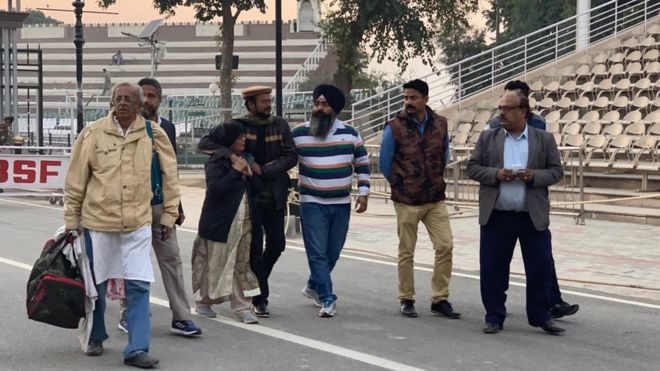
Image captionHamid Ansari reunited with his family at the border on Tuesday

An Indian man held for six years in Pakistan after illegally entering the country has returned to his family.

Hamid Ansari was convicted on charges of spying after he was found with a fake Pakistani identity card.

But his supporters said he had entered the country to pursue “blind and stupid” love with a woman he met online.

It is not clear, however, if he ever met the woman he crossed the border for.

Ansari was greeted at India’s Wagah border by his family, government officials and journalists.

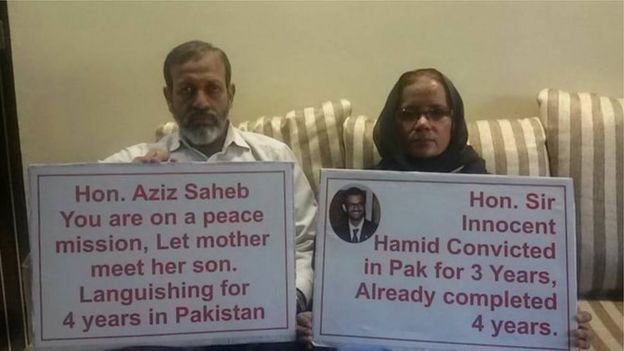
His return ends a years-long ordeal for his family who fought to first track him down, and then secure his release.

Though officially convicted in 2015, Ansari had been in Pakistani custody since 2012.

His jail term officially ended on Sunday, but his release was delayed because legal formalities had not been completed.

India and Pakistan have fought three wars since independence and the partition of India in 1947 and regularly jail each others citizens.

Who is Hamid Ansari?

Hamid Ansari is the youngest son of Fauzia Ansari, the vice-principal of a Mumbai college, and banker Nihal Ansari.

In November 2012, the 33-year-old had just started a new job as a lecturer at an educational institute when he told his parents that he was going to Afghanistan for an interview with an airline company.

But a few days after he landed in the Afghan capital Kabul, Ansari went missing.

हामिद अंसारी के माता पिताImage copyrightFAUZIA ANSARI

His family says that he stopped communicating with them, and his phone number was switched off.

Activist Jatin Desai, who has been at the forefront of efforts to get Ansari released, told BBC Hindi that that the family had then checked his laptop, where they discovered that he had been communicating with several people from Pakistan via email and social media.

They had also realised that he was in the Khyber Pakhtunkhwa province of the country.

So why did he go?

“Blind and stupid love,” according to Mr Desai.

In comments to India’s Mumbai Mirror newspaper, Mr Desai said that he first met Ansari when he had approached him about six months before his disappearance, asking for help with getting a Pakistani visa. He claimed he wanted to marry a woman in Khyber Pakhtunkhwa who he had met online.

“I had a big laugh when he told me that he wanted to marry a woman in a place notorious for honour killings. I told him to stop being stupid and concentrate on his career,” the newspaper quoted him as saying.

But the determined Ansari reportedly reached out to people in Pakistan, who apparently told him he could enter the country through Afghanistan more easily.

He entered through Torkham in Afghanistan after obtaining a fake Pakistani identity card under the name Hamza.

Then, according to documents released later, he was arrested from a hotel in Kohat city, where the girl he had come to find reportedly lived.

How did his release come about?

After his family was unable to trace his whereabouts in Pakistan, they reached out to government officials and activists for help.

Among them was Mr Desai, who has been working for many years to secure the release of both Indian and Pakistani prisoners jailed in each others countries.

A Pakistani journalist – who was later detained for a long period – managed to get in touch with Hamid’s mother in Mumbai and filed a missing person’s petition in court on her behalf.

She played an important role in encouraging a government commission on enforced disappearances to investigate his case.

As a result, security agencies, in early 2016, eventually admitted that Ansari was in their custody and had been jailed.

Hamid Ansari
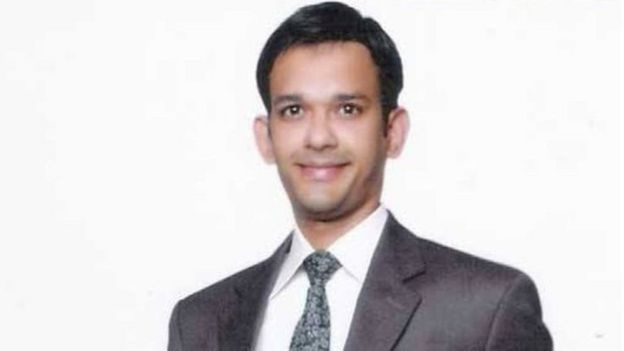
Image captionAnsari pictured before he went to Pakistan

The Indian Express newspaper quoted official sources as saying that the Pakistan government did not allow any Indian officials to meet Ansari for the entire six years,

His release now is being seen as a “humanitarian gesture” by the new Pakistan government, led by Imran Khan.


The reaction from Pakistan

Ilyas Khan, BBC News, Islamabad

The morning headlines on Pakistani television channels were unanimous: “Indian spy released after completing prison term,” they said. But the reality may not be as stark.

Hamid Ansari was missing for well over three years before it was disclosed that he’d actually been picked up by an intelligence agency and sentenced to three years by a military court for espionage.

Since the military court records remain secret, it is not clear what the actual evidence was. But investigations conducted by the human rights cell of the Supreme Court and hearings held at Peshawar High Court found Mr Ansari’s account of events to be reliable in the light of evidence put before it.

At one point, Mr Ansari’s lawyer even pleaded that he should be charged for illegal entry only and that espionage charges be dropped. But the Peshawar court refused this in the end on grounds that it had no jurisdiction to overturn the ruling of a military court.

Pakistan’s foreign ministry spokesman on Monday still described Ansari as an “Indian spy” but the narrative in India is very different.

However given Mr Ansari trespassed into Pakistan at a time when militancy was at its peak, and the fact that he is an Indian national, the military court actually took a rather lenient view of his case, observers here say.

Law of Unintended Consequences

continuously updated blog about China & India

ChiaHou's Book Reviews

continuously updated blog about China & India

What's wrong with the world; and its economy

continuously updated blog about China & India