Archive for ‘Chindia Alert’

14/12/2018

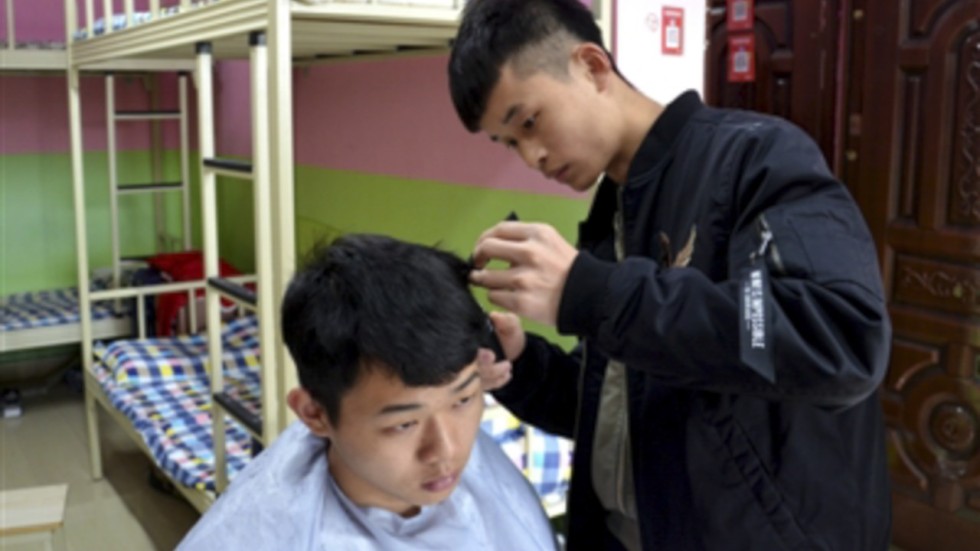
Chinese university student creates a buzz with cheap campus haircuts

An enterprising student is creating a buzz at a university campus in southwest China, where his cheap and reliable haircuts are in demand.

Ding Weijie, 19, opened an “express hairdressing salon” in his dormitory at the Sichuan Hope Automotive Vocational College in early November, Chengdu Economic Dailyreported on Friday.

Although Ding is self-taught, his hairdressing skills have already turned heads on the campus in Ziyang. His 5 to 6 yuan (73 to 87 US cents) cuts for men have become so popular that appointments need to be booked a few days in advance.

The first-year student, whose major is new energy vehicles, said he had been looking for a way to make some extra cash.

“After I started university, I wanted to find a part-time job to earn some money for my living costs,” Ding, who is from Yibin in Sichuan province, told the newspaper.

ADVERTISEMENT

He initially took a job as a dishwasher in the university canteen, but it did not pay well and left him with little time for studying.

14/12/2018

Trips made by China-Europe freight trains surge in 2018

CHINA-EUROPE-FREIGHT TRAINS TRIPS-SURGING

Staff unload containers from the freight train X8044 after the train from Hamburg of Germany arrived at Wujiashan railway container center station in Wuhan, central China’s Hubei Province, Aug. 26, 2018. China-Europe freight trains made 5,611 trips in the first 11 months of 2018, surging 72 percent compared with the same period last year, according to a meeting held in southwest China’s Sichuan Province. In 2017, more than 3,000 trips were made via the China-Europe freight trains between cities on the two continents. The number is expected to reach 6,000 in 2018, according to the meeting held by the Transport

Photo taken on May 21, 2018 shows a cross-border e-commerce freight train from Hamburg of Germany arriving in Xi’an, northwest China’s Shaanxi Province. China-Europe freight trains made 5,611 trips in the first 11 months of 2018, surging 72 percent compared with the same period last year, according to a meeting held in southwest China’s Sichuan Province. In 2017, more than 3,000 trips were made via the China-Europe freight trains between cities on the two continents. The number is expected to reach 6,000 in 2018, according to the meeting held by the Transport Coordinating Committee of China Railway Corporation’s China-Europe project. As of November, the trains connect 56 Chinese cities with 49 European cities in 15 European countries. The number of trips from Europe to China has increased and accounted for 71 percent of the trips to Europe, according to the committee. In late August, the trains marked their 10,000th trip since beginning operations in March 2011. The China-Europe freight rail services have pushed forward China’s opening-up and boosted economic and trade cooperation with countries along the Belt and Road, the China Railway Corporation said in a statement. This year marks the fifth anniversary of the Belt and Road Initiative, a transnational network connecting Asia with Europe, Africa and beyond. Over the past five years, China’s trade in goods with countries along the Belt and Road exceeded 5.5 trillion U.S. dollars. Chinese direct investment in the non-financial sectors of these countries reached 80 billion dollars during the same period. (Xinhua/Li Yibo)

CHENGDU, Dec. 13 (Xinhua) — China-Europe freight trains made 5,611 trips in the first 11 months of 2018, surging 72 percent compared with the same period last year, according to a meeting held in southwest China’s Sichuan Province.

In 2017, more than 3,000 trips were made via the China-Europe freight trains between cities on the two continents. The number is expected to reach 6,000 in 2018, according to the meeting held by the Transport Coordinating Committee of China Railway Corporation’s China-Europe project.

As of November, the trains connect 56 Chinese cities with 49 European cities in 15 European countries. The number of trips from Europe to China has increased and accounted for 71 percent of the trips to Europe, according to the committee.

In late August, the trains marked their 10,000th trip since beginning operations in March 2011.

The China-Europe freight rail services have pushed forward China’s opening-up and boosted economic and trade cooperation with countries along the Belt and Road, the China Railway Corporation said in a statement.

This year marks the fifth anniversary of the Belt and Road Initiative, a transnational network connecting Asia with Europe, Africa and beyond.

Over the past five years, China’s trade in goods with countries along the Belt and Road exceeded 5.5 trillion U.S. dollars. Chinese direct investment in the non-financial sectors of these countries reached 80 billion dollars during the same period.

14/12/2018

Sino-US trade talks advance amid close contact: Ministry of Commerce

BEIJING, Dec. 13 (Xinhua) — China and the United States are advancing their trade talks with close communication on details, the Ministry of Commerce (MOC) said Thursday.

“The Chinese side welcomes the U.S. team to visit China for consultation and is open to visiting the U.S. for communication,” MOC spokesperson Gao Feng told a news conference.

Gao said the two countries had reached consensus on specific issues including agricultural products, energy and automobiles. “Soybean has always been an important kind of agricultural import from the U.S. given the huge demand in China.”

Gao said more details of the trade talks would be released.

Chinese Vice Premier Liu He, who currently heads the China-U.S. trade talks, spoke with U.S. officials on Tuesday, and the two sides exchanged views on implementing the consensus reached by the heads of state of the two countries and on the timetable and roadmap to push forward the trade talks.

13/12/2018

China to ‘cut US car tariff to 15%’

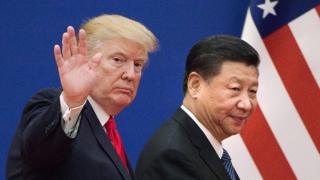
This file picture taken on November 9, 2017, shows US President Donald Trump (L) and China"s President Xi Jinping leaving a business leaders event at the Great Hall of the People in BeijingImage copyrightAFP/GETTY
Image captionUS President Donald Trump says he has a good relationship with President Xi Jinping

China has reportedly proposed cutting tariffs on US-made cars to 15%, the same tax levied on car imports from other countries.

Bloomberg reported that China’s cabinet will review the plans, which would undo the 40% import duty China imposed on US cars this summer.

The proposal, the timing of which remains uncertain, comes as the two countries restart trade talks.

President Donald Trump said earlier this month China would cut the tariffs.

However the claim has not yet been confirmed by Chinese officials, sowing confusion.

Tuesday’s reports in US media, which were based on anonymous sources including a car industry executive, said China outlined the plan on a recent telephone call between top trade negotiators from the two countries.

Bloomberg, which cited “people familiar with the matter”, said the step was not finalised and could still change.

The office of the US Trade Representative, which is leading the discussions, did not respond to a BBC request for comment.

In a tweet, Mr Trump said the two sides were having “very productive conversations”.

China’s commerce ministry confirmed that the two sides had spoken. In a statement it said the conversation concerned “pushing forward the timetable and road map for the next stage of economic and trade consultations work.”

Shares in car companies, including BMW, rose on the reports.

Image captionTesla, a US electric car-maker, has said its sales have been hurt by Chinese tariffs

Argentina meeting

The back-and-forth is the latest in a trade tow triggered by US claims that China engages in “unfair” trade practices, such as theft of intellectual property.

The dispute has prompted the US and China to impose new tariffs on billions of dollars worth of annual trade this year, measures that have contributed to economic worries in both countries.

The two sides, led by Mr Trump and President Xi Jinping, recently met in Argentina, where they agreed to a 90-day halt to any new tariffs.

Image captionMr Trump (front right) met Mr Xi (front left) after the G20 summit in Buenos Aires

US officials later said they wanted to see China move to reduce the car tariffs “immediately” as a sign that negotiations would proceed in good faith.

Analysts remain sceptical that the two sides will be able to reach a resolution of the underlying issues by 1 March.

Those doubts increased after the recent arrest of a high-ranking Huawei official in Canada at the request of the US, which worsened relations between the two countries.

Deja vu?

White House officials have maintained that the two matters are separate, but apparent agreements have faltered before.

In May, after talks in Washington, the US agreed to hold off on tariff threats, while China said it would reduce the import duty on foreign cars from 25% to 15%.

However that deal fell apart within weeks, after Mr Trump decided to move ahead with tariffs.

In retaliation, China raised the duty on US car imports to 40%, though it proceeded with the lower rate on imports from other countries.

13/12/2018

Canadian Michael Spavor detained in China as Huawei row continues

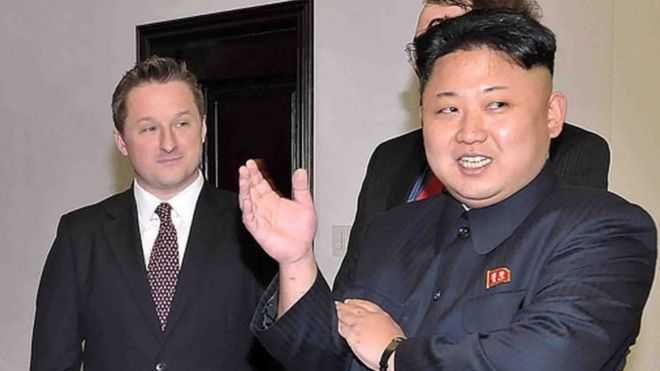
Michael Spavor with North Korean leader Kim Jong-un (2013)Image copyrightAFP
Image captionMr Spavor met North Korea’s Kim Jong-un during his 2013 visit to Pyongyang

A second Canadian has been detained in China on the same accusation of harming national security, as tension continues between the two countries.

It was confirmed on Thursday that Michael Spavor, a businessman, had been detained in addition to former diplomat Michael Kovrig.

Canada drew Chinese protests after it arrested an executive at telecoms giant Huawei at the request of the US.

Meng Wanzhou has been bailed but may face extradition for fraud.

She denies violating US sanctions on Iran through Huawei’s business dealings and China has threatened unspecified consequences if she is not released.

So high-profile is the case that US President Donald Trump has said he could intervene if it helps to avoid a further decline in US relations with China.

Who are the two Canadians?

Michael Spavor is a businessman based in Dandong, near the Chinese border with North Korea. He has deep ties to the North Korean government.

Ex-diplomat Michael Kovrig currently works for a think tank, the International Crisis Group (ICG), which has said it is concerned for his health and safety.

Presentational grey line

Timeline of events

1 December: Meng Wanzhou arrested in Canadian city of Vancouver at the request of the US as part of an inquiry into alleged sanctions-busting by her company Huawei

10 December: Canadian former diplomat Michael Kovrig arrested in Beijing “on suspicion of engaging in activities that harm China’s state security”

11 December: Meng Wanzhou released on bail but still faces the prospect of extradition to the US

12 December: China confirms the detention of businessman Michael Spavor for “activities that endanger China’s national security”, saying the investigation began on 10 December

Presentational grey line

He is being held officially “on suspicion of engaging in activities that harm China’s state security”.

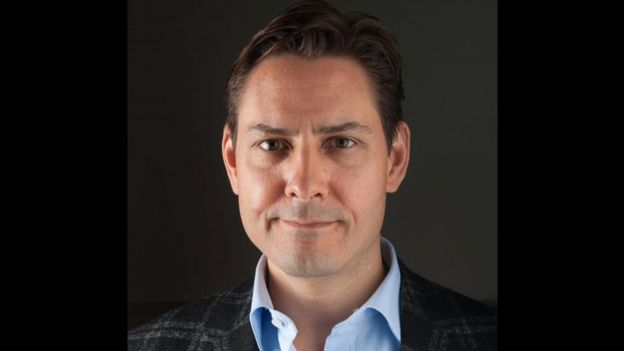
Michael KovrigImage copyrightAFP
Image captionMichael Kovrig was working for a think tank that focuses on conflict reduction research

However, a Chinese foreign ministry spokesman, Lu Kang, suggested another reason, saying the ICG had not been registered as a non-governmental organisation in China and therefore it was unlawful for its staff to work there.

Canadian Foreign Minister Chrystia Freeland has said Mr Kovrig’s case was raised directly with Chinese officials.

Foreign ministry spokesman Guillaume Bérubé confirmed that Mr Spavor had contacted them earlier in the week because “he was being asked questions by Chinese authorities”.

Canada is working hard to determine Mr Spavor’s whereabouts, Mr Bérubé said.

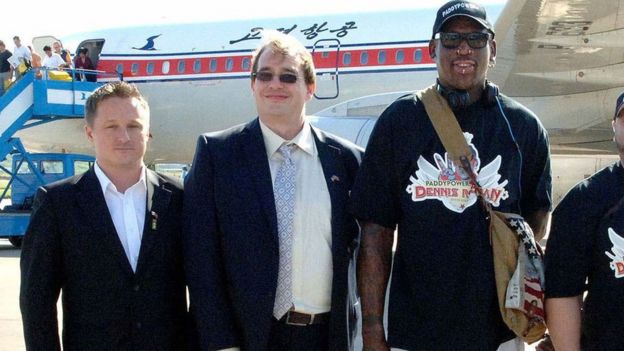
Michael Spavor (L) in North Korea with former NBA star Dennis Rodman (right) (3 Sept 2013)Image copyrightAFP
Image captionMichael Spavor (left) helped arrange ex-NBA star Dennis Rodman’s trip to North Korea in 2013

China state media confirmed on Thursday that, as with the previous arrest, Mr Spavor was under investigation on suspicion of “engaging in activities that endanger China’s national security”.

Mr Spavor runs an organisation called Paektu Cultural Exchange, which organises business, culture and tourism trips to North Korea.

He is a regular visitor to North Korea and regularly comments in the media on Korean issues. He is particularly well known for helping to arrange the visit by former NBA star Dennis Rodman to North Korea in 2013.

Rodman is a personal friend of North Korean leader Kim Jong-un.

One of Mr Spavor’s last tweets, on Sunday, said he was about to travel to Seoul in South Korea, but he did not arrive on Monday as planned.

Why was Meng arrested?

The former Canadian resident was detained in Vancouver where she has family and property connections.

She was granted bail of C$10m (£6m; $7.4m) on Tuesday but could still be extradited to the US.

Court sketch of Meng Wanzhou during her bail hearing in Vancouver, British Columbia, Canada 7 December 2018Image copyrightREUTERS

The US has been investigating Huawei, one of the world’s largest smartphone makers, since 2016, believing that it used a subsidiary to bring US manufacturing equipment and millions of dollars in transactions to Iran illegally.

The Supreme Court of British Columbia was told Ms Meng had used a Huawei subsidiary called Skycom to evade sanctions on Iran between 2009 and 2014.

She had allegedly misrepresented Skycom as being a separate company.

Ms Meng faces up to 30 years in prison in the US if found guilty of the charges, the Canadian court heard.

Are the arrests in China an act of retaliation?

After the detention of Mr Kovrig, Canada said there was no “explicit indication” of any link to the Meng case but China experts doubted that it was just a coincidence.

Guy Saint-Jacques, Canada’s former ambassador to China, told Canadian broadcaster CBC: “In China there are no coincidences… If they want to send you a message, they will send you a message.”

Speaking on condition of anonymity, a Western diplomat in China told Reuters news agency: “This is a political kidnapping.”

Asked if the detention of the two Canadians was in response to Ms Meng’s arrest, China’s foreign ministry spokesman described it as an “operation taken by China’s relevant national security authorities in accordance with the laws”.

Lu Kang said Ms Meng’s arrest was “wrong practice”, adding: “I can point out that, since the Canadian government took the wrong action at the request of the US and took Meng Wanzhou into custody, many Chinese are wondering if their trips to Canada are safe.”

Related Topics

More on this story

  • Huawei: The life of Chinese tech heiress Meng Wanzhou
    11 December 2018
  • Canada is seeking consular access to ex-diplomat detained in China
    12 December 2018
  • Huawei arrest puts ‘bullseye’ on Apple
    11 December 2018

China

13/12/2018

3 Chinese teachers detained for ‘stabbing kindergartners with toothpicks’

  • Parents say their children were warned that if they reported the abuse they would be punished even more
  • School’s legal representative dismisses claims of wrongdoing by teachers
PUBLISHED : Thursday, 13 December, 2018, 6:17pm
UPDATED : Thursday, 13 December, 2018, 6:24pm

Three kindergarten teachers in northeast China have been detained on suspicion of physically abusing pupils in their care, including stabbing them with toothpicks, according to local media reports.

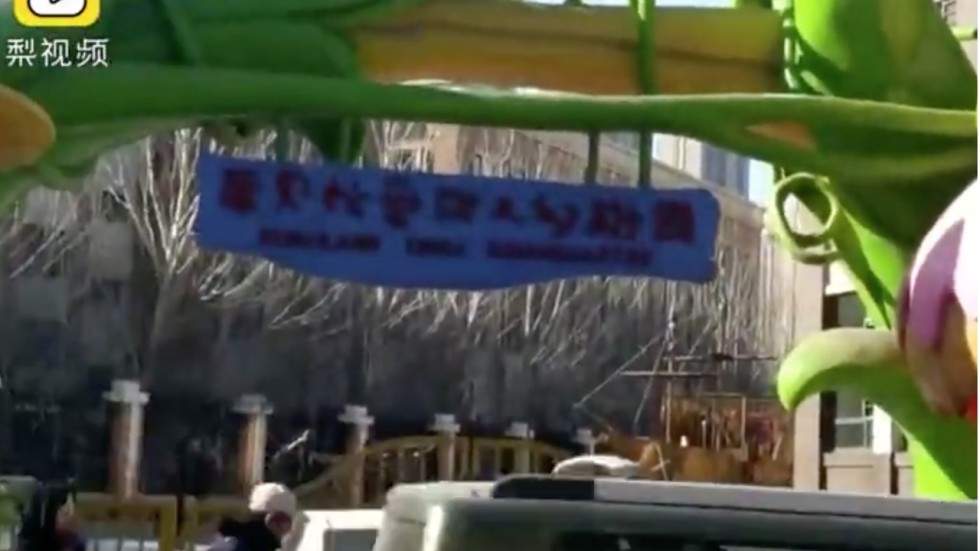
Police in Shenyang, Liaoning province, launched an investigation into the Kubeiland Emile International Kindergarten after receiving complaints from parents that at least 15 of its pupils had been abused by staff.

“They [pupils] would be pricked if they couldn’t finish their meal, or moved during nap time or didn’t dance well,” one parent was quoted as saying by China Business Journal.

The youngsters were even warned that if they spoke out about the punishments they received there would be worse to come, another parent said.

Several parents had medical records and photographs showing multiple prick marks on their children’s hands, legs, bottoms and abdomens, the report said.

Another parent said the school even tried to cover up the abuse by sending children who bled after being pricked to the school clinic to have their wounds cleaned up and sterilised.

In a report by video news website Pear Video, a mother was quoted as saying that she became suspicious after catching her son stabbing other children with a toothpick. When she challenged him about it, the boy said he was copying his teacher.

A father of another of the pupils echoed the claim that the children were warned not to report the abuse.

“He [the man’s son] said a teacher told them she could see and hear them talking to their parents, so they must not tell.”

The police officer in charge of the case said that three people had been detained pending a full investigation into the allegations.

However, Su Ning, the kindergarten’s legal representative, dismissed claims children had been abused and said the school had provided footage from its surveillance cameras that would invalidate the charges.

Accusations of child abuse in schools are not uncommon in China. Last month, eight teachers from a nursery in Shanghai were sentenced to prison terms of up to 18 months for roughly handling young children and force feeding them mustard.

13/12/2018

Can South China Sea conflict between Washington and Beijing be avoided?

This story is part of an ongoing series on US-China relations produced jointly by theSouth China Morning Post and POLITICO, with reporting from Asia and the United States.

Rising tensions over Beijing’s accelerating military build-up in the South China Sea are stoking fears of a major-power clash between China and the United States – fuelling urgent calls for new security talks before the two nations stumble into a shooting war.

But the worries come amid a dearth of official dialogue between two of the world’s largest militaries, and as US leaders espouse an increasingly harder line against China’s actions.

The US and its allies have stepped up naval and air patrols over the sea and cancelled joint exercises with Beijing, while China is considering requiring all aircraft flying over the area to first identify themselves – a step that many nations would consider threatening.

Military experts say the showdown could easily spin out of control.

“Chinese colleagues have said to me explicitly that if the US continues to sail through and overfly what they see as their waters, China will eventually shoot down the offending aircraft,” said Matthew Kroenig, a former CIA analyst and Pentagon strategist.

“Maybe that’s just a bluff, but if China shot down a US plane, that would be a scenario ripe for escalation. It’s hard to see President Trump or any other US leader backing down from that.”

US military leaders insist they’re determined to avoid that. Navy Admiral Phil Davidson, the US commander of the Indo-Pacific Command, told POLITICO he’s eager to open a new dialogue with his Chinese counterparts, contending that “a military-to-military relationship is quite important.”

“I have yet to meet the [chief of defence] or the minister of defence in China,” he said. “I hope to visit early next year.”

Marine General Joseph Dunford, the chairman of the US Joint Chiefs of Staff, says establishing more channels for the militaries to avoid conflict is one of his top priorities as Washington and Beijing also tussle over issues such as trade and North Korea’s nuclear program. “Competition does not necessarily lead to conflict,” he said at a recent security forum in Canada.

On the other hand, the US is trying to send Chinese leaders a pointed message by sending an increased number of military patrols through the disputed waters, Dunford said in an interview with POLITICO.

“What we are doing is preserving the principle of open access to the global commons,” Dunford said. And he said nations “violating international norms, standards and the law” should know they are “going to pay a cost that is higher than whatever they hope to gain.”

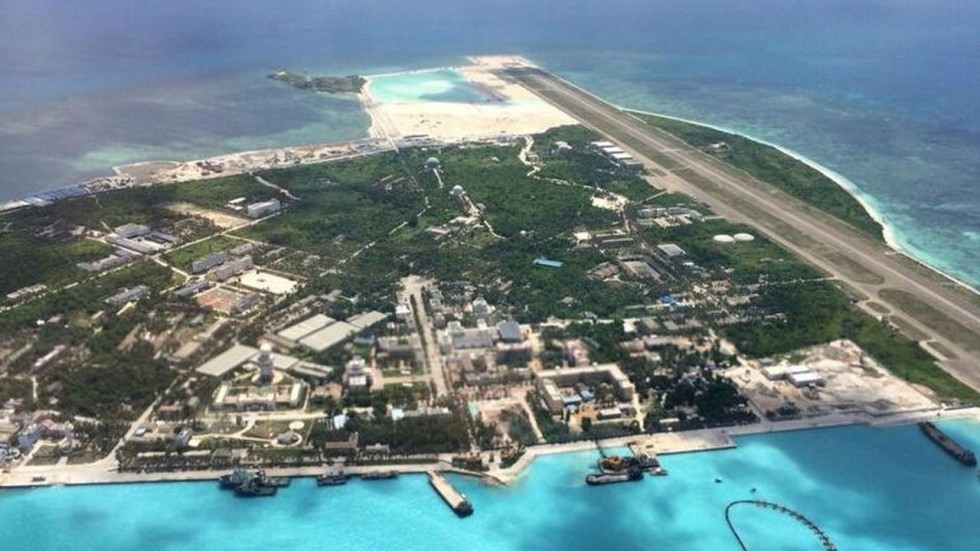
Similarly, Beijing’s leaders are not backing down from their military expansion in the vast South China Sea, which stretches more than 1.3 million square miles with trillions of dollars worth of trade transiting annually. Those waters near the Spratly Islands chain where China seized reefs and began building artificial islands during the second term of the Obama administration.

Despite public assurances from President Xi Jinping that the features would not be militarised, China recently deployed surface-to-air missiles and other weapons and equipment. Earlier this year, satellite images showed that Beijing has built at least four airstrips suitable for military aircraft on Woody Island, as well as the reefs in the archipelago known as Fiery Cross, Mischief and Subi.

China has telegraphed steps to further solidify its claims in the waters. In June, Chinese Lieutenant General He Lei acknowledged during the Shangri-La defence summit in Singapore that China is deploying troops and weapons on both natural and man-made islands in the Paracel and Spratly archipelagos.

Chinese military sources from a state-owned firm specialising in radar systems to detect stealth aircraft for the PLA said the People’s Liberation Army’s Air Force and Strategic Support Force have also placed sophisticated radar systems in the South China Sea.

“Since the US has kept sending spy aircraft to do the close-in reconnaissance activities near China’s territory waters in the South China Sea, it’s necessary to deploy a sophisticated radar system to the artificial islands to detect the US aircraft,” one of the sources from the firm said.

Lieutenant General He Lei, who led the Chinese military delegation to the Shanghai-La Dialogue, said that “deploying troops and weapons on islands in the South China Sea is within China’s sovereign right to do and allowed by international law.”
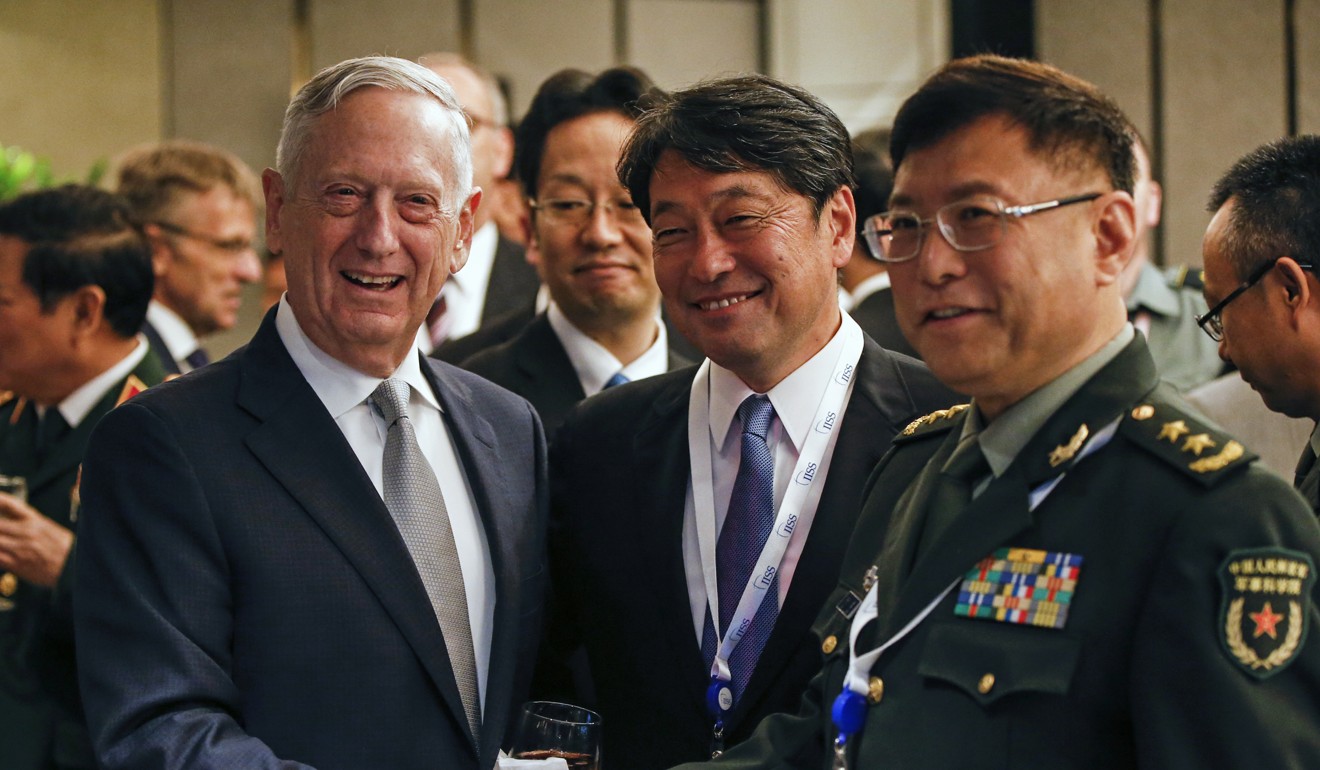
The US and other countries have condemned the expansion as a violation of international law. And, in recent months, top American military officials have dropped some of their usual diplomatic language.

US Defence Secretary James Mattis revoked China’s invitation to participate in an annual military exercise this fall, then cancelled a trip to Beijing planned for October.

“If you’d asked me two months ago, I’d have said we are still attempting to maintain a cooperative stance,” the retired four-star general said at the Shangri-La summit. “But then you look at what President Xi said in the Rose Garden of the White House in 2015, that they would not militarise the Spratlys, and then we watched what happened four weeks ago, it was time to say there’s a consequence to this.”

During his trip to Vietnam in October, Mattis said Washington was highly concerned about China’s “predatory” behaviour and militarisation of the South China Sea.

“We remain highly concerned with the continued militarisation of features in the South China Sea,” he said, saying that this continued to happen despite a pledge by President Xi Jinping not to do so.

Davidson, the top American commander in the Asia-Pacific, expressed alarm recently at China’s “secretly deployed anti-ship missiles, electronic jammers and surface-to-air missiles.”

“So what was a great wall of sand just three years ago,” Davidson added, “is now a great wall of SAMs in the South China Sea, giving [the People’s Republic of China] the potential to exert national control over international waters in the South China Sea.”

The US and its allies have also launched “freedom of navigation” operations in the region. In September, two pairs of US Air Force B-52 bombers flew over the disputed area – one pair over the South China Sea and one over the East China Sea. A week later, the destroyer USS Decatur came within 12 nautical miles of two of the disputed reefs, prompting manoeuvres by a Chinese destroyer that the Pentagon called “unsafe” and “unprofessional.”

Australia, Japan, France, Canada and New Zealand are among the allies taking part in the patrols.

But the growing prominence of those other military forces has caused China to “push back more, and that heightens the risk that you could have an inadvertent crisis,” said Lindsey Ford of the Asia Society, who is also a former senior adviser to the US assistant secretary of Defence for Asian and Pacific security affairs.

China’s interest is not simply to exert political or economic influence in the region, said Kroenig, the former CIA analyst. Its activities are also defensive in nature, he believes.

China, like the Soviet Union during the cold war, is not confident that its nuclear ballistic missile submarines could survive in the open ocean during a conflict with the United States, he said – because waters closer to Chinese territory are too shallow. So it hopes to use the South China Sea as an operating area for its subs.

“That’s a strategic military purpose on top of the political purpose,” said Kroenig. “I’ve had a Chinese colleague say to me: ‘You guys don’t really care about these territorial claims in the South China Sea. You’re trying to deny our nuclear deterrent.’”

Now, Chinese military experts say, Beijing is considering establishing an “air defence identification zone”, which would require all aircraft over the area to declare their identity and destination.

The rationale is ostensibly peaceful in nature: Chinese officials maintain it would help prevent disasters such as the 2014 disappearance of Malaysia Airlines flight MH370.

But a zone Beijing established in the East China Sea in 2013 drew a joint rebuke from Japan and the Association of Southeast Asian Nations, which considered it threatening.

The resistance from other nations “implied that such a move constituted a security challenge”, said Collin Koh Swee Lean, an analyst at the S. Rajaratnam School of International Studies in Singapore.

Koh warned that the air traffic proposal could derail regional talks about establishing a code of conduct to avoid confrontations in the area. He also predicted that the US might feel compelled to ramp up its military presence in response – a view echoed by Zhou Chenming, a military expert based in Beijing.

Further fuelling tensions in the South China Sea is the growing role of China’s so-called Maritime Militia, a naval paramilitary force that operates disguised as fishing or other civilian vessels. Vice-President Mike Pence recently criticised the forces as extra-legal, and the rules for approaching them are ill-defined.

“Should we treat them as military vessels and expect them to behave that way?” asked the Asia Society’s Ford. “China is exploiting a loophole. Pence’s recent remarks calling out the Maritime Militia explicitly suggest the US is refining its thinking about how to approach that loophole.”

For now, senior American military leaders are expressing confidence that US forces can continue to aggressively promote their freedom of navigation mission without sparking a violent confrontation.

“I think one of the unfortunate things is the focus on two destroyers passing in the daylight,” Davidson told POLITICO. “That is not what the issue is about in the South China Sea. It is about trade, commerce, financial markets moving their information around the globe – every airline that flies over the top.”

Others worry that the longer the United States and China up the ante the more likely things could spin out of control.

13/12/2018

Winners decided for China’s 2018 national science and technology awards

BEIJING, Dec. 12 (Xinhua) — China has decided the winners for the 2018 national science and technology awards at an executive meeting of the State Council presided by Premier Li Keqiang on Wednesday.

The list of winners and awards are yet to be released.

According to the meeting, the purpose of the awards is to inspire more domestic technicians, especially younger ones, to engage in the study of cutting-edge technologies, make breakthroughs in essential technologies, expand international cooperation and to have science and technology better serve and support economic development and the improvement of people’s livelihood.

A grand ceremony was held in Beijing in January, where 271 projects and nine scientists won the national prizes last year. There were also seven foreign scientists who won international science and technology cooperation awards.

13/12/2018

China-Qatar visa exemption agreement to take effect later this month

CHINA-BEIJING-WANG YI-QATAR-DEPUTY PM-STRATEGIC DIALOGUE MECHANISM-MEETING (CN)

Chinese State Councilor and Foreign Minister Wang Yi (R) and Sheikh Mohammed bin Abdulrahman Al Thani, deputy prime minister and minister of foreign affairs of Qatar, co-chair the first meeting of a China-Qatar inter-governmental strategic dialogue mechanism in Beijing, capital of China, Dec. 12, 2018. (Xinhua/Ding Haitao)

BEIJING, Dec. 12 (Xinhua) — An agreement on mutual exemption of visas between China and Qatar will take effect from Dec. 21, the two countries announced Wednesday in Beijing.

The announcement came as State Councilor and Foreign Minister Wang Yi and Sheikh Mohammed bin Abdulrahman Al Thani, deputy prime minister and minister of foreign affairs of Qatar, co-chaired the first meeting of a China-Qatar inter-governmental strategic dialogue mechanism in Beijing.

The two sides hope to take this opportunity to bolster cooperation in tourism and expand people-to-people exchanges.

This year marks the 30th anniversary of the establishment of diplomatic relations between China and Qatar. Wang said it is of great importance to initiate an inter-governmental strategic dialogue mechanism between the two countries.

“China stands ready to work with Qatar to push bilateral ties towards another 30 years of faster development,” said Wang. He proposed the two sides use the opportunity of jointly pursuing the Belt and Road Initiative to synergize their development strategies and carry out win-win cooperation in in fields including energy, high and new technology, investment, finance.

Wang also introduced the measures taken and results achieved by Xinjiang Uygur Autonomous Region in combating violence, terrorism and extremism.

While calling terrorism a common threat to humanity, Mohammed said Qatar supports the measures taken by China in safeguarding national security and stability, and stands ready to strengthen cooperation in security and anti-terrorism.

13/12/2018

Xi holds talks with Ecuadorean president, eyeing steady development of bilateral ties

CHINA-BEIJING-XI JINPING-ECUADOR-PRESIDENT-TALKS (CN)

Chinese President Xi Jinping (L, front) holds a welcoming ceremony for Ecuadorean President Lenin Moreno Garces ahead of their talks at the Great Hall of the People in Beijing, capital of China, Dec. 12, 2018. (Xinhua/Li Tao)

BEIJING, Dec. 12 (Xinhua) — President Xi Jinping on Wednesday held talks with Ecuadorean President Lenin Moreno at the Great Hall of the People in Beijing, calling for the healthy and steady development of the bilateral ties.

Recalling his state visit to the South American country in 2016, Xi said the healthy and steady development of China-Ecuador ties goes with not only the fundamental interests of the two countries and peoples but also the trend of peace, development and win-win cooperation.

During the 2016 visit, the two countries established a comprehensive strategic partnership, ushering in a new chapter for the bilateral relationship, Xi said.

Xi said he appreciates President Moreno’s commitment to deepening the friendly cooperation between the two countries since Moreno took office last year.

Xi stressed that the two sides should increase interactions to intensify their strategic communication and coordination and exchange experience on governance, so as to enhance mutual understanding and support for each other’s path of development and continue backing each other firmly on issues involving their core interests and major concerns.

Noting that Ecuador’s participation in the construction of the Belt and Road is welcomed by the Chinese side, Xi expects the two sides to jointly promote cooperation in areas such as infrastructure, production capacity, agriculture, information technology, new energy and environmental protection.

“China welcomes Ecuador to actively explore the Chinese market and share opportunities brought by China’s development,” Xi said.

China’s financing cooperation with Ecuador is conducted on the basis of equality, mutual benefit and business principles, without attaching any political condition, said Xi.

Noting that the Chinese government requires Chinese enterprises in Ecuador to abide by local laws and regulations and run business fairly in the market, Xi expects the Ecuador side to create a good investment environment and protect their legitimate rights and interests.

He called for closer people-to-people and technology exchanges, urging both sides to carry out law enforcement cooperation to guarantee normal exchanges of personnel, economy and trade.

Xi also said China will continue to support Ecuador’s post-earthquake reconstruction and its disaster prevention work.

China and Ecuador have same or similar positions on major international and regional issues, said Xi, calling on the two sides to collaborate closely to safeguard multilateralism, promote reform of the global governance system and defend the legitimate rights and interests of developing countries.

Moreno expressed gratitude for China’s assistance on Ecuador’s economic and social development, especially for the help offered after Ecuador was hit by an earthquake in 2016.

Moreno said Ecuador is ready to actively take part in the Belt and Road Initiative and expand bilateral cooperation in various fields.

He welcomed and appreciated China’s financing cooperation with Ecuador and expects to expand exports to China. Moreno also expressed the will to enhance coordination and collaboration with China in multilateral affairs such as UN Sustainable Development Goals.

After the talks, the two leaders witnessed the signing of several cooperation documents, including a memorandum of understanding on jointly promoting the construction of the Belt and Road.

Law of Unintended Consequences

continuously updated blog about China & India

ChiaHou's Book Reviews

continuously updated blog about China & India

What's wrong with the world; and its economy

continuously updated blog about China & India