Chindia Alert: You’ll be Living in their World Very Soon
aims to alert you to the threats and opportunities that China and India present. China and India require serious attention; case of ‘hidden dragon and crouching tiger’.
Without this attention, governments, businesses and, indeed, individuals may find themselves at a great disadvantage sooner rather than later.
The POSTs (front webpages) are mainly 'cuttings' from reliable sources, updated continuously.
The PAGEs (see Tabs, above) attempt to make the information more meaningful by putting some structure to the information we have researched and assembled since 2006.
Bride Isha Ambani, the daughter of the Chairman of Reliance Industries Mukesh Ambani, and her groom Anand Piramal, heir to a real-estate and pharmaceutical business, after they got married in Mumbai, India, December 12, 2018. Reliance Industries/Handout via REUTERS
MUMBAI (Reuters) – The daughter of India’s richest man got married on Wednesday in a traditional ceremony in Mumbai attended by Bollywood stars and former U.S. presidential candidate Hillary Clinton.
The marriage brings together two of India’s most influential families. The bride, Isha Ambani, 27, is the daughter of Mukesh Ambani, head of the vast Reliance conglomerate whose net worth Forbes put at $43 billion.
Her groom, Anand Piramal, 33, is heir to a real-estate and pharmaceutical business.
The wedding bash took place at Ambani’s Mumbai residence, an extraordinary 27-storey structure known as one of the most expensive homes in the world. It was covered in red roses and decorated with lights and flowers for the occasion.
The groom and his family arrived in vintage cars as security guards onlookers and photographers from the narrow lane in south Mumbai that leads to the residence.
India’s Filmfare magazine said 600 guests were expected at what media have dubbed the “the big, fat Indian wedding”.
The festivities were a culmination of lavish pre-wedding celebrations in the desert city of Udaipur over the weekend which featured a private concert by American singer Beyonce.
As well as Clinton, who according to Indian media reports has an association with the Ambanis that goes back more than 18 years, attendees included newly-weds actress Priyanka Chopra and singer Nick Jonas, former Indian finance minister P. Chidambaram, cricketer Sachin Tendulkar and Bollywood actor Aamir Khan.
Many in India, where millions of people live in dire poverty, have closely followed the wedding preparations, including the couple’s engagement at a luxury hotel on Italy’s Lake Como.
NEW DELHI (Reuters) – India’s monthly oil imports from Iran plunged to their lowest in a year in November with Tehran dropping two places to become only the sixth biggest supplier after New Delhi cut purchases due to the impact of U.S. sanctions, according to ship tracking data and industry sources.
Last month, the United States introduced tough sanctions aimed at crippling Iran’s oil revenue-dependent economy. Washington did, though, give a six-month waiver from sanctions to eight nations, including India, and allowed them to import some Iranian oil.
India is restricted to buying 1.25 million tonnes per month, or about 300,000 barrels per day (bpd).
In November, India imported about 276,000 bpd of Iranian oil, a decline of about 41 percent from October and about 4 percent more than the year-ago month, ship tracking data obtained from shipping and trade sources showed.
After abandoning the 2015 Iran nuclear deal, U.S. President Donald Trump is trying to force Tehran to quash not only its nuclear ambitions and its ballistic missile program but its support for militant proxies in Syria, Yemen, Lebanon and other parts of the Middle East.
India’s imports from Iran in November, included some parcels that were loaded in October. In November, Iraq and Saudi Arabia continued to be the top two oil sellers to India.
The UAE, which was the sixth biggest oil seller to India in October, became the third top seller to India in November, knocking down Venezuela by a notch to fourth position.
Nigeria continued at No. 5 position, while Iran slipped to sixth place.
“Iran do not have vessels to export oil on time … some November loading vessels will arrive in December,” said an industry source, with knowledge of the matter.
Local and international shippers are not carrying Iranian cargoes despite India winning a waiver, this source said. The key problem is that while India can import Iranian oil without falling foul of Washington, that may not apply to a shipping company signing a new delivery contract.
Instead, India is relying on Iranian tankers for crude imports and Iran is using many of its vessels for crude storage.
The sources declined to be identified citing the confidentiality of the numbers.
Indian refiners, wary of the impact of U.S. sanctions, had boosted imports from Iran ahead of their introduction, with imports averaging about 563,000 bpd in April-November, a growth of about 32 percent from a low base in the previous fiscal year, the data showed.
(For an interactive graphic on ‘India’s Oil Imports From Iran’ click tmsnrt.rs/2SIFkfF)
In the previous financial year to March 2018 India had cut oil imports from Iran due to a dispute over development rights of a giant gas field.
Iran was hoping to sell more than 500,000 bpd of oil to India in 2018/19, its oil minister Bijan Zanganeh said in February, and had offered almost free shipping and an extended credit period to boost sales to India.
Government sources say Reuters’ calculations showing India’s oil imports from Iran in this fiscal year would be higher than the 452,000 bpd, or 22.6 million tonnes, it imported in the previous year, are correct.
During January-November this year India’s oil imports from Iran rose by an annual 18.4 percent to 552,000 bpd, the data showed. [L3N1YI38M]
NEW DELHI (Reuters) – Prime Minister Narendra Modi’s ruling BJP will try to canvass and galvanise its activists across India before a general election due next May, after losing power in three heartland rural states, senior leaders said after a meeting on Thursday.
Disgruntled voters blamed the slow pace of job creation and weak farm prices for the Hindu nationalist party’s defeat in the states, two of which it had ruled for three straight terms.
“We realise that rural distress and employment generation are the key issues and we are working on them,” said BJP spokesman Gopal Krishna Agarwal, who attended the meeting. “They’ll have to be tackled, and we will take suggestions from wherever needed.”
The Bharatiya Janata Party’s (BJP) various wings – representing women, farmers, lower castes, Muslims and young members – will all hold deliberations after losses in the supposed stronghold states of Madhya Pradesh, Rajasthan and Chhattisgarh.
“These meetings are aimed at preparing for the 2019 election and spreading the party’s message in various sections of society,” Bhupender Yadav, a BJP national general secretary, said after the meeting, which he said had been scheduled before the state election results came out on Tuesday.
He also announced that a planned national convention would be held in New Delhi on Jan. 11 and 12.
Senior BJP minister Nitin Gadkari told the ET Now business channel on Thursday that the agriculture sector may have been neglected under their government.
JOBS AND FARM PRICES
Agarwal, a chartered accountant who is also a director in a state-run bank, said increasing lending for job-generating small businesses was a key focus, as was enhancing procurement of grain from farmers by government agencies at state-mandated prices so there are no distress sales.
The government announces so-called minimum support prices for most crops to set a benchmark, but state agencies mainly buy limited quantities of staples such as rice and wheat at those prices, restricting benefits of higher prices to only around 7 percent of India’s 263 million farmers, according to various studies.
Following the state election setbacks, Modi’s government is expected to announce loan waivers worth billions of dollars to woo farmers, government sources told Reuters this week.
Agarwal said the party’s loss in Madhya Pradesh, known for multiplying agriculture production under three BJP governments, has reinforced its realisation that higher output helps consumers by bringing down prices, but can badly hurt farmers.
“The focus has so far been on consumers, like importing onions when prices shot up,” Agarwal said. “Now we need to look at the producers, not just the consumers.”
He also said there was a case for fiscal stimulus, given that inflation fell to a 17-month low in November. Food inflation sank to a negative 2.61 percent from a negative 0.86 percent in October, according to official data released on Wednesday.
MUMBAI (Reuters) – Indian forest rangers have launched a hunt for a leopard that killed a monk meditating under a tree deep in a jungle.
The monk, Rahul Walke Bodhi, had been meditating in the Tadoba Andhari Tiger Reserve in the western state of Maharashtra for the last month, and was attacked while offering morning prayers on Tuesday, a forest official said.
Two other monks who were on their way to give him food said they witnessed the attack but Walke was dead by the time they reached him, according to a second forest official.
“I would like to tell everyone not to go into the forest,” Gajendra Narwane, deputy director of the reserve, told the BBC Marathi-language service.
Forest rangers have set up two cages and a camera trap to try to capture the animal. It was not clear what they would do with it if they caught it.
The forest, some 825 km (510 miles) east of the city of Mumbai, is in a reserve for big cats where four other fatal attacks have occurred in the last few weeks, according to media.
Forest officials have cordoned off the area where the monk was killed and are restricting the timing of visitor access to a Buddhist temple there.
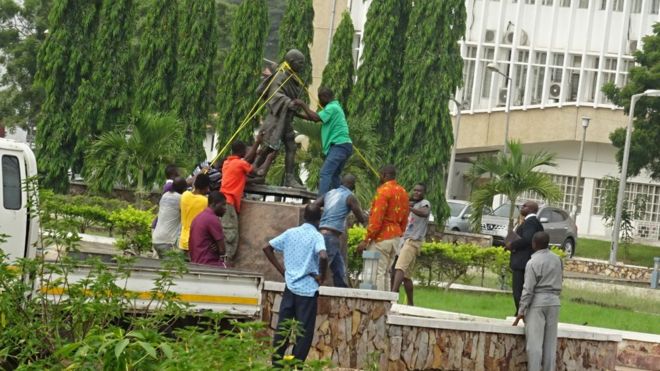
Lecturers and students told the BBC that the statue, originally located at the university’s recreational quadrangle, had been removed on Wednesday.
The university confirmed this, saying that the Ministry of Foreign Affairs and Regional Integration was responsible.
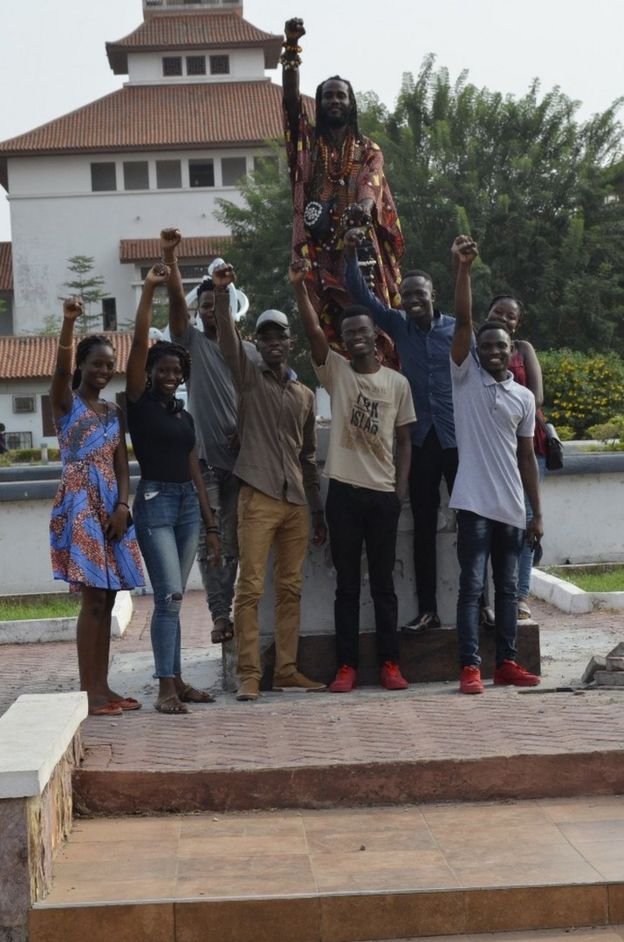
Law student Nana Adoma Asare Adei told the BBC: “Having his statue means that we stand for everything he stands for and if he stands for these things [his alleged racism], I don’t think we should have his statue on campus.”
Mahatma Gandhi was one of the most celebrated figures of the 20th Century. He is best known for leading non-violent resistance to British colonial rule in India.
However, as a young man he lived and worked in South Africa, and although he has inspired people throughout the world his comments on black Africans have been controversial.
In his early writings he referred to black South Africans as “kaffirs” – a highly offensive racist slur. He also said that Indians were “infinitely superior” to black people.
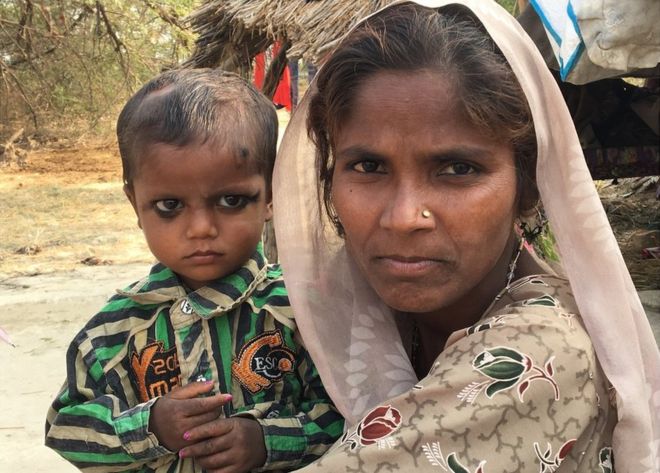
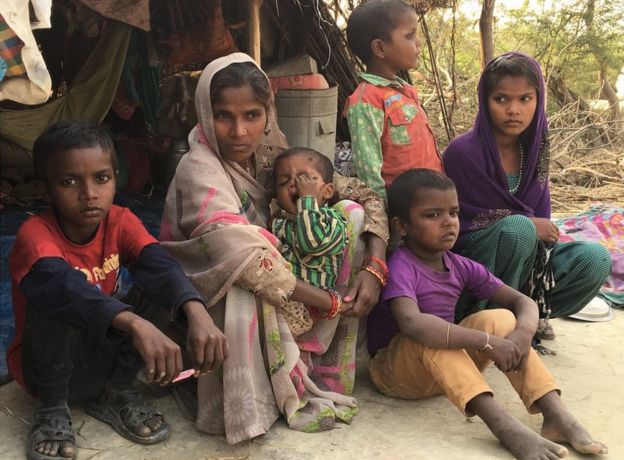
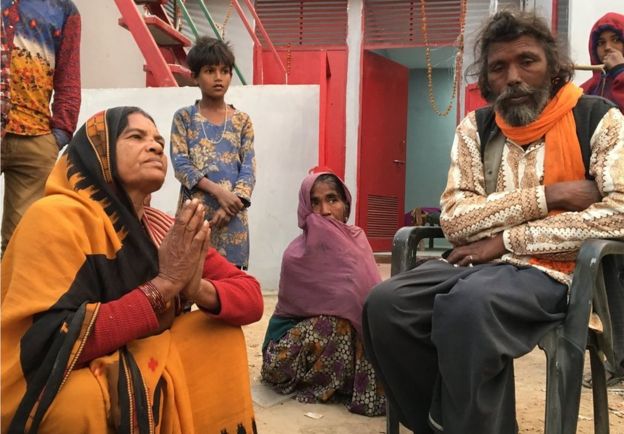
Image captionKhazanchi Nath was born two years ago as his mother Sarvesha Devi stood in a bank queue to withdraw cash
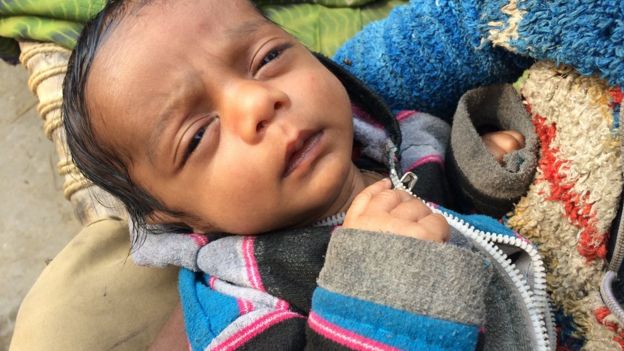
He arrived in the world with a bang. His birth in a bank queue made global news. But two-year-old Khazanchi Nath is now at the centre of a bitter fight between the two sides of his family and two villages because of his celebrity status. The BBC’s Geeta Pandey travels to rural Kanpur in northern India to piece together the toddler’s story.
Khazanchi, which means “treasurer”, was born in the state of Uttar Pradesh on 2 December 2016, less than a month after the Indian government banned 1,000 and 500 rupee notes overnight.
The decision by Prime Minister Narendra Modi, locally called demonetisation, led to a major cash crunch and for weeks millions of Indians were seen queuing outside banks to withdraw new currency notes.
A very heavily pregnant Sarvesha Devi had walked from her home in Sardar Pur village to the bank in Jhinjhak town and taken her place in the line – along with her mother-in-law Sashi Devi, her eldest child, 10-year-old daughter Priti, and hundreds of others – when she went into labour.
Her story made headlines and tiny Khazanchi became the poster boy in the state election campaign against India’s ruling BJP. When he was just over two months old, I travelled to their dusty village to see him.
Image captionKhazanchi’s birth made global news
Four months before his birth, his father had died from tuberculosis. Describing the trauma of giving birth in the bank, his mother told me she too would have died if it wasn’t for her mother-in-law.
But last week, when I wanted to see Khazanchi again, I had to visit another dusty village – Anantpur Dhaukal, where his mother moved last year after a bitter row with her in-laws. It’s where Sarvesha Devi’s parental home is, where her mother and three brothers live with their families.
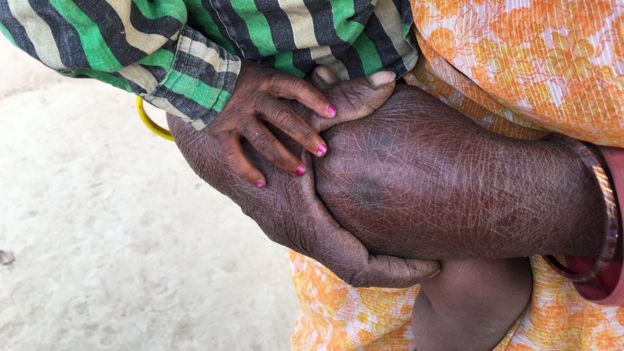
Khazanchi is curious about me – he fixes his kohl-lined eyes on me and, at his mother’s prompting, shakes my hand. I ask him who painted his nails deep pink. He smiles and points at Priti, his sister.
Unaware of the bitter battle being fought over him, he seems more interested in my glasses and tries to snatch away my phone when I get close to him to take a photo.
Sarvesha Devi borrows two wobbly plastic chairs from a neighbour’s house and we sit facing each other to chat. Within minutes, Khazanchi begins to get cranky. “He’s hungry,” she says and starts breastfeeding him. By now, word has spread about my visit and we are soon joined by her mother, her brothers and a few neighbours.
Once Khazanchi has quietened down, I ask Sarvesha Devi about her relationship with her mother-in-law. This time, she has nothing complimentary to say about Sashi Devi. In fact, the relationship has soured so much that she talks about threats to life – her own and Khazanchi’s.
After her baby was born, Sarvesha Devi was awarded 200,000 rupees ($2,990; £2,395) as compensation from the government for having to give birth in a bank queue.
Image captionKhazanchi lives with his mother and four siblings
The previously life-saving, loving mother-in-law is now described as the dreaded monster-in-law whom she accuses of hitting her regularly and demanding half the compensation money.
It’s a significant amount of money for a family steeped in poverty with no fixed sources of income. And it was then that the family relations began unravelling.
So what happened that tore the family apart like this? That’s the question I posed to Sarvesha Devi – and to her mother-in-law when I visited her later in Sardar Pur. And their family members and villagers.
In the claims and counterclaims, sometimes it’s difficult to sift the truth from falsehood, to understand who’s being honest and who’s just exaggerating.
Khazanchi’s family belongs to the Baiga tribe, which is among India’s poorest and most deprived communities. They have little education, own no land and most make a living through begging.
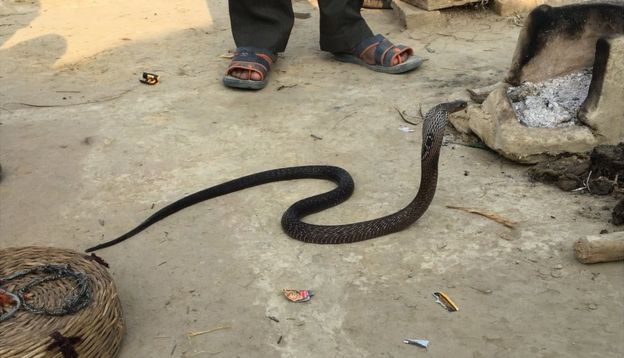
Traditionally though, the Baigas were snake-charmers, and even though catching snakes was outlawed a long time ago, every time I’ve visited them, they’ve proudly shown off reptiles.
Image captionKhazanchi’s family belongs to the Baiga tribe, who have traditionally worked as snake-charmers
This time too, one villager asks me if I want to see the latest catch and even before I can respond, an angry baby cobra is brought out of a basket. He prods and pokes the reptile which begins to crawl on the ground, less than a metre from me. It’s defanged, he assures me.
It’ll grow up to three times its current size, he explains before packing it back in the basket. I keep a wary eye on it as we resume talking.
Uttar Pradesh, where Sardar Pur and Anantpur Dhaukal villages are located, is India’s most populous state. It’s home to more than 200 million people and more than 15,000 babies are born here daily, so it’s difficult to imagine that the birth of one child could generate much excitement.
But Khazanchi was catapulted to stardom because of the circumstances of his birth, and that it came at a time when the state was getting ready to hold key regional elections. The then chief minister Akhilesh Yadav used the “birth in the bank queue” to point out what a misadventure demonetisation had been.
He invoked the infant at every political rally, insisting that PM Modi’s currency ban had hurt the poor most, the sort of family that is Khazanchi’s.
A few months after his birth, Mr Yadav presented his mother with the compensation money.
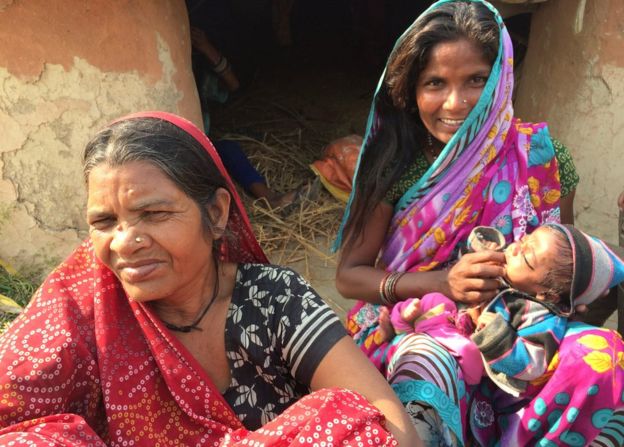
Image captionJust after Khazanchi’s birth, Sarvesha Devi (right) said she would have died if were not for her mother-in-law
Sarvesha Devi says she spent a part of it clearing debts her husband had left and on the treatment of her eldest son, who also suffers from tuberculosis. The remainder has been secured in a bank deposit.
But then, she says, her mother-in-law demanded half the reward money and when she refused, “the family threw me on the ground and beat me up”. And that’s when she decided to leave.
The 37-year-old mother-of-five, who walks with a very pronounced limp, says she refused to part with the money because “I’m disabled and with my husband gone, there’s no-one to look after my children and I have to secure our future”.
Relations further deteriorated after she moved. Malkhan Nath, her eldest brother, says he’s come under pressure from the community to send her back.
“We keep telling her that’s your family, your home, please go back, but she refuses because she says they beat her and treat her badly. We don’t know what to do. She’s my sister: how can I tell her to go if she doesn’t want to?”
The family dispute is now in the community court that Malkhan Nath calls their “high court”. It comprises prominent community elders who adjudicate in matters involving Baigas. Their rulings are not legally binding, but they’re rarely ignored because the defiant can face a social boycott and have to pay monetary fines.
Malkhan Nath says that in the past year he’s had to appear before the “court” three times, and that once he had to pay 650 rupees as a fine because his sister defied the order to appear along with Khazanchi.
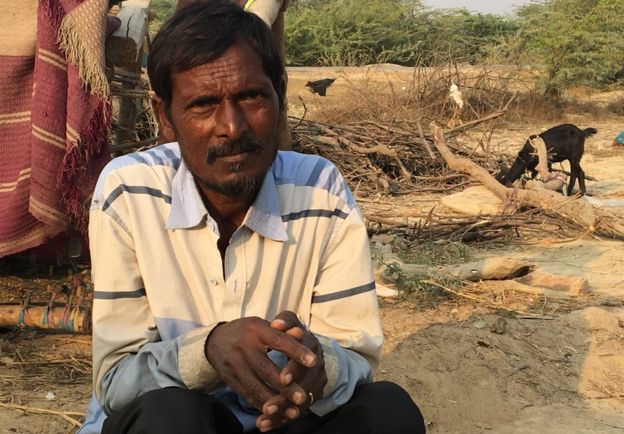
Image captionMalkhan Nath says he’s come under pressure from the community to send his sister back to her in-laws’ home
Matters came to a head earlier this month. On 1 December, a day before Khazanchi’s birthday, Sarvesha Devi says two car-loads of officials turned up late at night at her home.
“I was just sitting down for dinner and Khazanchi was asleep. They insisted that we go with them to Sardar Pur for his birthday celebrations the next day. I refused, so they picked him up and took him to the car. He woke up and started crying. We raised an alarm and chased them. All our neighbours came over and helped us rescue him. They were trying to kidnap him,” she insists.
Though Mr Yadav didn’t win last year’s regional election, he has maintained contact with Khazanchi. Local journalists say he had planned to use the toddler as his mascot for the general elections due in the summer and had announced that he would be gifting him two homes on his birthday – one each in Sardar Pur and Anantpur Dhaukal.
The plan was for the former chief minister to visit Sardar Pur on his birthday and hand over the keys to Khazanchi. With local journalists invited to cover the celebrations, it was meant to be a perfect photo-op.
But when Mr Yadav arrived at Sardar Pur, Khazanchi wasn’t there so the keys were handed over to Sashi Devi.
Clearly disappointed at the toddler’s absence, Mr Yadav said he didn’t know about the “battle between his maternal and paternal grandmothers” and sacked two senior party colleagues for “embarrassing” him.
Image captionSashi Devi’s relations with her daughter-in-law have turned bitter in the last year
A few days later when I visited Sardar Pur, I found the spanking new house right by the roadside. Sashi Devi had gone to the market, so I chatted with her relatives and neighbours as I waited for her return. The marigold flowers used to decorate the house had nearly wilted, and the mood was downbeat too.
“A lot of people had gathered to see Khazanchi, but his mother chose to stay away,” says his great-uncle Asharfi Nath. “Mr Yadav had come laden with presents, but he took it back. Sarvesha Devi could have come for an hour. By refusing to attend the celebrations, she humiliated Mr Yadav.”
The villagers say all was well until Khazanchi’s birth and they blame “the greed and jealousy of his mother’s family and her village” for ruining things. They allege that her family wants her money and her village believes that if the boy stays there, they will see development.
The villagers also darkly hint at a wider political conspiracy – Sardar Pur supports Mr Yadav’s Samajwadi Party while Anantpur Dhaukal is dominated by upper-caste Thakurs who support Mr Modi’s BJP.
Mulayam Nath, a villager, says if Sarvesha Devi doesn’t want to return, she can stay on in her parental village but “she must send Khazanchi back because he is our baby, he belongs to our village. The progress and the benefits the authorities have promised must come to us”.
By the time Sashi Devi returns, it’s beginning to get dark. She squats on the ground outside the newly constructed house as I ask her to respond to the allegations against her.
“It’s all lies,” she says. “I never asked my daughter-in-law for any money. She’s been coached to say what she’s saying.”
Sashi Devi talks about how Sarvesha Devi and her five children were fed and clothed by the family when her son was too sick to work. And in the months after his death, how the little money her husband and other sons brought home was shared with her even though no-one was obliged to do so.
She rejects allegations that they ever hit Sarvesha Devi. “I have four more daughters-in-law and 16 grandchildren. How come no-one else gets hit?” she asks.
She has her own stories of assault and abuse: “I went to her village twice to bring her and the children back. Each time, they hid Khazanchi, and the women there assaulted me.”
Sashi Devi also rubbishes the charge that she or any of her family members could hurt Sarvesha Devi or Khazanchi. “How can we kill our own daughter-in-law and grandchild?”
As I prepare to leave, I ask her if there’s any chance of a reconciliation, but she’s not very hopeful.
“I’ve met her thrice recently and asked her to come back and live in her new house, but she has refused,” she says, wiping a tear with the corner of her sari. “Earlier, I lost my son. Now I’ve lost my grandchildren too.”
In a big victory for the Narendra Modi led NDA government, the Supreme Court on Friday gave a clean chit to the Centre on the procurement of 36 Rafale fighter jets from France.
A three-Judge bench headed by Chief Justice Ranjan Gogoi dismissed all the petitions, and said no Rafale probe was required.
The petitions seeking probe into the deal were filed by Prashant Bhushan, Arun Shourie, former Finance Minister Yashwant Sinha, advocates M.L.Sharma and Vineet Dhanda, and AAP lawmaker in Parliament Sanjay Singh.
Taking up the petitions on Friday, the CJI said the court studied the materials carefully and interacted with defence officials, and was “satisfied” with the NDA government’s decision making process.
Here’s what the Supreme Court said in its order:
“The court does not find substantial matter to interfere with issue of procurement, pricing and offset partner in Rafale jet deal.”
“We studied the materials carefully, interacted with defence officials and we are satisfied with decision making process.”
“This is not court’s job to deal with pricing details of Rafale fighter jets.”
“We are satisfied that there is no occasion to doubt the procurement process. A country cannot afford to be under-prepared. Not correct for the court to sit as an appellant authority and scrutinise all aspects.”
“There is no reason for interference in the choice of offset partner and perception of individuals can’t be the basis for roving inquiry in sensitive issue of defence procurement.”
“We do not find any material to show that it is commercial favouritism.”
“We cannot compel the government to purchase 126 aircraft.”
“There has been necessity of fighter aircraft and country cannot remain without fighter jets.”
The bench had on November 14 reserved its verdict on a batch of pleas seeking a Rafale probe.
Reserving its verdict, the Supreme Court had said the pricing details of Rafale jets could only be discussed once it decided on whether to make it public.
The observation by the apex court had come after the government refused to publicly divulge pricing details of the deal, saying the Rafale deal pricing details are a matter of “national security” and cannot come under judicial review.
The verdict comes as a major boost for the Narendra Modi government that had been cornered over the Rafale deal ahead of the five-state Assembly elections.
Manufactured by aerospace company Dassault Aviation, the Rafale fighter is a twin-engine Medium Multi Role Combat Aircraft.
India has signed an agreement with France to buy 36 Rafale fighter aircraft, costing approximately Rs 58,000-crore (about USD 8 billion), in a fly-away condition for Indian Air Force equipment upgrade.
The verdict comes as a major boost for the Narendra Modi government that had been cornered over the Rafale deal ahead of the five-state Assembly elections.
SNS Web | New Delhi | December 14, 2018 12:27 pm
n a big victory for the Narendra Modi led NDA government, the Supreme Court on Friday gave a clean chit to the Centre on the procurement of 36 Rafale fighter jets from France.
A three-Judge bench headed by Chief Justice Ranjan Gogoi dismissed all the petitions, and said no Rafale probe was required.
The petitions seeking probe into the deal were filed by Prashant Bhushan, Arun Shourie, former Finance Minister Yashwant Sinha, advocates M.L.Sharma and Vineet Dhanda, and AAP lawmaker in Parliament Sanjay Singh.
Taking up the petitions on Friday, the CJI said the court studied the materials carefully and interacted with defence officials, and was “satisfied” with the NDA government’s decision making process.
Here’s what the Supreme Court said in its order:
“The court does not find substantial matter to interfere with issue of procurement, pricing and offset partner in Rafale jet deal.”
“We studied the materials carefully, interacted with defence officials and we are satisfied with decision making process.”
“This is not court’s job to deal with pricing details of Rafale fighter jets.”
“We are satisfied that there is no occasion to doubt the procurement process. A country cannot afford to be under-prepared. Not correct for the court to sit as an appellant authority and scrutinise all aspects.”
“There is no reason for interference in the choice of offset partner and perception of individuals can’t be the basis for roving inquiry in sensitive issue of defence procurement.”
“We do not find any material to show that it is commercial favouritism.”
“We cannot compel the government to purchase 126 aircraft.”
“There has been necessity of fighter aircraft and country cannot remain without fighter jets.”
The bench had on November 14 reserved its verdict on a batch of pleas seeking a Rafale probe.
Reserving its verdict, the Supreme Court had said the pricing details of Rafale jets could only be discussed once it decided on whether to make it public.
The observation by the apex court had come after the government refused to publicly divulge pricing details of the deal, saying the Rafale deal pricing details are a matter of “national security” and cannot come under judicial review.
The verdict comes as a major boost for the Narendra Modi government that had been cornered over the Rafale deal ahead of the five-state Assembly elections.
Manufactured by aerospace company Dassault Aviation, the Rafale fighter is a twin-engine Medium Multi Role Combat Aircraft.
India has signed an agreement with France to buy 36 Rafale fighter aircraft, costing approximately Rs 58,000-crore (about USD 8 billion), in a fly-away condition for Indian Air Force equipment upgrade.
LONDON (Reuters) – Stocks worldwide tumbled on Friday after weak economic data from China and Europe fanned concerns of a global economic slowdown and left investors fretting over the wider impact of a still-unresolved Sino-U.S. trade dispute.
The MSCI All-Country World Index .MIWD00000PUS, which tracks stocks across 47 countries, was down half a percent.
Euro zone business ended the year on a weak note, expanding at the slowest pace in over four years as new order growth all but dried up, hurt by trade tensions and violent protests in France, a survey showed.
Another survey showed French business activity plunged unexpectedly into contraction this month, retreating at the fastest pace in over four years in the face of violent anti-government protests.
Germany’s private sector expansion slowed to a four-year low, meanwhile, suggesting growth in Europe’s largest economy may be weak in the final quarter.
The data out of Europe added to weak readings from China, where November retail sales grew at the weakest pace since 2003 and industrial output rose the least in nearly three years, underlining risks to the economy as Beijing works to defuse a trade dispute with the United States.
Stock markets in Europe opened sharply lower, with Germany’s DAX index .GDAXIfalling 1-1/2 percent. The pan-European STOXX 600 index was down 1.3 percent. [.EU]
“The data this morning out of France really hasn’t helped the mood. You look at China data, you look at the flash PMIs out of France and Germany and they’ve really sort of reinforced concerns that the global economy is slowing down,” said Michael Hewson, chief markets analyst at CMC Markets in London.
“Ultimately, I think it rather questions the wisdom of the ECB ending its asset purchase programme at the end of this month. You’ve got Mario Draghi basically tightening into a downturn.”
MSCI’s broadest index of Asia-Pacific shares outside Japan .MIAPJ0000PUS fell 1.5 percent. Japan’s Nikkei .N225, also dragged down by the country’s weak tankan sentiment index, dropped 2.0 percent.
China’s benchmark Shanghai Composite .SSEC and the blue-chip CSI 300 .CSI300closed down 1.5 percent and 1.7 percent, respectively, and Hong Kong’s Hang Seng .HSI was off 1.5 percent.
A Chinese statistics bureau spokesman said the November data showed downward pressure on the economy is increasing.
The data “means that the worst is yet to come and policymakers will be very worried, particularly with consumption growth falling off a cliff,” said Sue Trinh, head of Asia FX strategy at RBC Capital Markets in Hong Kong.
“So I expect further support measures including rate cuts will come in coming weeks, although these data would indicate measures to date aren’t really working.”
The Chinese yuan weakened 0.4 percent to 6.9063 per dollar CNH=D4 in offshore trade following the data.
“Although hopes of progress in U.S.-China talks and cheap valuations are supporting the market for now, we have lots of potential pitfalls,” said Nobuhiko Kuramochi, chief strategist at Mizuho Securities.
“If U.S. shares fall below their triple bottoms hit recently, that would be a very weak technical sign.”
Overnight on Wall Street, the S&P 500 .SPX ticked down 0.02 percent to 2,650, not far from its 6-1/2-month closing low of 2,633 touched on Nov. 23, while the Nasdaq Composite .IXIC dropped 0.39 percent.
U.S. corporate earnings due next month could throw a spotlight on the impact from the U.S. tariffs on imports from China, while there is risk of a government shutdown and further political stalemate in a divided U.S. congress, Kuramochi added.
In the currency market, the euro was down 0.7 percent after the weak PMIs, last changing hands at $1.1293.[FRX/]
Sterling’s rally fizzled as signs that the British parliament was headed towards a deadlock over Brexit prompted traders to take profits from its gains made after Prime Minister Theresa May had survived a no-confidence vote.
The European Union has said the agreed Brexit deal is not open for renegotiation even though its leaders on Thursday gave May assurances that they would seek to agree a new pact with Britain by 2021 so that the contentious Irish “backstop” is never triggered.
The pound fell 0.6 percent to $1.2615 GBP=D3, on track to post its fifth consecutive week of losses. It was down 0.9 percent so far this week.
The dollar stood at 113.48 yen JPY=, down 0.1 percent on the day but above this week’s low of 112.245 set on Monday.
Oil prices gave up some of their Thursday’s gains following inventory declines in the United States and expectations that the global oil market could have a deficit sooner than they had previously thought.
U.S. crude futures CLc1 edged down 0.5 percent to $52.32 per barrel and Brent crude LCOc1 slipped 0.6 percent to $61.09, after both gained more than 2.5 percent on Thursday.
Cryptocurrency Bitcoin BTC=BTSP fell as low as $3,200, a fresh 15-month low.
A rash of bomb threats were emailed on Thursday to hundreds of businesses, public offices and schools across the United States and Canada demanding payment in cryptocurrency, but none of the threats appeared credible, law enforcement officials said.
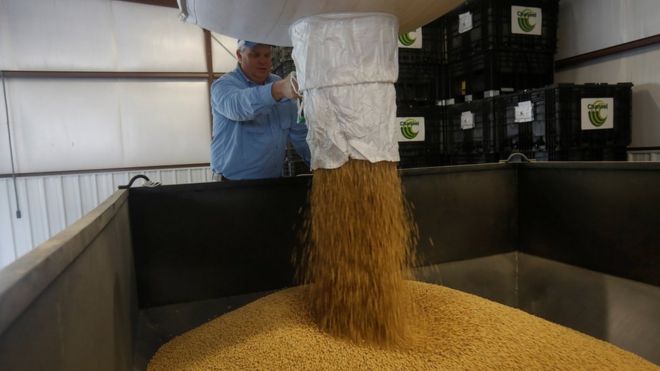
Image copyrightREUTERSImage captionChina’s purchase of 1.13 million tonnes of US soybeans has been hailed as a wonderful, great step by US officials.
China has bought US soybeans for the first time since the trade war between the two countries started in July – a move hailed as a “great step” by US officials.
One of the biggest casualties of the US-China trade war has been the US soybean sector.
China is by far the world’s biggest importer of soybeans.
And Beijing’s high tariffs placed on US soybeans this year has been severely hurting US farmers.
A trade truce between China and the US was reached earlier this month however, and there had been much anticipation that China would soon return to the US soybean market.
But while China’s purchase of 1.13 million tonnes of US soybeans on Thursday was met with much applause from some, others said the purchase was too small, and not a sign that the trade war was cooling.
“Having a million, million-and-a-half tonnes is great, it’s wonderful, it’s a great step,” said Steve Censky deputy secretary of the US Department of Agriculture.
“But there needs to be a lot more as well, especially if you consider it in a normal, typical year, we’ll be selling 30 to 35 million metric tonnes to China.”
The sale also failed to excite traders, who said the numbers fell short of estimates, which saw a sell-off in soybean futures.
“It’s a start, but it’s not nearly enough to fix our problems in regards to soybeans and a soybean oversupply in this country,” said Joe Vaclavik, president of Standard Grain, a Tennessee-based brokerage.
And soybeans are vitally important to China because they use the product to feed livestock.
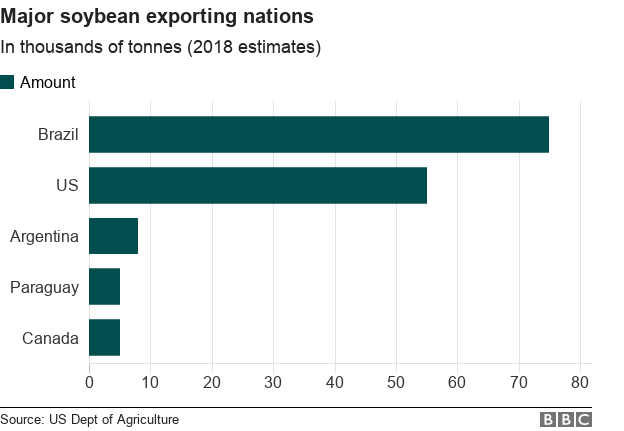
The key supplier globally is Brazil, but China has also relied heavily on the US for soybeans supplies – in part due to seasonality.
Chief economist Robert Carnell from ING Bank told the BBC that China’s purchase on Thursday was more about convenience than anything else.
“The simple fact is China needs a lot of soybeans and it’s been buying them from Brazil, not the US,” he said.
“But Brazil could never supply all the soybeans China needed, so ultimately [China has] been driven back to US soybeans. And I think it’s just convenient for them to do that right now.”
“[It’s] a battle for technology, a battle for 5G,” he said. “In particular, Huawei has become one of the world’s biggest suppliers of telecoms technology – and the US doesn’t really like that.
“[So that arrest] is giving you a much better, a much clearer message on where the trade war lines in the sand are really being drawn.”
Beijing had high hopes that tax cuts for individuals would lift consumer spending and boost an economy which is showing the effects of the trade war, but overall retail sales in November proved disappointing.
November’s retail sales, which covers both corporate and consumer spending, stood at 3.52 trillion yuan, down from 3.55 trillion yuan in October, according to data released by the National Bureau of Statistics on Friday.
The growth rate fell to 8.1 per cent compared to November 2017, below the 8.6 per cent rate in October. The figure was also below the 8.8 per cent growth forecast by a Bloomberg poll of economists. Adjusted for inflation, the growth was even lower, at 5.8 per cent.
As the US-China trade war continues to weigh on exports, Beijing is counting on households and companies to spend more to stabilise growth.
However, weak consumption underscores the difficulties the Chinese leadership is having in its efforts to keep the economy stable.
The government expected that its October move to raising the threshold for taxable personal income to 5,000 yuan per month would release unlock spending power equivalent to hundreds of billions of yuan.
It appears likely that some consumers saved their extra income for the November 11 shopping festival, when they can benefit from large discounts.
Shen Li, a physical therapist from Beijing, said his monthly after-tax income increased by 1,000 yuan due to the tax cut, which he used to purchase items such as household appliances on Singles’ Day.
Singles’ Day, China’s version of the US’ Black Friday, is often seen as a gauge of Chinese consumers’ spending power, but in the past it has not been able to drive up total retail sales figures.
This year’s Singles’ Day sales across Alibaba’s e-commerce platforms totalled US$30.8 billion, dwarfing the online sale numbers for Black Friday and Cyber Monday combined. But the growth rate of total transactions fell to 27 per cent, from last year’s 39 per cent.
The late October launch of Apple’s new iPhone XR, which is cheaper than the earlier iPhone XS series, did not boost telecom sales in China, which dropped 5.9 per cent in November year on year, to 48.5 billion yuan.
However, a plunge in car sales was the main culprit for weak consumption. Auto sales were down 10 per cent on a year earlier, to 345.9 billion yuan, according to the statistics bureau figures, as auto dealers struggled to clear their inventories.
This matched industry surveys from the China Passenger Car Association (CPCA), which reported this week that retail sales of sedans, multi-purpose vehicles and sport utility vehicles plunged 18 per cent to 2.05 million units last month, which makes a full-year decline very likely in the world’s largest auto markets.
Ding Shuang, chief China economist from Standard Chartered Bank, said weak auto sales were caused by the expiration of tax rebates for smaller cars, a slowdown in consumer loans partly due to the crackdown in online peer-to-peer lending platforms, and subdued property investment, since new homes are often sold together with garages.
Local commentators worried about ‘downgrading’ of consumption in 2018 as spending on premium goods slowed.
The growth of real estate investment from January to November remained stable at the 9.7 per cent rate seen in the January to October period.
“The decline of consumers’ abilities and willingness to spend is going to first cut down on big ticket items like cars,” said Jiang Chao, chief economist from Haitong Securities. “Auto accounts for two-thirds of China’s consumption of consumer durables.”
Rising household debt has given Chinese policymakers few options to boost spending other than cutting taxes. China’s household debt-to-GDP rose to 49.3 per cent in the first quarter, which was lower than in advanced economies but higher than the average 40 per cent among emerging economies, according to the Bank of International Settlements.
“Household debt will continue to rise and so debt service costs will remain a drag on consumption. But the debt service burden on households should not get much worse unless there is a big acceleration in credit growth (which we do not expect),” Ernan Cui, an analyst from research firm Gavekal Dragonomics, wrote in a report.
“Local commentators worried about ‘downgrading’ of consumption in 2018 as spending on premium goods slowed,” Cui said. “The biggest boom in products favoured by affluent households is probably over, but consumption upgrading will continue as long as income growth does.”
NBS spokesman Mao Shengyong said at a press conference on Friday that China still had the potential to maintain a stable and fast rate of consumption growth next year, given the rise in the number of middle class citizens.
Economists are eyeing new individual tax deductions that will go into effect next year and more tax relief for private companies to prevent the economy from slowing further.
A more complex tax deduction policy which takes in six types of expenses – from elderly care to medical costs- could inject an additional 80 billion yuan in consumers spend, according to Cui’s estimate.
Beijing has also indicated that it will tighten the collection of social insurance contributions that employers are required to pay, but analysts fear that this could negate the benefits of the tax deductions for employees.