Chindia Alert: You’ll be Living in their World Very Soon
aims to alert you to the threats and opportunities that China and India present. China and India require serious attention; case of ‘hidden dragon and crouching tiger’.
Without this attention, governments, businesses and, indeed, individuals may find themselves at a great disadvantage sooner rather than later.
The POSTs (front webpages) are mainly 'cuttings' from reliable sources, updated continuously.
The PAGEs (see Tabs, above) attempt to make the information more meaningful by putting some structure to the information we have researched and assembled since 2006.
Iranian news outlet quotes military official as saying exercise will be held soon, but Chinese media silent on reported manoeuvres
An Iranian news source says China, Russia and Iran are planning a joint naval exercise soon. Photo: Xinhua
China, Russia and Iran are planning a joint naval drill in the Sea of Oman and northern Indian Ocean “soon” a semi-official Iranian news outlet reported on Saturday, just days after the United States blamed Iran for a drone attack on Saudi Arabian oil facilities.
General Ghadir Nezami Pour, head of international affairs and defence diplomacy of the Iranian Armed Forces General Staff, said the drill would take place in international waters, Iran Press news agency reported.
“The exercises have different goals including the exchange of tactical and military experiences and sometimes they seek political goals which show a kind of convergence between participants,” he was quoted as saying.
“Officials at the level of defence minister, chief of staff of the armed forces and commanders of the armed forces will come to Iran in the near future and these actions reflect Iran’s active defence diplomacy.”
The comments came in the aftermath of the September 14 missile strikes on Saudi Arabia’s Abqaiq and Khurais oil facilities.
Washington accused Tehran of masterminding the attacks, allegations that Iran denied.
Tehran warned that any military action by the United States or Saudi Arabia would result in “all-out war”.
US Secretary of State Mike Pompeo initially condemned the attacks on the oil facilities as an “act of war” but later said the US was seeking a peaceful solution to the crisis.
On Friday, Chinese President Xi Jinping condemned the attacks during a phone conversation with Saudi Arabia’s King Salman, adding that he hoped the incident would receive a full and fair investigation.
There was no report of the joint drill plan in Chinese media.
Analysts said the exercise was possible as China might want to show support for Iran.
“The timing of the joint exercise might be a bit sensitive and some might take it as a show of China’s support for Iran should there be any military conflicts between countries,” Beijing-based naval expert Li Jie said.
“But it might well be a regular military exchange between the countries if it is held in international waters and without targeting another country.”
China calls for calm in aftermath of drone strikes on Saudi oil facilities
Ni Lexiong, a military specialist and professor at Shanghai University of Political Science and Law, said the drill was to send the message that China would side with Iran “in extreme scenarios”.
“I don’t see things will go that far, but the navy drill is to send the intimidating message,” Ni said.
Two years ago China and Iran conducted a joint naval exercise near the Strait of Hormuz in the Persian Gulf after Washington accused Tehran of sending fast attack boats to harass US warships passing through the area.
Major General Mohammad Baqeri, Chief of Staff of the Iranian Armed Forces, was in Beijing for a three-day visit earlier this month and agreed that the two countries would have more visits with senior military officials and advance cooperation in training.
China still accounts for more than half of Iran’s oil exports, according to the United States, complicating Washington’s efforts to economically isolate Tehran in its “maximum pressure campaign”.
A Long March-11 carrier rocket carrying five new remote-sensing satellites blasts off from the Jiuquan Satellite Launch Center in northwest China’s Gansu Province, Sept, 19, 2019. Five new remote-sensing satellites were sent into planned orbit on Thursday. The satellites belong to a commercial remote-sensing satellite constellation project “Zhuhai-1,” which will comprise 34 micro-nano satellites. (Photo by Wang Jiangbo/Xinhua)
JIUQUAN, Sept. 19 (Xinhua) — Five new remote-sensing satellites were sent into planned orbit from the Jiuquan Satellite Launch Center in northwest China’s Gobi Desert Thursday.
The five satellites were launched by a Long March-11 carrier rocket at 2:42 p.m. (Beijing Time).
The satellites belong to a commercial remote-sensing satellite constellation project “Zhuhai-1,” which will comprise 34 micro-nano satellites, including video, hyperspectral, and high-resolution optical satellites, as well as radar and infrared satellites.
The carrier rocket was developed by the China Academy of Launch Vehicle Technology, and the satellites were produced by the Harbin Institute of Technology and operated by the Zhuhai Orbita Aerospace Science and Technology Co. Ltd.
Thursday’s launch was the 311th mission for the Long March series carrier rockets.
The newly launched satellites comprise four hyperspectral satellites with 256 wave-bands and a coverage width of 150 km, and a video satellite with a resolution of 90 centimeters.
The Zhuhai-1 hyperspectral satellites have the highest spatial resolution and the largest coverage width of their type in China.
The data will be used for precise quantitative analysis of vegetation, water and crops, and will provide services for building smart cities, said Orbita, the largest private operator of hyperspectral satellites in orbit.
The company aims to cooperate with government organizations and enterprises to expand the big data satellite services.
NANNING, Sept. 19 (Xinhua) — Pham Thi Nguyet Hoa, a vendor living in Vietnam’s Mong Cai, comes to Dongxing, a southern Chinese port city, to sell Vietnam fruits every day. When night falls, she often ends up with thousands of yuan in her pocket, much more than what she can earn at home.
“Most of my customers are Chinese, and it is very convenient to exchange Chinese yuan to Vietnamese Dong as many banks in Dongxing have this currency exchange service,” said Pham.
Tourism has been a pillar industry in the border city of southern China’s Guangxi Zhuang Autonomous Region. Dongxing port saw 12 million people, of which half were tourists, pass through last year, ranking first among all land ports in China.
In the first six months this year, tourism consumption at the port exceeded 6.2 billion yuan (874 million U.S. dollars), up 40.4 percent from the year before.
The flourishing border tourism has brought a huge demand for currency exchange, with a slew of financial reforms rolled out in recent years.
In 2014, the ABC China (Dongxing Experimental Zone) ASEAN Currency business center was established in Dongxing, allowing direct convertibility of Chinese yuan and Vietnamese Dong.
In February 2018, a total of 8 million yuan was transferred in cash from Vietnam to China, marking the first cross-border cash transfer in Guangxi between China and Vietnam.
Fan Zuojun, vice president of Guangxi University, said the cross-border cash transfer will further promote the financial cooperation between China and Members of the Association of Southeast Asian Nations (ASEAN) as well as deepen reform and push forward the internationalization of the Chinese currency in the region.
China and ASEAN countries have always maintained close relations in trade.
In January 2010, the China-ASEAN Free Trade Area was set up, which has significantly boosted bilateral trade. China has maintained its position as the largest trading partner of ASEAN for 10 consecutive years, and trade between China and ASEAN has skyrocketed tenfold from 16 years ago to 587.8 billion U.S. dollars in 2018.
In the first half of 2019, ASEAN became China’s second-largest trading partner, with bilateral trade volume reaching 291.85 billion U.S. dollars, up 4.2 percent year on year.
Guangxi’s geographical advantages have also given it huge development dividends over the past decades. ASEAN has been Guangxi’s largest trade partner for 19 consecutive years, and trade volume between Guangxi and ASEAN in the first seven months of this year topped 128 billion yuan, accounting for 48.7 percent of Guangxi’s total foreign trade.
Now with the launch of the Guangxi Pilot Free Trade Zone (FTZ) in August, bilateral trade exchanges are expected to embrace another golden opportunity.
The pilot FTZ, with a total area of nearly 120 square km, will focus on modern financial services, smart logistics, digital economy, port shipping logistics, international trade and cross-border tourism, among others.
Guangxi vows to make greater efforts to consolidate its financial strength and build itself into an ASEAN-oriented financial portal, with over 90 financial reform measures being rolled out to further facilitate trade and investment and promote innovation in financial services with ASEAN countries.
A white paper titled “Equality, Development and Sharing: Progress of Women’s Cause in 70 Years Since New China’s Founding” is released by the State Council Information Office in Beijing, capital of China, Sept. 19, 2019. China on Thursday issued a white paper on the progress of women’s cause in the past 70 years since the founding of the People’s Republic of China. TO GO WITH “China publishes white paper on progress of women’s cause in 70 years” (Xinhua/Zhang Yuwei)
BEIJING, Sept. 19 (Xinhua) — China on Thursday issued a white paper on the progress of women’s cause in the past 70 years since the founding of the People’s Republic of China (PRC).
The white paper, titled “Equality, Development and Sharing: Progress of Women’s Cause in 70 Years Since New China’s Founding,” was released by the State Council Information Office.
The founding of the PRC in 1949 ushered in a new era for women in China, changing their social status from an oppressed and enslaved group in the past thousands of years to masters of their own fate, the white paper said.
As the Chinese nation is rising and growing richer and stronger, Chinese women’s social status has undergone enormous changes, it said.
“The great achievements China has made in the development of women’s cause is attributed to the leadership of the Communist Party of China (CPC),” said Huang Xiaowei, vice president of the All-China Women’s Federation, at a press conference.
The progress made by Chinese women led by the CPC is not only of considerable significance to China’s national rejuvenation but also a notable contribution to human civilization progress, Huang said.
As China’s development has entered a new era, promoting gender equality and women’s overall development at a higher level not only meets opportunities but also has a long way to go, the white paper said.
Under the guidance of Xi Jinping Thought on Socialism with Chinese Characteristics for a New Era, China will always adhere to safeguarding and improving women’s livelihoods, promote women’s all-round development, and lead hundreds of millions of women in working for national rejuvenation, it said.
MORE WORKING WOMEN
China has promulgated laws and regulations to fully protect women’s economic rights and interests, especially the right to equal employment, ensuring equal pay to men and women for equal work and eliminating gender discrimination in employment, the white paper said.
Women account for 40 percent of the labor force in China. In 2017, there were 340 million working women, doubling the figure in 1978.
Women’s job options have greatly expanded. In 2010, 46.8 percent of women worked in industry and service sectors, up 24.8 percentage points from 1982.
HIGHER POLITICAL STATUS
China has drawn up and implemented laws to guarantee that women share equal rights with men to vote, to be elected, and to participate in the administration of state affairs, the white paper said, adding that over the past four decades since the reform and opening-up, new opportunities and channels have been opened to women to participate in politics.
In 2017, women accounted for 52.4 percent of public servants newly-recruited by the central government organs and their affiliates, and the proportion was 44 percent among local governments.
The ratio of women deputies to the 13th National People’s Congress (NPC) was 24.9 percent, 12.9 percentage points higher than that of the first NPC in 1954.
MORE EDUCATED WOMEN
Chinese women’s education level has been dramatically lifted over the past seven decades, according to the white paper.
The illiteracy rate among females aged 15 and above dropped from 90 percent before the founding of the PRC to 7.3 percent in 2017, which was a historic change.
The gender gap in the nine-year compulsory education has been basically eliminated. In 2017, the net primary school enrollment rates of boys and girls were both 99.9 percent while the proportions of girls in primary schools and junior high schools were 46.5 percent and 46.4 percent respectively, 18.5 and 20.8 percentage points higher than those in 1951 respectively
In 2017, the gross high school enrollment rate was 88.3 percent, with girls accounting for 47.7 percent of all students in high schools.
Meanwhile, women accounted for 52.5 percent of students in regular institutions of higher education, 28.4 percentage points higher than in 1978, 32.7 percentage points higher than in 1949.
HEALTHIER WOMEN
Women’s health has further improved in China. Women’s average life expectancy grew to 79.4 years in 2015, an increase of 10.1 years over 1981 and 42.7 years over 1949, according to the white paper.
The maternal mortality rate has fallen 79.4 percent from 88.8 per 100,000 in 1990 to 18.3 per 100,000 in 2018, meaning that China has achieved the United Nations Millennium Development Goals ahead of time.
NEW DELHI (Reuters) – India’s aviation safety regulator may ask Boeing (BA.N) to set up simulators in India to train pilots on the 737 MAX planes once it clears the aircraft as safe for flying, a senior official with direct knowledge of the matter told Reuters.
The 737 MAX, the fastest-selling plane in Boeing’s history, has been grounded the world over since March in the aftermath of two fatal crashes in five months that killed 346 people.
India’s Directorate General of Civil Aviation (DGCA) will also conduct an independent inspection of the grounded planes once they are cleared for flying by the U.S. regulator, the Federal Aviation Administration (FAA).
“Once FAA re-certifies it and says these issues have been resolved then we will evaluate whether what they are saying is right or wrong … We will carry out our own inspections,” the official said, adding that it is unlikely the planes will fly in Indian skies until next year.
Boeing is making software changes and drawing up a new pilot training plan, and will need to conduct a key certification test flight to get the FAA’s approval before it can put the planes back in the air. Some federal officials expect the test flight to be conducted in October.
“Later this year India will send a team. We would like to take a look at their flight data, some simulators will also be required for training pilots,” the official said, adding it may ask Boeing to have simulators in India.
Indian carrier SpiceJet (SPJT.BO) has about a dozen Boeing 737 MAX planes in its fleet and a total of 155 on order – among the largest single orders for the narrow-body plane.
Boeing has delivered some 385 737 MAX jets globally before the March grounding and has roughly 5,000 orders for the aircraft, a more fuel-efficient version of the manufacturer’s best-selling single-aisle 737 series.
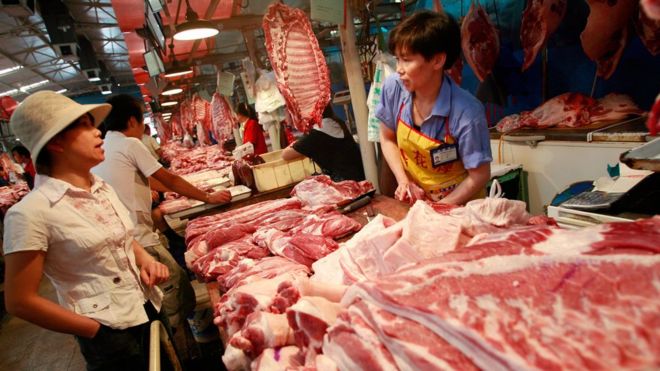
China is set to release pork supplies from its central reserves as it moves to tackle soaring prices and shortages caused by an outbreak of swine fever.
A state-backed body will auction 10,000 tonnes of frozen pork from its strategic reserves on Thursday.
China, the world’s biggest producer and consumer of pork, has struggled to control the spread of the disease.
In a bid to stabilise prices, a state-backed group that manages the pork reserves will auction imported frozen pork from countries including Denmark, France, the US and UK.
Only 300 tonnes will be sold to each bidder at the auction.
Pork is used widely in Chinese festivals, and the auction comes as the country prepares to celebrate a week-long national holiday for the 70th anniversary of the People’s Republic of China.
Julian Evans-Pritchard, senior China economist at Capital Economics, said the auction would provide slight relief to the industry but would not do much to contain prices.
“In itself, I don’t think it will be able to prevent pork prices from rising further unless they manage to get the disease under control,” he said.
Beijing created its strategic pork reserve in 2007 but the size of the stockpile is not known.
Capital Economics estimates that at most, the stockpile would hold four days’ worth of pork supplies to feed China.
About 1.2 million pigs have been culled in China in an effort to halt the spread of swine fever since August 2018, according to data from the Food and Agriculture Organization, a UN agency.
In April, Rabobank estimated Chinese pork production would fall by up to 35% this year due to swine fever.
The supply shortage has sent pork prices soaring and has eaten into household incomes.
That poses a fresh challenge for the Chinese economy, which is already facing a slowdown and a trade war between Beijing and Washington.
Authorities investigating why passenger suddenly leapt to her feet and went through open door
The woman in yellow died after alighting from the moving bus in Fenggang county, Guizhou province, on Sunday. Photo: Weibo
Police in southern China are investigating the death of a woman who suddenly leapt from her seat and through the door of a moving bus on the weekend.
The unidentified woman was confirmed dead at hospital in Fenggang county, Guizhou province, on Sunday after alighting from the bus through the rear door which should have been closed, according to county police.
An officer from the county’s traffic police bureau told the South China Morning Post that an investigation into the woman’s action and the bus driver’s responsibility was under way.
Surveillance footage posted online shows the woman in a yellow top sitting near the open back door before suddenly getting up and rushing through the door.
The door then closes and the bus stops moments later as passengers appear shocked.
Chinese police do U-turn on traffic crash after online crowd doubt official account
The footage was shared widely online on Weibo, China’s Twitter-like platform.
Some internet users said the woman might have been dozing and awoke suddenly thinking she had missed her stop.
Others noted that the door should not have been open.
Just late last month, a woman was injured getting off a moving bus in Chongqing as the driver accidentally opened the rear door, video news app Kankanews.com reported.
The woman, in her 60s, simply stepped off as she saw the door open and thought she had arrived at her destination.
The driver said his safety belt loosened and he accidentally triggered the door button while trying to buckle up. He was held fully responsible for the passenger’s injury.
Image copyright AFPImage caption Chinese experts will investigate Chuang Chuang’s death
A popular giant panda has died unexpectedly in a Thai zoo – prompting China to send experts to investigate.
Chuang Chuang had been at the Chiang Mai zoo on loan from China since 2003.
The 19-year old bear was widely popular across Thailand, especially due to repeated efforts by the zoo to get him to mate with his female companion.
His unexplained death on Monday caused uproar on Chinese social media, with many users accusing Thailand of not caring properly for the animal.
Giant pandas, which are native to China, usually live for 25 to 30 years in captivity. They were regarded as endangered, but were reclassified as “vulnerable” by the International Union for Conservation of Nature, following an increase in numbers.
China loans the animals to countries around the world as a way of strengthening diplomatic ties.
There’s extensive reporting in China about the animals’ lives overseas, and Chuang Chuang’s early death has received widespread coverage in state media.
Media caption Panda diplomacy: China’s cutest peacemakers
According to Chinese news agency Xinhua, an investigation will be carried out to establish the cause of death, and experts from the China Conservation and Research Centre will travel to Chiang Mai to work with their Thai counterparts.
Some social media users on China’s Twitter-like platform Weibo were concerned, saying: “Thailand is not suitable for raising pandas”, and “they don’t treat animals as well as we think”.
Others asked for the remaining female panda in Chiang Mai, Lin Hui, to be returned to China.
Chuang Chuang had been at the Chiang Mai zoo since 2003, alongside his female companion.
Failing to show any sexual interest in Lin Hui, the zoo tried various methods to boost his sex drive, including putting him on a low-carb diet, and showing videos of mating pandas.
With all efforts failing, the zoo eventually resorted to artificial insemination and Lin Hui gave birth in 2009.
TOKYO (Reuters) – China, Japan and South Korea have set ambitious targets to put millions of hydrogen-powered vehicles on their roads by the end of the next decade at a cost of billions of dollars.
But to date, hydrogen fuel cell vehicles (FCVs) have been upstaged by electric vehicles, which are increasingly becoming a mainstream option due to the success of Tesla Inc’s (TSLA.O) luxury cars as well as sales and production quotas set by China.
Critics argue FCVs may never amount to more than a niche technology. But proponents counter hydrogen is the cleanest energy source for autos available and that with time and more refueling infrastructure, it will gain acceptance.
AMBITIOUS TARGETS
China, far and away the world’s biggest auto market with some 28 million vehicles sold annually, is aiming for more than 1 million FCVs in service by 2030. That compares with just 1,500 or so now, most of which are buses.
Japan, a market of more than 5 million vehicles annually, wants to have 800,000 FCVs sold by that time from around 3,400 currently.
South Korea, which has a car market just one third the size of Japan, has set a target of 850,000 vehicles on the road by 2030. But as of end-2018, fewer than 900 have been sold.
WHY HYDROGEN?
Hydrogen’s proponents point to how clean it is as an energy source as water and heat are the only byproducts and how it can be made from a number of sources, including methane, coal, water, even garbage. Resource-poor Japan sees hydrogen as a way to greater energy security.
They also argue that driving ranges and refueling times for FCVs are comparable to gasoline cars, whereas EVs require hours to recharge and provide only a few hundred kilometers of range.
Many backers in China and Japan see FCVs as complementing EVs rather than replacing them. In general, hydrogen is seen as the more efficient choice for heavier vehicles that drive longer distances, hence the current emphasis on city buses.
THE MAIN PLAYERS
Only a handful of automakers have made fuel cell passenger cars commercially available.
Toyota Motor Corp (7203.T) launched the Mirai sedan at the end of 2014, but has sold fewer than 10,000 globally. Hyundai Motor Co (005380.KS) has offered the Nexo crossover since March last year and has sold just under 2,900 worldwide. It had sales of around 900 for its previous FCV model, the Tucson.
Honda Motor Co Ltd’s (7267.T) Clarity Fuel Cell is available for lease, while Daimler AG’s GLC F-CELL has been delivered to a handful of corporate and public sector clients.
Buses are seeing more demand. Both Toyota and Hyundai have offerings and have begun selling fuel cell components to bus makers, particularly in China.
Several Chinese manufacturers have developed their own buses, notably state-owned SAIC Motor (600104.SS), the nation’s biggest automaker, and Geely Auto Group, which also owns the Volvo Cars and Lotus brands.
WHY HAVEN’T FUEL CELL CARS CAUGHT ON YET?
A lack of refueling stations, which are costly to build, is usually cited as the biggest obstacle to widespread adoption of FCVs. At the same time, the main reason cited for the lack of refueling infrastructure is that there are not enough FCVs to make them profitable.
Consumer worries about the risk of explosions are also a big hurdle and residents in Japan and South Korea have protested against the construction of hydrogen stations. This year, a hydrogen tank explosion in South Korea killed two people, which was followed by a blast at a Norway hydrogen station.
Then there’s the cost. Heavy subsidies are needed to bring prices down to levels of gasoline-powered cars. Toyota’s Mirai costs consumers just over 5 million yen ($46,200) after subsidies of 2.25 million yen. That’s still about 50% more than a Camry.
Automakers contend that once sales volumes increase, economies of scale will make subsidies unnecessary.
Hangzhou subway operator says water seeped into underground construction site
Zhejiang’s capital was scene of subway collapse that claimed 21 workers’ lives in 2008
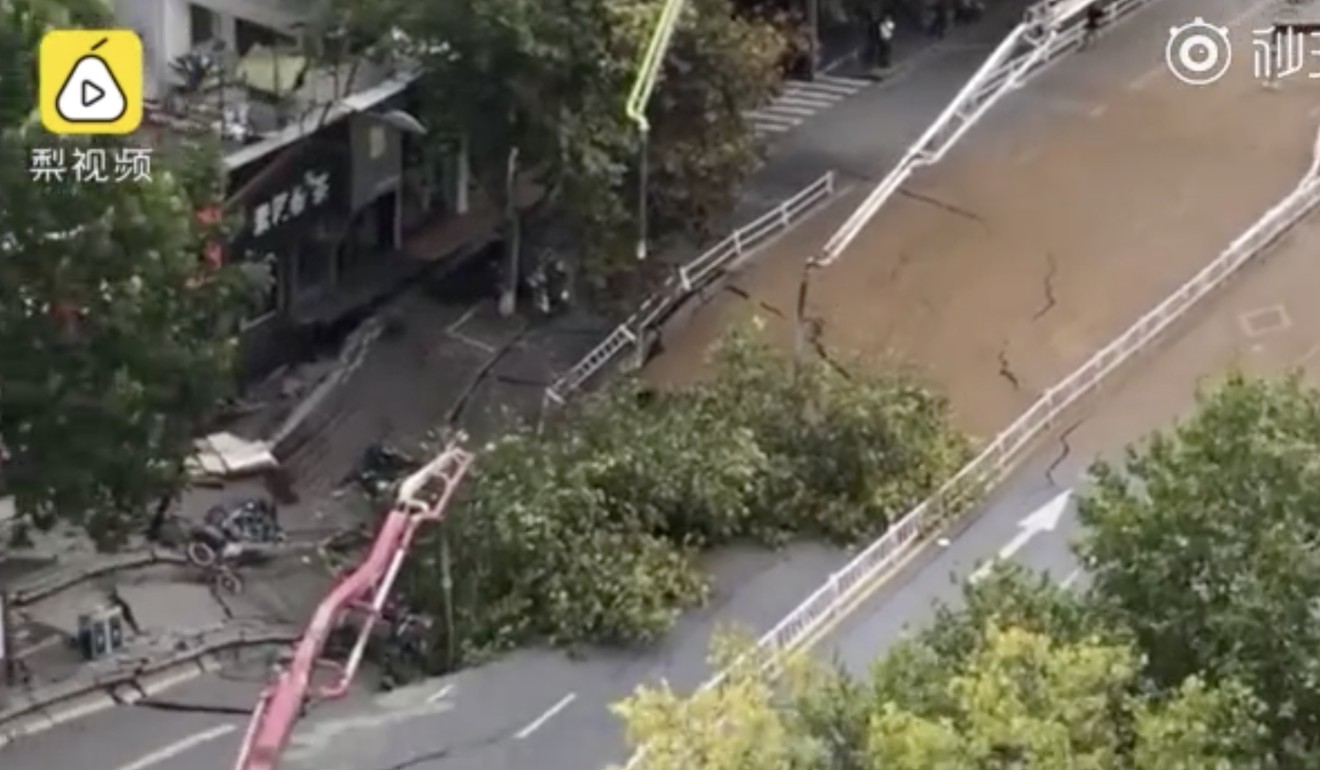
A yellow cloud engulfs buildings after a subway tunnel in Hangzhou, Zhejiang province, collapses. Photo: Pear Video
Homes in a major city in eastern China were evacuated on Wednesday after water seepage at a subway construction site caused a main road to cave in and cut a gas main.
Authorities in Hangzhou, Zhejiang province, said dozens of residents feared for their homes as buildings cracked and swayed from the cave-in.
Videos posted to the Weibo microblogging network showed yellow smoke engulfing the neighbourhood as the road fell below street level. Authorities said Hangzhou’s gas supplier managed to close off the mains.
Hangzhou Metro Group, the city’s subway operator and the company overseeing the network’s expansion from four lines to nine for the 2022 Asian Games, said on Weibo that water seeped into a tunnel that connected two stations in the centre of the city, leading to the collapse.
The collapse took down a four-lane road in central Hangzhou. Photo: Pear Video
That caused a hole under the carriageway and took the pavement down with it. Hangzhou Metro said homes around the site were cleared and authorities were monitoring for further danger.
It was not known how many residents were affected, but no casualties were reported.
Most residents were put up in a nearby school until accommodation could be arranged, the City Express newspaper reported, adding that several truckloads of cement were poured into the hole.
Eight Chinese killed as road collapses near subway construction project
The road collapse in central Hangzhou was the latest in a series of subway construction accidents there – some of them deadly – in the past decade as China races to expand its urban rail networks.
In November 2008, 21 workers were killed and 24 were injured when a tunnel Hangzhou’s Line 1 collapsed beneath an eight-lane road and river water rushed in. A court sent eight people to jail for terms of between three and 5½ years for negligence at the site.
Two years later at the same place, a truck driver died and another was injured as a pit collapsed.
In 2016, four construction workers were killed when mud flooded a pit at a station on Line 4.
In 2008, an eight-lane riverside road in Hangzhou fell in on workers building a subway tunnel, killing 21. Photo: AFP
A cave-in similar to Wednesday’s collapse overturned a truck at a construction site near Hangzhou railway station this month, but no one was injured, Hangzhou Metro said.
According to the China Association of Metros, by the end of last year, more than 5,700km (3,540 miles) of urban railway had been built in 35 mainland cities, of which more than a third – 2,100km – was completed since 2015.









 CHINDIA ALERT: You'll be living in their world, very soon