Archive for ‘Chindia Alert’

01/07/2016

Our bulldozers, our rules | The Economist

THE first revival of the Silk Road—a vast and ancient network of trade routes linking China’s merchants with those of Central Asia, the Middle East, Africa and Europe—took place in the seventh century, after war had made it unusable for hundreds of years. Xi Jinping, China’s president, looks back on that era as a golden age, a time of Pax Sinica, when Chinese luxuries were coveted across the globe and the Silk Road was a conduit for diplomacy and economic expansion. The term itself was coined by a German geographer in the 19th century, but China has adopted it with relish. Mr Xi wants a revival of the Silk Road and the glory that went with it.

This time cranes and construction crews are replacing caravans and camels. In April a Chinese shipping company, Cosco, took a 67% stake in Greece’s second-largest port, Piraeus, from which Chinese firms are building a high-speed rail network linking the city to Hungary and eventually Germany. In July work is due to start on the third stage of a Chinese-designed nuclear reactor in Pakistan, where China recently announced it would finance a big new highway and put $2 billion into a coal mine in the Thar desert. In the first five months of this year, more than half of China’s contracts overseas were signed with nations along the Silk Road—a first in the country’s modern history.

Politicians have been almost as busy in the builders’ wake. In June Mr Xi visited Serbia and Poland, scattering projects along the way, before heading to Uzbekistan. Last week Russia’s president, Vladimir Putin, made a brief visit to Beijing; he, Mr Xi and Mongolia’s leader promised to link their infrastructure plans with the new Silk Road. At the time, finance ministers from almost 60 countries were holding the first annual meeting in Beijing of an institution set up to finance some of these projects, the Asian Infrastructure Investment Bank (AIIB). Like a steam train pulling noisily out of a station, China’s biggest foreign-economic policy is slowly gathering speed.

Chinese officials call that policy “One Belt, One Road”, though they often eviscerate its exotic appeal to foreigners by using the unlovely acronym OBOR. Confusingly, the road refers to ancient maritime routes between China and Europe, while the belt describes the Silk Road’s better-known trails overland (see map).
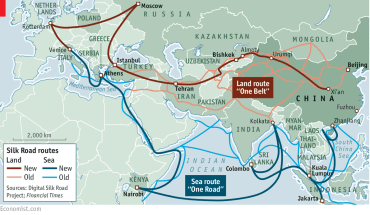
OBOR puzzles many Western policymakers because it is amorphous—it has no official list of member countries, though the rough count is 60—and because most of the projects that sport the label would probably have been built anyway. But OBOR matters for three big reasons.

First, the projects are vast. Official figures say there are 900 deals under way, worth $890 billion, such as a gas pipeline from the Bay of Bengal through Myanmar to south-west China and a rail link between Beijing and Duisburg, a transport hub in Germany. China says it will invest a cumulative $4 trillion in OBOR countries, though it does not say by when. Its officials tetchily reject comparison with the Marshall Plan which, they say, was a means of rewarding America’s friends and excluding its enemies after the second world war. OBOR, they boast, is open to all. But, for what it is worth, the Marshall Plan amounted to $130 billion in current dollars.

Next, OBOR matters because it is important to Mr Xi. In 2014 the foreign minister, Wang Yi, singled out OBOR as the most important feature of the president’s foreign policy. Mr Xi’s chief foreign adviser, Yang Jiechi, has tied OBOR to China’s much-touted aims of becoming a “moderately well-off society” by 2020 and a “strong, prosperous” one by mid-century.

Mr Xi seems to see the new Silk Road as a way of extending China’s commercial tentacles and soft power. It also plays a role in his broader foreign-policy thinking. The president has endorsed his predecessors’ view that China faces a “period of strategic opportunity” up to 2020, meaning it can take advantage of a mostly benign security environment to achieve its aim of strengthening its global power without causing conflict. OBOR, officials believe, is a good way of packaging such a strategy. It also fits with Mr Xi’s “Chinese dream” of recreating a great past. It is not too much to say that he expects to be judged as a leader partly on how well he fulfils OBOR’s goals.

Third, OBOR matters because it is a challenge to the United States and its traditional way of thinking about world trade. In that view, there are two main trading blocs, the trans-Atlantic one and the trans-Pacific one, with Europe in the first, Asia in the second and America the focal point of each. Two proposed regional trade deals, the Trans-Pacific Partnership and the Transatlantic Trade and Investment Partnership, embody this approach. But OBOR treats Asia and Europe as a single space, and China, not the United States, is its focal point.
Source: Our bulldozers, our rules | The Economist

01/07/2016

India factory growth at 3-month high in June on strong demand | Reuters

Indian manufacturing activity edged up to a three-month high in June, driven by stronger demand, but firms barely raised prices, a private survey showed, leaving the door open for another rate cut by the central bank this year.

The Nikkei/Markit Manufacturing Purchasing Managers’ Index (PMI) rose to 51.7 in June from May’s 50.7, its sixth month above the 50 mark that separates growth from contraction after it fell below that level in December for the first time in more than two years.

“The domestic market continues to be the main growth driver, as the Indian economic upturn provides a steady stream of new business,” said Pollyanna De Lima, economist at Markit.

“There were also signs of an improvement in overseas markets, as new foreign orders rose. However, it looks as if lackluster global demand remains a headwind for Indian manufacturers.

“While retail inflation hit a near two-year high in May, the survey’s output prices sub-index fell to a three-month low of 50.1 in June versus 50.5 the previous month, as input costs rose at a weaker pace.

There was also broadly no change to manufacturing employment in India during June, the survey showed.

“This lack of inflationary pressures provides the Reserve Bank of India (RBI) with further leeway to boost economic growth through cutting its benchmark rate,” said De Lima.

According to a Reuters poll, RBI Governor Raghuram Rajan could deliver another rate cut before his term ends in September. After cutting rates in April, he has left the key interest rate unchanged at a five-year low of 6.50 percent.

However, at the June policy meeting he signalled another rate cut later in the year if monsoon rains were sufficient enough to dampen upward pressure on food prices.

Rains are expected to be above average this year which could keep prices in control and give the government room to focus on key economic reforms in tandem with low interest rates.

Source: India factory growth at 3-month high in June on strong demand | Reuters

30/06/2016

Why You Need Near-Perfect Exam Scores to Bag a Place at the University of Delhi – India Real Time – WSJ

India’s prestigious University of Delhi on Wednesday released the grades students need to study at its various colleges.

With an excess of qualified students and a limited number of places, India’s universities have famously stringent exam-score requirements.

The University of Delhi is no exception. To get one of the 99 spots on offer for Ramjas College’s undergraduate business degree, Bachelor of Commerce (Honors) program, students this year need to have scored 99.25% in their senior-year exams. That’s the highest the so-called “cut-off,” as the score requirements are popularly known, has peaked to in the first round.

While the minimum score for admission to the university’s over 55 programs doesn’t demand a perfect 100% from students this year, they need to be pretty close.In the past, university administrators have said they raised the percentage requirements for students because they receive inflated scores in their school leaving exams. This year, for instance, an estimated 90,000 students across the country secured more than 90% in their exams. Until three years ago, there were less than half that number of students in that category.

There are about 54,000 spots available on the programs across the University of Delhi’s 61 colleges. Administrators say they have received an estimated 250,000 applications this year.

The score is an average of a student’s best results in four subject areas, including a language. Scores tend to be lower for applicants from marginalized and backward classes, who have a certain number of spots set aside for them under the federal affirmative-action program. And, colleges do slash score requirements as they invite students to apply in a second round of admissions, depending on the number of places available.

Rajendra Prasad, the principal of Ramjas College, told television news channel NDTV that fixing the requirement at 99.25% this year was a “calculated risk” to attract the finest students. Mr. Prasad added that the second round of admissions might bring the score requirement down marginally by at least 1%.

The university’s other famous colleges, such as the Shri Ram College of Commerce and the Lady Shri Ram College for Women, which started a trend of asking for a 100% score from students in 2011, have set their requirements slightly lower. Both colleges demand a 98% score from students to qualify for admission onto their Bachelor of Commerce program.

Despite their efforts, colleges across the university remain saddled with the number of applications. The university moved a preliminary registration process to an online platform this year that has contributed to the swelling of the applicant pool. Until last year, students could register to apply through forms available offline as well.

“Streamlining the process has led to more students applying when the number of seats has remained the same,” said Muneesh Kumar, a member of the academic council at the university.

Source: Why You Need Near-Perfect Exam Scores to Bag a Place at the University of Delhi – India Real Time – WSJ

29/06/2016

India approves rise in salaries, pension for govt employees – govt source | Reuters

India’s cabinet on Wednesday approved a proposal to revise up salaries and pensions for government employees, an official, privy to the decision, told reporters.

The official declined to be named or identified as he was not authorised to speak to the media.

The move is estimated to benefit nearly 10 million government employees.

Details were not immediately available ahead of a government briefing later.

Source: India approves rise in salaries, pension for govt employees – govt source | Reuters

28/06/2016

Pfizer to invest $350 million in China biotech hub, first in Asia | Reuters

Pfizer Inc (PFE.N) will invest $350 million to build a biotech center in China, the latest in a series of moves by pharma industry giants to set up shop in the world’s no. 2 drugs market with the aim of securing faster approvals for their products.

The facility in eastern Hangzhou region – Pfizer’s first biotech center in Asia – is expected to be completed by 2018, the firm said in a statement on Tuesday.

Global “Big Pharma” is increasingly looking for smart ways to tap China’s healthcare market, estimated by consultancy IMS Health to be worth around $185 billion by 2018. From investing in China facilities to acquisitions, licensing deals and joint ventures, the aim is to seek an edge in dealings with domestic regulators and government.

John Young, group president for Pfizer’s essential health division, said in the statement that the Hangzhou facility should “help support China’s aim to increase the complexity and value of its manufacturing sector by 2025”.

Pfizer said it would “work closely” with local regulators to bring the drugs “to market as soon as possible”. The center will mostly on biologic drugs – made from living micro-organisms rather than chemically synthesized – and lower-cost ‘biosimilars’, of generic versions of biologics.

Pharmaceutical executives have long complained about the slow process of getting drugs to market in China, while others have run up against regulatory roadblocks. Pfizer had to close its vaccine business in the country last year after a license for its top-selling vaccine Prevenar was not renewed.

China’s overall healthcare spending is set to hit $1.3 trillion by 2020, but drug market growth has slowed to a low single-digit percentage pace from over 20 percent just four years ago as branded generics have lost their shine and Beijing has looked to drive down prices to keep a lid on costs.

Source: Pfizer to invest $350 million in China biotech hub, first in Asia | Reuters

27/06/2016

For single women in Maharashtra, owning land can be the difference between life and death | Reuters

Rajshree Gungoo, a chatty 27-year-old with a quick smile, speaks up at a gathering of about 40 women discussing the challenges facing single women in Maharashtra.”It’s very difficult. I don’t have a husband, I don’t have a son, even my father doesn’t want me,” she says, her voice breaking. “I am alone and powerless to do anything.”

She breaks off, using the end of her saree to wipe her tears. Around her, others nod and mutter.

In drought-hit Marathwada, the state’s poorest region, there is an unusually high number of single women. Some were widowed after their farmer husbands committed suicide because of debt; others were abandoned because they didn’t produce a son, while some were left behind when their husbands left to search for work.

Alone and without financial support, the women and their children are usually thrown out of home by their in-laws, denied ownership of the land they worked on and any compensation from the government.

They are also taunted and harassed by communities who believe a woman is nothing without a man.

“In this country, single women are the most vulnerable category – they are neglected by the government, by society, even their own family,” said Vishwanth Todkar, secretary at Paryay, a charity that works with marginalised communities.

“Every day, every hour is a struggle for them – to get a home, get land, even their identity cards, which are in the name of the father or the husband. They face humiliations constantly,” he said.

Source: For single women in Maharashtra, owning land can be the difference between life and death | Reuters

27/06/2016

China city shuts down waste burning plant over protests | Reuters

A city in central China is shutting down a waste incineration project, it said, after thousands of people protested against the plant over fears it will damage the environment and residents’ health.

Photos posted on social media, which could not be verified by Reuters, showed dozens of riot police marching in the city of Xiantao, located in Hubei province in central China.

About 10,000 people protested in Xiantao on Sunday, the state-backed Global Times reported, citing a local resident, even after the local government said it planned to suspend the project on Sunday morning.

Another resident told Reuters by phone on Monday that the protests continued, and several protesters were injured in clashes with riot police.

“There are hundreds of police here because of the demonstrations,” said the resident, who declined to give his name because of the sensitivity of the matter.

The city government called on residents to refrain from taking “extreme actions” and spreading rumors in a statement on its official microblog.

Tens of thousands of “mass incidents” – the usual euphemism for protests – happen in China each year, spurred by grievances over issues such as corruption, pollution and illegal land grabs, unnerving the stability-obsessed ruling Communist Party.

Last June, thousands of people protested in Jinshan, about 60 km (37 miles) from China’s commercial hub of Shanghai, against plans to build a chemical plant in the district.

A Xiantao official said that the planned plant’s emissions of dioxin, a toxic compound, would have been in line with European Union standards, state media reported.

Source: China city shuts down waste burning plant over protests | Reuters

27/06/2016

This Is What Happens to Your Clothes When You Donate Them in the West – India Real Time – WSJ

As heaps of castoff clothes from the U.S. cascade down a conveyor belt, rows of sari-clad women frantically sort the garments by type—T-shirts in one barrel, women’s jeans in another. They pluck out sweatpants, underwear, sweaters, coats, and even furs.

The jumble is part of the thousands of tons of used clothing that arrive each month in this western Indian port, a hub in the vast global network that purchases secondhand clothes in rich countries and resells them throughout the developing world.

“I don’t understand why people throw away all these clothes,” says one of the sorters, as she sits on a warehouse floor during a break. “Maybe they don’t have time to wash them.

”In fact, the glut springs from the rise of fast fashion, which has flooded the world with inexpensive clothing, often produced in some of the same low-wage countries where it later ends up sold in market stalls or reprocessed into goods like blankets or pillow stuffing.

To some, this a virtuous circle, minimizing waste while providing jobs and a source of low-cost clothes for the poor. Even retailers such as Hennes & Mauritz AB and others have gotten into the act, collecting worn apparel to recycle. Since it began collecting used clothing at its stores in 2013, H&M has recycled more than 20,000 tons of it.

Source: This Is What Happens to Your Clothes When You Donate Them in the West – India Real Time – WSJ

24/06/2016

Two stumbles forward, one back | The Economist

LAST November, two days after India’s ruling party suffered a drubbing at local polls in the state of Bihar, the government unexpectedly opened a dozen new industries to foreign direct investment (FDI). A gushing official called it “the biggest path-breaking and the most radical changes in the FDI regime ever undertaken”.

On June 20th, two days after Raghuram Rajan, the respected governor of India’s central bank, abruptly announced that he would soon step down, the government covered its embarrassment with another impromptu salute to FDI. The slim package of enticements, amounting to a slight lowering of barriers in some of the same industries, has made India “the most open economy in the world for FDI,” said the office of Narendra Modi, the prime minister.

Hyperbole is not unexpected from a government keen to burnish its liberalising credentials. But it has not lived up to its cheery slogans (“Startup India”, “We Unobstacle”, “Minimum Government, Maximum Governance”). Two years after clinching a sweeping electoral mandate, and with the opposition in disarray, Mr Modi’s reform agenda should be in full swing. Instead, as with previous governments, his ill-focused initiatives have run up against India’s statist bureaucracy.

To be fair, much of what has been done is useful. Corruption has been stemmed, at least at ministerial level. A vital bankruptcy law has been approved. Yet for all the evidence that Mr Modi’s team is doing a better job running the existing economic machinery, it has shown limited appetite for overhauling it.

Pessimists see Mr Rajan’s departure as evidence of a further wilting of ambition. After all, as a former chief economist of the IMF, he is an enthusiastic advocate of structural reform. Then again, at the central bank he has focused chiefly on bringing down inflation. Optimists hope he is being eased out because of his habit of speaking his mind, thereby occasionally contradicting the government line, rather than to pave the way for retrograde policies.

Thanks to a mix of lower oil prices and prudent fiscal policies (and perhaps also flawed statistics) the economy grew by 7.9% in the first quarter, compared with the same period the year before, the fastest pace among big economies. Ministers think further acceleration is possible.

That may prove difficult. India’s public-sector banks, which hold 70% of the industry’s assets, are stuffed with bad loans; the central bank reckons that some 17.7% are “stressed”. That Mr Rajan forced them to disclose this fact will not have endeared him to politically connected tycoons now being badgered to repay the banks. Bank shares rose after he said he was leaving, presumably in the hope that his successor will go easy on them. Rating agencies fret that they will still need recapitalising, blowing a hole in the government’s finances. In the meantime, credit to industry has all but ground to a halt.

India’s overweening bureaucracy is another drag on growth. Copious red-tape and poor infrastructure put India 130th out of 189 countries in the World Bank’s “Ease of doing business” rankings. Getting permits to build a warehouse in Mumbai involves 40 steps and costs more than 25% of its value, compared with less than 2% in rich countries. It takes 1,420 days, on average, to enforce a contract.

A slew of liberalising reforms in 1991, when India was in far worse shape than now, were left unfinished as the economy gradually recovered. Whereas product markets were freed from the “licence Raj”, which no longer dictates how much of what each factory can produce, inputs such as land, labour and capital are still heavily regulated. Having once sought to prise those open, the Modi government now encourages state governments to take the lead with their own reforms.

One result is that there is no proper market for land: businesses that want to set up shop are best off wooing state governments to provide some. Chief ministers with a presidential approach (a model Mr Modi espoused in his previous job running Gujarat) scurry around scouting for plots on behalf of the private sector in a manner that would have seemed familiar to the central planners of yore.

That India is pro-business but not necessarily pro-market is a frequent refrain. “The government wants to create jobs, not the environment in which job-creation flourishes,” says one investor. Special economic zones are set up as sops, sometimes to entice single companies. Even big foreign investors are essentially told what to do: Walmart can only open cash-and-carry stores closed to the general public, Amazon must sell mostly other merchants’ goods rather than its own, and so on.If businesses cannot get things done themselves, even the most energetic politician will struggle to set up enough factories to general public, Amazon must sell mostly other merchants’ goods rather than its own, and so on.

Source: Two stumbles forward, one back | The Economist

24/06/2016

Unwanted model | The Economist

MARCHING by the thousands this week in stifling heat through their small coastal village, residents of Wukan carried Chinese flags and shouted out slogans in support of the Communist Party. That was just to protect themselves from retribution by the riot police, who watched them closely but did not intervene. Their real message was in other chants: “Give us back our land!” and “Free Secretary Lin!”

The secretary in question was their village chief, Lin Zulian, whom they elected in 2012 in what was widely hailed at the time as a breakthrough for grassroots democracy. Mr Lin had led Wukan in a months-long rebellion against local authorities. Villagers kicked out party officials and police from their offices in protest against the alleged seizure of some of Wukan’s land by corrupt officials who had lined their pockets with the proceeds of selling it. Police responded by blockading the village, turning it into a cause célèbre—including in some of the feistier of China’s heavily censored media. In the end the government backed down: it allowed Wukan to hold unusually free elections and it promised to sort out the land dispute. The “Wukan model” became Chinese reformists’ shorthand for what they hoped would be a new way of defusing unrest.

They have been disappointed. Villagers did not get their land back, or the money some wanted in lieu of it. Mr Lin, who won another landslide victory in elections two years ago, announced plans on June 18th to launch a new campaign for the return of the land. That was clearly too much for the local government: Mr Lin was promptly arrested on charges of corruption. Angry residents took to the streets again.

Villagers in China often stage protests over land rights; local authorities usually deal with them either with force, or by promising concessions and then rounding up the ringleaders. Restoring calm to Wukan will be tougher. Because of its fame, journalists have poured in, especially from nearby Hong Kong. Local officials may be reluctant to resort to the usual thuggish tactics in front of such an audience.

In an effort to undermine support for Mr Lin, the government has tried blackening his name. On June 21st officials released a video showing him confessing to bribe-taking. But that merely stoked the villagers’ anger. His wife, Yang Zhen, says she is certain the confession was coerced. His halting delivery in substandard Mandarin, she believes, was his way of letting villagers know this. “They are trying to deceive everyone, but no one believes it,” she says. Dozens of furious villagers went to a local school where nervous officials had barricaded themselves behind metal doors and barred windows; they kicked the doors and shouted abuse. As The Economist went to press, Wukan was preparing to embark on its sixth consecutive day of protest.

Many residents say they have lost all faith in the local government, and that only the central authorities in Beijing will be able to find a fair solution. “They took our land. My father and grandfather farmed it, and now I have nothing. No work and no other path forward,” says a 39-year-old villager. “We have a black government, all corrupt. They cannot trick us again with more talk of the ‘Wukan model’. We need our land back,” he fumes.

But the central government will be reluctant to cave in to the protesters’ demands. “Handling the Wukan problem well means much to the rest of China,” said Global Times, a pro-party paper in Beijing. But it warned that if the “drastic actions” of Wukan’s villagers were copied by others, China would “see mess and disturbance” at the grassroots. In a country where many seethe with grievances similar to Wukan’s, officials do not want the village to become a model for revolt.

Source: Unwanted model | The Economist

Law of Unintended Consequences

continuously updated blog about China & India

ChiaHou's Book Reviews

continuously updated blog about China & India

What's wrong with the world; and its economy

continuously updated blog about China & India