Chindia Alert: You’ll be Living in their World Very Soon
aims to alert you to the threats and opportunities that China and India present. China and India require serious attention; case of ‘hidden dragon and crouching tiger’.
Without this attention, governments, businesses and, indeed, individuals may find themselves at a great disadvantage sooner rather than later.
The POSTs (front webpages) are mainly 'cuttings' from reliable sources, updated continuously.
The PAGEs (see Tabs, above) attempt to make the information more meaningful by putting some structure to the information we have researched and assembled since 2006.
Chinese State Councilor and Foreign Minister Wang Yi(R) meets with Angolan Foreign Minister Manuel Domingos Augusto, who is also Angolan President Joao Lourenco’s special envoy, in Beijing, capital of China, July 23, 2019. (Xinhua/Shen Hong)
BEIJING, July 23 (Xinhua) — Chinese State Councilor and Foreign Minister Wang Yi met with Angolan Foreign Minister Manuel Domingos Augusto here Tuesday, pledging to further develop bilateral ties.
Wang said that China is ready to implement consensus reached by leaders of the two countries and strengthen strategic communication with Angola.
He called on the two sides to press ahead pragmatic cooperation on the platform of the Belt and Road and the Forum on China-Africa Cooperation.
The Chinese side will continue to encourage its enterprises and financial institutions to cooperate with the Angolan side, provide assistance within its capability and facilitate the African country’s economic diversification, Wang said.
Augusto, who is visiting China as a special envoy of Angolan President Joao Lourenco, appreciated China’s long-term support to Angola’s development and voiced his country’s willingness to continue pragmatic cooperation.
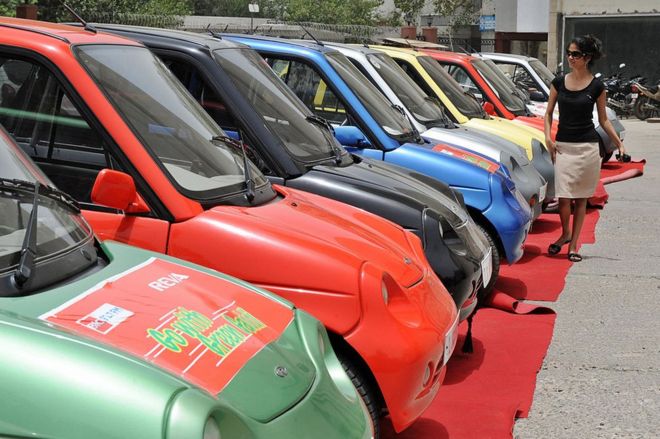
Image copyright GETTY IMAGESImage caption India wants to move to 30% electric cars by 2030
India is making a big push for electric vehicles, signalling a turning point in its clean energy policy, writes energy writer Vandana Gombar.
In 2017, Transport Minister Nitin Gadkari shocked the automobile industry (and the world) when he announced that he intended for India to move to 100% electric cars by 2030.
“I am going to do this, whether you like it or not. And I am not going to ask you. I will bulldoze it,” he said at an industry conference.
That was an ambitious target given that even the UK and France were hoping to phase out conventional combustion-engine cars only by 2040.
Mr Gadkari and his Bharatiya Janata Party or BJP-led government eventually diluted their plans for electric passenger cars – from 100% the target is now down to 30%.
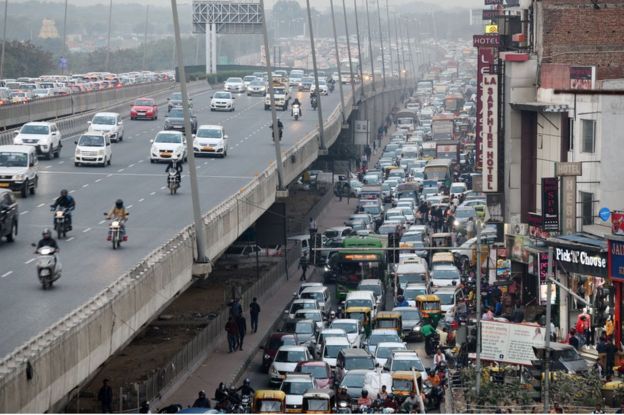
Image copyright GETTY IMAGESImage caption India has some of the world’s most polluted cities, including Delhi
A pushback by the industry and the fear of job losses were among the reasons for the government to do so.
The government has now decided to focus on the segment below cars: two-wheelers, where sales are much higher, and three-wheelers (largely auto-rickshaws).
In the financial year that ended in March, about 3.4 million passenger cars were sold in the country against 21.2 million two-wheelers, according to data released by Indian automobile manufacturers. The number of three-wheelers sold totalled 0.7 million.
The new proposal is to have only electric three-wheelers operating in the country by 2023, and only electric two-wheelers by 2025.
The government seems to have two dominant objectives – to control pollution and take the lead in an emerging industry.
Media caption How an electric car can make money
India wants to become a “global hub of manufacturing of electric vehicles”, Finance Minister Nirmala Sitharaman said in her budget speech earlier this month. The Economic Survey, a government forecast, released a day before the budget envisaged an Indian city possibly emerging as the “Detroit of electric vehicles” in the future.
But it will be a challenge to create a competitive advantage in electric vehicle manufacturing, or even a market for them, given that India does not have the infrastructure or deep pockets that the world’s current leader in electric mobility, China, has.
The American electric carmaker, Tesla, is setting up a manufacturing plant in Shanghai that is expected to be operational by the end of 2019.
India can perhaps learn a few lessons from China. The authorities there spurred sales partly by placing caps on the number of conventional combustion vehicles that can be sold in its most congested and polluted cities. Beijing has also limited the number of electric vehicles that can be sold. Further, car manufacturers now have to ensure that a specified share of their production is of so-called zero emission vehicles.
Another inspiration for India could be Norway, where electric vehicles accounted for half of last year’s total car sales. A phase-out of combustion vehicles in the country is planned by 2025.
Media caption Why is Norway the land of electric cars?
But there are many encouraging signs in India too.
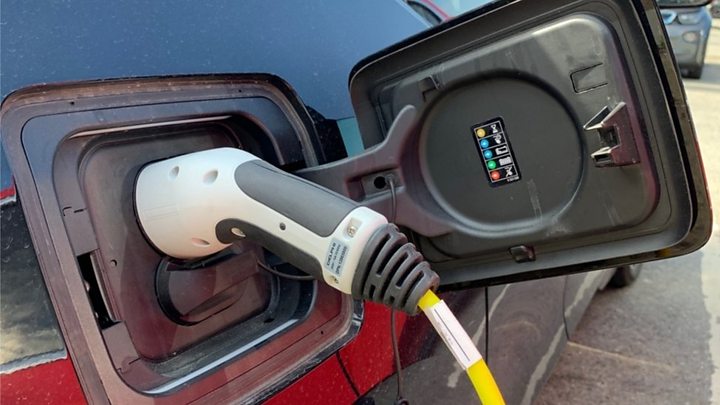
For one, charging stations are being built at government offices, malls and even within neighbourhoods. Government-owned power companies such as Bharat Heavy Electricals and Energy Efficiency Services plan to begin rolling out charging stations soon. The latter is looking at 10,000 stations over the next two years.
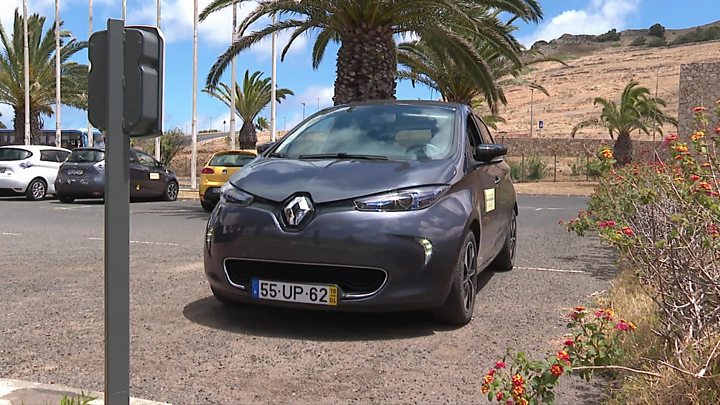
Second, electric vehicle models are proliferating. Hyundai launched its electric Kona car in India in July and Nissan is expected to launch its Leaf model soon. Indian carmakers Mahindra & Mahindra and Tata Motors both sell electric cars.
There are already several models of electric two-wheelers, and bike-sharing companies like Bounce are also going electric. Electric buses too can be spotted in many cities, partly fuelled by incentives. India’s capital, Delhi, is expected to have 1,000 electric buses running on its roads soon.
Even taxi-hailing apps and home delivery services have taken to ferrying parcels and passengers on electric bikes. After a pilot run with electric cabs, Indian ride-hailing giant Ola is now focussing on electric bikes and three-wheelers.
Instead of charging batteries, which could be a time-consuming task, it intends to opt for a battery swapping model where a fully charged battery would quickly replace the discharged one at swapping stations. Bounce too is experimenting with battery swaps.
Image copyright GETTY IMAGESImage caption India sold 3.4 million passenger cars this past financial year
The government is also planning to offer incentives for manufacturing electric vehicles and batteries to boost economic growth and encourage local manufacturing under its Make in India initiative.
The falling cost of batteries could boost India’s electric mobility plans, and make it that much easier for electric vehicles to be competitive with those running on other fuels. And there is the added bonus of cleaner air.
That would push India towards electric mobility in its own unique style and at its own unique pace.
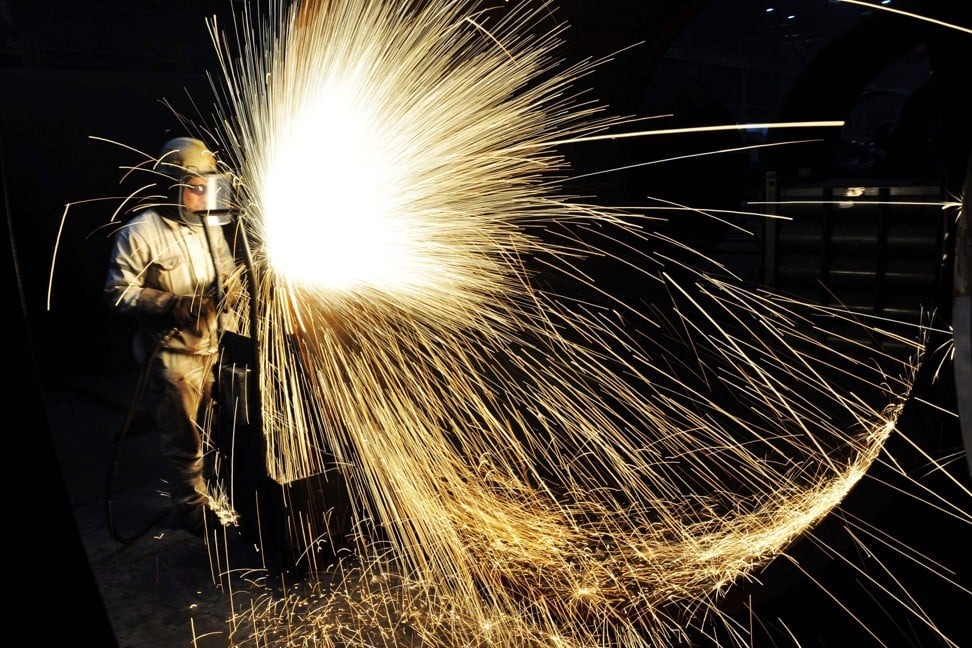
Growth in Shandong, China’s third largest provincial economy, slowed in the first quarter due to cuts in inefficient industrial capacity
Shandong government aims to cut capacity in traditional sectors to boost ‘new’ industries, as well as reduce pollution
Shandong’s gross domestic product growth accelerated to 6.4 per cent last year from 5.7 per cent in 2017, but slipped back to 5.5 per cent in the first quarter of 2019. Photo: AP
Shandong province, a manufacturing heavyweight in eastern China, will press ahead with plans to cut capacity in inefficient “old” industries, even though it will hurt short-term growth, the provincial party chief said on Tuesday.
Like many provinces that still rely heavily on traditional industries, Shandong’s growth has slowed recently, in part due to the effect of the trade war with the United States.
While its gross domestic product (GDP) growth accelerated to 6.4 per cent last year from 5.7 per cent in 2017, it slipped back to 5.5 per cent in the first quarter of 2019, according to to Liu Jiayi, the secretary of Shandong Provincial Committee of the Communist Party of China.
The primary reason for the slowdown in growth was a plunge in production in “backward” industries at the start of the year, due in part to cuts already made to reduce production capacity, said Liu. He added that the capacity cutting measures will help the province reduce air pollution, one of the central government’s priorities for 2019.
“The quality of development is changing [in Shandong],” said Liu, who referred to the fact that Shandong’s industrial sectors dominate the economy and that 70 per cent of this heavy industry is in the chemicals sector. “As a result, our economic volume is large, but the quality of development is not very high.”
According to statistics from the Hong Kong Trade Development Council (HKTDC), Shandong’s industrial output has been dominated by heavy industry, which accounted for about 67.1 per cent of the gross industrial output in 2017. Within that, raw chemical materials and chemical products had the biggest share of all value-added industrial output, at 9.7 per cent, according to the HKTDC.
“This decline [in first quarter growth] was in exchange for our development of high-quality [production], because our traditional and backward production capacity has declined,” Liu added.
Shandong, the third largest provincial economy in China, will continue to reduce its reliance on chemicals production, while also cutting the use of coal for power, heating and fuelling heavy trucks for transport, all of which are major contributors to regional pollution, according to Gong Zheng, the governor of Shandong.
Shandong’s gross domestic product growth accelerated to 6.4 per cent last year from 5.7 per cent in 2017, but slipped back to 5.5 per cent in the first quarter of 2019. Photo: AFP
“We have stepped up our efforts [to cut pollution] and have refused to allow it to rebound, and we will do this well,” said Gong.
The central government launched a campaign to tackle pollution in 2014 as it sought to reverse the severe damage done to the environment after decades of breakneck industrial growth.
However, the rising costs of doing business in China – including higher wages and the costs of pollution control – have forced some manufacturing out of China. That process has been accelerated by firms searching for an alternative production base to avoid
implemented as part of the trade war, which has made a severe dent in China’s investor and consumer confidence.China’s GDP growth slid to 6.2 per cent in the second quarter, the lowest reading since records began in the first quarter of 1992, and below the levels reported during the global financial crisis, the National Bureau of Statistics said on Monday.
However, Shandong party chief Liu, the former head of the National Audit Office who led the nationwide investigation into local government debt in 2014, said he was not concerned with GDP growth in Shandong.
“Now our GDP growth rate has dropped a little, and the growth rate for fixed asset investment has dropped a little,” said Liu. “Some people worry that the growth of Shandong is slipping. I can tell you responsibly, not only [growth] will not slip, we have to take a step back these years in exchange for the healthy development of the next few years.”
Sun Ling became a cyber star in China after she responded to an online question: how can you get an overseas education if you are dirt poor?
‘I just put my story out there to show there is a possibility in your life even if you have a low starting point,’ the 29-year-old says
Sun Ling works as a contract software engineer at Google in New York. Photo: Sun Ling
To get where she is today, Sun Ling has beaten very long odds.
Born in a rural hamlet in central China’s Hunan province, Sun shot to Chinese social media stardom for her rags-to-relative-comfort career trajectory. Her story begins in a household of such modest means that her mother had to sell blood to make ends meet and a primary school education interrupted by the need for her hands in the family’s fields.
She has no fancy college degree, having gone to work on the assembly line at a Shenzhen factory directly from high school.
Yet today, the 29-year-old works as a contract software engineer at Google in New York, coding on workdays and playing frisbee on weekends, with an annual salary of about US$120,000.
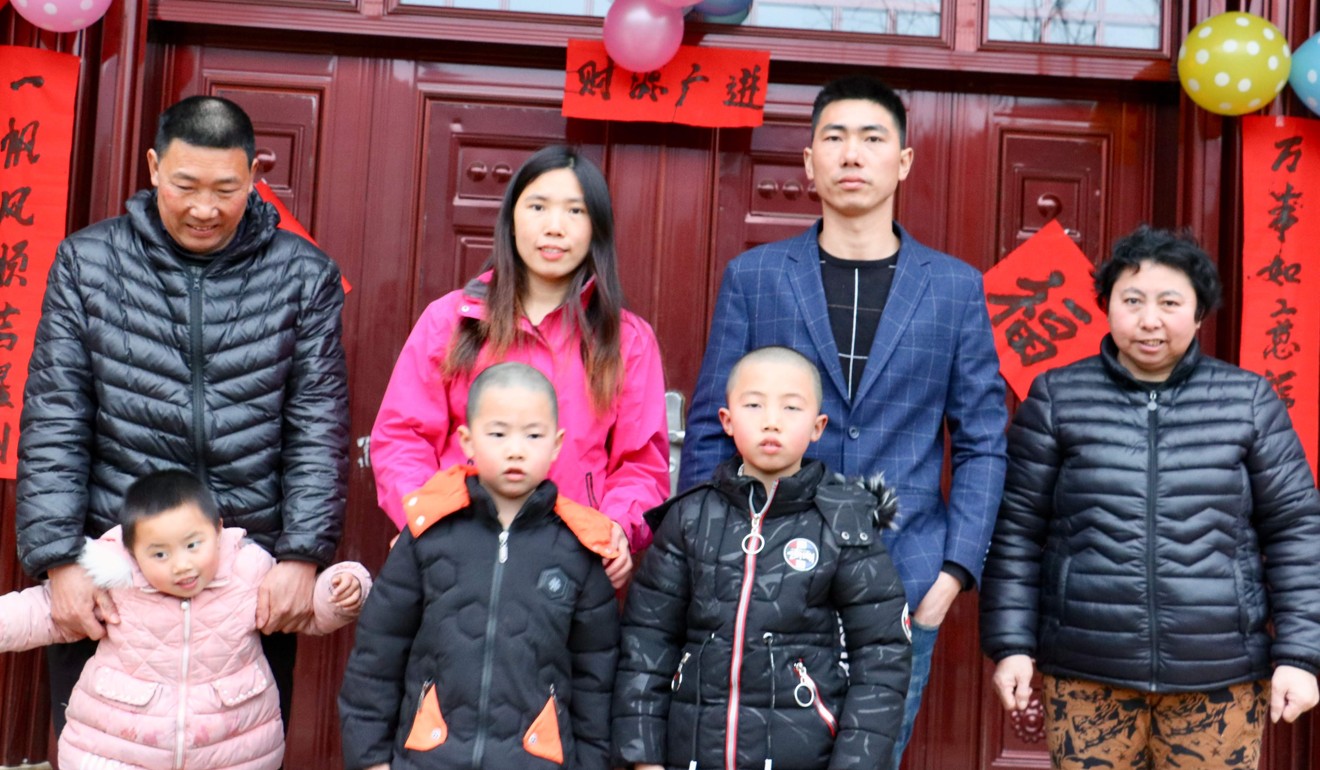
Sun Ling with her parents, brother, niece and nephews in China. Photo: Sun Ling
Sun’s journey from factory worker to high-paid software engineer has garnered Chinese social media headlines such as “the most inspiring story of all times”, and internet users have applauded her as a “positive energy girl”.
But others have not been as flattering, with some questioning the credibility of her story and saying what she has accomplished is almost too difficult to be true amid growing concern about the lack of opportunity and social mobility in China.
“I don’t consider myself a success and I have no intention to become a role model,” Sun told the South China Morning Post on Thursday. “I just put my story out there to show there is a possibility in your life even if you have a low starting point.”
A look inside Google’s new campus outside Silicon Valley
Her story became known in China after she posted an answer on Zhihu, the Chinese version of Quora, responding a question: how can you get an overseas education if you are dirt poor?
In the answer she posted earlier last month, Sun detailed her 10-year journey in making the seemingly impossible possible.
“It is not the orthodox way of studying overseas, just for your reference,” Sun wrote in the post, which has received nearly 35,000 likes on Zhihu. The answer was picked up by other social media; one of her most popular stories, which is circulating on WeChat, has been viewed more than 100,000 times.
Sun said her story was not a textbook “American dream” or “Chinese dream comes true” experience, but rather one driven by the simple motivation to forge a better life.
I just put my story out there to show there is a possibility in your life even if you have a low starting point Sun Ling
When Sun was born in 1990, her parents were farmers in a small village about a 2½-hour drive from Hunan province’s capital city, Changsha. Growing up in a place where a middle school education was considered good enough for a girl, Sun was forced to temporarily drop out of school when she was about 13 to ease the financial burden on her parents, who favoured her brother, the only son in the family.
“I begged and begged till my father allowed me to return to school,” she said. “But to be honest, my strong desire to stay at school at the moment was mainly because farming was too hard. The work got calluses on my hands.”
Sun in her home village in Hunan province in 2013. Photo: Sun Ling
Among her 11 village friends, she was the only one who completed high school. But the education she received at the rural school failed to get her into any college in China. So, like her peers in the village, she went to Shenzhen to become a factory worker.
But the routine of shifts spent examining the quality of batteries bored her. “I have no idea what kind of life I want to live, even today. But I am very certain about the life I don’t want to live,” Sun said.
She quit the factory job after eight months and enrolled in a computer training programme to learn what she regarded as the must-have skills to leave the blue-collar life behind.
That is the thing I like about America: they value what you are able to do more than where you come fromSun Ling
To have enough money to complete the training to become an entry-level software engineer, she worked three part-time jobs, including sending out fliers and waitressing at restaurants, and lived on three credit cards.
After more than a year of training and a debt of 10,000 yuan (US$1,450), in September 2011 she was hired as a software engineer by a Shenzhen company responsible for developing an online payroll system. With her own cubicle, a monthly salary of 4,000 yuan and weekends for herself, the job met all of Sun’s expectation as a “white-collar office lady”.
But the excitement of the new life didn’t last. She started to feel small in a big city where “everyone else is so excellent, with fancy degrees”.
To overcome her educational disadvantage, she signed up for an English training programme and a long-distance programme that allowed her to earn a degree from Shenzhen University. All of this took place while she maintained her software engineering job.
To practise her English, in 2014 she picked up ultimate frisbee, a game where in Shenzhen at the time, most of the players were expats. With a different circle of friends, most of whom had overseas experience, Sun started to dream of a life outside China’s borders.
Sun was born in a rural hamlet in central China’s Hunan province. Photo: Sun Ling
In early 2017, she discovered a master’s programme at Maharishi University of Management in Fairfield, Iowa, which features a controversial “consciousness-based education” system that includes the practice of meditation.
Sun applied and was accepted into the university’s computer science programme.
According to her, its design fit her well as it allowed students to have internships or jobs on a work-study visa after months of attending classes on campus. The rest of the programme could be completed remotely.
After nine months studying on campus and 60 job interviews, Sun received a job offer from EPAM Systems, a vendor for Google, late last year.
Google moving some hardware production out of China
Of her work as a contract software engineer at Google’s Manhattan headquarters, Sun said she was very “lucky” since many of her colleagues had a PhD or studied at top-tier American universities.
“But none of them treat me like I don’t deserve all of this,” she said. “That is the thing I like about America: they value what you are able to do more than where you come from.”
However, her story has not been without controversy in China’s cyber world.
Supporters have sent an increasing number of messages from various online channels, thanking her for an inspiring story and seeking her advice on life decisions. Sceptics claim she just got lucky, and some have accused her of being an advertising tool for Maharishi University of Management.
Chinese family paid US$1.2 million for Yale spot. Why weren’t they charged?
“At first, I got really angry,” Sun said. “I don’t think I deserve all the criticism for simply sharing my real life experience. But then I realised that not everyone has the same attitude in life.”
“I had no resources and I had very few options,” she said. “It is natural that people think it is difficult or even impossible to do. But for me it is actually not that difficult. Just keep learning and keep trying new things step by step, day by day.”
Her journey continues. Sun has been practising English and trying to fit better into her life in the US by doing short video interviews on the streets of New York streets. She has also taken courses about artificial intelligence online.
“My next goal is to become an in-house Google software engineer,” she said. “It won’t be easy. But your life begins at the end of your comfort zone.”
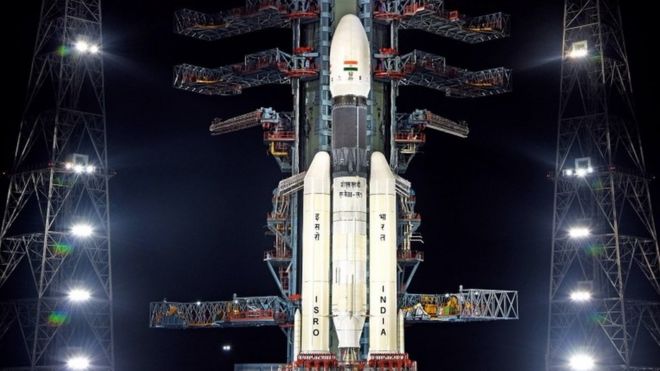
Image copyright EPAImage caption The rocket weighs as much as a fully-loaded jumbo jet
India is set to re-attempt the launch of its second lunar mission a week after it halted the scheduled blast-off due to a technical snag.
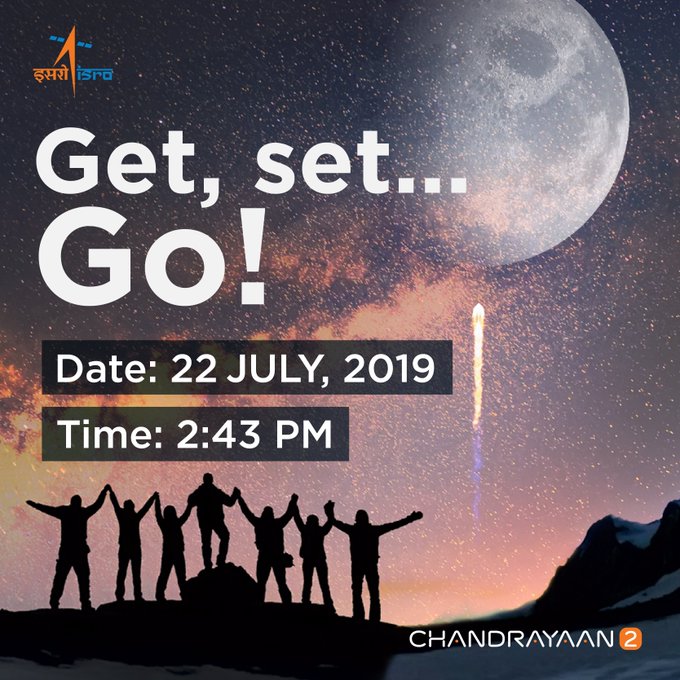
Chandrayaan-2 will be launched at 14:43 local time (09:13 GMT) on Monday, space agency Isro said.
It added the spacecraft was ready “to take a billion dreams to the Moon – now stronger than ever before”.
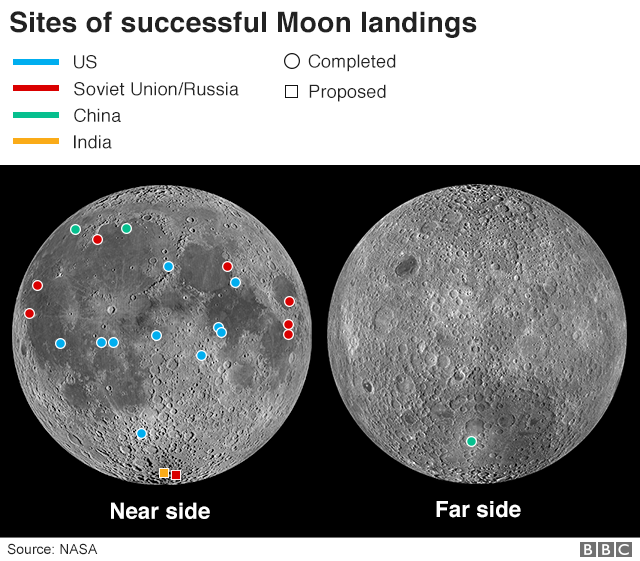
The space agency hopes the $150m (£120m) mission will be the first to land on the Moon’s south pole.
The countdown on 15 July was stopped 56 minutes before launch after a “technical snag was observed in [the] launch vehicle system”, according to Isro. Indian media have reported that a leak from a helium gas bottle in the cryogenic engine of the rocket was to blame.
The fuel from the rocket was drained and the scientists resolved the glitch.
“It was a simple to fix [but it was] a serious problem that could have resulted in total failure,” says a source at Isro.
Isro thanked people for supporting the mission despite the delay.
Chandrayaan 2 is ready to take a billion dreams to the Moon — now stronger than ever before! Join us for the launch on Monday — 22 July, 2019 — at 2:43 PM IST. #Chandrayaan2#GSLVMkIII#ISRO
India’s first lunar mission in 2008 – Chandrayaan-1 – did not land on the lunar surface, but it carried out the first and most detailed search for water on the Moon using radars.
Chandrayaan-2 (Moon vehicle 2) will try to land near the little-explored south pole of the Moon.
The mission will focus on the lunar surface, searching for water and minerals and measuring moonquakes, among other things.
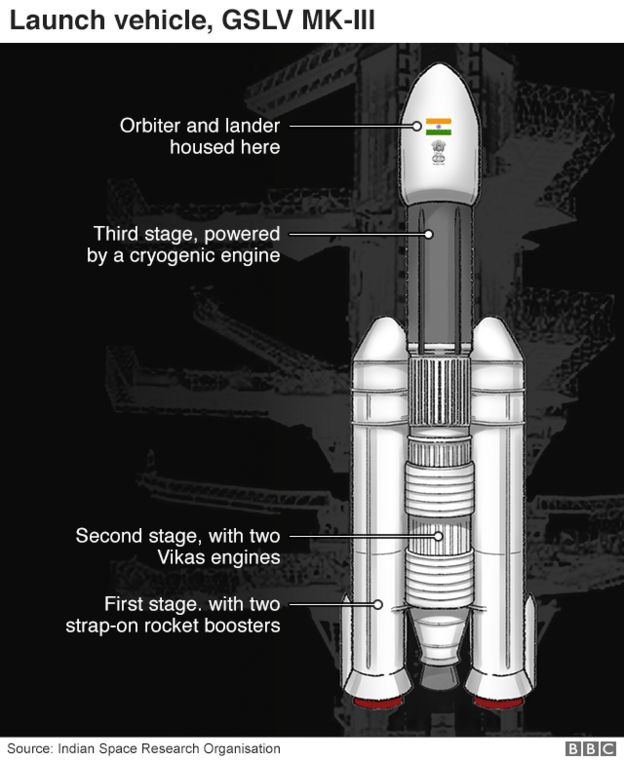
India is using its most powerful rocket, the Geosynchronous Satellite Launch Vehicle Mark III (GSLV Mk-III), in this mission. It weighs 640 tonnes (almost 1.5 times the weight of a fully-loaded 747 jumbo jet) and at 44 metres (144ft) is as high as a 14-storey building.
The spacecraft weighs 2.379kg (5.244lb) and has three distinct parts: an orbiter, a lander and a rover.
The orbiter, which has a mission life of a year, will take images of the lunar surface, and “sniff” the tenuous atmosphere.
The lander (named Vikram, after the founder of Isro) weighs about half as much, and carries within its belly a 27kg Moon rover with instruments to analyse the lunar soil. In its 14-day life, the rover (called Pragyan – wisdom in Sanskrit) can travel up to a half a kilometre from the lander and will send data and images back to Earth for analysis.
“India can hope to get the first selfies from the lunar surface once the rover gets on its job,” Dr K Sivan, the Isro chief, said before the first launch attempt.
Media caption Is India a space superpower?
How long is the journey to the Moon?
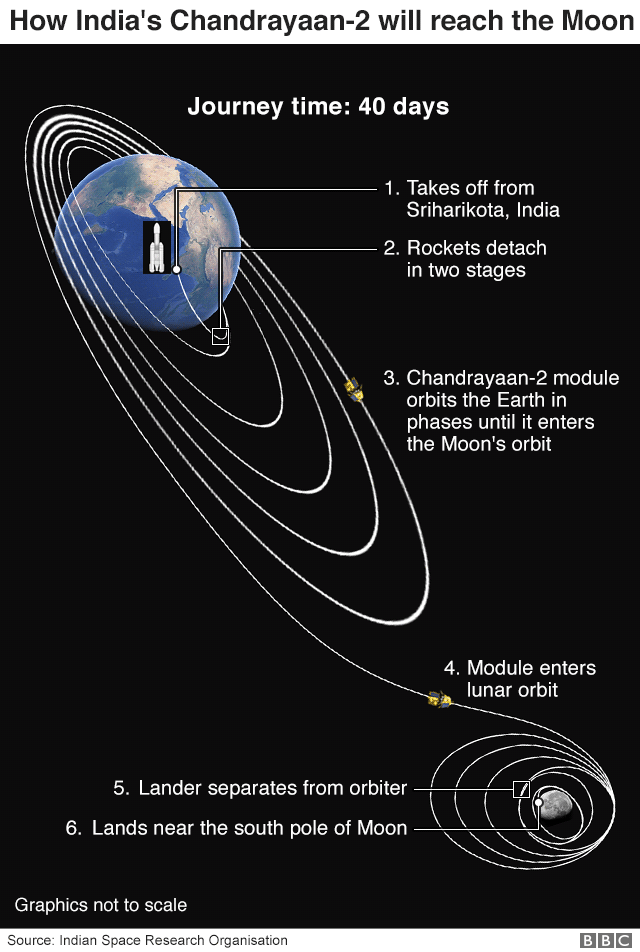
The launch is only the beginning of a 384,000km (239,000-mile) journey – Isro is still hoping the lander will touch down on the Moon on 6 or 7 September as planned, despite the week-long delay of the launch.
The journey of more than six weeks is a lot longer than the four days the Apollo 11 mission 50 years ago took to reach the Moon- and land humans on the lunar surface for the first time.
In order to save fuel, India’s space agency has chosen a circuitous route to take advantage of the Earth’s gravity, which will help slingshot the satellite towards the Moon. India does not have a rocket powerful enough to hurl Chandrayaan-2 on a direct path. In comparison, the Saturn V rocket used by the Apollo programme remains the largest and most powerful rocket ever built.
“There will be 15 terrifying minutes for scientists once the lander is released and is hurled towards the south pole of the Moon,” Dr Sivan said.
He explained that those who had been controlling the spacecraft until then would have no role to play in those crucial moments. The actual landing, he added, was an autonomous operation dependent on all systems performing as they should. Otherwise, the lander could crash into the lunar surface.
Nearly 1,000 engineers and scientists have worked on this mission. But for the first time, Isro has chosen women to lead an interplanetary expedition.
Two women are steering India’s journey to the Moon. While programme director Muthaya Vanitha has nurtured Chandrayaan-2 over the years, it will be navigated by Ritu Karidhal.
BEIJING, July 18 (Xinhua) — China has launched an online poll to solicit public opinions on whether to name peony or another plower as its “national flower,” according to the China Flower Association (CFA).
Based on suggestions from an expert team, the association listed 10 candidates including the peony, chrysanthemum, orchid, Chinese rose and narcissus.
Recommending the peony as China’s national flower, the CFA said in an online statement that the flower has been widely planted around China with a history of more than 4,000 years and has long been called “king of the flowers” in the country.
Prerequisites to be nominated as China’s national flower include originating in the country with a long history, being elegant in both shape and color, and being able to represent Chinese culture, according to the CFA.
The flower to be named should also have a profound cultural connotation and be extensively utilized.
By Wednesday afternoon, nearly 600,000 people had joined in the vote on mobile social media platform WeChat, the association said.
BEIJING, July 17 (Xinhua) — China’s disaster relief authorities have dispatched a second batch of supplies to areas hit by floods and rainstorms in central China’s Hunan Province.
A total of 8,000 folding beds, 8,000 sets of folding tables and chairs, and 5,000 quilts were allocated by the the Ministry of Emergency Management (MEM) and National Food and Strategic Reserves Administration, to support local government’s relief work, the MEM said Wednesday.
The Office of State Flood Control and Drought Relief Headquarters earlier launched an emergency response as Hunan Province has been suffering from severe rainstorms and floods.
The first batch of supplies included 1,000 tents, 10,000 quilts, 5,000 folding beds, as well as 6,000 sets of folding tables and chairs, according to the MEM.
HANOI (Reuters) – Vietnamese and Chinese ships have been embroiled in a weeks-long standoff near an offshore oil block in disputed waters of the South China Sea, which fall within Vietnam’s exclusive economic zone, two Washington-based think-tanks said on Wednesday.
China’s U-shaped “nine-dash line” marks a vast expanse of the South China Sea that it claims, including large swathes of Vietnam’s continental shelf where it has awarded oil concessions.
The Haiyang Dizhi 8, a ship operated by the China Geological Survey, on Monday completed a 12-day survey of waters near the disputed Spratly Islands, according to separate reports by the Center for Strategic and International Studies (CSIS) and the Center for Advanced Defense Studies (C4ADS)
One of the oil blocks it surveyed is licensed by Vietnam to Spanish energy firm Repsol, which was forced last year and in 2017 to cease operations in Vietnamese waters because of pressure from China.
As the Haiyang Dizhi 8 conducted its survey, nine Vietnamese vessels closely followed it. The Chinese ship was escorted by three China Coast Guard vessels, according to data from Winward Maritime, compiled by C4ADS.
In a separate incident days earlier, the China Coast Guard ship Haijing 35111 manoeuvred in what CSIS described as a “threatening manner” towards Vietnamese vessels servicing a Japanese-owned oil rig, the Hakuryu-5, leased by Russian state oil firm Rosneft in Vietnam’s Block 06.1, 370 km (230 miles) southeast of Vietnam.
That block is within the area outlined by China’s “nine-dash line”. A series of dashes on Chinese maps, the line is not continuous, making China’s claims often ambiguous.
Last year, Reuters exclusively reported that Rosneft Vietnam BV, a unit of Rosneft, was concerned that its drilling in Block 06.1 would upset China.
“On July 2 the vessels were leaving the Hakuryu-5 when the 35111 manoeuvred between them at high speed, passing within 100 metres of each ship and less than half a nautical mile from the rig,” CSIS said in its report.
It was not clear on Wednesday if any Chinese ships were still challenging the Rosneft rig.
In 2014, tension between Vietnam and China rose to its highest levels in decades when a Chinese oil rig started drilling in Vietnamese waters. The incident triggered boat rammings by both sides and anti-China riots in Vietnam.
‘READY TO FIGHT’
In response to reports of this month’s standoff, which first emerged on social media, Chinese foreign ministry spokesman Geng Shuang said on July 12 that China’s position on the South China Sea was “clear and consistent”.
“China resolutely safeguards its sovereignty in the South China Sea and maritime rights, and at the same time upholds controlling disputes with relevant countries via negotiations and consultations,” Geng said, without elaborating.
On Tuesday, Vietnam’s foreign ministry released a statement in response to unspecified “recent developments” in the South China Sea.
“Without Vietnam’s permission, all actions undertaken by foreign parties in Vietnamese waters have no legal effect, and constitute encroachments in Vietnamese waters, and violations of international law,” foreign ministry spokeswoman Le Thi Thu Hang said.
Neither statements confirmed or elaborated on the standoff.
Neither Rosneft nor Repsol immediately responded to an emailed request from Reuters for comment.
In a new statement on Wednesday, China’s foreign ministry spokesman Geng acknowledged that there had been an incident with Vietnam.
“We hope the Vietnam side can earnestly respect China’s sovereignty, rights, and jurisdiction over the relevant waters, and not take any actions that could complicate the situation,” Geng told a regular news conference.
On July 11, as China was conducting its survey of the blocks, Vietnam’s prime minister, Nguyen Xuan Phuc, visited the headquarters of the Vietnam Coast Guard in Hanoi.
State media did not mention the incident, but showed Phuc speaking to sailors on board vessels via a video link.
Phuc told the sailors to “stay vigilant and ready to fight” and to be aware of “unpredictable developments”, the Vietnam Coast Guard said in a statement on its website.
On the same day, Vietnam’s national assembly chairwoman, Nguyen Thi Kim Ngan, met her Chinese counterpart, Li Zhanshu, in Beijing, China’s Xinhua news agency reported.
The two officials agreed to “jointly safeguard peace and stability at sea”, Xinhua said.
BEIJING, July 14 (xinhua) — China has seen a record high of rivers reporting floods since this year’s high-water season began, the Ministry of Water Resources said Sunday.
A total of 377 rivers across the country have reported floods exceeding alarm levels, over 80 percent more than the annual number of such rivers registered since 1998 when severe floods hit China, according to Wang Zhangli, deputy director with the ministry’s flood and draught disaster prevention department.
Some 15 small and medium-sized rivers had seen the all-time worst floods, Wang added.
Both north and south China are expected to see some regions suffering intensive rainfalls from July 16 to August 15, while two to three typhoons might hit China during this period.
The ministry has sent over 30 work teams to guide local floods relief work, according to the official.
The chief of the Indian Space Research Organisation (Isro), K Sivan, said this was “the most complex space mission ever to be undertaken by the agency”.
If the launch had gone to plan, the lander and rover would have been expected to touch down in early September.
India’s space agency is yet to give more details on why the launch was delayed and how it will affect the timeline.
The country’s first lunar mission in 2008 – Chandrayaan-1 – did not land on the lunar surface, but it carried out the first and most detailed search for water on the Moon using radars.
How will it get to the Moon?
Chandrayaan-2 (Moon vehicle 2) will attempt a soft landing near the little-explored south pole of the Moon.
India is using its most powerful rocket, the Geosynchronous Satellite Launch Vehicle Mark III (GSLV Mk-III), in this mission. It weighs 640 tonnes (almost 1.5 times the weight of a fully-loaded 747 jumbo jet) and at 44 metres (144ft) is as high as a 14-storey building.
The spacecraft weighs 2,379kg (5,244lb) and has three distinct parts: an orbiter, a lander and a rover.
The orbiter, which has a mission life of a year, will take images of the lunar surface, and “sniff” the tenuous atmosphere.
The lander (named Vikram, after the founder of Isro) weighs about half as much, and carries within its belly a 27kg Moon rover with instruments to analyse the lunar soil. In its 14-day life, the rover (called Pragyan – wisdom in Sanskrit) can travel up to a half a kilometre from the lander and will send data and images back to Earth for analysis.
“India can hope to get the first selfies from the lunar surface once the rover gets on its job,” Dr Sivan said.
A new frontier for India’s space programme
By science writer Pallava Bagla
A soft landing on another planetary body – a feat achieved by just three other countries so far – would be a huge technological achievement for Isro and India’s space ambitions.
It would pave the way for future Indian missions to land on Mars and an asteroid. More importantly, it would open up the possibility of India sending astronauts to the Moon. India hopes to carry out a crewed space flight by 2022.
India also wants to assert itself as a space power to be reckoned with – and national pride is riding high as it aims to hoist its flag on the surface of the Moon.
A successful mission to the Moon would also be a win for India’s ambitious space agency, which has had a string of successes recently.
Media caption Is India a space superpower?
In 2014, it successfully put a satellite into orbit around Mars, becoming only the fourth nation to do so. In 2017, India created history by successfully launching 104 satellites on a single mission, overtaking the previous record of 37 satellites launched by Russia in 2014.
All eyes are on Isro again. Global interest in India’s frugal Moon mission is peaking, according to Simonetta Di Pippo, director of the UN office of Outer Space Affairs.
“The mission’s studies of lunar topography, mineralogy, elemental abundance, the lunar exosphere, and signatures of hydroxyl and water ice will contribute to scientific progress for all of humankind,” she says.
The Indian space community is nervous and Dr Sivan says “there is churning in his stomach”.
“Unknown-unknowns can kill a mission, [although] no stone has been left unturned to understand all the complexities”.
How long is the journey to the Moon?
The launch is only the beginning of a 384,000km (239,000-mile) journey – the robotic craft is expected to land on the Moon some 54 days later.
Isro chose a circuitous route to take advantage of the Earth’s gravity, which will help slingshot the satellite towards the Moon. India does not have a rocket powerful enough to hurl Chandrayaan-2 on a direct path.
“There will be 15 terrifying minutes for scientists once the lander is released and is hurled towards the south pole of the Moon,” Dr Sivan says.
He explains that those who had been controlling the spacecraft until then will have no role to play in those crucial moments. The actual landing, he adds, is an autonomous operation dependent on all systems performing as they should. Otherwise, the lander could crash into the lunar surface.
Earlier this year, Israel’s first Moon mission crash-landed while attempting to touch down.
Who is on the team?
Nearly 1,000 engineers and scientists have worked on this mission. But for the first time, Isro has chosen women to lead an interplanetary expedition.
Two women are steering India’s journey to the Moon. While programme director Muthaya Vanitha has nurtured Chandrayaan-2 over the years, it will be navigated by Ritu Karidhal.
“Women power is powering India’s Moon ambitions,” Dr Sivan said, adding that at Isro, “women and men are all equal. Only talent matters – not the gender.”










 CHINDIA ALERT: You'll be living in their world, very soon